Category Archives: Uncategorized

“Reclaiming ICT4D” – in the beginning

It is always exciting submitting a book manuscript to a publisher, and today is no exception!  I have at last finished with my editing and revisions, and sent the manuscript of Reclaiming ICT4D off to Oxford University Press.  I just hope that they like it as much as I do!  It is by no means perfect, but it is what I have been wanting to write for almost a decade now.

This is how it begins – I hope you like it:

“Chapter 1

A critical reflection on ICTs and ‘Development’

This book is about the ways through which Information and Communication Technologies (ICTs) have become entwined with both the theory and the practice of ‘development’.  Its central argument is that although the design and introduction of such technologies has immense potential to do good, all too often this potential has had negative outcomes for poor and marginalized people, sometime intended but more often than not unintended.  Over the last twenty years, rather than reducing poverty, ICTs have actually increased inequality, and if ‘development’ is seen as being about the relative differences between people and between communities, then it has had an overwhelming negative impact on development.  Despite the evidence to the contrary, I nevertheless retain a deep belief in the potential for ICTs to be used to transform the lives of the world’s poorest and most marginalized for the better.  The challenge is that this requires a fundamental change in the ways that all stakeholders think about and implement ICT policies and practices.  This book is intended to convince these stakeholders of the need to change their approaches.

It has its origins in the mid-1970s, when I learnt to program in Fortran, and also had the privilege of undertaking field research in rural India.  The conjuncture of these two experiences laid the foundations for my later career, which over the last twenty years has become increasingly focused on the interface between Information and Communication Technologies (ICTs) on the one hand, and the idea of ‘development’ on the other.  The book tells personal stories and anecdotes (shown in a separate font).  It draws on large empirical data sets, but also on the personal qualitative accounts of others.  It tries to make the complex theoretical arguments upon which it is based easy to understand.  Above all, it has a practical intent in reversing the inequalities that the transformative impacts of ICTs have led to across the world.

I still remember the enjoyment, but also the frustrations, of using punch cards, with 80 columns, each of which had 12 punch locations, to write my simple programs in Fortran.  The frustration was obvious.  If you made just one tiny mistake in punching a card, the program would not run, and you would have to take your deck of cards away, make the changes, and then submit the revised deck for processing the next day.  However, there was also something exciting about doing this.  We were using machines to generate new knowledge.  They were modern.  They were the future, and we dreamt that they might be able to change the world, to make it a better place.  Furthermore, there was something very pleasing in the purity and accuracy that they required.  It was my fault if I made a mistake; the machine would always be precise and correct.  These self-same comments also apply to the use of ICTs today.  Yes, they can be frustrating, as when one’s immensely powerful laptop or mobile ‘phone crashes, or the tedium of receiving unwanted e-mails extends the working day far into time better spent doing other things, but at the same time the interface between machines and modernity conjures up a belief that we can use them to do great things – such as reducing poverty.

Figure 1.1 Modernity and the machine: Cambridge University Computer Laboratory in the early 1970s.
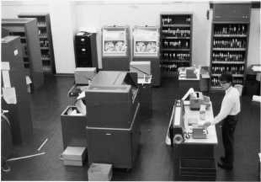
1.1

Source: University of Cambridge Computer Laboratory (1999)

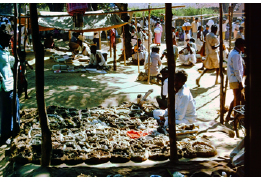
In 1976 and 1977 I had the immense privilege of undertaking field research in the Singbhum District of what was then South Bihar, now Jharkhand, with an amazing Indian scholar, Sudhir Wanmali, who was undertaking his PhD about the ‘hats’, or periodic markets, where rural trade and exchange occurred in different places on each day of the week (Figure 1.2).  Being ‘in the field’ with him taught me so much: the haze and smell of the woodsmoke in the evenings; the intense colours of rural India; the rice beer served in leaf cups at the edges of the markets towards the end of the day; the palpable tensions caused by the ongoing Naxalite rising (Singh, 1995); the profits made by mainly Muslim traders from the labour of Adivasi, tribal villagers, in the beautiful forests and fields of Singbhum; the creaking oxcarts; and the wonderful names of the towns and villages such as Hat Gamharia, Chakradharpur, Jagannathpur, and Sonua.  Most of all, though, it taught me that ‘development’ had something powerful to do with inequality.  I still vividly recall seeing rich people picnicking in the lush green gardens of the steel town of Jamshedpur nearby, coming in their smart cars from their plush houses, and then a short distance away watching and smelling blind beggars shuffling along the streets in the hope of receiving some pittance to appease their hunger.  The ever so smart, neatly pressed, clothes of the urban elite at the weekends contrasted markedly with the mainly white saris, trimmed with bright colours, that scarcely covered the frail bodies of the old rural women in the villages where we worked during the week.  Any development that would take place here had to be about reducing the inequalities that existed between these two different worlds within the world of South Bihar.  This made me look at my own country, at the rich countries of Europe, and it made me all the more aware of two things: not only that inequality and poverty were also in the midst of our rich societies; but also that the connections between different countries in the world had something to do with the depth of poverty, however defined, in places such as the village of Sonua, or the town of Ranchi in South Bihar.

Figure 1.2: hat, or rural periodic market at Hat Gamharia, in what was then South Bihar, 1977 1.2 Source: Author
            Between the mid-1970s and the mid-2010s my interests in ICTs, on the one hand, and ‘development’ on the other, have increasingly fascinated and preoccupied me.  This book is about that fascination.  It shares stories about how they are connected, how they impinge on and shape each other.  I have been fortunate to have been involved in many initiatives that have sought to involve ICTs in various aspects of ‘development’.  In the first instance, my love of computing and engineering, even though I am a geographer, has always led me to explore the latest technological developments, from electronic typewriters that could store a limited number of words, through the first Apple computers, to the Acorn BBC micro school and home computer launched in 1981, using its Basic BASIC programming language, and now more recently to the use of mobile ‘phones for development.  I was fascinated by the potential for computers to be used in schools and universities, and I learnt much from being involved with the innovative Computers in Teaching initiative Centre for Geography in the 1990s (see Unwin and Maguire, 1990).  During the 2000s, I then had the privilege of leading two challenging international initiatives that built on these experiences.  First, between 2001 and 2004 I led the UK Prime Minister’s Imfundo: Partnership for IT in Education initiative, based within the Department for International Development (UK Government Web Archive 2007), which created a partnership of some 40 governments, private sector and civil society organisations committed to using ICTs to enhance the quality and quantity of education in Africa, particularly in Kenya, South Africa and Ghana.  Then in the latter 2000s, I led the World Economic Forum’s Partnerships for Education initiative with UNESCO, which sought to draw out and extend the experiences gained through the Forum’s Global Education Initiative’s work on creating ICT-based educational partnerships in Jordan, Egypt, Rajasthan and Palestine (Unwin and Wong, 2012).  Meanwhile, between these I created the ICT4D (ICT for Development) Collective, based primarily at Royal Holloway, University of London, which was specifically designed to encourage the highest possible quality of research in support of the poorest and most marginalized.  Typical of the work we encouraged was another partnership-based initiative, this time to develop collaborative research and teaching in European and African universities both on and through the use of ICTs.  More recently, between 2011 and 2015 I had the privilege of being Secretary General of the Commonwealth Telecommunications Organisation, which is the membership organisation of governments and people in the 53 countries of the Commonwealth, enhancing the use of ICTs for development.

Two things have been central to all of these initiatives: first a passionate belief in the practical role of academics and universities in the societies of which they are a part, at all scales from the local to the international; and second, recognition of the need for governments, the private sector and civil society to work collaboratively together in partnerships to help deliver effective development impacts.  The first of these builds fundamentally on the notion of Critical Theory developed by the Frankfurt School (Held, 1980), and particularly the work of Jürgen Habermas (1974, 1978) concerning the notion of knowledge constitutive interests and the complex inter-relationships between theory and practice.  The next section therefore explores why this book explicitly draws on Critical Theory in seeking to understand the complex role and potential of ICTs in and for development.  Section 1.2 thereafter then draws on the account above about rural life in India in the 1970s to explore in further detail some of the many ways in which the term ‘development’ has been, and indeed still is, used in association with technology.”
4 Comments

Filed under 'phones, Accessibility, Africa, Caribbean, Commonwealth, Communication, Ethics, ICT4D, ICT4D general, India, Radio, Story-telling, Uncategorized

Reclaiming ICT4D

I am so relieved to have finished the first draft of my new book on ICT4D to be entitled “Reclaiming Information and Communication Technologies for Development” which is to be published by Oxford University Press.  Now it is time to redraft and revise it in the light of all of the helpful comments that I have received from colleagues and friends – for which many thanks.  Somehow, I also need to cut it in length, which is proving to be much more difficult than I had anticipated!

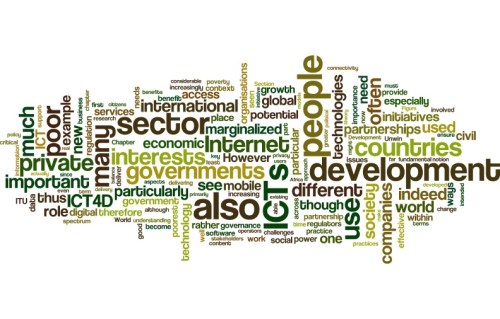
It is always fun to create wordles just to try to capture the essence of a book in an image, and so I thought I would share this to provide an overview of what I have written – and of course to whet potential readers’ appetitites.  I guess that most of what I had hoped for has indeed been revealed, but of course the image does not capture the emphasis or the way in which I have referred to particular themes!  It is good, though, to see the emphasis on people, development and ICTs!

ICT4DwordleFor those who would like a little more detail, this is the provisional Table of Contents – subject of course to revision:

  1. A critical reflection on ICTs and ‘Development’
    • A ‘critical’ approach to ICTs for development
    • Understanding ‘Development’
    • ICT4D in theory and practice
    • Reclaiming ICT for Development (ICT4D)
  1. Understanding the technologies
    • An ever more converged and miniaturized digital world: technological and business implications
    • Spectrum and their management
    • From fixed line to wireless communication
    • From voice to data: impacts of the digital transition
    • On Openness and being Free
    • Social Media and Over The Top services
    • 5G and the Internet of Things
    • Incubators, Digital Hubs and App Development
    • The importance of a technical understanding
  1. The international policy arena of ICTs and Internet Governance
    • Stakeholders in the international ICT arena
    • The World Summit on the Information Society and the evolution of ICT4D multi-stakeholder dialogue in the context of the Sustainable Development Goals
    • The differing interests of multi-stakeholderism: the ITU, ICANN and the IGF
    • The future of multi-stakeholderism and interests in the Internet
  1. Partnerships in ICT4D: rhetoric and reality
    • The idea of partnerships in development
    • The emergence of Public-Private Partnerships
    • ICT4D partnerships: a good case still remains
    • Delivering effective multi-sector partnerships
  1. From regulation to facilitation: the role of ICT and Telecommunication Regulators in a converging world
    • A balance of interests
    • Technical aspects of ICT and telecommunication regulation
    • Universal Service and Access Funds
    • The challenge of revenue generation
    • New models of facilitation in the interests of the poor
  1. Reflections on the dark side of ICT4D
    • Privacy and security
    • The dark side
    • From ‘cybersecurity’ to resilience
    • The big con: social media, Google and Big Data
    • Dehumanization: cyborgs and the Internet of Things
    • In the interests of the poor and marginalized
  1. …in the interests of the poorest and most marginalized
    • ICTs and empowerment
    • Technical options for empowering the poor and marginalized
    • The role of governments and international organisations
    • The power of multi-sector partnerships
    • The Dark Side: managing security and resilience
    • Enhanced learning, understanding and action
    • Reclaiming ICTs for development

7 Comments

Filed under ICT4D, Uncategorized

Dehumanization: cyborgs and the Internet of Things

[Just written this,  the beginning of Section 6.5 of my new book on ICT for Development – thought it might be of interest]

I distinctly remember once walking down Queen Victoria Street in London, and looking down through a window beneath street level to see row upon row of computers, each with their human attached, working away at delivering some unknown products.  It so reminded me of my early readings of Marx’s (1976) Capital, and the dehumanization of labour through the factory system that was designed to extract yet greater surplus value for the capitalists.  Although people like to think that they are in control of their ICTs, this is increasingly not the case.  Office workers come into their open plan work spaces, and ‘their’ computers force them to log in so as to access the information and communication tools necessary to do their work.

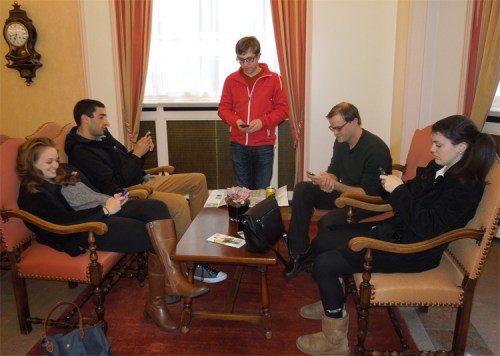
All too often, people communicate together by mobile devices even when they are in the same room (Figure 6.1); the art and skill of face to face conversation is swiftly being eroded, mediated instead through technology.  Internet addiction is now widely recognised as a compulsive-impulsive spectrum disorder (Block, 2008) involving excessive use, withdrawal, tolerance and negative repercussions (see also Cash et al., 2012), with rehabilitation centres being created across the world, from China to the USA, in order to try to help addicted people.

Figure 6.1: Young people communicating at the Hotel International and Terminus, Geneva, 2013

Dehumanisation

Source: Author, 19 May 2013 (taken with permission of all five people shown in the photograph).

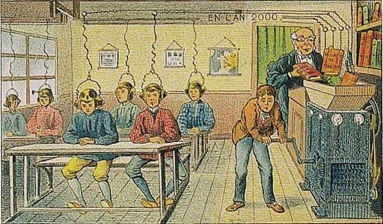
One particularly prescient early image of the relationship between humans and technology is Villemard’s depiction in 1910 of how he thought a school might look in 2000, showing books being dropped into a machine that transforms the information, which then passes through electric cables into each pupil’s headsets.  Conceptually, this is not that different from the online learning systems that now increasingly dominate classrooms on both rich and poor countries alike.

Figure 6.2: Villemard’s 1910 image À l’École, depicting how he thought a school might look in 2000.

Villemard

Source: http://expositions.bnf.fr/utopie/grand/3_95b1.htm, accessed 3 August 2016.

In the GSMA’s Mobile World Congress held in Barcelona in February 2014 smartwear was all the rage, and I remember thinking as I walked past Sony’s advertisement for Xperia on the metro platform wall (Figure 6.3) that there were things about my life that I would definitely not want to log, and would certainly not want others to have access to by hacking either my devices or the cloud servers where they might be stored.  Yet countless people have purchased such devices, and regularly have their health data automatically uploaded so that companies can analyse it and generate profits without paying them anything in return.  This is an extreme example of Big Data surplus extraction, because not only do people have to buy the devices in the first place, and sometimes the software, but they also then give the data to the companies for no recompense, and generally receive little back individually that might actually enhance their health.

Figure 6.3: Sony’s poster “Log your life with SmartWear” on the wall of a metro station in Barcelona during Mobile World Congress, 2014

Sony

Source: Author, 28 February 2014

[now time to write the actual section that explores the increasingly interwoven character of machines and humans, especially as ICTs are increasingly being advocated as a way to enhance development]

2 Comments

Filed under ICT4D, Photographs, Uncategorized

Response from President Juncker on UK’s EU referendum

I was, and still very much remain, deeply opposed to the referendum on whether or not the UK should remain within the EU, and on the outcome which was decided by a small minority of those who voted and which is moving towards the UK leaving the EU (see my views on why we should remain in the EU here).  The referendum should never have been called, since in a representative democracy, decisions are delegated to elected representatives.  The campaign itself was full of half-truths and deceit, especially promulgated by those in favour of leaving the EU.  The UK government is spineless in taking the tough decision not to accept the referendum outcome in the interests of the country as a whole.

I have therefore been taking whatever action I can to promote the case for remaining, even despite the referendum outcome.  As part of this process, I sent the following e-mail to the President of the European Commission on 28th June.

Dear President Juncker
 
You and colleagues at the European Commission must be feeling very frustrated with the people of the UK.  I am so sorry for this.  I believe that the majority of people in the UK do indeed value their European heritage, and indeed want to remain as the integral part of Europe that we are.  I would therefore urge you to explore ways through which the very unfortunate decision by a relatively small number of people in the UK might actually be rejected, and not to press too swiftly on accepting the outcome of the referendum. As you are well aware, there are discussions in Scotland and Gibraltar, as well as a petition to the UK government with almost 4 million signatures on it, about how we might explore ways of remaining an integral part of the Union.  A welcoming voice from you to those of us in the UK who value Europe would be very much appreciated.
 
Let me take this opportunity to remind you that only 17.4 million people voted to leave the EU, representing but 37% of the electorate (for clarity, I note that the turnout was 72.2%, so 27.8% failed to vote).  However, the total population of the UK is around 65 million people, and includes the young people below the age to vote who will be most affected by this decision in the long term.  Therefore, only 26.7% of the people of the UK actually voted in favour.  How can we accept such a decision?  Almost three-quarters of the UK population did not vote to leave Europe.
 
It is critically important at this juncture, when extremist people who did not tell truths to the UK population have gained the ascendency, that our friends in Europe do understand that there are very many people in Britain who value our historic and contemporary links with our European brothers and sisters, and do not want these to be yet further tarnished by the behavior of selfish and arrogant people in our country.  You will have seen the behavior of Mr. Farage today in the European Parliament where he was described by MEPs as a liar who used Nazi propaganda.  We cannot let people such as him come to power.  Yes, in a democratic society all voices must be heard, but we must do all that we can to prevent those who can cause such damage from coming to power.  Most people in Britain are not racists or fascists.
 
I do hope that you can have the statesmanship and leadership to be able to act wisely in this difficult situation, and recognize that it is in Europe’s interest to hold on to the UK, and not to let a relatively small group of people do irreparable damage.
 
With best wishes
Tim

I had not expected a reply, but thought that if enough people wrote then at least he would know that wise people in the UK were dismayed by the outcome of the referendum.  I was therefore very pleasantly surprised to receive the following e-mail yesterday:

Thank you for sharing your views with me following the result of the United Kingdom’s Referendum.
 
I am sad about the choice of the British people. The European Commission worked hard to keep the United Kingdom in the European Union.
 
European leaders offered the United Kingdom a fair deal that reflected their hope that the United Kingdom remained part of the European Union.
 
This is an unprecedented situation but the European Union will stand strong and uphold its core values of promoting peace and the well-being of its peoples.
 
I truly hope that the United Kingdom will be a close partner of the European Union in the future.
 
I wish you well.

Jeab-Claude Juncker
 European Commission
200, rue de la Loi,
1049 Bruxelles

To be sure, this is probably a standard e-mail, written by an official (which is why I feel that I can make it public), but I just wanted to share it here because it seems to strike such a generous and thoughtful chord, typical of our brothers and sisters in other European countries, who care deeply about the UK.

This can be contrasted, for example, with the response I received on 6th July from Philip Hammond to a similar letter that I sent him:

Thank you for your recent correspondence about the result of the referendum on the UK’s membership of the European Union.
 
The British people have voted to leave the EU and their decision will be respected. The Government will now prepare for a negotiation with the European Union, working alongside the Scottish, Welsh and Northern Ireland governments, to ensure that the interests of all parts of our UK are taken properly into account in that process.
 
The Prime Minister, David Cameron, has announced that he will step down in the coming months, stating that new leadership is required for this important next step in the UK’s path. The Prime Minister has also announced that he will leave it to his successor to decide when to invoke Article 50 of the Lisbon Treaty and begin the formal two-year process of exit negotiations.
 
Article 50 is invoked only when the Prime Minister writes to the European Council.  Parliamentary approval is not required.
 
The Treasury, the Bank of England and the Financial Conduct Authority have spent the last few months putting in place robust contingency plans for the immediate financial aftermath in the event of this result, and the Bank has announced that it stands ready to provide £250 billion to continue to support banks and the smooth functioning of markets.
 
I can also reassure British nationals living in European countries and European citizens living here in the UK that there will be no immediate changes in their circumstances.
 
There will be no immediate change in the way Britons can travel, in the way our goods can move or the way our services can be sold.  The UK will remain in the European Union with all the rights and obligations of full membership, while we negotiate our exit with our European neighbours.
 
Speaking personally, I am disappointed by the result because, as I said during the campaign, I believe that Britain is stronger, more influential and better off inside the European Union.  By voting to leave, we have set ourselves a huge economic challenge and, in the short-term, we can expect a negative impact on living standards.  The Government’s job now is to do everything in our power to negotiate the best possible deal with the European Union to minimise the negative economic effects in the medium- to long-term.  In parallel, we will need to start to re-shape the UK economy for life outside the EU.
 
The British people have spoken and our job is to implement their decision.  I will do so to the best of my ability in whatever capacity is asked of me.  The challenges ahead will require steady hands, good judgement and solid pragmatism.  The zealous rhetoric of the campaign needs to be put behind us.  In my judgement, the person best able to deliver these qualities is the Home Secretary, Theresa May – and, for that reason, I will be backing her in the leadership contest.
 
On the specific concerns you raise about the validity of the referendum result, I do not believe it would be appropriate to have a second referendum on our EU Membership and the Prime Minister has been clear that this is “not remotely on the cards”. The British people voted, through a free and fair referendum on 23rd June, for the UK to leave the European Union. Whatever one’s view of this decision, it must be accepted, and the process of implementing the decision in the best possible way must now begin.
 
Thank you again for taking the time to contact me.
 
Regards,
 
Philip Hammond

I do not think that the referendum was necessarily fair.  The British public was beguiled by lies, half-truths and deceit promulgated by deeply unpleasant, arrogant and selfish people such as Boris Johnson, Michael Gove, and Nigel Farage, who had no realistic plan for the future.  It is to be regretted that Boris Johnson has been made Foreign Secretary in the new Tory government, much to the dismay and bafflement of senior officials across the world. It is, though, at least some good news that Messrs Gove and Farage are currently in the wilderness.

1 Comment

Filed under Politics, Uncategorized

Education reform in Pakistan: rhetoric and reality

Shia TretOne of the most interesting aspects of my visit to Pakistan in January this year was the informal, anecdotal information that I gathered about educational change in the Punjab, and in particular DFID’s flagship Punjab Education Support Programme II.  I should declare right at the beginning here that I used to work for DFID (between 2001 and 2004), and I am a member of their Digital Advisory Panel.  I have many friends in the Department, and I admire much of the work that they do.  I was therefore indeed shocked by what I was told and what I summarise below.
When ever the subject of this particular programme came up in conversation in Pakistan, it was always greeting with severe criticism, even derision.  Most of my conversations were with educationalists, academics, landowners, and rural people in the Punjab.  I have not shared these comments before, because they were indeed anecdotal, and I did not see the evidence with my own eyes.  Nevertheless, a report that a colleague recently shared with me by Gethin Chamberlain in the Mail on Sunday (not a paper that I ever usually read!) updated on 14th April 2016,  coincides so strongly with what I was told that I do feel it is worth sharing some of my insights here.

In summary, the Mail on Sunday report commented that:

  • “Department for International Development gives £700m to Pakistan
  • In Punjab, which gets £383m, auditor general uncovered huge corruption
  • 5,000 schools and 40,000 teachers syphoning off cash in other area, Sindh
  • Rana Mashhood is under investigation for corruption”

To be sure, such allegations undoubtedly reflect internal political battles within Pakistan, and continuing complaints about corruption more generally in the administration of agriculture in Punjab (see for example, reports in the local press about matters such as laser land levelling technology, and the widespread corruption in the Agriculture Department of the Punjab Assembly). They are also intended to add fuel to the newspaper’s campaign to “end foreign aid madness”!  However, they nevertheless reflect poorly on the role of DFID and on the implementation of this particular programme.  There is an amazing dissonance between the rhetoric of success, and what I heard on the ground in Punjab.

The DFID programme is ambitious, as highlighted in a report in 2013 by Sir Michael Barber (DFID’s Special Representative on Education in Pakistan, and Chief Education Advisor at Pearson) entitled The Good News from Pakistan: How a revolutionary new approach to education reform shows the way forward for Pakistan and development aid everywhere.  In this, he says “This time it’s going to be different” (p.9).  The work of DFID is wide ranging, and has many elements to it, but one of Barber’s main contributions was to explore ways through which expansion in low-cost private sector educational delivery might spur the government to reform itself (pp.49-50).  The private sector is also involved heavily in other ways, with British Consultancy Firm IMC Worldwide (an International Development and Engineering Consultancy) being the main contractor in rolling out much of the school building programme on the ground, through the Humqadam initiative.  IMC maintains the rhetoric of success, claiming that “In Punjab, the programme is helping the government to meet overall provincial needs, by providing missing facilities in 16,000 schools and providing 27,000 additional classrooms”.  The Humqadam website itself provides further euphoric statements about Britain’s support for education in Pakistan, noting that “Evidence regarding Pakistan’s education opportunities comes from none other than David Cameron, the Prime Minister of Great Britain.  Following a recent visit to Pakistan, he laid the foundations for the initiation of this programme by highlighting the importance of education and Great Britain’s deep commitment, the Department of International Department (DFID), to support education sector reform and the promotion of a quality education for all school age children” (sic).  Humqadam goes on to note that they are working on school construction and rehabilitation using a £184 million allocation of funding from DFID, as well as funding from the Australian DFAT.

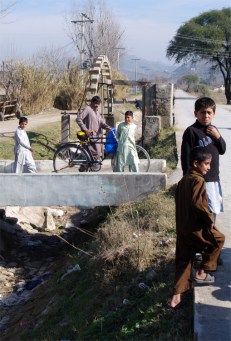
Irrigation and peopleThe reality, as it was relayed to me, is very different. Clearly, these are anecdotes, but the following were the main points that my colleagues mentioned:
  • They felt that the project was well behind schedule, and feared that delays would mean that delivery would thus be rushed in an attempt to catch up, leading to poor quality.  The programme was frequently described as a “joke”.  In contrast, DFID’s Development Tracker page suggests that there was a substantial over-spend in 2013/14, and a slight underspend in 2015/16, with 2014/15 being just about on budget.  Moreover, DFID’s most recent review of the project dated January 2016 had provided an overall very positive account of the work done so far, although it did note that “The school infrastructure component has been slow to perform” (p.2).
  • There was also a strong perception that those involved in the design of the project had not grasped the actual realities of the educational challenges on the ground in Punjab.  The truth of this is much more difficult to judge, but there was undoubtedly a feeling that the views of influential “outsiders”, who rarely visited schools and villages on the ground, but spent most of their time talking with senior government officials in offices in Lahore or Islamabad, had been prominent in shaping the programme.  Interestingly, I also overheard a fascinating conversation between two foreign aid workers over breakfast one day in a smart international hotel.  They were absolutely scathing in what they said about the programme in both design and delivery, and seemed to verify the comments that I had previously received from my Pakistani friends.  I so wanted to go over and ask them more, but I had felt guilty about listening to their conversation; in my defence, they were speaking so loudly that it was actually impossible not to hear what they were saying!
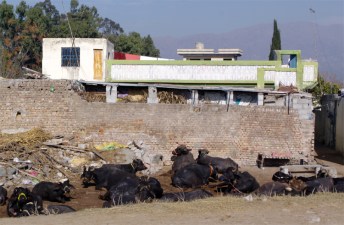
  • CowsFor me, though, the most important thing was what people said about the actual delivery of school building on the ground, and how it did little to counter the  power of landlords.  I was, for example, told on several occasions that some landowners used the newly built school buildings as cattle byres, and that the first thing that teachers had to do in the morning was to clean out all of the manure that had accumulated overnight before they could start teaching.  More worryingly, I was given one account whereby my interlocutor assured me that on more than one occasion a landlord’s thugs had beaten teachers and threatened to kill them if they ever returned to their new school buildings.  The reality and threat of rape for women teachers was a common complaint.  Again, I never witnessed this, but the assuredness of those who told me these stories, many of whom I deeply trust, makes me inclined to believe them.  This is the perceived reality of education reform on the ground in Punjab.
Even if these stories are untrue, and are themselves myths designed to undermine DFID’s important work in trying to help deliver better education in the Punjab, they are indeed damaging to DFID’s reputation.  I would love to know more about the reality of these claims, but as was pointed out to me during my time in Pakistan, it is not easy for a white European to spend time in villages, especially overnight, in the parts of Punjab where such things might be happening.

The main thing that persuaded me to write this piece was a Facebook message I received this morning, that then suddenly disappeared.  It read:

“It is true though Tim Unwin.  What is really pathetic is that neither Dfid nor Sindh/Punjab government are made accountable for those children whose education will discontinue after this debacle. Education Fund for Sindh boasted enrolling 100 thousand out of school kids. Overnight the project and project management has vanished, website dysfunctional…Poof and all is gone. There is no way to track those children and see what’s happening to their education”

This is so very sad.  We need to know the truth about educational reform in Pakistan – and indeed the role of donors, the private sector and richly paid consultants – in helping to shape this.   I cannot claim that what I have been told is actually happening on the ground, but I can claim that this is a faithful record of what I was told.


5 Comments

Filed under Development, Education, ICT4D, Pakistan, Uncategorized

On the representation of the poor in international ICT4D forums

I found myself writing today about the ways through which the poor and marginalised are represented in major global ICT4D forums.  What I wrote, shocked me, and I fear that when published it will shock most of the readers of my new book as well! I am therefore sharing it here to try to garner some feedback beforehand that can help me recraft and improve the chapter.  This short piece is only the beginning of the section, and it does go on to suggest ways through which the voices of poor people can indeed be articulated and listened to,  not least through innovative uses of ICTs.  However, I would be fascinated to receive any feedback, preferably polite, on my thoughts below:

WSIS+10 HL Panorama small

“… the voices of the poorest and most marginalised are rarely if ever directly present in international ICT4D forums.  There is therefore a very real challenge of representation in such meetings.  Few participants have anything other than a relatively shallow understanding of what poverty is really like, or have ever engaged deeply trying to understand the needs of the poor, and how these might be delivered through ICTs.  To be sure, much research has been undertaken on ICTs and poverty, and some policy makers may have read a little of this literature, but global ICT4D forums remain forums of the elite and the powerful.  Some civil society representatives, with their supposedly strong involvement with community groups, are most likely to be closest to understanding the needs of the poorest and the most marginalised, but even then their senior representatives at international meetings are often far removed from the grounded reality of poverty.  Theoretically, government officials, with their responsibility for all of their citizens, should be mindful of the needs of their poorest and most marginalised citizens, but all too often government representatives are drawn from ruling elites, in both rich and poor countries alike, and again do not necessarily understand how ICTs might be able to empower poor people.  Their interests are often primarily in being re-elected. Moreover, the increasingly close relationship between governments and the private sector mean that all too often governments favour the interests of the private sector over those of the most marginalised, in the mistaken belief that economic growth will necessarily eliminate poverty.  Additionally, many of the most capable young ICT Ministers in poor countries are themselves drawn from the private sector, thereby reinforcing this private sector view of how to reduce poverty through the use of ICTs.   The private sector itself, including the supposedly munificent founders of Foundations, is primarily interested in driving economic growth and profits, and tends to see the poor and the marginalised largely as customers or an enhanced market. Few representative of the private sector at international ICT4D forums can lay claim to being poor.  To be sure, it is inevitable that international forums are populated by elites, and many people who attend them do like to think that they have the interests of the marginalised at heart.  Nevertheless, it is important that further consideration is given to this issue, and innovative ways are indeed sought through which the balance of conversation and debate is changed.  This short section highlights challenges with three particular areas: the involvement of young people, the highly sexist male-dominated character of the ICT sector itself, and the voices of those with disabilities.”

14 Comments

Filed under Africa, Commonwealth, Development, ICT4D, Story-telling, Uncategorized

On Britain and Europe: why we must stay “in”

I have held off writing about the referendum being held on 23rd June on Britain’s membership of the European Union (EU), in part because it is such a complex issue and difficult to write about succinctly.  However, recent conversations with taxi drivers here in the south-east of England have convinced me that I should indeed respond to my friends across the world who keep asking me what my own thoughts are.  I very much fear that the referendum may indeed result in a majority vote to leave the EU, and this frightens me.

I have many concerns over the way in which the European Union ‘functions’, about the costs of this additional tier of European wide government, about the excesses of its bureaucracy and the lifestyles of its bureaucrats, and the attempts by some politicians to make it a truly federal centralised state.  However, I have absolutely no doubt that we have to remain within the EU and I have great difficulty in understanding the overly simplistic statements, many of which are erroneous, that are being promulgated by those advocating that we should leave the EU.  Quite simply, the UK is part of Europe, and whatever happens in the EU will affect all aspects of our lives whether we remain in or leave.  We must therefore remain ‘on the inside’ where we are able to influence the EU’s decision-making processes.  Britain has much to contribute to the EU, and much to gain from it.  Yes, I voted against our membership of the European Community in 1975, but the conditions were very different then, and more than 40 years of membership have so changed the context that I feel very strongly that we must remain in.

My taxi conversations shocked me because they revealed that many people are going to vote about a single issue that they think is true, and yet that in my view is quite simply wrong.  One taxi driver complained, for example, that we are paying £55 million a day to the EU, and that we could better use this money to support our health services and other government expenditure.  Whilst it is very difficult to measure the precise financial inputs and benefits of EU membership, it is worth noting that in 2015 the UK would have been liable for £18 billion in contributions if it did not have rebate of almost £5 billion.  In practice, the UK therefore paid about £13 billion to the EU last year, but it must be remembered that the EU also provided support for the UK of some £4.5 billion, mainly through payments to farmers and poorer regions in the UK.  Britain’s net contribution was therefore in the region of only £8.5 billion, or  just over £23 million a day, for which we also get many other intangible benefits that it is difficult to measure in precise financial terms.  Moreover, there is no guarantee that any savings  would actually be spent on relevant public services or social welfare, even if the UK were to make a net financial saving by leaving the EU.

Another taxi driver claimed that migrants were mainly living in ghettos and that large numbers were simply here to sponge off the generous British benefits system.  The impact of migrants on the British economy and society is indeed a highly charged subject, with much contrasting evidence being adduced to support particular ideological positions.  My own view is unquestionably that Britain has benefited hugely over many centuries from immigration.  From the arrival of Celtic people, through the Roman occupation (1st century BC – 5th century AD), and then the Anglo-Saxon (5th-7th centuries AD) and Norse (8th-11th centuries) invasions, Britain was born through immigration.  More recently in the 20th century, immigration from South Asia, the Caribbean and Africa has vastly enhanced our cultural diversity, economic vitality, and social distinctiveness.  Immigration from other European countries is but a new dimension of an old tradition.  To be sure, the UK (263 people/sq. km.), and particularly England (410 people/sq. km.), is more densely populated than many other European countries such as Germany (229 people/sq. km.) and France (121 people/sq. km.) (Figures from 2012), and there is undoubtedly pressure on housing as well as urban encroachment in rural areas in the UK.  However, recent migrants from the EU, about whom there has tended to be most criticism, appear to contribute £1.34 to the British economy for every £1 that they have taken out.  While those who migrated before 2000 contributed less, at £1.05, this is still a net financial benefit to the UK.  The bottom line, even if only financial figures are considered and all of their social and cultural contributions are ignored, is that EU migrants contribute more to Britain than they take out.  I very much prefer living in a country to which people want to come than in one from which people want to leave.

These were the conversations that precipitated my desire to write, but I also want to comment briefly on some of the other things that are being said about many of the political, social, economic and cultural dimensions of EU membership.

Political

  • I am amazed that so many people are saying that by leaving the EU we will regain our sovereignty.  Boris Johnson, the Mayor of London, has made numerous statements about this, claiming that Britain will inevitably be led into a superstate if we remain in the EU and would lose its sovereignty yet further as a result.  Much depends on precisely how sovereignty is defined, but few states actually have absolute sovereignty because the world is already so inter-connected.  Not least, countries that sign UN treaties have to abide by them, and numerous trade and other international agreements limit the real freedom of national governments to take truly independent, sovereign decisions.  Moreover, whilst in the past some European politicians have indeed had a vision to create a politically united centralised European state, and I have no doubt that the creation of the Euro was one means of trying to do this through the back door, my judgement is that there is now much less appetite for a centralised vision of Europe than was once the case. Indeed, the voice of Britain in Europe has been one of the factors that has tended to limit some of the wilder tendencies of the centralists.
  • Others argue that Britain can be ‘great’ again only if we leave Europe.  This is complete and utter nonsense!  Whether Britain ever was ‘great’ can be debated (much of our ‘greatness’ was gained at the expense of others, thus belying our claim to greatness), but we are now a post-imperial, small and largely insignificant country on the edge of Europe!  It is amazing that we still retain some respect in the world.  In terms of population we are ranked the 21st largest country in the world, and in terms of size we are the 79th largest country.  We are dwarfed by China and India, which themselves dwarf the USA!  The future lies with countries such as these, and we need to learn to play by the rules that they will determine if we wish to play at the table.  Being part of Europe enables us to have a greater voice than we would otherwise have.  We should also not believe that by leaving Europe we will somehow be able to rekindle other special relationships.  Those who think that it might bring us closer to the USA miss the point that the USA is itself a failing state, and will soon have to grapple with just the same post-imperial trauma that Britain has come to grips with since the middle of the 20th century.

Economic

  • The most important point to note here is that European countries, and especially those in the EU, are Britain’s biggest trading partner as a bloc.  Again, it is possible to choose various trade figures to make different arguments, but I am persuaded by the argument that the EU is the “UK’s major trading-partner, accounting for 45% of exports and 53% of imports of goods and services in 2014”.  Were Britain to leave the EU, there is no guarantee that we would continue to retain a special relationship economically with the EU bloc.  Indeed, I would imagine that governments of other European countries would be so infuriated that they would probably seek to isolate Britain as much as possible in terms of any beneficial trade agreements!
  • I know that bankers are not the most popular people in Britain, and rightly so given their past misdemeanors!  However, the past battles between London and Frankfurt over which city should play the central role in Europe’s banking system testify to what will happen if Britain were to leave the EU.  Frankfurt would undoubtedly become the financial captial of the EU, and would therefore become much stronger in its competitiveness with London.  This is not to say that London’s financial roles would overnight become defunct, but it is to say that it will become very much tougher for London to maintain its strong position in the global financial markets, which would be to the detriment of Britain as a whole.
  • The UK attracts substantial inward investment because foreign investors have traditionally seen us as a strong and stable economy within Europe, and therefor a safe means of accessing wider European markets.  If we were to leave Europe, this incentive for foreign investment would vanish overnight, and we would have difficulty in attracting the further investment that has recently played such an important part in fueling our economy.
  • Further evidence of the likely economic impact of leaving the EU is the effect that the uncertainty has had on the Sterling-Euro exchange rate, which was around € 1.38 to the pound in early December 2015 and had fallen to just over € 1.26 by the end of February 2016.  Although it is very difficult to predict financial markets, most analysts suggest that the pound would fall considerably in value were the referendum to result in a vote to leave the EU.  Goldman Sachs, for example, suggests that “if the UK voted to leave the EU, the UK’s current account deficit would still be a source of vulnerability despite some recent improvement. An abrupt and total interruption to incoming capital flows in response to a ‘Brexit’ could see the pound decline by as much as 15-20%.”

Social

  • The social impact on the UK of  leaving the EU would also be very considerable, not least in terms of social diversity.  Whilst some people undoubtedly see an increase in diversity as being negative, I suggest that the greater social mobility and inter-mixing between European people that has resulted from the existence of the EU over the last half century has unquestionably been positive.  Understanding different societies better through meeting and socialising with different people is of great importance for reducing tensions and misunderstandings between countries, and this still remain of very great importance even though, hopefully, the devastating 19th and 20th century wars across the continent are now a thing of the past.
  • The European Union has also done much to try to ensure a fairer society across Europe, and acts as an important factor in seeking to promote a more communal and less individualistic society than, for example, exists in the USA.  I fundamentally disagree with the European human rights agenda as well as some aspects of European social legislation, but I have no doubt that the tempering social effect of the EU has been beneficial in reducing some of the excesses of rampant capitalism.
  • Another important aspect of social impact has been reflected in comments that I have received from friends across Europe, who simply cannot believe that people in the UK would be selfish enough, and foolish enough, to leave the EU.  This has two particular manifestations: first, the overwhelming reaction of my friends is along the lines of “if people in the UK choose to leave Europe, then we will have little sympathy for them in the future when life gets difficult”; but second, there is a genuine belief that the UK also has much to contribute to Europe, and it will be to Europe’s disadvantage as well if the vote is indeed to leave.  The British would be very much missed from Europe, but our truculence in having a referendum has already seriously dented our reputation.

Cultural

  • Finally, there are clear cultural implications of any decision to leave the EU.  While cultural exchange, and the ebb and flow of ideas, will undoubtedly continue if the UK was outside the EU, the amount of such exchange at many different levels would decline without the support and encouragement provided by the EU.  Not least, the implications for tourist visits are very substantial.  According to the Office for National Statistics, UK residents made 43.8 million visit to the EU in 2014, and EU citizens made just over 23 million visits to the UK in the same year.  For those who like visiting Europe, the thought of possible new visa requirements, and additional border checks, especially if European governments did not take kindly to the UK’s departure, is hardly a pleasant one!

These are just some of the more important reasons I believe without a shadow of doubt that despite problems with the European Union, we should unquestionably vote to stay in, and continue to play a very active role in reformulating the Union so that it better serves all of the people of Europe.  Yes, there are problems with the European bureaucracy, its legal system, and its many excesses, but the people of the UK would be far worse off outside it than remaining within it.  The UK is a small, relatively insignificant island off the north-west coast of Europe.  In a world increasingly dominated by large powerful states who do not necessarily share our values and interests, we need to continue to work together with people and governments from similar minded countries in Europe if we wish our cultural values, our social system, our economic vitality and our political structure to continue to represent the interests of the people of the UK and Europe more widely.

3 Comments

Filed under Development, Politics, UK, Uncategorized

Citizen journalism, trolls, and international terrorism

IMG_5302On Saturday, I had my first encounter with the world of Internet trolls. It was only a small skirmish, but it taught me a lot about some of the darker aspects of the internet. I now have a much greater understanding of the devastating impact that trolling can have on people, particularly in terms of personal abuse.

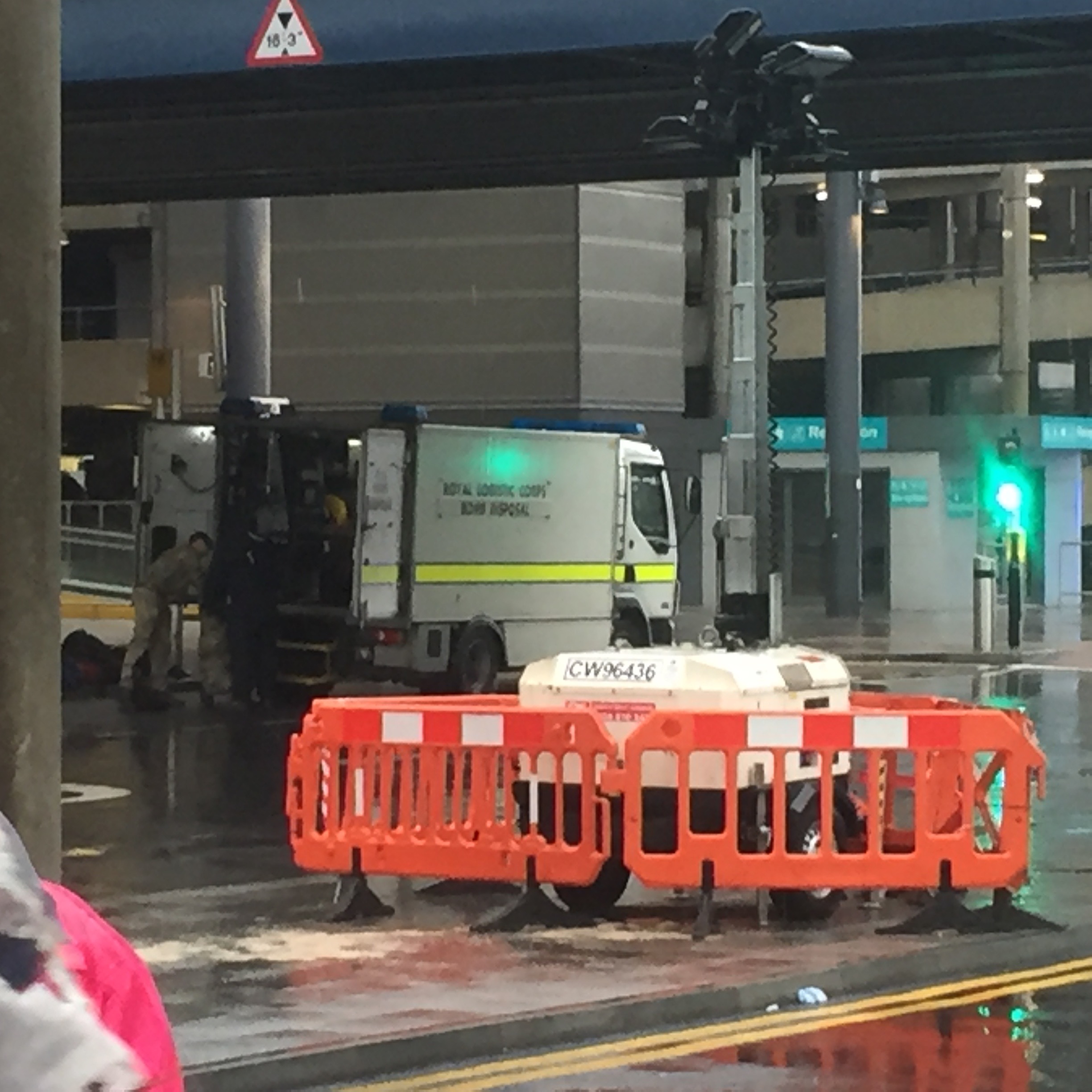
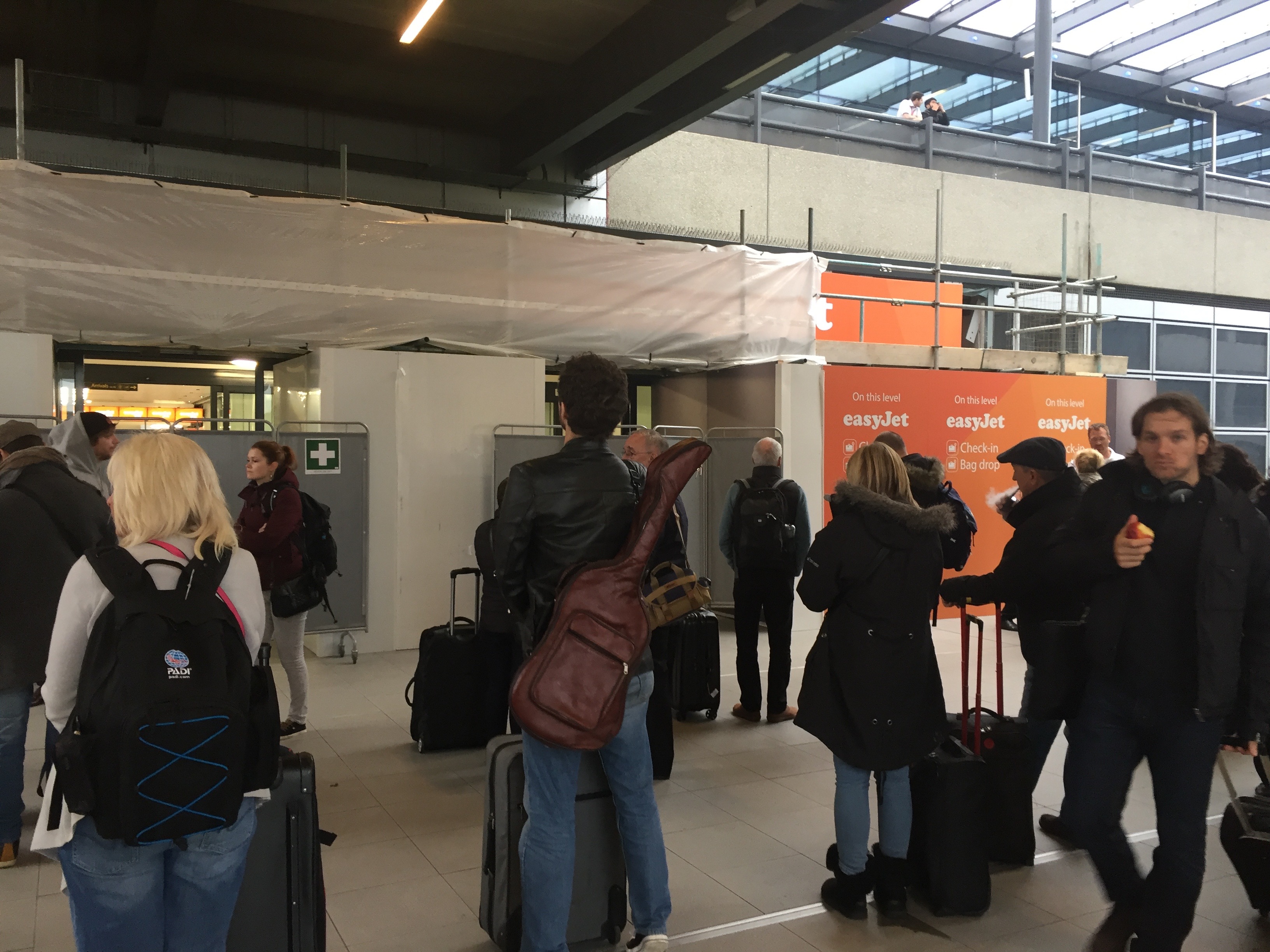
But there were many good things about yesterday as well, not least my first foray into “citizen journalism”.  I arrived at Gatwick North, all ready to go away for a few days holiday.  Little did I know then that I would not be going on holiday, and I would be leaving the airport to go home again some eight hours later! As we drew up to Level One check-in, airport security staff were rapidly closing the entrances and preventing anyone from entering.  As swiftly became clear, a major terrorist alert was just beginning, that would lead eventually to a 41 year old French man being arrested.

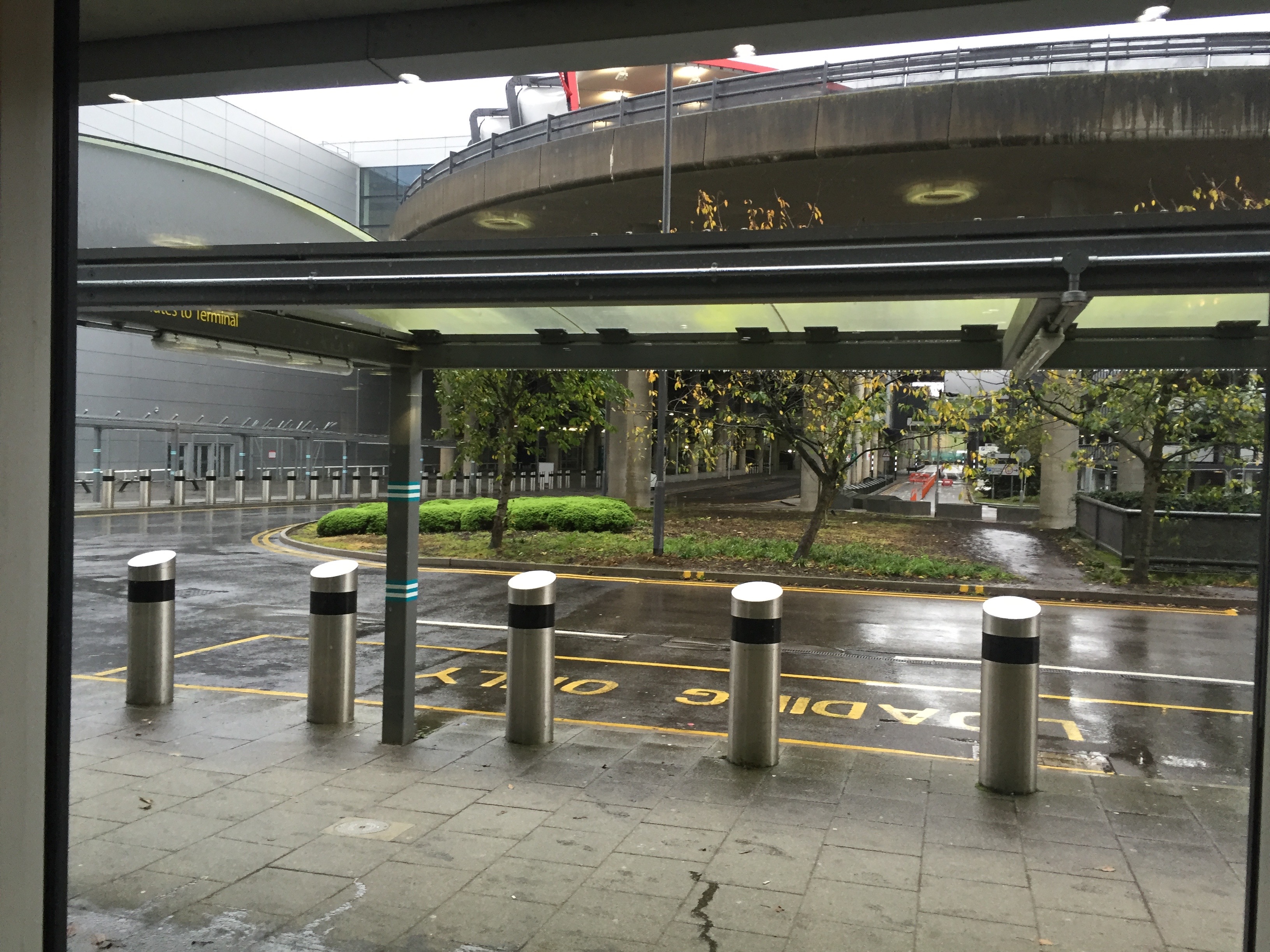
I often post tweets, particularly at conferences and when I find something that I think might be of interest to other people.  So, IMG_5310at 09.49 a.m. I posted the above picture, and then as things began to develop, I gradually began to post further images and comments, so that those arriving at the airport might be aware of the situation.  Surprisingly, it seems that rather few other people were recording the incident, and quite swiftly a number of journalists began to get in touch, and encouraged me to provide them with information, and share further details through my tweets.  It swiftly became evident that the North Terminal was locked down, and so I was one of the few people with whom the outside world could communicate to gather first hand information and imagery.  I felt very strongly as the day developed that I should let the images speak for themselves, and just provide information as I became aware of it, rather than giving personal interpretations or conjectures as to what might be happening.

This made me very aware of the power of citizen journalism, and the way in which individuals can contribute to the wider international making of news.  Never having been involved in a similar situation before, it was fascinating fielding the flow of requests from journalists, until the flood became far too great to deal with and I had to stop taking calls if I was to record what was actually happening.  There were so many fascinating aspects about this, not least the ways in which journalists (and others) tried to get in touch, either by tweeting their phone numbers, or asking to be made friends so that we could “direct message” each other.  Given how reluctant I usually am to share my phone number, this caused some interesting discussions, but I was surprised at how willing journalists were to share their numbers in an environment as open as Twitter.

IMG_5319I posted 53 tweets during the day, and it was fascinating seeing the impact that these had, not only on national and international news media (see, for example, CNN and the BBC), but also for many individuals who got in touch to thank me for the information that I was sharing.  However, I had never expected the darker side of what might happen – and herein lies a warning for other citizen journalists.

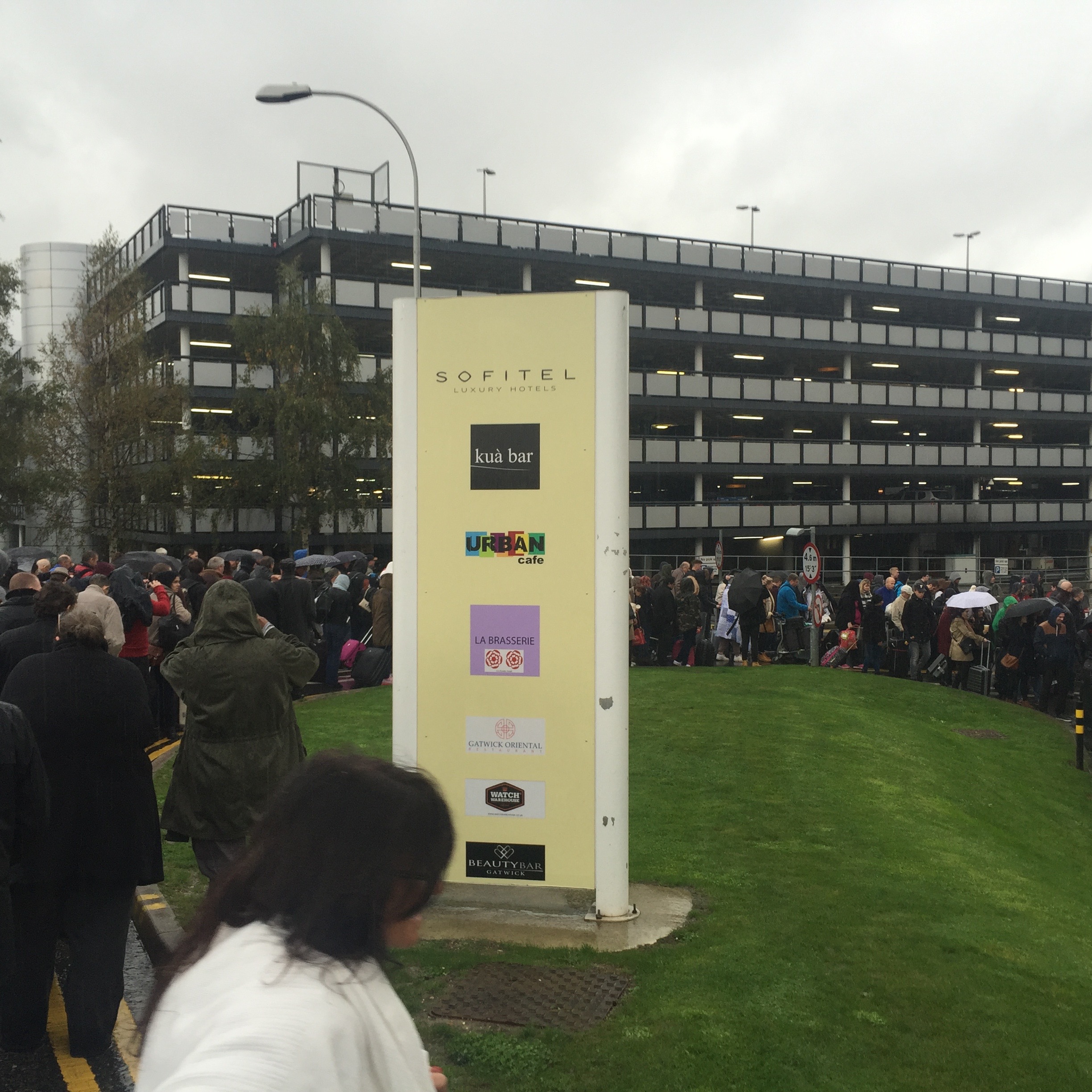
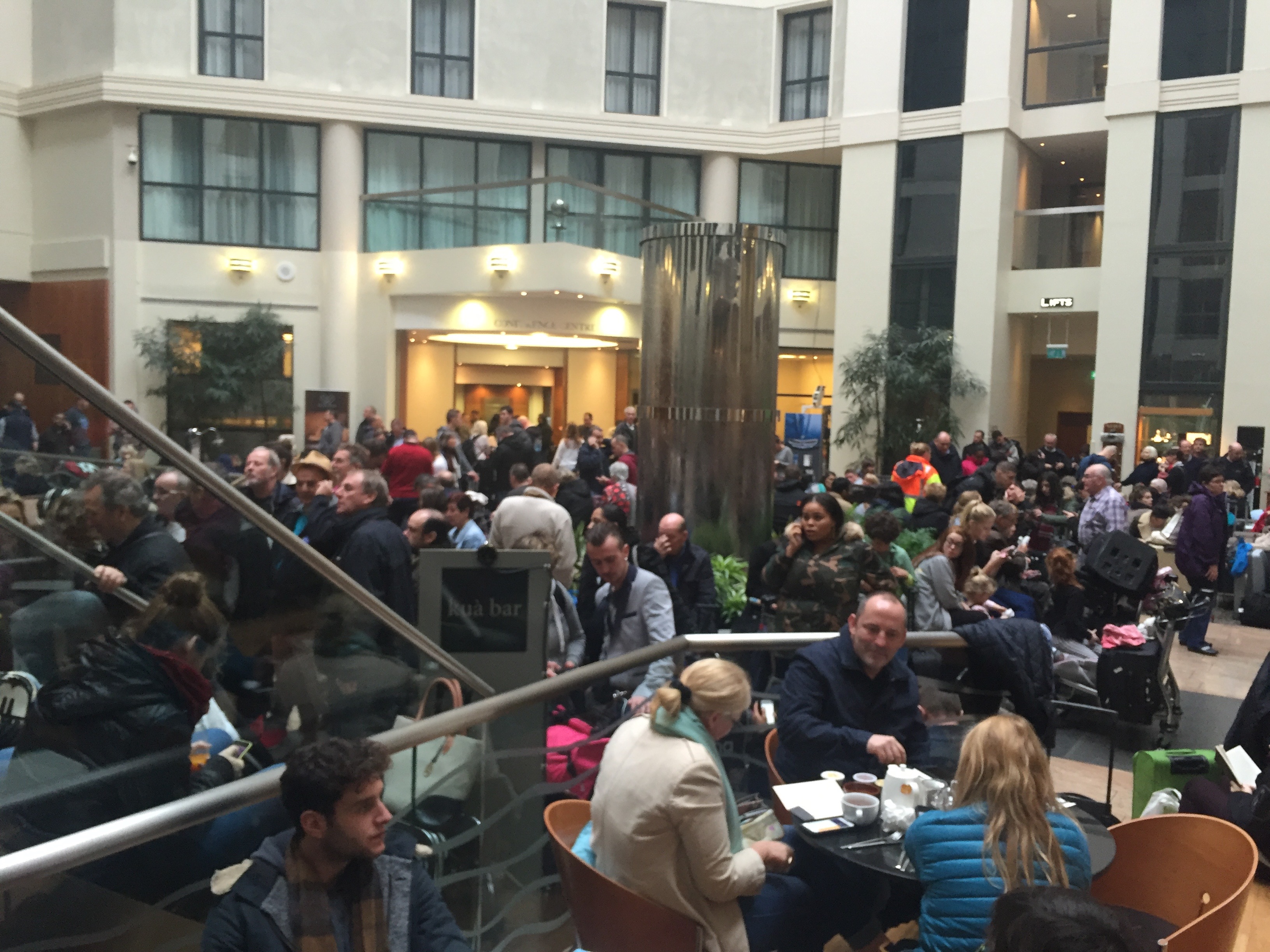
Quite swiftly, those who were locked in and not permitted to leave the terminal vicinity were moved down the ramp to huddle in the drizzle under nearby bus shelters.  They were then eventually moved to Jubilee House, where some limited refreshments were made available, and people could escape from the damp and cold.  At about 11.40 a.m., however, people were evacuated again out into the rain for the walk to the Sofitel, where most arrived before 12.00 mid-day, and were to stay until just before 4 p.m.  Whilst in the airport itself, we were kept reasonable well informed, but once we arrived in the Sofitel very little information was provided, and we seemed very much to be left at the mercy of the Sofitel staff.  I had rather naively assumed that emergency routines had frequently been practised for this scenario, and therefore that the Sofitel would indeed be prepared for a large influx of tired, frustrated, damp, hungry and thirsty people, but cannot help but think in hindsight that this was probably not the case.  The Sofitel seemed completely unprepared for us, and not only was there little information, but there was also very little refreshment available unless you were willing to pay very expensive prices and queue in long slow queues.  To be sure, there was a large influx of people (between 500 and 1000), but I remain surprised at how poorly treated most of the evacuees were.

Interestingly, I did not tweet many negative comments at all about this, but one tweet was picked up by a crowd of people who became highly critical and abusive of me.  At 12.40 I tweeted “Have to say staff at Gatwick Sofitel serving tea/coffee are doing an appalling job – queue does not move. Management please do something”, and this precipitated a torrent of unbelievable abuse.  i tried hard to resist the temptation to respond to the abuse then and there on Twitter, which I am sure would only have exacerbated the situation more, and just blocked the abusive messages, but new people kept re-tweeting negative messages already posted by others!

IMG_5325I very much stand by what I wrote!  There were four staff “serving” in the café area at the edge of the Sofitel lobby, and it took more than 30 minutes for them to serve ten people standing in the queue.  All of the tables in the café were full, and those in the queue just wanted any refreshment that they could get to take away.  There appeared to be no other outlets, and no-one was offering the evacuated passengers any food or drink – free or otherwise.  To make matters worse,

  • the staff showed no sign of hurry or interest in the plight of the passengers;
  • they spent more time just chatting with each other, rather than trying to serve customers;
  • one dropped a whole jug of milk on the floor and took a long time clearing it up;
  • they seemed to have considerable problems working out how much change to give customers paying with cash;
  • payment via card took ages; and
  • perhaps the ultimate annoyance was the cost: £8.89 for one tea and one coffee!

I was amazed at the abuse I received on Twitter, and just want to rebut some of the comments here! I guess there were seven main types of criticism (many were much more abusive than the comments I post below, but I prefer not to use the language in them on my blog!):

  • I was a complete [insert numerous body parts] for complaining
    • gratuitously unpleasant – just cannot understand why people want to be unpleasant like this, deliberately seeking to be nasty to someone they don’t know
  • Being grateful for our situation: “Better being tired and hungry than the unthinkable! People should be grateful they are safe” and “so you had to wait in the warm whilst the police dealt with a serious incident?! Get a grip!!!”
    • fair enough, but I was just pointing out the situation, and imploring management to do something about it
    • people were indeed very grateful that they were safe (and I had tweeted positive sentiments about this), but the lack of preparation and co-ordination was surprising
    • well, passengers had been out in the damp and cold before going into the Sofitel, and they were very grateful to the police
  • I should not be complaining, especially after the dreadful incidents in Paris the previous night (polite versions of this were: “Time for a bit of persepctive considering what happened to our neighbours yesterday evening, perhaps?” and “this really grinds my gears. Would u rather have been blown 2 smithereens. People in Paris would love 2 swap places “)
    • what happened in Paris was clearly dreadful, and earlier in the day I had already tweeted my thoughts about this, expressing solidarity with my French friends (as I do frequently when there are incidents elsewhere in the world)
    • this highlights that trolls focus on just one or two tweets, and do not know the full context of the person about whom they are being abusive
  • A range of comments along the lines that I should be in the terminal with the terrorist (“I take it you’d rather be back in the airport with a gunman?”), or should be killed by a terrorist for writing such things
    • I was just shocked to get such comments – which were actually very hurtful.  I can only imagine how horrible it must be for someone to have a sustained barrage of hate-tweets over a long period
  • I should offer to help serve tea and coffee – implying that I was not willing to do so: “I can’t even fathom how you can be so ungrateful in a time like this. If you’re so concerned get off your phone and go help them”
    • Well, I did offer to help, but you can imagine the response I got – yes, no way would they let me!
  • I was from a spoilt and privileged background, and I should focus my attention on more important things (a polite version: “Gatwick is on lockdown because of a potential terror attack but the coffee is the main problem”)
    • Yes, I do come from a privileged background, but I have spent much of my life focusing on major issues of development, as far as possible from a critical and empowering perspective
    • And I never, ever said “coffee was the main problem” – using “coffee” was in any case shorthand for tea/coffee/water/sandwiches etc. – any kind of food and drink!  Passengers had been “evacuated” in total for six and a half hours that day, and many had not had food or drink because they were hoping to have breakfast/lunch at the terminal
  • I was milking the situation for my own personal gain, by checking with news media who wanted to use my pictures that they would credit me with the images
    • this is a tricky one – I certainly had no intention of having any personal gain, and thought I was doing a service by providing imagery (which was indeed what most people said, and I had some lovely comments thanking me)
    • Most media journalists simply asked if they could use my images saying that they would credit me – my replies were usually just affirming this
    • I have been long involved in debates over Open information, and particularly Open Educational Resources, and years ago like to think I was was at the leading edge (certainly in my own university) about making all of my courses freely available.  I do not even use Creative Commons licensing, because I see that as a constraint!  I just believe (as an academic only too aware of being plagiarised) that credit should be given to the originators of ideas, words and images.

IMG_5322It was the personalising of much of the negative commentary that hurt – I though that I was just observing and sharing information that I saw.  People in the queue for any kind of refreshment were indeed getting very frustrated, and I felt that my own comment trying to capture this was actually quite mild!  It was therefore so, so nice to receive kind messages thanking me for what I was doing – if I hadn’t received such messages I would certainly have stopped tweeting once the abuse had started.  As one kind person wrote, “thanks for all your updates. It’s a shame that some are being rude to you. If it wasn’t for people like you, we’d be in the dark”.

There are many lessons about trolling (even in the relatively mild form I received) to be drawn from this experience, and in concluding I highlight just seven lessons I drew from the experience:

  • Just a single tweet can set off a torrent of abuse, especially when your tweets are going viral – trolls do not care about your previous tweets, or anything about you
  • You have to be tough skinned to deal with such abuse
  • Blocking people who send you abuse as soon as possible can help reduce the impact, but be prepared for others to keep retweeting their originally offensive tweets
  • Certainly in my case the level of abuse increased over time, almost as if people were trying to be more offensive than the people whose abusive comments they were retweeting
  • It is important not to reply to those sending unpleasant tweets – initially I did try to defend myself, but that made matters worse, until I remembered this advice from things I had read previously about trolling
  • It is so nice to receive positive comments, because they help to put things in balance.  I was very grateful for this comment “respect to you for keeping people informed and not spreading mindless crap. Someone buy this man a beer!”.  Sadly I never got a beer!
  • All tweeting is very much “in the present” and so the abuse will usually stop after a couple of days. That was my experience of what I know was low-level trolling, but I can only imagine the really deeply unpleasant effects that long term digital abuse must have.  Clearly, the only situation in such circumstances must be to change one’s digital identity, or even go offline completely for a period of time.

There was, of course, some irony in this scenario: it turned out that this was not a major terrorist incident after all, and that the man was eventually only charged with having an air rifle and a knife.  Only a relatively few (perhaps a thousand at most) were affected, since those who were not caught up in the incident as it happened were redirected to the South Terminal.  All in all, I was at Gatwick for some eight hours, and am now rebooked on a flight later in the week.  Am very much looking forward to a holiday!  However, I learnt a great deal about citizen journalism and trolls!

5 Comments

Filed under Uncategorized

An evening walk through Doha’s Souq Waqif

One of the many challenges of attending conferences is that one usually has to spend around 12 hours a day deep underground in cavernous halls, or in dim windowless rooms watching images and words on large screens!  Not only is one left bereft of natural light, but air conditioning is no replacement for the oxygen of fresh air!  So after the main activities of ITU’s Telecom World were over today, I took myself back to Doha’s Souq Waqif just to immerse myself in the smells of spices, shisha and the wonderfully rich oud perfumes, to glimpse the rich colours of the textiles and jewels, to hear the laughter of small children and the squaks of parrots, and just to walk among ‘real’ people far from the robots and aggressive capitalism of many in the ICT and telecommunications sector who were expounding the virtues of the latest technologies at the conference!  Although this souq is a relative modern re-interpretation of the souq that used to be here, it continues in that rich tradition of sounds, smells, tastes and textures that have always dominated markets in the region.  I hope that the pictures below capture something of the reality of this world beyond the virtual!

This slideshow requires JavaScript.

Leave a comment

Filed under ICT4D, Photographs, Uncategorized

Old Town Dhaka

Finishing meetings early provided an ideal opportunity to experience something of the vibrancy, colour and energy of the old town of Dhaka by the riverside and the Ahsan Manzil Palace Museum.  Thanks so much to colleagues from Ericsson for their hospitality.  Mind you, this area should be avoided when students are sitting exams!  The crowded streets made progress very, very slow, but nevertheless gave me time to take lots of photos of rickshaws!


This slideshow requires JavaScript.

1 Comment

Filed under Uncategorized