On publishing in ICT4D

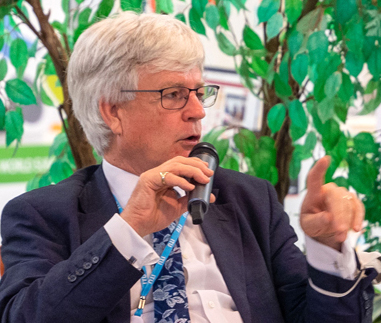
During the recent ICTD2010 conference, Hari kindly brought together a group of us to discuss academic publishing in the field of ICT4D.  Each speaker was to talk for about ten minutes, directing our ‘advice’ primarily towards those who may be less experienced in academic publishing.  Whilst I absolutely love seeing, holding and smelling the first copy of one of my new books, or reading one of my new papers in an academic journal, or seeing authors that I respect referencing one of my publications in their own work, I now recognise that a system that I once admired has become fundamentally, perhaps fatally, flawed.  There is sadly much that is not really scholarly and little at all that is value free in the world of academic publishing today.  It does not foster the excellence or originality that it is  intended to achieve.  All too often it leads instead to a morass of mediocrity and replication.

Two comments in the distant past still haunt me:

  • when my first academic paper was published, a friend and colleague said “congratulations, but you don’t expect anyone will read it do you”; and
  • a senior colleague in a government department once said to me: “I don’t ever read academic papers, I get consultants to provide a short synthesis of them for me”.

The reality of academic publishing is that very few papers are ever actually read, and few people are ever influenced by what is written in journals.

Some of the most challenging problems to do with academic publishing are:

  • Academic journals are fundamentally a way to ensure professional exclusivity.  They are a means through which one group of academics excludes others from participating in their ‘mysteries’.  Thus ‘apprentices’ have to learn the rituals and obey the rules if they wish to belong to this exclusive and privileged club.
  • Because of the need for authors to obey the rules, journals all too frequently fail to promote the very innovation that is meant to be their life blood.  There is a real danger that referees or editors will reject papers that are too innovative or fail to abide by the logics and requirements of a particular journal’s editorial board.
  • Many citation cartels exist, whereby in order to boost their rankings in citation indices, academics agree to cite each other’s papers in their own works.
  • There are also real issues surrounding the dominance of the English language, and far too few journal editors or reviewers are willing to pay heed to different cultural traditions of academic writing style.  We should do much more to enable people from different linguistic backgrounds to get their papers published in the ‘top’ journals.
  • Peer review is by no means the innocent, quality control exercise it is meant to be.  Far too often academics use it as a way of preventing ideas that are contrary to their own from being published.
  • Citation indices usually only incorporate the more prestigious journals, and thus often omit the more innovative and cutting edge papers.
  • The emphasis on quantity rather than quality of publication means that vast numbers of dreadful papers are submitted to journals – and it is very frustrating for editors and referees to have to sift through the dross!

The net outcome of these is that far too many papers that are published are mediocre and tend to replicate existing knowledge.  Moreover, many of these problems have become exacerbated over the last 20 years as academic publication in ‘top’ journals has become such an important part of research assessment exercises.

I offered five key tips for less experienced academics who wish to succeed in this environment:

  • The most important tip is that one must realise that academic publishing is a game.  New academics therefore have to learn the rules and play by them – if they want to achieve success in terms that the profession’s gatekeepers have defined.  Once your career is established, then you are in a position to try to change the rules!
  • Write something that is reasonably good and then submit it to a journal.  Referees are bound to suggest revisions, and so don’t be hurt by the comments.  Use them, alongside your own developing ideas, to improve the paper and resubmit it – in most cases it will eventually be published (as long as it is reasonably good in the first place!)
  • Publish less, but publish better; focus on quality rather than quantity.  When I was head of department, I remember encouraging colleagues to make sure that they published just two or three papers a year in major journals, and a book every three to four years.
  • Remember that few people actually read academic journals. If you want your ideas to have an impact, it is therefore essential that you make them available in different formats and contexts – as, for example, through your own blog
  • Only ever agree to have your supervisor’s name as an author on the paper if she or he has actually written a substantial amount of it!  Good academics don’t need to have their names on your research – although it is always nice to recognise their advice in an acknowledgement.

Two final points are worth mentioning.  The first is that publishing in a multidisciplinary field such as ICT4D is fraught with a particular set of additional difficulties.  Where academic success is defined in large part through publication in prestigious journals, most academics seek to publish their work in their own discipline’s top-ranked  journals.  It is thus more prestigious for a computer scientist working in ICT4D to publish in a top computer science journal than in a new ICT4D journal. Those who edit cross-disciplinary journals often therefore find that the papers that are submitted to them are those that have been rejected by other more mainstream journals.  Consequently, papers published in multidisciplinary journals are often of less good quality than those in the major single disciplinary journals.  This does, though, provide editors of multidisciplinary journals with an opportunity to be innovative and creative in what and how they publish. Moreover, it is incumbent on those working in the field to support new journals that are indeed trying to break the mould of traditional academic arrogance and exclusivity.

Finally, we need to explore alternative modalities of publishing.  Those of us working in the field of ICT4D should seek to use ICTs creatively to enable multiple voices from many different backgrounds to share their research findings.  However, we still need to find appropriate business models to enable more open and free publication options to be created.  Traditionally, journal publishers have added considerable value to the publication process, not least through funding the editorial and publication process.  Such costs remain to be covered, and few ‘free’ journals have yet actually enabled high quality original academic papers to be widely disseminated. We also need to work creatively with existing publishers, since they have much to offer the publication process.

For some of my more detailed reflections on peer review see:

[For the presentations by Geoff Walsham, Cathy Urquhart and Shirin Madon as well as the full discussion see the video “Publishing ICT4D Research available from ICTD2010 videos and photos]
2 Comments

Filed under ICT4D, Postgraduate supervision, Universities

Celebrating the Estonian kroon

On the 1st January 2011, Estonia will join the Eurozone, and its currency the Kroon will fade into the realms of history.  For some this is a cause for great celebration, as Estonia becomes ever more integrated into the European economy.  Andris Vilks, Latvia’s Finance Minister is thus reported as saying that “The introduction of the euro in Estonia will foster long-term economic development in the entire region”. Likewise, as the official Estonia.eu site comments, “Estonia’s accession to the euro zone will be in the country’s own interest despite the current crisis gripping the monetary union. The changeover to the euro, a world currency, will boost business confidence, investor confidence, and also the well-being and confidence of the Estonian people.”

However, life is about very much more than mere economic development. Banknotes are thus not only a medium of economic exchange, but are also a fundamentally important symbol of national identity.  On their independence from the Soviet Union in 1991, all of the Baltic States thus embarked on a diversity of programmes to reassert their own individual identities. One of the most visible of these expressions was the creation of new currencies and banknote designs that drew on their rich cultural heritages.

In the case of Estonia, the banknotes focused especially on the nation’s original ‘awakening’ in the 19th century, drawing on themes associated with the countryside, small family farms, and the deep significance of  a very particular link with nature.

In summary, the pictures shown were as follows:

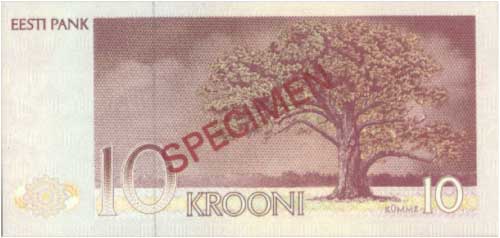
  • 1 Kroon – front: image of the graphic artists Kristjan Raud, who illustrated the epic saga Kalevipoeg; back: Toompea Castle
  • 2 Kroon – front: the scientist Karl Ernst von Baer; back: the main building of Tartu University
  • 5 Kroon – front: Paul Keres, an international grand master in chess; back: the towns of Narva and Jaanilinn
  • 10 Kroon – front: Jakob Hurt, the Estonian folklorist who played a major role in the 19th century national awakening; back: the Tame-Lauri oak tree in southern Estonia
  • 25 Kroon – front: Anton Hansen-Tammsaare, author of the saga Truth and Justice; back: Tammsare’s farm at Varagamae
  • 100 Kroon – front: the Estonian poetess Lydia Koidula; back: the northern Estonian limestone cliffs at Panga Pank
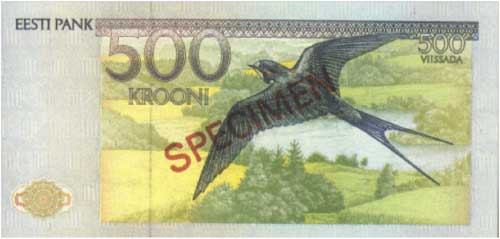
  • 500 Kroon – front: Carl Robert Jakobsen, journalist and promoter of agriculture; back: a barn swallow, the Estonian national bird, flying over a rural landscape

Designed by Vladimir Taiger and printed by Thomas de la Rue, I find these banknotes to be exceptionally beautiful, capturing with great insight the aspirations of some of those who strove to create a new Estonia following the Soviet occupation.  To be sure, this vision of a rural heritage did not sit well with those who were determined to turn Estonia into a thriving capitalist urban economy, and it is perhaps symbolic of the shift in political power within the country that it was at the vanguard of those knocking on the door of Europe, both in terms of its original incorporation into the European Union in 2004, and now with its rejection of the Kroon in favour of the Euro.  As I predicted back in 2000 when writing about the creation of these banknotes, “This efflorescence of artistic representations of national identity in the 1990s therefore reflects a brief and poignant moment in these states’ development”.

Let us celebrate the short history of the new Estonian Kroon and hope that its replacement by the bland, anodyne and utilitarian commercial instrument of the Euro will not reflect the complete submersion of Estonia’s proud identity within the selfish, individualistic capitalist mentality that drives the Eurozone and its arrogant bankers.

[I was fortunate enough to speak with many of those involved in the original design and production of these banknotes in the course of a British Academy funded research project with Virginia Hewitt, the results of which were published as:

  • Hewitt, V. and Unwin, T. (2004)  Reconstructing national identities: the banknotes of central and eastern Europe in the 1990s, in: Green, E., Lampe, J. and Stiblar, F. (eds) Crisis and Renewal in 20th Century Banking, Aldershot: Ashgate, 254-275.
  • Unwin, T. and  Hewitt, V. (2001) Banknotes and national identity in central and eastern Europe, Political Geography, 20, 1005-1028.
  • Hewitt, V. and Unwin, T. (2001) Vidurio ir rytų Europos šalių Xxa dešimtujo dešimtecio banknotai, Pinigų Studijos, 3, 88-100
  • Unwin, T. (2001) Banknotes and national identity in central and eastern Europe, The British Academy Review, 46-48]

For further comment, see also this BBC report published on 23rd December 2010 that captures the diversity of opinion in Estonia surrounding the ditching of the Kroon.

2 Comments

Filed under Banknotes

Leaving the best until last – Day 4 at ICTD2010

Great to hear how many people enjoyed the party last night – and thanks once again to Ugo and Fftang! Fftang!  I’m amazed how many people were fit for action this morning – but probably just as well that we were starting at 09.00 rather than 08.00!

An amazing set of discussions and workshops – some of the highlights in the pictures below.

Thanks once again to everyone who came to ICTD2010 and helped make it so valuable a place to explore our shared interests in ICT4D!

This slideshow requires JavaScript.


Leave a comment

Filed under ICT4D, ictd2010, Photographs

Day 3 at ICTD2010

The third day – reminiscent of one of my favourite films, The Third Man. Some serious papers, excellent posters and demos. It was the conversations in the corridors that I enjoyed most…

Thanks to Paul and Michelle for the evening reception – and in case anyone is wondering about exactly which winery Michelle was referring to it was Bloodwood in Orange!

Congratulations to Georgia Tech who will be the hosts for ICTD2012!

This slideshow requires JavaScript.

Leave a comment

Filed under ICT4D, ictd2010, Photographs, Wine

ICTD2010 Party Time with FFtang! FFtang!

Thanks to Ugo for arranging all of the evening social events during ICTD2010, and especial thanks to Fftang! FFtang! for the great party this evening!  Clearly some of the best ICT4D brains occasionally need to recharge their inspiration on the dance floor! Brilliant atmosphere, and great to see so many people having such a good time.

This slideshow requires JavaScript.

Leave a comment

Filed under ictd2010, Photographs

Geoff Walsham’s Keynote Address at ICTD2010

Great Keynote Address by Geoff Walsham at ICTD2010 – reminding us not only of the importance of the FOR DEVELOPMENT in ICT4D, but also that one can combine high quality scholarship with a touch of levity!  His jokes were a definite antidote to any excesses of the night before, and inspired us for the third day of ICTD2010.

This slideshow requires JavaScript.

Leave a comment

Filed under ICT4D, ictd2010, Photographs

Sir Tim Berners-Lee at ICTD2010

It was great to hear Sir Tim Berners-Lee give a Keynote Address at ICTD2010 on 14th December.  Some photographs are given below:

This slideshow requires JavaScript.

2 Comments

Filed under ICT4D, ictd2010, Photographs

Scholarship holders at ICTD2010

Through the generosity of the sponsors of ICTD2010, we were able to make more than 100 offers of scholarships, most of which covered flights, accommodation and registration.  This was an absolutely central part of our agenda in putting together the conference, because we wanted to create an opportunity for all of us to learn from each other.  It was therefore great to see so many colleagues from Africa, Asia and Latin America attending, and the rich diversity of our scholarship holders is reflected in the pictures below

This slideshow requires JavaScript.

4 Comments

Filed under ICT4D, ictd2010, Photographs

Day 2 at ICTD2010

Wow!  Time passes so fast when you are enjoying yourself!!  We had some excellent and thought provoking papers at ICTD2010 on Day 2.  Here is just a selection of some of the photographs I took throughout the earlier parts of the day, not only of the plenary sessions but also of the great posters and demos.  Thanks to everyone for their commitment and enthusiasm in contributing to these diverse modalities of representing their research.

This slideshow requires JavaScript.

Oh yes, and I just wanted to add that the conference App is indeed available for all smartphones – through the Web App – and I very much want to thank oMbiel and campusM for the work that they did in putting the structure together and providing this to the conference for free as a partner.  If you have any complaints about the content, then that’s definitely my fault since I did this – and yes, the wake up calls and alerts you get on the App do indeed come from my laptop!

1 Comment

Filed under ICT4D, ictd2010, Photographs

Open Mic/Jam session at ICTD2010

Thanks to Ugo for bringing together such an amazing set of ICT4D talent for last night’s party in the Stumble Inn.  It was an fine start to the social programme – and thanks to everyone for being so willing to contribute with everything from teaching us how to do Flamenco (Nicholas Negroponte style), to poetry to dancing.  The evening finished off with a guest performance from singer-songwriter Roxanne de Bastion

This slideshow requires JavaScript.

Leave a comment

Filed under ICT4D, ictd2010, Music, Photographs