
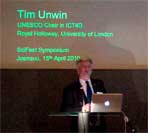
 I had the privilege of being a keynote speaker at the SciFest symposium on ICT for development and learning held in association with a meeting of the Computer Science Days of the Finnish Computer Society held at the University of Joensuu on 15th April. Here is a summary of the key issues that I raised:
- The main question I sought to address was “How can Computer Science contribute to the lives of some of the poorest and most marginalised people in the world?”
- Much computer science seems to be very theoretical, and practised by people who prefer to remain in their familiar institutional surroundings
- However, for those who wish to gain new experiences, insights and intellectual challenges, working in some of the poorest countries of the world offers great opportunities
- Unfortunately, much so-called ICT4D research and practice tends to be top-down and led by people from Europe and north America
- All too rarely does such research really address development needs
- As privileged academics, we ought to listen much more to the stated needs of the poorest and most marginalised in crafting our research agendas
- The private sector is likely to enable many relatively poor people to benefit from ICTs, but the very poorest – those with disabilities and street children – need interventions by governments and civil society organisations to help them use ICTs to achieve their aspirations
- For those computer scientists not lured by the interests of capital, there remains the wonderful challenge of working for social agendas that can make a difference – both to their own intellectual benefit, and to the benefit of the world’s poorest people

 Tim Unwin's Blog