
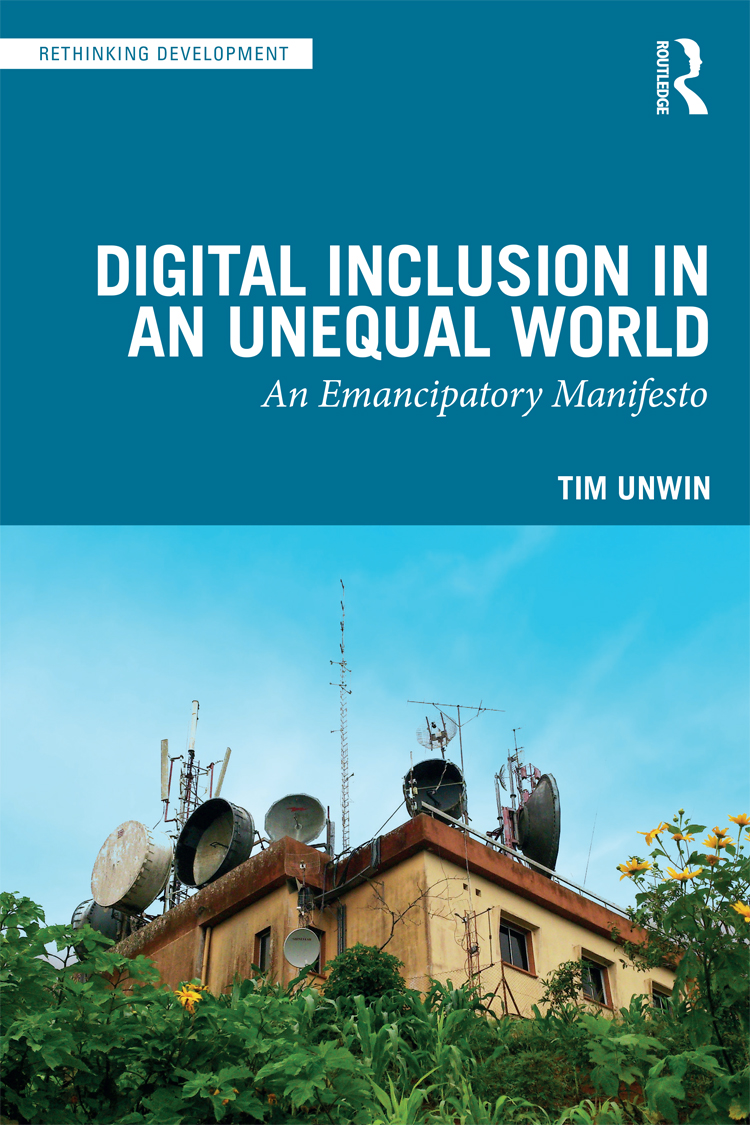
The ICT4D Collective has recently launched a podcast channel on Apple Podcasts which contains audio versions of the vignettes in my upcoming book Digital Inclusion in an Unequal World: An Emancipatory Manifesto. The third tranche of episodes (7-10) is now available as follows:
Digital Inclusion in an Unequal World (Episode 10) – Nick Hughes OBE on “The Power of Micro-Transactions”

This is the tenth episode of our podcast based on the vignettes contributed by friends and colleagues to Tim Unwin’s new book Digital Technologies in an Unequal World: An Empancipatory Manfesto. In it, Nick Hughes argues that “we must use technology to create new economic wealth by either helping someone make money or save money: market-creating innovation“. He then provides insights into how he thinks this can happen, suggesting that “The next phase of development will see digital payments linked to real-time economic output data. The use-cases are multiple, with the following being just a few: clean energy from distributed solar; earnings from tiny retail outlets unlocking working capital; and the lock-up of carbon into biochar rewarding buyers and sellers in the carbon markets”
The full vignette can be read here.
All audio files relating to the book are also available on our podcast with a new episode every week.
Digital Inclusion in an Unequal World (Episode 9) – Emily Hickson’s contribution to “Nigel Hickson: a digital life well lived for others”

This is the ninth episode of our podcast based on the vignettes contributed by friends and colleagues to Tim Unwin’s new book Digital Technologies in an Unequal World: An Empancipatory Manfesto. Our dear friend and colleague, Nigel Hickson was to have written one of these vignettes based on his wealth of experience working on Internet Governance, especially for the British Government and ICANN, but his untimely death meant that he was unable to complete it. Instead, some of his friends have contributed very short pieces on what it was that made him so special, and a model to follow for anyone wishing to work at the policy level to ensure that the poorest and most marginalised can benefit from the use of digital tech. The full vignette can be read here.
All audio files relating to the book are also available on our podcast with a new episode every week.
Digital Inclusion in an Unequal World (Episode 8) – Judith Hellerstein’s contribution to “Nigel Hickson: a digital life well lived for others”

This is the eighth episode of our podcast based on the vignettes contributed by friends and colleagues to Tim Unwin’s new book Digital Technologies in an Unequal World: An Empancipatory Manfesto. Our dear friend and colleague, Nigel Hickson was to have written one of these vignettes based on his wealth of experience working on Internet Governance, especially for the British Government and ICANN, but his untimely death meant that he was unable to complete it. Instead, some of his friends have contributed very short pieces on what it was that made him so special, and a model to follow for anyone wishing to work at the policy level to ensure that the poorest and most marginalised can benefit from the use of digital tech. The full vignette can be read here.
All audio files relating to the book are also available on our podcast with a new episode every week.
Digital Inclusion in an Unequal World (Episode 7) – G. ‘Hari’ Harindranath – How May Academics Help to Empower Marginalised Communities Through Digital Tech?

This is the seventh episode of our podcast based on the vignettes contributed by friends and colleagues to Tim Unwin’s new book Digital Technologies in an Unequal World: An Empancipatory Manfesto. In it, Hari argues that “Empowering marginalised groups through our work with digital technologies, and striving to make the world a better place as a result may be lofty aspirations, but they are worth pursuing. That will require us all to get out of our comfort zones and find ways to prioritise outcomes, commit time and resources, and engage with communities on the ground, rather than in the ivory towers, to learn and gather evidence of impact and outcomes of using digital tech in the service of the world’s poorest and most marginalised”
The full vignette can be read in English here and all audio files relating to the book are also available on our podcast.


 Tim Unwin's Blog