
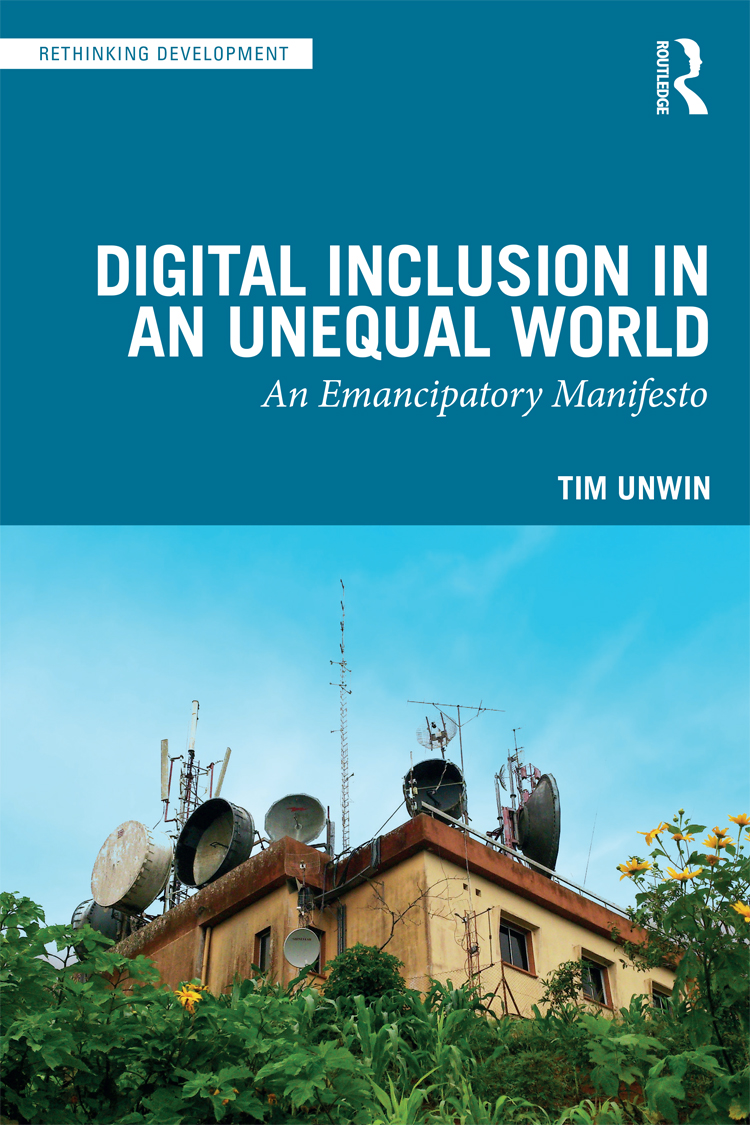
The ICT4D Collective has recently launched a podcast channel on Apple Podcasts which contains audio versions of the vignettes in my upcoming book Digital Inclusion in an Unequal World: An Emancipatory Manifesto. The fourth tranche of episodes (11-16) is now available as follows:
Episode 16. Benita Rowe on “The Tech Will Save Her’ – False Promises in Digital Gender-Based Violence (GBV) Solutions”

This is the sixteenth episode of our podcast based on the vignettes contributed by friends and colleagues to Tim Unwin’s new book Digital Technologies in an Unequal World: An Empancipatory Manfesto. In it, Benita Rowe illustrates how “Digital interventions aimed at preventing or responding to gender-based violence (GBV) have re-emerged in recent years in cyclical form, each positioned as a world-first innovation”. Yet, she argues that “Despite differences in format, these interventions often replicate a flawed set of design assumptions that consistently fail to
account for lived realities”.
The full vignette can be read here.
All audio files relating to the book are also available on our podcast with a new episode every week.
Episode 15. Nimmi Rangaswamy on “Social, Shared and Sustainable: Whatever Happened to the Community Internet?”

This is the fifteenth episode of our podcast based on the vignettes contributed by friends and colleagues to Tim Unwin’s new book Digital Technologies in an Unequal World: An Empancipatory Manfesto. In it, Nimmi Rangaswamy concludes that “What was once imagined as a shared, empowering infrastructure has become a personalised, pay-per-use playground — curated for binge and scroll rather than community or collective good. The Internet in India today is more a screen in the palm than a shared window. It entertains more than it empowers, and connects more to content than to community”.
The full vignette can be read here.
All audio files relating to the book are also available on our podcast with a new episode every week.
Episode 14. Nnenna Nwakanma on “Working WITH, not FOR”

This is the fourteenth episode of our podcast based on the vignettes contributed by friends and colleagues to Tim Unwin’s new book Digital Technologies in an Unequal World: An Empancipatory Manfesto. In it, Nnenna Nwakanma tells the story of her experiences having asked to visit a “school that the media has touted as the ‘model’” of good use of digital tech in education in a West African country. As she notes, “I needed to see things for myself, where the rubber hits the road. I also refused any ‘official’ or ‘media-related’ accompaniment”. The vignette reports on the schocks she encountered when she visited. As she concludes “When are we going to stop working FOR stakeholders and start working WITH them?”
The full vignette can be read here.
All audio files relating to the book are also available on our podcast with a new episode every week.
Épisode 13 en français. Yuliya Morenets sur « Au-delà du rôle symbolique: repenser l’inclusion des jeunes dans les forums mondiaux »

Voici le treizième épisode de notre podcast, inspiré des témoignages d’amis et de collègues qui ont contribué au nouveau livre de Tim Unwin, «Digital Technologies in an Unequal World: An Empancipatory Manfesto». Yuliya Morenets y raconte sa rencontre dans le hall d’inscription d’un événement IGF, illustrant comment l’inclusion des jeunes privilégie souvent la familiarité à l’innovation. Elle conclut : « Si nous voulons une véritable participation, nous devons dépasser le symbolisme. Nous devons investir dans les jeunes, non seulement comme des acteurs, mais aussi comme des bâtisseurs : imparfaits, passionnés et toujours en apprentissage. L’important n’est pas de polir chaque voix, mais d’écouter celles qui n’ont pas encore été entendues ».
Le texte intégral est disponible ici.
Audio en français
Tous les fichiers audio relatifs au livre sont également disponibles sur notre podcast, avec un nouvel épisode chaque semaine.
Episode 13 in English. Yuliya Morenets on “Beyond the Token Seat: Rethinking Youth Inclusion in Global Forums”
This is the thirteenth episode of our podcast based on the vignettes contributed by friends and colleagues to Tim Unwin’s new book Digital Technologies in an Unequal World: An Empancipatory Manfesto. In it, Yuliya Morenets tells the story of an encounter in the registration lobby of an IGF event to show how youth inclusion often rewards familiarity over innovation. She concludes that “If we want real participation, we must move beyond tokenism. We need to invest in youth not just as performers, but as builders—messy, passionate, and still learning. The point is not to polish every voice but to hear the ones that haven’t been heard”.
The full vignette can be read here.
Audio in English
All audio files relating to the book are also available on our podcast with a new episode every week.
Episode 12. David Hollow on “Evidence-driven decision-making in the use of digital technologies in education”

This is the twelfth episode of our podcast based on the vignettes contributed by friends and colleagues to Tim Unwin’s new book Digital Technologies in an Unequal World: An Empancipatory Manfesto. In it, David Hollow argues that building a cuture of evidence-driven decision making can help ensure that EdTech is used wisely to mitigate the global learning crisis. He argues that everyone can contribute to building such a culture of evidence-based decision-making in EdTech by asking the following question: will this use of technology lead to an impact on learning outcomes that is cost-effective and works at scale?
The full vignette can be read here.
All audio files relating to the book are also available on our podcast with a new episode every week.
Episode 11. Janet Longmore on “The Youth-led Imperative”

This is the eleventh episode of our podcast based on the vignettes contributed by friends and colleagues to Tim Unwin’s new book Digital Technologies in an Unequal World: An Empancipatory Manfesto. In it, Janet Longmore provides a summary of the six main learnings from the work of Digital Opportunity Trust with young people drawing especially on their recent experiences in Rwanda and Uganda. Implementation of these learnings can provide a fundamental ‘mindset shift’ that reflects new skills and an entrepreneurial socially responsible spirit, resiliency and adaptability among young people that are critical for navigating employment and self-employment opportunities in a digital economy.
The full vignette can be read here.
All audio files relating to the book are also available on our podcast with a new episode every week.

 Tim Unwin's Blog