Category Archives: Commonwealth

Summary of Keynote for COL’s PCF7 in Abuja

Despite limited digital connectivity, I just thought I would upload a short summary of my upcoming keynote at the Commonwealth of Learning’s Seventh Pan-Commonwealth Forum this afternoon to encourage productive debate!  Its central argument is that we are not delivering as effectively as we could in using ICTs for education at all levels, because of very explicit interests that are serving to limit this effectiveness. (Later on 17th December: the slides that accompanied the keynote have now been made available by COL)

Good practices

I begin with a short overview of ten good practices that need to be in place to ensure effective use of ICTs in education:

  1. It’s the learning that matters, not the technology
  2. Teachers must be involved from the beginning
  3. Sustainability built in from the start
  4. Supporting infrastructure must be in place
  5. Appropriate content must be developed
  6. Equality of access for all learners
  7. Continual monitoring and evaluation
  8. Appropriate maintenance contracts
  9. Using the technology 24/7
  10. Good practices, rather than best

So, why are these not done?

I focus here first on the observation that ICTs generally increase inequalities unless very specific actions are taken to ensure that the poorest and most marginalised are able to benefit.

I then explore the various interests that tend to limit delivery of the above ten practices, focusing especially on the activities of the private sector, and especially hardware and software companies, connectivity companies and content developers.

In so doing, I also draw on some of the increasing amount of empirical evidence that the use of computers in education is actually damaging learning.

Implications for innovation

In the final section, I explore some of the implications of these trends for innovation and creativity, paying specific attention to five themes:

  1. Content replication
  2. Memory
  3. Language and literacy
  4. Personalised searching
  5. Privacy and failure

In conclusion

In drawing these reflections to an end, I argue that one way forward is to work towards new and effective models of multi-stakeholder partnerships for education, that address education as something much more important, much more complex, and much more exciting than merely as a vehicle for economic transformation.

Leave a comment

Filed under Africa, Commonwealth, Development, Education, Higher Education, ICT4D

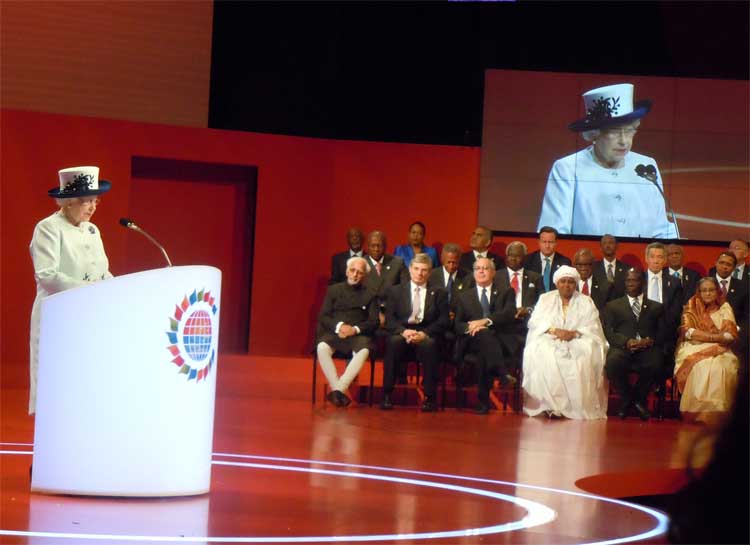
CHOGM 2013 Opening Ceremony

This is the third time I have been privileged to attend an Opening Ceremony of the Commonwealth Heads of Government meeting.  As well as the formal speeches, and parading of heads of state, these occasions provide a fascinating opportunity to see how a country wishes to present itself, and I hope that the images below capture something of the essence of the opening ceremony just held in Sri Lanka. The Sri Lankans certainly put on a beautiful pageant, and there were thousands of young dancers lining the streets – they must have been exhausted by the time the ceremony was over!

This slideshow requires JavaScript.

1 Comment

Filed under Commonwealth, Politics

Transform Africa 2013 and a celebration of Rwanda

I had the great privilege – especially as a white Yorkshireman – to be invited to chair the session on Smart Education at Transform Africa 2013 held in Kigali, Rwanda – a conference led by Africans, for Africans.  It is some five year since I was last in Rwanda, and the changes that have been made in the country over this time, especially in the field of ICTs, are palpable.

It was really excellent to hear seven Presidents of east African countries champion the potential of ICTs to transform Africa, whilst also being realistic about the challenges that still remain in using them effectively to contribute to the social, political and economic development of their countries.

It was also good to experience some of the musical heritage of Rwanda – and even to have the chance of learning yet another different style of African dance!  This was especially so at the launch of Rwandapedia this evening – an excellent resource for those wishing to learn more about Rwanda’s turbulent history over the last 20 years or so.  Congratulations, too, to the Panorama Restaurant at the Des Mille Collines for what has to be one of the best dinners I have recently had in Africa!

The photos below catch but a glimpse of some of my experiences here over the last few days.

This slideshow requires JavaScript.

1 Comment

Filed under Africa, Commonwealth, Development, Education, ICT4D

ICTs for Education Initiatives

I spent last week in Abuja for the Commonwealth Telecommunications Organisation‘s Annual Forum and Council meeting, during which there was also a meeting of ICT Ministers, at which many of them highlighted the importance of ICT initiatives for education in their countries.  One thing that particularly struck me about some of the discussions I had was, that despite such interest, there remains a surprising lack of knowledge about many of the challenges that exist in delivering such initiatives.  All too often it is simply taken for granted that such programmes must be successful, and that they will unquestionably lead to an improvement in education.  I find this deeply worrying, because one of the few things that we really know is that the majority of ICT for education initiatives in developing countries have actually been disappointing failures – at least as far as delivering effective educational change is concerned.  I have therefore spent some of today writing a page on the CTO’s site about this, trying to summarise some of the findings of work in which I have been engaged over the last decade.

boy with computer smallI am also making these ideas available on my personal blog to try to encourage debate around this important subject.  There is far too much duplication of effort, and reinventing the wheel in terms of how to deliver effective ICT for education initiatives.  This can be incredibly wasteful of valuable resources, and I hope that by providing links to some of the more important available resources people will at least have a starting point from which to work.  It would be good also if colleagues could add to the list of the most important references and websites/portals by leaving comments, thereby using this as a vehicle for sharing more information on the subject.

Based on my work over the last decade or so, I have come to the conclusion that ten key issues need to be considered if effective ICT in education initiatives are to be delivered:

  1. It is the learning that matters and not the technology. Many e-learning and m-learning initiatives place the emphasis on the technology – be it laptops or mobile ‘phones.  Effective initiatives begin with identifying the learning objectives, and then identify the technologies that are best suited to delivering them.
  2. Teachers must be closely involved in the implementation of ICT for education initiatives, and they need to be given effective training in advance of the roll-out of computers in schools.
  3. Sustainability issues must be considered at the very beginning.   Computers, laptops and mobile ‘phones are expensive.  Whilst it can be affordable to purchase these as a one-off investment, careful thought must be given to the budget costs of maintaining this equipment, and of how to provide it for the next generation of school-children.  Computers do not last forever, and a substantial budget stream must constantly be made available.
  4. The supporting infrastructure must be in place.  All too often insufficient attention is paid to ensuring that there is sufficient reliable electricity and Internet connectivity to enable the equipment to be used, and for teachers and students to gain access to the Internet.
  5. Appropriate content must be available to help deliver the curriculum and learning needs.  All too often ICT initiatives merely provide access to internationally available content delivered in foreign languages.  It is important that local content developers are involved in shaping learning content, and that as much attention is focused on using ICTs to provide new ways of communicating, and not just delivering information.
  6. Ensure equality of access to all learners.  ICTs enhance inequality between those who have access to them and those who do not.  It is essential therefore that attention is paid to ensuring that all learners are indeed able to access the benefits.  Usually, ICT for education initiatives start with those who are already privileged, through their wealth or by living in urban environments with the necessary infrastructures.  Enlightened initiatives actually begin with delivering learning solutions to the most marginalised people and those living in rural areas.  Remember that people with greater disabilities have more to gain from learning ICT skills than do those with fewer disabilities.
  7. Appropriate monitoring and evaluation must be undertaken from the very beginning to ensure that learning objectives are indeed being delivered, and that the initiative can be tweaked accordingly.
  8. Appropriate maintenance contracts for equipment and networks need to be established.  Training local people in the maintenance of learning technologies is essential so as to ensure that the equipment is used effectively. This can also provide a real boost to local economies.
  9. Use equipment and networks in schools for as long as possible each day.  ICT equipment and networks in schools should be used by local communities in out-of-school hours.  This maximises the use of expensive equipment, and can provide a source of income generation that can help defray the costs of its usage.
  10. Think creatively in your own context.  There are no best practices, only a range of good practices from which to choose.  Develop solutions that best fit your learning needs, and then get on with implementing them!

I  very much look forward to developing these ideas in more detail in my keynote address on technology in education at the Commonwealth of Learning’s seventh Pan-Commonwealth Forum to be held in Abuja this December.

It is hugely difficult to summarise the vast wealth of existing literature on ICTs and education in a development context, but I suggest that the following ten publications are essential reading for anyone engaged in delivering effective ICT for education initiatives, particularly through multi-stakeholder partnerships (listed alphabetically):

I have always found that the following websites on ICTs and education in a development context (listed alphabetically) contain a wealth of useful information:

4 Comments

Filed under Commonwealth, Development, Education, ICT4D

My keynote address at CTO Forum 2013 in Abuja

The Commonwealth Telecommunications Organisation is convening its Annual Forum and Council meeting in Abuja, kindly hosted by the Federal Ministry of Communication Technology and the Nigeria Communications Commission on behalf of the Federal Government of Nigeria, on the theme of Innovation through Broadband.  This is something I care passionately about, and my team permitted me to give a keynote opening address.  Several people have already asked me for the text – and so provide an abbreviated version below, which omits the diplomatic niceties and my heartfelt thanks to all who have made this event possible.

“Over the next few days we address critically important themes, and I specifically wanted to say a few words to challenge us all now, at the beginning of this event.  Quite simply, we cannot deliver on the title of this Forum, “Innovation through Broadband” unless we actually have broadband.  Many of the CTO’s members have less than 5% of their population connected to the Internet; my own country, the UK, still has 17% of its households not connected. For those of you from the corporate sector, this is indeed a great market opportunity!  However, the case I want to put before you is that, more importantly than merely the economic agenda, is a moral agenda.  These technologies are so important, so powerful, so life-changing, that we fail our brothers and sisters if we do not ensure that they too have access to broadband.

There are three simple things I would like you to take away from what I say this morning:

  1. Boy on streetFirst, the expansion of ICTs over the last decade has made the world a more unequal place.  Put simply, these technologies are hugely powerful.  Those who have access to them, and know how to use them, can benefit immensely.  But those who do not have access, who only have an old style mobile ‘phone, who cannot afford the costs of connectivity, are becoming increasingly disadvantaged.  This is not only a moral agenda, but also a very practical social and political one, because sooner or later, the disadvantaged will – and I have no doubt about this – seek to redress the balance by taking action into their own hands, as we see across so many parts of the world today. We must, and again there has to be no doubt about this, ensure that everyone has access to the Internet.  I am delighted to see that we have a session specifically on women and children at this Forum, and that (for a change) we do indeed have a distinguished woman on the platform here at the start.  But this is not enough.  As most of you know, I champion the use of ICTs by people with disabilities – at least 10% of the world’s population; we have to do more for them, so that they too can benefit from the use of ICTs.  Access for all is therefore my first point.
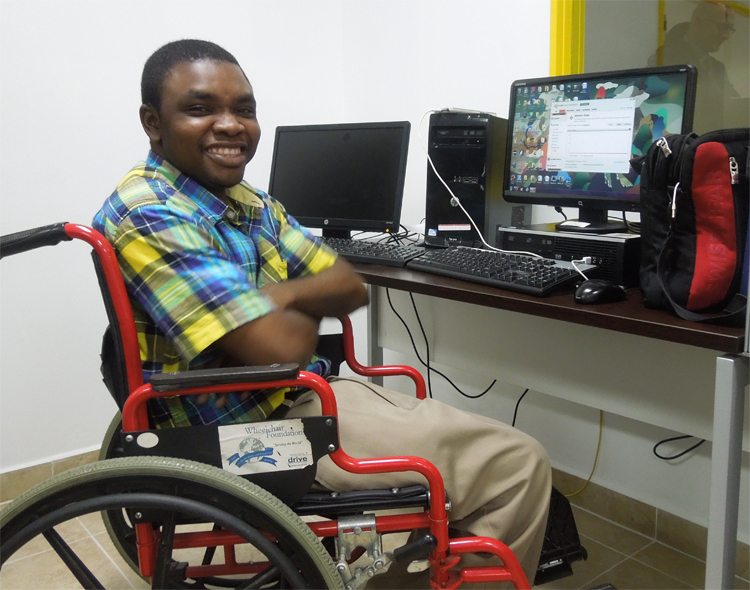
  2. Wheelchair computer technicianSecond, we need to develop new models through which such access can be provided at an affordable price to those who do not currently have access.  This is an immense challenge.  Put simply, the market will deliver solutions for many of our peoples.  We must therefore ensure that regulatory environments enable the market to deliver for the greatest number possible.  Regulators and companies must work together in an environment of trust to ensure that this happens.  However, the market will not deliver for everyone – for those living in the most peripheral rural areas, for the elderly, for those with severe disabilities.  Here, I believe passionately that we need to craft innovative multi-stakeholder partnerships to ensure such delivery.  These need to involve governments, the private sector, civil society, international organisations and bilateral donors in providing solutions that will serve the needs of everyone in our societies.  This is not easy.  Everyone talks ‘partnerships’ but few ICT4D partnerships have truly been successful.  It is here that the CTO can offer much in terms of partnership brokering, and working with all of our members to deliver such partnerships practically on the ground.  As many of you will know, broadband is one of the CTO’s six priority areas, and it is highly appropriate that we are here in Nigeria shortly after they have published their national broadband plan. … This emphasis on partnerships is also why I am so delighted that the CTO has joined the Alliance for Affordable Internet, and that they have privileged us by launching this very important initiative here in Abuja.My second point, is thus the need for carefully crafted multi-stakeholder partnerships to help deliver affordable broadband for all those for whom the market itself will not deliver solutions.
  3. children 2But third, providing broadband connectivity is only a beginning.  If we do not work with the poorest and most marginalised in our societies, truly to understand their needs, and then develop solutions that will be of explicit benefit to them, as much as to the privileged rich and elites, then the divisions within our societies will only increase yet further.  This is why this Forum focuses on “Innovation through Broadband”.  These innovations must not just be concerned with how to make yet greater profits from the telecommunications sector, or for governments to raise yet more revenue through levies and spectrum auctions – however important these are.  No.  This is only part of the story.  We are simply failing in our duties as responsible citizens, and indeed decent human beings, if we do not enable everyone to benefit from broadband: the young orphaned girl, bringing up her younger brother in the slums; the widow, gleaning an existence in the forests far from the capital city; the child soldier who had his arms lopped off and is now begging on the streets…

 My three messages are, I hope clear:

  • Enabling everyone to have access
  • The importance of multi-stakeholder partnerships to serve the most marginalised, and
  • Working with the poor and marginalised to enable them to develop solutions that are fundamentally in their interests

Distinguished colleagues and friends.  My final thanks are to you for being here.  We have a packed programme of inspirational speakers – I often think our events are far too packed!  Take time to talk with each other.  Use Wednesday morning to hold bilateral meetings and engage in productive discussions.  We are the privileged.  We are the elite – whether we like it or not.  We therefore have immense responsibilities.  The CTO has brought us all together.  But this is not enough.  I want every one of you to make a commitment – here and now in this room – not just to listen, not just to speak, but to act.  The time is almost too late.  The inequalities generated by ICTs have almost become too big for us to overcome.  Now is the time to make a difference.  Now is the time to turn rhetoric into reality.”

Leave a comment

Filed under Africa, Commonwealth, ICT4D

Reflections on Montserrat – crafting a viable economy for 5000 people

The chance to work with the Ministry of Communication and Works on the tiny island of Monserrat in the Caribbean last week gave me a rare opportunity to reflect not only on the economic viability of many of the UK’s Overseas Territories, but also on the ways that people living in small island states cope in the aftermath of physical disasters.  Montserrat was devastated by Hurricane Hugo in September 1989, leaving some 11,000 of the island’s population of 12,000 without homes.  Ten people were killed, 89 were injured, and the cost of the damage was reported to be at least $260 million.  In the years afterwards, substantial reconstruction took place, but then in 1995 the island’s Soufrière Hills volcano became active again.  The island’s capital, Plymouth, was soon buried by more than 12 metres of ash and mud, which also destroyed the airport and harbour.  The southern part of the island became uninhabitable, and a strict exclusion zone was introduced to limit future loss of life.  Then, in 1997 a pyroclastic flow passed down Mosquito Ghaut, overflowing the valley sides and killing 19 people who were in the exclusion zone.  Subsequently, there has been ongoing volcanic activity, mostly consisting of ash falls in the south of the island, but in 2009-10 further pyroclastic flows also occurred.  This double disaster had immense impact on the island’s population, with some 8,000 people choosing to leave, primarily for the UK which had granted the islanders full residency rights in 1999, and British citizenship in 2002.

Although I broadly knew about the island’s history, it is impossible to appreciate both the impact of these physical disasters, and the resilience of the people without actually visiting the island, and standing on the hillside overlooking the devastated city of Plymouth.  Having spent a couple of days with Montserratians before visiting Plymouth, and appreciating something of their warmth and generous hospitality, I was left with an overwhelming sense of sadness just standing on the edge of an ash filled swimming pool overlooking the devastated landscape of the island’s former capital.

This slideshow requires JavaScript.

Monserratians are determined people, and those who I met were adamant about not only their British citizenship, but also their love for the island and their wish to ensure that it has a viable economy for the future.  The cost of the necessary reconstruction and development is nevertheless very, very substantial.  Much is already being done: there are plans for a new harbour; geothermal drilling is underway to see whether it could provide a source of energy for the future; and a submarine cable is to be laid to support their international digital connectivity.  However, much still needs to be done to ensure that the island can once again be self-sufficient as it was before the volcanic eruptions.  The challenge is that it is extremely difficult to identify how best this can be achieved, especially with such a small population.

From my very short visit, it is not easy to see the niche areas that the Monsterratians can build upon to regain their economic vitality.  Thinking back to the late 1970s when the Beatle’s producer George Martin created the AIR studios, Montserrat was able to attract some of the world’s most famous musicians to its green and peaceful environment.  There are still beautiful landscapes on the island, but the nature of the recording industry has changed so much that it would be difficult to imagine such an ‘adventure’ working again.  Perhaps, though, George Martin’s house (Olveston House – on Penny Lane), which now serves as a most welcoming guest house for visitors, does indicate one way forward, in that the island could carve itself out as a niche for high quality, environmentally sensitive tourism.  It is certainly beautiful, and the people most friendly.  However, its airport is tiny, with the runway only able to take very small planes, and it requires a new, much larger harbour to attract cruise ships and yachts to the island. There remains, though, the inevitable “chicken and egg” problem: visitors will not come unless there are high quality facilities on the island, and few people are willing to invest without there being strong prospects for sufficient visitor numbers to enable them to recoup their investments.

On the more quirky side, any country has to turn to its strengths and opportunities.  The volcano itself is a source of interest to visitors on the neighbouring islands, with air tours regularly bringing people from Antigua to visit.  It seems a shame that Montserrat itself currently benefits relatively little from such initiatives, and it must be possible for innovative initiatives to be developed that could enable Montserratians to reap dividends from such opportunities.  For film makers wishing to produce films in apocalyptic settings, the old capital of Plymouth on Montserrat would make an ideal – albeit highly risky – setting!  The island is also known as the Emerald Isle of the Caribbean, not only because of its lush vegetation, but also because it was settled by Irish immigrants from St. Kitts.  The potential for its Irish heritage to be marketed much more strongly, could also foster enhanced tourism from Éire.  Some of the bays in the north of the island would also make ideal facilities for luxury yacht marinas, and their development could offer a very different kind of destination for those sailing the Caribbean.  Finally, the ultimate strength of any country is its people, and there is no doubt that better connectivity to the Internet will enable those who wish to stay on the island and build economic activity around the provision of digital services will  be able to do so much more effectively once the new cable is completed.  Already, one software company (Lavabits) is developing its business there, and with an educated population, well-connected to the diaspora living in the UK, there has to be further potential for the islanders to use the Internet, not only to attract tourism, but also to build a new digitally-based economy in Monsterrat.

It was a real privilege to spend time on the island.  I admire the resilience, fortitude and determination of those whom I met, and I greatly appreciated their warmth and generosity.


1 Comment

Filed under Caribbean, Commonwealth, ICT4D, Photographs, Politics, UK

Closing dates approaching for exciting jobs at Commonwealth Telecommunications Organisation

The Commonwealth Telecommunications Organisation is currently advertising vacancies for three exciting roles, as well as opportunities for Professional Fellowships.  The closing dates are rapidly approaching!  These are ideally suited to people who want to make a real difference on the ground in the use of ICTs for effective development

Manager, and Head of Capacity Development and Training Division
Closing Date: 15th September 2013

Manager, and Head of Events and Conferences Division
Closing Date: 20th September 2013

Senior Officer, Operations Division
Closing Date: 20th September 2013

Commonwealth Professional Fellowships
Please share with colleagues and friends who might be interested, and encourage them to apply!  Do note that all applicants must be from Commonwealth countries that are Full Member Countries of the CTO.

Leave a comment

Filed under Commonwealth, Development, ICT4D

CTO is currently advertising for post of Head of Research and Consultancy

The Commonwealth Telecommunications Organisation (CTO) is seeking to appoint a Manager to serve as Head of its Research and Consultancy Division. This exciting opportunity would suit applicants from diverse backgrounds, including academia, the private sector and the international development community. Ideally, candidates for this role will have worked for at least five years within a university research environment, a top-tier consultancy, or within the research department of a leading company within the Telecoms, Media, or Technology sectors. The key role of this position is to manage the delivery of the CTO’s research and consultancy work, both for member organisations and other entities working in the field of ICT for Development. It is expected that applicants will be able to attract new research and consultancy projects, and also to undertake some of this work themselves. The appointment will be at Manager level with a starting salary in the range £36,000-£38,938, and it will be permanent subject to satisfactory performance and a 6 month probationary period. The closing date is 1st September 2013.

Outline Job Description:

The successful applicant will:
  • Lead, manage and motivate staff in the Research and Consultancy Division
  • dentify appropriate research and consultancy opportunities for the CTO, and manage their effective delivery
  • Undertake research and consultancy work in their own areas of expertise
  • Manage the CTO’s priority areas and their advisory boards
  • Manage the CTO’s alumni networks
  • Ensuring that the CTO’s website is updated in all areas of its research and consultancy activities
  • Be responsible for the effective control and management of the Division’s finances, in collaboration with the Finance and Administration Department
  • Lead relationships with relevant entities in one or more of the CTO’s regions
  • Lead the CTO’s work in one or more of its priority areas.
  • Assist in any other aspect of the CTO’s work as assigned by the Secretary General, or by the Head of the Operations Department

Leave a comment

Filed under Commonwealth, ICT4D, Universities

Cultural Diplomacy in the Commonwealth

4I am fortunate – well, I think that’s the right word – to serve in two Commonwealth roles:

  • since 2004, I have served as a Commonwealth Scholarship Commissioner, and since 2009 have had the privilege of being Chair of the Commission; and
  • in 2011 I was appointed as Chief Executive Officer, and since 2012 have been Secretary General, of the Commonwealth Telecommunications Organisation.

At times, this gives rise to interesting comparisons – being Chair of one Commonwealth organisation, whilst Chief Executive of another!

Rarely, though, do I write specifically about the Commonwealth.  There is so much that could be written!  One day, I must definitely write something substantial on the subject.  However, an invitation to give a lecture on cultural diplomacy in the Commonwealth for the Academy for Cultural Diplomacy at the Romanian Cultural Centre in London on 10th July provided an opportunity to present some of my thoughts on the subject.

This identified six main challenges facing cultural diplomacy in the Commonwealth:

  1. A failure to understand each other – emphasising the immense cultural diversity that exists in the Commonwealth, as well as the remaining arrogance of so many of the privileged across the Commonwealth
  2. The dominance of an economic mentality – highlighting a world driven by simplistic economic imperatives, and the need to recalibrate our values to focus more on social and cultural agendas
  3. A damaging emphasis on the individual rather than the community – to be balanced by the need to reassert our responsibilities to each other rather than simply human rights
  4. The need for wise leadership – and the reticence of the metropolitan power.
  5. Failures of the international aid system – that have left many Commonwealth countries both poor and also focusing on economic growth rather than how to address inequality
  6. A lack of understanding of the huge potential of the Commonwealth – including its many shared values, its basis on Common Law, and the fact that its members are drawn from every continent.

In overcoming these challenges I suggested six practical ways forward:

  1. The need to focus more on ways of developing shared understandings – focusing especially on shared cultural values and the critical importance of agendas for peace
  2. A recognition of mutuality of interests and benefits – focusing on common interests and mutual benefits rather than competitive advantage
  3. It does not just happen – it is essential to spend considerable effort in fostering a coherent diplomatic strategic vision
  4. Recognition of the costs of cultural diplomacy – and therefore the need to quantify the very considerable long term mutual benefits of such diplomacy
  5. The potential for digital technologies to support new social networks and relationships between citizens and states.
  6. Balancing diversity with uniformity – and the need for clarity of cultural rather than simply economic agendas.

In conclusion, I emphasised that:

  • we must reassert the value of cultural diplomacy
  • we need to explain more clearly why the Commonwealth really matters
  • the common-weal is ultimately more important than individual success
  • we must invest more in the youth of the Commonwealth
  • we need to explore innovative ways through which ICTs can help foster shared values within the Commonwealth

Leave a comment

Filed under Commonwealth

ACU Session at WISE 2011: Doctorates, development and the brain drain

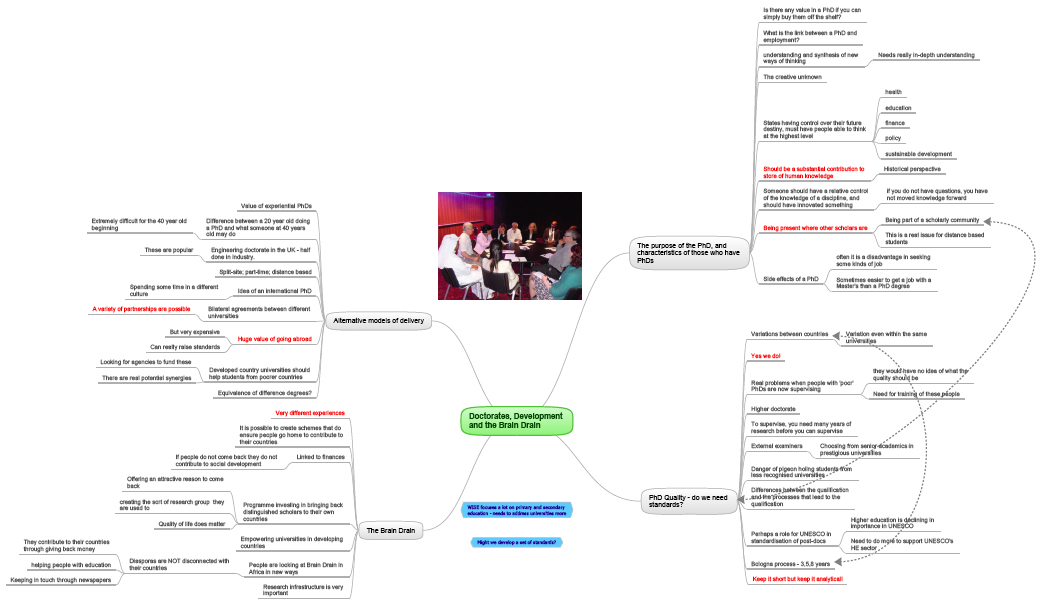
I was delighted to be able to help the Association of Commonwealth Universities run a workshop on “Doctorates, development and and brain drain” at the recent World Innovation Summit for Education (WISE) held in Doha from 1st-3rd November.  This focused on four key themes:

  • the purposes of a PhD and the characteristics of those who have PhDs
  • the quality of a PhD; do we need standards?
  • alternative modes of delivery for doctorates
  • the brain drain

Although the number of participants was small, the discussion was highly interesting, and the mind map below attempts to capture what we discussed (click WISE 2011 for a .pdf version).

Leave a comment

Filed under Commonwealth, Development, Education, Higher Education, Postgraduate supervision, Universities