Category Archives: Development

Trust, privacy and digital security

The pace with which the UK government is forcing through legislation to permit its security agencies legally to gather information about the use of digital technologies by people living in the UK raises ethical issues of the utmost importance. In the past, I have very much emphasised the significant concerns that citizens should have about the use of their ‘digital lives’ by both global corporations and governments. In so doing, I have sought to emphasise the interesting conjuncture of ideas surrounding the three concepts of trust, privacy and the law that lie at the heart of such discussions (for some early thoughts, see my 2010 paper on ICTs, citizens and states).

One of the most remarkable things about digital technologies, and particularly the extremely rapid expansion of social media, has been the ways that people have been willing to make so much information available for public view that was previously considered to be ‘private’. Why, for example, if people are providing so much of their information on-line for free should they have any concerns about whether or not governments make use of this? Social media companies have benefited hugely from the willingness of people to give for free without thinking too much about the consequences, and so too have those providing search engines and location based digital services.  So why should governments not likewise use this information?

In trying to unravel some of the complexities of these issues, it is useful to contrast two very different perspectives on what privacy actual is:

  • The dominant view would seem to follow Etzioni (2005) in accepting that privacy is in effect a good that can be weighed up against other goods. From this perspective, people are willing to give up some of their ‘privacy’ in return for various perceived benefits. Hence, people seem to be willing to let companies use information about their e-mail or search engine usage, in return for having a ‘free’ e-mail account or the ability to search the Internet for ‘free’ for some information that they want to find. Similarly, it can readily be argued that governments can, and indeed should, be permitted to pry into the lives of individuals in order to protect all citizens, especially if a justification, such as preventing potential ‘terrorist’ action can be provided.
  • An alternative type of definition of privacy, though, is offered by Friedman (2005) who instead sees privacy as a means through which we have power over our own lives. He emphasises the asymmetric power relationships between states and citizen. Few citizens, for example, possess their own tanks or fighter aircraft, and few have the digital analysis technologies that large corporations and governments possess. As he suggests, in referring to the state, ‘limiting its ability to protect us from bad things done to us by ourselves or by other people, may not be such a bad deal’.

In the past, I have very much supported Friedman’s arguments, and on balance still do. However, this is where notions of ‘trust’ become so important. From conversations in many different countries, I have come to the clear view that where people do not trust their governments, then they are much more willing for their digital lives to be known by companies, but where they do trust their governments then the reverse is the case. Governments have the power to do very bad things to their people, and digital technologies have the potential to offer them very large amounts of knowledge indeed in support of such actions.

The interesting observation to be made here is that it is actually the companies, be they ‘phone operators or social media corporations, that actually already collect this information on a regular basis, and indeed use it to generate their profits. Whilst there is much angst against governments for wanting to access some of this information, I am surprised at how little concern there actually is about the uses that companies already make of such information. Again, in part, this comes down to trust, but I think this is only in part. Companies seem to me to be much more circumspect in telling people actually what data they collect and how they use it. They leave the governments to take the flack in wanting to access such information!

The arguments currently being debated as the Data Retention and Investigatory Powers Bill moves through the UK Parliament are ultimately derived from social contract theory. In essence, building on the ideas of Hobbes and Locke in the 17th century, the idea that citizens are willing to give up some of their rights to governments in return for protection of their remaining rights has become central to much of the way in which our governance systems work. Following Etzioni’s line of thought, citizens might therefore consider giving up some of their privacy in return for greater protection from other citizens (or ‘terrorists’) who for whatever reason wish to do them harm. It becomes incumbent for governments therefore to show that there is indeed a very considerable increase in the potential threat to citizens from ‘terrorism’, or indeed any other harmful effects, if they want to pry further into citizens’ privacy.

This is, in effect, what the UK government is seeking to do, without perhaps illustrating the full extent of the threat. As I learn more about these matters, and speaking with many people who I have come to trust over the last couple of years, I am becoming increasingly aware of just what the level of threat is, and I am much more persuaded by the arguments that some greater surveillance might indeed be necessary. However, the challenge for a government is that it is difficult for it to indicate just what these threats are because of the obvious security implications, and so citizens have to place a lot of emphasis on trusting their governments.

How can this be achieved? The most important thing in building trust on such matters is to have as full, open and transparent a debate as possible amongst relevant stakeholders. Rushing legislation through Parliament is therefore unwise, unless the level of threat is very severe indeed. I cannot judge this, but unfortunately recent failures of trust over such things as the UK’s support for the USA in the invasion of Iraq over ‘weapons of mass destruction’, make it very difficult for people to believe a UK government of any political colour on such matters.

MPs would therefore be wise if they are to pass this Bill to insist that immediately in its aftermath a wide-ranging and fully transparent consultation should take place, so that the issues are debated openly and constructively. This will take a considerable amount of time, but will ultimately be worth it, not only in rebuilding trust, but also in reaching a wise decision on how to balance privacy and security.

This does not, though,  resolve the concerns raised by Friedman, with whom my own allegiance really lies. The balance of power between states and their citizens is indeed unequal, and there must be mechanisms whereby governments and their servants can be held to account for their actions and misdemeanours. It is here where I believe the law is so important, and it seems to me that judges have a particularly crucial role to play in determining the appropriate balance. The separation of the judiciary from the executive is another important heritage of the British political system, and one that is shared to a greater or lesser extent in many Commonwealth countries. Whatever outcomes are agreed on in the consultation that I encourage, they must be enshrined in a very carefully constructed legal framework that can indeed insist on the severest of penalties for misuse of the powers that are being discussed in Parliament as I write.


Leave a comment

Filed under Commonwealth, Development, Ethics, ICT4D, Politics, UK

Education Fast Forward – 10th Debate

Education Fast Forward is a great initiative that brings together leading global experts and change agents from the world of education to debate key topics in contemporary education. The forum addresses many of the challenges facing governments, educators and employers both now and in the future, and aims to find practical resolutions.

Today’s debate (June 25, 2014 at 1pm BST) is entitled Better teaching for better learning: Results of the OECD Teaching and Learning International Survey (TALIS).

The lead debaters will be the OECD’s Andreas Schleicher, Acting Director and Special Advisor on Education Policy to the Secretary-General and Professor Michael Fullan former dean of the Ontario Institute of Education Studies in Education. Plus specially invited guests.  Andreas will be revealing the results of the TALIS survey and looking at what conditions teachers face and how this data can influence policy to make sure that teachers have the best environment possible to create effective learning environments.

The debate will be live streamed at www.PrometheanPlanet.com/EFF  – there is no need to register, just click to view. The debate can also be followed on Twitter @effdebate and  questions and comments can be posted to #EFF10.

 EFF10

 So sorry that I cannot be there personally! Hoping that the debate goes really well, and looking forward to following up on the outcomes.

Leave a comment

Filed under Development, Education

If m-learning is the answer, what is the question?

I was very privileged that Adrian Godfrey asked me to say a few words to introduce the session on m-education that the GSMA convened earlier today at the Mobile World Congress in Barcelona.  It was good to be with a fun group of panelists, and I hope that we gave them some food for thought.

So, this is what I said.  It was designed to be provocative, but its intent was to emphasise that there are many different interests in the use of mobile devices for learning, and that if we are going to take advantage of the enormous potential that they can offer for the poorest and most marginalised then we need to recognise these interests, and work together in carefully crafted partnerships to deliver effective learning opportunities.

“If m-learning is the answer, what is the question?
MaasaiLess than two weeks ago, I was in northern Tanzania.  Walking across the dry savannah, I entered the thorned enclosure of a boma, or small village. I was welcomed by the Maasai chief’s son, who engaged me in conversation.  I remembered seeing striking images in the international media around 2007 of Maasai warriors, resplendent in their red, “lion proof” robes, holding mobile ‘phones to their ears, and knowing that I was due to speak a world away, here in Barcelona today, I slowly began to explore the question of mobile telephony.  I should not have done so.  The conversation left me embarrassed and humbled.

As my friends used their smart-phones to take photos, I asked “Does anyone in the village have a mobile phone?”

“No” he said, in his excellent English.

One of my friends asked “Would a mobile ‘phone not be useful to call your friends in other villages?”

“Why?” he responded, “I can walk two or three hours to see them”.

And I admired his life.

Earlier, he had shown me the small hut where young children were learning the alphabet and counting in English. So I gently sought to explore the benefits of mobile learning: “But if you had a smart-phone, could you not use it to get learning resources for your children?”.

He looked bemused. My question meant little to him.  He had asked for chalk and books.

I changed the subject.

Of course, many Maasai – and indeed poor people in rural areas across Africa – do indeed use mobile ‘phones, for a wide range of purposes.  But this brief conversation re-emphasised many of the challenges of mobile-learning, and highlights the importance of the question: “if m-learning is the answer, what is the question”.

Let me therefore tease out just four of these questions here in my opening comments:

If m-learning is the answer, what is the question?
How do we increase our data traffic?”  To me, this is one of the most important questions –  all too often asked behind the closed doors of the luxurious offices of mobile operators – that is answered by the term “m-learning”.  It is nothing to do with education or learning. There is far more data capacity in the world than is currently used.  The arrival of the submarine cables across Africa in recent years has transformed connectivity, and much remains unused.  Mobile networks are expanding rapidly, but again there is insufficient demand for their use. Hence, it is crucial for operators to encourage the development of more services if they are to generate the profits that they seek.  Mobile banking has been one such successful service emanating from Africa; now mobile health services, and mobile-learning are seen as important means of moving beyond the simple data requirements of social media apps.

If m-learning is the answer, what is the question?
“How can we gain external funding from governments and donors so that we can extend our networks?”
The costs of putting networks into low-density rural areas, far from the fibre backbones of most countries, greatly outweigh the likely returns, at least in the short term. It is “uneconomic”.  In many poorer countries of the world, operators have been able to gain lucrative revenue opportunities from those living in the relatively small dense urban areas, and have been able to circumvent requirements to provide universal coverage, that would benefit all citizens. Hence, operators are always seeking to find sources of co-financing that can help them extend their networks into “marginal” areas.  Where they have to pay taxes into Universal Service (or Access) Funds, they naturally want a share back in extending networks.  They need a handle to persuade governments, and indeed donor agencies, to provide resources to enable them to extend their infrastructure. How better than to persuade them that by so doing they will enable all of their citizens to benefit from the opportunities that m-learning has to offer.  “If you will help fund the networks, you can then use them to ensure that every citizen has access to m-learning, alongside m-health and m-gov”.  This makes real sense.  With the drive to deliver the Millennium Development Goals, the thirst by the international donor community to ensure that “their” targets are reached, and the aspirations of “enlightened” governments really to deliver valuable services to their citizens, m-learning really is the answer.

If m-learning is the answer, what is the question?
“What is the best market opportunity for our company?”
  Education is no longer of value largely for its own sake; it is a commodity to be bought and sold; it has become a vibrant market.  Hence, there are considerable profits to be made by everyone in the education industry.  The company could be an app-developer, eager to find the “killer” education-app.  It could be a publisher, eager to extend its sales.  It could be a teaching company (often known as schools), eager to grow the market for the services offered by its teachers.  Academics in research companies (sometimes still known as universities) are eager to compete to gain prestigious research grants to study, or perhaps more usually to “prove”, the potential of m-learning, and fuel this thriving industry. The explosion of mobile telephony, and the expectation that it will soon become ubiquitous opens up vast new possibilities for companies to extend the reach of their educational “solutions”.  We truly can achieve education for all, if only we can ensure that the poorest people can still afford a cheap smartphone, and that we can have universal network coverage.   And that is the point, it is education for all. Unlike “health”, which is mainly for those who are ill, learning is something that everyone “must” do.  It is institutionalised in our education systems, and now we are all encouraged to partake in lifelong learning.  Education is 24 x 7 x 365 x 80 or so, depending on how long we live – the magic multiplier number is 6,384,000 times the number of people in the world! This is a market indeed.

If m-learning is the answer, what is the question?
“How can we reach the most marginalised in our societies, and give them the highest possible quality of learning opportunity?”
  I guess this is the question that most people would have expected me to begin with. Of course m-learning provides a wealth of opportunity for the enlightened, the altruists, those who care about reducing the inequalities that digital technologies otherwise enhance, and hopefully some governments and civil society organisations, who are committed to providing quality learning opportunities for the poorest and most marginalised in our societies – those living in isolated rural areas, street children, people with disabilities.  The ubiquity of networks and devices, their mobility – anywhere, anytime – and their simplicity of use, all make mobile devices – be they phones, tablets or laptops, wonderful platforms for learning.

But we still need to work harder to find what works best. We still need high-quality, locally produced content, and above all we still need teachers trained in ways of using these technologies in the best interests of pupils.  Perhaps mobile devices may even one day free us completely from what many people see as being the shackles of an outmoded school system…”

3 Comments

Filed under 'phones, Accessibility, Africa, Commonwealth, Development, Education, ICT4D

Contributions to GSMA MWC Ministerial discussion on mobile-learning

It was great to be on Monday’s panel on “Why put ‘mobile’ in education?” hosted by Adrian Godfrey during the GSMA’s Mobile World Congress Ministerial Programme in Barcelona.  Mike Trucano set the panel underway by giving an important keynote on “Education, jobs and national productivity – why mobile education matters”, which was as usual full of down-to-earth sensible suggestions.  I suggested that governments should try cloning him, and each then have one clone to help them implement effective ICT and education initiatives.

Rebecca Walton (British Council) then hosted a panel discussion that also included Carolina Jeux (Telefónica), Chris Penrose (AT&T), and Tarek Shawki (American University, Cairo), asking us each a pre-set question to get the ball rolling.  Mine was “What are the three things that policy makers should know about mobile technologies in education, and what are the three things that governments should do?”.  This is actually much tougher than it might appear – keeping the list down to only three things each!

Here was my response:

Three things policy makers should know about mobile technologies in education:

  • The focus should be on the learning and not on the technology
  • Never ignore the content – far too many initiatives focus on putting equipment into schools or into learners’ hands – but often there is insufficient relevant content – and pupils do not always know how to access this themselves
  • It is essential to provide high quality training for teachers in how to use technologies in the classroom – and particularly mobile devices of all kinds. Keep mobile switched on in classrooms (and beyond)!

Top three things governments should do:

  • Approach mobile learning in a holistic and integrated way – bringing together all relevant ministries – ICTs, energy, education…
  • Focus on the most marginalised.  The market will take care of the majority, and it is the responsibility of states to deliver services for their poorest citizens. Hence, governments must implement programmes to support those living in isolated rural areas, and that will enable people with disabilities to gain the benefits of mobile learning
  • Begin by ensuring that the basic infrastructure is in place – electricity and connectivity (preferably mobile broadband) as far as possible making this universal.

I wonder what your three answers to these questions might be?

1 Comment

Filed under 'phones, Accessibility, Africa, Commonwealth, Development, Education, ICT4D

Reflections on “corruption”…

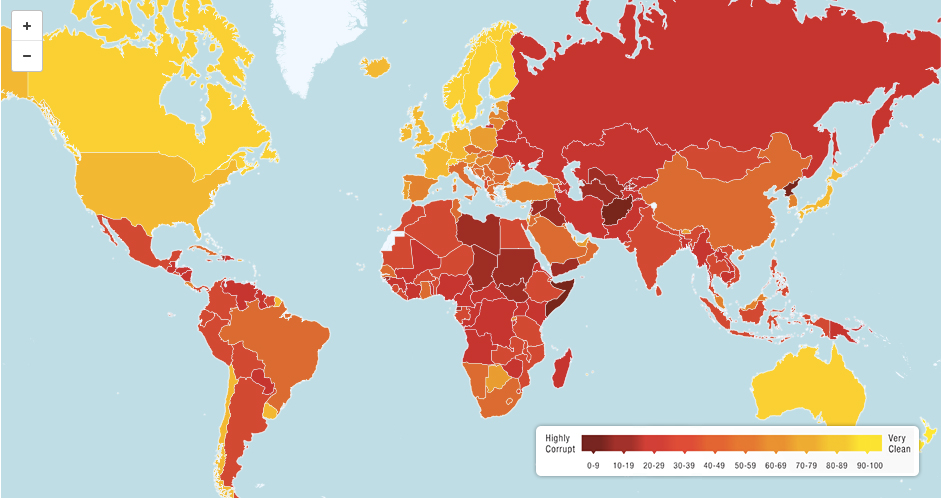
I have long argued that people tend to use the word “corruption” mainly to describe cultural practices that differ from those with which they are familiar.  It is a term that is almost always used negatively. Re-reading Transparency International‘s 2013 Corruption Perceptions Index has very much reinforced this view, but in a way that I suspect will not be expected by those who read what follows!

Corruption TI

I have huge admiration and respect for the work of Transparency International. The map above shows the perceived levels of public sector corruption in 177 countries in the world.  In brief, it indicates that 69% of countries have a score of less than 50%, indicating a serious corruption problem.

However, what stands out most to me about this map is that it is very largely the countries of northern Europe, northern America, and Australasia that are perceived as being least corrupt.  The yellow “holiness” is so marked against the “evil” red of corruption that swathes most of the rest of the world!

Corruption according to Transparency International can be defined  “Generally speaking as ‘the abuse of entrusted power for private gain’. Corruption can be classified as grand, petty and political, depending on the amounts of money lost and the sector where it occurs”.

Three ideas seem particularly pertinent in this context:

  1. The notion of corruption is intimately tied up with the nature of capitalism.  Put simply, the apparently least corrupt countries according to this definition are generally the most advanced capitalist countries.  This suggests that it serves capitalist interests to try to reduce “corruption” as much as possible. It is interesting to ponder why this might be.  One reason may be that reducing the abuse of entrusted power for private gain actually reduces the tendency for the rate of profit to fall.  However, it is difficult to see how this might happen, and it seems in stark contrast to a fundamental characteristic of capitalism which is that it is actually designed to ensure the maximum possible private gain for the capitalists.  I guess the reality may be that limiting or preventing private gain from entrusted power actually enables the market (i.e. the principles of capitalism) to flourish as effectively as possible.  By extension a reduction of all entrusted power (i.e. limiting the power of the state) could be seen to enhance the power of the market, and therefore increase the potential for private gain of those who do not hold political power.  Hence, keeping the power of the state as small as possible, and ensuring that it functions in a way that does not lead to private gain for the holders of power in the state, will ensure that the maximum surplus profit is available to the leaders of global corporations and their shareholders.
  2. However, it is very clear that there is also corruption in the leading capitalist states.  The countries shaded yellow on the above map may be perceived as being less corrupt than others, but corruption still abounds in them!  Hence, there is huge hypocrisy when leaders (and indeed others) in the “yellow” countries accuse those in the “red” countries of being corrupt.  Those in the banking sector, for example, who pay themselves and their staff huge salaries are surely also using their positions of power for private gain?  The amount of money spent in US Presidential elections is also an indication of the way in which “money speaks”: Obama thus raised $715,677,692 in the 2012 elections, and Romney raised $446,135,997.  Together, this sum of money was worth more than the GDP of 25 countries in 2012 (according to UN figures).  One needs huge amounts of money to be elected President of the US, and those who contribute this money expect the policies that the President introduces to benefit them – for private gain.  Likewise, in the UK in 2012, Michael Meacher in a letter to the Guardian newspaper noted that “that the richest 1,000 persons, just 0.003% of the adult population, increased their wealth over the last three years by £155bn. That is enough for themselves alone to pay off the entire current UK budget deficit and still leave them with £30bn to spare”.  Is not this also a form of corruption?
  3. Corruption is seen differently in countries where rampant capitalism and private financial gain may not be seen as the most important priorities.  According to the Transparency International report, most countries in the world are perceived as having a serious corruption problem.  This poses an interesting question: might their systems of priorities actually in some ways be better?  If they were not, why do these systems persist?  For a person living in a culture where ties to family and tribe are more important than individual private financial gain, it must seem very wrong not to give employment opportunities to members of one’s family, regardless of actual ability. Likewise, where personal loyalty matters more than direct monetary return, supporting a friend to achieve their particular job aspirations would seem much more appropriate than ensuring that there is a “fair” competence based application process.  Giving gifts to reciprocate for generous hospitality is merely a different way of redistributing and sharing financial benefits.  Moreover, much of what passes for probity in the “yellow” countries actually tends to be a smokescreen for traditional modes of “corruption”.  The appointments process is invariably biased through friendship ties – not least through the reference system and the use of headhunters – and is never purely competence based.  Likewise, the UK’s honours system is still very largely determined by personal friendship networks, rather than necessarily by ability or contribution to the common good.

In short, I am more than ever convinced that “corruption” is simply a pejorative term that people use to describe political, social and economic systems that are  different from their own.  In a world dominated by capitalist interests, it is scarcely surprising that less-advanced capitalist economies are perceived as being more corrupt than those where the search for individual gain and success is highest.  Yet this very focus on individual gain in capitalist societies is itself fundamentally “corrupt”, since it detracts from the communal good which, at least for me, is ultimately far more valuable.  I suggest that we may have much more to learn from the mutually supportive social and cultural networks that underlie such “corrupt” regimes, than we do from the economic interests that determine definitions of probity in the capitalist heartland. However, this is because I believe that the common good is far more important than private individual gain.

5 Comments

Filed under Africa, Commonwealth, Development, Entrepreneurship, Universities

Summary of Keynote for COL’s PCF7 in Abuja

Despite limited digital connectivity, I just thought I would upload a short summary of my upcoming keynote at the Commonwealth of Learning’s Seventh Pan-Commonwealth Forum this afternoon to encourage productive debate!  Its central argument is that we are not delivering as effectively as we could in using ICTs for education at all levels, because of very explicit interests that are serving to limit this effectiveness. (Later on 17th December: the slides that accompanied the keynote have now been made available by COL)

Good practices

I begin with a short overview of ten good practices that need to be in place to ensure effective use of ICTs in education:

  1. It’s the learning that matters, not the technology
  2. Teachers must be involved from the beginning
  3. Sustainability built in from the start
  4. Supporting infrastructure must be in place
  5. Appropriate content must be developed
  6. Equality of access for all learners
  7. Continual monitoring and evaluation
  8. Appropriate maintenance contracts
  9. Using the technology 24/7
  10. Good practices, rather than best

So, why are these not done?

I focus here first on the observation that ICTs generally increase inequalities unless very specific actions are taken to ensure that the poorest and most marginalised are able to benefit.

I then explore the various interests that tend to limit delivery of the above ten practices, focusing especially on the activities of the private sector, and especially hardware and software companies, connectivity companies and content developers.

In so doing, I also draw on some of the increasing amount of empirical evidence that the use of computers in education is actually damaging learning.

Implications for innovation

In the final section, I explore some of the implications of these trends for innovation and creativity, paying specific attention to five themes:

  1. Content replication
  2. Memory
  3. Language and literacy
  4. Personalised searching
  5. Privacy and failure

In conclusion

In drawing these reflections to an end, I argue that one way forward is to work towards new and effective models of multi-stakeholder partnerships for education, that address education as something much more important, much more complex, and much more exciting than merely as a vehicle for economic transformation.

Leave a comment

Filed under Africa, Commonwealth, Development, Education, Higher Education, ICT4D

Transform Africa 2013 and a celebration of Rwanda

I had the great privilege – especially as a white Yorkshireman – to be invited to chair the session on Smart Education at Transform Africa 2013 held in Kigali, Rwanda – a conference led by Africans, for Africans.  It is some five year since I was last in Rwanda, and the changes that have been made in the country over this time, especially in the field of ICTs, are palpable.

It was really excellent to hear seven Presidents of east African countries champion the potential of ICTs to transform Africa, whilst also being realistic about the challenges that still remain in using them effectively to contribute to the social, political and economic development of their countries.

It was also good to experience some of the musical heritage of Rwanda – and even to have the chance of learning yet another different style of African dance!  This was especially so at the launch of Rwandapedia this evening – an excellent resource for those wishing to learn more about Rwanda’s turbulent history over the last 20 years or so.  Congratulations, too, to the Panorama Restaurant at the Des Mille Collines for what has to be one of the best dinners I have recently had in Africa!

The photos below catch but a glimpse of some of my experiences here over the last few days.

This slideshow requires JavaScript.

1 Comment

Filed under Africa, Commonwealth, Development, Education, ICT4D

DFID’s Digital Advisory Panel

The UK’s Department for International Development has recently created a Digital Advisory Panel to provide advice to the Department in line with its digital strategy announced in December 2012.  The role of the panel is to take an overview of DFID’s strategy for digital and technology matters in its organisation and programmes, and to provide advice and challenge to the organisation. The panel met for the first time on 22nd October, and started to discuss the scope and priorities for their work programme.

The Chair of the Panel is Tim Robinson, CEO of LGC, and he joined DFID’s board as a non-executive director in May 2013.  Other members of the Panel (in alphabetical order, and as described by DFID blogger Julia Chandler) are:

  • Ken Banks is the founder of kiwanja.net and creator of FrontlineSMS, a mobile messaging application aimed at the grassroots non-profit community.
  • Rebecca Enonchong is founder and CEO of AppsTech, and sits on the board of VC4Africa, the largest online community dedicated to entrepreneurs and investors building companies in Africa.
  • Mark Graham director of research at the Oxford Internet Institute.
  • Nick Hughes formerly head of Global Payments at Vodafone Group, where he started M-PESA, is now founder and strategy director of m-kopa.
  • Stephen King is a partner in Omidyar Network UK and was formerly chief executive of BBC Media Action.
  • Rick Robinson is an Executive Architect at IBM responsible for the development and delivery of Smarter City solutions and a member of the Academy of Urbanism.
  • Kathy Settle is deputy director for networks at the Government Digital Service, where she coordinates development of government’s overarching digital strategy, working alongside “digital leaders” to create complementary departmental strategies.
  • Tim Unwin has many roles, including Secretary General of the Commonwealth Telecommunications Organisation (CTO), Chair of the Commonwealth Scholarship Commission in the UK, Emeritus Professor of Geography and UNESCO Chair in ICT4D at Royal Holloway, University of London.
  • Amy Semple Ward is CEO of NTEN, the nonprofit technology network, based in Oregon, US.

I am delighted to have been invited to serve on this panel, and look forward to some lively discussion as we seek to guide DFID in its digital and technological practices.

Leave a comment

Filed under Development, ICT4D, UK

Seoul: cyberspace, hospitality and Seolleung

I had the privilege of being invited to participate in the recent Seoul Conference on Cyberspace, which provided me with an opportunity to visit Korea for the first time.  Although most of the three days I stayed there was spent in the COEX Convention Centre, the organisers had also arranged for some of us to go on an ‘industry tour’ which briefly took us out into the ‘countryside’ to the south of the city last Saturday.  The  hospitality of our hosts was both generous and humbling.  I post below some photos that seek to capture that hospitality, and the energy, tastes and beauty that we all experienced.

This slideshow requires JavaScript.

The slideshow captures images from the Seolleung and Jeongneung Royal Tombs,  the amazing music of Miji and the energy of TAL‘s Taekwondo performance at the Gala Dinner, Bongeunsa Buddhist temple, images from the conference, and some more general pictures of the Gangnam area of Seoul.

I left challenged and excited, determined to learn more about how the people of the Republic of Korea have transformed their economy and society in recent years.  Experiencing a tiny bit of Korea, makes me reflect all the more vividly on the observation that in 1960 Ghana and the Republic of Korea had the same per capita income, and I wonder all the more at the very different ‘development’ paths experienced subsequently in Africa and eastern Asia.

3 Comments

Filed under Development, ICT4D, Photographs, Politics

ICTs for Education Initiatives

I spent last week in Abuja for the Commonwealth Telecommunications Organisation‘s Annual Forum and Council meeting, during which there was also a meeting of ICT Ministers, at which many of them highlighted the importance of ICT initiatives for education in their countries.  One thing that particularly struck me about some of the discussions I had was, that despite such interest, there remains a surprising lack of knowledge about many of the challenges that exist in delivering such initiatives.  All too often it is simply taken for granted that such programmes must be successful, and that they will unquestionably lead to an improvement in education.  I find this deeply worrying, because one of the few things that we really know is that the majority of ICT for education initiatives in developing countries have actually been disappointing failures – at least as far as delivering effective educational change is concerned.  I have therefore spent some of today writing a page on the CTO’s site about this, trying to summarise some of the findings of work in which I have been engaged over the last decade.

boy with computer smallI am also making these ideas available on my personal blog to try to encourage debate around this important subject.  There is far too much duplication of effort, and reinventing the wheel in terms of how to deliver effective ICT for education initiatives.  This can be incredibly wasteful of valuable resources, and I hope that by providing links to some of the more important available resources people will at least have a starting point from which to work.  It would be good also if colleagues could add to the list of the most important references and websites/portals by leaving comments, thereby using this as a vehicle for sharing more information on the subject.

Based on my work over the last decade or so, I have come to the conclusion that ten key issues need to be considered if effective ICT in education initiatives are to be delivered:

  1. It is the learning that matters and not the technology. Many e-learning and m-learning initiatives place the emphasis on the technology – be it laptops or mobile ‘phones.  Effective initiatives begin with identifying the learning objectives, and then identify the technologies that are best suited to delivering them.
  2. Teachers must be closely involved in the implementation of ICT for education initiatives, and they need to be given effective training in advance of the roll-out of computers in schools.
  3. Sustainability issues must be considered at the very beginning.   Computers, laptops and mobile ‘phones are expensive.  Whilst it can be affordable to purchase these as a one-off investment, careful thought must be given to the budget costs of maintaining this equipment, and of how to provide it for the next generation of school-children.  Computers do not last forever, and a substantial budget stream must constantly be made available.
  4. The supporting infrastructure must be in place.  All too often insufficient attention is paid to ensuring that there is sufficient reliable electricity and Internet connectivity to enable the equipment to be used, and for teachers and students to gain access to the Internet.
  5. Appropriate content must be available to help deliver the curriculum and learning needs.  All too often ICT initiatives merely provide access to internationally available content delivered in foreign languages.  It is important that local content developers are involved in shaping learning content, and that as much attention is focused on using ICTs to provide new ways of communicating, and not just delivering information.
  6. Ensure equality of access to all learners.  ICTs enhance inequality between those who have access to them and those who do not.  It is essential therefore that attention is paid to ensuring that all learners are indeed able to access the benefits.  Usually, ICT for education initiatives start with those who are already privileged, through their wealth or by living in urban environments with the necessary infrastructures.  Enlightened initiatives actually begin with delivering learning solutions to the most marginalised people and those living in rural areas.  Remember that people with greater disabilities have more to gain from learning ICT skills than do those with fewer disabilities.
  7. Appropriate monitoring and evaluation must be undertaken from the very beginning to ensure that learning objectives are indeed being delivered, and that the initiative can be tweaked accordingly.
  8. Appropriate maintenance contracts for equipment and networks need to be established.  Training local people in the maintenance of learning technologies is essential so as to ensure that the equipment is used effectively. This can also provide a real boost to local economies.
  9. Use equipment and networks in schools for as long as possible each day.  ICT equipment and networks in schools should be used by local communities in out-of-school hours.  This maximises the use of expensive equipment, and can provide a source of income generation that can help defray the costs of its usage.
  10. Think creatively in your own context.  There are no best practices, only a range of good practices from which to choose.  Develop solutions that best fit your learning needs, and then get on with implementing them!

I  very much look forward to developing these ideas in more detail in my keynote address on technology in education at the Commonwealth of Learning’s seventh Pan-Commonwealth Forum to be held in Abuja this December.

It is hugely difficult to summarise the vast wealth of existing literature on ICTs and education in a development context, but I suggest that the following ten publications are essential reading for anyone engaged in delivering effective ICT for education initiatives, particularly through multi-stakeholder partnerships (listed alphabetically):

I have always found that the following websites on ICTs and education in a development context (listed alphabetically) contain a wealth of useful information:

4 Comments

Filed under Commonwealth, Development, Education, ICT4D