
Category Archives: Development

Drought, poverty and famine in East Africa

Am I the only one who feels distinctly uneasy about the rhetoric surrounding the impending famine in East Africa?  Of course, we should do everything we can to sustain those who are starving.  Of course the images in our media of starving mothers and dying children are harrowing, but that it was they are intended to be.

I am minded of discussions that I once participated in at the offices of a major bilateral donor on the subject of their new programme of planned support for Ethiopia.  This was almost a decade ago, but I recall being shocked at how little support was intended for simple things such as the creation of effective small scale irrigation systems and grain storage facilities.  Drought happens.  It always has, and it always will.  Fluctuations in climate occur regardless of any human induced climate change.  Hence, programmes of development assistance should be doing all that they can to ensure that food production in poor countries is increased and that surpluses are retained to enable governments to withstand the droughts that will always come again.

According to DFID’s web-site the current top priorities for  its funding for Ethiopia are:

  • Addressing the underlying causes of poverty and fragility through new support for wealth creation, peace and security and tackling the effects of climate change
  • Ensuring better access to basic services, enabling millions of people to go to school, drink clean water and access basic health care”

Note that there is nothing here about agricultural production or food security.  Other donors are little different.  Might not more attention to sustaining effective agricultural production so that the devastating impact of drought could be mitigated have been sensible, so that the misery and suffering of so many poor people could have been reduced?  If some of the large sums of money now being spent on famine relief had been spent instead on effective drought mitigation methods, the severity of the crisis could have been reduced.

But this is not just the fault of donor policy.  The governments of the affected countries must also take their share of the blame.  Lawlessness, war, violence and high levels of military expenditure do not make for a stable background against which effective rural development programmes can be implemented. Piracy on the high seas is not a particularly good means of encouraging sustained agricultural production that could reduce the impact of drought.  For too long, governments of some poor countries have continued on development strategies that do not sufficiently address the needs of the poor, relying on the richer countries of the world to come to the rescue when their peoples are starving.  There will come a time when taxpayers in countries providing development assistance will start to realise just how inappropriate much so-called development expenditure really is, and ask questions about the continuing sense of helping such governments with continuing ‘aid’.  DFID is spending £331 million a year on average in support of the Ethiopia government until 2015.  This aid has clearly had insufficient impact on the ability of the country to prevent mass hunger.

For how long will people continue to respond to the media images pulling at our heart-strings to persuade us to fund the errors in development policy that mean that so many people in East Africa are now starving? The impending famine is not ultimately caused by drought, but rather by the policies of national governments, both donors and recipients of development assistance alike. The time has come for a radical re-think of such development assistance.  The time has also come for people to demand real and effective change from their governments in poor countries, so that the impact of drought will never again be felt in the way that the poor of East Africa are now suffering.

Leave a comment

Filed under Africa, Development

New ITU report on the role of ICTs in advancing growth in the least developed countries

The ITU has just published a very important report on the role of ICTs in enhancing development in the least developed countries.  I was privileged to have been asked to write the foreword, in which I made the following comments:

  • “This important ITU report focuses explicitly on the experiences of people living in the world’s ‘Least Developed Countries’ (LDCs). It addresses not only how and why ‘outsiders’ have been eager to offer new ICTs as a means to encourage their ‘development’, but also how technical innovation can occur in some of the poorest countries of the world. Above all, it suggests that there is nothing automatic about the potential contribution of ICTs to ‘development’ processes, however these are defined. If marginalised people and poor countries are to take advantage of ICTs in transforming their fortunes, then specific efforts need to be made to address their needs and aspirations. The market by itself will not deliver on the information and communication requirements of the poorest and most marginalised people and communities”, and
  • “This exciting report points in many directions. It highlights both the successes and the failures of ICT initiatives and developments over the last decade, particularly with respect to LDCs. It emphasises the many challenges that still need to be overcome before we can claim that these technologies really have had the equalising benefits that many attendees at WSIS had hoped for. However, above all, it provides suggestions for innovative ways forward through which some of the poorest countries in the world can grasp the potential of ICTs to enhance the lives of their peoples”.

The charts and graphs contained within the volume provide very important evidence that many of the poorest countries and people in the world have not yet benefited from the potential of ICTs, and that very substantial effort is needed to ensure that ICTs do not actually lead to further increases in the differences in access between the world’s richer and poorer people.  This is essential reading for all involved in ICT4D.

2 Comments

Filed under Africa, Development, ICT4D

Policy Brief on the Development Impact of ICT4D Partnerships

The Policy Brief resulting from the systematic review report by Marije Geldof, David Grimshaw, Dorothea Kleine and Tim Unwin on the development impact of ICT4D partnerships is now avalable from the R4D website (Policy Brief) and the ICT4D Collective website (Policy Brief).

This emphasises five key findings:

  1. Success is increased when detailed attention is paid to the local context and the involvement of the local community in partnership implementation.
  2. It is important for such partnerships to have clear and agreed intended development out-comes, even where constituent partners may themselves have different reasons for being involved in the partnership.
  3. Sustainability and scalability of the intended development intervention need to be built into partnership design at the very beginning.
  4. Successful partnerships are built on trust, honesty, openness, mutual understanding and respect.
  5. A supportive wider ICT environment needs to be in place, both in terms of policy and infrastructure, if such partnerships are to flourish and deliver effective development outcomes

Link to Full Systematic Review Report on ICT4D Partnerships (.pdf)

Leave a comment

Filed under Development, ICT4D

ICTD2012 Call for Papers

The call for papers for the ICTD2012 conference has just been released – full details given below:

CALL FOR PAPERS
Fifth IEEE/ACM International Conference on Information and Communication Technologies and Development, Georgia Institute of Technology, Atlanta GA USA

Conference dates: March 12-16, 2012
Paper submission deadline: July 22, 2011 (11:59pm UTC)
Conference website: http://www.ictd2012.org
Contact us at: program@ictd2012.org
Twitter: @ICTD2012   Facebook: ICTD 2012 Atlanta

ICTD provides an international forum for scholarly researchers exploring the
role of information and communication technologies (ICTs) in social,
political, and economic development. The conference program and accepted
papers will reflect and deepen the multidisciplinary nature of ICTD
research, with anticipated representation from anthropology, computer
science, communication, design, economics, electrical engineering,
geography, information science, political science, public health, sociology,
and so on.

Submitted papers are subject to a rigorous and selective double-blind peer
review; accepted papers will appear in electronic conference proceedings and
will be archived in the ACM and/or IEEE systems. A subset of the papers will
also appear in a special issue of Information Technologies & International
Development.

ICTD2012 is the fifth of an ongoing series of conferences occurring every
one-and-a-half years; previous conferences have taken place in: Berkeley, CA
(USA) ICTD 2006; Bangalore (India) ICTD 2007; Doha (Qatar) ICTD 2009; and London (United Kingdom) 2010.

For the purposes of this conference the term “ICT” comprises electronic
technologies for information processing and communication, as well as
platforms that are built on such technologies. “Development” means
international development, including, but not restricted to, poverty
alleviation, education, agriculture, healthcare, general communication,
gender equality, governance, infrastructure, environment and sustainable
livelihoods. Papers considering novel designs, new technologies, project
assessments, policy analyses, impact studies, theoretical contributions,
social issues around ICT and development, and so forth will be considered.
Well-analyzed negative results from which generalizable conclusions can be
drawn are also sought.

Relevant papers reporting high-quality original research are solicited. Full
papers will be reviewed by a multidisciplinary panel, and evaluated
according to their novel research contribution, methodological soundness,
theoretical framing and reference to related work, quality of analysis, and
quality of writing and presentation. Authors are encouraged (but not
required) to address the diversity of approaches in ICTD research by
providing context, implications, and actionable guidance to researchers and
practitioners beyond the authors’ primary domains.

Only original, unpublished, full research papers in English will be
considered. Submissions not meeting a minimum bar of academic research
writing will be rejected without full review. Papers should contain a
maximum of 8000 words. Reviews are double blind, so papers should not
include author names or other information that would identify the authors
(references to previous work by the authors should be in the third person).
Authors should follow IEEE formats and styles
http://www.ieee.org/documents/stylemanual.pdf. Samples of this are also
available in PDF at http://www.ictd2012.org/ICTD2012_sample.pdf and MS Word
http://www.ictd2012.org/ICTD2012_sample.doc formats. Authors will be
required to sign a copyright release for publication in the conference
proceedings.  Additional submission details will be posted on the conference
website at http://www.ictd2012.org, as the information becomes available.

As a new opportunity for 2012, we are offering a peer mentorship program for paper submissions. Submit your paper early (by May 1st, 2011) to this
program and get feedback from peer mentors ahead of the normal submission process and June deadline. See http://www.ictd2012.org/mentorship for details.

Atlanta is a world-class city with a rich and passionate history. Spring
comes early to Atlanta; March is likely to be sunny, crisp, and pleasant.
The conference venue is the Georgia Tech Hotel and Conference Center
(http://www.gatechhotel.com/). Georgia Tech is one of the top research
universities in the United States, distinguished by its commitment to
improving the human condition through advanced science and technology.

The conference website is http://www.ictd2012.org. Follow us on Twitter
@ICTD2012, or visit our Facebook page at “ICTD 2012 Atlanta”.

Contact us at program@ictd2012.org

Important dates:
Peer review mentor program submission deadline: May 1, 2011
Paper submission deadline: July 22, 2011
Acceptance notifications: September 16, 2011
Camera-ready papers due: January 16, 2012
Conference dates: March 12-16, 2012

Program Committee Chairs
Jonathan Donner, Microsoft Research India
Beki Grinter, Georgia Institute of Technology
Gary Marsden, University of Cape Town

General Conference Chairs
Michael Best, Georgia Institute of Technology
Ellen Zegura, Georgia Institute of Technology

2 Comments

Filed under Development, ICT4D, ICT4D conferences, ictd2010

AGFUND Prize for Youth Empowerment Projects

Noted below is the call from the Arab Gulf Programme for Development for the AGFUND Prize 2011 focusing on Empowering Youth through Entrepreneurship and Job Opportunities.  This is a very worthwhile initiative, and I would encourage people working in this area to apply.


“FOR UN AND INTERNATIONAL ORGANIZATIONS, NGOS, GOVERNMENTAL AGENCIES AND INDIVIDUALS
AGFUND ANNOUNCES THE OPENING OF NOMINATIONS FOR ITS PRIZE ON
YOUTH EMPOWERMENT PROJECTS
May 31st is the deadline


The Arab Gulf Programme for Development (AGFUND) has opened the door for nominations for the AGFUND International Prize for Pioneering Human Development Projects. It invites the United Nations, international, and regional organizations as well as NGOs, ministries, public institutions, universities, and research centres worldwide to submit their nominations for the Prize amounting to $500 000 in its four Categories. The theme of the prize for the year 2011 is ‘Empowering Youth through Entrepreneurship and Job Opportunities.’ subdivided to match the four categories of the Prize are as follows:

  • First Category:The role of international organizations in supporting the developing countries’ national policies and programs for empowering youth through entrepreneurships and job opportunities. (For projects implemented by UN, international or regional organizations)
  • Second Category: NGOs-led efforts to empowering youth through entrepreneurships and job opportunities. (For projects implemented by national NGOs).
  • Third Category: The governmental bodies’ efforts in adoption of pioneering entrepreneurships for empowering youth and increasing their job opportunities. (For projects by government ministries and public institutions).
  • Fourth Category: Individual-led efforts to empowering youth through entrepreneurships and job opportunities. (For projects initiated, sponsored and/or implemented by individuals).


The Communications Department is receiving nominations at the address of the Arab Gulf Programme for Development: Riyadh 11415, P.O. Box 18371, KSA; or the email address prize@agfund.org
<mailto:prize@agfund.org> . For more information and for downloading the nomination form, please visit the AGFUND website http://www.agfund.org <http://www.agfund.org/> . Nomination forms will be accepted until May 31st, 2011.

The projects submitted for the Prize are evaluated with high objectivity and transparency by juries chosen every year with regard to the experience and specialization relevant to the Prize theme. The number of projects which have won the Prize since its inception in 1999 amounts to 38 projects, implemented by UN and international organizations as well as NGOs and individuals. More than one hundred developing countries in Asia, Africa, Latin America, and Eastern Europe have benefited from the prize.

The Prize Committee is composed a number of distinguished world personalities representing the world’s geographical regions. The Committee convenes annually to discuss the evaluation results of the nominated projects and to choose the winning projects. Prizes are presented in a ceremony to which representatives of the winning organizations, specialists and experts in the field of development, celebrities interested in development issues, and media representatives are invited.”

1 Comment

Filed under Development, Entrepreneurship

Important new report on the impact of ICT4D partnerships on development

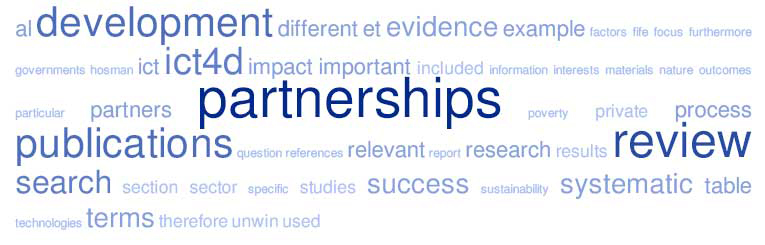
Together with Marije Geldof, David Grimshaw and Dorothea Kleine from the ICT4D Collective, I have just completed a DFID funded systematic review on the development impact of ICT4D partnerships. This is part of the extensive programme of systematic reviews initiated recently by DFID, that draws very largely on the model of such reviews used in the medical sciences.  DFID thus emphasises that ‘Systematic reviews have been used in health, education and social policy to meet this need. Systematic reviews are a well-established and rigorous method to map the evidence base in an unbiased way as possible, assess the quality of the evidence and synthesize it. Systematic reviews can then be mediated in specific ways to make it easier for policy makers and practitioners to rapidly understand the body of evidence and use this as a strong foundation on which to base policy and practice decisions’.  Undertaking the review was both challenging and interesting, and we not only reached substantive conclusions about the role of ICT4D partnerships, but we also made considerable comments about the difficulties in undertaking rigorously defined systematic reviews on topics such as this.

Based on our review of 53 key publications in the field, we had five main substantive conclusions:

  • Success of ICT4D partnerships is increased when detailed attention is paid to the local context and the involvement of the local community in partnership implementation
  • It is important for such partnerships to have clear and agreed intended development outcomes, even where constituent partners may themselves have different reasons for being involved in the partnership
  • Sustainability and scalability of the intended development intervention need to be built into partnership design at the very beginning
  • Successful partnerships are built on trust, honesty, openness, mutual understanding and respect
  • A supportive wider ICT environment needs to be in place, both in terms of policy and infrastructure, if such partnerships are to flourish and deliver effective development outcomes

In terms of our recommendations relating to the actual systematic review methodology, we suggest that

  • When dealing with multidisciplinary issues such as this, it is crucial to retain some flexibility in search strategies, and procedures such as those often adopted in reviews of health interventions may sacrifice real understanding in the name of overly zealous adherence to claimed rigour
  • External reviewers play a crucial role in guaranteeing the quality of such reviews, and they need to be rewarded for their contributions
  • Many of the publications that we reviewed lacked a rigorous account of their research methodology, and we recommend that all funders of development related research should insist that researchers carefully document their methods in all of their publications, so that readers can judge the reliability of the findings
  • Many publications on ICT4D partnerships do not specify either what they mean by partnerships or the real development outcomes that they were pursuing.  It is therefore very difficult to identify the precise impact of partnerships on development.  It may well be that interventions that claim to have benefited from partnerships could have been delivered more effectively through other contractual arrangements

Copy of report (.pdf)

Policy brief (.pdf)

Leave a comment

Filed under Development, ICT4D

ICTD2010 Papers and Posters online

Much of the material presented at ICTD2010 is now available on the conference web-site:

ICTD2012 will be hosted at Georgia Tech.

Leave a comment

Filed under Development, ICT4D

Social networks, digital technologies and political change in North Africa

Much has been written about the potential of new ICTs, and particularly mobile technologies and social networking software, to transform political and social systems.  A fundamental question that underlies all work in ICT4D is whether new ICTs can indeed be used by the poor to overthrow oppressive regimes, or whether, like other technologies before them, ICTs are used primarily by the rich and powerful to maintain their positions of power.  Until very recently, it seemed that despite the potential of ICTs to undermine dominant political structures, most attempts to do so have been ruthlessly crushed.  The ruling regime in Iran was thus able to suppress the ‘Twitter Revolution’ of 2009-10, and the Burmese government likewise maintained its grip on power despite extensive use of mobile ‘phones and the Internet during protests in 2007.

Recent events in North Africa, with the overthrow of President Ben Ali in Tunisia and the continuing protests against President Mubarak in Egypt, have widely been attributed in considerable part to the agency of mobile ‘phones and the use of social networking environments over the Internet.  Whilst it is too early fully to judge their importance in fueling such political protests, the following reports provide evidence in support of such claims:

Tunisia

Egypt

Wider ramifications

Much research needs to be undertaken on the real role of ICTs in these ongoing political processes.  What seems apparent, though, is that many participants do indeed believe that these technologies are helping them achieve their objectives.

5 Comments

Filed under 'phones, Accessibility, Africa, Development, Ethics, Social Networking

Corruption in the Global Fund – implications for ICT4D

I have long been critical of many aspects of the work of the Global Fund to Fight Aids, Tuberculosis and Malaria, and it therefore comes as no surprise to learn that the Fund’s newly reinforced Inspector General’s office has encountered corruption.  What is surprising, though, is its scale.  As an Associated Press report on 24th January  comments, “A full 67 percent of money spent on an anti-AIDS program in Mauritania was misspent, the investigators told the fund’s board of directors. So did 36 percent of the money spent on a program in Mali to fight tuberculosis and malaria, and 30 percent of grants to Djibouti.In Zambia, where $3.5 million in spending was undocumented and one accountant pilfered $104,130, the fund decided the nation’s health ministry simply couldn’t manage the grants and put the United Nations in charge of them. The fund is trying to recover $7 million in “unsupported and ineligible costs” from the ministry.”

In response, the Global Fund has issues a Press Release, including the following assertions: “The Global Fund has zero tolerance for corruption and actively seeks to uncover any evidence of misuse of its funds. It deploys some of the most rigorous procedures to detect fraud and fight corruption of any organization financing development. The vast majority of funds disbursed by the Global Fund is untainted by corruption and is delivering dramatic results in the fight against the three diseases.“Transparency is a guiding principle behind the work of the Global Fund and we expect to be held to the highest standards of accountability,” said Prof. Michel Kazatchkine, Executive Director of the Global Fund. The news report that has caused concerns refers to well-known incidents that have been reported by the Global Fund and acted on last year. There are no new revelations in yesterday’s media reports. In its report last year, the Global Fund’s Inspector General listed grave misuse of funds in four of the 145 countries which receive grants from the Global Fund. As a result immediate steps were taken in Djibouti, Mali, Mauritania and Zambia, to recover misappropriated funds and to prevent future misuse of grant money”.

At the time of the World Summit for the Information Society in 2003 and 2005, many private sector and civil society organisations were clamouring for a similar fund to support the implementation of ICT4D initiatives, and I distinctly remember discussions among donor government officials who strongly opposed such ideas.  In part, their arguments were based on the need to focus on using general budgetary support mechanisms to foster economic growth through Poverty Reduction Strategy Paper processes, but they also reflected concerns about the difficulty of ensuring that money from funds such as the Global Fund could be appropriately accounted for.  Whilst there are problems in accounting for all so-called Official Development Assistance, the Global Fund’s experiences suggest that bilateral donors were right in their scepticism. It is to be hoped that all those involved in the substantial disbursal of ‘development assistance’, and especially some of the large private foundations that have been established in recent years, will look closely at these findings, and act upon them to ensure that well-intentioned assistance does indeed go to the people who have most need of it.

Leave a comment

Filed under Development, ICT4D

ICTs, citizens and the state: moral philosophy and development practices

Great to see my latest paper just published in The Electronic Journal on Information Systems in Developing Countries – thanks to Mark Levy and Vignesh Ilvarasan for all their editorial work on this.

The paper examines the moral implications of the use of ICTs in e-government initiatives, focusing especially on national databases, identity cards, and surveillance technologies. It suggests that in resolving debates over these, we need to reach ethical resolutions concerning notions of trust, privacy, and the law. It also draws attention to the ethical problems that emerge in linking the notion of of Universal Human Rights with the introduction of ICTs in developing countries.

As I argue in the paper, “The really difficult ethical questions that arise from this are about how we judge whether it is better for poor and marginalised communities for such egovernment initiatives to have been introduced, or whether they might actually be more advantaged if their governments did not spend vast sums of money on their implementation. Just because it is possible to implement national citizen databases, to use biodata for ID cards, and to introduce sophisticated digital surveillance mechanisms does not mean that it is right to do so”.

Leave a comment

Filed under Development, Ethics, ICT4D