Category Archives: Education

ICTs for Education Initiatives

I spent last week in Abuja for the Commonwealth Telecommunications Organisation‘s Annual Forum and Council meeting, during which there was also a meeting of ICT Ministers, at which many of them highlighted the importance of ICT initiatives for education in their countries.  One thing that particularly struck me about some of the discussions I had was, that despite such interest, there remains a surprising lack of knowledge about many of the challenges that exist in delivering such initiatives.  All too often it is simply taken for granted that such programmes must be successful, and that they will unquestionably lead to an improvement in education.  I find this deeply worrying, because one of the few things that we really know is that the majority of ICT for education initiatives in developing countries have actually been disappointing failures – at least as far as delivering effective educational change is concerned.  I have therefore spent some of today writing a page on the CTO’s site about this, trying to summarise some of the findings of work in which I have been engaged over the last decade.

boy with computer smallI am also making these ideas available on my personal blog to try to encourage debate around this important subject.  There is far too much duplication of effort, and reinventing the wheel in terms of how to deliver effective ICT for education initiatives.  This can be incredibly wasteful of valuable resources, and I hope that by providing links to some of the more important available resources people will at least have a starting point from which to work.  It would be good also if colleagues could add to the list of the most important references and websites/portals by leaving comments, thereby using this as a vehicle for sharing more information on the subject.

Based on my work over the last decade or so, I have come to the conclusion that ten key issues need to be considered if effective ICT in education initiatives are to be delivered:

  1. It is the learning that matters and not the technology. Many e-learning and m-learning initiatives place the emphasis on the technology – be it laptops or mobile ‘phones.  Effective initiatives begin with identifying the learning objectives, and then identify the technologies that are best suited to delivering them.
  2. Teachers must be closely involved in the implementation of ICT for education initiatives, and they need to be given effective training in advance of the roll-out of computers in schools.
  3. Sustainability issues must be considered at the very beginning.   Computers, laptops and mobile ‘phones are expensive.  Whilst it can be affordable to purchase these as a one-off investment, careful thought must be given to the budget costs of maintaining this equipment, and of how to provide it for the next generation of school-children.  Computers do not last forever, and a substantial budget stream must constantly be made available.
  4. The supporting infrastructure must be in place.  All too often insufficient attention is paid to ensuring that there is sufficient reliable electricity and Internet connectivity to enable the equipment to be used, and for teachers and students to gain access to the Internet.
  5. Appropriate content must be available to help deliver the curriculum and learning needs.  All too often ICT initiatives merely provide access to internationally available content delivered in foreign languages.  It is important that local content developers are involved in shaping learning content, and that as much attention is focused on using ICTs to provide new ways of communicating, and not just delivering information.
  6. Ensure equality of access to all learners.  ICTs enhance inequality between those who have access to them and those who do not.  It is essential therefore that attention is paid to ensuring that all learners are indeed able to access the benefits.  Usually, ICT for education initiatives start with those who are already privileged, through their wealth or by living in urban environments with the necessary infrastructures.  Enlightened initiatives actually begin with delivering learning solutions to the most marginalised people and those living in rural areas.  Remember that people with greater disabilities have more to gain from learning ICT skills than do those with fewer disabilities.
  7. Appropriate monitoring and evaluation must be undertaken from the very beginning to ensure that learning objectives are indeed being delivered, and that the initiative can be tweaked accordingly.
  8. Appropriate maintenance contracts for equipment and networks need to be established.  Training local people in the maintenance of learning technologies is essential so as to ensure that the equipment is used effectively. This can also provide a real boost to local economies.
  9. Use equipment and networks in schools for as long as possible each day.  ICT equipment and networks in schools should be used by local communities in out-of-school hours.  This maximises the use of expensive equipment, and can provide a source of income generation that can help defray the costs of its usage.
  10. Think creatively in your own context.  There are no best practices, only a range of good practices from which to choose.  Develop solutions that best fit your learning needs, and then get on with implementing them!

I  very much look forward to developing these ideas in more detail in my keynote address on technology in education at the Commonwealth of Learning’s seventh Pan-Commonwealth Forum to be held in Abuja this December.

It is hugely difficult to summarise the vast wealth of existing literature on ICTs and education in a development context, but I suggest that the following ten publications are essential reading for anyone engaged in delivering effective ICT for education initiatives, particularly through multi-stakeholder partnerships (listed alphabetically):

I have always found that the following websites on ICTs and education in a development context (listed alphabetically) contain a wealth of useful information:

4 Comments

Filed under Commonwealth, Development, Education, ICT4D

Latest round of Commonwealth Scholarships for citizens of ‘developing’ Commonwealth countries announced

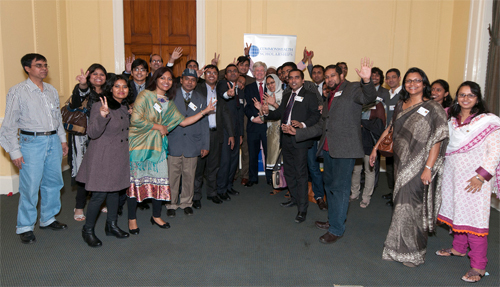
Pakistan smallThe Commonwealth Scholarship Commission has just announced its application process for scholars wishing to study in UK universities for Master’s and PhD degrees from the 2014-15 academic year .  Its Electronic Application System is now live, and will close on 3rd December 2013.  All applications need to be made through national nominating agencies – full details of which are available on the Commission’s website.  Summary details of the application process taken directly from the Commission’s site are given below:

Commonwealth Scholarships – developing Commonwealth country citizens

Commonwealth Scholarships for students from developing Commonwealth countries are offered for Master’s, PhD, and split-site (PhD) study in the UK. These scholarships are funded by the UK Department for International Development (DFID).

Nominations

There is a nominating agency for Commonwealth Scholarships in each Commonwealth country. In addition, universities and university bodies in a number of developing Commonwealth countries are invited to nominate candidates to the CSC.

Each year, the CSC invites each nominating agency/university/university body to forward a specific number of nominations. Each nominating agency/university/university body is responsible for its own selection process, and in most cases they will set their own closing date, which will be before the CSC’s deadline for nominations (17 December 2013).

Approximately 300 scholarships are awarded each year. The CSC invites around three times more nominations than scholarships available – therefore, nominated candidates are not guaranteed to get a scholarship. There are no quotas for scholarships for any individual country. Candidates nominated by national nominating agencies are in competition with those nominated by universities/university bodies, and the same standards will be applied to applications made through either channel.

Terms and conditions and eligibility

Applications are considered according to the following selection criteria:

  • Academic merit of the candidate
  • Quality of the proposal
  • Likely impact of the work on the development of the candidate’s home country

See Selection criteria – 2014 Commonwealth Scholarships for developing Commonwealth country citizens for further details.

Please note that the CSC does not impose any age limit on applicants for its awards, but national nominating agencies may do so in line with their own priorities.

Candidates may also find the Feedback for unsuccessful candidates in 2013 useful.

Levels of study

You can apply for a Commonwealth Scholarship for the following levels of study:

  • Master’s (one-year courses only)
  • PhD
  • Split-site, where the CSC supports one year’s study at a UK university as part of a PhD being undertaken in your home country

All subject areas are eligible, although the CSC’s selection criteria give priority to applications that demonstrate strong relevance to development.

You are requested to apply for a course of study at a UK university with which the CSC has a part funding agreement.

How to apply

All applications must be made through your nominating agency (or university/university body, if applicable) in your home country. You must check with them in the first instance for specific advice on how to make an application and for their own closing date. The CSC cannot accept any applications direct from candidates.

The CSC expects all Commonwealth Scholarship candidates to be nominated by an approved nominating agency/university/university body, and to have completed an application form using our Electronic Application System (EAS).

Full help on how to apply using the EAS is provided in our guides, which should be read in full before making any attempt to use the EAS.

The EAS will close to applicants on 3 December 2013 and no further applications can be made after that date. The CSC will not accept any applications which are not submitted via the EAS to the nominating agency/university/university body in the candidate’s home country.

How to access the EAS

Please note that all enquiries about these scholarships should be directed to the nominating agency/university/university body in your home country.

Leave a comment

Filed under Development, Education, Higher Education, Universities

#EFF7: Access and Quality in Education – can we achieve both?

The latest Education Fast Forward debate is due to be held tomorrow, 17th July 2013, at 13.30 GMT+1.  The debate, featuring Carol Bellamy and Andreas Schleicher on Access and Quality in Education – can we achieve both? can be joined live from the EFF site.  Can also be followed on Twitter at #EFF7.

Education Fast Forward (EFF) brings together leading global experts and change agents from the world of education to discuss the topics that matter most. The forum addresses the key challenges facing governments, educators and employers both now and in the future, and aims to find practical resolutions.

Quality and access to education continue to top the list of education priorities in countries across the world. According to UNESCO in 2010 59 million primary school-age children were not enrolled in school and 31 million primary school-age children had dropped out of school. An additional 32 million repeated a grade. These figures are truly shocking but is access to education enough? Students today live in an entirely different world to 10, even 5 years ago. The digitally connected world is bringing down boundaries and making education more fluid. Pupils are increasingly demanding a more personalised working environment with instant access to data and collaborative team work as the norm.

EFF7 will look at key questions such as How can we balance the needs of access and quality and how do we measure quality? Can we achieve both? What will be the drivers and who will champion the students? What are we doing to address the issue of an education system that is still failing many students, leaving them poorly prepared for work or enterprise?

Leave a comment

Filed under Education, ICT4D

Discussions on educational partnerships

For those interested in education partnerships The Partnering Initiative is convening what should be a very interesting breakfast event next week on 5th June at the Science Museum in London and there are still some places available (details at http://bit.ly/16ppNr7).   Oh yes, and I am moderating a ‘table’ – be warned, it could be controversial!

In essence, the event is designed to explore how collective action can maximise the impact of business investments in education and skills.

As the organisers say, “Education is a fundamental pillar of sustainable development and underpins enduring prosperity and economic growth. Yet, achieving quality ‘Education for All’ remains a major global challenge. There is a growing trend of businesses investing in education and skills both for philanthropic reasons and to help ensure their own long term sustainability. However, businesses have tended to support their own, often isolated projects. Could a move towards stronger collective approaches lead to more effective, transformational delivery of education and skills? How can such approaches be encouraged and supported?”

Speakers include:

  • Ben Dixon – Head of Social Performance, BG Group
  • Olav Seim – Director, Global Partnerships ED/EFA, UNESCO
  • Darren Towers – Head of Sustainability and Environmental Leadership, EDF Energy
  • Professor Timothy Unwin – Secretary General, Commonwealth Telecommunications Organisation (yes, I think that’s me!)

Places are limited, so please register your interest with jessica.mcghie@iblf.org – do include your name, organisation and job title.

Leave a comment

Filed under Education

Mike Trucano’s ten worst practices in e-learning

I have always admired Mike Trucano‘s work, and so it was great to hear him speaking this morning at Online Educa Berlin.  His theme was understanding failures in e-learning, especially in the countries where the World Bank is working.

This was his list of the ten worst practices in e-learning:

  1. Dump hardware in schools, hope for magic to happen
  2. Design for OECD learning environments, implement elsewhere
  3. Think about educational content only after you have rolled out your hardware
  4. Assume you can just import content from someone else
  5. Don’t monitor, don’t evaluate
  6. Make a big bet on an unproven technology (especially one based on a closed/proprietary standard) or single vendor, don’t plan for how to avoid ‘lock in’
  7. Don’t think about or acknowledge total costs of ownership/operation issues or calculations
  8. Assume away equity issues
  9. Don’t train your teachers (nor your school headmasters, for that matter)
  10. ….for your own worst practice

The really sad thing is that all of these known worst practices continue to be replicated across the world.  Hopefully, more people will listen to Mike, and then we can develop much better ways through which technology can really be used effectively to enhance learning!

8 Comments

Filed under Education, ICT4D

Wildlife in Costa Rica

Staying with friends in Costa Rica provided a wonderful opportunity to spend  Sunday exploring something of the landscapes and wildlife of the country.  The photos below, mainly from the Carara National Park on the Pacific coast, provide an interesting comparison with those that I took recently in the tropical rain forests of southern Sri Lanka.  At least we avoided the leeches this time!

This slideshow requires JavaScript.

3 Comments

Filed under Education, Photographs, Wildlife

WISE Awards 2012 – applications open until 31st May

The World Innovation Summit for Education (WISE) Awards are now open for applications – until 31st May 2012.  If you are aware of people working on innovation initiatives that have transformed educational delivery, do encourage them to apply!

The WISE Awards are specifically designed to identify, showcase and promote innovative educational projects from all sectors and regions of the world to inspire change in education. Each year, a Jury composed of leading experts from the education world selects six innovative projects for their concrete and positive impact on communities and societies. Each winning project gains global visibility through the Awards process and receives a prize of $20,000 (US).  Since the creation of the Awards in 2009, over 1,300 applications from 116 countries have been received, resulting in 98 Finalists and 18 winning projects from across the world.

In 2012, one of the six awards will be given explicitly to a project that has best delivered innovative financing of primary education.  This reflects the support of the Qatar Foundation’s Chairperson Her Highness Sheikha Moza bint Nasser for the United Nations MDG 2 on achieving universal primary education and it is designed to stimulate innovative projects targeted at achieving this goal.

All of the necessary details concerning the awards are available on the WISE Awards website, which provides specific information about:

All relevant applications are first reviewed by a Pre-Jury of distinguished educationalists.  They will  recommend 24 finalists who will then be invited to submit more detailed applications for consideration by the prestigious Jury of international experts.

It is particularly important that applicants explain clearly and in detail how their projects deliver on the nine criteria by which the WISE Awards are judged:

1. Educational Transformation: the overall extent to which the educational activity has transformed an aspect of education that has also had societal impact. Applicants must show what aspect of education they have sought to transform, and the impact that the project has achieved, not only in educational terms but also through the effect that this has had on society more generally.

2. Sustainable Financing: the extent to which the educational activity is funded in a sustainable way and achieves value for money to ensure its continuing viability. Applicants need to show how their projects have sought to ensure continuing financial viability.

3. Innovation: the extent to which the educational activity is innovative in design and/or practice, thereby transforming traditional means of educational delivery. Innovation can be of many different kinds, but it is important for applicants to emphasize what is particularly novel about their project.

4. Inclusion and Diversity: the extent to which the activity includes a diversity of beneficiaries and has enhanced equality of access to education. Successful applicants will have paid special attention to ways through which their project has ensured greater equality of access to education, particularly through an increase in the diversity of those participating in learning opportunities provided through the initiative.

5. Quality of Learning: the extent to which the transformation has contributed to the improvement of the quality of learning. Applicants need to indicate what they understand by quality of learning, and show explicitly how the intervention has indeed enhanced this.

6. Scalability: the extent to which there is evidence that the educational activity has the potential to be scaled up effectively, or has already been replicated at a larger scale than originally piloted. For more recent projects, it is essential that applicants show explicitly how they will ensure that the initiative can be scaled up effectively.

7. Partnership and Participation: the extent to which the educational activity has established effective partnerships and includes participation from beneficiaries and stakeholders. Applicants need to indicate the character of the partnerships involved, and be explicit about the ways through which beneficiaries and stakeholders participate in the design and implementation of the initiative.

8. Monitoring and Evaluation: the extent to which there is evidence of effective ongoing enhancement of the program through regular monitoring and also evidence of formal internal or external evaluation procedures. It is important that applicants show how ongoing monitoring procedures have enhanced the project, and also how formal evaluations after completion of specific stages have contributed to the initiative’s subsequent development.

9. Dissemination: the extent to which the organization has already effectively disseminated and shared educational practices with other practitioners in a diversity of ways. Applicants should provide evidence of how they have already shared their educational experiences with other practitioners.

Leave a comment

Filed under Education

Reflections on multi-stakeholder partnerships for education

At the end of the last decade, I had the real pleasure of working with colleagues at the World Economic Forum and UNESCO on their Partnerships for Education initiative.  Amongst many other things, this generated a number of useful materials for anyone interested in developing such partnerships in the future – but note that these are now based on the UNESCO site at http://www.unesco.org/pfore/ (and not at the former PforE site!).

I was therefore really delighted when Alex Wong at the Forum invited me last year to work with him on writing a reflection on all that the World Economic Forum’s Global Education Initiative (GEI) achieved.  My one condition was that anything we wrote should reflect not only the successes, but also the problems and challenges faced by the initiative!  I think we often learn more by our failures than our successes.  In writing the report, we interviewed many of those who had been involved in the GEI’s various initiatives, and sought to craft a document that included many of their insightful comments.

This report has recently been published, under the title Global Education Initiative: Retrospective on Partnerships for Education Development 2003-2011 (Geneva: World Economic Forum, 2012).  As well as providing an overview on all of the diverse elements of the GEI, it draws together our reflections on the nine key things necessary for the implementation of successful multi-stakeholder partnerships for education:

  • High level leadership
  • A partnership broker that is knowledgeable about the education sector
  • That broker also being trusted and neutral
  • Beginning with the educational outcomes in mind
  • The central role played by Ministries of Education
  • Effective project management
  • Adequate and timely resourcing
  • Consistent strategy and flexible delivery and
  • Effective internal and external communication

The sixty page report contains much more than this, though, and I really hope that it will provide a useful guide for anyone thinking of using multi-stakeholder partnerships to deliver effective educational initiatives.

1 Comment

Filed under Development, Education

Donating Computers to Schools

A young acquaintance from Europe visiting a country many miles away sent me an e-mail saying that she was about to set out on a programme to donate computers to schools, and asking my advice. Such enquiries are hard to answer.  On the one hand I want to support such commitment and enthusiasm, but on the other I know just how problematic so many such initiatives have been.

This is how I responded:

There are many initiatives that have been set up to ‘deliver’ computers into schools (and other places), many of which have been unsuccessful. Some of these have used refurbished computers (such as Computer Aid); others have been donated new by NGOs. Invariably, they are ‘given’ by people who know what computers can do – often based on their own experiences – and think that it would be great if less advantaged people could benefit likewise. However, invariably this is not a good use of money and resources. As you can imagine, there is a huge literature on this – but I guess your connectivity may not be that good in terms of wanting to download information!

So, a few key tips are:

  • begin with the teachers and ensure that everything is led by them, and integrated into what and how they teach.
  • much better to contribute to expanding an existing successful initiative, rather than starting up something from scratch
  • don’t try and reinvent the wheel – build on existing experience and good practices
  • ensure that there is effective electricity and connectivity – as well as the money to pay for it
  • ensure that any content is in local languages and integrated with the curriculum
  • ensure that the use of the computers is also about communication and not just content
  • use of computers in schools is far more than just teaching people to learn how to use office skills – so make sure they are really used for education
  • try to ensure that the computers are used 24/7 – by for example running adult training courses in the schools out of hours
  • try to identify how the computers can be used to generate an income, so that the school can then have enough money to buy more and replace the ones that break
  • ensure that there is technical back up and support, so that if minor things go wrong (like a plug being accidentally pulled out), then people can simply fix it
  • do not have a printer (it gets very expensive on paper and ink and usually breaks swiftly)
  • think of using COWS (Computers on Wheels) that can be rolled around from classroom to classroom, rather than having a computer lab
  • if there are only one or two computers, make sure that they do not finish up (unused) in the head teacher’s office
  • build usage of the computers around community needs – involving parents, siblings and the wider community – so that everyone can see their worth
  • if teachers and children have mobile ‘phones, think of building the learning solutions around them, rather than around computers

I wonder how others would have advised my young acquaintance…

7 Comments

Filed under Education, ICT4D

ACU Session at WISE 2011: Doctorates, development and the brain drain

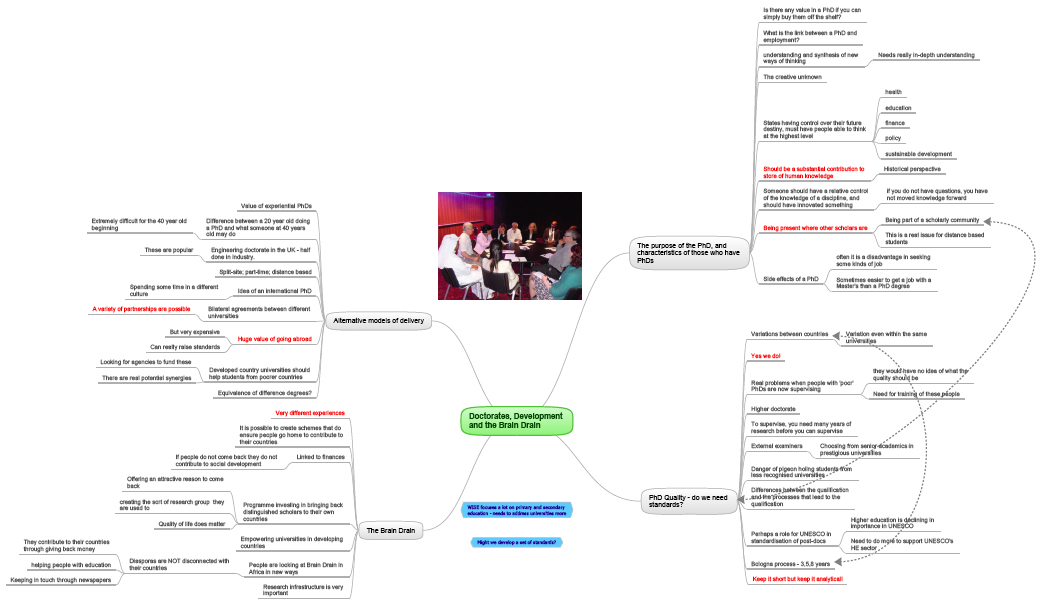
I was delighted to be able to help the Association of Commonwealth Universities run a workshop on “Doctorates, development and and brain drain” at the recent World Innovation Summit for Education (WISE) held in Doha from 1st-3rd November.  This focused on four key themes:

  • the purposes of a PhD and the characteristics of those who have PhDs
  • the quality of a PhD; do we need standards?
  • alternative modes of delivery for doctorates
  • the brain drain

Although the number of participants was small, the discussion was highly interesting, and the mind map below attempts to capture what we discussed (click WISE 2011 for a .pdf version).

Leave a comment

Filed under Commonwealth, Development, Education, Higher Education, Postgraduate supervision, Universities