Category Archives: Education

Shadow Scholars, plagiarism and academic merceneries

Ages ago a friend, knowing of my interests in the extent of plagiarism in higher education, sent me a link to an article in the Chronicle of Higher Education entitled The Shadow Scholar: the man who writes your students’ papers tells his story.  In a nutshell, this tells ‘the story of how he makes a living writing papers for a custom-essay company and to describe the extent of student cheating he has observed’. Although it refers primarily to the US context, it provides a salutary tale for all those involved in helping university students to learn.  Above all, it should remind us that such practices are becoming increasingly commonplace.  In the month that followed its original publication, the report attracted 640 comments, and these are also well worth a read.

On re-reading it today, I am even more convinced that it should become required reading for academics and students alike!

Leave a comment

Filed under Education, Higher Education

Back copies of journals seeking a new home …

I am seeking to dispose of back copies of the journals I have collected over the last 30 years as an academic – but cannot find anyone who might be interested in having them!  I hate to see them simply going to a shredder, but even organisations that send publications to universities without the resources to purchase them now seem to shred back issues and use the money to support online subscriptions instead.

So, if anyone knows of a good home for the following journals, please let me know:

  • Advances in Horticultural Science (since c.1990)
  • Annals of the Association of American Geographers (since c.1980)
  • Area (since c. 1970)
  • Australian Wine Research Institute Technical Review (since c.1990)
  • Children’s Geographies (since 2002)
  • Environmental Ethics (since c.1995)
  • Geographical Journal (c. 1985-2000)
  • Journal International des Science de la Vigne et du Vin (since c.1990)
  • Journal of Geography in Higher Education (since c. 1985)
  • Landscape History (since 1980)
  • Philosophy and Geography (since 2001)
  • Professional Geographer (since c.1980)
  • Third World Quarterly (since c. 1990)
  • Transactions of the Institute of British Geographers (since c.1970)
  • Treballs de la Societat Catalana de Geografia (since c. 2000)
  • Vitis (since c. 1990)

It seems a great waste to consign these journals to a skip, but unless I have requests for them by the end of September they will have to be shredded.  Please help find a home for them!

6 Comments

Filed under Development, Education, Higher Education

Ofsted report on declining Geography in England’s schools

In a press release, Ofsted comment on their report on school geography in the UK published today that ‘A polarised picture of school geography teaching has emerged … While geography was flourishing in a minority of the schools visited by inspectors, it was found to be under pressure in the rest.’   As the press release continues ‘The primary schools visited presented a sharp contrast between inadequate and outstanding practice. Half were characterised by a lack of expertise and awareness of what constituted good geography. In approximately one in 10 of the primary schools visited, geography was more or less disappearing. Just over half the primary and secondary schools visited did not use fieldwork adequately. In some of the secondary schools visited, there was a drop in the numbers studying geography GCSE. Uninspiring teaching and the lack of challenge discouraged many students from choosing geography at GCSE. The quality of provision was declining and the time allocated to the subject in the first critical years of secondary schools was being reduced’.

The study is based on observations of geography classes in 91 primary schools and 90 secondary schools between 2007 and 2010, and represents a depressing picture of the present state of teaching in the discipline.  Official figures show that the number of people taking GCSE in geography fell from 173,800 in 2008-9 to 169,800 in 2009-10, with the number of state schools not entering pupils for the subject increasing from 97 (out of more than 3000) in 2007 to 137 in 2009.

As a BBC report on the findings commented, ‘”Core knowledge for the majority of the students surveyed, but especially for those in the weaker schools, was poor,” it said. It found all but the best students were “spatially naive” and that they were unable to locate countries, key mountain ranges or other features with any degree of confidence.”For example, they understood about development issues in Kenya but had little or no idea of where Kenya was in Africa.”Many of them had studied Amazonia and could talk with some conviction about the exploitation of resources and environmental degradation but they knew nothing about the rest of South America.”‘

This is hugely damning, not only for those who care about geography as a discipline, but also for the futures of our young people. Geography is one of the most important and exciting subjects of all:

  • it explores the place of people in the world – in both a conceptual and a physical sense;
  • it is explicitly concerned with the interactions between people and the physical environment – which lie at the heart of so many contemporary global issues such as climate change, the impact of migration, resource allocation and distribution, and international development;
  • it provides young people with an understanding of the importance of diversity and tolerance based on a detailed understanding of other cultures and people; and
  • it is one of the most enjoyable and exciting subjects to study at school and university – reflected in the importance of field work and a practical understanding of places.

In a response to the Oftsed report, the Geographical Association (GA) notes, amongst other things, that:

  • ‘This Report therefore sends a strong message to senior leaders in primary and secondary
    schools: it is unacceptable to tolerate geography that is weak, because this impoverishes the
    curriculum. If geography is weak it “is a key issue to be addressed by the leadership teams in
    these schools” (p5)’;
  • ‘The Report shows many examples of schools in which geography has been encouraged and is
    flourishing. These are schools where the geography is driven by challenging questions about the
    contemporary world, where pupils’ knowledge of people, places and environments is extensive
    and where the teaching is lively, topical and well informed. One reason for good geography was
    found to be where “subject specific professional support had been sought out and utilized” (p6)’; and that
  • ‘A strong theme is the polarized pattern of provision in terms of the quality of teaching and
    learning and the curriculum between schools. This is linked to the lack of subject specialist
    teachers and/or lack of subject specialist training. It is therefore a worry that training numbers
    are being cut in geography.’

As David Lambert, the GA’s Chief Executive notes, ‘It is a pity that Ofsted’s own press release designed to draw attention to this report is headlined ‘geography declining in schools’. Why? Because the report makes clear that the story is much more complicated than that. In some schools, if you suggested that geography were declining you’d be faced with puzzlement, for the subject is thriving. And yet, the national picture which has been taking shape for many years now, is unsatisfactory. The GA takes this very seriously. The decline in school geography means that there is less geography being taught in school and more children leaving school with an inadequate knowledge and understanding of their existence on planet earth’.

The report nevertheless represents systematic failings across the discipline, and far too much complacency amongst professional academic geographers. Whilst the GA has been valiantly trying to support secondary and primary geography over many years, the number of university academics involved in and willing to give their time to school geography (other than as part of their own selfish recruitment drives) has dwindled dramatically.  We need to provide a vision of the excitement of the discipline that inspires young people to engage in the discipline.  We also need to act much more strategically at a political level with Ministers, senior Civil Servants and leaders of the private sector to advocate for the value of geography.  If we do not, we will not only have failed a generation of school pupils, but will ultimately have helped to create a society with little understanding of the complex relationships that shape interactions between people and the physical environment.

Leave a comment

Filed under Education, Geography

Monitoring and Evaluation of ICT in Education initiatives: reflections from WISE

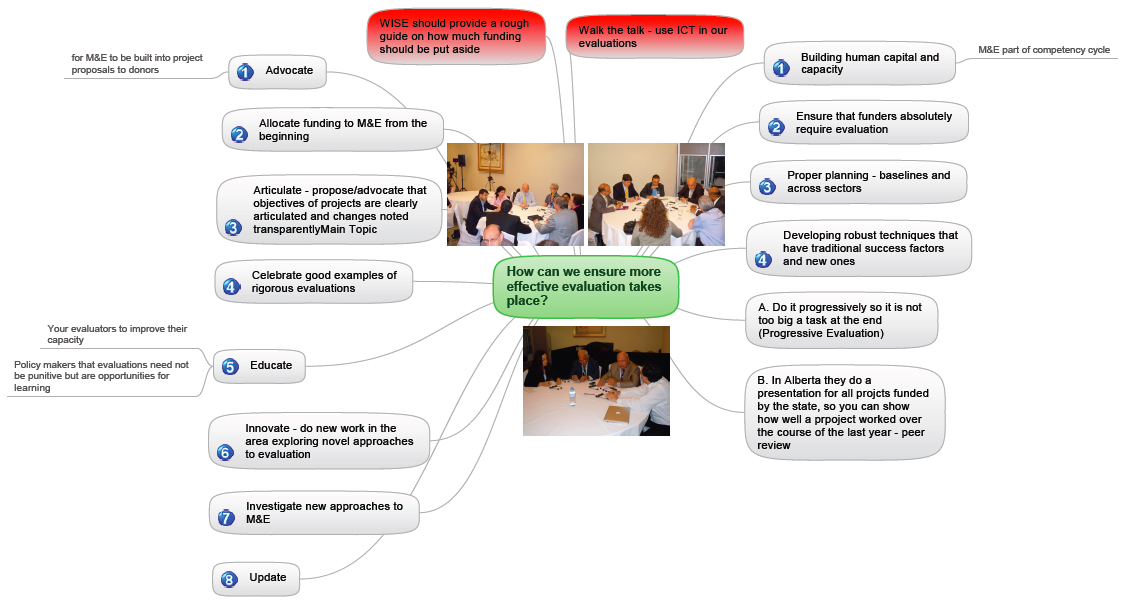
The second WISE (World Innovation Summit for Education) summit provided an opportunity for colleagues from Education Impact to host a lively and highly participatory workshop designed to contribute to more effective monitoring and evaluation of ICT in education activities, focusing particularly on developing countries.

It was premised on two assumptions:

  • that there is too little monitoring and evaluation of ICT for education initiatives, and much of what is undertaken is of poor quality; and
  • that it is important to differentiate between monitoring (the process of continuing self-reflection within organisations and individuals aimed at improving their performance) and evaluation (the review of outcomes against targets, often undertaken by external agencies)

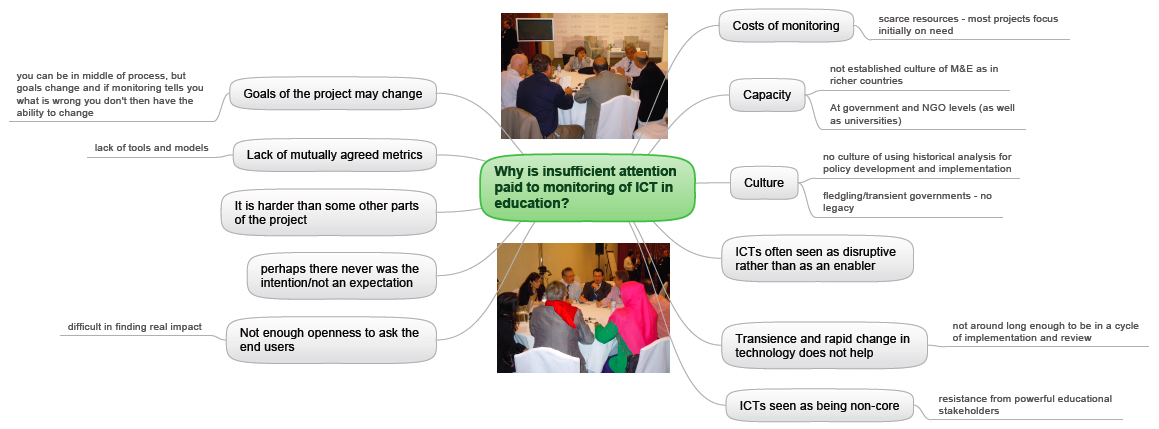
The workshop began by identifying the reasons why there is so little effective monitoring

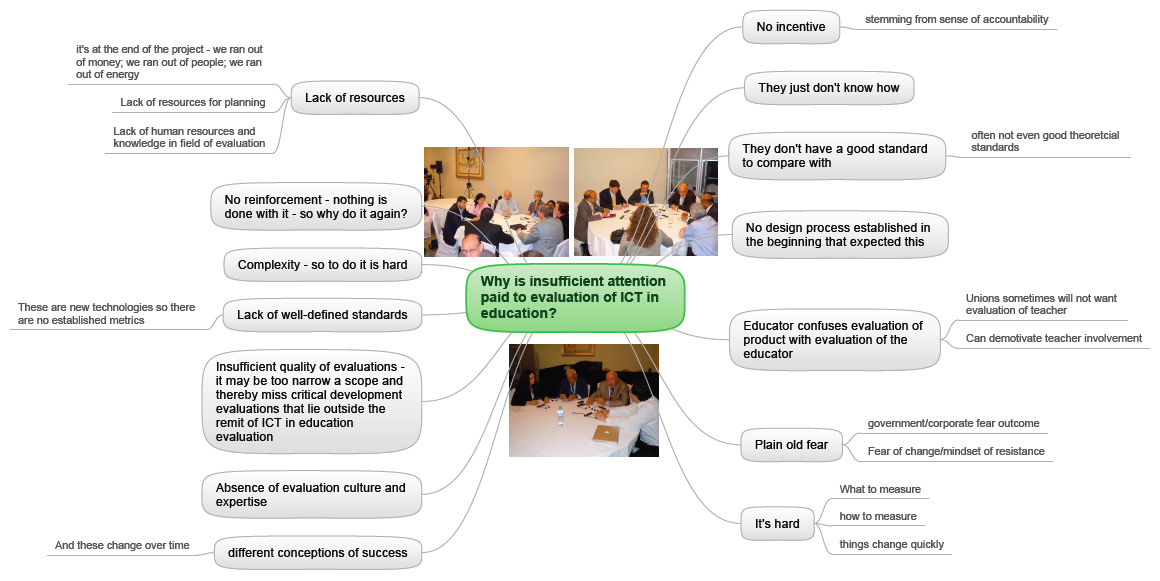
and then why there is so little good and effective evaluation

This was then followed by a discussion of how we can ensure better monitoring

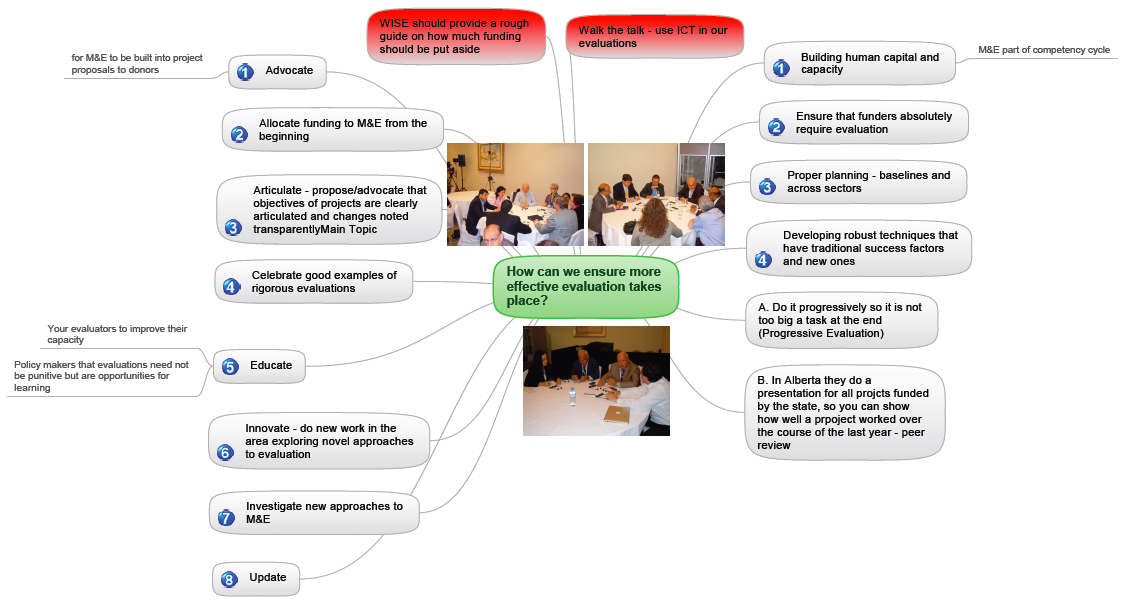
and the things that need to be put in place to ensure better evaluation.

Clicking on the above mind-maps enables them to be viewed at full size!

2 Comments

Filed under Education, ICT4D

Towards a free university

I have generally been highly critical of plans by successive UK governments to commodify higher education and create a free market in university degrees that will require students to pay fees of well over £6000 for their degrees.  The review of higher education chaired by Lord Browne published on 12th October thus commented that “We do not in our proposals include a cap on what institutions can charge for the costs of learning. There is no robust way of identifying the right maximum level of investment that there should be in higher education. A cap also distorts charging by institutions” (p.37).  Under these proposals, universities would be able to receive all of the money for charges of up to £6,000 and then pay a levy on the amounts that they charge above this.

So, how feasible might it be for universities in the UK not to charge students fees for the learning that they receive?  The standard reaction amongst most British vice chancellors to the possibility of increasing fees has been one of relief and welcome as they see it as the only way to counter the decline in income that they have faced in recent years, and that is about to get very much more severe if reports of the impending cut of perhaps 79% in funding for undergraduate teaching in the upcoming spending review prove to be true.  It would be a brave vice chancellor who used this as an opportunity to cut student fees, and provide students with a free education.  However, it would be a remarkably astute piece of marketing, and might just prove to be the means to save their institutions.

This, or course, depends a little on how we choose to define a university – and I see universities as something very, very different from the low quality, mass-producing, learn and regurgitate type of higher education institutions that dominate the world today.  A university should be a place of research and learning; it is where leading academics push the frontiers of knowledge forward, and in so doing enable bright students to learn something of value from them.  Universities are exciting places for those who are bright enough to benefit from the opportunities that they provide; they are dreadful for students who simply want to be taught the right answers to regurgitate in exams. The tragedy in the UK is that this distinction has been blurred, and in seeking to provide a higher education system that enables half of our young people to gain degrees, we have dumbed down the quality and created a system that we can no longer afford.

So, how might a university that provides free learning work?  The following are some tentative ideas:

  1. Such universities could focus primarily on gaining high value research funding, both from government research councils and also from external research contracts.  Whilst undertaking research, academics would also be expected to do some ‘teaching’ (for free), but at a much reduced level.
  2. New ICTs can help dramatically to reduce the amount of time academics actually spend in classes.  Filming of standard lectures, for example, which could be used for more than just one year, and the use of digital learning management systems can effectively reduce the time that academics actually need to spend teaching.
  3. Universities could change their employment contracts, only paying staff for nine or ten months a year (thereby leading to an immediate 16.7%-25% cut in salary bills), and expecting them to gain whatever extra income they wished to through external consultancy or contracts for the additional two or three months. This might actually turn out to be much more lucrative for academics in terms of salaries
  4. Once students have left halls of residence in droves (because they can no longer afford both fees and accommodation),  universities could focus on using this vacated space for the conference trade and other external sources of income generation.  This could then be used to subsidise free education to the students living locally
  5. Learning could be provided for free, but students would then be expected to pay something to take examinations if they wanted the external recognition that modern credentialism demands. Oh for the day when students could get a job without showing that they gained a 2:1 from the university of mass production, but rather by simply showing that they had learnt something from being with Dr. Wisdom!
  6. Might we even be able to move to a system whereby students paid academics on a voluntary basis – as with tips in a restaurant?
  7. Academics could write text books, make them available to students online and charge realistic prices for them, thereby gaining some of the profits traditionally made by textbook  publishers.
  8. Traditional styles of teaching could be changed dramatically.  If academics are spending most of their time doing research, perhaps students could learn by being apprentices, working together with the relevant academics and doing some of the simpler research tasks for them.

These are just a few ideas, and they are proposed here simply to show that the notion of a university where people can learn for free – something very different from free higher education for the masses – is not entirely ridiculous.  All it requires is some imagination, vision and passion.

Leave a comment

Filed under Education, Higher Education, UK, Universities

ICTs and Special Educational Needs in Ghana

Godfred Bonnah Nkansah and I are delighted that our paper on the contribution of ICTs to the delivery of special educational needs in Ghana has just been published in Information Technology for Development, 16(3), 2010, 191-211. The paper not only provides rich empirical evidence of the usage and potential of ICTs in the special educational needs sector in Ghana, but also argues strongly that much more attention should be paid to the positive benefits that ICTs can bring to the lives of people with disabilities across Africa.

Abstract
This paper explores three main issues in the context of Ghana: constraints on the delivery of effective special educational needs (SEN); the range of information and communication technologies (ICT)-based needs identified by teachers, pupils and organizations involved in the delivery of SEN; and existing practices in the use of ICTs in SEN in the country. It concludes that people with disabilities continue to be highly marginalized, both in terms of policy and practice. Those involved in delivering SEN nevertheless recognize that ICTs can indeed contribute significantly to the learning processes of people with disabilities. Governments across Africa must take positive action to ensure that such experience with ICTs can be used to enable those with SEN to achieve their their full potential, whether in special schools or included within mainstream education.

For media comments on this research see:

  • The Commonwealth Secretariat News

2 Comments

Filed under Accessibility, Africa, Education, Ethics, ICT4D

WISE Awards 2010 – closing date 15th July

The Qatar Foundation has recently announced the WISE (World Innovation Summit for Education) Awards application process for 2010 – with a closing date of 15th July 2010.

Recipients of the 2009 WISE Awards were:

  • Sheetal Mehta for Project Nanhi Kali (India)
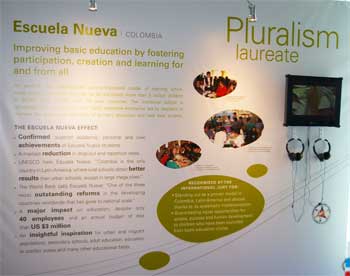
  • Vicky Colbert for Escuela Nueva (Colombia)
  • Delio Morais for Distance Learning in the Amazon Forest (Brazil)
  • Peter Levy for Curriki (USA)
  • Martin Burt for The Self-Sufficient School (Paraguay)
  • Joyce Dongotey-Padi for the Widows Alliance Network for Sustainable Economic Development in Ghana

The 2010 WISE Awards are designed to recognise and support outstanding practice and achievement within the theme of Transforming Education: Investment, Innovation and Inclusion. Applicants must show how they deliver on the following ten criteria:

  1. Educational Transformation: the overall extent to which the educational activity has transformed an aspect of education that has also had societal impact;
  2. Sustainable investment: the extent to which the educational activity is funded in a sustainable way to ensure its continuing viability;
  3. Innovation: the extent to which the educational activity is innovative in design and/or practice, thereby transforming traditional means of educational delivery;
  4. Inclusion and Diversity: the extent to which the activity includes a diversity of beneficiaries and has enhanced equality of access to education;
  5. Quality of Learning: the extent to which the transformation has improved the quality of learning;
  6. Scalability: the extent to which there is evidence that the educational activity has the potential to be scaled up effectively, or has already been replicated at a larger scale than originally piloted;
  7. Partnership and Participation: the extent to which the educational activity has established effective partnerships and includes participation from beneficiaries and stakeholders;
  8. Monitoring and Evaluation: the extent to which there is evidence of effective ongoing enhancement of the programme through regular monitoring and also evidence of formal internal or external evaluation procedures;
  9. Dissemination: the extent to which the organisations involved are already effectively disseminating and sharing their educational practices with other practitioners;
  10. Clarity of proposal: the extent to which the proposal is clearly intelligible and conforms to the requirements of the application process.
The  application process is designed to generate six Awards. Each of the six recipients will receive a WISE Prize Award of $20,000 at the Gala Dinner on 8 December 2010. Recipients will also be given the opportunity to showcase their projects during the WISE Summit to be held in Doha from 7 to 9 December 2010.
The WISE Awards application process is open to individuals or teams of individuals from across the world and across all education sectors (apart from previous WISE Award winners). Thirty finalists will be announced by mid August 2010, and they will be invited to submit more detailed applications. The six prize winners will be selected from these finalists.

Leave a comment

Filed under Education, Higher Education

The World Bank ‘releases’ its data

Yesterday, the World Bank announced the good news that it is making all of its statistical information available freely to anyone who has access to the Internet. As World Bank Group President Robert B. Zoellick commented, “I believe it’s important to make the data and knowledge of the World Bank available to everyone,”“Statistics tell the story of people in developing and emerging countries and can play an important part in helping to overcome poverty. They are now easily accessible on the Web for all users, and can be used to create new apps for development”. The database includes some 331 of the World Development Indicators (WDI) covering 209 countries from 1960 to 2008 translated into Spanish, French and Arabic.

However, this reveals what is very much a ‘World Bank’ view of the world.  The data are only partial, and should never be seen in some ways as ‘hard facts’.  There is a real danger that sources such as this may be used uncritically to give misleading views of international development.  Take education for example. There are only 5 indicators that show up when a search on “Find an Indicator” is done for “education” among the 331 indicators made available in this way:

  • public spending on education as a % of GDP
  • public spending on education as a % of government expenditure
  • ratio of female to male enrollments in tertiary education
  • ratio of girls to boys in primary and secondary education
  • trained teachers in primary education as a % of total teachers

However,  using “Topics”, one can find a further 24 indicators about education, and this provides a much more balanced view of global education.   On delving deeper, it is possible to access a still more detailed set of data from the databank itself.  Here, there are some 1247 different time series on educational data, and they can also be downloaded for free.  This is indeed a valuable resource.

Another problematic feature of the main public database is its maps.  At first sight, these could be seen to be  helpful visualisations of the data, but they are fundamentally misleading, because they use proportional symbols to represent % data – the higher the percentage, the larger the circle.  While such symbols are fine for absolute data (such as total GNI), they are inappropriate for showing ratios such as percentages for a spatial territory (such as % enrollment in secondary education).   For such data, it is much more appropriate to use choropleth maps that shade the areas in different densities.

These criticisms having been noted, we should applaud the World Bank for sharing its statistical understanding of the world in such an accessible way.  It tells us as much about the Bank as it does about development.

Leave a comment

Filed under Development, Education, Higher Education

Dumbing down in UK higher education – what’s new?

Three Appeal Court judges ruled on 24th February that Paul Buckland, a professor at Bournemouth University, who resigned in 2007 in a row over the alleged dumbing down of degrees, was treated unfairly.  In essence, Professor Buckland had given fail marks to a number of students, whose papers were subsequently remarked and permitted to pass (for a detailed summary of the case, see the University and College Union News). He had complained, and subsequently resigned as a result of the university’s investigatory process.  As UCU general secretary, Sally Hunt, said: “This is an important victory for everyone who values high standards and probity in our universities. Dr Buckland’s defence of academic standards and examination procedures must be congratulated. However, we are deeply concerned about the events that led to this tribunal. Staff need the confidence to be forthright and honest in their comments and assessment of work”.

This is an important and personal case, but what surprises me most about it is that few people or reports seem to have picked up on the fundamental underlying issue, which is that universities across the country have indeed been manipulating the degrees they have been awarding in recent years to give higher marks.  According to the then Department for Children, Schools and Families, between 1994/5 and 2005/6 the percentage of first class and upper second class degrees in HE institutions in the UK increased from 47% of all first degrees awarded to 56%. The latest HESA figures show that this percentage had risen to 62% in 2008/9.

Universities, just like schools, are subject to league tables, and one of the criteria they are frequently  judged by is the percentage of students getting good honours degrees, usually defined as upper seconds and firsts.  Is it therefore surprising that universities have sought means to maximise this figure as they compete in an increasingly competitive market?  Moreover, it is perfectly possible to manipulate the percentages of good degrees gained, even without any changes in the actual rigour of the marking. Typical of such ways are the following:

  • changing the mechanisms for awarding degree grades by, for example, ignoring the worst 20% of marks given
  • discounting the first year exam marks, when students often do worst as they get used to the university system
  • reducing the amount contributed by terminal exams to the overall assessment, and increasing the amount of coursework at which most students usually do better

There is also some evidence that actual marking is becoming more lenient, as universities seek to encourage more diverse expressions and interpretations in response to assignments that are set.  This was the issue that gave rise to the original disagreement at Bournemouth. Attention paid to the quality of written expression has, in many institutions, declined, and it is therefore scarcely surprising that employers regularly complain about the quality of these skills in apparently highly qualified graduates!  The nature of assignments has also in many instances changed to make them easier.  Typical of this is the expectation of what is required for an undergraduate research dissertation.  Years ago, it was expected that students would spend most of the summer vacation between their second and third years undertaking their dissertations – and I indeed still expect a substantial amount of empirical work to be done for a dissertation to gain a good mark.  However, on more than one occasion colleagues have berated me saying that this is completely unreasonable, because students have to gain paid employment over the summer to cover their fees, and that I should therefore be willing to accept what I consider to be paltry amounts of empirical work.

The situation is at least as bad in many Master’s degrees, especially where foreign students are concerned.  Many universities rely heavily on the financial income derived from fees paid by foreign students.  Despite the requirements imposed on such students to have high language scores as tested, for example, by the International English Language Testing System (IELTS), the reality is that many such students do not have sufficient language abilities to perform at a high level in written terminal examinations.  Many Master’s degrees which in the past were assessed by terminal examinations that required a high degree of competency in academic writing in English, are now being assessed purely by course assignments, and even in some cases largely by oral presentations!  As is well know, anyone who can use a word processor with  grammar and spelling checkers can produce a half-competent piece of written work, even when their ability to do so without such support is very much less!  The assessment requirements are less challenging, and therefore the pass rates remain high.  Universities are too desperate for the fees that such students bring in that they cannot be seen to be failing large numbers of them; the assessment system therefore has to change to accommodate the financial realities.

To make matters even worse, this percentage increase in ‘good degrees’ is taking place at a time when many universities have reduced the amount of time academic staff actually spend teaching students so that they are able instead to concentrate on research.  Across the country, class sizes have gone up, there are fewer and fewer personal or group tutorials, and undergraduates have less and less contact with academics!

This is of course not to deny that many students work incredibly hard, and get the good degrees that they deserve.  However, it is to claim that university degrees taken as a whole have seen very considerable dumbing down in recent years.  There is nothing extraordinary or surprising about this.  Universities do have some clever people working for them, and in a competitive market place where they are being judged in part on the number of ‘good degrees’ that they award, some of them are bound to find ways of manipulating the system!  There is nothing new in this.
2 Comments

Filed under Education, Higher Education

Learning Management Systems in Africa

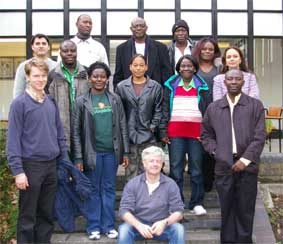
Our research paper on Learning Management Systems in Africa resulting from the DelPHE funded collaboration with colleagues in the University of Education, Winneba (Ghana), Maseno University (Kenya), and Eduardo Mondlane University (Mozambique) has just been published as

  • Tim Unwin, with Beate Kleessen, David Hollow, James B. Williams, Leonard Mware Oloo, John Alwala, Inocente Mutimucuio, Feliciana Eduardo and Xavier Muianga (2009) Digital learning management systems in Africa: myths and realities, Open Learning: the Journal of Open and Distance Learning, 25(1), 5-23.

In summary, the paper  reports on a survey of 358 respondents across 25 African countries into their usage of learning management systems. It concludes that while there are some enthusiastic advocates of such systems, the reality is that most African educators as yet have little knowledge about, or interest in, their usage. There remain very considerable infrastructural constraints to be overcome before they can be widely adopted for open and distance learning across the continent, and there is still reluctance in many institutions to develop systems that can enable learning resources to be made available in this way. This does not mean that the potential of high-quality digital learning management systems should be ignored in Africa, but rather that much more sustained work needs to be done in human capacity development and infrastructural provision if African learners are truly to benefit from the interactive learning experiences that such systems can deliver.

Leave a comment

Filed under Africa, Education, Higher Education, ICT4D