Category Archives: Education

Report on using technology to help at-risk youth and people with disabilities gain employment

Researchers at the Technology and Social Change Group in the University of Washington in Seattle (Joyojeet Pal, Jay Freistadt, Michele Frix, and Phil Neff) have recently released an important report on the impact of technology training on the employment prospects of at-risk youth and people with disabilities in five countries in Latin America.

The report’s findings are “broadly divided by the themes that emerged in the coded transcripts of our conversations on the ground. Under environmental factors, we discuss issues around the prevalent discourse of technology that underlines the ways in which the various stakeholders imagine the role of computers and technology training within the larger social and economic ecosystems. An important environmental factor is the aspirational environment, for the role it plays in peoples’ willingness to participate in such training programs. Finally, structural issues around the labor market form the third set of environmental factors that are extremely important, given that both populations discussed here have histories of geographical and institutional exclusion from formal employment opportunities”.

It is good to see these important issues examined in detail; ICTs can indeed make a significant difference to the lived experiences of people with disabilities and at-risk youth
2 Comments

Filed under Education

Reflections on WISE – The World Innovation Summit for Education

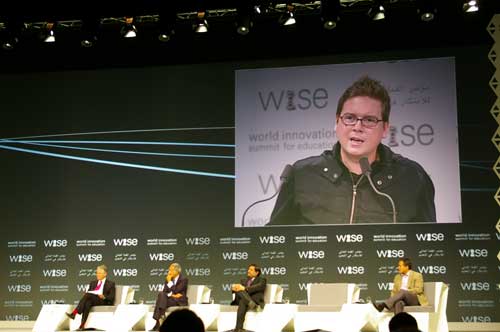
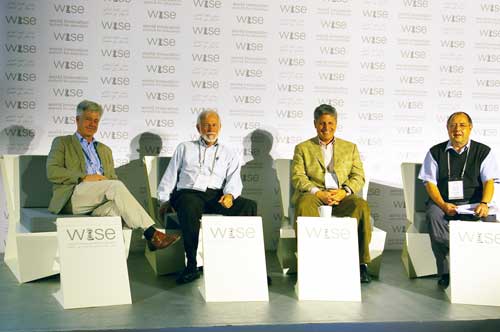
I do not usually like big conferences and summits.  All too often, people read prepared papers or speeches, and rarely inspire or speak from the heart.  However, the World Innovation Summit for Education held in Doha from 16th-18th November was surprisingly different.  Of course there were some fairly tedious presentations, but the Summit nevertheless did have a buzz about it.  People were talking, really talking, about the importance of education, and what we might be able to do enhance its sustainability, pluralism and innovation across the world.  There were also some really inspirational presentations – both by academics and by politicians!

However, the hosting of the conference  by the Qatar Foundation, bringing together 1000 of the world’s leading educationalists, and giving awards to six  outstanding examples of pluralism, sustainability and innovation in education, raised many interesting questions.  Why has so little yet been done globally to deliver on agreed educational targets? As the 2009 Global Monitoring Report summarised, “Progress towards the EFA goals is being undermined by a failure of governments to tackle persistent inequalities based on income, gender, location, ethnicity, language, disability and other markers for disadvantage”.

Three key inter-related issues come to mind:

  • All too often education is now being treated as a private good – people are being encouraged to pay for education in the expectation that it will bring them advantages in their future lives.  However, if we are to create a fairer, more equitable world, it is essential that education should be treated as a common rather than a private good.  An educated population is an integral factor in helping to ensure good governance, equality of opportunity, peaceful co-existence, and innovative solutions to poverty.
  • One of the reasons why governments across the world continue to provide insufficient funding for education, may be because in recent years they have come to believe that education is no longer a common good, but is instead a private one.  This enables governments to argue that people should pay for education themselves, rather than funding it from the common purse. Increasing fees for higher education in the UK are thus regularly justified by government ministers who argue that a degree brings increased lifetime earning capacity, and that individual students should therefore pay for it.  However, such arguments may also underlie the reticence of many governments across the world to fund education sufficiently.  Even though 23 countries contribute more than 7% of their GDP to public expenditure on education, 35 contribute less than 3%.  We need to work through existing global mechanisms more effectively to help ensure that all states fund education appropriately, so that all peoples can have equal and fair access to quality education.
  • How, though, do we do this?  How can we ensure that the enthusiasm and energy generated at events such as WISE is channeled effectively to initiatives that will actually make a difference?  UNESCO has for long sought to promote the importance of education across the world, but has been beset by too high expectations and too low levels of funding to have been able to make the impact that many of its staff would like to see.  How do we turn the energy that the Qatar Foundation released at WISE into systemic change?

Four more quirky observations from WISE:

  • I did not hear anyone publicly thank the French agency \Auditoire who did all of the organisation of the Summit on behalf of the Qatar Foundation. They were quite outstanding, and much of the success of the Summit was undoubtedly due to the experienced and dedicated team that they had in place.  Well done to all involved!
  • Carla Bruni attended – was I the only one who was left decidedly unimpressed?
  • Fidel Castro is alive and well in Doha – and can occasionally be seen in the Habanos bar in the Ritz Carlton – he did, though, look remarkably young – definitely in his prime!  But, it was nevertheless strange to see him there
  • I always thought that the role of a good master/mistress of ceremonies  was to ensure that everything keeps to time, that the speakers and participants are able to shine, and that they should do so by being almost invisible themselves.  It would appear that Nima Abu-Wardeh had been given a different set of instructions – or perhaps she simply had other ideas!

4 Comments

Filed under Education

Putting a value on the UK’s universities

The latest report on the ‘added value’ of universities in this country undertaken by academics at the University of Strathclyde for Universities UK, has found that “Universities in the UK now generate £59 billion for the UK economy putting the higher education sector ahead of the agricultural, advertising, pharmaceutical and postal industries, according to new figures published today”.

In more detail, Universities UK summarised the report’s findings as follows:

  • “The higher education sector spent some £19.5 billion on goods and services produced in the UK.
  • Through both direct and secondary or multiplier effects this generated over £59 billion of output and over 668,500 full time equivalent jobs throughout the economy. The equivalent figure four years ago was nearly £45 billion (25% increase).
  • The total revenue earned by universities amounted to £23.4 billion (compared with £16.87 billion in 2003/04).
  • Gross export earnings for the higher education sector were estimated to be over £5.3 billion.
  • The personal off-campus expenditure of international students and visitors amounted to £2.3 billion”.

These are generally interpreted as being very positive results; UK Universities contribute significantly to our economy. Indeed, the Guardian newspaper picks up on the report’s findings, noting in particular that “Higher education generates 2.3% of the UK’s gross domestic product, making it ‘one of the most effective sectors,’ said Ursula Kelly, another of the report’s authors. ‘As a producer of goods and services alone, the sector makes an evidentially large contribution to the UK economy of £19.5bn.’ Universities brought in £5.3bn from overseas students, international conferences and work conducted for overseas businesses. They provide the equivalent of 314,600 full-time jobs, or 1.2% of all full-time jobs in the UK. Those visiting universities from abroad and overseas students spent £2.3bn off-campus, the study found”.

But amidst all this economic justification, let us never forget what universities should be about.  Above all universities should be moving the research frontiers forward, developing innovative and creative science and scholarship, and engaging students in the challenge of using this knowledge to make the world a better place.  It would be worth doing this even if universities did not make an economic profit.  Their value is worth immeasurably more than these crude economic indicators might suggest. One hallmark of a civilised society is that it has a university sector that is vibrant, pursues excellence, and challenges taken for granted assumptions.  Access to such universities must remain free for the brightest and most able students.  We are in danger of becoming uncivilised.

2 Comments

Filed under Education, Higher Education

Analysis in Geographical Research

There are many books that provide students with detailed accounts of the methods that they can use in geographical research, but very few that give much guidance on analysis.  Hence, whilst students – both undergraduate and postgraduate – can often undertake a competent piece of empirical data collection, all too often they come unstuck when it comes to how to analyse the data.  This note is therefore intended to provide a quick checklist of tips to help with analysis in geographical research, and it is derived particularly from my experiences in helping PhD students to grapple with these issues.

  • Do not be beguiled into thinking that there is one definitive way to analyse data – there are many different types of analysis.  Thus, positivist approaches focus on ‘explanation’ and ‘prediction’, whereas hermeneutic approaches focus on ‘understanding’; some critical approaches tend to focus on encouraging ’emancipation’.   Whichever approach one adopts, though, there are certain key principles that can generally help to guide analysis.
  • Analysis is the way in which researchers choose to make sense of the data. All good research will have some kind of analytical framework, which makes clear to the reader how the author has tried to interpret diversity in the empirical data.
  • Analysis must refer back to the conceptual/theoretical framework of the research.  Research is about moving knowledge forward.  Hence, the analytical chapters of a thesis, must show how the empirical data gathered has enabled the author to make sense of questions raised by the literatures examined in the conceptual or theoretical introductory chapters to a thesis.  Analytical chapters must have just as comprehensive a bibliography as the methodological and theoretical chapters.
  • Analysis should focus on the ‘why?’ questions.  All too often, students tend to concentrate on descriptive questions, such as ‘what?’, ‘where?’, ‘who?’ and ‘when?’ when gathering data, without then going on to ask ‘why?’.  Unless ‘why?’ is asked, it becomes very difficult to explain or understand  what is actually going on.  This applies just as much to asking why particular geomorphological structures are shaped as they are, as to asking why people behave in the ways that they do.  ‘How?’ questions fall between these two extremes – they can be used to ‘explain’ ‘how’ something works, but I do still prefer to read about ‘Why?’ as well.
  • It can be helpful to think about ‘dependent’ and ‘independent’ variables when trying to shape an analytical framework.  Particularly when working within a positivist approach, it is useful  to think about one group of variables (the independent ones) explaining the variation and differences in the pattern of the ‘dependent’ ones.
  • It is very important to have a good idea about the analytical framework before going out ‘into the field’ to collect data.  Unless one has some idea in advance about how the data are actually to be analysed, there is a danger that much redundant data could be gathered or that it will not be possible actually to explain or understand it.  Remember the ‘Why?’ questions!  This raises important issues to do with the balance between ‘inductive’ and ‘deductive’ approaches.  Very little research is either purely deductive or inductive, and there is always an exciting interplay between theoretical and empirical work.  Even when the research is heavily inductive, a focus on consistently asking ‘why?’ questions in the field can help to ensure  rigorous analysis.
  • Analysis is about imposing structure.  Very often when one is immersed in exploring the data gathered in empirical fieldwork it is difficult to see any structure in it.  Sometimes it is therefore useful to step back and try to look at it in a different way.  Asking (and answering!) a simple question, such as ‘What are the three main factors that help to explain this?’, can help to impose structure.

I do hope this is all helpful advice.  Please add comments below about the things that you find helpful in undertaking analysis.

Leave a comment

Filed under Education, Higher Education, Postgraduate supervision

London Centre for Arts and Cultural Exchange – The Inside Out Festival

The London Centre for Arts and Cultural Exchange (LCACE) is organising a one week festival – the Inside Out Festival – from 19th-25th October, highlighting the contribution made by nine London university institutions to the arts and to culture.

The Festival will showcase the exciting, unexpected and sometimes unsung contribution made by nine London universities to the arts and culture. A packed programme of public events will include film, music, theatre and visual art, exhibitions and screenings, workshops and debates, with great thinkers of the day, high-profile figures and well-known academics, as well as up-and-coming undergraduate and postgraduate students. The events will take place all over the city both on university campuses and at leading cultural venues such as Kings Place, the National Portrait Gallery and Somerset House.

Highlights of the Inside Out Festival will include

  • a hard-hitting and controversial debate Art: What’s it good for? chaired by Michael Portillo at Kings Place with panellists including Evelyn Welch (Dean of Arts at Queen Mary, University of London), The Guardian’s Economics Editor Larry Elliott and contemporary artist Nasser Azam
  • ‘Colour, The Big Draw’ a fun, free, family drawing event at Goldsmiths, University of London
  • a performance by the improvising ensemble the Laptop Orchestra with experimental musician and sound curator David Toop from the London College of Communication

There are currently some 41 events listed in the programme, including student film screenings, Tudor and Stuart Southwark, a series of concerts on the theme of Impressions of Spain, a Gamelan concert, Andrew Motion in conversation, a creative writing workshop, and lots more

LCACE is a collaboration promoting the exchange of knowledge and expertise with the capital’s arts and cultural scholars. The partners are: University of the Arts London; Birkbeck, University of London; City University; Courtauld Institute of Art; Goldsmiths, University of London; King’s College London; the Guildhall School of Music & Drama; Queen Mary, University of London; and Royal Holloway, University of London.

Leave a comment

Filed under Education, Higher Education, Music

WISE awards for outstanding educational achievement

LOGO WISEThe Qatar Foundation has recently announced the launch of its WISE (World Innovation Summit for Education) awards for outstanding educational achievements.  In this inaugural year, the WISE Awards nominations will generate six prizes to existing projects aligned with the Forum’s three main themes: Pluralism, Sustainability and Innovation.  Two prizes will be awarded for each of these three themes. Each of the six laureates will receive a WISE Prize Award of $20,000 at the Gala Dinner on November 17th, 2009. Laureates will also be given the opportunity to showcase their projects during the WISE Forum.
The WISE Awards application process is open to individuals or teams of individuals from across the world and in all education sectors, to be supported by a letter of endorsement from senior management of their organisations. The closing date for applications is 15th July 2009.

Laureates will be selected by a pre-jury and then by an International Jury consisting of some of the world’s leading experts in pluralism, sustainability and innovation in education, drawn from public institutions, civil society, the private sector, international organisations, universities and social entrepreneurs.

Further details are available as follows:

Leave a comment

Filed under Education, Higher Education