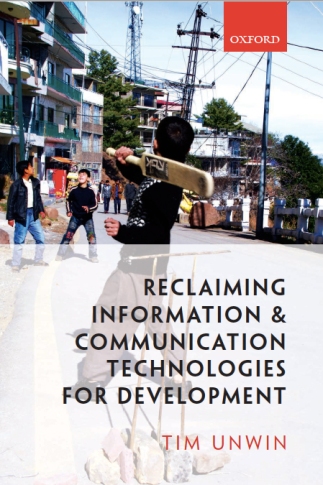
 One of the strong claims of my book Reclaiming Information and Communication Technologies for Development (OUP, 2017) is that we now have “Development for ICTs” (D4ICT) rather than “ICT for Development” (ICT4D). In other words, the private sector, governments and civil society are all using the notion of “development” to serve their own ICT interests. This has been reinforced by the 2030 agenda, and an increased emphasis on the ways through which ICTs can indeed contribute to delivering the SDGs, which I have also challenged in my chapter in the ITU’s book ICT-centric economic growth, innovation and job creation (ITU, 2017), as well as in a recent blog post on ICTs and the failure of the SDGs.
My frustrations with much civil society work in the field of ICT4D came to the fore in a short Tweet that I wrote on 5th May: “Challenging question: do most international development civil society organisations serve the interests of those who want to try to do good, or the interests of the poorest and most marginalised? How many poor people create such organisations to empower themselves?“.
This was shortly before I headed to Lusaka for the ICT4D Conference held there on 8-10 May, the lead partner of which is Catholic Relief Services (the official international humanitarian agency of the Catholic community in the United States), and for which the two strategic partners are Nethope (a collaboration between the 50 leading international nonprofit organizations 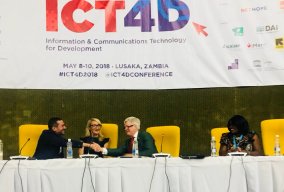 and the technology sector) and The Norwegian Refugee Council (an independent humanitarian organization helping people forced to flee). I was delighted that the UNESCO Chair in ICT4D at Royal Holloway, University of London, had also been invited as one of the content partners, and it was great to work with colleagues from other content partners to co-lead the education and livelihoods tracks.
Nothing that I write below is intended to denigrate the commitment and interests of many of the people organising and attending this conference. Some very close friends were participating, and I made many other new friends. However, the conference forced me to reflect further on my Tweet, and to challenge once again much contemporary ICT4D practice. The conversations that I participated in and overheard (over breakfast, at dinners, and on the shuttle buses) at the conference very much reinforced my view that the arguments of Reclaiming Information and Communication Technologies for Development are indeed important, and that those of us committed to helping the poorest and most marginalised to empower themselves through the use of ICTs still have a very, very touch challenge ahead of us.
In short, it seems to me that many of us involved in ICT4D are primarily in it for our companies, our organisations and ourselves, rather than for the people that we claim to serve.
To justify this claim, I focus here on three issues: the funding policies and interests of donors, the practices and interests of many of the companies and civil society organisations involved in delivering aid, and the commitment and interests of many individuals involved in these organisations to do good.
The funding policies and interests of donors
It is widely accepted that much international aid is a form of neo-imperialism; a way through which donor countries can influence, if not entirely control, poorer recipient countries. At best, aid is a relatively benign, self-centred, form of bourgeois apologetics, through which rich and middle-class people seek to provide support for the poor and marginalised, without necessarily realising that their affluence is in part a direct result of the policies of their states and companies which create such poverty in the first place. At worst, it is a means through which states on behalf of companies, seek to create the conditions through which those companies can extract greater profits; this is done in the name of economic growth, as represented and formalised through the SDGs. It has to be more widely understood that economic growth, largely fueled by ICTs, is leading to considerably increased inequality in the world, and if poverty is defined in relative ways, it is actually therefore leading to an increase in poverty.
Participating in the ICT4D conference forced me to go back and look at the levels of funding provided by international donors to major private sector corporations. In 2001, the Development Assistance Committee (DAC) of the OECD recommended that aid to the Least Developed Countries should be untied, meaning in effect that those countries should be able to choose where to spend the aid that they were given; it should not have to be spent on companies and organisations from the countries that provide the aid. As a result, the percentage of tied aid has decreased considerably over the last 15 years or so. However, recently the tide has turned the other way. As a recent DAC report has commented, “In 2014, the share of ODA covered by the Recommendation that was reported as untied stood at 87.1%. This marks a drop of 2.4 percentage points, from 89.5%, in 2013. After a further drop of 3.6 percentage points, the share stood at 83.5% in 2015. The share remains high by historical standards, but represents the lowest figure since 2009”.
Not all countries have untied their aid, with the USA being one of the main countries still actively encouraging their companies to benefit from aid spending. A recent report on the Devex platform thus notes that USAID “continues to award the bulk of its contracts to American firms. In 2015, the top 20 recipients of USAID funding were all U.S.-based organizations. Combined, these transactions account for 70 percent of the total USAID spending for obligated contracts for the year, up slightly from 67 percent in 2014”. Several of these top-20 companies sponsored, were partners, and were present at, the ICT4D Conference: Chemonics (ranked 2nd), Tetra Tech (ranked 4th), DAI (ranked 5th), and FHI 360 (ranked 11th) featured prominently.
Yet, even those countries that claim to have their aid untied often have very close relationships with large corporations and consultancy companies which gain a surprisingly large percentage of their funding. According to a 2017 UK House of Commons International Development Committee report, the percentage of the total aid budget spent by DFID through contractors operating on a for-profit basis (not necessarily headquartered in the UK), has thus risen from 12% to 22% between 2010/11 and 2015/16. This report goes on to say that “We are also greatly concerned about the appalling conduct of some contractors who have behaved in a way that is entirely misaligned with the Department’s purpose”. Moreover, the UK’s cross-government Prosperity Fund, which “aims to remove barriers to economic growth and promote the economic reform and development needed to reduce poverty in partner countries” is specifically designed to support initiatives that will generate direct benefit to UK companies and organisations. Claiming to have untied aid need not therefore mean that many of the direct benefits of such funding are not within the grasp of companies or other entities based within the donor countries.
The ICT sector is strong in many donor countries, and their support for ICT4D initiatives in poorer states is thus but one of the many means through which donor governments directly enhance the competitiveness and profits of their consultancy and ICT companies. This was sadly all too evident from listening to the conversations at the Lusaka conference.
The practices and interests of ICT4D companies, consultancies and civil society organisations
The majority of participants at the 2018 ICT4D Conference were from the private sector and NGOs, most of whom live and work outside Zambia. This is scarcely surprising, since the purpose of the conference was primarily to serve their interests. On the platforms, in the workshops, in the corridors, over dinner and on the buses – although perhaps not on  the dance floor – the conversations were dominated by concerns over maintaining the viability of such organisations and companies, through enhancing the ways through which ICTs could contribute positively to development in general, and to the SDGs in particular. Where poor people and marginalised communities were mentioned, it was usually merely as “beneficiaries” of the largesse, wisdom and technological expertise of those delivering the ICT4D interventions. Scarcely ever did anyone dare to suggest that these technologies might have a darker side.
Three inter-related issues seemed to be particularly apparent, and for me at least worrying, about their claimed practice of ICT4D:
- First, the core interest of many of the participants seemed to be to represent their companies in the best possible light, and thus to gain respectability and prestige that will subsequently enable them to gain more contracts and thus greater profits. If they are honest, the majority of people say that they learn more from their mistakes than their successes. Yet, there was little discussion of mistakes, or even of how the problems associated with ICTs for development can be mitigated. Consequently, generation after generation of people working in ICT4D keep on making the same old mistakes that we made more than two decades ago. This is desperately depressing, especially for the poorest and most marginalised who such interventions are supposedly intended for. Perhaps this version of ICT4D, though, is not actually interested in the needs of the poorest and most marginalised at all, but instead the pay packages of the senior executives of the companies and organisations marketing their wares.
- Second, the self-assuredness of many of the senior executives of companies and civil society organisations involved in ICT4D was remarkable to behold. For the first time in my life I was told by a speaker from one of the top-20 company recipients of USAID in a session that I was meant to be moderating that he was an experienced speaker and had no need of a moderator! To be sure, I might not be a very good moderator, but neither was he a real expert in ICT4D, at least not as I understand it – but I simply stood aside and let him take the floor on his own. So many of these so-called experts had nothing new to say, and the way that they gave their presentations focused primarily on how wonderful their organisations were in implementing ICT4D programmes, rather than on whether these really made a substantive impact to the empowerment of poor people and marginalised communities. Rarely did I hear anyone talking about what they had learned from listening to the voices and needs of the poorest, and how they sought to deliver on these needs.
- Third, it was fascinating listening to the conversations of staff within many of these organisations, about the key importance of gaining contracts to build their companies, social enterprises or civil society organisations; it was actually hard to avoid listening to them given the tendency of people from some countries seemingly to shout at the tops of their voices in restaurants or other public spaces! These conveyed overwhelmingly the impression that ICT4D was being used above all else as a vehicle to build their organisations rather than serving the needs of the poorest.
The interests of individuals in doing good
Understanding the real interests of individuals involved in delivering international development, particularly through the use of ICTs, is one of the hardest things to do. We all make mistakes that we try to cover up. We all like to be seen to be successful. Most of us like to be seen to be doing good. It was fascinating, though, just listening to the conversations, particularly among many of the brilliantly able young people participating. Most people, but definitely not everyone, participating in the conference, were there because they truly wanted to do good, and they believed that they were indeed doing so. Again, the failure to look sufficiently at the dark side, and the actual harm that many ICT4D initiatives have done, was cause for concern. If only more people could focus on the challenges in using such technologies, then perhaps things could be different. To be sure, there were also plenty of people who made no real claim to do good, but rather focused explicitly on the business models of their organisations and how they could ensure greater profitability. However, I suspect that many of even them began their careers thinking that they could indeed do good for others as well as for themselves.
Much more worrying was that all too often the conversations degenerated into discussions about sources of funding for their next projects, or how to gain financial support from particular donors. Rarely did after-dinner conversations focus down on such issues as listening to the voices of the poor and marginalised, and truly trying to understand how we can design and implement technologies that will indeed serve their interests. Of course there were some such discussions, but they seemed to be in a small minority. The pressure of career success, following the “logics” of the organisation employing you, seeking to build its success, and wanting to gain promotion by doing the “right” thing, all mean that it is the interests of the companies and organisations delivering ICT4D that seem to prevail, rather than those of the poorest and most marginalised.
Concluding reflections
There were many great moments in the conference, and I learnt a lot – perhaps not so much about how ICTs can indeed empower poor people, but certainly about the power of the beltway bandits in delivering USAID projects. I share these reflections with constructive intent, primarily to encourage wider debate on the interests underlying ICT4D initiatives across the world. I hope I am wrong, and that these do not primarily serve neo-imperialist governments and the companies that they seek to empower that are headquartered within their territories. Most people attending the ICT4D Conference in Lusaka were there in the belief that they were indeed doing good to others. Few, I imagine, ever thought that they were there primarily to do good to themselves and their organisations. I hope that by sharing these thoughts I will encourage greater reflection, and thus the enlightenment and empowerment about which I wrote in Reclaiming Information and Communication Technologies for Development .

 From the beginning, Brexit was more about the internal politics of British political parties than it was about serving the interests of the British people. As we approach the endgame, this farce continues. Some MPs, such as Chuka Umunna (Independent Group, formerly Labour), David Lammy (Labour), and Caroline Lucas (Green) have indeed stood up for the people, and for what is right, but sadly they are a small minority. The chaos of last week’s votes in the House of Commons, and the pathetic spectacle of Prime Minister May still trying to get MPs to support “her deal” after two defeats already by calling for an “honourable compromise“, only serve to reinforce the failure of the UK’s current political system. Our system of so-called democracy is unfit for purpose, and it is time that it was replaced.
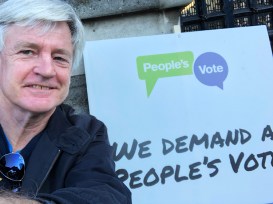 I have often been asked by friends from oversease how we could possibly have arrived at such a situation, where 12 days before we are due to leave the EU, we have no idea of what will actually happen. I have written extensively about the half-truths upon which the original referendum was based, the voice of the 700,000 who marched on 20th October 2018 in London, and the need to use use powerful arguments that combine emotion and logic if we are indeed to convince people about the benefits of remaining. I have tweeted ad nauseam (much to the chagrin of some of my friends) about Brexit, and likewise shared my increasingly frustrated opinions on Facebook. As we rapidly approach the abyss of Brexit, let me just briefly share some of the most important failures that our Parliament (and by that I mean both Corbyn and May as leaders, as well as politicians on all sides who have failed to serve the interests of the people) have made.
 I live in hope that we may somehow remain. My European friends, and apparently most wise European politicians do not want us to leave. However, remarkably, despite all of the evidence, many people in the UK still wish to leave the EU. That having been said, almost every poll in the UK since the summer of 2017 has indicated that a majority of people would now vote to remain in the EU. If most MPs originally voted to remain, and most people now want to remain, how can it be that our Parliament will not enable us to do so? They, and our parliamentary dmocracy are failing the people of Britain.






 Tim Unwin's Blog