Category Archives: Accessibility

UNESCO publishes report on ICTS for people with disabilities

UNESCO has recently published a short report by a group of experts on “ICT for persons with disabilities“.

This presented the following recommendations to UNESCO for consideration:

“Making UNESCO ICT-accessible
The group of experts recommended that UNESCO should ensure overall accessibility of persons with disabilities. To achieve this goal the Organization should improve its online presence and the accessibility of its website. It should also create accessible physical environment, develop appropriate procurement and recruitment policies, and ensure training and retaining of the employees.

Mainstreaming ICT in inclusive education
UNESCO is encouraged to foster effective use of ICT that are accessible, adaptive and affordable for person with disabilities. Specific guidelines and tools are needed to teach persons with disabilities and to ensure that corresponding ICT competencies are embedded in initial teacher training.

Mobilizing resources and international cooperation
The experts stressed the importance of identifying arguments for shifts in policy practices and determining funding opportunities where UNESCO could get involved. It is important to cooperate with organizations of persons with disabilities in order to get the best possible input and to have credible action lines and projects for funding.

Creating an information and knowledge access ecosystem
This recommendation focuses on “touch points”, such as WorldWide Web, broadcasting, publishing, languages, etc., in the system in which people and humans interact with information and services. It also includes e-governance, which could be used to promote e-voting and e-democracy initiatives for citizen participation in an accessible way, as well increase participation in cultural activities.”
Leave a comment

Filed under Accessibility, ICT4D

ICTs and Special Educational Needs in Ghana

Godfred Bonnah Nkansah and I are delighted that our paper on the contribution of ICTs to the delivery of special educational needs in Ghana has just been published in Information Technology for Development, 16(3), 2010, 191-211. The paper not only provides rich empirical evidence of the usage and potential of ICTs in the special educational needs sector in Ghana, but also argues strongly that much more attention should be paid to the positive benefits that ICTs can bring to the lives of people with disabilities across Africa.

Abstract
This paper explores three main issues in the context of Ghana: constraints on the delivery of effective special educational needs (SEN); the range of information and communication technologies (ICT)-based needs identified by teachers, pupils and organizations involved in the delivery of SEN; and existing practices in the use of ICTs in SEN in the country. It concludes that people with disabilities continue to be highly marginalized, both in terms of policy and practice. Those involved in delivering SEN nevertheless recognize that ICTs can indeed contribute significantly to the learning processes of people with disabilities. Governments across Africa must take positive action to ensure that such experience with ICTs can be used to enable those with SEN to achieve their their full potential, whether in special schools or included within mainstream education.

For media comments on this research see:

  • The Commonwealth Secretariat News

2 Comments

Filed under Accessibility, Africa, Education, Ethics, ICT4D

Lugano grottos and wines…

Smiley smallThanks to Isabella Rega, I had an opportunity  last week not only to learn much more about the exciting research ongoing at the Università degli Svizzera italiana in the field of ICT4D (NewMinE Lab and webatelier.net), but also to enjoy something of the culinary and vinous traditions of Ticino.

Hence, some additions to my periodic listing of interesting restaurants:

  • Canvetto luganese – this really good small restaurant is owned and managed by the Fundazione Diamante, which provides support and work for people with disabilities, integrating them into a diversity of different enterprises.  Since 2003 it has been recognised by the Osterie d’Italia di Slow-Food, and offers a range of delicious regional foods.  Its handmade pastas and ravioli are particularly good, as was the steak tartare!
  • Grottos – the hillsides around Lugano are replete with small restaurants, originally built around caves (hence the name ‘grottos’), but now offering some excellent freshly grilled meats and local foods in open air surroundings.  I particularly enjoyed dinner at the Grotto Circolo Sociale Montagnola, which had really excellent grilled grilled costine, as well as lunch at the Grotto Ticinese, where we shared risotto, grilled meats and salads, sitting under the trees on an otherwise very hot and humid day!
  • In Lugano itself, La Rosa dei Venti is situated on the lake shore by a small yacht club – a heavy rainstorm forced us inside, but the seafood risotto was good!

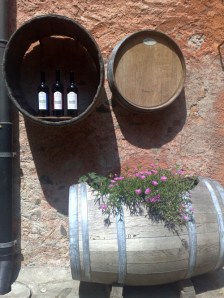
Barrell smallAs for wine, Ticino often suffers from rain and dampness in October which has a tendency to cause rot – but sadly not of the noble kind – the Botrytis cineria here in Ticino is far from benevolent! Hence, grape growers have been keen to plant early ripening varieties, most notably Merlot.  In recent years,  these red grapes have also been used to make the white wine Bianco di Merlot, which can have complexity and subtle flavours – when well-vinified they have a fresh acidity that goes really well with the local food.

  • Tenuta Bally & von Teufenstein, with vineyards and winery at Vezia, a short distance from Lugano, produces a good range of interesting wines.  As well as a rich and fruity Bianco di Merlot, their red wines (Cresperino 100% Merlot; Riserva Ernesto 75% Merlot, 25% Cabernet Sauvignon) are generally much fuller and with better tannin structure than many of the rather light Merlots that can be found in Ticino.  Their Tre Api Merlot Riserva from the excellent 2007 vintage is made from old vines, and has fine soft tannins with a real richness of flavours – combining redcurrants, blackberries and violets.  They also make a rosati wine (Sarabanda) and a sparkling Spumante di Merlot, as well as a white (La Piana) that combines Sauvignon Blanc, Chardonnay and Semillon, and an 100% Chardonnay (La Sfinge)

2 Comments

Filed under Accessibility, ICT4D, Restaurants, Wine

OECD report on demography and higher education

The OECD has recently (2008 ) published an important monograph entitled Higher education to 2030 (Volume 1): demography (read only version)  In summary, this assumes that:

  • There will be continued expansion of student participation, with majority female participation, greater variation in student profiles and increased emphasis on issues of access and equality.
  • The academic profession is to become more internationally oriented and increasingly mobile. There will also be greater variety in academic employment contracts and a movement away from the traditional concept of a self regulated community of professionals.
  • Society will contain a greater proportion of graduates which will have implications for social well-being and economic growth, the gap between the number of graduates from OECD area and from emerging economies (especially China and India) will be significantly reduced and issues around the social exclusion of those without HE qualifications will rise.

It is a long – but interesting – read, and includes syntheses of much useful data.  It is good to see a chapter by Serge Enersold on ‘Adapting higher education to the needs of disabled students’.

1 Comment

Filed under Accessibility, Higher Education

Refurbished assistive technology hardware

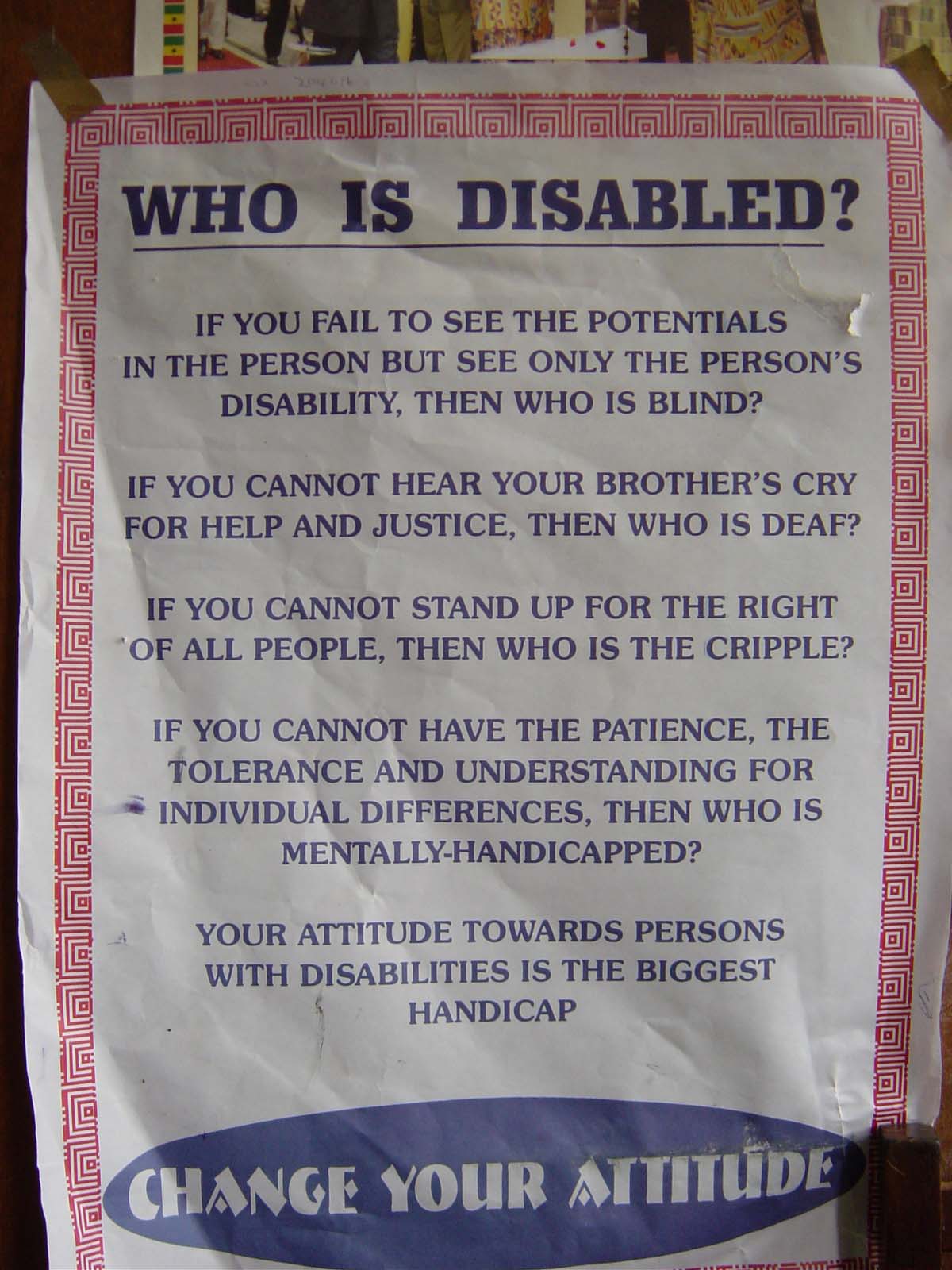
I have long thought that it is close to obscene that ICTs designed to suport who-is-disabled1people with disabilities are often much more expensive than the standard computers and mobile ‘phones that most of us take for granted.  In large part, this is because of relatively low demand for assistive technologies.
However, ICTs can transform the lives of people with serious disabilities much more than they can help those of us who have fewer disabilities.

There is a huge debate about the value (or otherwise) of refurbished computers being sent to the poorer countries of the world – and there are clearly examples of good and bad practices in this field.  Ideally we should strive to bring down prices of assistive technology so that people in poorer countries can afford them – but the reality is that this is unlikely to happen.  It is great to see some companies such as Apple, building its universal access software into every computer it sells – but everyone is not so enlightened.

I am therefore exploring the possibility of working with companies producing assistive technology hardware and existing computer refurbishment organisations to collect and distribute such hardware to people in the poorer countries of the world.  I would be really interested in people’s thoughts on this – and particularly on offers of help.

In the meanwhile, the ICT4D Collective has a page on accessibility/disability which might be of interest to readers of this blog!

Leave a comment

Filed under Accessibility

Web Accessibilitiy Initiative’s new standards

Those interested in the use of the Web for and by people with disabilities will be gladdened by the announcement by W3C on 11th December 2008 that it had launched “a new standard that will help Web designers and developers create sites that better meet the needs of users with disabilities and older users. Drawing on extensive experience and community feedback, Web Content Accessibility Guidelines (WCAG) 2.0 improves upon W3C’s groundbreaking initial standard for accessible Web content, applies to more advanced technologies, and is more precisely testable”

Further information is available at:

Leave a comment

Filed under Accessibility