Are you or your organisation thinking of endorsing the Global Digital Compact (GDC)? Has your organisation already endorsed it? If so, please think again, and make a valuable political statement by not endorsing it. Endorsing it gives validity to a flawed process and a deeply problematic document. If it only receives a few endorsements those behind it cannot claim legitimacy, despite it having been agreed by governments participating in the UN Secretary General’s Summit of the Future. Those behind the GDC state that it is a “roadmap for global digital cooperation to harness the immense potential of digital technology and close digital divides”. Put simply, as it is currently structured it cannot deliver on this (for some of the reasons why see Reflections on the Global Digital Compact, Why “we” (the people of the world) need to reject the Global Digital Compact, and Scientism, multistakeholderism and the Global Digital Compact). The endorsement process “calls on all stakeholders to engage in realizing an open, safe and secure digital future for all”. As it is currently worded, it will never deliver this.
Choosing not to endorse the GDC is a positive action that will save a huge amount of unnecessary time and effort – and thus money – that could better be spent on delivering effective digital futures in the interests of the many rather than the few. Here are six things to think about before you make a decision:
Have you read it all? You cannot endorse the document unless you agree with it. I also wonder how many people in the 106 organisations that have already signed it have actually read the full document, and do indeed agree with its content? If you do not agree with all of it, how can you endorse it?
Does the UN Secretariat have the capacity (both quantitatively and qualitatively) to manage the envisaged GDC process. Despite the planned dramatic expansion of the Office of the Tech Envoy, do you think there is capacity within the UN Secretariat to manage all of the endorsements and engage you actively in future processes and activities? Anyone who is aware of the time and effort that have already been spent by UN agencies in delivering previous global digital initiatives (and processes such as WSIS and the IGF) will know how complex and difficult this is. Do you have faith that the UN Secretariat can effectively deliver the required management of the GDC process? What indeed will this involve?
Whose interests does the GDC really serve? Is it anything more than a vanity project for a few leaders within the UN Secretariat, and the powerful interests that they serve? Will it really deliver benefits in the interests of the world’s poorest and most marginalised? If you do not think so, you should not endorse it.
Is your organisation merely signing it for appearance’s sake? Are you afraid that you might miss out on an opportunity? Is it just a chance to rebrand what you are already doing, and be seen to be supporting a “global” initiative that has the UN label behind it?
Are you endorsing it primarily in your own interests? Are you doing this in the hope that there could be possible future advantages for your own organisation in doing so? Are you really committed to doing things differently so that digital technology can indeed be used by everyone in their own interests? That means everyone, not just the rich and powerful. Are you really going to change fundamentally what you are doing so that you work in the interests of those without power, without a voice, who are being enslaved by those driving the future of digital tech?
How can you endorse the GDC if you do not yet know exactly what this means in terms of your future commitments? Apparently endorsing the GDC merely means that you endorse its vision and principles. Do you really endorse all of them? If not, can you endorse it? The endorsement protocol also states that “Organisations and associations can specify action areas where they are involved in and/or interested in contributing, regardless of whether they have endorsed the Compact”. Yet, this does not say what is meant by “contributing”. What do you really want to contribute, and how will you do so?
Please think twice before endorsing the GDC. Do you really think that it provides a sufficiently rigorous or comprehensive framework for crafting a future for the design and use of digital tech that will serve the interests of the world’s poorest and most marginalised people and communities. If you care deeply about these issues, can you really endorse it?
I have previously written at some length about why the UN Secretary-General’s Global Digital Compact (GDC) is a deeply flawed agenda.[i] I will not repeat those arguments in detail here, but they do provide important context for the comments that follow. The first revision of the GDC text, published on 15 May 2024, provides a useful opportunity to review progress, and assess once again its strengths and fundamental weaknesses. This is timely following the recent WSIS+20 summit in Geneva, where many people I spoke with seemed to be vehemently against the GDC in private, but few were willing to make public statements about it – other than those with a vested interest in its agenda.
In summary
The essence of the GDC – and why it is so flawed – is captured in its scene setting opening paragraph:
1. Digital technologies are dramatically transforming our world. They offer immense potential benefits for the wellbeing and advancement of people, societies, and for our planet. They hold out the promise of accelerating the achievement of the Sustainable Development Goals.
There are three fundamental reasons why this is so problematic:
First it adopts and propounds an instrumental view of digital tech, claiming that these technologies are transforming our world.[ii] There has in contrast been much literature in recent years that emphasises that it is not the technologies that are actually doing this, but rather that these changes are caused, deliberately and also perhaps sometimes unintentionally, by those who conceive, design, produce and sell them.[iii] It is these people, those I often refer to as the Digital Barons,[iv] and their acolytes (or “knights” – not necessarily in shining armour) who are actually the ones changing the world. We must focus on them, rather than the technologies they create, if we wish to gain a sounder understanding of the causes of change, and therefore what we have to do to rectify them.
Second, this opening paragraph’s claim that “They offer immense potential benefits for the wellbeing and advancement of people, societies, and for our planet” tells but half the story. Digital technologies are designed and used to do both harms and positive things, but this scene-setting statement chooses only to focus on the latter. It thereby reinforces the widespread focus by those promoting the view that digital technologies (as well as science and innovation more generally) are inherently “good”. This is nonsense. There is some recognition later in the first revision draft of a small number of potential harms caused by digital tech, but by failing to call this out in the opening paragraph those drafting the document reinforce the view that the harms are somehow an aberration, and that digital tech is inherently good. Harms are central to digital tech.
Third, those drafting the document link the GDC directly to the achievement of the SDGs and Agenda 2030, seeing digital tech as a saviour that will magically accelerate their success. Connecting everyone in the world, even if that were possible, would not necessarily solve the problems of poverty and inequality. It might actually make them worse. The SDGs were fundamentally flawed in their design and very few of them have any hope of being achieved by 2030. Not only is the economic growth agenda underlying them actually causing greater relative poverty in the world, but the use of digital technologies is also at the heart of this accelerating inequality and the increased damage being caused to the natural physical world. It is time to start looking beyond 2030 if we are to have any hope of making the world a better, more equitable, and nature-friendly place for humanity.[v]
The opening paragraph of the GDC did not have to be written in this way. It could have been drafted to reflect a completely different understanding of the use of digital tech in our societies, but that would not have served the coalition of interests between global capital and the UN Secretary-General’s Office that lie at the heart of the GDC.[vi]
These introductory concerns suffuse the whole document and summarise the main reasons why I see the GDC as actually being harmful to the interests of the poor and marginalised. The next sections go on to address in more detail some of the problems associated with GDC in terms of its novelty and claimed necessity, its use of language, and its modality of delivery. The penultimate section then notes some of the more positive attributes of the draft, before the final section highlights its most egregious aspects.
There is little if anything new about the GDC.[viii] We have been discussing these issues for at least a quarter of a century, and there is a wealth of material written about them, not least generated by existing entities such as the WSIS Process, the Internet Governance Forum and ICANN. Yet much of this does not seem to be sufficiently recognised in the GDC first revision.[ix] It is almost as though the UN Secretary-General and those in his Secretariat have recently discovered the importance of digital tech, yet know very little about it, and nevertheless wish to claim leadership over the global digital-development agenda. This revised version of the GDC reads much like a partial synthesis of existing knowledge in the field, rather than a significant proposal to create an innovative, wise and forward looking document.[x]
Moreover, para 70 has the audaciousness to propose that “We recognize the role of the Secretary-General in leading UN system-wide collaboration on digital and emerging technologies”. Why should the UN Secretary-General, who is already very busy, and appears to have little in-depth knowledge about the interface between digital tech and development, be charged with leading this, when there are many other people in the UN system (not least DGs or SGs of UN agencies) who have many years of good experience and understanding in this field and would be better suited to the task?[xi] It is positive that he appears to have recognized the importance of the ways through which digital technologies are being used to create a new type of world, but surely the Secretary-General of the United Nations should be delegating this to someone else more experienced for the task and be focusing instead on the fundamental purposes of the UN, such as those articulated in Article 1, Paragraph 1 of the UN Charter, which emphasises the core purpose of the UN as it relates to peace:
“To maintain international peace and security, and to that end: to take effective collective measures for the prevention and removal of threats to the peace, and for the suppression of acts of aggression or other breaches of the peace, and to bring about by peaceful means, and in conformity with the principles of justice and international law, adjustment or settlement of international disputes or situations which might lead to a breach of the peace”.[xii]
This is to my mind a much more pressing need for the world in the mid-2020s, than is his attempt to take a lead on the global discourse on digital tech.[xiii]
Language and intent
There are also very real issues with the language used in the document, particularly from a legal perspective. Two key issues need further consideration: the distinction between “must” and “will” in the wording; and also who “we” actually refers to.
There are seven uses of the word “must”,[xiv] and 36 uses of “will” in the GDC First Revision. Generally in contractual parlance, “must” is used to impose an obligation, whereas “will” is used to refer to something in the future, but not necessarily to create an obligation, although the context of any such usage has important implications for its meaning.[xv] Although some will see many of the “musts” and indeed the “wills” in the GDC as desirable, it is unrealistic to think, for example, that any government (see below on who “we” are) could agree to a document that requires them to agree to all of the “musts” or even more loosely to all the “wills”. Some may aspire to many of these, but aspiration is fundamentally different from agreeing that they “must” do something.
Even more concerning is that nothing is said in the document about what might happen to a country, UN agency, or other entity that fails to deliver on an obligation relating to a “must” (or even a “will”). Furthermore, none of the “musts” appears to be time-bound in the document, and so are presumably meant to be started, if not completed, forthwith, and certainly by 2030; most of the “wills” are likewise merely aspirational, without any time limit.[xvi] Ten of the paragraphs in the GDC relating to commitments do specify a date, as in “we commit by 2030 to”, but another eight merely say “we commit to”. It is unclear whether this distinction between must and will is a result of loose drafting, or whether a distinction in meaning is indeed intended.
There is also ambiguity in the meaning of the words “commit” and “commitment” in the text. Overall, there are 63 commitments listed under the headings “we commit by 2030 to” and “we commit to”, but the character of these commitments varies from vague aspirations such as “increase the availability of digital technology platforms…:” (para 13b) and “Foster an open, fair, inclusive and non-discriminatory digital environment for all” (para 21a), to much more precise ones such as “Develop, through multistakeholder consultations, effective methodologies to measure, track and counter sexual and gender-based violence which occurs through or is amplified by the use of technology” (para 30e). Most are on the decidedly vague side, and despite a commitment in para 9 to “pursue meaningful and measurable actions”, no clear criteria are given to measure any of the commitments. It is difficult to see how anyone could agree to something that is not clearly defined and has no real means of evaluating whether or not it has been successful.[xvii] Most of the aspirations when looked at in detail are also unattainable.
Second, it remains very unclear as to exactly whom the word “we” refers in the Global Development Compact. The Office of the UN Secretary-General’s Envoy on Technology (OSET) states that “The Common Agenda proposes a Global Digital Compact to be agreed at the Summit of the Future in September 2024 through a technology track involving all stakeholders: governments, the United Nations system, the private sector (including tech companies), civil society, grass-roots organizations, academia, and individuals, including youth”.[xviii] Those attending the Summit are defined as “world leaders”,[xix] which narrows the field a bit, but is noticeably rather in contradiction to the GDC’s claim to include “grass-roots organizations, academia, and individuals, including youth”. In practice, Resolution 76/307 of the UN General Assembly on the modalities for the Summit of the Future makes clear that the action-oriented outcome document of the Summit will be agreed by consensus through intergovernmental negotiations (para 4), and therefore implies that it is governments who will make the final decisions. Given that the Summit is due to be held on 22 and 23 September, only three and a half months away, it is difficult to see how this might be achieved. Moreover, throughout the GDC there is mention of the importance of “multistakeholderism”[xx] (better as “multi-sector approaches”[xxi]) and language as noted above that implies a diversity of stakeholders must be included. This is recognised in Resolution 76/307 para 11 which requests the President of UNGA to draw up a list of relevant others who might participate in the Summit. At one level, it appears that “we” means everyone involved, at another it seems to imply governments, and at another UN agencies with the UN Secretary-General at the helm (as noted above). Reaching agreement amongst governments, the private sector and civil society about the complexity involved around the future governance of digital technologies by the deadlines required for the Summit seems palpably unrealistic. In practice, it is likely to be governments, heavily influenced by the private sector and global corporations, who will make the decisions. There is no guarantee that this will be in the interests of the vast majority of the world’s peoples, and especially of the poor, weak and marginalised.
Practicalities of delivering the GDC
Reaching agreement on the conceptualisation of the GDC is bad enough; putting any agreements into practice would be even worse. Who will serve as its Secretariat and be responsible for delivery ? How will entities actually make their commitments? How will these be monitored and reported? Who will pay for the very significant costs involved?[xxii] What will happen if an entity fails to deliver all the “musts”, “wills” and commitments”?
It is difficult to see how any single body could oversee and deliver all of the 63 GDC commitments, especially by 2030. Although it is not made explicit in the draft, the imprimatur that it gives to the UN Secretary-General would suggest that one option could be that it is intended for it to be delivered by OSET.[xxiii] However, the staffing of this office would seem to be insufficient in both quantity and relevant experience to be able to deliver on such an undertaking. While some people working within the orbit of the Office, mainly in an advisory capacity, do indeed have considerable expertise relevant to “digital and development”, this is by no means true of many of the staff there.[xxiv]
It is therefore good to see that the first revision of the GDC does indeed make reference to “building on” some of the existing UN structures that do indeed address these issues. This is welcome news, and runs counter to some of the earlier talk suggesting that the UN Secretary-General’s office was seeking to take central control over the future of digital tech and development. WSIS is thus mentioned 8 times, and it is reassuring to note that it states explicitly in para 5 that “We remain committed to the outcomes of the World Summit on the Information Society (WSIS) reflected in the Geneva Declaration of Principles and Plan of Action and the Tunis Agenda for the Information Society”. Likewise, the Internet Governance Forum (IGF) is mentioned four times, including the suggestion that “We consider that the Internet Governance Forum has a key role to play in amplifying the Compact’s purpose and objectives to a global multistakeholder constituency through its national and regional networks” (para 73). Such statements though, do not go far enough in challenging the perception that the GDC process is merely reinventing the wheel, is unnecessary, and is making the same mistakes that previous efforts to reach global agreements around digital tech have made in the past. They also still suggest that WSIS, the IGF, and other processes such as the United Nations Commission on Science and Technology for Development (CSTD) should be subservient to the Compact. Why is the Compact needed if it does not actually have the capacity to deliver anything worthwhile and substantive?
On the bright side
The first revision of the GDC does have some elements that many people will find welcome. Not least, this is because it repeats much of what has been said previously in numerous global fora about the governance of digital technology and its interface with international development.
Its five unexceptional main objectives are to:
“Close all digital divides and accelerate progress across the Sustainable Development Goals;
Expand inclusion in and benefits from the digital economy for all;
Foster an inclusive, open, safe and secure digital space that respects, protects and promote human rights;
Advance responsible and equitable international data governance;
Strengthen international governance of emerging technologies, including Artificial Intelligence, for the benefit of humanity”.
Nevertheless, the wording of some of these is deeply problematic for the reasons outlined in my introduction above, and are discussed further in the next section.
There are also numerous, small items of detail that can be welcomed:[xxv]
The potential of new risks to humanity (para 3), although note that these tend to be phrased as exceptions or aberrations, rather than as fundamental characteristics of digital technologies;
Shared responsibilities that are necessary to anticipate and mitigate risks (paras 3 and 63), although little is said about the practicalities and partnerships necessary to deliver this;
The emphasis placed on inclusive, open, safe and secure digital space (Objective 3, paras 14, 22-35), although many of these are aspirational and again fail to recognise sufficiently the explicit and deliberate harms caused by the design and use of much digital tech;
The attention paid to accessibility and affordability (para 8g), although even here the assumption is about full participation (which serves the interests of global capital and surveillance), and ignores the notion of the “right not to be connected”;
Developing and agreeing principles for environmental sustainability (paras 8e and 47), although there is an urgent need to go much further than what is anticipated here in the GDC and Summit of the Future more broadlyt;[xxvi]
The need for robust cyber-security and information integrity standards and capacity (paras 20, 28, 30, 32, 34, 35), although the scale of what is required here is not sufficiently emphasised;[xxvii] it is also especially positive to see the emphasis that is placed on child protection (paras 23c, 31c);
The emphasis on “human rights”, mentioned 32 times will be welcomed by many, but there is also a need for this to be balanced by an equivalent emphasis on “human responsibilities” that redresses the focus away from the individual and towards the community;[xxviii]
The attention paid to the gender-based abuse, and especially to sexual violence (paras 29-30), although this needs to emphasise that it is across the full spectrum of gender identities, and that such violence also occurs to many other minorities who require equal attention and protection;
The protection of privacy (para 38a), although this increasingly seems a lost cause; it is good to see para 38d highlighting that “data collection, access, sharing, transfer, storage and processing practices are transparent, secure and in compliance with international law”; and
The emphasis placed in Objective 5 (paras 47-61) on the governance of emerging technologies; although as discussed further below this is rather limited in scope
Why “into the long grass” is a good option for kicking the GDC[xxix]
If some people enjoy spending time on developing initiatives such as the GDC, think that it serves their own interests, and can find people to fund the process, then who is to stop them? However, no-one should be under any impression that the proposed GDC document and process will make any significant difference to, or improve the lives of the many. Rather, as hinted at the beginning of this piece, it largely reflects an intriguing attempt to include and balance the power between global capital and national governments. It is a document that serves the interests of the rich and powerful against the poor and the weak and the marginalised. The best thing that could happen to it is that governments and UN agencies should reject it outright and condemn the UN Secretary-General and his acolytes for having wasted so much time and money on a vanity project.[xxx] That is hardly likely to happen, and so the second-best option would simply seem to be to kick it into the long grass. The UN has an uncanny knack of being able to do this, and so it is perhaps the optimal outcome that can be expected.
The fundamental problem with the GDC is that it is a product of a global system that has become ever more focused on serving the interests of those with power, especially the digital barons and the countries where they choose to live, at the expense of the world’s poorest and most marginalised people. It is premised on the basic assumption that digital tech is inherently good. This is fundamentally flawed. Most digital tech is developed and designed to enslave as many people as possible, so that profit can be extracted from them. In so doing, it also has devastating negative impacts on the environment. Many people are happy with this, and see it as being positive. I do not see it in this way, and I believe passionately that the global community (if such a thing still exists, or has ever existed) needs a fundamental rethink about digital tech if we are indeed to have a future.
As I argued in my earlier critique on the origins of the Global Digital Compact in April 2023, if it were to exist at all, it should be forward looking and far reaching focusing on three core challenges:
The fundamental changes taking place in the relationship between machines and humans (focusing more on cyborgs than on the latest digital-fetish, AI);
The fundamental implications for the environment as a result of the techno-digital-innovation complex that we are deliberately creating and thus our survival on planet earth; and
The increased enslavement (loss of freedoms) of humans by machines and their designers (I here leave open the option that the machines may one day design themselves).
On a more practical note, many aspects of the present framing of the Global Digital Compact are deeply problematic, and it if were to be adopted would make the matters it claims to want to solve even worse. In addition to the three main problems embedded in the opening paragraph, and summarised at the start of this piece, the most significant of these are (in broadly chronological order as they appear in the first revision document):
Its emphasis on human rights (first in para 5, and then mentioned 31 further times; see also above) is deeply problematic because it fails sufficiently to address the responsibilities or obligations of governments and individuals. Furthermore, it creates a tendency to focus on individual rights rather than communal responsibilities.[xxxi] In essence, the present rapid expansion of the use of digital tech in most people’s lives is deeply threatening to many kinds of “freedom”,[xxxii] and can thus be suggested to be inherently harmful to existing human rights law. It is either näive or deliberately misleading to claim that “Our cooperation will harness digital technologies to advance these rights”.[xxxiii]
The notion of digital divides in para 7(1) (and 7 further times; see especially Objective 1, paras 10-17, and para 22) has long ago been shown to be deeply problematic.[xxxiv] Digital tech is actually being used to increase inequality and thus divides, and so it cannot be claimed that these can simply be closed thrieugh further use of digital tech. We need to recognise that its untrammelled use causes inequalities at all scales.
The claim that the cornerstone of the Compact is inclusivity in para 8(1) (and 18 further mentions of “inclusive) ignores the realty that the poorest and most marginalised do not have a voice in such forums. Despite some efforts by the UN system to include diverse voices, and representation from all states, it remains (and is likely to do so in the future) the case that governments of small and poor states cannot afford (both in terms of time and funding) to participate in many such international gatherings on digital tech.[xxxv] Moreover, it is extremely difficult for most civil society organisations to stand up to the physical and financial weight of private sector companies in participating in such “multistakeholder” gatherings.[xxxvi]
The conceptualisation of development embodied in the SDGs and Agenda 2030, as mentioned in para 8(b), is essentially grounded in an ideology of economic growth that actually increases relative poverty.[xxxvii] The notions of eradicating poverty and leaving no-one behind therefore become unachievable and meaningless. Relative poverty will always be with us; it is an inalienable accompaniment to the ecomomic system that we have created, and will only be made worse through expanding the use of digital tech in its present modality.[xxxviii] Using phrases such as “Emerging technologies offer new opportunities to turbocharge development” (para 8i) are undoubtedly true, but ignore the fact that these will also dramatically increase inequality and exploitation of the poor.
The claims in the Compact over the potential of digital tech to “empower all women and girls” (para 8d) are ill-considered and illusional. Women and girls cannot all be empowered when there are so many men who are hostile to this and do not understand what they need to do to change their mothers’, sisters’ and daughters’ lived experiences. Moreover, digital tech is usually used to accentuate existing socio-economic and cultural characteristics: where there is equality it can help to maintain this, but where there is inequality it is usually used to exaggerate it.[xxxix]
The Compact’s focus on environmental sustainability (first mentioned on para 8e, and then twice afterwards) is at best over-simplistic. It pays insufficient attention to the very significant harms that are caused to nature and the physical environment by the design and use of digital tech. To be sure, digital tech can be used positively to reduce carbon emissions and monitor environmental change, but the UN needs to adopt a very dramatic change of approach to this issue if real environmental sustainability is to be achieved, such as the holistic approach proposed by the Digital-Environment System Coalition (DESC).[xl] The compacrt’s aim, for example, to achieve “net-zero” (presumably meaning net-zero carbon emissions) takes no cognizance of the other environmental harms that will be caused in seeking to do so.
As noted above, private sector interests lie at the heart of the GDC, as evidenced by paragraphs such as the principle 8(j) “Innovation-friendly: Creativity and competition drive digital advances. Our cooperation will foster innovation and the potential for societies and businesses, regardless of size or origin, to reap the benefits of digitalization and thrive in the digital economy”. This is where the true interests behind the GDC are to be found, and do not provide the basis for a better world. Para 11(b) for example, places emphasis on new methods of funding, which in effect are designed to reduce the costs for the private sector in rolling out digital interventions from which they will reap profits.[xli]
The emphasis on capacity building in digital skills (para 13a), especially for women and girls (para 13c), is open to many different interpretations. In the context of the GDC, it seems as if this refers primarily to enabling everyone to have the skills to contribute to the digital economy, thereby increasing economic growth. However, it is essential that it also means training people in the safe wise and secure/private use of digital tech, so that they can limit the very significant harms that can be caused to them through such use. While the Compact does indeed refer to the importance of cyber security, again this seems to be primarily in the importance it has for the digital economy (see, for example, paras 20, 21i, and 13e ), rather than for the life-changing personal harms that its use can cause.[xlii]
The use of the term “best practices” (7 times) persists in the myth that such things exist.[xliii] The term is almost always used by some individual or entity wishing to promote (or more usually sell) their particular approach to as large a market as possible, preferably universally (hence “best”). In reality, there are many good practices that people or governments can choose from and adapt to implement something that works well in their local context.
The proposed commitment by 2030 to “Foster an open, fair, inclusive and non-discriminatory digital environment for all” (para 21a) is deeply problematic. Much depends on how the word “foster” is understood, but it is totally impossible for an open, fair, inclusive and non-discriminatory digital environment for all to be achieved by 2030. Moreover, there is no evidence or proposed mechanism to support how this might be achieved. As argued before in this piece, the digital tech companies thrive on inequality, and have shown little evidence of designing technologies that could deliver on such an aspiration, however desirable it might be.
The commitment to “Refrain from Internet shutdowns and ensure that any restrictions are in full compliance with international law, including with the principles of legality, necessity, proportionality and non-discrimination” (para 28d) may be well-meaning, but it is remarkably naïve to think that all governments and potentially malicious actors would agree to such a constraint.
Para 31 is problematic when it states “Call on digital technology companies and developers to engage with users of all ages and backgrounds to incorporate their perspectives and needs into the life cycle of digital technologies”. It is unclear why tech companies should consult babies (or old people in advanced stages of vascular dementia and Alzheimer’s disease) to understand their perspectives (see para 31a).[xliv] To be sure their interests should be considered, but as with so much of the document the actual wording lacks precision and is open to multiple interpretations.
The suggestion that “we” urgently need to “Call on social media platforms to enhance the transparency and accountability of their systems” (para 35) seems to lack the necessary bite, and avoids difficult questions around regulatory environments that different widely in various parts of the world. Yes, social media companies must be made to be more transparent and accountable, but just “calling on” them is unlikely to make any significant difference. Likewise it also seem far too late to try to “Empower individuals and groups with the ability to consider, give and withdraw their consent to the use of their data and the ability to choose how that data is used” (para 38). Although this is highly desirable, it seems completely unfeasible across every country in the world.
Why do we need yet another scientific panel on AI and emerging technolgies (para 53a), and what does it mean that this should be under the auspices of the UN? There are already countless forums where such issues are discussed, not least within UN agencies such as UNESCO and the ITU; there is no need for yet another one. Moreover, if this actually means that it should be under the auspices of the UN Secretary-General, there is little justification for it, and it would therefore largely seem to represent yet another power-grab by those surrounding him.[xlv] Can the UN affrd the proliferation of such bodies?
Why does para 58 use the inappropriate and divisive terminology “North-South, South-South and triangular collaboration”, when the word “global” would suffice? The use of such terms implies geographical determinism that is innacurate and unhelpful.[xlvi]
Ultimately, much of the document would seem to be based on the requirement for more funding to be made available to those wishing to implement and benefit from the contents of the GDC. This is acknowledged directly in para 65 which is a plea for governments, international financing entities, and companies to make financial pledges in support of the Compact. Such pledges are notoriously hard to monitor, and their precise impact is almost impossible to measure. Some companies may wish to contribute to raise their visibility in apparently “doing good”, and further contributing to the SDGs, but in practice they will also largely be the ultimate beneficiaries.[xlvii]
In conclusion
The processes leading to, and the first revision of the Global Digital Compact text are part of the problem and most definitely not a solution for the future use of digital technologies in the interests of everyone living in the world and those yet to be born. It is an outcome of the processes leading to the global digital crisis that gave rise to its birth. Those involved in crafting it are those resposible for the crisis. They are incapable of shaping a solution that will serve the world’s poorest and most marginalised peoples.
It is time for a fundamental rethink of the role of the UN Secretariat and its Secretary General. The issues that the Global Digtial Compact seeks to resolve are already being discussed by every UN agency, and by the governments of countries across the world. There is no need for this Global Digtial Compact. The document is deeply flawed, and for the reasons discussed above will not achieve its proposed outcomes. It is primarily a product of the coalition of interests between private sector companies and the UN system that serves both at the expense of the world’s poorest and most marginalised people and communities.
Its failure lies above all else in its genesis, and is well summarised by its opening paragraph. If we, the global we, are indeed to move forward, we need to recall that digital technologies have no power of themselves, that they can be used to do much harm as well as good, and that the economic growth model at the heart of the SDG agenda will never serve the interests of the world’s poor.
[v] Note too that the allocation of SDGs to many paragraphs of the GDC often seems to be quite random and rather difficult to justify – although that is in part a fault of the SDGs themselves which are often difficult to differentiate.
[vi] Not least as they are represented in the Office of his Envoy on Technology.
[ix] Although see further below on the GDC’s claims that it aims to build on the work of entitites such as the WSIS Process and the IGF. It is hard to find anything that the GDC actually adds to existing processes.
[x] It would actually be an interesting experiment to use different General Purpose AI systems to draft such a document and see how it differed from that produced through the GDC consultation process. Perhaps all of the submissions could be entered into such a system and a new draft constructed from them.
[xi] To be sure, Guterres graduated in the early 1970s with a degree in engineering, but neither this nor his subsequent career would seem to make him suitable to lead UN system-wide collaboration on digital tech. Having graduated, he worked briefly as a physics instructor and joined the Socialist Party in 1974. In 1976 he was elected to parliament, and became very much more active in national politics and the wider international Socialist movement, eventually becoming Prime Minister in 1995 (serving until 2002). Although focusing particularly on the economy, finance, planning and territorial administration, his time in politics provided him with little experience in digital tech and development. Thereafter, his UN experience from 2005 was likewise almost exclusively as High Commissioner for Refugees (a role he served in until 2015), and again in this capacity he had little real opportunity to become a global specialist in digital tech and development. See Britannica (2024) António Guterres https://www.britannica.com/biography/Antonio-Guterres, and United Nations Secretary-General biography https://www.un.org/sg/en/content/sg/biography (7 June 2024)
[xiii] The revised draft of the Pact for the Future, which is the core document of the UN Secretary General’s Summit of the Future rightly has Peace and Security as one of its key objectives (Section 2), but it is salient to note that the GDC is one of only two banner headings/sections on the summit’s website, the other being the Declaration of Future Generations. More generally, the Pact for the Future also suffers from many of my criticisms of the GDC. Although it claims to focus on the practicalities of how we can together create multilateral solutions for a better tomorrow, most of it is vague and aspirational, with very little chance of having any real impact in terms of improving the lives of the world’s poorest and most marginalised peoples.
[xiv] GDC First Revision, Para 2 “Our cooperation must leave no one behind and increase the potential for all states, communities and individuals to fully harness the benefits of technology”, para 6 “Our cooperation must be agile and adaptable to the rapidly changing digital landscape”, para 8c “All human rights, including civil, political, economic, social and cultural rights, and fundamental freedoms, must be respected, protected and promoted online and offline”, para 8l “Our cooperation must be capable of identifying, assessing, tracking and adapting to emerging technologies”, para 12 “…we must ensure that people can meaningfully use the Internet and safely navigate the digital space”, para 26” We recognize that the Internet is a critical global facility for inclusive and equitable digital transformation. To fully benefit all, it must be stable, secure and unfragmented”, and para 29 “We must urgently prevent and address sexual and gender-based violence which occurs through or is amplified by the use of technology, all forms of hate speech and discrimination, mis- and disinformation, cyberbullying and child sexual exploitation and abuse”.
[xvi] Only four of the “wills” (two in para 11 and two in para 43) are in sections relating to commitments by 2030.
[xvii] The document does make brief mention of the set of targets developed by the ITU and the Office of the UN Secretary-General’s Envoy on Technology developed in 2022 https://www.itu.int/itu-d/meetings/statistics/umc2030/ (although little has yet been heard on the progress that was meant to be achieved on these by 2026), but does so in rather general terms of commitment to “Agree on common targets, indicators, and metrics for universal meaningful and affordable connectivity, building on the work of the ITU, and integrate these into international, regional and national development strategies” (Para 11(a)). Interestingly, targets are only specifically mentioned in two other places in the GDC First Revision.
[xx] There are numerous mentions in the GDC of multistakeholder (10, and one mention of multi-stakeholder) engagement, the private sector (14), civil society (5), and academia (2), and the implications for their potential engagement in the GDC process. A key problem of the GDC is that there is next to nothing about the precise mechanisms for such collaboration and engagement, and nothing about the penalties that those who fail to adhere to its principles will face.
[xxii] Paras 60 and 61 thus refer to the Global Fund AI and Emerging Technologies for Sustainable Development, which “should be put into operation with an initial amount of 100 million US dollars at launch in 2025, financed by voluntary contributions from public, private and philanthropic sources”. This seems largely to be a means of creating extra funding for private sector companies to roll out these new technologies to the poorer countries of the world, thus enhancing their markets and increasing their profits.
[xxiv] It is difficult to identify the exact numbers of staff involved in OSET, and the website of the Office of the Secretary-General’s Envoy on Technology does not provide their details. LinkedIn nevertheless mentions between 11 and 50 staff: https://www.linkedin.com/company/un-tech-envoy (10 June 2024))
[xxv] The paragraph numbers are not exhaustive but merely illustrative.
[xxvii] A strong case can be made for shifting towards an attitude where all digital tech should be considered first as a threat, rather than thinking that it is actually good and that harms are an aberration.
[xxix] Rejecting the GDC outright would save governments and the peoples of the world a great deal of time that could be better spent doing other things, but as with so many global summits and agendas few people want to rock the boat too much, and it is easier simply to kick them into the long grass by agreeing to parts of documents in general terms subject to further revision and discussion.
[xxx] This was not my term for it, but was suggested to me by a good friend and colleague attending the WSIS process in May 2024.
[xxxiii] The commitment to “Establish appropriate safeguards to prevent and address any adverse impact on human rights arising from the use of digital and emerging technologies” (para 23b) is naïve and completely unachievable, and shows little understanding of how and why digital technologies are designed and used. It should be removed, or rephrased to be more realistic of what can actually be delivered.
[xxxv] See also, for example, para 37 calling for “the equal participation of all countries” in international data governance. Although this might be desirable, it is completely unrealistic.
[xxxvi] As noted above the term “multi-sector” is far preferable to “multistakeholder” when collaboration between governments, the private sector and civil society are being referred to. It can also be noted that many civil society organisations have been co-opted by corporations to their agendas, and are no longer realistically an independent voice.
[xxxvii] See also, for example, claims that AI has immense potential “to accelerate progress across all the SDGs”. Little is said about the enormous harms that could be created by so doing.
[xxxviii] It is also salient, and interesting, to note that in the Bible Matthew 26:11 reports Jesus as having said “The poor you will always have with you”. For further on relative and absolute poverty, as well as on economic growth and inequality, see my 2010 piece Development as ‘economic growth’ or ‘poverty reduction’, as well as my 2007 critique of Jeffrey Sachs’ work in “No end to Poverty”, Journal of Development Studies, 45(3), 929-953.
[xxxix] See the work of our TEQtogether initiative which involves men and women working together to transform men’s attitudes to women and technology.
[xl] See, for example, our recent contribution to the WSIS+20 meeting in Geneva in May 2024.
[xli] Typical of these are initiative such as Giga (para 11b) which inter alia make it cheaper for companies to exploit education systems and the data they glean from children and teachers across the world. Expanding the market lies at the heart of the capitalist economic system that underlies such practices.
[xlii] It is good, therefore, to see mention of cyberbullying and child sexual exploitation in para 29, but much more attention could be paid to such harms throughout the document.
[xliv] This para reads: We… “Call on digital technology companies and developers to engage with users of all ages and backgrounds to incorporate their perspectives and needs into the life cycle of digital technologies”.
[xlv] Similar arguments would apply to para 53(b) which commits to the UN creating an an International Contact Group on AI Governance.
[xlvii] The most sensible option would seem to be for no-one to provide any financial support for the Compact, which would be one way of kicking it into the long grass, and then the only wasted money would have been the cost of having drafted and discussed it at the Summit of the Future.
Whenever I mention my criticisms of Bill Gates and the Bill & Melinda Gates Foundation, I am usually met with quizzical looks, and in some instances by downright disbelief. Now I know I am not alone. Tim Schwab’s really excellent new book The Bill Gates Problem: Reckoning with the Myth of the Good Billionaire (Penguin Business, 2023) provides a detailed and rigorous account of why we all need to be concerned about the harm caused by Gates, and others like him (those I frequently refer to as The Digital Barons). It is essential reading for anyone who has received, or is considering applying for, funding from the Gates Foundation. Although the book is not without its problems, and it should be noted that the right wing (and digital) press has been far less generous than I am about it (see, for example, reviews by Ben Wright and David Enrich), it is a timely and salutary account of why Gates’ work has been so hugely problematic for “international development” and in particular for the lives of the world’s poorest and most marginalised communities.
I have long been critical of Gates, but have only occasionally written or spoken in any detail about the reasons for this. The publication of Schwab’s book provides a catalyst for me to articulate my own concerns, and compare them briefly with some of Schwab’s very apposite observations.
A problem with Microsoft
I confess that I have never particularly liked Microsoft’s products, and ever since the mid-1980s I have always purchased Apple devices and software (apart from also using Linux and Open Office). Originally, I think this was probably because I was beguiled by the slightly anarchic image of Apple’s products at that time, and because they just seemed easier and more intuitive to use. I have so often found Microsoft’s products (especially software such as Excel, Sharepoint and Teams) to be so clunky and counter-intuitive! To be fair, I increasingly now also have serious concerns over Apple’s business model, especially with respect to their environmental impact, right to repair issues, and cost, but I must be open about my early bias against Microsoft. That having been noted, I nevertheless retain some very good friends who have worked, or are indeed still working, within Microsoft.
My main criticisms of Microsoft in the 1980s and 1990s tended to be at quite an abstract level: that it seemed to be trying to create a global monopoly of operating systems and generic “office” software; that it was proprietary and “closed”; that it was too expensive for the world’s poorest to use (which is why there were so many pirated versions of its software in circulation across the world); that it was primarily a sales-led company; and that it was generating very large profits, often at the expense of those who could little afford it. These profits provided the foundation for Gates’ enormous wealth. To put this into perspective, Gates’ total net worth according to Forbes in 2023 was around $134 billion, although the actual amount he has earnt from Microsoft is impossible to calculate. According to the World Bank, only 60 countries in the world in 2022 had an annual GDP of more than this. Gates’ total wealth was about the same as the annual GDP produced by Morocco in 2022, and was more than that of countries such as Ethiopia ($127 billion) and the Slovak Republic ($115 billion), let alone the remaining 140 countries of the world who generated very much less.
At a more theoretical level, my intellectual background in Marxist theory, the Critical Theory of the Frankfurt School (especially that of Jürgen Habermas – see my The Place of Geography, 1992), my commitment to reducing global inequalities, and my concerns with the increasingly dominant power of US Imperialism (and “American Exceptionalism”) all no doubt also helped to shape my opinions about Microsoft.
In the early 2000s, I had the privilege to lead Tony Blair’s Imfundo initiative based with the UK’s Department for International Development (DFID), which was charged with creating partnerships to use ICTs for education in Africa. This brought me face to face in a very practical way with the harsh realities of the enormous inequalities that exist across the world, and how digital technologies might be used to reduce these. Microsoft’s business model did not sit well with our practice, and guided especially by my colleagues Bas Kotterink and Jason Monty we became proud advocates of Open Source “solutions” and the use of thin client Linux systems in Africa. I fondly recall the energy and enthusiasm of people such as Ed Holcroft (NetDay) and Shafika Isaacs (SchoolNet Africa) who contributed so passionately to this work, and also the commitment of private sector companies such as Cisco, Virgin and Marconi who seconded staff to work with us. Since my earliest research in rural India in the mid-1970s I had argued that “development” should be more about reducing inequalities than about increasing economic growth. My work with Imfundo convinced me even more of this “truth” (see myNo end to poverty, 2007).
Working in DFID at that time also made me acutely aware of changes taking place in the global structuring of Official Development Assistance (ODA), particularly the role of Poverty Reduction Strategy Papers (PRSPs; see IMF and World Bank, 2001), and the Paris Declaration, (2005) and Accra Agenda for Action (2008) (see OECD). I felt that things were beginning to change, and that the global donor community was at last repositioning itself to try to work collaboratively with, and more in the interests of the world’s poorest countries. I have absolutely no doubt that many of the then senior leadership team within DFID believed in this agenda. Hence, I could not help but feel that private foundations that could do what they wanted undermined the ongoing global efforts towards responding to the real needs of poor people and countries, rather than imposing our own ideologies and practices on them. The Bill & Melinda Gates Foundation (created in 2000 from the merger of the William H Gates Foundation formed in 1994 and the Gates Learning Foundation) was thus hugely problematic to me in its conceptualisation. Whilst I can understand the founders’ desire to do something different about poverty and try to overcome many of the long-standing problems of “aid”, it struck me that to create what seemed to be a parallel system was only going to make matters worse. From talking with colleagues at DFID working in the health sector, I also became all the more convinced of these distortions through the negative impacts of Gavi, the Vaccine Alliance, that had been created in 2000 with substantial support from Gates.
Meeting Bill Gates
In 2009 I had the opportunity as part of a small group of people working in the field of ICTs and development to meet with Bill Gates. I remember greatly looking forward to this opportunity to discuss some of my experiences with him, to explore why he had not yet really supported the use of digital tech in “development”, and to try to persuade him of the potential for Microsoft to use its considerable expertise to do “good” in the world through digital tech. Most of the people at the meeting seemed to be completely in awe of Gates. Perhaps my own enthusiasm at this opportunity served to fuel the sense of disillusionment and disappointement that I felt afterwards.
He was so arrogant; he did not brook any real discussion. He swiftly closed down any attempt to engage in critique. He just wanted us to accept what he said as being “the truth”. He conveyed the impression that because he had been successful in business it was only right and proper that he should know how to solve poverty. He seemed to know very little about the actuality of the lives of the world’s poor. He implied that he had a right to try to change the world in his own image because of his success and wealth. He appeared to have no comprehension at all that digital tech drives global inequalities and its use can cause immense harm. In short, I found the brief meeting to be extraordinary and disappointing.
Despite this, having heard that he was an avid reader, I remember arranging for my recent edited book on ICT4D to be sent to him in the naïve expectation that he might read it and learn something. Unsurprisingly, I never heard back…
I have often thought about this encounter, not least because it fundamentally influenced my subsequent attitudes to both him and his Foundation. At the centre of my concerns was that Bill Gates is funding development practices based primarily on his own (flawed) vision of the economic growth model, with apparently little understanding of the impacts that this has on inequality and its negative effects on the lives of many of the world’s poorest people – especially with respect to the use of digital tech. I was therefore delighted to read such similar thoughts in Tim Schwab’s critique in The Bill Gates Problem (pagination from 2023 Penguin Business edition):
The Foundation is “… an institution that thrives on the grotesque economic inequalities that govern the globe, that counts on the rest of us to be too poor or too stupid to say no to its largesse” (p.18).
“Why have we allowed Bill Gates to take so much power from us for so long”? (p.19).
“The simple fact is Bill Gates doesn’t have expertise, training, or education in most of the topics where he asserts it” (p.127).
“While Bill Gates is widely celebrated as the most generous man on earth, during his tenure as the world’s leading philanthropic donor, he has managed to nearly double his personal wealth” (p.178).
“Bill Gates’s public persona is very much wrapped up in his identity, as a businessman and then as a philanthropist. But underpinning his success, in Gates’s own mind, is his superior intelligence” and “most journalists have embraced the Gates-as-genius narrative” (p.202).
“Giving away money is not supposed to magnify the asymmetries in power that govern society, but to collapse them. And this is precisely why, in many respects, Bill Gates mght be better described as a misanthrope – if he does not hate his fellow man, then he certainly views himself as superior” (pp.242-3).
These are just a tiny sample of the content and style of Schwab’s critique, but based on my brief conversation with Bill Gates, and listening to some of Gates’ wider rhetoric, they resonate completely with my own experience and understanding. To be sure, Schwab does not sufficiently justify his own position, and has been widely criticised for his anti-capitalist stance, for his claims around neo-colonialism, for over-generalising based on scant evidence (despite the book’s 104 pages of detailed supporting notes), and above all for not proffering an alternative vision for the future. I would also add to these criticisms that the book is written very much from a USA’n perspective in which the voices of the world’s poor are largely, although not completely, absent. However, this was not his point in writing the book, which was above all else to lay bare some of the evidence and contradictions concerning Gates’ life, his business tactics, his political influence, his philanthropy and his exercise of power without accountability.
And the Bill & Melinda Gates Foundation
The Gates Foundation has been built largely on Bill Gates’ own ideology, experience and practice, and it closely reflects his own approach to business and power. I have always found it difficult to accept the comments from people I have spoken with who work in or near to the Foundation who deny this, and who claim that Gates only provides the funding and lets them get on with delivering the development. It was therefore very refreshing to read Schwab’s detailed account of the ways through which Gates does indeed influence the policies and practices of the Foundation. At the most basic level, people who are critical of the approach and style of Gates and his Foundation are unlikely to apply to work there, let alone be appointed. However, even I was surprised at the extent of Schwab’s revelations about the levels of secrecy and control that pervade the Foundation for those who are indeed employed there. A real problem for anyone wanting to find out about the Foundation is that so few people are willing to speak truthfully on the record about it, and it may be that not everything Schwab suggests is therefore recognisable to its employees, or to those who are so eager to accept its funding. However, the overall thrust of his argument again seems to accord with my own experiences and those of people I know who have worked with the Gates Foundation.
The most important issue for me is the way that the Gates Foundation seeks to provide direction, or control, over the individuals and organisations that it funds. However, it is not a sine qua non that all foundations should necessarily behave in the same way. One of the potentially valuable things about non-governmental funding (be it through foundations or charitable trusts) is that it can be a bit anarchic and its recipients need not necessarily be tied by the parameters and reporting mechanisms required through tradiutional bilateral aid systems. Mackenzie Scott (former wife of Jeff Bezos of Amazon fame), for example, has a notoriously hands-off, trust-based approach that has raised many eyebrows amongst traditional philanthropists, in part because of her aversion to micromanagement (Candid, 2023; the Chronicle of Philanthropy). Her style is very far removed from that of Bill Gates.
I have often thought that the Gates Foundation is a bit like like a virus that gets inside an organisation in which is it interested, and then seeks to control it. This comparison has always struck me as being appropriate, not least because of the Gates Foundation’s strong support for vaccines and several of the large pharmaceutical companies. I have never therefore sought funding from Gates, and one of the reasons why I resigned from my role as Chair of the Intellectual Leadership Team and Non-Executive Director of the DFID and World Bank funded EdTech Hub in 2019 was because the Gates Foundation was also about to become one of its funders. I saw the writing on the wall, and was not willing to be party to this decision.
In conclusion: please never accept funding from the Bill & Melinda Gates Foundation
I have written this post for two main reasons: first to encourage others to read Tim Schwab’s accomplished book to help them make up their own minds as to whether or not Gates is indeed a “good billionaire”; and second to try to encourage anyone thinking of applying for funding from the Gates Foundation to think again. In a very practical sense, the best way to decompose and decapacitate the Gates Foundation is to refuse knowingly to accept its funding. I add the word “knowingly” because it is often difficult to tell exactly where research funding comes from. This will be difficult for many organisations and researchers because of the extent that they already rely upon the Foundation for support. But is not that itself an indication of how dangerous the Foundation actually is? The Foundation will cease to exist in its present form if no-one is willing to accept its tarnished money. Do we really want a world built in the image of Bill Gates? If not, we need to work consciously and assiduously to undermine what the Foundation is trying to do, and take apart the power structures that it has created. Above all we need to forge a new development discourse built around reducing inequalities rather than maximising economic growth.
Let me leave the last word to Tim Schwab with the closing words of his book:
Billionaire philanthropy, as practiced by someone like Gates, preys on our cultural biases to disguise its influence. It makes us believe that a billionaire’s giving away his vast fortune is an unimpeachable act of charity that must be exalted, rather than a tool of power and control that must be challenged.
It was a great honour to be asked by a group of young Chinese interns at the United Nations University Institute in Macau to give a short keynote address at the hybrid event that they were organising from there on 30th April in partnership with The Institute for AI International Governance of Tsinghua University (I-AIIG), forming part of the World Data Forum satellite event being convened by the Institute in the city of Macau. As their introduction to the event summarised:
The younger generation are often seen as digital natives who have more exposure and access to data technology than older generations. They are also more likely to use data technology for learning, innovation, participation and empowerment. However, this also means that they face unique opportunities and challenges related to data that need to be explored and addressed. As the satellite event of this year’s World Data Forum, this youth forum will take “Digital and Youth” as the main theme, adhere to youth leadership and youth participation, aiming to provide a platform for dialogue and exchange among different stakeholders who are interested in or affected by data and its impact on youth.
In the brief 15 minutes available, I chose to focus on three proposals:
We need new, more inclusive modes of inter-generational dialogue about digital
Just because it is possible to do something, does not mean that it is right or good to do so.
Digital tech is all too often assumed to be inherently good – but we need to mitigate the harms to ensure any good can prevail
We must all consider the environmental impact of data, and digital tech more widely.
Digital tech is often the cause of environmental harms rather than a solution
The full presentation (in .pdf format is available at Data and Youth.
The event was great fun, and the organisers had brought together many leading young academics from across China working on digital tech in general, and data in particular, divided into four main sessions:
Youth Work on Digital Humanities in Empowering the Cultural Legacy
Digital technology and Wellness
Artificial Intelligence Cutting Edge
Personal Information Protection and Data Security Governance
Many thanks to everyone involved for making this such an interesting and enjoyable experience.
emphasised the substantial amount of existing research on spectrum efficiency and energy efficiency;
highlighted the lack of existing research on “spectrum environmental efficiency” (rather than just on energy);
reflected on the observation that, although 5G is widely seen as being more energy efficient, the total increase in traffic (and sensors) means that 5G systems as a whole require more energy than was the case with previous wireless generations;
emphasised the importance of future wireless generations being designed to reduce environmental harms;
outlined aspects of the future research agenda of the working group, including:
always taking environmental considerations (not just climate and energy) into our research practice;
what are environmental implications of using different parts of the spectrum?
how do different masts/antennae impact the environment?
new ways of assessing landscape impact
environmental implications of sensor network
recommendations for good practices by telecom/wireless companies – and regulators
helping develop a toolkit for the UN Partner2Connect digital coalition
how can future wireless generations minimise environmental harms?
links with DESC working group on satellites and outer space (with UNOOSA involvement);
recognised the importance of listening to and understanding alternative/indigenous knowledges about the environment (and digital tech);
noted that the WWRF is a formal partner of DESC; and
invited members of the WWRF, and especially those from the private sector, to join DESC and contribute to our future work.
It was a great pleasure to have been invited to contribute as a panellist to Session 406 of the WSIS Annual Forum on 2nd June 2022 on the theme of “Academic perspectives on WSIS and the SDGs”. This was a hybrid event, and as the picture below shows it was sadly not attended by very many people actually in Geneva! (Follow this link for my short, full presentation.)
However there was active participation online, and it was good to share some reflections on the theme. As ever, I tried to be diplomatically provocative, reflecting on my participation in the original World Summit on the Information Society in Geneva (2003) and Tunisia (2005)…
… as well as on many occasions since at the WSIS annual forums, especially when in 2019 I changed WSIS to MISS in front of my good friend Houlin Zhao the Secretary General of the ITU:
My presentation in particular emphasised the important need for the UN system to stop replicating and duplicating its efforts to use ICTs for “development” (or should this read “to serve the interests of the rich and powerful” especially the “digital barons“?); it is striking and sad, for example, that the UN Secretary General’s Roadmap for digital cooperation and Our Common Agenda make no mentions at all of the WSIS process.
My main argument was that with only eight years to go, it is essential that we start planning now for what will replace the SDGs, especially with respect to the uses of digital tech.
I did, though, also address to other themes: how academics can indeed benefit from the WSIS process (see below) as well as a short introduction to the work that we are now doing as part of the Digital-Environment System Coalition (DESC).
It was a delight and a challenge to have the opportunity earlier today to present a keynote for this year’s IFIP 9.4 conference on Freedom and Social Inclusion in a Connected World in the form of a thought experiment on the topic of “Freedom, enslavement and the digital barons“.
My main aim was to explore how thinking about the “unfree” can help us better understand the intersection between freedom and digital tech. In particular I focused on five main themes: some of the ways in which academics have previously considered the concept of freedom within the field of Information and Communication Technologies for Development (ICT4D); ways of understanding “unfreedom”; six examples of digital enslavement; the relationships between freedom, rights and responsibilities; and the ways in which people in general and academics in particular can resist enslavement by the digital barons.
The examples of digital enslavement that I briefly explored were:
Digital addiction
We are the data
Governments enforcing use of digital systems for government services
Labour exploitation (through extending the working week)
Digital poverty and education
Digital tech contributing to modern slavery
Time precluded the inclusion of several other forms of enslavement that I might have considered. Drawing on my medievalist backgroung, I was especially interested in the role and interests of the Digital Barons.
In part, this keynote drew on arguments that I have previously addressed in more detail in
I also made it clear that appropriately designed digital tech can be used to great advantage by poor and marginalised communities, although given the theme of the confernce I concentrated exclusively on “digital enslavement” and the role of the “digital barons”.
The full slide deck (in .pdf format) is available here without the transitions and animations. It also omits the subtitles in Spanish that were included for our colleagues in Peru who had originally been planning to host us in person.
The 3rd ICT4D workshop convened by the Inter Islamic Network on IT (INIT) and COMSATS University in Islamabad, and supported by the UNESCO Chair in ICT4D (Royal Holloway, University of London) and the Ministry of IT and Telecom in Pakistan on the theme of Mainstreaming the Marginalised was held at the Ramada Hotel in Islamabad on 28th and 29th January 2020. This was a very valuable opportunity for academics, government officials, companies, civil society organisations and donors in Pakistan to come together to discuss practical ways through which digital technologies can be used to support economic, social and political changes that will benefit the poorest and most marginalised. The event was remarkable for its diveristy of participants, not only across sectors but also in terms of the diversity of abilities, age, and gender represented. It was a very real pleasure to participate in and support this workshop, which built on the previous ones we held in Islamabd in 2016 and 2017.
The inaugural session included addresses by Prof Dr Raheel Qamar (President INIT and Rector COMSATS University, Islamabad), Mr. Shoaib Ahmed Siddiqui (Federal Secretary Ministry of IT & Telecom) and Dr. Tahir Naeem (Executive Director, INIT), as well as my short keynote on Digital Technologies, Climate Change and Sustainability. This was followed by six technical sessions spread over two days:
Future of learning and technology
Policy to practice: barriers and challenges
Awareness and inclusion: strategizing through technology
Accessibility and Technology: overcoming barriers
Reskilling the marginalised: understandng role reversals
Technical provisio: indigenisation for local needs.
These sessions included a wide diversity of activities, ranging from panel sessions, practical demonstrations, and mind-mapping exercises, and there were plenty of opportunities for detailed discussions and networking.
Highlights for me amongst the many excellent presentations included:
Recollections by Prof Abdful Mannan and Prof Ilyas Ahmed of the struggles faced by people with disabilities in getting their issues acknowledged by others in society, and of the work that they and many others have been doing to support those with a wide range of disabilities here in Pakistan
The inspirational presentations by Julius Sweetland of his freely available Open Source Optikey software enabling those with multiple disbilities to use only their eyes to write and control a keyboard
Meeting the young people with Shastia Kazmi (Vision 21 and Founder of Little Hands), who have gained confidence and expertise through her work and are such an inspiration to us all in continuing our work to help some of the pooorest and most marginalised to be empowered through digital technologies.
The very dynamic discussions around practical actions that we can all take to enable more inclusive use of digital technologies (mindmaps of these available below)
Enormous thanks must go to Dr. Tahir Naeem (COMSATS University and Executive Director of INIT) and his team, especially Dr. Akber Gardezi and Atiq-ur-Rehman, for all that they did to make this event such a success.
A shortened version of this workshop was also subsequently held on Monday 3rd February at the University of Sindh in Jamshoro, thanks to the support and facilitation of Dr. Mukesh Khatwani (Director of the Area Study Centre for Far East and Southeast Asia) and his colleagues. This also focused on the practical ways through which some of the most marginalised can benefit from the appropriate use of digital technologies, and it was once again good to have the strong involvement of persons with disabilities.
High Level Session on Internet Governance at IGF 2019
I have been quite critical of the Internet Governance Forum (IGF) process in the past, arguing that it was created essentially as a talking shop and a palliative to civil society following the original WSIS meetings in 2003 and 2005 (for details see my Reclaiming ICT4D, OUP, 2017), and that it has subsequently achieved rather little of substance. I still retain the view that there are far too many “global” ICT4D gatherings that overlap and duplicate each other, without making a substantial positive difference to the lives of the poorest and most marginalised. Likewise, I have been hugely critical of the creation and work of the UN Secretary General’s High-Level Panel on Digital Cooperation (HLPDC), despite having several good friends who have been involved in trying to manage this process (see the UNESCO Chair in ICT4D’s response to the original call for contributions). I retain the view that it is poorly conceived, duplicates other initiatives, and will again have little positive impact on the lives of the poorest and most marginalised.
So, it was with much interest that I arrived at the IGF in Berlin on 25th November in response to three invitations: to participate in a session on ICTs for people with disabilities, to support colleagues involved in the EQUALS initiative intended to increase gender digital equality, and also to participate in a side event on Many Worlds. Many Nets. Many Visions, for which I had contributed a short piece on our TEQtogether initiative designed to change men’s attitudes and behaviours towards women and technology. To this end, it is salient to note the largely elderly white male dominance on the key opening plenary panel on the future of Internet governance shown in the picture above – more on that later! I had many interesting discussions during the week, but want here to share five main reflections and challenges in the hope that they will provoke dialogue and discussion.
IGF (plus?)…
Water Station at IGF 2019
It was rumoured that the German government had put aside some €10 million to cover the costs of this year’s IGF. Whilst that may well be an exaggeration we were certainly hosted in great luxury, and it would be churlish not to thank the German government for their generous hospitality. In compliance with increasing concerns over plastic and climate change, there was even a very impressive water station in the exhibition area! They had also done much to encourage the participation of many quite young people, and to get the gender balance better than at some similar digital technology events in the past. The IGF 2019 outputs are already available and make interesting reading.
UN SG speaking in IGF 2019 Opening Ceremony
However, I was struck by the relative absence of people from China, India and Russia, as well as from many of the poorer countries of the world who were unable to afford the travel costs or who had difficulties in obtaining visas. This absence set me thinking of the wider global geopolitical interests involved in the IGF process. At a time when the ITU is unfortunately being increasingly criticised by North American and European countries for being too heavily in the pocket of Chinese organisations and companies (recent criticism of China’s efforts to influence global standards on facial recognition is but one small example), free-market capitalist governments have turned ever more to the IGF as the main forum for their engagement on Internet issues.
Angela Merkel in IGF 2019 Opening Ceremony
The theme of this year’s IGF One World. One Net. One Vision. says it all (and hence why I was so eager to be involved in the innovative and creative Many Worlds. Many Nets. Many Visions initiative). The IGF is about maintaining a unitary free open Internet in the face of perceived attempts by countries such as China and Russia to fragment the Internet. It is no coincidence that next year’s IGF is in another European country, Poland, and that the last two IGFs have been in France and Switzerland. The messages of the UN Secretary General and the German Chancellor (shown in the images above) were equally forceful about the kind of Internet that they want to see.
Moreover, this hidden war over the future of the Internet is also being played out through the HLPDC process which has suggested that there are three possible architectures for digital cooperation. The presence of such high-level participants at this year’s IGF very much conveyed the impression that the IGF Plus option is the one that they prefer as the main forum for policy making over the Internet in the future. This is scarcely surprising: all but two (one Chinese and one Russian) of the 20 members of the HLPDC Panel and Co-chairs are from free-market capitalist-inclined countries; 8 of the 20 are from the USA and Europe.
The sale of .org by ISOC to Ethos Capital
Another major issue that raised its head during this year’s IGF was the very controversial sale by the Internet Society (ISOC) of its non-profit Public Internet Registry (PIR) which had previously managed the top-level domain .org to a for-profit company, Ethos Capital, for the sum of $1.135 bn.
Key elements of the controversy that were widely mentioned during the IGF, and are well summarised by The Registry, include:
ISOC’s decision under a new CEO to shift its financial structure from benefitting from the variable profits derived from .org to creating a foundation from which it would then use the interest to fund the activities of its various chapters (the new Internet Society Foundation was created in February 2019);
The lifting of the cap announced in May 2019 by ICANN on prices of .org domain names, which would enable the owner of the .org registry to impose unlimited price rises for the 10 million .org domain name owners; and
The observation that the former CEO of ICANN had personally registered the domain name used by Ethos Capital only the day after the cap had been lifted (it appears that he and a small number of his close affililates linked to ICANN are the only people involved in Ethos Capital) .
The lack of transparency over this entire process, and the potential for significant profits to be gained by certain individuals from these changes have given rise to huge concerns, especially among civil society organisations that use .org domain names. As a recent article in The Register concludes, “The deal developed by former ICANN CEO Chehade is worth billions of dollars. With that much money at stake, and with a longstanding non-profit registry turned into a for-profit with unlimited ability to raise prices, the internet community has started demanding answers to who knew what and when”.
Inclusion, accessibility and people with disabilities…
Absence of people in IGF 2019 Main Hall for High Level Session on Inclusion
It was good to see a considerable number of sessions devoted to inclusion, accessibility and people with disabilities at this year’s IGF. However, it was sad to see how relatively poorly attended so many of these sessions were. The exodus from the Main Hall between the High Level Session on the Future of Internet Governance and the High Level Session on Inclusion, for example, was very noticeable. The content of most of these sessions on disabilities and inclusion was generally interesting, and it is just such a shame that the wider digital community still fails to grasp that digital technologies will increase the marginalisation of those with disabilities unless all such technologies are designed as far as is reasonably possible to be inclusive in the first place. Assistive technologies can indeed make a very significant difference to the lives of people with disabilities, but such persons should not have to pay more for them to counter the increased marginalisation that they face when many non-inclusive new technologies are introduced.
IGF 2019 Session WS#64 on empowering persons with disabilities
I was, though, hugely challenged by my own participation in one of these sessions. Having been invited by Brian Scarpelli to be the penultimate speaker in a session that he had convened on Internet Accessibility Empowering Persons with Disabilities (WS #64), I just felt that it needed a little livening up by the time it was my turn to speak. I therefore decided to take a roving microphone, and did my presentation walking around inside the cage of desks around which everyone was seated. I wanted to engage with the “audience” several of whom did indeed have disabilities, and I tried hard to involve them by, for example, describing myself and the venue for those who were blind. The audience seemed to welcome this, and I had felt that I had got my messages across reasonably well. Afterwards, though, someone who is autistic came up to me and in the nicest way berated me for having walked around. She said that the movement had distressed her, and made it difficult for her to follow what I was saying. She suggested that in the future I should stay still when doing presentations.
This presented me with a real challenge, since I have been encouraged all my life to deliver presentations as a performance – using my whole body to engage with the audience to try to convince them of my ideas. So, what should we do when making presentations to an audience of such varied abilities? Can we cater for them all? Clearly, I don’t want to upset those with one disability. Should I ask if anyone in an audience minds if I walk around? But then, someone with autism might well not want to speak out and say that they did actually mind? Should the preference of one person with a disability over-ride the preferences of the remaining 49 people in a room? There is no easy answer to these questions, but I would greatly value advice from those more familiar with such challenges than I am.
Exclusion in the midst of diversity: being an elderly, white, grey-haired, European man…
“Many Worlds. Many Nets. Many Visions” gathering held during IGF 2019 at HIIG
Far too many international events associated with digital technologies continue to be excessively male dominated, and it was refreshing to see the considerable gender diversity evident at IGF 2019. Despite this, as noted above, several panels did remain very “male”! It was therefore very refreshing to participate in the Many Worlds. Many Nets. Many Visions side event held at the Alexander von Humboldt Institute for Internet and Society (HIIG), and congratulations should once again be given to Matthias Kettemann and Katharina Mosene for putting this exciting and challenging initiative together.
Reflecting on the various gender-related events held during and around IGF 2019, though, has made me very uneasy. I was particularly struck by the frequency with which presenters advocating plurality and diversity of ideas, behaviours, and self-identification, nevertheless also seemed to castigate, and even demonise one particular group of people as being, in effect, the “enemy”. That group is the group that others see me as belonging to: elderly/middle-aged, white, grey-haired, European (and let’s add north American and Oceanian as well), men! Perhaps it was just in the sessions that I attended, but over and over again this group was seen as being oppressive, the main cause of gender digital inequality, and those who are to be fought against. The language reminded me very much of some of the feminist meetings that I attended back in the 1970s.
I was surprised, though, how sad this made me feel. Some elderly, white, grey-haired, European (etc.) men have indeed worked over many decades to help change social attitudes and behaviours at the interface between women and technology. This group is not uniform! Some have written at length about these issues; some have helped implement programmes to try to make a real difference on the ground. To be sure, we need to continue to do much more to change men’s attitudes and behaviours; TEQtogether has been set up to do just this. What upset me most, though, is that these efforts were rarely recognised by those who were so critical of this particular “uniform” group. Too often, all elderly, white, grey-haired, European (etc.) men seemed to be lumped together in a single group by those very people who were calling for recognition of the importance of diversity and multiple identities. There is a sad irony here. Perhaps it is time for me just to grow old gracefully…
It was therefore amazingly humbling that, almost at the end of the EQUALS in Tech awards, a young woman who I had never met before, came up to me and simply said thank you. Someone had told her what one elderly, white, grey-haired, European (etc.) man had tried to do over the last 40 years or so… I wonder if she has any idea of just how much those few words meant to me.
Novelty and learning from the past
Poster about sexual exploitation of children, Ethiopia, 2002
Finally, the 2019 IGF re-emphasised my concerns over the claims of novelty by people discovering the complexity of the inter-relationships between technology and society. All too often speakers were claiming things that had actually been said and done twenty or more years ago as being new ideas of their own. This was typified by a fascinating session on Sex Work, Drug Use, Harm Reduction, and the Internet (WS 389). Whilst this is indeed a very important topic, and one that should be addressed in considerably more detail, few of the presenters made any reference to past work on the subject, or appeared to have made much attempt to learn from previous research and practice in the field. Back in the early 2000s, for example, the Imfundo initiative had spent time identifying how “bar girls” in Ethiopia might have been able to use digital technologies that were novel then to help transform their lives and gain new and better jobs. I wonder how many people attending Session WS 389 were at all aware of the complex ethical questions and difficulties surrounding the conduct of research and practice on this topic that the Imfundo team had explored all those years ago. There were important lessons to be learnt, and yet instead the wheel seems to be being reinvented over and over again.
This example was not isolated, and a recurrent feature of the field of ICT for Development is that people so rarely seem to learn from mistakes of the past, and everyone wants to claim novelty for ideas that have already been thoroughly explored elsewhere. I must write at length some time about the reasons why this seems to happen so often…
Finally, the artists who created this image of Berlin from tape during IGF 2019 deserve to be congratulated on their amazing work!
I’m so glad to have been invited to contibute to the session on Internet Accessibility Empowering Persons With Disabilities at this year’s Internet Governance Forum Meeting in Berlin (Wednesday 27th November, 1500-1650 CET in Room IV of the Estrel Congress Center, Sonnenallee 225, 12057 Berlin).
Hopefully, the introductory pieces by all of the speakers will be short, so that we can have a lively discussion. I am speaking last, so previous speakers will probably have made all of the important points! However, for those unable to attend, this is what I am hoping to say:
I would like to use this opportunity to make four brief points:
First, unless universal inclusion and accessibility are built into all new digital technologies from the original design stage to end user, they will further increase inequality. The more and more advanced technologies become, the further they benefit those who can afford and are able to use them, rather than the most marginalised and poorest, especially those with disabilities
Second, it is crucial that we change the design approach mindset so that inclusion becomes of paramount importance for the internet and the use of digital technologies. This can be done in many ways, but I have always been impressed by the power of the market, and the role that procurement can play, especially by governments and large corporations.
Third, we can all get better at what we do! I continually get cross with myself that I do not always insert alternative text for all of the images I post on my digital platforms, and in the slide decks that I share of my talks. It is not good enough, but it takes longer to do, and with a tight schedule I usually forget. I need to do better; we all do.
Finally, and to end on a more optimistic note, of course the design of new digital technologies can indeed be used by people with disabilities to transform their lives. There are always new things being developed – my latest exciting discovery is OptiKey . However, we need to do much more to help change developers’ attitudes – and indeed those of the wider tech community. Smart city technology for example should be being used much more to help the blind and visually impaired. We must all do more – together with those with disabilities, and not just “for them”.
For more about our work on inclusion and disability, see our small site at Disabilities and ICT4D.










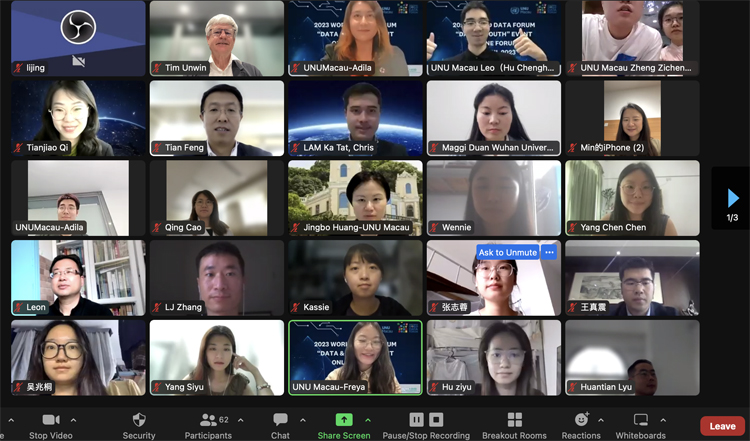
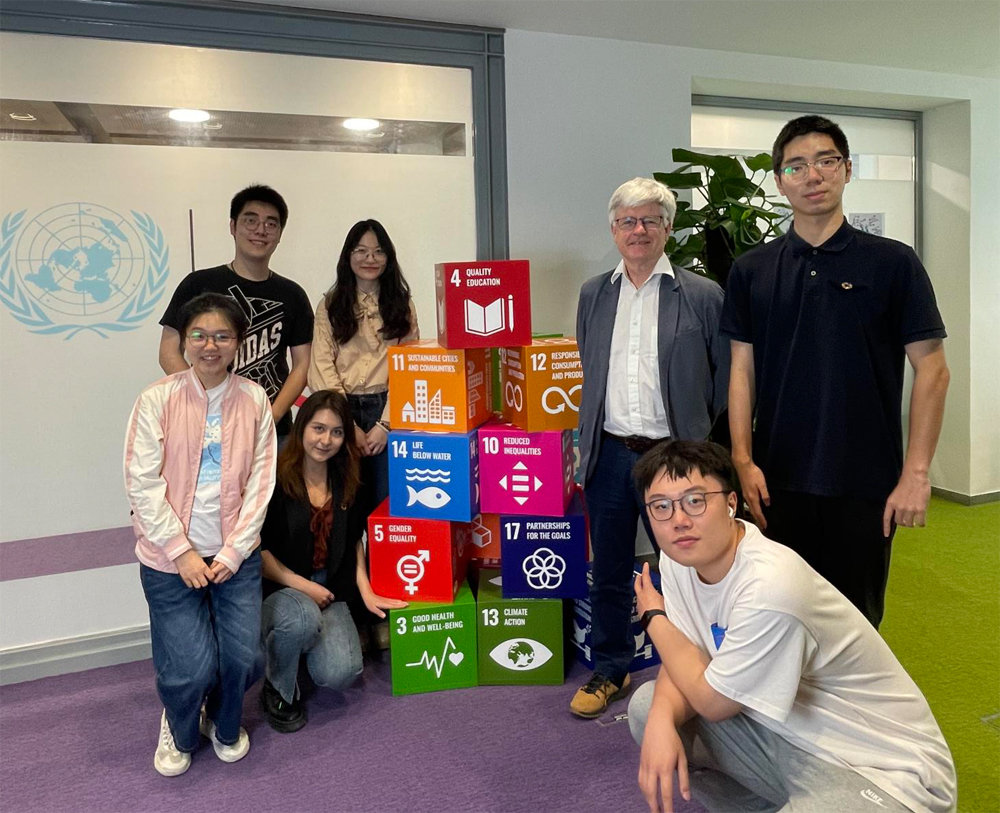
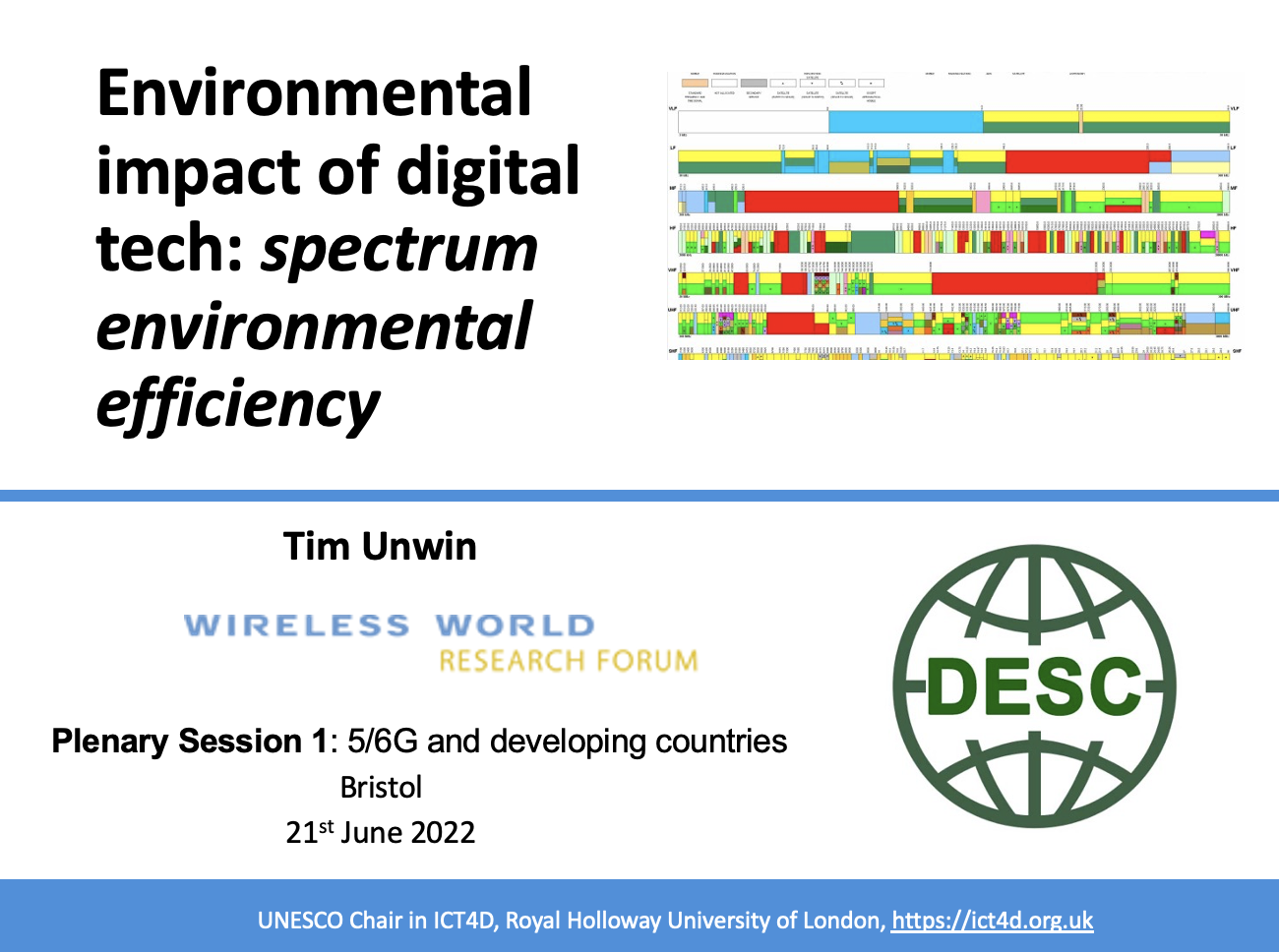

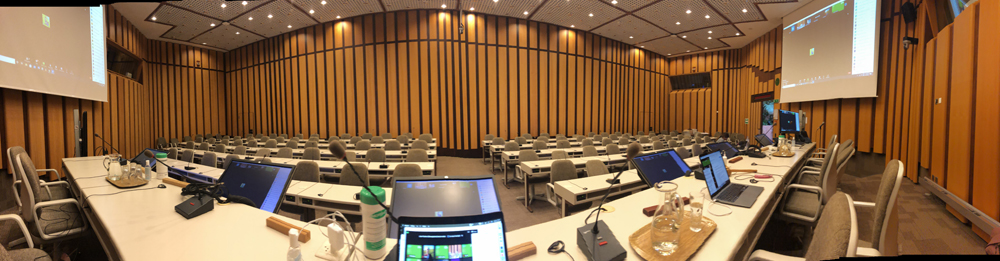
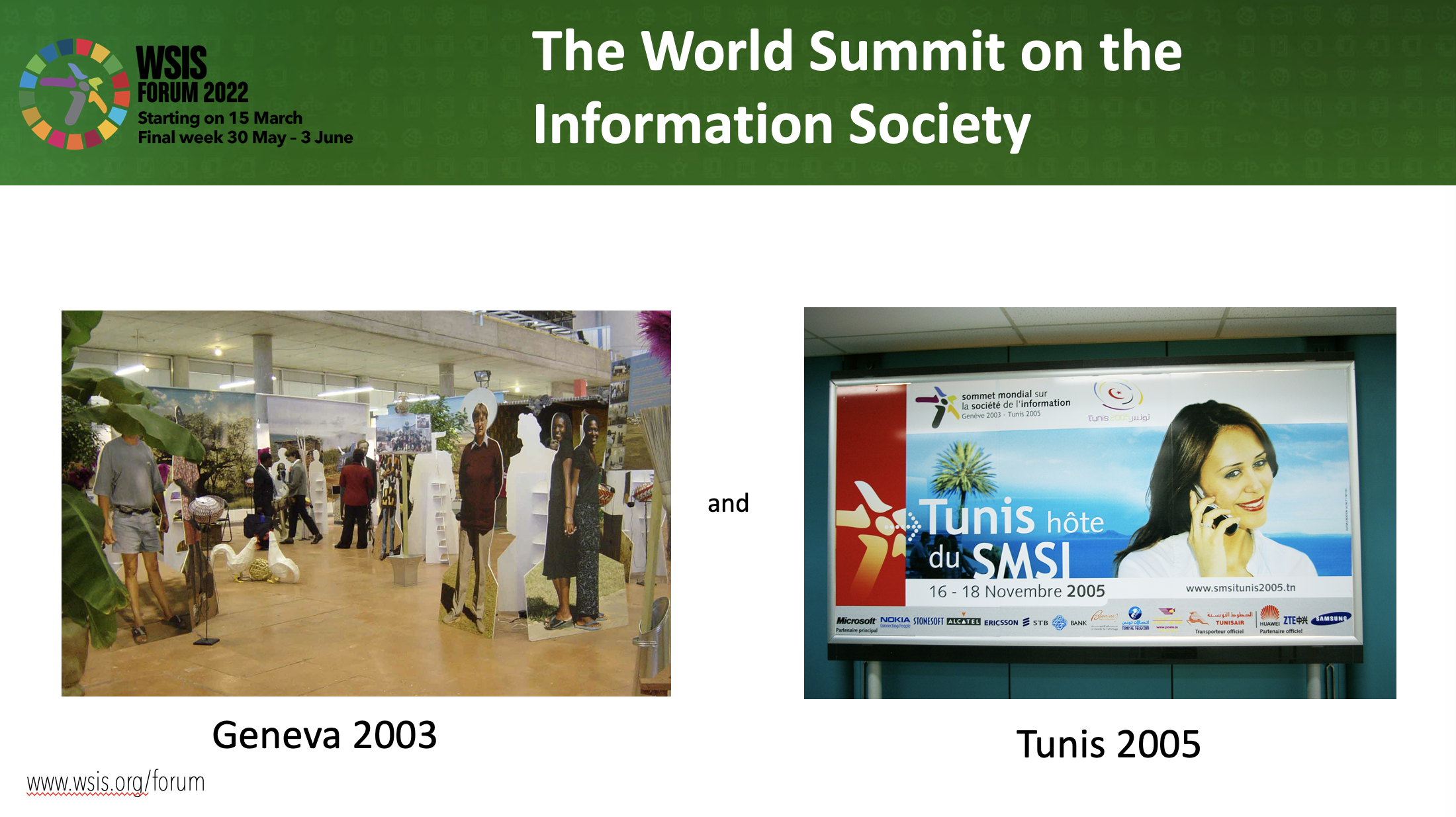
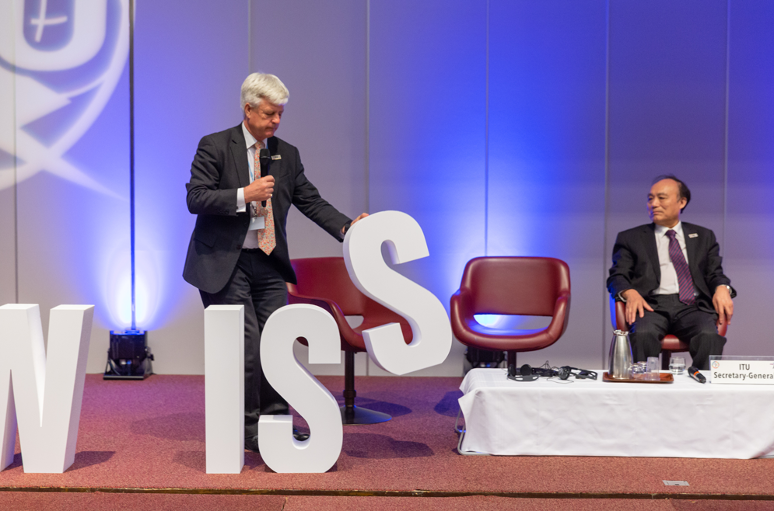
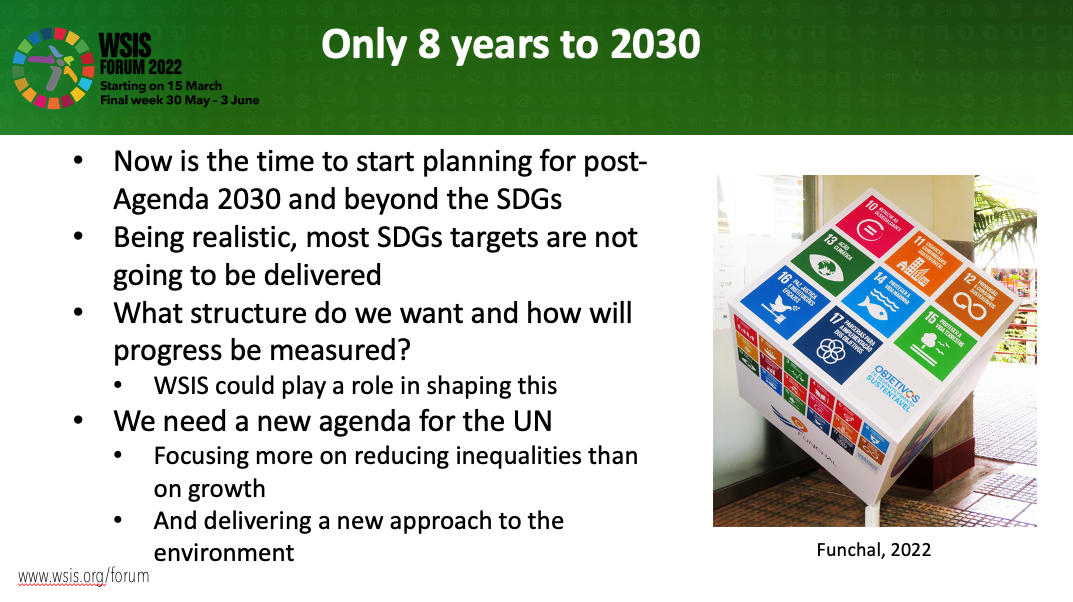

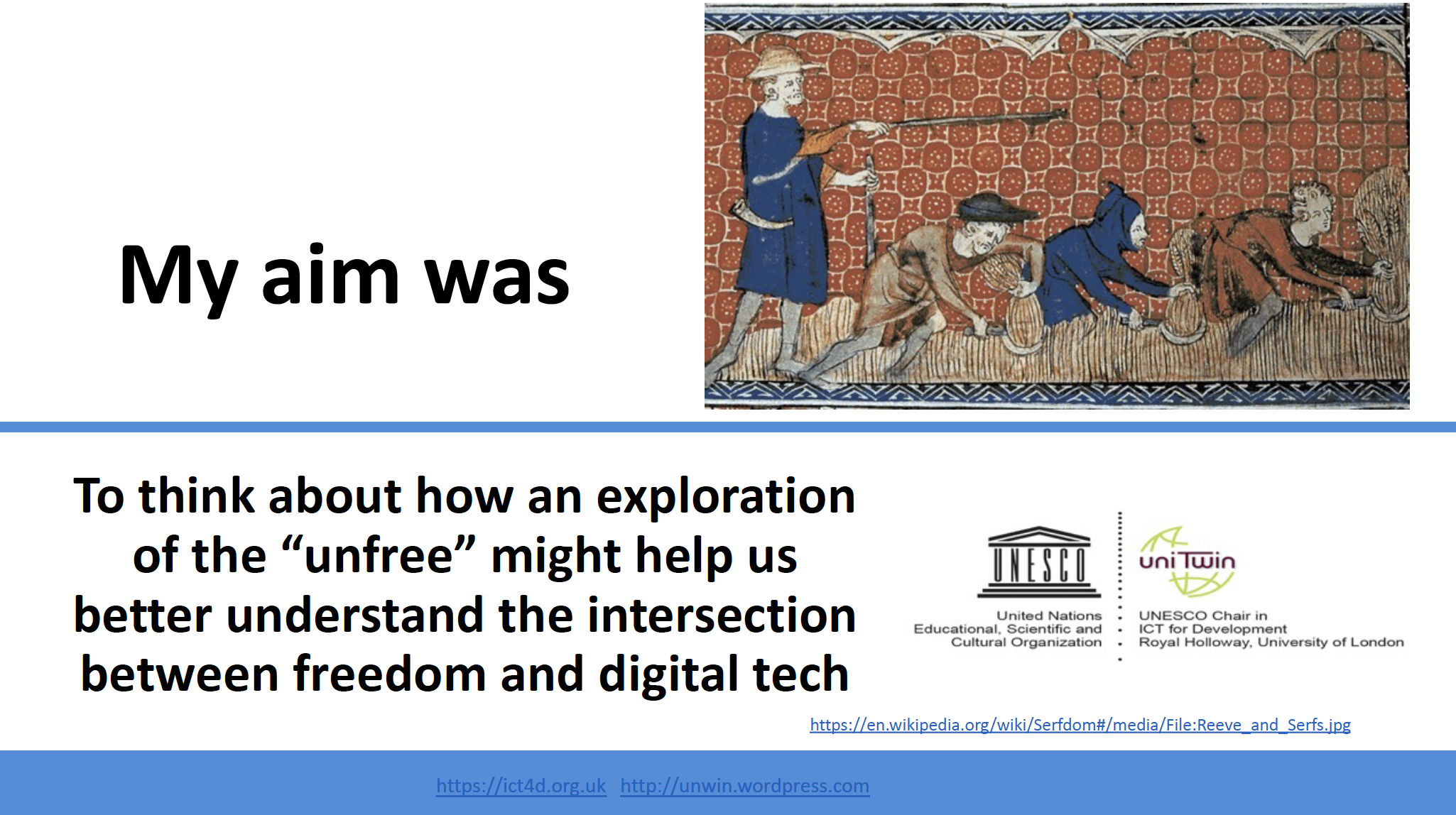

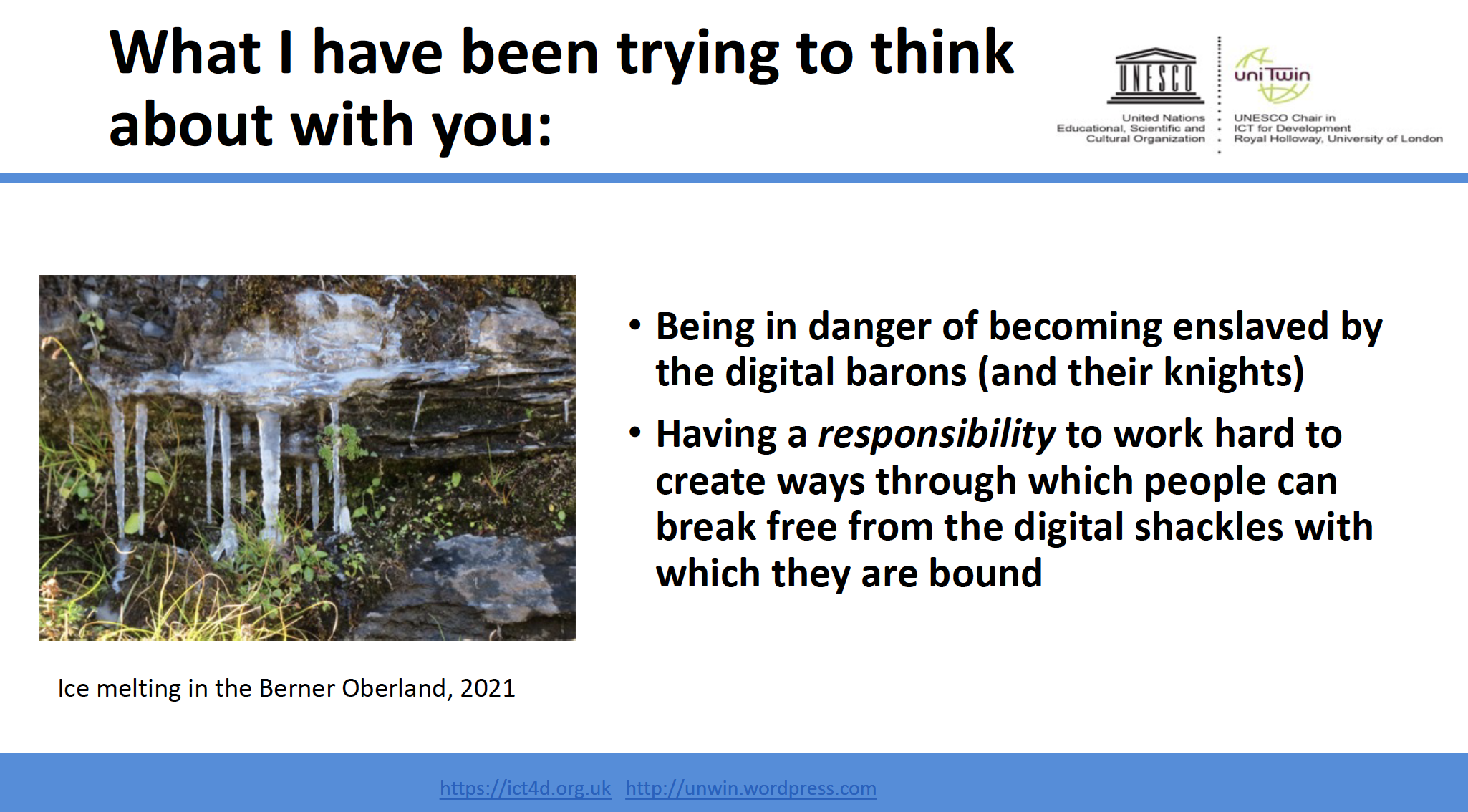
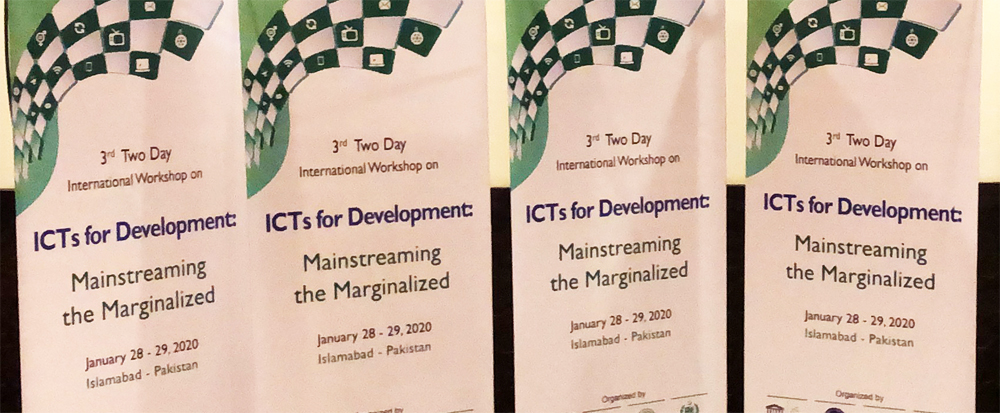 The 3rd ICT4D workshop convened by the Inter Islamic Network on IT (INIT) and COMSATS University in Islamabad, and supported by the UNESCO Chair in ICT4D (Royal Holloway, University of London) and the Ministry of IT and Telecom in Pakistan on the theme of Mainstreaming the Marginalised was held at the Ramada Hotel in Islamabad on 28th and 29th January 2020. This was a very valuable opportunity for academics, government officials, companies, civil society organisations and donors in Pakistan to come together to discuss practical ways through which digital technologies can be used to support economic, social and political changes that will benefit the poorest and most marginalised. The event was remarkable for its diveristy of participants, not only across sectors but also in terms of the diversity of abilities, age, and gender represented. It was a very real pleasure to participate in and support this workshop, which built on the previous ones we held in Islamabd in 2016 and 2017.


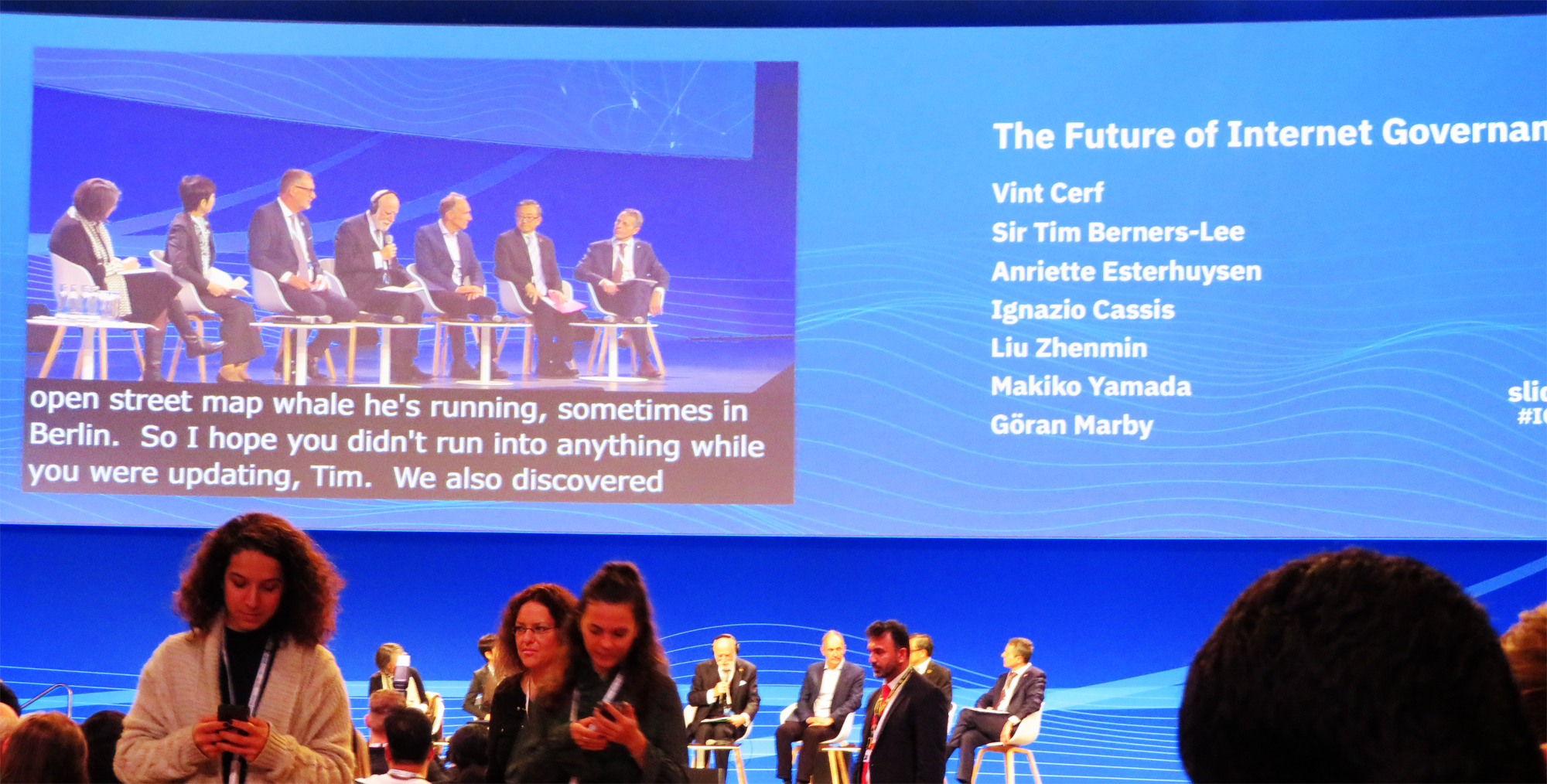

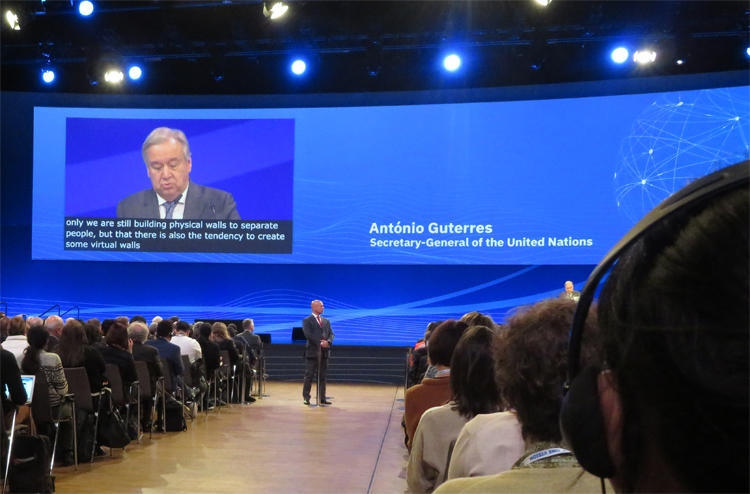
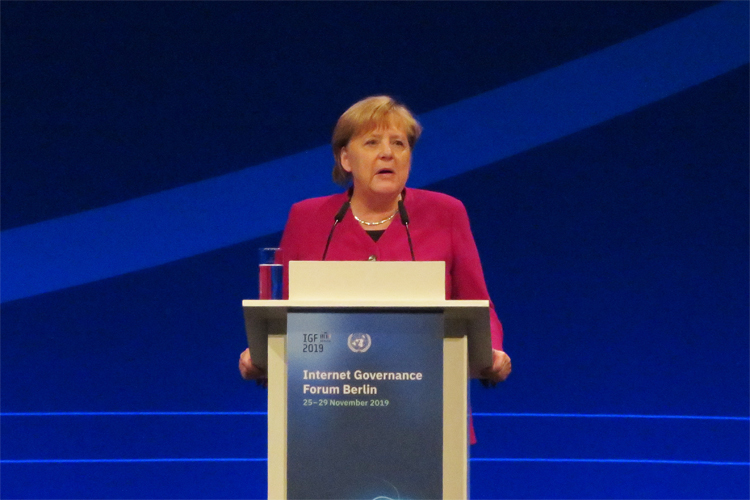
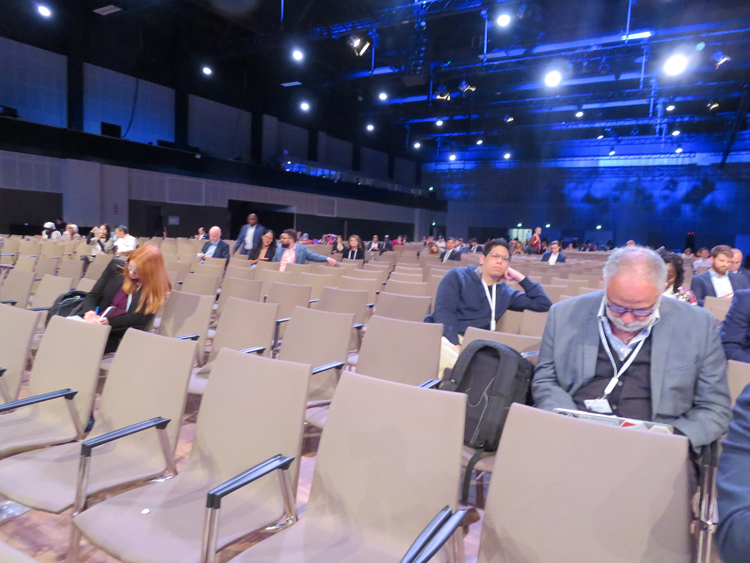
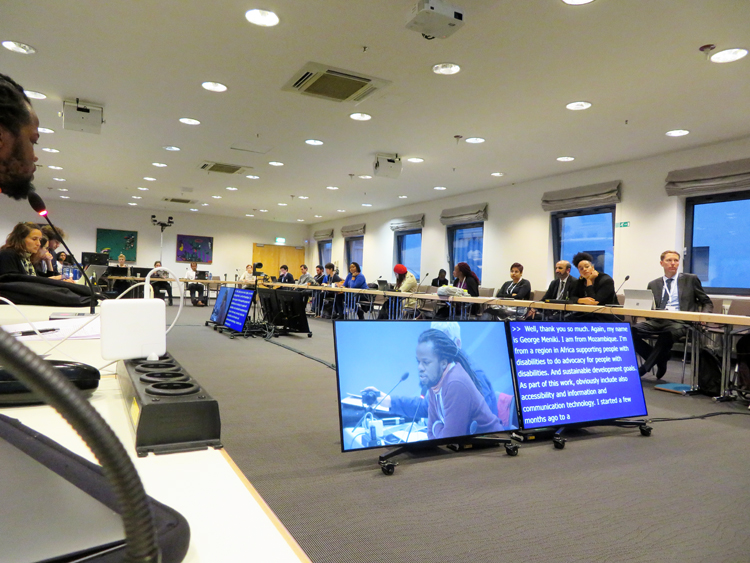
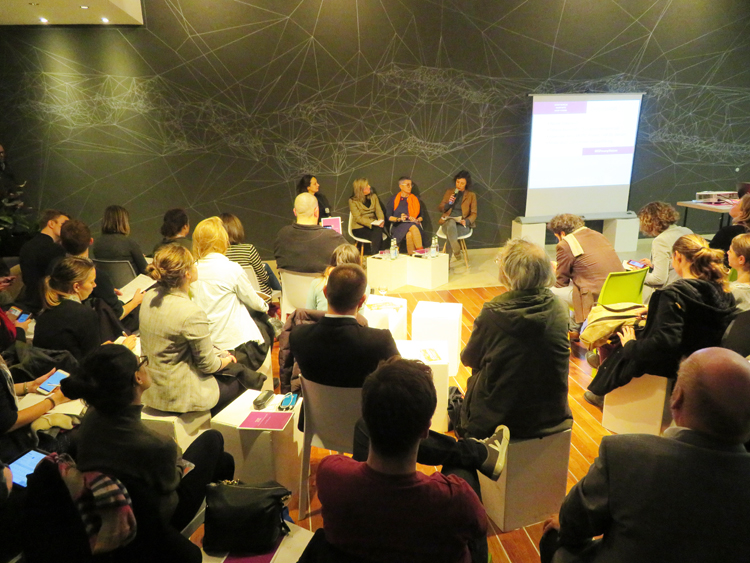
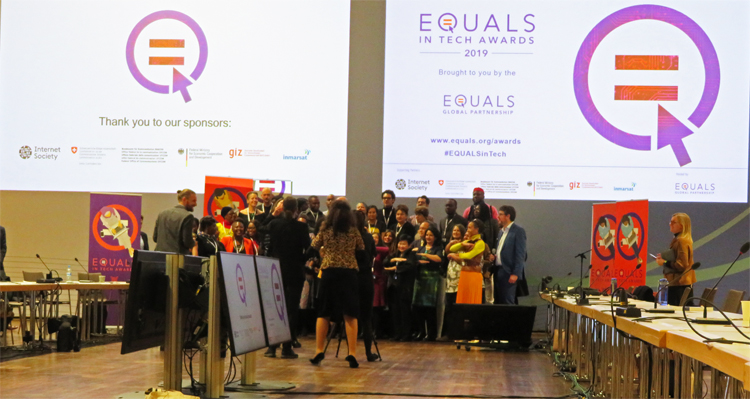 It was therefore amazingly humbling that, almost at the end of the EQUALS in Tech awards, a young woman who I had never met before, came up to me and simply said thank you. Someone had told her what one elderly, white, grey-haired, European (etc.) man had tried to do over the last 40 years or so… I wonder if she has any idea of just how much those few words meant to me.

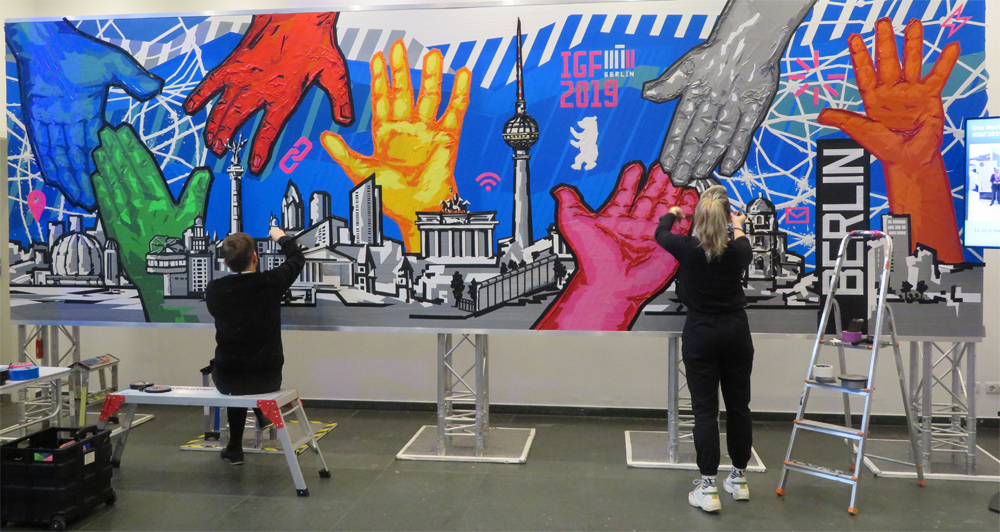
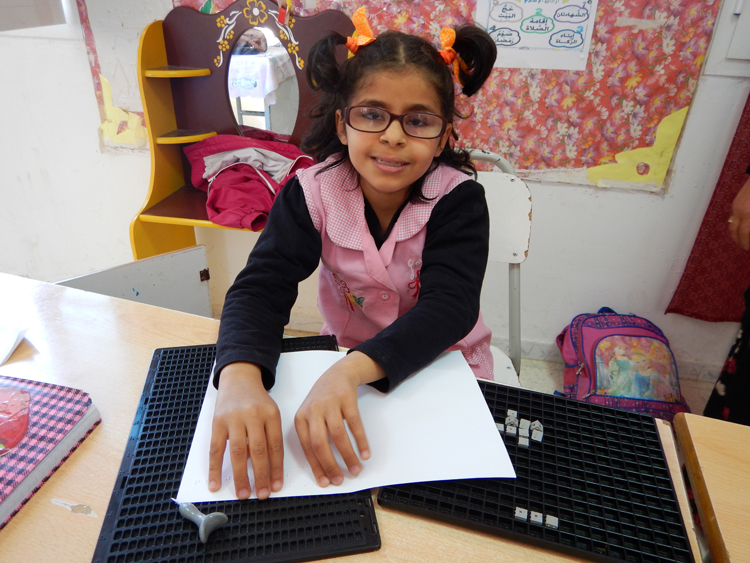

 Tim Unwin's Blog