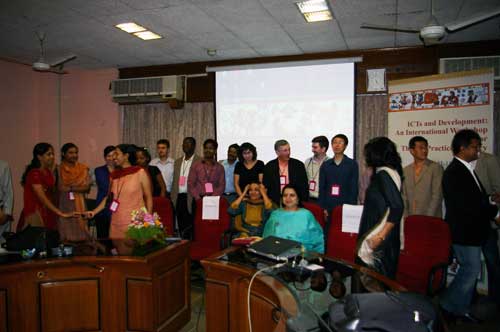
 Welcome back to the second day of the ICTs and development workshop at IIT Delhi.
We got underway with Jonathan Donner’s (Microsoft Research India) invited lead talk on The changing roles of mobile phones in development: some examples from Africa
- Emphasised amazing growth of mobile ‘phones – but rightly noted that this is neither universal not homogenous
- We need to focus on the people rather than the technology – M4D is the tip of an iceberg of uses that people make of mobile ‘phones
- Uses of mobiles for agriculture: use of mobiles for ‘traditional’ extension; creating platform mobile services including new market systems such as Manobi, or lean market places such as Google Trader
- Homegrown services: M-PESA and MXIT – low barriers to adoption, affordable and compelling relative to existing alternatives, woven into everyday life, network effects. They do well because they are so simple.
- Both of these offer real possibilities for scale – albeit not yet for the poorest of the poor – and do things that traditional voice cannot do
- Importance of unintended consequences
- We need more evidence; we need to distinguish between mobility and connectivity; and we need to take the long view
- We should also resist the use of “M4D” as a research term so as to de-fetishise it – moving the emphasis to the people not the technology; if we keep the term, we need to focus on the “4”
MOBILES AND MICRO-ENTREPRENEURS
Parveen Pannu (University of Delhi, India) Mobiles and socio-economic life of press workers in Delhi
- Focus on urban growth in India and the rapid adoption of mobiles, especially among informal sector workers
- Having clothes ironed is a central part of urban middle class India – the ironing business depends a lot on personal contact and good will (but there is also a press workers union)
- Survey of households who did ironing work: c.65% had a family mobile ‘phone; cost of ‘phones was major factor influencing price (some received them from their customers); users of mobile ‘phones earned more than non-users, but cause/effect not known; usage – 38% social, 29% work related; most calls were received from the lady of the house who arranged collection/delivery of clothes and finding new companies; 50% were not into texting SMS messages (not comfortable because of English language texting)
 Ishita Shruti (IIT Delhi) Remittance behaviour and doing business among Indian rural salesmen in Cambodia
- New ICTs have played an important role in remittances (both economic and social) – focus of this ethnographic research is on rural salesmen mostly from UP
- Internet based ‘phone calls are the cheapest means of communicating – so people use internet cafés/’booths’
- ‘Agents’ are used to deliver remittances – informal network enabled through ‘phone calls (social capital plays an important role in delivering remittances)
- Mobile ‘phones have also facilitated business, enabling salesmen to interact with family but also to make decisions about their businesses
ICTs, CIVIL SOCIETY AND THE STATE
Jean-Yves Hamel (UNDP) Public interests, private costs: civil society and the use of ICTs in Timor Leste
- Placed emphasis on the notion of freedoms and the capability approach
- Highlighted role of FDI from Telstra – supported by UN – and subsequent problems associated with its monopoly position. Monopolies are associated with high costs of ICT provision; regulators are unable to challenge these.
- Noted the early use of ICTs from 1994 to enable communication of civil society ‘opposition’ with the rest of world
- Key role of deep women’s networks – links to health organisations, scholarships, women’s rights groups
- ICTs provide an important window on the world
ICTs AND ECONOMY
Nimmi Rangaswamy (Microsoft Research India) The PC aided enterprise and recycling ICT
- Role of ICTs in expanding small and micro-enterprises in Mumbai slums
- ICTs can help promote skill building; business are organic and self-sustaining
- Nice business ecology coming into play – capital, space, skills, hardware
- Not simply assimilating technology for business, but also creating new systems and processes
- “There is no ‘for D’ in it, because they are doing it themselves” – not sure I agree with this, surely this is itself a form of development
Jack Linchuan Qiu (Chinese University, Hong Kong) Working-class information society? Open questions about China and ICTs
- Focused on the “information have-less”
- Some statistics from China: internet users 2 m in 1998, but 298 m in 2008; 49% of internet users are now not college-educated – so Internet is being used much more widely across different sectors of the population
- Private sector now accounts for more than half of urban population employment – so people have to find jobs, and this has been associated with a rapid increase in ICTs: does macro-empowermnet lead to (seemingly) micro-empowerment
- Measuring information needs is complex; fundamental differences between information needs and wants.
- Bottom of pyramid innovations are firstly social and only secondarily technological
- Developing a new class analysis based on horizontal networking among workers
- Chindia as a new path to development – a re-evaluation of labour-centred production
INTERNET AND SOCIAL CHANGE
Otgonjargal Okhidoi (Educational Channel Television, Mongolia) Can technology level the inequality in education delivery? Blended technology based education program in Mongolia
- Mongolian democritisation and economic liberalisation created freedom for flourishing media companies, mostly for profit commercial broadcasting – mostly focus on imported programmes (soaps, sumo…)
- Educational Channel TV began only three years ago for public sector broadcasting (4-6 hours airtime a day on academic subjects; not for profit and one of only 2 nationwide broadcasters). Then Internet service and cellphone messaging added on to make it more interactive and provide feedback (focus of project on English language and IT)
- 93% of total population of Mongolia names TV as the key source of information
- Inequality of access to education and quality of content – 66% of children live outside Ulaanbatar, and are poorly served by education
- Almost all schools have computer labs set up by donor funding, and all are connected to the Internet – but there is not much good content available. So, they used 20 minute TV programmes and followed up with work in class on Internet. Reported that impact on knowledge acquisition was positive, and it enhanced self-learning
S. Subash (National Academy of Agricultural Research Management) Knowledge empowerment of farmers through interactive web-module on dairy innovations
- Use of ICTs for technology transfer agricultural extension in the field of dairying focusing particularly on web-module (Haryana and Tamil Nadu case study)
- Training in ICT centres given to farmers; needs of farmers identified and web-based learning module given to them
- Reported that farmers in Haryana has a 16% knowledge gain as a result of the intervention, and 28% gain in Tamil Nadu – although some concerns were expressed in questions about the impact of experimental design
- Benefits also gained by extension workers
- Users requested more interactivity and provision of real-time information; it is important to ensure that content is regularly updated; mobile alerts for farmers should also be introduced
 Murali Shanmugavelan (Panos, London) Telecentres and public spaces
- Substantial amount of recent support for telecentres in India – but “what information is reaching what communities?”
- How do telecentres interact with village communities – are they reinforcing or changing social structures? Study of 12 telecentres of different kind.
- ICTs can constrain or expand public spaces (four layers of public: physical, management, human as public, and services) – communication practices can create a chaos in traditional systems
- Key factors: location influences accessibility; telecentres specifically designed for particular underprivileged groups such as dalits are exclusionary rather than ‘public’; management layer is very influential (recruiting women increases inclusivity); type of service delivery influences usage (and real needs of excluded users are not necessarily delivered); social and cultural factors constrain usage (discrimination against women and dalits; low participation of elderly and disabled communities)
- There is a real need to map non-users and understand more about why they do not use ICTs – traditional hierarchies


 is about – bringing together things that already exist. Perhaps we should instead be “African Hunters” – after all, African peoples have great hunting traditions – along with my friend the cheetah. My hope for today is that we will indeed become hunters – hunters for ways in which we can use ICTs more effectively to empower the marginalised and poor, hunters for truth and wisdom, hunters for humility…

 Tim Unwin's Blog