Category Archives: ICT4D

Murree, Pakistan, 1946-2016

My father spent time in Pakistan in 1946, and it is some 70 years since then that I now have the privilege of  visiting the country for the first time.  During the 1939-45 war, he had served in the Signals with the 8th Indian Division, and had been in North Africa, and then fought with them up the eastern coast of Italy.  At the end of the war he had returned with them to India, and particularly to the north-west, in the towns of what became Pakistan after partition in 1947.  The time he spent here was one of the happiest  of his life, and I particularly remember stories he told about the times he spent in Murree and Tret to the north east of Rawalpindi.  Islamabad had not even been thought of by then.

The opportunity to run a workshop for the Ministry of IT and another under the auspices of the Inter-Islamic Network for IT over the last fortnight provided me with a chance to visit some of the places he had known and told me about many years ago, and it was wonderful to experience the magic of the landscape and generosity of the people in this particular part of Pakistan.
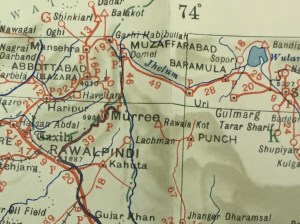
IMG_5679Just before I left, my mother showed me an old map, dating from 1945, on which he had depicted the route he had followed across India, highlighted with a black pen.  The map as a whole provides fascinating insights into what the sub-continent looked like before the traumatic events of partition in 1947.  Murree is clearly shown, as befits its role as the summer capital of the Punjab Province until 1864, and its beautiful position as well as its relatively cooler climate makes it clear why it was such a popular location, particular for the British living in India.  Indeed, it had recently snowed when I visited, even though the weather was much warmer only a relatively short distance away in Islamabad.

My father had taken some pictures of his time at Murree, and in the village of Tret approximately mid-way between Murree and Islamabad in April 1946, and these provided me with an amazing opportunity to compare how things had changed.  First, was the view of the mountains of Kashmir from Kashmir Point in Murree

Kashmir Point 1946 Kashmir Point 3

It was extraordinary to have been able to find almost exactly where he must have stood to take his photograph, and almost equally interesting to note how rather little must have changed since he had been there.  He would certainly have recognised my photographs!

He had also taken a photograph of a street scene in Murree, which included a Lloyds Bank building.  Unfortunately I was not able to find it any more, but the accompanying photograph shows how very much more crowded the streets are today than they were 70 years ago!


Lloyds MurreeStreet scene

My father clearly loved the mountains and landscapes, and took several photographs of these.  Again, I attach one below (labelled “Hills from Murree Road – 5000 feet”), together with one of the hills between Tret and Murree today, albeit from a different viewpoint.  Both pictures  illustrate a typical settlement on the top of the hills in the mid-distance, but a contrast between them is the difference in forest cover.


Hills from Murree roadHills

I was not able to find exactly where he was based while in Tret, but the photo on the left below shows a 1946 view of the military encampment there with the village in the background on the hill top, and to the right my 2016 photo which might just be of the same buildings.  The photo on the right is also particularly interesting because it shows many black flags flying on the buildings, indicating that these houses belong to some of the Shia minority.


Tret 2016Tret 1946

Sadly I was not able to locate the old regimental animal lines shown in the picture on the left below, but have matched it with a view of Tret today on the right.  My father had been a keen polo player, and had become very fond of one of his horses (Bellezza) in particular, and I recall him being very sad that he had to leave the horse behind on his next assignment. Remarkably, on returning to Islamabad, a friend told me that the old polo ground is still there, and had managed to survive encroachment from the bus station.  Next time I visit Pakistan I will have to return and try to find it.

Daddy's horses Tret 3

I’m so grateful to everyone who made this visit possible and particularly colleagues in the Ministry of IT, my security team (below), and Asim Malik who accompanied me.
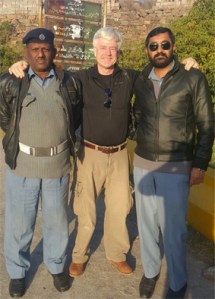
Tret security copy

15 Comments

Filed under ICT4D, Photographs

ICTs and the failure of the Sustainable Development Goals

The euphoria associated with the consensus reached by UN member states on 2nd August on the Sustainable Development Agenda to be signed by World Leaders in New York on 25-27 September is fundamentally misplaced, although not unexpected (for process see UN Post-2015 Development Agenda).  The Sustainable Development Goals (SDGs) will do little to reduce poverty, will continue to propagate a world system based on inequality, and will continue primarily to serve the interests of those in the UN system and practitioners in the “development industry”.

I find it difficult to believe how Ban Ki-moon could really believe the words he said when welcoming the agreement, saying it “encompasses a universal, transformative and integrated agenda that heralds an historic turning point for our world … This is the People’s Agenda, a plan of action for ending poverty in all its dimensions, irreversibly, everywhere, and leaving no one behind. It seeks to ensure peace and prosperity, and forge partnerships with people and planet at the core. The integrated, interlinked and indivisible 17 Sustainable Development Goals are the people’s goals and demonstrate the scale, universality and ambition of this new Agenda”.

Here, I wish to focus attention particularly on the almost complete omission of ICTs from the final agreed SDGs, and why this is a very serious failing.  Back in June 2013, I wrote stridently about the paucity of mentions of ICT in the report of the High-Level Panel of Eminent Persons on the Post-2015 Development Agenda, which provided the initial basis for the agreement reached last Sunday.  Little has changed since then. Although my focus is on ICTs, it is important, though, to begin by noting some of the fundamental structural issues that mean the SDG process has been so flawed, and will fail to address the interests of the world’s poorest people:

  • There are far too many goals (17) and targets (169) – this will lead to diffusion of effort and lack of focus, not only within the ‘global system’, but also in individual countries.  It is much better to do a few things well, rather than try to do too many things, and fail to do any of them well.  The reality is that this list is a compromise of everything that those involved in the formal deliberations could think of that might reduce poverty (and serve their own interests)
  • Target setting is hugely problematic in that it can lead to resources being directed too much towards delivering the targets and not enough to other factors that might actually have greater impact.  This would not be so worrying if goals and targets were treated as flexible aspirations, but the reasons for the failure to deliver on many of the original Millennium Development Goals (MDGs) should have sent a much more powerful message to those planning the SDGs.  The UN’s own 2014 report on the MDGs, for example, stated that “Substantial progress has been made in most areas, but much more effort is needed to reach the set targets”.  If the world could not deliver on 8 Goals in 15 years, how is it going to deliver on 17 goals and 169 targets in the next 15 years?
  • The process remains largely concerned with absolute poverty rather than relative poverty.  Claiming that the SDG agenda will end poverty in all of its dimensions is, I’m afraid, crass (see my now very old paper No end to poverty that explores this further).  The SDGs will do little fundamentally to change the structural conditions upon which the present world system is based, which remain primarily concernd with economic growth rather than reducing social and economic inequality (despite claims that the agenda does indeed address inequality, as in Goal 10).
  • These goals and targets represent the interests of those organisations (UN, civil society, private sector) driving the SDG agenda, rather than the poorest and most marginalised; it is these organisations that are actually likely to benefit most from the SDG agenda.  Perhaps more than anything else, the SDGs have become a vehicle through which the UN and its many agencies can try to show their continued relevance in an ever-changing world.
  • The need to monitor progress against the goals/targets will further expand the “development industry”, and consultants and organisations involved in such monitoring and evaluation will undoubtedly benefit hugely.  Small, poor countries simply do not have the capacity to implement, let alone develop the complex monitoring systems required by, the new SDGs and targets.
  • The SDGs reflect a relatively small set of interests (economic growth, agriculture, health, education, gender, environment and climate, justice and security, urban/industrial development), and focus insufficiently on some of the key issues that require attention if we are to create a fairer and more equal world, notably the role of ICTs, and the relative lack of attention paid to people with disabilities.

Each of the above claims (and indeed the many other reasons why the SDGs will fail) needs justifying at much greater length, but the last point brings me directly to the abject failure of the SDG agenda to pay sufficient attention to the critical role of ICTs in shaping contemporary development.  ICTs are not mentioned directly in any of the SDGs, and are only to be found in but four of the 169 targets:

  • 4b) By 2020, substantially expand globally the number of scholarships available to developing countries, in particular least developed countries, small island developing States and African countries, for enrolment in higher education, including vocational training and information and communications technology, technical, engineering and scientific programmes, in developed countries and other developing countries
  • 5b) Enhance the use of enabling technology, in particular information and communications technology, to promote the empowerment of women
  • 9c) Significantly increase access to information and communications technology and strive to provide universal and affordable access to the Internet in least developed countries by 2020
  • 17.8) Fully operationalize the technology bank and science, technology and innovation capacity-building mechanism for least developed countries by 2017 and enhance the use of enabling technology, in particular information and communications technology

Only one of these (9c) has a focus on ICTs as a direct aim.  All of the others merely mention ICTs in an enabling role: for higher education scholarships (4b); to promote the empowerment of women (5b); and for the development of a technology bank and science, technology and innovation capacity-building mechanism (17.8).  In this context, it is quite scandalous that the SDGs, while mentioning the empowerment of women, fail to mention the much more significant use that ICTs can make to the lives of the 10% of the world’s population with disabilities.

There is widespread agreement that ICTs have been one of the major factors that have transformed the world over the 15 years of the MDGs.  They have driven extraordinary economic growth, have opened up entirely news ways of delivering education, health and rural development, have transformed the relationships between governments and citizens, and have created an interconnected world of communication and knowledge sharing.  It is not an exaggeration to say that they have been one of the most significant changes to humanity over the last 20 years.  Yet, those determining the SDG agenda for the next 15 years barely give them any recognition at all.  This would not be so worrying if ICTs had not also created some of the greatest inequalities that the world has ever seen; the differences in life experience between someone connected through mobile broadband to a 4G network, and someone with only 2G connectivity, let alone without a smartphone or equivalent digital device, is extraordinary (for a wider discussion see some of my recent papers).  ICTs have the capacity to be used for great good, and to transform the lives of poor people; but they also have the capacity to be used to create vast inequality, and to do much that is negative.

Hence, those involved in crafting the SDGs should have paid very much greater attention to the transformative role of ICTs.  The single target (9c) “Significantly increase access to information and communications technology and strive to provide universal and affordable access to the Internet in least developed countries by 2020” is indeed to be welcomed, but as one of only 169 targets there is a real danger that it will be lost in the plethora of other competing aspirational targets for governments across the world.  As it is, there is little indication of what “significantly increase” actually means, or indeed of how best this target can be achieved.  The dominant rhetoric in the “global community” is still of how to reach the “next billion”, rather than how to serve the needs of the poorest and most marginalised, what most people call the “bottom billion” but which should better be termed the “first billion” to focus our attention on it being the most important!

The failure of ICTs to be mentioned more substantially within the SDGs provides a salutary example of how such goals are formulated, and the politics of the UN and international development system.  Looking back, it is remarkable that ICTs were mentioned explicitly within the sixth target of Goal 8 of the original MDGs in 2000: “In cooperation with the private sector, make available benefits of new technologies, especially information and communications”.  Yet, from this highpoint the role of ICTs within the SDG agenda of 2015 can be seen to have diminished almost to insignificance.  In large part this reflects the failure of international organisations with interests in ICTs to realise the significance of the SDG agenda early enough, and then to engage sufficiently actively in the discussions surrounding their formulation.  In this context, I was delighted that under my leadership the Commonwealth Telecommunications Organisation (CTO) did indeed reach agreement in 2014 on a statement about the role of ICTs in the SDGs, but sadly this fell on rather deaf ears in the wider international community. Interestingly, during informal discussions with several multilateral and bilateral donors in recent years, during which I have personally sought to promote the crucial role of ICTs in development, I have regularly been told that the relevant UN organisations (such as the ITU) and other donors have insufficiently promoted the need for a goal on ICTs.  This, I am sure, is correct, but it is also important to understand why this might be the case.  At least four reasons seem relevant:

  • First, the UN system is one of strict hierarchy, with some agencies being seen as much more powerful and dominant than others.  Despite dramatic enhancements in the efficacy and role of the ITU in recent years under the leadership of Hamadoun Touré and now Houlin Zhao, it still seems to lack the clout at the wider international table of some of the other more powerful UN organisations and lobbies, for example, in the fields of health, gender and climate change.
  • Second, despite their being some young brilliant Ministers for ICTs/Telecommunciations across the world, more often that not these ministers are relatively low down the national hierarchy of ministerial responsibility, and were therefore unable effectively to influence national delegations who contributed to the crafting of the SDGs about the importance of ICTs.
  • Third, many bilateral and multilateral donors remain unconvinced of the power of ICTs to transform development in the interests of the poor and marginalised. This reflects badly both on the ICT for Development (ICT4D) community who have failed to provide enough evidence of the real development benefits of ICTs, but also on the ignorance, self-interest and bigotry of many of those working for donor agencies.
  • Fourth, when push comes to shove, individuals and institutions will usually focus on their own core areas, rather than on cross-cutting or collaborative initiatives.  Hence, the WHO and the powerful international health lobbies focus primarily on delivering health, UNESCO and the educational industry will focus on education, and the FAO and rural development lobby will focus on agriculture and rural development.  The ICT for Development field is relatively new, and remains insufficiently robust to compete against these powerful existing entities.

Building on this last point, it is highly salient that at the May 2015 WSIS Forum held in Geneva, the UN agencies involved explicitly recognised that the battle had been lost to have one of the SDGs with an explicit focus on ICTs, and instead developed a matrix to show how ICTs as represented in the WSIS Action Lines could contribute to each of the emerging SDGs.  While this goes some way to indicate how different UN agencies can indeed use ICTs to deliver their wider SDG commitments,  it fails comprehensively to tackle the deep structural issues that mean that ICTs are continuing to contribute to greater global inequality.

Without much greater focus on ensuring that the poorest and most marginalised, including people with disabilities, can use ICTs effectively to lead enhanced lives, the SDGs will inevitably lead to a more fractured and unequal world.

21 Comments

Filed under Development, ICT4D

Ten things not to do when developing national cybersecurity policies

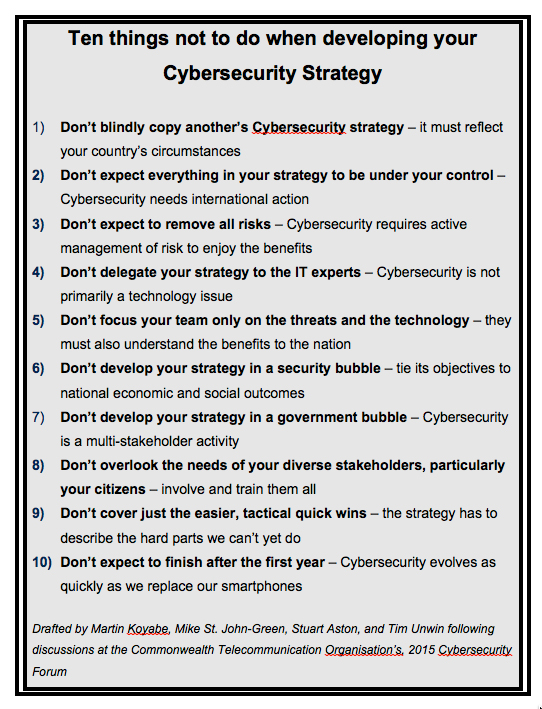
The Commonwealth Telecommunications Organisation held its 2015 Cybersecurity Forum on 22nd-24th April at the BT Centre in London.  During this, several of us thought it would be an interesting idea to draft a set of ten “not-to-do” things relating to various aspects of cybersecurity, and the first to be prepared (by Stuart Aston, Mike St. John-Green, Martin Koyabe and myself) is on ten things not to do when developing cybersecurity strategies.

We have deliberately focused on the “not-to-do” approach because we feel that such lists can serve as very useful simple reminders to people. As a check-list of negatives, they act as salient caviats for all those involved in developing cybersecurity strategies.

Our “don’ts” should be easy to remember:

  1. Don’t blindly copy another’s Cybersecurity strategy
  2. Don’t expect everything in your strategy to be under your control
  3. Don’t expect to remove all risks
  4. Don’t delegate your strategy to the IT experts
  5. Don’t focus your team only on the threats and the technology
  6. Don’t develop your strategy in a security bubble
  7. Don’t develop your strategy in a government bubble
  8. Don’t overlook the needs of your diverse stakeholders, particularly your citizens
  9. Don’t cover just the easier, tactical quick wins
  10. Don’t expect to finish after the first year

The full version of the recommendations, which includes the positive things that need to be done alongside the negatives, can be downloaded by clicking on the image below:

Ten things not to doDo print this off and share with colleagues you know!  I very much hope that it will act as a useful checklist for all those involved in cybersecurity policy making.

Leave a comment

Filed under Commonwealth, ICT4D, Politics

Thoughts on mobile learning for the EFA GMR 2015

GMRI was delighted to have been asked by UNESCO to write an overview of the evolution of mobile devices and their uses in learning (m-learning), focusing especially on the fifteen-year period of the first Millennium Development Goals, as a background paper for the 2015 Education for All Global Monitoring Report, and it is great that this has now been published.

I thought it might be useful to summarise some of the key points here. The paper highlights eight emerging good practices, and six significant policy implications. The emerging good practices are:

  • Focusing on learning outcomes not technology
  • Involving teachers and users at all stages from design to implementation and review
  • Involve participatory approaches in design so as to ensure that adoption of technology is user-centric
  • Consider sustainability, maintenance and financing right at the beginning
  • Think holistically and systemically
  • Ensure that all relevant government departments are involved
  • Ensure equality of access to all learners, especially those who are marginalised
  • Appropriate and rigorous monitoring and evaluation must be in place

The policy implications identified are closely linked to these and can be summarised as:

  • Joined up approaches across Governments
  • Sharing of effective and rigorous monitoring and evaluation findings
  • Ensuring affordability
  • Providing connectivity
  • Effective multi-stakeholder partnerships
  • Development of relevant content

Four case studies drawn from different parts of the world and at different scales were used to illustrate the considerable success that can be achieved through m-learning. These were:

  • BBC Janala in Bangladesh;
  • Red UnX: a mobile learning community for entrepreneurship in Latin America;
  • Learning on the Move in Singapore; and
  • Worldreader: making books available to primary school children in low-income countries

However, the paper also illustrates clearly that unless very considerable efforts are made to ensure that the poorest and most marginalised people and communities have access to appropriate devices, connectivity and electricity, any increased attention on digital technologies is likely to increase inequalities rather than reduce them.

It concludes that to date, great strides have been made in using the very rapid expansion of mobile devices for the benefit of education, and for those companies involved in exploiting this. However, as a review of delivery on the past EFA goals and MDGs, it is apparent that much remains to be done in using such devices to help achieve universal primary education and gender equality in education.  Looking to the future, as more and more people gain possession of, or access to, mobile devices, they will have the opportunity to use the Internet to access an ever more innovative array of learning tools and content. The challenge, particularly for governments, is how to pay for and use this potential to enable universal access, and thus equality of opportunity within the education sector. Given the central role of teachers and administrators within education, an important concluding recommendation is that much more attention should be paid to providing training, resources and support to them in the use of mobile devices. A well-equipped, knowledgeable and inspired cadre of teachers, capable of using mobile ‘phones effectively in their classes, is a crucial first-step towards delivering m-learning for all. Sadly, all too often, even in the richest countries of the world, children are told to switch off their mobile ‘phones before entering the classroom. M-learning has much potential, but we are still a long way from using it to benefit the world’s poorest and most marginalised.

Leave a comment

Filed under 'phones, Development, Education, ICT4D

Reflections on government-led infrastucture development in the ICT sector in the Caribbean

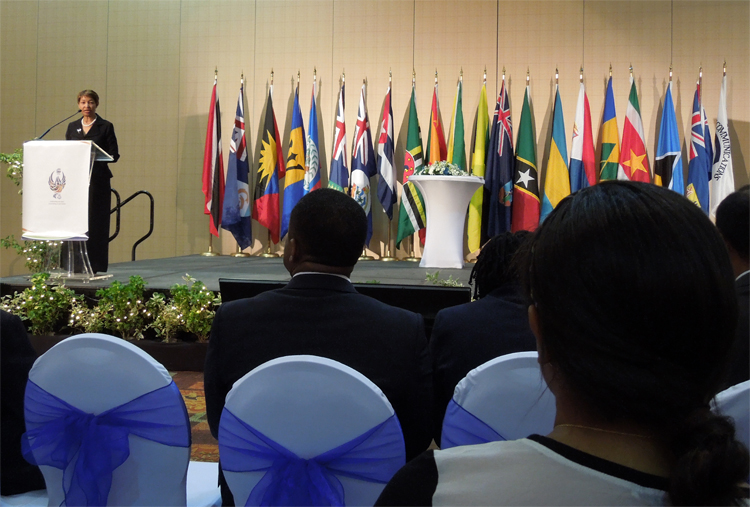
CTUI had the privilege of being invited to moderate the session on government-led infrastucture development at the Caribbean Telecommunications Union‘s 25th anniversary event held in Port of Spain, Trinidad, this week.  It provided an excellent opportunity to discuss in quite some detail the balance between private sector and state investment in the ICT sector, and ways through which infrastructure could be made available to some of the poorest and most marginal communities.  As a moderator, I always see my role primarily as being to facilitate some lively, and hopefully provocative, discussion, and so I tried to say very little myself during the session. Reflecting afterwards, though, particularly in the wider context of the Commonwealth as a whole, the following broad observations seem appropriate:

  1. There is very great diversity within the Caribbean, but nevertheless I did sense that there was much greater appetite here for the state to play a significant role in infrastructure development than is encountered in many other parts of the world.  It was very refreshing, for example, to hear the term “public utilities” spoken about almost with reverence.  The all-too-often accepted “development mantra” that privatisation of public utilities will ensure that they are much more efficient and thus deliver on the needs of poor people and communities, was not one that seemed to be widely accepted.  The belief that states have a clear duty to serve the interests of all of their people, and that this cannot be achieved through privatisation, was healthy and very different from the views that I all too often encounter.
  2. It was, though, clear that old business models are already failing to deliver sufficient profits for many of those involved in the sector, and that new models are required.  I find this particularly exciting, because I firmly believe that there are many exciting ways through which both public services and private benefit can be achieved, through a closer working relationship between companies and governments.
  3. The role of regulators is particularly important at this interface.  In particular, and recalling a session at the ITU’s Telecom World in Doha that I chaired last December, there is a need for regulators to think of themselves much more as “facilitators” than as “controllers”.  This applies not only in terms of providing the context through which the private sector can generate profits across all sectors of the economy, and thus enable governments to generate greater taxation revenues, but also through facilitating public awareness and understanding.  I was thus impressed by the way in which TATT (the Telecommunications Authority of Trinidad and Tobago) provides a considerable amount of information directly to consumers on such matters as “Cyberspace Dangers”, level of services expectations, and complaints procedures.
  4. Nevertheless, throughout the conference, I gained the impression that all too often conversations across the Caribbean have tended to happen in silos, and this was certainly the case  in the session on government-led infrastructure!  I was impressed that most panel sessions had speakers drawn from government, the private sector and civil society, but I got the feeling that the positions of each “sector” were often rather far apart.  There needs to be much more effective dialogue between the different sectors across the region (and indeed elsewhere in the world as well) if innovative solutions are to be developed to enable everyone to benefit from Internet connectivity.  To do this, there needs to be a cadre of well qualified and effective brokers who can facilitate such discussions.  This is one of the key roles that I believe the Commonwealth Telecommunications Organisation can play.
  5. Small Island Developing States (SIDS) face very problematic challenges, not least because of their small market size.  This reinforces the impression that I have previously gained from discussions at the UN’s SIDS conference in Samoa last year as well as work that I have done in the Pacific islands and elsewhere in the Caribbean.  In particular, I am convinced that traditional arguments about competition bringing the price of delivery down for consumers simply don’t apply in many such circumstances.   It really does not make sense to expect two or three operators to compete to deliver services in tiny islands.  Again, the precise business models need to be thought through very carefully, but where there is a social and political appetite for public utilities still to be delivered by governments, I see no logical reason why state-owned entities cannot provide value for money efficient ICT services in small island states.
  6. One of the most interesting discussions during the session was the ways through which existing government infrastructure can be used to reduce costs of rolling out ICT infrastructure, notably fibre.  In particular, the Puerta Rican El Zum initiative sounds especially interesting, in that it intends to deliver fibre connectivity through the sewers that link to most houses in the country.  Whilst this is not a solution that would suit every country, the idea of using the vast network of existing public infrastructure as a means through which to bring connectivity to the home is indeed appealing.  Likewise, I am more than ever convinced about the value of shared infrastructure solutions, and I see this as being one of the most significant things that governments can insist on in trying to reduce costs, especially in rural low-density contexts.
  7. This still, though, leaves the challenge of reaching the most remote, sparsely settled areas of any country, and few clear solutions or recommendations were received on how this could best be done. The debate over whether or not Universal Service/Access funds are effective continues apace, and I think that this increasingly reflects political dogma rather than actual practical reality! The reality is indeed often that money in such funds is either not used effectively, or sometimes not used at all, but the notion that taxation of some kind should be used to benefit the poor and marginalised is still a powerful one (the GSMA reports on such funds provide much helpful evidence).  The size of many Caribbean, and indeed Pacific, islands is nevertheless also one advantage for them, in that being small means that the distances required for roll out of fibre, or in provision of mobile broadband services, are not particularly large, and are thus relatively cheaper than those of large land-locked states.
  8. Finally, we had an interesting debate on the potential of mobile app development in the Caribbean and small island states more generally.  On balance, there seemed to be some agreement that the potential for app development to bring large numbers of people into the productive economy is very much less than some might advocate; thus 1.6% of app developers make more money than the remaining 98.4% combined (Financial Times).  (Incidentally, Mobile Vision has some useful statistics and data on the app sector).  There were, though, suggestions that there could be some potential in the Caribbean for local app developers to work on locally relevant e-government applications.

Overall, it was a fascinating discussion that raised many interesting ideas.

1 Comment

Filed under Caribbean, Commonwealth, ICT4D

Beyond the Digital Divide: Developing Local Capacity to Deliver Local Content

Below is a slightly revised text of the interview that the Caribbean Telecommunications Union (CTU) did with me on the occasion of the CTU’s 25th Anniversary (photo with SG Bernadette Lewis of the CTU when signing a mutual co-operation agreement with the CTO a while back) 

CTO CTUBy 2016, one per cent of the world’s population will own more than half of its wealth. The staggering projection, from a recent study by anti-poverty group Oxfam, made headlines just as the World Economic Forum was getting started in Davos last month.

One concern for Secretary General of the Commonwealth Telecommunications Organisation (CTO) Professor Tim Unwin, who was at the World Economic Forum’s Annual Meeting, is that the rapid spread of information and communications technologies is not helping to reduce that growing gap between poor and rich.

“The difference between the least developed and the most developed is getting greater. In that way, you can say that ICTs are actually increasing inequality,” he said, in a telephone interview from the annual gathering of top political and business leaders in Switzerland.

As head of a body bringing together perspectives of telecoms stakeholders from across the 53 countries of the Commonwealth—about one-third of the world’s population—Unwin is deeply concerned about that growing digital divide, and the dual impact of technology development on the world’s poorest.

Developing Caribbean capacity

“One of the things that always strikes me when I visit the Caribbean is how much more advanced and successful and connected it is than many other parts of the Commonwealth,” he said.

While the islands’ size is a source of some economic challenges, it also provides some advantages.

“The islands are relatively small, so it is not so problematic to get universal connectivity, as compared with, say, Nigeria or Pakistan,” Unwin said.

But Internet access and connectivity alone won’t reduce the gap between poor and rich. For Unwin, the real priority is not simply to increase the quantity of Internet users but to improve the overall quality of Internet usage. Two major issues affecting quality, he said, are bandwidth and cost, which is where Internet service providers and industry regulators play such a critical role in the region’s Internet system.

“What you can do with large bandwidth compared with low bandwidth is incredibly different, particulary with the rapid increase in applications that use video and large amounts of data. And the second variable is cost. That’s where regulators play a crucial role in helping to ensure that markets operate as effectively as possible.”

Delivering Caribbean content

The point of developing local capacity, Unwin was quick to point out, is to deliver local content. The potential of the underlying technology is only realised if it is used to facilitate the delivery of other services, such as digital banking, online education, mobile health or e-government. But that is easier said than done.

“Content development is quite expensive and resources aren’t always put into that. It’s much easier to lay a bit of fibre than it is to develop the content that is going to go over it,” said Unwin, who also sits on the advisory board of the m-Powering Development Initiative of the International Telecommunication Union (ITU).

One obstacle to developing local content, he said, is the lack of functional relationships between government ministries or even ministerial departments, which would need to harmonise their operations in order to produce high-quality local content.

So significant is the difficulty involved in developing relevant local content that there is a great temptation to simply import content from abroad, and sidestep the growing pains of building local capacity. But shortcuts are dangerous, Unwin said, citing the example of MOOCs, or massive open online courses, which are web-based courses aimed at unlimited participation through open access.

“I’d like to challenge some of those who think that things like MOOCs are the solution for the education of small-island states. I completely disagree because MOOCs can be a form of cultural or intellectual imperialism. The fact that people can get access to courses from richer countries is problematic, to me. What we want to have is locally developed, locally produced content, that is indigenous to users in Caribbean countries.”

The challenge for Caribbean societies, therefore, is to define and produce content that is appropriate and relevant, to enable solutions that align with development priorities.

“You have to make sure you have the right content in the right formats for the right people. If you’re just importing content from outside, you’re not building the knowledge-base of your own countries.”

Beyond the Divide

One of the CTO’s key partners in helping the region to face up to this challenge is the Caribbean Telecommunications Union (CTU). The two work together on policy development, and have collaborated closely at significant international gatherings, including meetings held by the International Telecommunication Union.

“We believe, as does the CTU, in the real importance of avoiding duplication and overlap. One of the things we respect about the CTU is their openness to working collaboratively,” Unwin said.

The CTU was established in 1989 by the heads of Caricom governments, to support its members in leveraging telecommunications for social and economic development. Unwin explained the importance of the CTO in helping the CTU pursue that mission in a globalised environment.

“Across the world, there are different regional telecommunications unions, sometimes working in isolation and therefore unable to learn from each other. So, what’s happening in Africa may not be known in Asia. Or what’s happening in the Caribbean may not be as well known to people in the Pacific. One of the things that the CTO can do is bring together perspectives from people from many different parts of the Commonwealth, so that together we can do far more than any one of us could do by ourselves.”

Several Caribbean ministers were among 30 official delegates from across the Commonwealth who signed an agreement outlining shared principles for the development of broadband, at the CTO’s first-ever Commonwealth ICT Ministers in London in March of last year. The CTO is working with the Organisation of American States and the CTU to help Caribbean states seeking to take that commitment forward, Unwin said.

At one upcoming workshop, organised in partnership with the Antigua and Barbuda government, Unwin will focus on how technology can help improve quality of life for people with disabilities.

“Last time I was in Port of Spain,” he said, “we ran a workshop for young people on how they can use technology to build their entrepreneurial skills and contribute to the economy.”

Partnering with Success

Unwin returned to Trinidad and Tobago this month to speak in the CTU’s 25th Anniversary ICT Week, from February 2nd to 6th, at the Hyatt Regency.

The high-level event is a forum for government ministers, regional policy makers and other stakeholders to share perspectives on the importance of ICTs to Caribbean development. Prime Ministers of Trinidad and Tobago and Grenada will attend. Mr Irwin LaRocque, Secretary General of Caricom Secretariat, and Mr Brahima Sanou, Director of the ITU’s Telecommunication Development Bureau, are also expected to speak.

The event will celebrate the achievements of CTU members and the contribution of strategic partnerships, like the one with the CTO, drawn from within and beyond the region. The last two days will feature workshops organised in partnership with the Internet Society, the Latin American and Caribbean Internet Addresses Registry, the International Corporation of Assigned Names and Numbers, the Organisation of American States, the University of the West Indies, The American Registry of Internet Numbers, the Caricom Implementation Agency for Crime and Security, and Arkitechs.

Among the highlights of the five-day event will be the signing of new agreements between the CTU and the International Telecommunications Satellite Organisation and the ITU.

Inter-organisational relationships clearly account for a big part of the past achievements of organisations like the CTO and the CTU, and form the fabric of their future success. If the partnership between the CTO and the CTU is a pattern for success, then strengthening those relationships may well be the key to the future of all regional development.

Leave a comment

Filed under Caribbean, Commonwealth, ICT4D

On deciding to leave after one term of office as Secretary General of the Commonwealth Telecommunications Organisation

The advertisement for my replacement as Secretary General of the Commonwealth Telecommunications Organisation (CTO) has precipitated numerous questions as to why I am leaving.  So, I thought it might be helpful – not least to applicants – if I briefly tried to explain my decision here.  In so doing, I should stress right at the beginning that many members of the CTO’s Council and our Executive Committee were rather surprised by my decision, and did their best to try to persuade me to stay on.  I am immensely grateful to them for their support.  It is a huge privilege to be Secretary General of the CTO, and I have learnt a phenomenal amount doing the job.  I have also met some absolutely outstanding people – and to be sure, some less outstanding ones! The chance to lead an international organisation, committed to using ICTs to support people across the 53 countries of the Commonwealth is absolutely amazing, and I have thoroughly enjoyed the challenges that this has involved. However, there are two fundamental reasons why I have decided  to serve only one four-year term. These are what I have shared with members of our Council:

  • First, it is very important for there to be clarity and certainty over any transition in leadership of an organisation.  Changes of Chief Executives – or Secretary Generals – must be handled with very great care so that there is a smooth hand-over, and that confidence and trust in the organisation remains high.  I am going to be 60 this year (the truth is now out!), and I would like to have the opportunity to be considered for other jobs before I retire!  Sadly, some international organisations still have relatively low upper-age limits, with the UN, for example, having a mandatory age limit of 62!  Hence, I took the view that I should not stand for a second term as Secretary General of the CTO.  I simply felt that it would have been destabilising and damaging to the CTO if I had indeed been appointed for a second term, and then people had heard that I might be applying for various other jobs a year later, whether or not I actually got them.
  • Second, I think that eight years is too long for a single person to head an international organisation such as the CTO.  With such a long term of office, there becomes a real danger that the incumbent can begin to treat the organisation as his or her personal fiefdom, and I do not think that this is a particularly healthy situation.  Having just completed a three-year plus three-year stint as Chair of the Commonwealth Scholarship Commission, I am all the more convinced that six years (in a three plus three format) should be the maximum term of office for heads of organisations.  Fresh ideas, and new ways of doing things are definitely needed after this length of time!  I also think that any organisation should be bigger than its leader.  After a long period at the helm, there is a very real tendency for a leader and ‘their’ organisation to be seen as being very closely associated if not one-and-the-same, and I simply do not think that this is particularly healthy for the organisation.

I know that not everyone agrees with these views, but two of the things that I have sought to bring to the CTO have been trust and transparency, and it seems to me that both of these are absolutely central to the decision I have made. Of course there are other reasons as well.  The strategic plan that we created back in 2012 had at its heart an expansion in membership.  The aim was to bring back countries and organisations that had previously left the CTO, such as India, Australia, Canada and New Zealand.  Without them, the CTO is but a fraction of what it could be!  Not least, the additional membership fees would enable the CTO to expand its staffing and thereby deliver more and better services to all of its members.  Furthermore, since people can only be employed at the CTO if they are nationals of Full Member Countries, the absence of these countries means that the organisation is more restricted in its employment potential than need be the case – and membership is only £20,000 a year! Despite encouraging words, and indeed promises from some countries to rejoin, these have not yet materialised. Having banged my head against a brick wall on this, and one or two other matters, for nearly four years, I think it is time that I moved on and let someone else build on the foundations we have laid. As I began, let me conclude by stressing once again that the post is an amazing one.  It provides an opportunity to work with some fantastic people, to deliver real on-the-ground solutions that can help poor and marginalised communities use ICTs effectively for their development aspirations.  When eventually I leave in September this year, I know that I will have many regrets.  I have done my best to lead the CTO forward, so that it will be in a better position than when I started.  It is now time for someone else to take the CTO forward so that it can indeed achieve its full potential. Oh yes, and the deadline for applications is 26th January!

Leave a comment

Filed under Africa, Caribbean, Commonwealth, Development, ICT4D

An evening walk through Doha’s Souq Waqif

One of the many challenges of attending conferences is that one usually has to spend around 12 hours a day deep underground in cavernous halls, or in dim windowless rooms watching images and words on large screens!  Not only is one left bereft of natural light, but air conditioning is no replacement for the oxygen of fresh air!  So after the main activities of ITU’s Telecom World were over today, I took myself back to Doha’s Souq Waqif just to immerse myself in the smells of spices, shisha and the wonderfully rich oud perfumes, to glimpse the rich colours of the textiles and jewels, to hear the laughter of small children and the squaks of parrots, and just to walk among ‘real’ people far from the robots and aggressive capitalism of many in the ICT and telecommunications sector who were expounding the virtues of the latest technologies at the conference!  Although this souq is a relative modern re-interpretation of the souq that used to be here, it continues in that rich tradition of sounds, smells, tastes and textures that have always dominated markets in the region.  I hope that the pictures below capture something of the reality of this world beyond the virtual!

This slideshow requires JavaScript.

Leave a comment

Filed under ICT4D, Photographs, Uncategorized

The future of communication

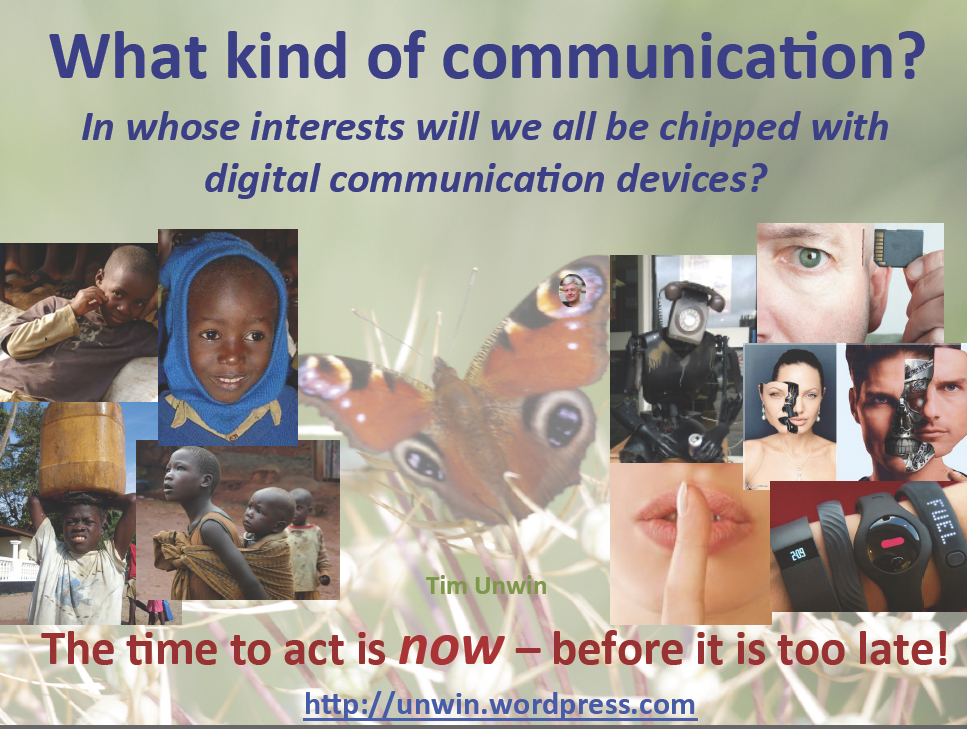
In recent years, I have become increasingly interested in the interface between humans and machines, and thus the world of cyborgs.  This was first formally articulated in my presentation entitled “How will the world communicate in 2113?” given at the Commonwealth Summer School held in Cumberland Lodge on 9th August 2013.  However, as part of the ITU’s ongoing discussion on ICTs in the future, associated with  the Leadership Summit on the Future currently being held during its Telecom World (#ituworld) event in Doha , I was asked to put together a prediction and a single slide summarising some of my thoughts on the future of communication.  So, to give this a little more visibility, I thought I would also post it here:

ITU futures

My actual short quotation was “The future is not so much about the Internet, but rather about the human-machine interface.  Cyborgs are already with us.  If we do not want humans to be mere appendages of machines, we must act now!””

I have to admit that I found the actual ITU session to be much less inspirational than I had expected/hoped it might be – there was very little new in what was discussed!  I was therefore actually rather sad that the presentation that I sent to the ITU for possible inclusion amongst its predictions was seen as being rather too provocative for inclusion!

1 Comment

Filed under Commonwealth, Development, ICT4D

Korean hospitality and vitality at opening evening of ITU Plenipotentiary 2014

When I was last in Korea in 2013, I had the opportunity to watch some amazing drumming, martial arts and dancing in Seoul.  I was therefore greatly looking forward to the celebration of Korean culture that was to accompany the welcome dinner for the ITU 2014 Plenipotentiary conference held in Busan this evening.  As I hope the images below indicate, this was a vibrant and energetic performance that showed much about Korean culture, both old and new.  Thanks to the people of Korea, and of Busan in particular, for sharing with us just a little bit of their beauty, culture and hospitality  this evening.

This slideshow requires JavaScript.

Leave a comment

Filed under Dance, ICT4D, Music, Photographs