Category Archives: ICT4D

Mike Trucano’s ten worst practices in e-learning

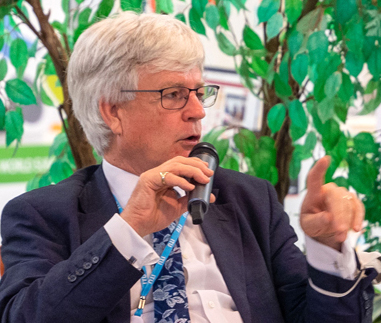
I have always admired Mike Trucano‘s work, and so it was great to hear him speaking this morning at Online Educa Berlin.  His theme was understanding failures in e-learning, especially in the countries where the World Bank is working.

This was his list of the ten worst practices in e-learning:

  1. Dump hardware in schools, hope for magic to happen
  2. Design for OECD learning environments, implement elsewhere
  3. Think about educational content only after you have rolled out your hardware
  4. Assume you can just import content from someone else
  5. Don’t monitor, don’t evaluate
  6. Make a big bet on an unproven technology (especially one based on a closed/proprietary standard) or single vendor, don’t plan for how to avoid ‘lock in’
  7. Don’t think about or acknowledge total costs of ownership/operation issues or calculations
  8. Assume away equity issues
  9. Don’t train your teachers (nor your school headmasters, for that matter)
  10. ….for your own worst practice

The really sad thing is that all of these known worst practices continue to be replicated across the world.  Hopefully, more people will listen to Mike, and then we can develop much better ways through which technology can really be used effectively to enhance learning!

8 Comments

Filed under Education, ICT4D

New GSMA publication on how mobiles contribute to economic growth

The GSM Association, together with Deloitte and Cisco have recently published a useful report (.pdf 3.4 MB) on the contribution of mobiles to economic growth, and they intend to run their analysis on an annual basis so as to provide a barometer of change in the industry and its impact.

Some of the key findings of the report include:

  • For a given level of total mobile penetration, a 10% substitution from 2G to 3G penetration increases GDP per capita growth by 0.15% points
  • A doubling of mobile data use leads to an increase in the GDP per capita growth rate of 0.5% points
  • A 10% increase in mobile penetration increases Total Factor Productivity in the long run by 4.2% points

The Appendices provide much more detail about the precise econometric models used, and it is good to see such detail and transparency.  I retain some concerns, though, about the ways in which causality is imputed from what are essentially relationships between economic indicators.  This could be the basis of an interesting dialogue about methodologies for undertaking such research, which I guess would depend heavily on ideological premises!  However, using this as a starting point, it would be interesting to drill down in more detail to ask what factors need to be in place for the economies of particular countries to follow the general observations noted.  From my perspective, we need to learn more about what some of the poorest countries and peoples can do to ensure that they too benefit.  In other words, we need to disaggregate the data, and understand in detail about the wider governance structures, infrastructure and social conditions that need to be in place to enable growth.  That is, of course, if economic growth is of prime concern!

2 Comments

Filed under 'phones, ICT4D

There is one good call-centre employee at Vodafone after all!

Following my recently highly critical rant about the appalling customer service that Vodafone ‘provides’, I was delighted at long last to ‘meet’ someone who was not only polite and could speak English that I could understand, but who was also able to resolve the latest problem in our relationship.  Her name is Mia. I suggest that anyone calling Vodafone explicitly asks for her by name – I guess she is based in India, and she does speak with a slight US accent, but don’t hold that against her!

I know it is not Mia’s fault, but Vodafone’s website is still not functional for some users – I wonder how many more weeks it will take before I can access my account?

Leave a comment

Filed under 'phones, ICT4D

Appalling ‘service’ by Vodafone

I don’t usually use my blog to illustrate poor customer service, but an e-mail I received this morning has infuriated me so much that I am putting fingers to keyboard!  Vodafone has to be one of the very worst companies for customer service in the UK! Why does anyone still use them? For that matter, why do I?!

I renewed my contract with them a couple of weeks ago, and upgraded my phone.  Since I could not do the necessary change-over online, because their website was down, I took my new phone in to a Vodafone shop (in Hammersmith) to ask them to activate the SIM and transfer my data across.  “Of course”, the assistant said, “It will only be a couple of minutes”.  Half an hour later, when the assistant was unable to do it, his manager came over and managed to get most of the issues sorted.

However, not all of the data was transferred, and I could not access WiFi from the hotspots because of a problem with my account, which they said would soon be activated.  A week later, nothing had happened, and so began a series of quite bizarre phone calls with ‘customer service staff’.  None of theme were able to resolve the problem.  Unbelievably, three out of the four staff could barely speak English, and I kept having to ask them to repeat their questions – really simple things like “What is the first line of your address?” were completely unintelligible.  Eventually, I was told that I could not access my account because of a problem with their website that they were fixing, but that they would give me a £5 refund on my next bill because of the inconvenience.

Still nothing happened – I could not access my account online, and still could not use the WiFi hotspots because I could not sign into my account!  So, I sent an e-mail, and two days later received the message below:

“Thank you for contacting Vodafone Customer Services
I have checked the online account and can see that you are not able to access the online account however if you are unable to access the account; hence I have escalated this to the online escalation department they will look into this matter.
Your patience will be appreciated in this matter
I trust the above information is helpful.
Kind regards,”

This is unbelievable.  First, I am appalled that an e-mail can be sent by a company based in the UK that is so illiterate!  Second, I am not told that the problem is being fixed, but merely that the matter is being escalated to the escalation department!

I wonder how many more weeks it will take for them to get this fixed?!


2 Comments

Filed under 'phones, ICT4D

Google admits it is in breach of UK data privacy

The BBC has reported that “Google has admitted that it had not deleted users’ personal data gathered during surveys for its Street View service. The data should have been wiped almost 18 months ago as part of a deal signed by the firm in November 2010. Google has been told to give the data to the UK’s Information Commissioner (ICO) for forensic analysis”.

When it was originally reported that Google had obtained private data from unsecured wireless networks whilst it was gaining images and spatial data for Street View, the company said it was a mistake and agreed to delete the data by the end of 2010.  However, Google has now contacted the UK’s Information Commissioner to say that not all of these data have been destroyed, asking what it should do with it.

As the BBC continued to report “Possessing data that should have been deleted ‘appears to breach’ the undertaking Google signed in November 2010, said the ICO in a statement. ‘The ICO is clear that this information should never have been collected in the first place and the company’s failure to secure its deletion as promised is cause for concern,’ it added”.

Leave a comment

Filed under Ethics, UK

World Bank report on maximising mobiles

The World Bank has just published a useful new report entitled Maximizing Mobile (full report .pdf).  This “report analyzes the growth and evolution of applications for mobile phones, focusing on their use in agriculture, health and financial services, as well as their impact on employment and government. It also explores the consequences for development of the emerging ‘app economy’, summarizing current thinking and seeking to inform the debate on the use of mobile phones for development. It’s no longer about the phone itself, but about how it is used, and the content and applications that mobile phones open”.

Individuals chapters address the use of mobile devices in agriculture, health, finance, entrepreneurship, and government.  A final chapter provides insights on financing mobile broadband.

Leave a comment

Filed under ICT4D

Vanuatu – gun running

Just seen this exciting report from Radio New Zealand International:

“Posted at 22:38 on 24 July, 2012 UTC

Vanuatu authorities have confiscated firearms after detaining a yacht, the Phocea.

16 crew members and the skipper, along with the owner’s girl friend have been arrested.

The owner, Anh Quan, was a Chinese national but became a Vanuatu citizen this year.

Local media has reported that police believe the vessel was being used to try to smuggle high-powered firearms and illegally acquired money into the country.

Authorities have also confiscated 16 allegedly fake diplomatic passports, and Vanuatu Maritime legal documents.

The passports reportedly include the fake signatures of the Principal Immigration Officer, Francois Batick, and a former Vanuatu Maritime Commissioner, Les Napuati.

Two government ministers, another MP and other politicians were spotted on the yacht before the authorities went on board on Sunday.

The yacht, which had been travelling from Italy to Papua New Guinea, was once owned by a former French government minister, Bernard Tapie.

News Content © Radio New Zealand International
PO Box 123, Wellington, New Zealand”.

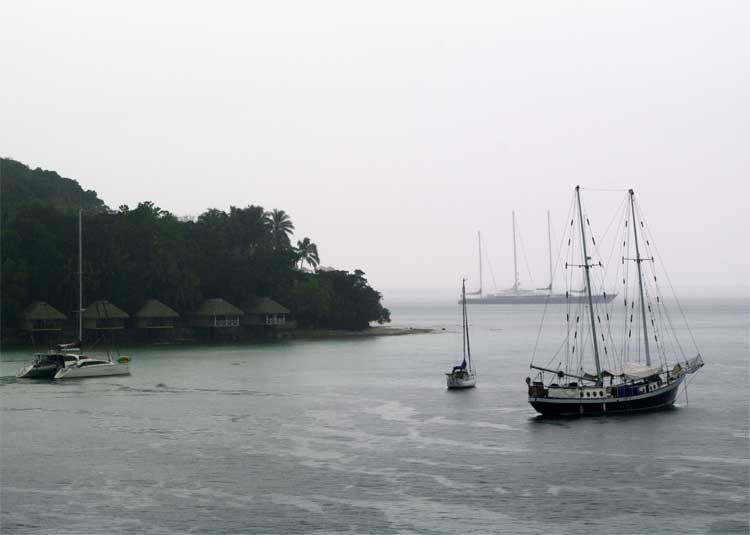
And all this happened just after I left Vanuatu!

Leave a comment

Filed under Story-telling

Broadband in the Pacific

The Pacific Broadband Forum 2012, convened by the Commonwealth Telecommunications Oganisation and the International Telecommunications Union, together with regional partners PITA, PiRRC and SPC, is currently being hosted by the Fijian Ministry of Communications on Denarau Island, Fiji.  This morning’s session provided a wealth of information about the current status of broadband roll-out across the region.  Sadly, my fingers and brain were insufficiently co-ordinated to record everything that was said, but I hope that the following notes may be useful for those interested in ways through which ICTs are being developed in the region:

Cook Islands

  • No policy and regulations in place for broadband
  • There is a national ICT policy – based on 6 platforms
  • New national sustainable development plan – will have to align with this.
  • Legislation: 1989 Telecom Act; new draft bill in consultation; SPAM act 2008; electronics transactions bill; evidence act (needs to be updated); cyber crime legislation in development. But most need training in implementation.
  • Many challenges – budget, lack of implementation capacity, lack of consultation with stakeholders
  • Need to establish a regulator

Federated States of Micronesia

  • Connected with fibre optics with the Kwajalein to Guam (USA) since 2005 (spurs to Marshalls and elsewhere)
  • President Mori said need to connect all islands, and a regulator
  • 2007 ADB issued report on liberalisation, regulation and community service requirement
  • Hantru cable became operational in Pohnpei – eight 20 Gbps capacity to Guam; other islands are not yet connected.
  • Close links with World Bank who have conducted studies and due diligence
  • Optimising on current investments.
  • Debt servicing of DSDA loans that enabled what was originally done.
  • There will be sector reform to liberalise the market
  • Next challenges – to endorse the policy and the FSM Congres will need to endorse World Bank Assistance and the Telecommunications Sector Reform.

Kiribati

  • 33 atolls over 3.5 million km2; population of only 112,000
  • relies on satellite
  • fixed line 4.14%, mobile 1.04%; internet 2.07%
  • prices of telephony and internet are very high
  • monopolistic market TSKL sole ICT provider
  • World Bank funding for ICT review and advice
    • Policy and legal support
    • Regulatory support
    • Outer islands connectivity support
    • Project management support
  • 9 telecentres funded by government; PACRICS provided internet connectivity in 10 secondary school

Marshall Islands

  • 68,000 pop, 34 islands
  • broadband – 2 urban cities have cable installed; gsm sites in four islands. Telecentres. DAMA sites.  Aim to cove all country by end of 2012.
  • ICT policy should be in place by end of August and will provide for market liberalisation, regulator, cybercrime
  • Only 1% of submarine cable in being used
  • Remote area is getting connected for e-health, e-learning and climate change
  • Difficulties: connecting the unconnected; teamwork; perfect competition; consumer satisfaction; move small
  • Challenges
    • Costs of backbone
    • Geographical challenges for operations
    • Quality and reliability
    • Costs of bandwidth
  • 2008 National ICT Policy
    • NICTA regulator
    • Aims to have efficient ICT infrastructure as backbone
    • Open competition
  • 2012 National Broadband policy
  • LNG Fibre cable project announced – cable is piggy backing on the pipe

Nauru

  • Population less than 10,000
  • Regulator – enabling environment
  • Challenge of ability to provide broadband – only one service provider.  Bandwidth to increase by 30% in next month.  Talking with O3b to increase
  • If you cry hard enough you are bound to be heard.
  • Need to lay the foundations and have regulations in place
  • Major reforms in last decade in telecoms sector.  Telecom Act 2005 established regulator in 2006 which introduced competition
  • Competition has worked even in a small island
  • PM Chairs national IT committee – it is important to have leadership from the top
  • Draft masterplan for broadband supported by ITU
  • Universal access policy
  • Shared infrastructure
  • c. 95% coverage
  • Looking at 2nd submarine cable

Niue

  • Just one island – the Rock (260 sq kms); population 1600.
  • Telcom Niue – sole provider and regulator; two ISPs
  • Fixed line 60%; mobile 30% (only introduced July 2011); broadband 1% (introduced April this year)
  • Bills before Parliament (SPAM, Cybercrime, Draft ICT Policy)
  • Issues for Niue: very small market means lack of service and difficulties of setting prices; satellite bandwidth, but costs are too high for us; capacity building.
  • Free wifi access – arrangement with manager of top level domain nu – to develop access on the island.
  • OLPC has not really worked that well – laptops breakdown very easily and no back-up; and not managed properly. Children took them home and did not bring them to school except when they were broken.
  • Future plans – looking to develop services.

Palau

  • 240 islands; population 20,000
  • mobile coverage 98%; internet subscribers 6%; fixed broadband 2%
  • 113 mile long underground and submarine SONET cable connecting 3 islands.  Using VSAT to reach remote islands.  Radio also used in isolated areas for emergency.
  • PNCC (Palau National Communications Corporation) provides the majority of communications services
  • Palau Mobile Corporation commenced operations in 2006 and offers GSM services (3G hopefully will roll out next year).
  • Palau Telecoms licensed for Digital TV and internet – yet to start mobile service
  • Skyfy yet to offer services, but is licensed
  • Mobile services can reach 98% with mobile density being 80%
  • 2011-2014 Palau National ICT Policy (thanks to ITU)
  • Expanding broadband and international fibre optic cable connectivity

Solomon Islands

  • Cable plan 2013
  • Setting up 50 GSM sites
  • 3G services launched by Telekom and Bemobile
  • establishment of universal access fund policy
  • costs high

Tuvalu

  • No-cable islands dreaming for cable
  • Population 11,000; landlines 1182, mobiles 2525, Internet 4000
  • Monopoly
  • Current activities: e-government, national ICT policy, cyberlegislation, licensing
  • Challenges: funding, human capacity, geography (500,000 sq miles), high costs of ICT, poor energy supply
  • Plans: strengthening outer island connectivity, disaster risk reduction (very vulnerable – one tsunami would take us all across to Fiji), offsite backup

Vanuatu

  • Been challenged in court and politically, but has come through that as an independent regulator
    Minister was ‘in bed with’ one of the telcos and has now been taken off – so ICT responsibility is in the Prime Minister’s office.
  • Technical advisors funded by the World Bank and AusAid.
  • ICT for all (7 goals)
  • Very strong Universal Access policy in draft – has been sitting on Minister’s desk for a year – but will hopefully now go through (only raises funds from operators for specific projects)
  • Zero rate importation tax for all ICTs
  • 2015 access to broadband connectivity for 85% of population
  • Spectrum available 700 MHz LTE and 3G
  • Submarine cable being led by Interchange
  • Employment is growing in the sector – now 2500
  • Telcentres in Rensarie and Melsis high schools; Nebul and South West Bay health centres – need to provide many additional services in the centres.  Quite slow take up; importance of the manager; potential for agriculture.
  • All stakeholders must work carefully together
  • High schools and health centres are a priority
  • Using mapinfo to find the most cost effective way to deliver services

Leave a comment

Filed under ICT4D, ICT4D conferences

Ensuring disability agendas are embedded effectively in national ICT strategies

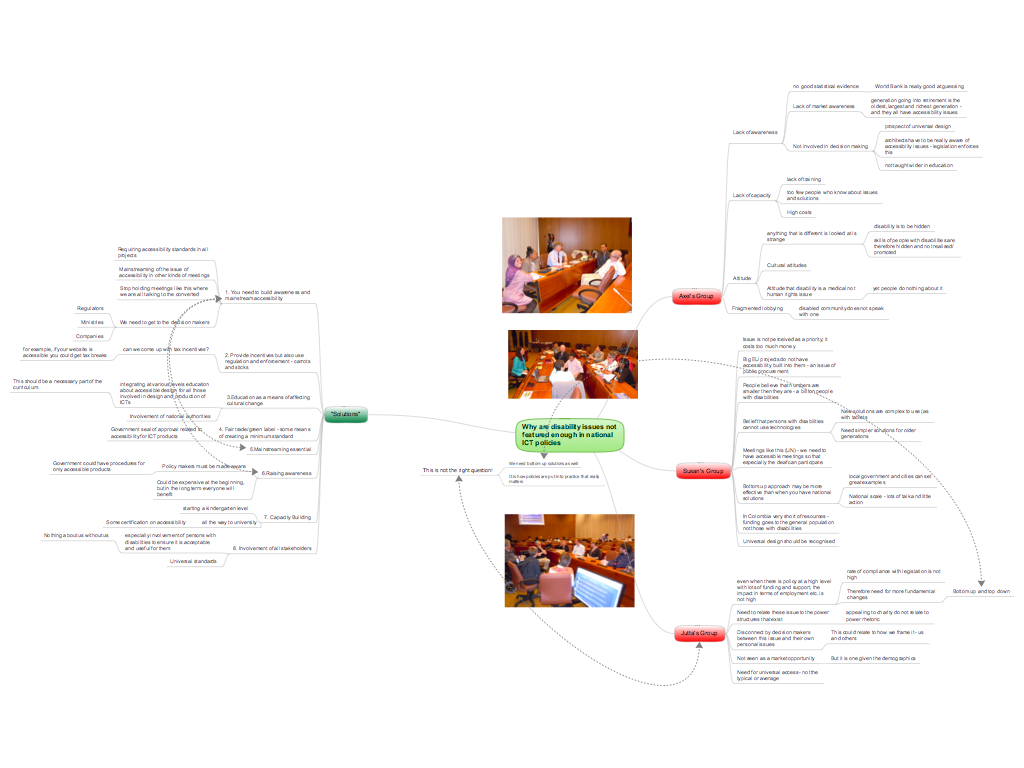
At today’s WSIS Forum session on ICTs and disability (#ICT4DD) led by the Commonwealth Telecommunications Organsation and the UNESCO Chair in ICTD at Royal Holloway, University of London, more than 35 people in Geneva and some 15 people participating externally came together to explore ways through which accessibility/disability issues can be included more effectively in national ICT strategies.  Three breakout groups came up with some 17 main reasons why disability issues are not more included within such policies and strategies, and then identified 7 practical ways through which these challenges can be overcome.  Details of the outcomes are summarised in the mind map below (click on the image itself for a larger version, or the link below for a full sized version).

WSIS Disability session

Solutions recommended included:

  1. The need to build awareness
  2. Mainstreaming accessibility
  3. Providing incentives, whilst also using regulation and enforcement
  4. Education as a means for affecting cultural change
  5. Using a quality label as a means for creating a minimum standard
  6. Capacity development
  7. The involvement of all stakeholders (Nothing about us without us)

Thanks to everyone who participated, and to all of the session partners including the ITU, G3ICT, the University of Michigan, OCAD University, the Daisy Consortium, and the Global Public Inclusive Infrastructure initiative.

2 Comments

Filed under Accessibility, ICT4D

Accelerating development using the Web

George Sadowsky’s new edited book entitled “Accelerating development using the Web: empowering poor and marginalised populations” has just been launched at the WSIS Forum in Geneva.  This contains some really excellent material, and is an important resource for those interested in exploring ways through which the Web can be used by some of the world’s poorest and most marginalised people to enhance their lives. Generously supported by the Rockefeller Foundation, and produced in partnership with the World Wide Web Foundation and the UNDP, this book is designed as “a compendium of articles by recognized experts describing the real and potential effects of the World Wide Web in all major aspects of economic and  social development”.  Many of the authors combine academic and practical experience, and so this book is much more than just an arid digest of academic thinking on the subject.  It also challenges many of the taken for granted assumptions about the Web, and examines the structural conditions that limit its use by the poorest of the world’s people.  Chapters cover the following main themes:

  • Chapter 1 – Introduction (George Sadowsky)
  • Chapter 2 – Fundamental Access Issues (Michael Jensen)
  • Chapter 3 – Technical Access Issues (Alan Greenberg)
  • Chapter 4 – Policy Access Issues (Cynthia Waddell)
  • Chapter 5 – Governance (Raúl Zambrano)
  • Chapter 6 – Agriculture (Shalini Kala)
  • Chapter 7 – Health (Najib Al-Shorbaji)
  • Chapter 8 – Education (Tim Unwin)
  • Chapter 9 – Commerce and Trade (Torbjörn Fredriksson)
  • Chapter 10 – Finance (Richard Duncombe)
  • Chapter 11 – Gender (Nancy Hafkin)
  • Chapter 12 – Language and Content (Daniel Pimienta)
  • Chapter 13 – Culture (Nnenna Nwakanma)
  • Chapter 14 – Conclusion

It was great fun working with George and the team on this project, and I do hope that those who read it will find a sense of our commitment, enthusiasm and, at times, outrage.  The Web is in danger of becoming a vehicle through which greater divides are created in our societies.  We have to take specific actions if the enormous benefits that it can provide are to be made available to all of the world’s people.  This is most definitely not the same as saying that access to the Web should be a human right – something that I  most profoundly disagree with.  However, it is most certainly to suggest that we cannot simply take it for granted that providing Internet access will without question benefit the poor. If the poor and the marginalised are indeed to benefit from the Web, there have to be clear mechanisms that enable them to use it to deliver on their needs and aspirations.

1 Comment

Filed under Development, ICT4D