Category Archives: ICT4D

The Internet and Development: a critical perspective

9780199589074_140I am delighted to see Bill Dutton’s magisterial edited The Oxford Handbook of Internet Studies (Oxford University Press, 2013) just published.  This is a really excellent and authoritative review of current research on all aspects of the Internet, with some 26 chapters from leading figures in the field.  The 607 page book is divided into five main parts:

  1. Perspectives on the Internet and Web as objects of study
  2. Living in a network society
  3. Creating and working in a global network economy
  4. Communication, power, and influence in a converging media world
  5. Governing and regulating the Internet.

Two of the real strengths of the book as an introduction to the field of Internet studies are the very readable style of most of the chapters, and the comprehensive bibliographies that accompany them.

I was delighted to have been asked to write the chapter on the Internet and Development, which Bill suggested should be sub-titled “a critical perspective”!  As I write in the summary, “This chapter explores research on the complex inter-relationship between the Internet and ‘development’, focusing especially on the effects of the Internet on the lives of some of the poorest people and most marginalised communities.  Much of the literature on Information and Communication Technologies for Development (ICT4D) suggests that the Internet can indeed bring very significant benefits in the ‘fight against poverty’ (see, for example, Weigel and Waldburger 2004; Rao and Raman 2009; Unwin 2009), but other research is marshalled in this synthesis to challenge this assumption.  In essence, I argue that the expansion of the Internet serves very specific capitalist interests, and that unless conscious and explicit attention is paid to designing interventions that will indeed directly serve the needs of the world’s poorest people, then the Internet will only replicate and reinforce existing structures of dominance and control. This argument supports the need for more research that challenges taken-for-granted assumptions about the Internet and development”.

In essence, the Internet is not some benign force for good as is so often supposed.  Instead it is being shaped and reshaped by a relatively small group of people with very specific interests.  It is absolutely essential that those committed to trying to ensure that digital technologies are used to serve the interests of all peoples in the world, and particularly the poorest and most marginalised, do indeed continue to challenge many of the all too often taken for granted assumptions that the Internet is necessarily automatically a force for positive “development”.

1 Comment

Filed under Development, ICT4D

Passwords, PIN numbers and cybersecurity

Ever since one of my websites was hacked a few months ago, I have taken a much more personal interest in issues of cybersecurity.  Whilst I have spoken and written many times on the subject, it is only when things really affect you in a personal way that you begin to gain different understandings of the issues.  It represents a shift from a theoretical understanding to a practical one!

I thought I knew most of the various recommendations concerning password and PIN security, and that I had indeed followed them.  However, no digital system is ever completely secure, and the level of sophistication now being used by those intent on stealing identity data, particularly with respect to banking information, is becoming very much more sophisticated.

There are many well known organisations providing advice and recommendations, such as Sophos, Symantec and Kaspersky Lab, but there are rather few places where all of this information is brought together in a single place.  The level of insecurity, and the apparent disinterest among vast numbers of people in doing much about their digital security is not only surprising, but is also deeply concerning.  So, in this posting, I have tried to bring together some of the more interesting observations that have recently been made about passwords and PIN numbers, in order to try to persuade people to take action on this really rather important topic!

Most popular PIN codes and iPhone passcodes
There are numerous articles on the most popular PIN codes – in other words the ones that no-one should actually use! One of the best is Daniel Amitay‘s experiment, where he used Big Brother’s passcode set up screen as a surrogate to estimate iPhone passcode usage, and discovered that the top ten codes listed below represented 15% of all passcodes used:

  1. 1234
  2. 0000
  3. 2580
  4. 1111
  5. 5555
  6. 5683
  7. 0852
  8. 2222
  9. 1212
  10. 1998

None of these are surprising, given that they represent easily remembered structures around the keypad. The passcode 1998 features because it is a year of birth and as Amitay goes on to point out other birth years also feature highly among passwords.

What is perhaps even more worrying is that research by Sophos in 2011 suggested that 67% of consumers do not even use any passcode on their ‘phones, so that a passer-by can access all of the information on the ‘phone without even having to bother to hack the code.

Four digit codes are also commonly used by banks to enable customers to access money through cashpoint machines (ATMs).  Research summarised by Chris Taylor (on Mashable) notes that 27% of people use one of the top 20 PINs for their banking, with the most popular number (1234) being used by a massive 11%.  The top 20 PIN codes he lists are as follows:

  1. 1234 (10.7%)
  2. 1111 (6.0%)
  3. 0000 (1.9%)
  4. 1212 (1.2%)
  5. 7777 (0.7%)
  6. 1004 (0.6%)
  7. 2000 (0.6%)
  8. 4444 (0.5%)
  9. 2222 (0.5%)
  10. 6969 (0.5%)
  11. 9999 (o.5%)
  12. 3333 (0.4%)
  13. 5555 (0.4%)
  14. 6666 (0.4%)
  15. 1122 (0.4%)
  16. 1313 (0.3%)
  17. 8888 (0.3%)
  18. 4321 (0.3%)
  19. 2001 (0.3%)
  20. 1010 (0.3%)

Chris Taylor goes on to comment that although there are 10,000 possible combinations of four digits, 50% of people use the most popular 426 codes!  As he says, “Pick up an ATM card on the street, and you have a 1 in 5 chance of unlocking its cash by entering just five PINs. That’s the kind of Russian Roulette that’s going to be attractive to any casual thief”.

There is therefore  really quite a high probability that even without watching someone enter their PIN number and then stealing the card, or using sophisticated technology to ‘crack’ someone’s PIN code, criminals would have a pretty good chance of accessing someone’s bank account just by using the most popular codes above.  The implication for users is clear: use a PIN code that is not among the most common!

Passwords
The situation is scarcely better with passwords that people use for their online digital activities. Numerous surveys have all pointed to the same conclusion, that a very small number of passwords continue to be used by large numbers of people.  These change a bit over time, and vary depending on cultural context and country, but the message is clear.  Even without sophisticated programmes to crack passwords, those wishing to access personal information can achieve remarkable success just by trying to use the most common passwords!  The most common passwords, in other words those to be avoided, are listed below:

Splashdata 2012

Sophos Naked Security 2010, based on leaked Gawker Media passwords

1

password

123456

2

123456

Password

3

12345678

12345678

4

abc123

lifehack

5

qwerty

qwerty

6

monkey

abc123

7

letmein

111111

8

dragon

monkey

9

111111

consumer

10

baseball

12345

11

iloveyou

0

12

trustno1

letmein

13

1234567

trustno1

14

sunshine

Dragon

15

master

1234567

16

123123

baseball

17

welcome

superman

18

shadow

iloveyou

19

ashley

gizmodo

20

football

sunshine

21

jesus

1234

22

michael

princess

23

ninja

starwars

24

mustang

whatever

25

password1

shadow

A slightly more sophisticated approach is that adopted by those wishing to break into networks by testing them automatically against a much larger number of different passwords.  One of the best publicised accounts of this was the Conficker worm, which used the passwords in the chart below to try to access accounts (Sophos, 2009):
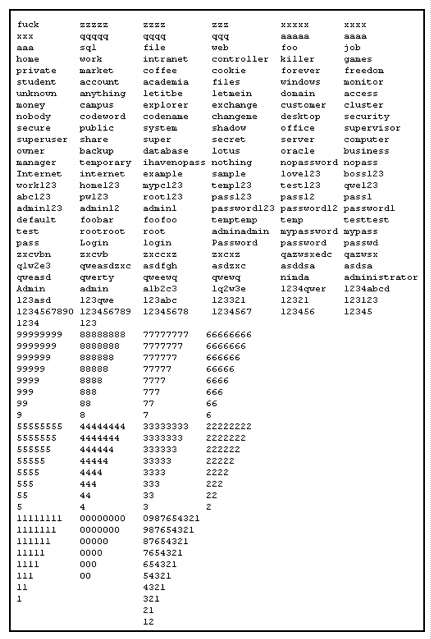
Worm

Again, this clearly indicates that considerable care needs to be taken in choosing passwords, and ensuring that they are at the very least more complex than those listed above.

Tips to reduce the risk of fraud through mobile devices and digital technologies
Much has been written about sensible advice for reducing the risk of fraud through mobile passcodes, banking PINs and online login passwords.  Such tips will never eliminate really determined people from hacking into your identity, but a few simple steps can at least make it more difficult for the less determined.  These include:

  • Always secure your ‘phone with a PIN code, or better still a password (iPhone users can do this simply in Settings>General>Passcode Lock).  This will help to prevent all of your contacts, photos, e-mails and other personal information being accessed immediately by anyone who picks up your ‘phone.
  • Reduce the time before your ‘phone automatically locks so that it is as short as possible, preferably no more than a minute
  • Always use complex passwords, that preferably include lower case and upper case letters, numbers and special characters
  • Use passwords that are at least 8 characters and preferably more than 12 characters in length
  • Frequently change your passwords at random intervals, so that possible hackers are unaware when to expect changes
  • Use different passwords for different accounts, so that if one password is ‘broken’ this will not permit access to your other accounts
  • Think about using a service that tests the strength of a proposed password (such as The Password Meter, Microsoft’s password checker, or Rumkin’s strength test) – for the hyper-security-conscious person, it is probably best to do this from a computer other than your own!
  • Never, under any circumstances give your passwords or PIN codes to other people

Ultimately, passwords and PIN numbers are just part of a wider defence needed against digital theft.  Human action, be it using the ‘phone in an unsafe public place or unfortunately responding to a phishing attack, is still the cause of much digital grief.  As I write, Sophos has just for example reported a phishing attack through a security breach on the Ethiopian Red Cross Society’s website purporting to be a Google Docs login page.

If the worst happens, and you do lose a ‘phone there are at least two important things to do:

  • Ensure you have software on the ‘phone that can enable you to track it (as with the Find My iPhone app, or for Android ‘phones there are apps such as Sophos’ Mobile Security app)
  • If there is no chance of getting the ‘phone back, then remotely delete all of its content as swiftly as possible, remembering that if it has been backed up on a laptop or cloud facility, then all of the data can be restored at a later date.

Working together, and sharing good practices in personal digital security we can do much to help reduce digital identity theft.


3 Comments

Filed under 'phones, ICT4D general

Commonwealth Telecommunications Organisation – vacancy for Head of Operations Department

The Commonwealth Telecommunications Organisation (CTO) is seeking to appoint a new Head of its Operations Department, managing the delivery of its three operations divisions (research and consultancy, capacity development and training, and events and conferences).  This exciting opportunity would suit applicants from diverse backgrounds, including the private sector and the international development community.  The appointment will be at Director level with a starting salary in the range £60,000-£66,150. Closing Date 15th February 2013.

The successful applicant will

  • Manage the CTO’s Operations Department, consisting of three divisions, with heads of these divisions being direct reports:
    • Research and Consultancy
    • Capacity Development and Training
    • Events and Conferences
  • Develop the Operations Department’s activities in line with the CTO’s Strategic Plan, so as to deliver effective, value for money services for the CTO’s members and others
  • Ensure that the Operations Department delivers on its financial targets
  • Contribute to the activities of the Operations Department in areas of own expertise.
  • Be responsible for oversight and development of one or two of the CTO’s six niche focus areas
  • Be responsible for oversight and development of the CTO’s activities in one or two regions of the Commonwealth.
  • Provide support and report directly to the Secretary General of the CTO
  • Liaise closely with the Head of the Finance and Administration Department and the Head of Corporate Services to ensure effective collaboration between Departments in delivering the CTO’s mission.

The successful applicant will have the following proven experiences and characteristics:

Essential

  • Excellent timely delivery against business targets
  • At least ten years of management experience within the broad field of ICTs, preferably with a development focus
  • Successful management of small teams charged with delivering ambitious financial targets
  • Strong sense of the need for accuracy and precision in delivery
  • Ability to set high individual and team standards
  • At least ten years direct experience of two or more of the areas of activity of the CTO’s operational divisions
  • An excellent team player, committed to helping staff build their careers within an organisation
  • Excellent international networking skills across different groups of stakeholders in ICT for Development

Desirable

  • Strong affinity with delivering ICT based activities through multi-stakeholder partnerships
  • Good knowledge of Commonwealth organisations and agendas
  • Experience of working in a multi-cultural environment and preferably in two or more regions of the Commonwealth (Africa, Asia, Caribbean, Europe, Pacific)
  • Fluency in the English language, as well as working knowledge of at least one other language.

Application procedure

The CTO is committed to providing a challenging and stimulating workplace, where all staff can fulfil their career ambitions in a diverse and supportive environment. It places considerable emphasis on the importance of teamwork, alongside its commitment to delivering the best possible value for money services to all of its members. People work for the CTO primarily because they believe in its commitment to using ICTs to help make a difference to the lives of some of the poorest and most marginalised people in the Commonwealth.  All employees must be citizens of Full Member Countries of the CTO at the time of employment.

All applications, including a curriculum vitae and a letter of application should be submitted to recruitment@cto.int by 15th February 2013.

Full details are available at http://www.cto.int/about-the-cto/working-with-us/current-vacancies/director-and-head-of-operations-department-full-time/

Leave a comment

Filed under ICT4D

Mike Trucano’s ten worst practices in e-learning

I have always admired Mike Trucano‘s work, and so it was great to hear him speaking this morning at Online Educa Berlin.  His theme was understanding failures in e-learning, especially in the countries where the World Bank is working.

This was his list of the ten worst practices in e-learning:

  1. Dump hardware in schools, hope for magic to happen
  2. Design for OECD learning environments, implement elsewhere
  3. Think about educational content only after you have rolled out your hardware
  4. Assume you can just import content from someone else
  5. Don’t monitor, don’t evaluate
  6. Make a big bet on an unproven technology (especially one based on a closed/proprietary standard) or single vendor, don’t plan for how to avoid ‘lock in’
  7. Don’t think about or acknowledge total costs of ownership/operation issues or calculations
  8. Assume away equity issues
  9. Don’t train your teachers (nor your school headmasters, for that matter)
  10. ….for your own worst practice

The really sad thing is that all of these known worst practices continue to be replicated across the world.  Hopefully, more people will listen to Mike, and then we can develop much better ways through which technology can really be used effectively to enhance learning!

8 Comments

Filed under Education, ICT4D

New GSMA publication on how mobiles contribute to economic growth

The GSM Association, together with Deloitte and Cisco have recently published a useful report (.pdf 3.4 MB) on the contribution of mobiles to economic growth, and they intend to run their analysis on an annual basis so as to provide a barometer of change in the industry and its impact.

Some of the key findings of the report include:

  • For a given level of total mobile penetration, a 10% substitution from 2G to 3G penetration increases GDP per capita growth by 0.15% points
  • A doubling of mobile data use leads to an increase in the GDP per capita growth rate of 0.5% points
  • A 10% increase in mobile penetration increases Total Factor Productivity in the long run by 4.2% points

The Appendices provide much more detail about the precise econometric models used, and it is good to see such detail and transparency.  I retain some concerns, though, about the ways in which causality is imputed from what are essentially relationships between economic indicators.  This could be the basis of an interesting dialogue about methodologies for undertaking such research, which I guess would depend heavily on ideological premises!  However, using this as a starting point, it would be interesting to drill down in more detail to ask what factors need to be in place for the economies of particular countries to follow the general observations noted.  From my perspective, we need to learn more about what some of the poorest countries and peoples can do to ensure that they too benefit.  In other words, we need to disaggregate the data, and understand in detail about the wider governance structures, infrastructure and social conditions that need to be in place to enable growth.  That is, of course, if economic growth is of prime concern!

2 Comments

Filed under 'phones, ICT4D

There is one good call-centre employee at Vodafone after all!

Following my recently highly critical rant about the appalling customer service that Vodafone ‘provides’, I was delighted at long last to ‘meet’ someone who was not only polite and could speak English that I could understand, but who was also able to resolve the latest problem in our relationship.  Her name is Mia. I suggest that anyone calling Vodafone explicitly asks for her by name – I guess she is based in India, and she does speak with a slight US accent, but don’t hold that against her!

I know it is not Mia’s fault, but Vodafone’s website is still not functional for some users – I wonder how many more weeks it will take before I can access my account?

Leave a comment

Filed under 'phones, ICT4D

Appalling ‘service’ by Vodafone

I don’t usually use my blog to illustrate poor customer service, but an e-mail I received this morning has infuriated me so much that I am putting fingers to keyboard!  Vodafone has to be one of the very worst companies for customer service in the UK! Why does anyone still use them? For that matter, why do I?!

I renewed my contract with them a couple of weeks ago, and upgraded my phone.  Since I could not do the necessary change-over online, because their website was down, I took my new phone in to a Vodafone shop (in Hammersmith) to ask them to activate the SIM and transfer my data across.  “Of course”, the assistant said, “It will only be a couple of minutes”.  Half an hour later, when the assistant was unable to do it, his manager came over and managed to get most of the issues sorted.

However, not all of the data was transferred, and I could not access WiFi from the hotspots because of a problem with my account, which they said would soon be activated.  A week later, nothing had happened, and so began a series of quite bizarre phone calls with ‘customer service staff’.  None of theme were able to resolve the problem.  Unbelievably, three out of the four staff could barely speak English, and I kept having to ask them to repeat their questions – really simple things like “What is the first line of your address?” were completely unintelligible.  Eventually, I was told that I could not access my account because of a problem with their website that they were fixing, but that they would give me a £5 refund on my next bill because of the inconvenience.

Still nothing happened – I could not access my account online, and still could not use the WiFi hotspots because I could not sign into my account!  So, I sent an e-mail, and two days later received the message below:

“Thank you for contacting Vodafone Customer Services
I have checked the online account and can see that you are not able to access the online account however if you are unable to access the account; hence I have escalated this to the online escalation department they will look into this matter.
Your patience will be appreciated in this matter
I trust the above information is helpful.
Kind regards,”

This is unbelievable.  First, I am appalled that an e-mail can be sent by a company based in the UK that is so illiterate!  Second, I am not told that the problem is being fixed, but merely that the matter is being escalated to the escalation department!

I wonder how many more weeks it will take for them to get this fixed?!


2 Comments

Filed under 'phones, ICT4D

Google admits it is in breach of UK data privacy

The BBC has reported that “Google has admitted that it had not deleted users’ personal data gathered during surveys for its Street View service. The data should have been wiped almost 18 months ago as part of a deal signed by the firm in November 2010. Google has been told to give the data to the UK’s Information Commissioner (ICO) for forensic analysis”.

When it was originally reported that Google had obtained private data from unsecured wireless networks whilst it was gaining images and spatial data for Street View, the company said it was a mistake and agreed to delete the data by the end of 2010.  However, Google has now contacted the UK’s Information Commissioner to say that not all of these data have been destroyed, asking what it should do with it.

As the BBC continued to report “Possessing data that should have been deleted ‘appears to breach’ the undertaking Google signed in November 2010, said the ICO in a statement. ‘The ICO is clear that this information should never have been collected in the first place and the company’s failure to secure its deletion as promised is cause for concern,’ it added”.

Leave a comment

Filed under Ethics, UK

World Bank report on maximising mobiles

The World Bank has just published a useful new report entitled Maximizing Mobile (full report .pdf).  This “report analyzes the growth and evolution of applications for mobile phones, focusing on their use in agriculture, health and financial services, as well as their impact on employment and government. It also explores the consequences for development of the emerging ‘app economy’, summarizing current thinking and seeking to inform the debate on the use of mobile phones for development. It’s no longer about the phone itself, but about how it is used, and the content and applications that mobile phones open”.

Individuals chapters address the use of mobile devices in agriculture, health, finance, entrepreneurship, and government.  A final chapter provides insights on financing mobile broadband.

Leave a comment

Filed under ICT4D

Vanuatu – gun running

Just seen this exciting report from Radio New Zealand International:

“Posted at 22:38 on 24 July, 2012 UTC

Vanuatu authorities have confiscated firearms after detaining a yacht, the Phocea.

16 crew members and the skipper, along with the owner’s girl friend have been arrested.

The owner, Anh Quan, was a Chinese national but became a Vanuatu citizen this year.

Local media has reported that police believe the vessel was being used to try to smuggle high-powered firearms and illegally acquired money into the country.

Authorities have also confiscated 16 allegedly fake diplomatic passports, and Vanuatu Maritime legal documents.

The passports reportedly include the fake signatures of the Principal Immigration Officer, Francois Batick, and a former Vanuatu Maritime Commissioner, Les Napuati.

Two government ministers, another MP and other politicians were spotted on the yacht before the authorities went on board on Sunday.

The yacht, which had been travelling from Italy to Papua New Guinea, was once owned by a former French government minister, Bernard Tapie.

News Content © Radio New Zealand International
PO Box 123, Wellington, New Zealand”.

And all this happened just after I left Vanuatu!

Leave a comment

Filed under Story-telling