Category Archives: ICT4D

How to make ICT4D partnerships better deliver real development impacts

The ICT4D Collective hosted a workshop at the WSIS Forum in Geneva today on the key factors colleagues considered to be necessary to overcome four of the most important problems in delivering effective ICT4D partnerships.  The idea for the workshop stemmed from the systematic review of the impact of ICT4D partnerships completed by Marije Geldof, David Grimshaw, Dorothea Kleine and myself for DFID earlier this year.  This highlighted four main areas where further thought was required:

  • How can we best ensure that local communities and interests are involved in partnership implementation?
  • How to ensure that intended development outcomes are really addressed?
  • How to build sustainability and scalability into ICT4D partnerships from the very beginning?
  • What mechanisms can be used to ensure trust, honesty, openness, mutual understanding and respect?
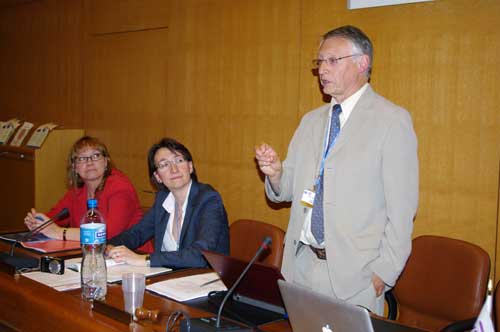
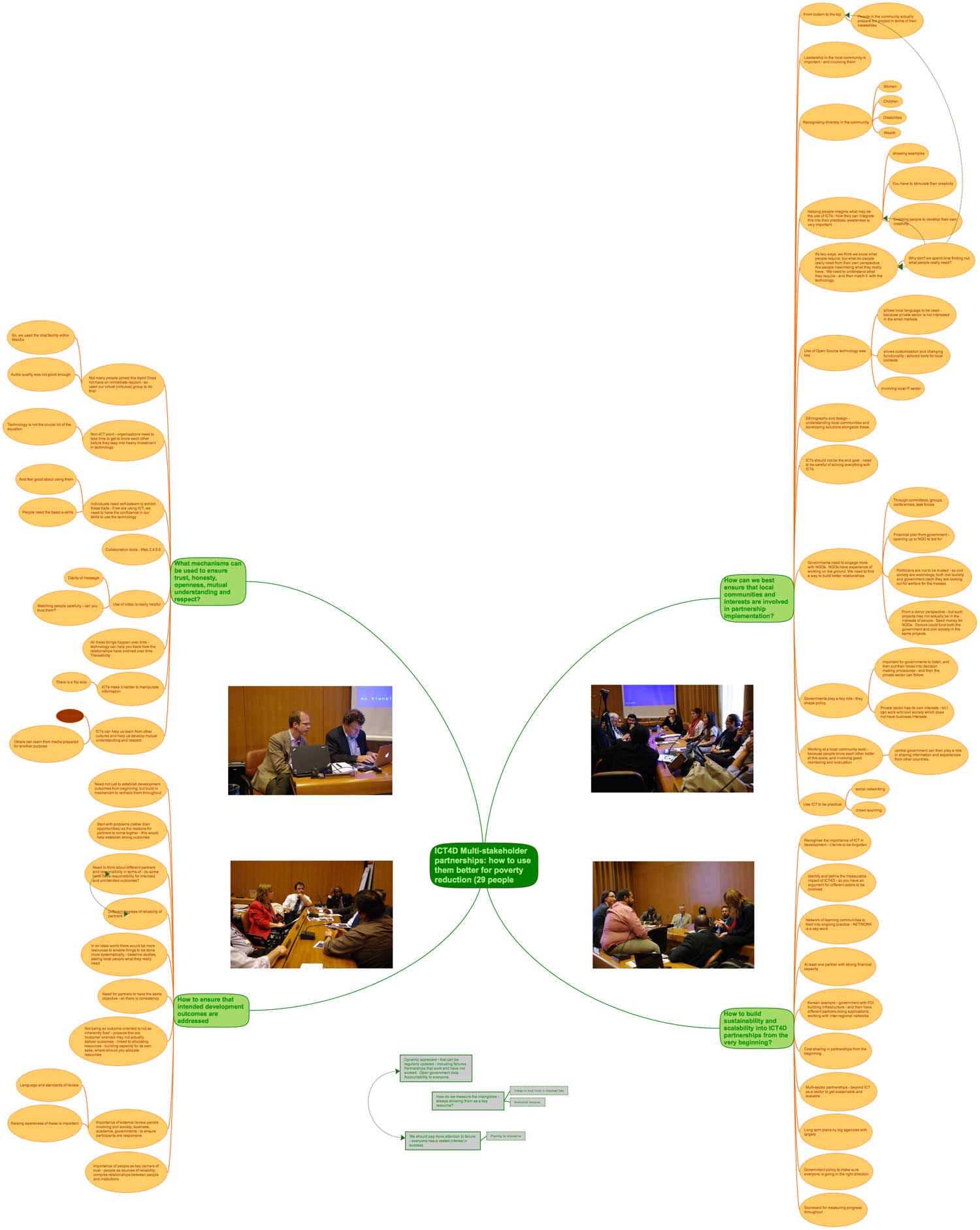
Following an opening presentation by David Grimshaw (Practical Action, and Royal Holloway, University of London), we divided up into four groups (chaired by Paola Uimonen from SPIDER, Peter Drury from Cisco, and Dorothea Kleine and myself from Royal Holloway, University of London), each discussing one of these themes, and the outcome was the following mind map (click on image for larger version) that reflected the collected views of the 30 or so people present, as well as those who joined by WebEx video conferencing services kindly provided by Cisco.
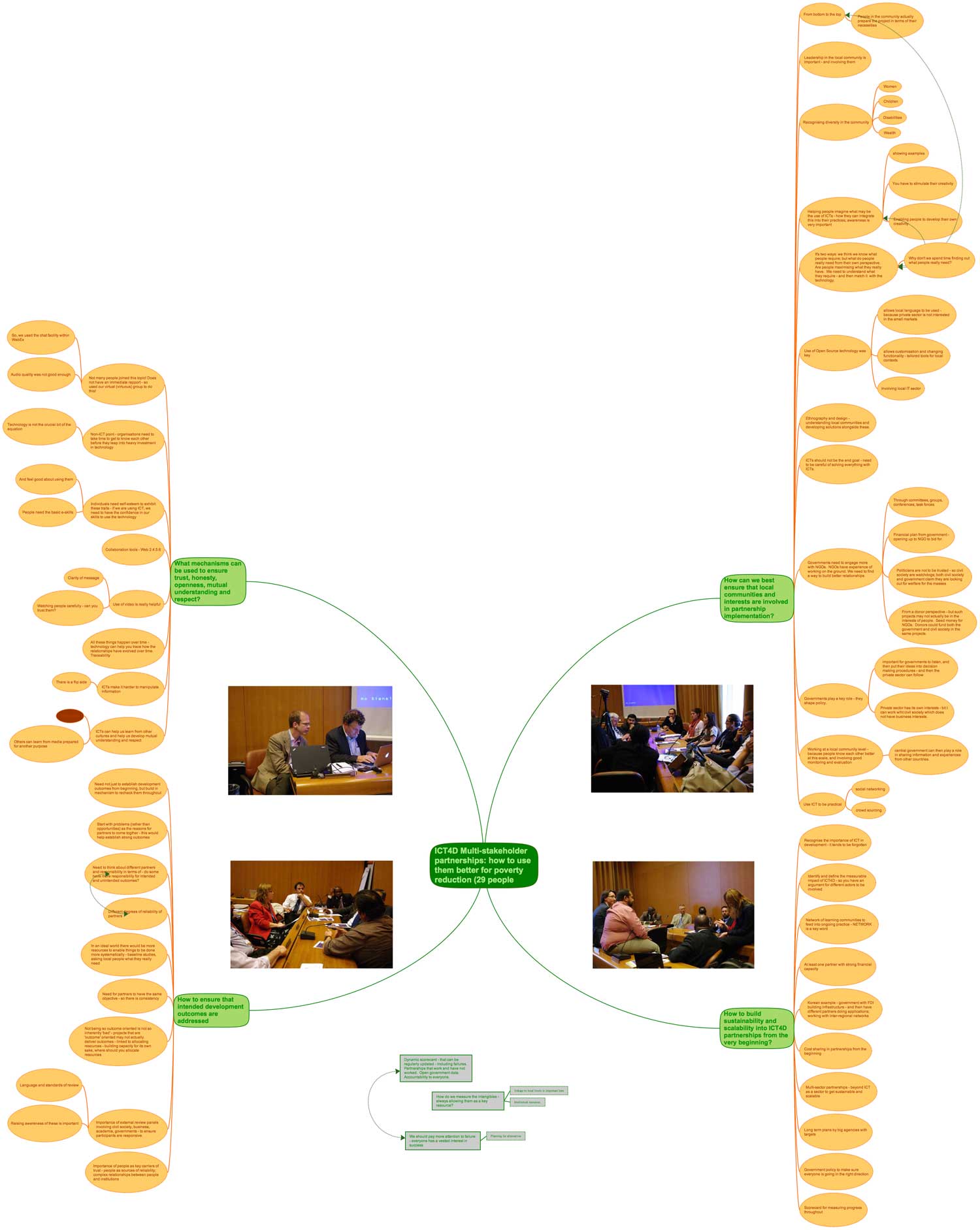

A more detailed .pdf file of the mind-map is available here: WSIS Forum 2011

Thanks to everyone who participated, and helped to make the discussions so interesting.

Leave a comment

Filed under ICT4D

World Telecommunication and Information Society Day

Today, May 17th, is World Telecommunication and  Information Society Day.  The theme is Better Life in Rural Communities with ICTs – which seems highly appropriate!  Let’s hope we can all do something to make this aspiration a reality!

Leave a comment

Filed under ICT4D

Remote participation at the 2011 WSIS Forum in Geneva

This week’s WSIS Forum is just about to get underway in Geneva.  The organisers have been very eager to ensure that people can participate remotely.  Full details of how to watch and engage in the discussions ‘at a distance’ are copied below:

“The WSIS Forum has a multi-stakeholder character. The WSIS Stakeholders include governments, civil society, private sector and international organizations from all parts of the world. Today, information and communication technologies (ICTs) provide the opportunity for representation and inclusion of all stakeholders in the WSIS Forum by way of remote participation. In order to ensure participation and inclusion of all WSIS Stakeholders, remote participation has been designed as an integral feature of the WSIS Forum 2011.

Building on the success of remote participation facilities initiated at WSIS Forum 2010, the organizers are working towards integrating the most user friendly and widely used tools for encouraging remote participation at WSIS Forum 2011. These easy to participate tools will enable two way communication, allowing the WSIS Stakeholders to participate in the WSIS Forum at their own convenience at the same time, disemminate information about the different sessions and happenings at the Forum.

Components of Remote Participation at WSIS Forum 2011

Webcast
Remote Participation will be a key feature of the WSIS Forum 2011 and you can follow all sessions via the video webcast (registration not required).
Webcast page: http://www.itu.int/ibs/WSIS/201105forum/index.html.

iWrite4WSIS
All Forum sessions will feature live reporting via twitter, as part of the iWrite4WSIS campaign.

Adobe Connect Conference Rooms
If you would like to participate actively in this conference as a remote delegate, you can do so by registering to participate via the Adobe Connect (virtual) conference rooms.   This will allow you to follow the video feed of the conference room, hear what is being discussed (English channel), see presentations and documents, and put questions to panelists via chat.   Each session will have 10-15 minutes for questions from remote delegates.  Participation, as a remote delegate, requires registration. (See registration page)

Short Video: Inside an Adobe Connect Meeting Room

The Adobe Connect Conference Rooms are provided below:

You can login to any of these rooms to have a look around, however they will only be active from Monday, 16 May at 08h45(Geneva time)

See also Frequently Asked Questions for Remote Participants

Leave a comment

Filed under ICT4D

New ITU report on the role of ICTs in advancing growth in the least developed countries

The ITU has just published a very important report on the role of ICTs in enhancing development in the least developed countries.  I was privileged to have been asked to write the foreword, in which I made the following comments:

  • “This important ITU report focuses explicitly on the experiences of people living in the world’s ‘Least Developed Countries’ (LDCs). It addresses not only how and why ‘outsiders’ have been eager to offer new ICTs as a means to encourage their ‘development’, but also how technical innovation can occur in some of the poorest countries of the world. Above all, it suggests that there is nothing automatic about the potential contribution of ICTs to ‘development’ processes, however these are defined. If marginalised people and poor countries are to take advantage of ICTs in transforming their fortunes, then specific efforts need to be made to address their needs and aspirations. The market by itself will not deliver on the information and communication requirements of the poorest and most marginalised people and communities”, and
  • “This exciting report points in many directions. It highlights both the successes and the failures of ICT initiatives and developments over the last decade, particularly with respect to LDCs. It emphasises the many challenges that still need to be overcome before we can claim that these technologies really have had the equalising benefits that many attendees at WSIS had hoped for. However, above all, it provides suggestions for innovative ways forward through which some of the poorest countries in the world can grasp the potential of ICTs to enhance the lives of their peoples”.

The charts and graphs contained within the volume provide very important evidence that many of the poorest countries and people in the world have not yet benefited from the potential of ICTs, and that very substantial effort is needed to ensure that ICTs do not actually lead to further increases in the differences in access between the world’s richer and poorer people.  This is essential reading for all involved in ICT4D.

2 Comments

Filed under Africa, Development, ICT4D

The development impact of ICT4D partnerships: join our discussion online at the WSIS Forum

Cisco is generously sponsoring the opportunity for anyone to participate in the session on the Development Impact of Multi-stakeholder Partnerships in ICT4D ( http://groups.itu.int/wsis-forum2011/Agenda.aspx?event=event_60) that the ICT4D Collective is convening from 16.30-18.00 Geneva time (15.30-17.00 UK time) on Tuesday 17th May at the WSIS Forum ( http://groups.itu.int/default.aspx?tabid=856).  Please share this information as widely as possible, so that colleagues across the world can join in our discussions and deliberations.

To join the online discussion, please use the following information (best to try to log-on about ten minutes in advance to download the applet and check the systems are working) :

Meeting Number: 608 639 429
Meeting Password: 123

——————————————————-
To join this meeting (Now from mobile devices!)
——————————————————-
1. Go to https://ciscosales.webex.com/ciscosales/j.php?J=608639429&PW=NYzY4NDE5MjI3
2. Enter the meeting password: 123
3. Click “Join Now”.
4. Follow the instructions that appear on your screen.

—————————————————————-
ALERT:Toll-Free Dial Restrictions for (408) and (919) Area Codes
—————————————————————-

The affected toll free numbers are: (866) 432-9903 for the San Jose/Milpitas area and (866) 349-3520 for the RTP area.

Please dial the local access number for your area from the list below:
–  San Jose/Milpitas (408) area:  525-6800
–  RTP (919) area:  392-3330

——————————————————-
To join the teleconference only
——————————————————-
1. Dial into Cisco WebEx (view all Global Access Numbers at
http://cisco.com/en/US/about/doing_business/conferencing/index.html
2. Follow the prompts to enter the Meeting Number (listed above) or Access Code followed by the # sign.

San Jose, CA: +1.408.525.6800  RTP: +1.919.392.3330

US/Canada: +1.866.432.9903  United Kingdom: +44.20.8824.0117

India: +91.80.4350.1111  Germany: +49.619.6773.9002

Japan: +81.3.5763.9394  China: +86.10.8515.5666

Leave a comment

Filed under ICT4D, ICT4D conferences

iPhone software update 4.3.3: limits tracking cache

Good to see that Apple has now released a software update (iOS 4.3.3) that means that iPhones will no longer retain information about where they have been!

As Apple, states:

“This update contains changes to the iOS crowd-sourced location database cache including:

  • Reduces the size of the cache
  • No longer backs the cache up to iTunes
  • Deletes the cache entirely when Location Services is turned off”

In effect, this means that the amount of information kept on the ‘phone is limited to a week’s usage, and the location data are no longer backed up on users’ computers.

In response to criticisms over iPhone location data being stored on the ‘phones and backed up on users’ computers, Apple claimed that iPhones were not actually logging locations – “Rather, it’s maintaining a database of Wi-Fi hotspots and cell towers around your current location, some of which may be located more than one hundred miles away from your iPhone, to help your iPhone rapidly and accurately calculate its location when requested. Calculating a phone’s location using just GPS satellite data can take up to several minutes. iPhone can reduce this time to just a few seconds by using Wi-Fi hotspot and cell tower data to quickly find GPS satellites, and even triangulate its location using just Wi-Fi hotspot and cell tower data when GPS is not available (such as indoors or in basements). These calculations are performed live on the iPhone using a crowd-sourced database of Wi-Fi hotspot and cell tower data that is generated by tens of millions of iPhones sending the geo-tagged locations of nearby Wi-Fi hotspots and cell towers in an anonymous and encrypted form to Apple”.

Apple went on to say that the fact that up to a year’s data was stored was the result of a bug: “The reason the iPhone stores so much data is a bug we uncovered and plan to fix shortly (see Software Update section below). We don’t think the iPhone needs to store more than seven days of this data”.  Further, their statement also emphasised that Apple believe that personal information security and privacy and important: “Yes, we strongly do. For example, iPhone was the first to ask users to give their permission for each and every app that wanted to use location. Apple will continue to be one of the leaders in strengthening personal information security and privacy”.

For further comment, see:

Leave a comment

Filed under 'phones, Ethics, ICT4D

Your iPhone is being tracked

I wonder how many iPhone users are aware that their movements are automatically being logged in a small, easily accessible application on their ‘phones?  Recent, important work by Alasdair Allen and Pete Warden has shown just how easy it would be for unscrupulous people to access this information.  It also raises worrying questions about why Apple has done this, and why they have not clearly informed users that this information is so readily available?

Allen and Warden have written a neat Open Source application that enables users to visualise this information – down to a very high level of detail in space-time – called iPhoneTracker.  Essentially, Apple stores this information on the ‘phone in terms of latitude, longitude and time stamp.  The database of locations is stored on the iPhone, but is also on any backups that might have been made when synced with iTunes.

As Apple and Warden comment with respect to why Apple has done this, “It’s unclear. One guess might be that they have new features in mind that require a history of your location, but that’s pure speculation. The fact that it’s transferred across devices when you restore or migrate is evidence the data-gathering isn’t accidental.”

They also point to the very serious moral and ethical issues that this raises: “The most immediate problem is that this data is stored in an easily-readable form on your machine. Any other program you run or user with access to your machine can look through it. The more fundamental problem is that Apple are collecting this information at all. Cell-phone providers collect similar data almost inevitably as part of their operations, but it’s kept behind their firewall. It normally requires a court order to gain access to it, whereas this is available to anyone who can get their hands on your phone or computer. By passively logging your location without your permission, Apple have made it possible for anyone from a jealous spouse to a private investigator to get a detailed picture of your movements”.

The screen grab from their visualiser shows where I have been using my iPhone in recent months. Perhaps colleagues who have been sceptical about why I have various different ‘phones and different SIM cards will now understand the reason!

We should all be immensely grateful to Alasdair Allen and Pete Warden for bringing this to our attention!

See also Jacqui Cheng’s recent article on this.

3 Comments

Filed under 'phones, Ethics, ICT4D

First impressions of Shenzhen

I flew down from Beijing to Shenzhen today for a 48 hour visit to meet with colleagues at the University.  This evening my good friend Man Xu kindly took me for an exploration of this extraordinary city.  Until 1979 when it became China’s first Special Economic Zone, it was little more than a fishing village just to the north of Hong Kong.  Over the last 30 years, it has come to symbolise China’s energy and dynamism, becoming one of the fastest growing cities of the world.

Thanks to Jack’s suggestion, I took the opportunity to visit the digital rabbit warren that is Huaqiangbei, where you can buy everything, and copies of everything, electronic that you could ever want – apparently except any accessibility related hardware!  Given my interest in disability, we explicitly asked repeatedly whether there were, for example, any Braille keyboards or other assistive technologies, but no-one seemed aware that such things could exist.

And then we visited one of the smart new malls (MIXC), replete with numerous luxury stores rather putting London’s Bond Street to shame! The wealth that has accumulated here in such a short time, fueled by the city’s high-tech industries and banking sector is quite extraordinary.

Oh yes, and why is it that so many models on the advertising hoardings across China are ‘Western’ and blonde?

This slideshow requires JavaScript.

2 Comments

Filed under China, ICT4D

Juliano Mer Khamis killed in Jenin

It is with very great sadness that I reflect here on the murder of Juliano Mer Khamis, the Arab Israeli actor and one of the founders of the Freedom Theatre, who was killed on the 4th April in Jenin.  He was shot by a masked gunman who fired five bullets into the window of his car.

The Freedom Theatre has reported this tragic murder as follows: “Murdered the leader, thinker, fighter Juliano Mer-Khamis, Director of The Freedom Theatre, Jenin Refugee Camp, Occupied Terrirtories of the West Bank, Palestine. Today, the 4th of April 2011, at  16:00 o’clock at the entrance of The Freedom Theatre in Jenin Refugee Camp, a traitor’s hand shot and killed the Palestinian thinker Juliano Mer-Khamis who was stopped in his won car while driving along with his baby son and babysitter. Juliano was shot in his head and died in few instants, the remains of the bullet shot the babysitter in her arm. Juliano Mer-Khamis, actor, director, film-maker and cultural activist, son of Arna Mer and Saliba Khamis, was one of the founders of The Freedom Theatre in Jenin Refugee Camp in 2006. All his life Juliano longed to fight against occupation using the arts as a model of social change. The people in the camp refused what happened and called it “a coward’s act”.  The Palestinian Authority are doing an investigation and have contacted the Board of Management of The Freedom Theatre”

The Freedom Theatre was set up in Jenin in 2006 as a drama and community centre.  Juliano’s mother, Arna Mer, had previously worked there as a peace activist.  The theatre has done a considerable amount of work to foster peace, in circumstances that were never easy.  One of its recent projects was an initiative to empower young people in Jenin through the use of ICTs, and I was absolutely delighted to be able to include a short case study on this, written by Jonatan Stanczak, Ziad El-Khatib and Mohammad Moawia, in my recent book on ICT4D.

It is hugely sad to hear of the violent death of someone who worked so tirelessly for peace across cultures, ethnicities and religions.  Although I never had the pleasure of meeting him, my thoughts are with his family and friends.  Let us hope that his death – amongst so many others in Palestine in recent years – will not be in vain, and that others will relight the candle of peace that burnt so brilliantly in his life.

Leave a comment

Filed under ICT4D

Google and privacy

I am often criticised for my concerns over Google’s ethical claims. Most people seem to like the apparently ‘free’ services that the company offers, and are not greatly concerned about the implications of sharing private information with a corporate giant that claims to do no evil.  I was therefore very pleased to see a report yesterday on the the BBC’s news site that Google is to be audited over privacy concerns relating to its social network Buzz.  Highlights of the article noted that:

  • “Google will be subjected to independent privacy audits for the next 20 years over charges that it “violated its own privacy promises”.  The US Federal Trade Commission (FTC) said that the search giant wrongly used information from Google Mail users last year to create its social network Buzz”
  • “When companies make privacy pledges, they need to honour them,” said Jon Leibowitz, chairman of the FTC. “This is a tough settlement that ensures that Google will honour its commitments to consumers and build strong privacy protections into all of its operations.”
  • “Buzz’s launch in February 2010 came under heavy criticism from users. According to Google, the system was designed to bring together members’ personal and private lives. One widespread complaint was over a feature that allowed it to publicly list other Gmail contacts a user was most frequently in touch with. While this feature could be turned off, the default setting was to leave it on – potentially revealing a user’s contact with an ex-spouse, employer or similar.”
  • “The FTC said “deceptive tactics” were used to populate the network with personal data gained from use of Gmail, and that when users were given the change to opt-out of Buzz, they were still enrolled in some of its features”
  • “The FTC said Google violated its privacy policy which stated: “When you sign up for a particular service that requires registration, we ask you to provide personal information.”
  • “Reflecting on the latest settlement, Alma Whitten, Google’s director of privacy, product and engineering, said: “We’d like to apologize again for the mistakes we made with Buzz. “While today’s announcement thankfully put this incident behind us, we are 100 percent focused on ensuring that our new privacy procedures effectively protect the interests of all our users going forward.”

In another recent report from the BBC, it is also interesting to note that the US Department of Justice has approved a New York court ruling that blocked an agreement between Google and publishers over the publication of books online.  As the report noted, “An agreement between Google and publishers over the web firm’s publication of books online has been blocked by a US court. The web giant has scanned millions of books and made them available online via its eBooks platform. Google had negotiated the deal to settle a six-year-old class action suit claiming infringement of copyright. But the New York court said the deal would “simply go too far”, giving Google an unfair competitive advantage”.

Leave a comment

Filed under Ethics, ICT4D