Category Archives: ICT4D

Further reflections on the refereeing process

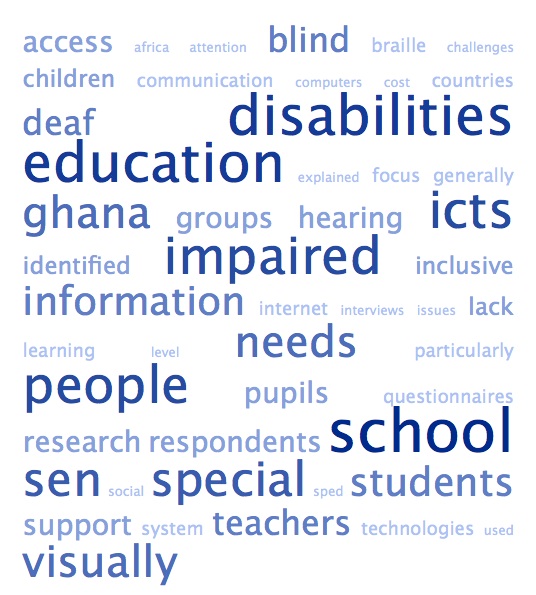
Not so long ago, I wrote about some of the issues associated with peer reviewing of research grant proposals.  This morning, I received editorial comments on one of my recently submitted papers – four sets of comments were broadly supportive, usefully recommending changes that would improve the paper.  However, a fifth referee clearly had not understood the purpose of the paper, which was a largely qualitative analysis of ICTs and disability in Ghana.  This is what the referee wrote:

“The paper lacks a profound research method & data analysis techniques.
In order to improve the paper I suggest:
-You develop taxonomy of the various possible factors (drivers, benefits, barriers, pitfalls) related to:
ICT & Special Education Needs in Developing Country Settings.
-Make a thorough field study grounded by previously derived taxonomy
-Use statistical analysis to determine the correlations between the taxonomies & derive the hypothesis for the study. Or use grounded theory analysis if you are interested more in the phenomenon rather than the correlations.
For the time being the paper findings are scattered and cannot be granted as validated or evenaccurate or complete.
Therefore the paper is not ready yet for publishing”.

OK – at one level, I accept that there are indeed different approaches to intellectual enquiry, but it seems quite clear that this referee fails to see the value of qualitative approaches, and is seeking to impose one particular view of the research process.

At least the other referees found something that they liked in the paper:

  • “This article addresses a particularly important issue very well. The authors understand the problem deeply and support their case with relevant evidence and clear writing.”
  • “This manuscript addresses an important and inadequately addressed topic. Data presented is valuable in informing programs and policy needs related to ICT for people with disabilities in educational settings in Ghana and other low-resource communities.”

I am tempted entirely to give up sending papers to academic journals – let’s face it, few people read them anyway – and instead simply put out material on the Internet and see what readers themselves make of them!

At the very least, I will try in future to submit papers to journals where I have greater faith in the quality of the refereeing process!

———————————————

Following correspondence with the journal’s Editor in Chief, I am delighted to say that my co-author and I are resubmitting our paper, and will include with this a commentary of exactly what we think of the referee’s comments above. Let’s see what happens!
7 Comments

Filed under Ethics, Higher Education

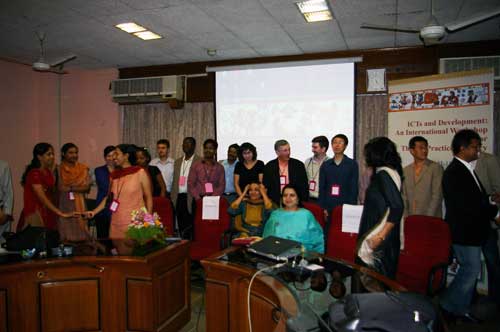
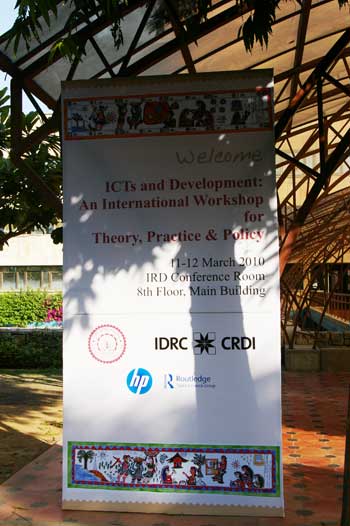
ICTs and Development: workshop at IIT Delhi (Day 2)

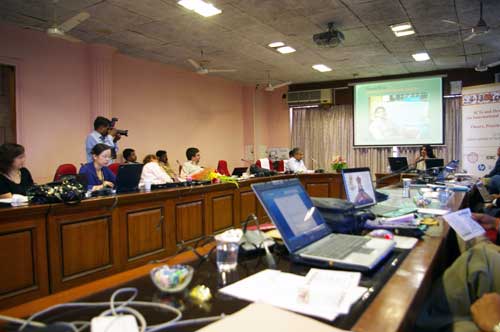
Welcome back to the second day of the ICTs and development workshop at IIT Delhi.

We got underway with Jonathan Donner’s (Microsoft Research India) invited lead talk on The changing roles of mobile phones in development: some examples from Africa

  • Emphasised amazing growth of mobile ‘phones – but rightly noted that this is neither universal not homogenous
  • We need to focus on the people rather than the technology – M4D is the tip of an iceberg of uses that people make of mobile ‘phones
  • Uses of mobiles for agriculture: use of mobiles for ‘traditional’ extension; creating platform mobile services including new market systems such as Manobi, or lean market places such as Google Trader
  • Homegrown services: M-PESA and MXIT – low barriers to adoption, affordable and compelling relative to existing alternatives, woven into everyday life, network effects.  They do well because they are so simple.
  • Both of these offer real possibilities for scale – albeit not yet for the poorest of the poor – and do things that traditional voice cannot do
  • Importance of unintended consequences
  • We need more evidence; we need to distinguish between mobility and connectivity; and we need to take the long view
  • We should also resist the use of “M4D” as a research term so as to de-fetishise it – moving the emphasis to the people not the technology; if we keep the term, we need to focus on the “4”

MOBILES AND MICRO-ENTREPRENEURS

Parveen Pannu (University of Delhi, India) Mobiles and socio-economic life of press workers in Delhi

  • Focus on urban growth in India and the rapid adoption of mobiles, especially among informal sector workers
  • Having clothes ironed is a central part of urban middle class India – the ironing business depends a lot on personal contact and good will (but there is also a press workers union)
  • Survey of households who did ironing work: c.65% had a family mobile ‘phone; cost of ‘phones was major factor influencing price (some received them from their customers); users of mobile ‘phones earned more than non-users, but cause/effect not known; usage – 38% social, 29% work related; most calls were received from the lady of the house who arranged collection/delivery of clothes and finding new companies; 50% were not into texting SMS messages (not comfortable because of English language texting)

Ishita Shruti (IIT Delhi) Remittance behaviour and doing business among Indian rural salesmen in Cambodia

  • New ICTs have played an important role in remittances (both economic and social) – focus of this ethnographic research is on rural salesmen mostly from UP
  • Internet based ‘phone calls are the cheapest means of communicating – so people use internet cafés/’booths’
  • ‘Agents’ are used to deliver remittances – informal network enabled through ‘phone calls (social capital plays an important role in delivering remittances)
  • Mobile ‘phones have also facilitated business, enabling salesmen to interact with family but also to make decisions about their businesses

ICTs, CIVIL SOCIETY AND THE STATE

Jean-Yves Hamel (UNDP) Public interests, private costs: civil society and the use of ICTs in Timor Leste

  • Placed emphasis on the notion of freedoms and the capability approach
  • Highlighted role of FDI from Telstra – supported by UN – and subsequent problems associated with its monopoly position. Monopolies are associated with high costs of ICT provision; regulators are unable to challenge these.
  • Noted the early use of ICTs from 1994 to enable communication of civil society ‘opposition’ with the rest of world
  • Key role of deep women’s networks – links to health organisations, scholarships, women’s rights groups
  • ICTs provide an important window on the world

ICTs AND ECONOMY

Nimmi Rangaswamy (Microsoft Research India) The PC aided enterprise and recycling ICT

  • Role of ICTs in expanding small and micro-enterprises in Mumbai slums
  • ICTs can help promote skill building; business are organic and self-sustaining
  • Nice business ecology coming into play – capital, space, skills, hardware
  • Not simply assimilating technology for business, but also creating new systems and processes
  • “There is no ‘for D’ in it, because they are doing it themselves” – not sure I agree with this, surely this is itself a form of development

Jack Linchuan Qiu (Chinese University, Hong Kong) Working-class information society? Open questions about China and ICTs

  • Focused on the “information have-less”
  • Some statistics from China: internet users 2 m in 1998, but 298 m in 2008; 49% of internet users are now not college-educated – so Internet is being used much more widely across different sectors of the population
  • Private sector now accounts for more than half of urban population employment – so people have to find jobs, and this has been associated with a rapid increase in ICTs: does macro-empowermnet lead to (seemingly) micro-empowerment
  • Measuring information needs is complex; fundamental differences between information needs and wants.
  • Bottom of pyramid innovations are firstly social and only secondarily technological
  • Developing a new class analysis based on horizontal networking among workers
  • Chindia as a new path to development – a re-evaluation of labour-centred production

INTERNET AND SOCIAL CHANGE

Otgonjargal Okhidoi (Educational Channel Television, Mongolia) Can technology level the inequality in education delivery? Blended technology based education program in Mongolia

  • Mongolian democritisation and economic liberalisation created freedom for flourishing media companies, mostly for profit commercial broadcasting – mostly focus on imported programmes (soaps, sumo…)
  • Educational Channel TV began only three years ago for public sector broadcasting (4-6 hours airtime a day on academic subjects; not for profit and one of only 2 nationwide broadcasters).  Then Internet service and cellphone messaging added on to make it more interactive and provide feedback (focus of project on English language and IT)
  • 93% of total population of Mongolia names TV as the key source of information
  • Inequality of access to education and quality of content – 66% of children live outside Ulaanbatar, and are poorly served by education
  • Almost all schools have computer labs set up by donor funding, and all are connected to the Internet – but there is not much good content available.  So, they used 20 minute TV programmes and followed up with work in class on Internet. Reported that impact on knowledge acquisition was positive, and it enhanced self-learning

S. Subash (National Academy of Agricultural Research Management) Knowledge empowerment of farmers through interactive web-module on dairy innovations

  • Use of ICTs for technology transfer agricultural extension in the field of dairying focusing particularly on web-module (Haryana and Tamil Nadu case study)
  • Training in ICT centres given to farmers; needs of farmers identified and web-based learning module given to them
  • Reported that farmers in Haryana has a 16% knowledge gain as a result of the intervention, and 28% gain in Tamil Nadu – although some concerns were expressed in questions about the impact of experimental design
  • Benefits also gained by extension workers
  • Users requested more interactivity and provision of real-time information; it is important to ensure that content is regularly updated; mobile alerts for farmers should also be introduced

Murali Shanmugavelan (Panos, London) Telecentres and public spaces

  • Substantial amount of recent support for telecentres in India – but “what information is reaching what communities?”
  • How do telecentres interact with village communities – are they reinforcing or changing social structures? Study of 12 telecentres of different kind.
  • ICTs can constrain or expand public spaces (four layers of public: physical, management, human as public, and services) – communication practices can create a chaos in traditional systems
  • Key factors: location influences accessibility; telecentres specifically designed for particular underprivileged groups such as dalits are exclusionary rather than ‘public’; management layer is very influential (recruiting women increases inclusivity); type of service delivery influences usage (and real needs of excluded users are not necessarily delivered); social and cultural factors constrain usage (discrimination against women and dalits; low participation of elderly and disabled communities)
  • There is a real need to map non-users and understand more about why they do not use ICTs – traditional hierarchies

Leave a comment

Filed under ICT4D, ICT4D conferences

ICTs and Development: workshop at IIT Delhi (Day 1)

It is good to be back in Delhi – and to have an opportunity to reflect on the use of ICTs in development practice with colleagues from across the world.  Thanks to Vigneswara Ilavarasan and Mark Levy for bringing us all together at IIT Delhi.

Following introductions from Prof Amrit Srinivasan (Head of the Department of Humanities and Social Sciences, IIT Delhi), Prof. Balakrishnan (Deputy Director, IIT Delhi) and Phet Sayo (Senior Program Officer, IIT Delhi), we got underway with the real business.  Below are some of my reflections on some of the presentations:

Rohan Samarajiva (Chair and CEI Lirneasia, Sri Lanka) Invited Lead Talk 1

  • Highlighted the key importance of bringing mobile prices down which led to expanded usage
  • Competition played an important part in this – he argues that this will actually lead to greater use by the poor
  • Implications for broadband and internet connectivity – will this follow the same path as with mobiles?
  • Policy implications: role of regulation (must deregulate); need to bring prices down; need for ‘fat pipes’ (international broadband connectivity); problems associated with rent seeking; need to go gentle on quality of service regulation (he commented that “I am a lapdog of the capitalists, but I prefer to work for the bottom of the pyramid”); in the end, customers pay taxes that governments impose on companies, so we need to phase out universal-service levies (companies show they do not need to be persuaded to work in rural areas).
  • Competition will find its level – he is a strong believer that the market will provide the right solutions.  My experience does not confirm this – I do not accept that the market will indeed serve the interests of the poorest and most marginalised.
ICTs AND SMEs
Vigneswara Ilavarasan (IIT Delhi) and Mark Levy (Michigan State University) ICTs and micro-enterprises
  • Used a probability sampling strategy of small/micro enterprises in Mumbai
  • Fundamental conclusion was that there is a mis-match between the rhetoric and reality of ICT-use for business purposes
  • Mobile phones are used for contacting employees and some business contacts, but they are used much more for social purposes with family and friends
  • Fewer enterprises have computers than mobile ‘phones, but those who have computers do use them more extensively for business purposes (using them for stock inventories, employee records, and tracking business processes)
Khalid Rabayah (Arab American University, Palestine) ICT use among Palestinian enterprises
  • Survey of just under 3000 Palestinian enterprises
  • Most business owners do not see much use for computers or Internet for their enterprises
  • Those who do use the Internet primarily use it for e-mail and searching for information; main reason for using Internet is to save time
  • They primarily use the communicating aspect of ICTs, and therefore especially use mobile telephony
  • Internet is not used much for business – mainly for cultural reasons; 50% prefer doing business face-to-face
Godfred Kwasi Frempong (Science and Technology Policy Research institute, Ghana) Mobile ‘phones and micro/small enterprises in Ghana

  • Reported the high usage of mobile ‘phones by businesses in Ghana.  Most used voice and only 21% used SMS as a business tool. Key issue why SMS is not used more is because people have to be literate to read a SMS message
  • Missed calls (flashing) are very important – some 65% of enterprises use them as an important business tool
  • Only 1% of the sample  used mobile ‘phone banking (although 13% knew about this)

ICTs AND WOMEN
Shikoh Gitau (University of Cape Town) Job-seekers in Khayelitsha

  • Highlighted the growing importance of mobile Internet
  • Reported on training scheme for a small group of young women in Khayelitsha – main use was to explore ways of accessing the Internet for gaining jobs
  • Other reasons why people were using mobile Internet included gospel music, news and information, Facebook and MXit
  • Knowledge among other people that they knew how to use the Internet raised their social capital

S. Nandini (Working Women’s Forum, India) ICT and women in the informal sector

  • Survey of usage by group of women in the Working Women’s Forum
  • Emphasised that women had an unfilled real need for communication, and mobile ‘phones can indeed now provide this.  Women in the informal sector has facilitated them in juggling multiple roles (social, business, etc.)

ICTs AND AGRICULTURE
Mokbul Morshed Ahmad (Asian Institute of Technology) Mobiles in Kampong Thom, Cambodia

  • Mobile ‘phones are mainly used for social purposes, but farmers can save some costs in terms of time spent travelling; that having been said, they need to find the means to pay for them
  • Traders generally use ‘phones more than the farmers

Surabhi Mittal (Indian Council for Research on International Economic Relations) Mobile ‘phones as a catalyst for agricultural growth in India

  • Mobile ‘phones can help linkage between agricultural extension services and farmers, and this can improve farm profitability
  • Farmers subscribe to customised services – mainly seeking information on weather, market prices, inputs, government services…
  • Knowledge of better input prices and information do indeed enable higher productivity and thus enhanced farm profitability going up between 5 and 25%

3 Comments

Filed under ICT4D

ICTs, Citizens and the State – seminar at Michigan State University

Thanks to colleagues in the Telecommunication, Information Studies and Media Department at Michigan State University for their valuable critique of some of my thoughts on the ethical dimensions of e-government initiatives following my seminar there today.  My paper examined the moral implications of the use of ICTs in e-government initiatives, focusing especially on national databases, identity cards and surveillance technologies.  It suggested that in resolving debates over these, we need to reach ethical resolutions concerning notions of trust, privacy and the law.  I also drew attention to the ethical problems that emerge in linking the notion of Universal Human Rights with the introduction of ICTs in developing countries.

In terms of general conclusions, the following seem particularly pertinent:

  1. First, there are indeed many complex ethical aspects associated with e-government, and while to date the emphasis among governments of developing countries, international agencies and donors has very largely been on their positive practical benefits, I suggest that we need to pay much more thorough attention  to their ethical grounding, and especially to the balance of rights and interests between citizens and the state.
  2. Second, in so doing, I suggest that three areas warrant particular attention, namely the ethics of trust, privacy and the law.   It is here that Geuss’s (2008) emphasis on existing real political contexts, rather than the imposition of some external ideal ethical solution, needs to reiterated.  The fundamental point I wish to emphasise is that in each country where e-government initiatives are introduced, people need to ask about the rights and wrongs of such proposals in terms of existing ethical understandings of trust, privacy and the law.
  3. I also sought to raise fundamental questions concerning the continuing validity of much of the human rights based policy and legislation that has dominated global agendas during the last 50 years – particularly in the context of e-government initiatives, and their implication for the rights of individuals and the responsibilities of states.  We need to open up for sensible debate the value of the emphasis placed on human rights, criticism of which is all too often seen as being politically incorrect and a taboo subject. However, if people do not actually have ‘rights’ that they can give up to a state, then we need to reconsider the whole edifice upon which such arguments are built.  An idealistic belief that people have universal rights has not been any protection for those who have suffered at the hands of those who do not believe in such rights.  There is therefore a strong argument that we need to shift the balance away from rights, and towards the responsibilities that people and states have for each other.  For example, rather than simply claiming that knowledge is some kind of human right, it might be a much more positive step to argue that states have a responsibility to enable their citizens to gain knowledge.
  4. Capurro (2007) has argued that ‘Western’ concepts of individual privacy are very different from the ‘African’ emphasis on communal traditions.  It may well therefore be that many of the existing models of e-government developed around European and north America notions of individual privacy are inappropriate in an African or Asian context, and that instead Africans and Asians should instead be designing new such initiatives around their own traditions and cultural practices
  5. Whatever the benefits to states, individuals and communities of e-government initiatives, there is no doubt that global corporations developing the hardware and software for such systems have been very great beneficiaries.  One of the difficult ethical questions that arise from this concerns how we judge whether it is better for poor and marginalised communities for such e-government initiatives to have been introduced, or whether they might actually be more advantaged if their governments did not spend vast sums of money on their implementation.  Just because it is possible to implement national citizen databases, to use biodata for ID cards, and to introduce sophisticated digital surveillance mechanisms does not mean that it is right to do so.

2 Comments

Filed under Africa, Ethics, ICT4D, My Lectures

Indian Visa Application Centre, Hayes

PLEASE NOTE THAT THIS POST WAS FIRST WRITTEN IN FEBRUARY 2010 AND SOME OF THE INFORMATION IS NOW OUT OF DATE – from 23rd November 2010 a new online application system was introduced – details are available at http://in.vfsglobal.co.uk/.  However, the information contained below may well still be of interest for those seeking to get to the Hayes office – for which the blog was originally intended!

————————————————————————————————————————

After reading some of the horror stories online about applying for a visa to visit India, I embarked on the process, and thought some tips might be helpful for others – especially about actually getting to the Centre in Hayes!

  • Yes, the online system is a bit clunky – and it crashed on me once without saving what I had done – which was a pain! But by automatically checking for completeness it did save time filling out the forms, perhaps incorrectly, and therefore having to redo them again.
  • Before embarking on completing the forms online, do check you have all the information to hand – down to the level of detail required about the place of both parents’ birth!  Unfortunately, there is not an easy to find guide to completing the visa form available in the drop-down menus!  One solution is to print out a hard-copy form from those available, and then use this as a guide.  The trouble is that not all of the questions asked are unambiguous!
  • The automatic fee charging system did indeed seem to overcharge me – as least compared with the advertised fees for visas! Watch out for this!
  • Make sure that you submit all of the relevant required documents, or have them with you (together with two photographs) when you go to the Centre.
  • For those taking the application form to the Indian Visa Application Centre in Hayes, there are many comments on the Web about how difficult this is to find!  It is actually very simple!  The Centre is accessed on the south side of Uxbridge Road in Hayes, just by the Grand Union Canal.  For those driving from the M4, take the A312 north to its junction with the A4020, and then turn east towards Southall.  Don’t take the first right down Springfield Road, but watch out for the large Currys superstore just before the Fiat car showrooms. That is the best place to park! Walk a short distance (c. 100 yards) towards the canal, and turn right just beyond the Fiat garage. The entrance to the Application Centre is then through some large metal gates  just  after the car park behind the garage. This is just by the A4020 label next to the canal on this map!
  • Once inside, you will receive a numbered ticket, and will then have to wait in the large seated waiting hall.  There are around a dozen service desks, and so the queue moves relatively quickly.  At 08.30 in the morning, I only had to wait about 25 minutes to be ‘processed’.  Opening hours for submission of passports are 08.30-14.30 Monday to Friday; passport pickup (usually withing 2-3 working days) hours are 13.00-16.30 Monday to Friday.

27 Comments

Filed under Higher Education, ICT4D conferences, Politics

Learning Management Systems in Africa

Our research paper on Learning Management Systems in Africa resulting from the DelPHE funded collaboration with colleagues in the University of Education, Winneba (Ghana), Maseno University (Kenya), and Eduardo Mondlane University (Mozambique) has just been published as

  • Tim Unwin, with Beate Kleessen, David Hollow, James B. Williams, Leonard Mware Oloo, John Alwala, Inocente Mutimucuio, Feliciana Eduardo and Xavier Muianga (2009) Digital learning management systems in Africa: myths and realities, Open Learning: the Journal of Open and Distance Learning, 25(1), 5-23.

In summary, the paper  reports on a survey of 358 respondents across 25 African countries into their usage of learning management systems. It concludes that while there are some enthusiastic advocates of such systems, the reality is that most African educators as yet have little knowledge about, or interest in, their usage. There remain very considerable infrastructural constraints to be overcome before they can be widely adopted for open and distance learning across the continent, and there is still reluctance in many institutions to develop systems that can enable learning resources to be made available in this way. This does not mean that the potential of high-quality digital learning management systems should be ignored in Africa, but rather that much more sustained work needs to be done in human capacity development and infrastructural provision if African learners are truly to benefit from the interactive learning experiences that such systems can deliver.

Leave a comment

Filed under Africa, Education, Higher Education, ICT4D

ICTD2010 call for papers and sessions

The calls f0r papers and sessions for the major ICTD2010 international conference being held at Royal Holloway, University of London, between 13th and 16th December 2010 have just been released.

The second and third days of ICTD2010 will primarily be for paper and poster presentations, whereas the first and last days will be  for workshops, panels and alternative events which could include open spaces, performances and exhibitions.

The deadline for all proposals and submissions  is 2nd April 2010.

Leave a comment

Filed under ICT4D

… and then the sun came out, Virginia Water, 7th January 2010

Following yesterday’s immense snowfall and dark skies, we awoke this morning to a gorgeous sunrise and freezing conditions.  Yes, the boiler stopped working again, but what does that matter when the weather takes its part in painting England at its best! Below is a selection of photographs of the scenery in Virginia Water, especially in the woodland surrounding the Wentworth golf course.  Enjoy!

For larger versions, just click on the images.

Leave a comment

Filed under Photographs, Story-telling

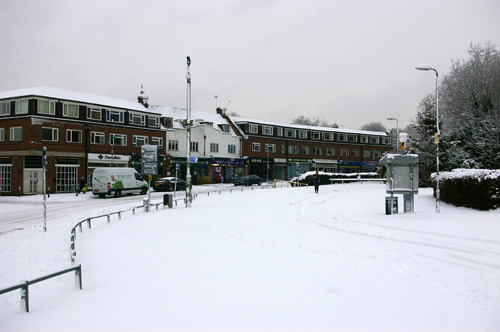
Snow in Virginia Water, 6th January 2010

Many parts of the world are deep in snow with temperatures well below freezing – Moscow is predicted to have a maximum temperature of -14o C today.  Our weather in the UK palls in comparison!  However, last night saw some of the heaviest snowfalls in southern England for many a year, which somehow creates a sense of exhilaration. Minor roads across the region have not been cleared, leading to many an ‘incident’ with cars sliding all over the place, and not being able to get up even relatively slight inclines.  Early this morning, attempts to help push drivers stuck on the hill outside our house proved surprisingly futile!  Some young people nevertheless managed to ‘enjoy’ themselves, throwing snowballs at passengers waiting to get on to the few trains that were running!  I know that this amount of snow is unusual, but Surrey County Council has done a really bad job of keeping local roads ice and snow free this winter.  To be sure, the weather has been extreme, and main roads should take priority, but in the last 20 years the local roads in north-west Surrey have never been as dangerous as they have been this year.

So, please enjoy these images from Virginia Water: snowing last night; at least 6″ of snow in the garden; the postmen had some fun at their depot; local rail bridge, not flooded for a change; Siam restaurant in the snow – a long way from Thailand; well done to South West Trains actually getting some trains to run; Wellington Avenue abandoned cars; the railway line; more abandoned cars; trees in the snow; Trumps Green Road trees; Trumps Green Road shops; and the car park by Station Parade.

1 Comment

Filed under Photographs, Story-telling

Google Dashboard

Readers of my Blog will be well aware of my previous criticisms of the company’s ambitions to gather all of the world’s knowledge on its servers, and my concerns over its infringement of traditional ideas about privacy.

It is therefore of considerable interest that Google has just launched Dashboard.  This is intended to provide users of Google services with a summary of all the information that Google currently lets users know that it stores about them.  This is what Google Dashboard shows when you visit the site:

googleAlways having refused to have a Gmail account, and limiting my use of Google, because I do not want the company to benefit too much from the information that they have about me (yes, of course, I use Google as a search engine  – albeit as little as possible – check out Cuil), I am delighted to see this limited opening up of their secrecy.  But just imagine, they will now be checking up on those who use Dashboard, and how they use it!
Google themselves claim under a heading Transparency and Choice that “At Google, we are keenly aware of the trust you place in us and our responsibility to protect your privacy. As part of this responsibility, we let you know what information we collect when you use our products and services, why we collect it and how we use it to improve your experience. The Privacy Center was created to provide you with easy-to-understand information about our products and policies to help you make more informed choices about which products you use, how to use them, and what information you provide to us”.

Brian Heater on PCMag comments as follows: “That whole ‘don’t be evil’ thing is all well and good, but when a company’s whole goal is cataloging the world’s information, it would–at the very least–be nice to know what Google knows about you. The company has just launched Dashboard, which aggregates the different information its gathered from 20 different Google products, including Gmail, Calendar, Docs, Web History, Orkut, YouTube, Picasa, Talk, Reader, Alerts, and Latitude. You’ll need to sign in to view your own personal information. Users can also edit account information from the page, such as privacy settings. Of course transparency doesn’t mean that you can’t still pat yourself on the back. The scale and level of detail of the Dashboard is unprecedented, and we’re delighted to be the first Internet company to offer this–and we hope it will become the standard,” Google said in a statement”.

So, will this actually make users realise exactly how much information and power they are giving Google, or will they consider that the benefits that they get from using Google’s services are worth it?  Google’s financial success has been based on persuading people to give them information for free from which they can then generate huge revenue. This has undoubtedly been one of the biggest business success stories – or cons, depending on how one looks at it – in recent years.  I watch with interest to see whether Google Dashboard will indeed persuade users that the company is as ‘innocent’ as it would like to appear to be.

1 Comment

Filed under Ethics, ICT4D