Category Archives: ICT4D

Reflections on IGF 2019 in Berlin

Header

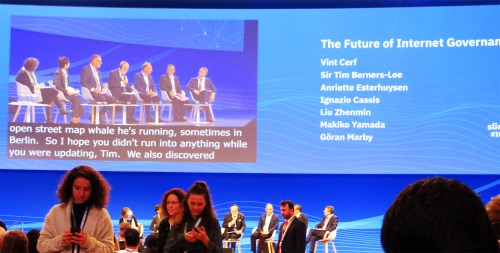
High Level Session on Internet Governance at IGF 2019

I have been quite critical of the Internet Governance Forum (IGF) process in the past, arguing that it was created essentially as a talking shop and a palliative to civil society following the original WSIS meetings in 2003 and 2005 (for details see my Reclaiming ICT4D, OUP, 2017), and that it has subsequently achieved rather little of substance.  I still retain the view that there are far too many “global” ICT4D gatherings that overlap and duplicate each other, without making a substantial positive difference to the lives of the poorest and most marginalised.  Likewise, I have been hugely critical of the creation and work of the UN Secretary General’s High-Level Panel on Digital Cooperation (HLPDC), despite having several good friends who have been involved in trying to manage this process (see the UNESCO Chair in ICT4D’s response to the original call for contributions).  I retain the view that it is poorly conceived, duplicates other initiatives, and will again have little positive impact on the lives of the poorest and most marginalised.

So, it was with much interest that I arrived at the IGF in Berlin on 25th November in response to three invitations: to participate in a session on ICTs for people with disabilities, to support colleagues involved in the EQUALS initiative intended to increase gender digital equality, and also to participate in a side event on Many Worlds.  Many Nets.  Many Visions, for which I had contributed a short piece on our TEQtogether initiative designed to change men’s attitudes and behaviours towards women and technology.  To this end, it is salient to note the largely elderly white male dominance on the key opening plenary panel on the future of Internet governance shown in the picture above – more on that later!  I had many interesting discussions during the week, but want here to share five main reflections and challenges in the hope that they will provoke dialogue and discussion.

IGF (plus?)…

Water stationms

Water Station at IGF 2019

It was rumoured that the German government had put aside some €10 million to cover the costs of this year’s IGF.  Whilst that may well be an exaggeration we were certainly hosted in great luxury, and it would be churlish not to thank the German government for their generous hospitality.  In compliance with increasing concerns over plastic and climate change, there was even a very impressive water station in the exhibition area!  They had also done much to encourage the participation of many quite young people, and to get the gender balance better than at some similar digital technology events in the past.  The IGF 2019 outputs are already available and make interesting reading.

UN SG speaking in IGF 2019 Opening Ceremony

UN SG speaking in IGF 2019 Opening Ceremony

However, I was struck by the relative absence of people from China, India and Russia, as well as from many of the poorer countries of the world who were unable to afford the travel costs or who had difficulties in obtaining visas.  This absence set me thinking of the wider global geopolitical interests involved in the IGF process.  At a time when the ITU is unfortunately being increasingly criticised by North American and European countries for being too heavily in the pocket of Chinese organisations and companies (recent criticism of China’s efforts to influence global standards on facial recognition is but one small example), free-market capitalist governments have turned ever more to the IGF as the main forum for their engagement on Internet issues.
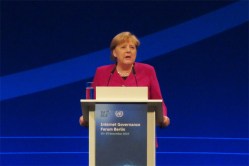
Angela Merkel in IGF 2019 Opening Ceremony

Angela Merkel in IGF 2019 Opening Ceremony

The theme of this year’s IGF One World.  One Net.  One Vision. says it all (and hence why I was so eager to be involved in the innovative and creative Many Worlds. Many Nets.  Many Visions initiative).  The IGF is about maintaining a unitary free open Internet in the face of perceived attempts by countries such as China and Russia to fragment the Internet.  It is no coincidence that next year’s IGF is in another European country, Poland, and that the last two IGFs have been in France and Switzerland.  The messages of the UN Secretary General and the German Chancellor (shown in the images above) were equally forceful about the kind of Internet that they want to see.

Moreover, this hidden war over the future of the Internet is also being played out through the HLPDC process which has suggested that there are three possible architectures for digital cooperation.  The presence of such high-level participants at this year’s IGF very much conveyed the impression that the IGF Plus option is the one that they prefer as the main forum for policy making over the Internet in the future.  This is scarcely surprising: all but two (one Chinese and one Russian) of the 20 members of the HLPDC Panel and Co-chairs are from free-market capitalist-inclined countries; 8 of the 20 are from the USA and Europe.

The sale of .org by ISOC to Ethos Capital

Another major issue that raised its head during this year’s IGF was the very controversial sale by the Internet Society (ISOC) of its non-profit Public Internet Registry (PIR) which had previously managed the top-level domain .org to a for-profit company, Ethos Capital, for the sum of $1.135 bn.

Key elements of the controversy that were widely mentioned during the IGF, and are well summarised by The Registry, include:

  • ISOC’s decision under a new CEO to shift its financial structure from benefitting from the variable profits derived from .org to creating a foundation from which it would then use the interest to fund the activities of its various chapters (the new Internet Society Foundation was created in February 2019);
  • The lifting of the cap announced in May 2019 by ICANN on prices of .org domain names, which would enable the owner of the .org registry to impose unlimited price rises for the 10 million .org domain name owners; and
  • The observation that the former CEO of ICANN had personally registered the domain name used by Ethos Capital only the day after the cap had been lifted (it appears that he and a small number of his close affililates linked to ICANN are the only people involved in Ethos Capital) .

The lack of transparency over this entire process, and the potential for significant profits to be gained by certain individuals from these changes have given rise to huge concerns, especially among civil society organisations that use .org domain names.  As a recent article in The Register concludes, “The deal developed by former ICANN CEO Chehade is worth billions of dollars. With that much money at stake, and with a longstanding non-profit registry turned into a for-profit with unlimited ability to raise prices, the internet community has started demanding answers to who knew what and when”.

Inclusion, accessibility and people with disabilities…

Absence of people in IGF 2019 Main Hall for High Level Session on Inclusion

Absence of people in IGF 2019 Main Hall for High Level Session on Inclusion

It was good to see a considerable number of sessions devoted to inclusion, accessibility and people with disabilities at this year’s IGF.  However, it was sad to see how relatively poorly attended so many of these sessions were.  The exodus from the Main Hall between the High Level Session on the Future of Internet Governance and the High Level Session on Inclusion, for example, was very noticeable.  The content of most of these sessions on disabilities and inclusion was generally interesting, and it is just such a shame that the wider digital community still fails to grasp that digital technologies will increase the marginalisation of those with disabilities unless all such technologies are designed as far as is reasonably possible to be inclusive in the first place.  Assistive technologies can indeed make a very significant difference to the lives of people with disabilities, but such persons should not have to pay more for them to counter the increased marginalisation that they face when many non-inclusive new technologies are introduced.
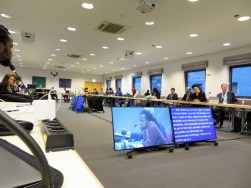
IGF 2019 Session WS#64 on empowering persons with disabilities

IGF 2019 Session WS#64 on empowering persons with disabilities

I was, though, hugely challenged by my own participation in one of these sessions.  Having been invited by Brian Scarpelli to be the penultimate speaker in a session that he had convened on Internet Accessibility Empowering Persons with Disabilities (WS #64), I just felt that it needed a little livening up by the time it was my turn to speak.  I therefore decided to take a roving microphone, and did my presentation walking around inside the cage of desks around which everyone was seated.  I wanted to engage with the “audience” several of whom did indeed have disabilities, and I tried hard to involve them by, for example, describing myself and the venue for those who were blind.  The audience seemed to welcome this, and I had felt that I had got my messages across reasonably well.  Afterwards, though, someone who is autistic came up to me and in the nicest way berated me for having walked around.  She said that the movement had distressed her, and made it difficult for her to follow what I was saying.  She suggested that in the future I should stay still when doing presentations.

This presented me with a real challenge, since I have been encouraged all my life to deliver presentations as a performance – using my whole body to engage with the audience to try to convince them of my ideas.  So, what should we do when making presentations to an audience of such varied abilities?  Can we cater for them all? Clearly, I don’t want to upset those with one disability.  Should I ask if anyone in an audience minds if I walk around?  But then, someone with autism might well not want to speak out and say that they did actually mind?  Should the preference of one person with a disability over-ride the preferences of the remaining 49 people in a room?  There is no easy answer to these questions, but I would greatly value advice from those more familiar with such challenges than I am.

Exclusion in the midst of diversity: being an elderly, white, grey-haired, European man…
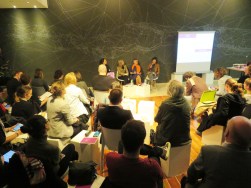
"Many Worlds. Many Nets. Many Visions" gathering held during IGF 2019 at HIIG

“Many Worlds. Many Nets. Many Visions” gathering held during IGF 2019 at HIIG

Far too many international events associated with digital technologies continue to be excessively male dominated, and it was refreshing to see the considerable gender diversity evident at IGF 2019.  Despite this, as noted above, several panels did remain very “male”!  It was therefore very refreshing to participate in the Many Worlds.  Many Nets.  Many Visions side event held at the Alexander von Humboldt Institute for Internet and Society (HIIG), and congratulations should once again be given to Matthias Kettemann and Katharina Mosene for putting this exciting and challenging initiative together.

Reflecting on the various gender-related events held during and around IGF 2019, though, has made me very uneasy.  I was particularly struck by the frequency with which presenters advocating plurality and diversity of ideas, behaviours, and self-identification, nevertheless also seemed to castigate, and even demonise one particular group of people as being, in effect, the “enemy”.  That group is the group that others see me as belonging to: elderly/middle-aged, white, grey-haired, European (and let’s add north American and Oceanian as well), men!  Perhaps it was just in the sessions that I attended, but over and over again this group was seen as being oppressive, the main cause of gender digital inequality, and those who are to be fought against.  The language reminded me very much of some of the feminist meetings that I attended back in the 1970s.

I was surprised, though, how sad this made me feel.  Some elderly, white, grey-haired, European (etc.) men have indeed worked over many decades to help change social attitudes and behaviours at the interface between women and technology.  This group is not uniform!  Some have written at length about these issues; some have helped implement programmes to try to make a real difference on the ground.  To be sure, we need to continue to do much more to change men’s attitudes and behaviours;  TEQtogether has been set up to do just this.  What upset me most, though, is that these efforts were rarely recognised by those who were so critical of  this particular “uniform” group.  Too often, all elderly, white, grey-haired, European (etc.) men seemed to be lumped together in a single group by those very people who were calling for recognition of the importance of diversity and multiple identities. There is a sad irony here.  Perhaps it is time for me just to grow old gracefully…

EQUALSIt was therefore amazingly humbling that, almost at the end of the EQUALS in Tech awards, a young woman who I had never met before, came up to me and simply said thank you.  Someone had told her what one elderly, white, grey-haired, European (etc.) man had tried to do over the last 40 years or so…  I wonder if she has any idea of just how much those few words meant to me.

Novelty and learning from the past

Poster about sexual exploitation of children, Ethiopia, 2002

Poster about sexual exploitation of children, Ethiopia, 2002

Finally, the 2019 IGF re-emphasised my concerns over the claims of novelty by people discovering the complexity of the inter-relationships between technology and society.  All too often speakers were claiming things that had actually been said and done twenty or more years ago as being new  ideas of their own.  This was typified by a fascinating session on Sex Work, Drug Use, Harm Reduction, and the Internet (WS 389).  Whilst this is indeed a very important topic, and one that should be addressed in considerably more detail, few of the presenters made any reference to past work on the subject, or appeared to have made much attempt to learn from previous research and practice in the field.  Back in the early 2000s, for example, the Imfundo initiative had spent time identifying how “bar girls” in Ethiopia might have been able to use digital technologies that were novel then to help transform their lives and gain new and better jobs.  I wonder how many people attending Session WS 389 were at all aware of the complex ethical questions and difficulties surrounding the conduct of research and practice on this topic that the Imfundo team had explored all those years ago.  There were important lessons to be learnt, and yet instead the wheel seems to be being reinvented over and over again.

This example was not isolated, and a recurrent feature of the field of ICT for Development is that people so rarely seem to learn from mistakes of the past, and everyone wants to claim novelty for ideas that have already been thoroughly explored elsewhere.  I  must write at length some time about the reasons why this seems to happen so often…


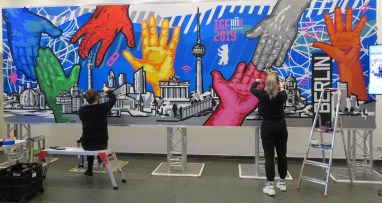
Finally, the artists who created this image of Berlin from tape during IGF 2019 deserve to be congratulated on their amazing work!
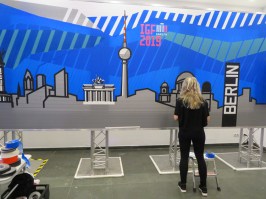
Artwork of Berlin made in tape, 25th November
Artwork of Berlin made in tape, 25th November

Artwork of Berlin made in tape, 29th November
Artwork of Berlin made in tape, 29th November
Leave a comment

Filed under Accessibility, Disability, Gender, ICT4D, ICT4D conferences, Internet

IGF 2019 WS #64 Internet Accessibility Empowering Persons with Disabilities

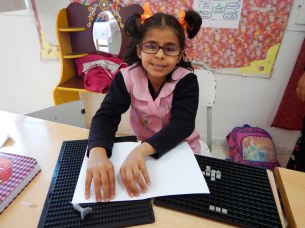
Visually impaired girl using Braille in Tunisia

Visually impaired girl using Braille in Tunisia

I’m so glad to have been invited to contibute to the session on Internet Accessibility Empowering Persons With Disabilities at this year’s Internet Governance Forum Meeting in Berlin (Wednesday 27th November, 1500-1650 CET in Room IV of the Estrel Congress Center, Sonnenallee 225, 12057 Berlin).

Hopefully, the introductory pieces by all of the speakers will be short, so that we can have a lively discussion.  I am speaking last, so previous speakers will probably have made all of the important points! However, for those unable to attend, this is what I am hoping to say:

I would like to use this opportunity to make four brief points:

First, unless universal inclusion and accessibility are built into all new digital technologies from the original design stage to end user, they will further increase inequality.  The more and more advanced technologies become, the further they benefit those who can afford and are able to use them, rather than the most marginalised and poorest, especially those with disabilities

Second, it is crucial that we change the design approach mindset so that inclusion becomes of paramount importance for the internet and the use of digital technologies.  This can be done in many ways, but I have always been impressed by the power of the market, and the role that procurement can play, especially by governments and large corporations.

Third, we can all get better at what we do!  I continually get cross with myself that I do not always insert alternative text for all of the images I post on my digital platforms, and in the slide decks that I share of my talks.  It is not good enough, but it takes longer to do, and with a tight schedule I usually forget. I need to do better; we all do.

Finally, and to end on a more optimistic note, of course the design of new digital technologies can indeed be used by people with disabilities to transform their lives.  There are always new things being developed – my latest exciting discovery is OptiKey .  However, we need to do much more to help change developers’ attitudes – and indeed those of the wider tech community.  Smart city technology for example should be being used much more to help the blind and visually impaired.  We must all do more – together with those with disabilities, and not just “for them”.

For more about our work on inclusion and disability, see our small site at Disabilities and ICT4D.


1 Comment

Filed under Accessibility, Disability, ICT4D conferences, inclusion, Uncategorized

The running shoes, girls’ learning in Africa and the gecko: a fable

shoesOnce there was a brilliant young entrepreneur living in Africa.  Let us call him Alfred.  He wanted to make loads of money, but was also very committed to trying to improve the quality of girls’ learning and education.  One evening, drinking probably too much Tusker, Alfred had a stroke of inspiration.  What if he could persuade the government that giving girls high quality new running shoes would transform the quality of their learning experience, and thus their future job prospects.  This was an absolute no brainer.  The government would have to buy his trainers for every girl in the school system!

Children 1

Schoolgirls in Ghana

But how was he to start? Many international donors are eager to support such schemes that might contribute to achievements of SDGs4 (education) and 5 (gender).  So, he set about getting to know the heads of country office of some of the leading European donors, and learnt that at the heart of getting funding was the need to have a theory of change (well, really not a comprehensive “theory”, but just a basic description of how running shoes would improve girls’ learning).  This was easy: good quality running shoes would enable the girls to get fitter, and it is well known that a fit body creates a fit mind; then, if they ran to and from school each day they would have more time to do their homework; and with good shoes on their feet they would not suffer as many injuries or catch diseases that might impair their learning.  Alfred had to think of an inspiring name for these shoes, so that everyone would want a pair.  How about “Jepkosgei” after the great young Kenyan runner who had just won the New York Marathon?  She was very happy to lend her name to this incredibly exciting initiative that could transform girls’ learning.

Malawi classroom bright

A school classroom in Malawi

The stage was set.  His friends among the donors recommended a great European university research team who would do the baseline survey as part of one of their research grants, and then they would do a follow-up evaluation at the end of the first term.  The shoes would be randomly allocated to girls in classrooms in a small set of pilot schools, and the purpose was to show that giving girls smart new running shoes would indeed improve their results when compared with those in the classrooms that were not given the shoes.  At the end of term, the researchers returned.  Everyone was on best behaviour.  What would they discover?

The results were extraordinary.  In just one term, the girls had improved their scores by 20% in Mathematics and English.  The researchers checked and re-checked their resuts, but there was absolutely no doubt.  The President got to hear of Alfred’s great success, and eager to do well in the next elections he ordered all schools immediately to supply girls with Jepkosgei running shoes. Demand outstripped supply, but Alfred set up new factories to produce them, providing much needed employment and contributing to the country’s economic growth.  Soon neighbouring countries got to hear about the impact of running shoes on girls’ learning, and they too sent in orders for tens of thousands of shoes.  Alfred became a superstar.  He won numerous awards at prestigious international events, and was fêted by the likes of Bill Gates and António Guterres.  Alfred was an African hero transforming African girls’ learning.  Why hadn’t anyone thought of this before.  It was so simple.

Gecko 2

A friendly and wise gecko

Back at the school where this all began there was a wise old gecko.  He had watched and listened as the changes took place.  He knew why learning had changed.  When the girls had first been given their runing shoes they were so proud!  They were going to be like Joyciline Jepkosgei!  People were paying attention to them.  For the first time in their lives they had felt appreciated at school.  They wanted to respond positively.  But it wasn’t just this.  Other children in the school knew that if the pilot was a success, they too would be given smart new running shoes.  So, they did everything they could to help ensure that their peers with the shoes would learn especially well that term.  They did extra chores for them so they could concentrate on their work.  They provided advice and help when something wasn’t understood.  They gave them quizzes and checked they knew the right answers.  The teachers also wanted to ensure that these girls did really well as a result of the running shoes, and so they put extra effort into preparing their classes, and ensuring that the girls had the best opportunities to learn, despite the limited resources.  Some even helped them with the answers in the tests when the researchers came to evaluate the scheme.

It was all a wonderful success.  Alfred was happy and rich, the President was happy and re-elected, the donors were happy because they could show how they delivered on the SDGs.  But the girls weren’t happy, and their exam results gradually declined over the next few years.  Girls’ feet grow, and their lovely bright shoes were soon too small for them.  There was no way to hand them on or recycle them, and in any case after a couple of years continual use by their younger sisters they were wearing out.  The government couldn’t afford to buy new shoes for all the girls.  Once everyone had them, those who had been in the pilot no longer felt special, and no-one helped each other to try to improve results.  In any case, the government was now more interested in the 4th Industrial Revolution, and how they could use it to control their people and further advantage those who were already rich and powerful and living in the burgeoning constantly surveilled smart cities…

The gecko, though, continued to enjoy catching insects, and watching the children play.  Occasionally, he wistfully wondered why no-one had asked him how to improve girls education and learning.

Malawi school children small

A school in rural Malawi

Leave a comment

Filed under Education, ICT4D, Learning, Story-telling, technology, Uncategorized

Short guides to literature on technology use in education: both the positives and the negatives…

Infant school

Infant school in Cocody, Abidjan, Côte d’Ivoire

Far too many initiatives using technology in education fail to learn from the experiences of others as they seek to be innovative and novel.  Consequently, the same mistakes tend to be replicated over and over again.  Far too many researchers likewise fail to read but a fraction of the vast literature that has been published on technology and education, and bibliographies in PhD theses in the field are increasingly often only sketchy at best.

In 2017 and 2018 I had the privilege of being asked to write a report for UNICEF on how the organisation might respond to the future interface between technology and learning.  This involved reading hundreds of reports, interviewing numerous people, and drawing on my experiences across the world over the last quarter of a century.  It made me realise how little I know, and how much still needs to be done.

However, in order to help others on this journey of discovery and learning, I thought it might be helpful to share a shortened version of the footnotes (34 sides) and a short summary bibliography (10 sides) that I included in that report.  Many of the links to the original literature or examples are included (please let me know if any are broken so that I can try to update them!).  Not least, I hope that this might reduce the flow of questions I receive from people beginning to get interested in the field, either for research or because they have a great idea that they would like to introduce in practice on the ground – most of whom have never actually read much before asking me the question!  These are but starting points on a lifetime of learning and discovery, but I hope that people may find them useful.

I have previously posted summaries of some of the content of my UNICEF report elsewhere on my Blog as follows:

I must stress that these are very much my own views, and in no way represent the opinions of UNICEF or those with whom I have previosuly worked.  They are offered here, though, to get us all to ask some of the difficult questions about ways through which some of the poorest and most marginalised can benefit from the use of technology in education, if indeed that will ever truly be possible (at least in a relative sense).

Leave a comment

Filed under Africa, AI, Education, Higher Education, ICT4D, technology, United Nations

Hungarian music and dance, at Telecom World 2019

One of the highlights of the ITU’s Telecom World this year was the generous hospitality of our Hungarian hosts.  Preceding the impressive (if slightly concerning) drone display over the Danube, there was an excellent performance of music and dance in the recently refurbished neo-Renaissance Castle Garden Bazaar complex overlooking the Buda riverfront.  I hope that the images below capture something of the evening’s entertainment.  The men dancing were truly spectacular!

This slideshow requires JavaScript.

1 Comment

Filed under Conferences, Drones, ICT4D, Uncategorized

Drones over the Danube, from Buda to Pest

The Hungarian government arranged an extraordinary drone display last night as part of their generous hospitality for this year’s ITU Telecom World event in Budapest.  I have never seen anything quite like it, and I hope the photos below provide just a glimpse into the technical and artistic success of this occasion.

This slideshow requires JavaScript.

So many thoughts sprang to mind!  In the future, drone displays may well take over from fireworks and laser shows!  But more worryingly, just imagine that each drone carried a small explosive payload, that the drones had facial and gait recognition capabilities, and that they were programmed autonomously to track you down…  There are many different futures: we need to ensure that the negatve aspects of digital technologies are mitigated, so that their positive aspects can flourish.

It is without doubt appropriate to thank HE Mr. István Manno, Head of the Protocol Department of the Ministry of Foreign Affairs and Trade of Hungary for his indefatigable work to ensure the strongest possible relationships between the ITU and the Government of Hungary, and especially for all of his efforts to make this evening event such a success.

3 Comments

Filed under Drones, ICT4D conferences, Uncategorized

Participating in the DFID-funded technology for education Hub Inception Phase consultation retreat

Windsor BuildingIt was great to be part of the DFID-funded technology for education EdTech Hub three-day Inception Phase consultation retreat from the evening of  29th July through to 1st August held at Royal Holloway, University of London.  This brought together some 30 members of the core team, funders and partners from the Overseas Development Institute, the Research for Equitable Access and Learning (REAL) Centre at the University of Cambridge, Brink, Jigsaw Consult, Results for Development, Open Development and Education, AfriLabs, BRAC and eLearning Africa, and the World Bank, as well as members of the Intellectual Leadership Team from across the world, and representation from the Bill and Melinda Gates Foundation.

The meeting was designed to set in motion all of the activities and processes for the Inception Phase of the eight-year Hub, focusing especially on

  • The Hub’s overall vision
  • The work of the three main spheres of activity
    • Research
    • Innovation, and
    • Engagement
  • The governance structure
  • The theory of change
  • The ethical and safeguarding frameworks
  • The communication strategy, and
  • The use of Agile and adaptive approaches

The Hub aims to work in partnership to “galvanise a global community in pursuit of catalytic impact, focusing on evidence so we can collectively abandon what does not work and reallocate funding and effort to what does”.  Moreover, it is “committed to using rigorous evidence and innovation to improve the lives of the most marginalised”.

Above all, as the pictures below indicate, this meeting formed an essential part in helping to build the trust and good working relationships that are so essential in ensuring that this initiative, launched in June 2019, will achieve the ambitious goals that it has set.

[A similr version of this post was first published on the UNESCO Chair in ICT4D site, 1st August 2019]

1 Comment

Filed under Africa, Development, Education, ICT4D, Inequality

The gendering of AI – and why it matters

Digital technologies are all too often seen as being neutral and value free, and with a power of their own to transform the world.  However, even a brief reflection indicates that this taken-for-granted assumption is fundamentally flawed.  Technologies are created by people, who have very specific interests, and they construct or craft them for particular purposes, more often than not to generate profit.  These technologies therefore carry within them the biases and prejudices of the people who create them.

This is as true of Artificial Intelligence (AI) as it is of other digital technologies, such as mobile devices and robots.  Gender, with all of its diversity, is one of the most important categories through which most people seek to understand the world, and we frequently assign gender categories to non-human objects such as technologies.  This is evident even in the languages that we use, especially in the context of technology.  It should not therefore be surprising that AI is gendered.  Yet, until recently few people appreciated the implication of this.

The AI and machine learning underlying an increasing number of decision-making processes, from recruitment to medical diagnostics, from surveillance technologies to e-commerce, is indeed gendered, and will therefore reproduce existing gender biases in society unless specific actions are taken to counter it.  Three issues seem to be of particular importance here:

  • AI is generally used to manipulate very large data sets.  If these data sets themselves are a manifestation of gender bias, then the conclusions reached through the algorithms will also be biased.
  • Most professionals working in the AI field are male; the World Economic Forum’s 2018 Global Gender Gap Report thus reports that only 22% of AI professionals globally are women. The algorithms themselves are therefore being shaped primarily from a male perspective, and ignore the potential contributions that women can make to their design.
  • AI, rather than being neutral, is serving to reproduce, and indeed accelerate, existing gender biases and stereotypes.  This is typified in the use of female voices in digital assistants such as Alexa and Siri, which often suggest negative or subservient associations with women.  A recent report by UNESCO for EQUALS, for example, emphasises the point that those in the field therefore need to work together to “prevent digital assistant technologies from perpetuating existing gender biases and creating new forms of gender inequality”.

These issues highlight the growing importance of binary biases in AI.  However, it must also be recognised that they have ramifications for its intersection with the nuanced and diverse definitions of gender associated with those who identify as LGBTIQ.  In 2017, for example, HRC and Glaad thus criticised a study claiming to show that deep neural networks could correctly differentiate between gay and straight men 81% of the time, and women 74% of the time, on the grounds that it could put gay people at risk and made overly broad assumptions about gender and sexuality.

The panel session on Diversity by Design: mitigating gender bias in AI at this year’s ITU Telecom World in Budapest (11 September, 14.00-15.15) is designed specifically to address these complex issues.  As moderator, I will be encouraging the distinguished panel of speakers, drawn from industry, academia and civil society, not only to tease out these challenging issues in more depth, but also to suggest how we can design AI with diversity in mind.  This is of critical importance if we are collectively to prevent AI from increasing inequalities at all scales, and to ensure that in the future it more broadly represents the rich diversity of humanity.


THIS WAS FIRST POSTED ON THE ITU’S TELECOM WORLD SITE ON 17TH JUNE 2019.  It is reproduced here with their kind permission.


Leave a comment

Filed under AI, Conferences, Gender, ICT4D, ITU

On digital happiness

Are digital technologies making people across the world any happier?  I recently posed this question on social media, commenting that I did not think they were, and was challenged by a colleague from Africa who implied that it was obvious that ICTs had increased human happiness in his part of the world.  Whilst I have touched on this issue in my previous work (ICT4D, 2009,  and Reclaiming ICT4D, 2017), I have never really teased out the difficult issues involved in answering such questions, preferring instead to focus mainly on the impact on inequality of economic growth supported by technological innovation , and the differences between development agendas based on absolute and relative definitions of poverty.  It is timely to address this issue in a little more depth.

Defining happiness

Butterfly mediumA large part of the challenge in exploring the relationships between digital technologies and happiness depends on the controversial issue of how happiness is defined.  Philosophers, psychologists, medical doctors, theologians, and even economists have long debated what happiness really is, and each has their own definition.  In psychology, one of the best-known approaches to happiness is Maslow‘s hierarchy of needs, but self-determination theory, free-choice approaches (see some of Inglehart‘s work, as well as Sen’s notions), and positive psycholoy (largely influenced by Seligman) all have much to say about happiness.
In very general terms, happiness is a collective word to describe positive feelings such as success, amusement, gratification and joy.  Many of the difficulties with the word derive from the observation that although we may know when we feel happy or sad, we do not always know the cause of the emotion, and it is not easy to measure it consistently.  Indeed, at the extremes, one person’s happiness might be another person’s sadness.  It is thus perfectly possible that one person playing digital games for six hours on end could feel elated as a result, whilst another could feel suicidal.  This illustrates the well-known view that digital technologies act primarily as an accelerator of things such as economic growth or human emotion.

Digital technologies, international development and happiness

Over the last two decades some work has explicitly explored the interface between  digital technologies, international development and happiness. As noted above, my own work has briefly explored this, as for example has Heeks in his 2012 paper on ICTs and Gross National Happiness.  Both of us, I think independently, were drawn to this important notion coined by the King of Bhutan in 1972, and have highlighted its role in leading Bhutan to measure Gross National Happiness as a key indicator of progress, emphasising that development should be holistic, combining both well-being and economic growth.  This clearly runs counter to the global hegemony on development largely as economic growth, which is enshrined in the MDGs and SDGs, and sees digital technologies as one of the prime drivers of such growth.

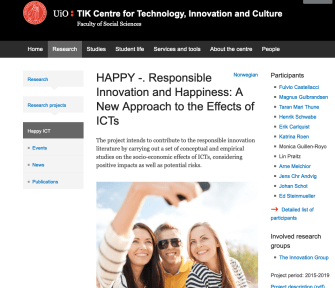
There are also now various new initiatives that are explicitly exploring the interface between digital technologies and happiness.  One of the most interesting of these is the University of Oslo TIK Centre for Technology, Innovation and Culture’s HAPPY project focusing on Responsible innovation and happiness: a new approach to the effects of ICTs, which is funded by the Norwegian Research Council.  Its core objective is to explore how we can “assess the complex and multifaceted impacts of ICTs on individuals’ welfare, and shape ICTs research and innovation activities towards responsible trajectories”.  One of its partners is NUPI, which has also published Maurseth’s (2017) useful overview on ICT, growth and happiness.

On the dehumanisation of labour

AI for Bad 2019

Most people still read this as “AI for Good”; image altered to make the point!

Until recently most digital technologies or ICTs have been largely seen as agents for good.  The ITU’s “AI for Goood”, or the GSMA’s Mobile World Congress with its 2018 slogan “Creating a Better Future” are but two graphic examples of this.  Underlying this positive image, though, have been the very significant advertising efforts of large global corporations eager to expand their markets by focusing exclusively on the positive benefits brought by ICTs; they truly make the world better, and people happy!   Moreover, this is all too frequently represented through the logic of increasing economic growth, and reducing absolute poverty.

Back in the 19th century Marx wrote passionately about the ways through which the rise of the factory system under capitalism dehumanized labour.  Very similar arguments have also been applied to the ways through which digital technologies are dehumanizing not only labour, but also many other aspects of human life as well in the 21st century (see my, 2016, Dehumanization: cyborgs and the Internet of Things, and more fully in Reclaiming ICT4D).  Almost by definition, dehumanization seems opposed to happiness.   Two simple digital examples can be used to illustratge this.  E-mails and online learning have dramatically extended the working day for office labourers who are now usually expected to be available online wherever they are for well beyond the traditional norm of 8 hours daily work – are they happyer as a result?  Likewise, 3D-printing is now replacing the happiness of human craftsmanship involved in creating fine objects.

Much more worrying, though, is the dark side of digital technologies, which is all too often hidden from the innocent eye.  To be sure, digital technologies do indeed have many positive benefits, but increasing research and attention are now at last shedding more light on their negative aspects.   UNICEF’s (2017) excellent report on Children in a Digital World, for example, provides a well balanced account of both the positive aspects of digital technologies and the harm that they can do.  Increasing evidence points to the link between smartphone use and depression amongst young people (see for example Twenge, 2017), addiction to digital technologies is becoming a growing concern (Brown, 2017) with clinics being set up across the world to treat it (see also Gregory, 2019), online gambling has been widely criticised for the harm it causes, and the role of social media in the rising tide of suicides is now being seen as an urgent prioirty that needs to be addressed by governments.  All these provide clear evidence that digital technologies do not always lead to the blissful happiness promoted in the advertising campaigns of digital corporations.

On method – historical and comparative

There is a clear need for much further research on the conditions under which digital technologies can indeed lead to greater human happiness, and those where they lead to a downard spiral of misery.  Methodologically, we need both historical and comparative studies to identify who is happier and why they are so when they use these technologies.  We need to understand more about the longitudinal experiences of those who were alive before computers and mobile phones became readly available and affordable.  We also need to understand much better what it is that enables some people to use digital technologies quite happily, whereas for others they can be the cause of misery so severe that people kill themselves.

The digitisation of human life

In conclusion, it is worth reflecting on what the future holds.  It has traditionally been thought that human happiness comes in part from the use of all of our senses of feeling, touching, seeing, hearing and smelling.  If this is so, happiness can be seen to derive in large part from fulfilment of this sentient being in the world.  Sitting for hours in front of a computer or other digital device has already been widely condemned for the negative health impacts that it causes: obesity, muscle degeneration, eye damage, back pain, and organ damage.  This is hardly happiness.  However, with the increasing commingling of human and machine, it may be that our cyborg future will no longer require traditional sentient experiences for us to be happy.  Our happiness may derive in the future from electrical impulses directed by neurally connected chips to stimulate feelings of happiness.  The rise of Transhumanism (H+), and the increasing numbers of people who are choosing to have microchips inserted in their bodies, is but one more step on this journey.

BirdI am privileged to have been born long before mobile phones existed, and vividly recall the first laptops, digital typewriters, and the pleasure of physically printing out cards to run my Fortran programmes.  I have also had the pleasure of recovering from broken bones, and the exhilarating happiness of playing the sports that caused them!  This has given me the sense that living life to the full as humans, being truly happy, does indeed require use to use all our senses.   We need wide public debate on the future relationships that we want to have with machines, a debate not driven by the economic interests of global capital, but one in which the joys of human sentient happiness can also be applauded and priortised.

 

2 Comments

Filed under Hacking, ICT4D, Inequality, social media

Participating in IFLA’s President’s Meeting and Ministerial Forum, Buenos Aires, 22-23 May 2019

Ministers Forum

Ministers and Secretaries of Culture Forum

It was a real privilege to have been invited to participate in the International Federation of Library Associations and Institutions (IFLA) Forum of Ministers and Secretaries of Culture of Latin America and the Caribbean on 22nd May, and to give a keynote address at its 2019 President’s meeting which was on the theme of Motors of change: libraries and sustainable development on 23rd May, both in Buenos Aires.  These meetings provided a valuable opportunity for those actively involved in the role of libraries in contributing to the development of Latin American and Caribbean countries to share ideas and experiences, and agree on ways through which their work can be further enhanced.

The Forum of Ministers and Secretaries of Culture was held in the very impressive Congress of the Argentine Nation, and provided an excellent opportunity for senior

President

IFLA President and Secretary General

government officials from across the region to share presentations and discuss the theme of Libraries, Access to Information and the Sustainable Development Goals.  Welcoming participants, IFLA President Glòria Pérez-Salmerón reminded them of the theme of her presidency – Motors of Change – and underlined the difference that libraries can make, for so many people, in so many ways.  IFLA Secretary-General Gerald Leitner stressed to the ministers of the power they had in their hands, and made the case for ensuring that they – and libraries – are included fully in national development plans.  A key outcome of the meeting was the signing of the Buenos Aires Declaration which affirmed participating governments’ commitment to the UN 2030 Agenda, and to the power of libraries and access to information to achieve it.  The meeting also saw the launch of the second edition of the Development and Access to Information Report produced by IFLA and the Technology and Social Change Group (TASCHA) at the University of Washington, focusing especially on SDG4 (education), SDG8 (decent work and economic growth), SDG10 (inequalities), SDG13 (climate chage) and SDG16 (peace, justice and strong institutions), and edited by Stephen Wyber and Maria Garrido.

In the evening, there was a Cultural Gala in the Public Hall of the Library of the National Congress, which consisted of three main elements:

  • Nacha

    Nacha Guevara

    A dance performance in two parts by the Arte Ballet Compañía: the Don Quijote suite, and Tiempos de Tango, with ideation, choreography and direction by María Fernanda Blanco.

  • Music played by the Chamber Orchestra of the Honorable Argentine Chamber of Deputies with a repertoire dedicated to the Argentine composer Astor Piazzolla, featuruing especially the saxophone soloist Jorge Retamoza.
  • A wonderful closing sequence of songs by the famous Argentine artist Nacha Guevara.

The 2019 President’s Meeting on 23rd May built on the themes of the Development and Access to Information Report, and began with a session of welcoming speeches by IFLA President Glòria Pérez-Salmerón, IFLA Secretary-General Gerald Leitner, Alejandro Lorenzo César Santa (General Coordinating Director, Library of the National Congress), and Rene Mauricio Valdes (United Nations Resident Coordinator, Argentina).  This was followed by my keynote  on Libraries and Sustainable Development: challenges of inequality in a digital world (.pdf of slide deck), which:

  • Screenshot 2019-05-25 at 21.00.54Challenged those who believe that the SDGs will deliver on their aspirations;
  • Highlighted the role of digital technologies in leading to increasing inequalities;
  • Explored issues around power, knowledge and content;
  • Advocated for the important role that libraries can serve as open places and communal resource centres; and
  • Concluded by encouraging participants to have the will to make a difference.

In the afternoon, there were three sets of discussions and presentations by the authors of the Development and Access to Information Report and others on the following themes:

  • A Library Response to Global Challenges: What Can Libraries Contribute to International Efforts to Tackle the Issues that Affect the Planet?
  • Driving Development at a Local Level: Libraries Making a Difference to People’s Lives
  • Improving Decision-Making and Accountability: Libraries as Pillars of Democracy and Good Governance
Tango 1

Our great tango teachers!

These two days of lively and interesting discussion provided a wealth of ideas for all those participating from governments and libraries to implement on return to their own countries.  It was also a very valuable opportunity to build a network of people working at the interface between libaries and international development, especially in Latin America and the Caribbean.  Very many thanks are due to the hard work and hospitality of colleagues from IFLA and our Argentian hosts.  One of my lasting memories will definitely be learning to dance the tango – for which many thanks to our brilliant teachers!


1 Comment

Filed under Conferences, Dance, ICT4D, Latin America, My Lectures, Photographs, research, SDGs, United Nations, Universities