Category Archives: Internet

Power hierarchies and digital oppression: towards a revolutionary practice of human freedom

I recently spent three hours completing an online financial expenses claim form for the finance department of our university relating to an overseas research trip.  There were only 20 items of expenditure to be entered.  However, each of the receipts had to be copied, reduced in size to suit the requirements of the software and uploaded into the system, along with separate details of the credit card payments for them. These had to be matched with numbered explanatory entries on another page of the online form, none of which could be automatically generated, and each of which required separate keyboard entry.  On average, it therefore took me nine minutes per entry.  I’m sure that anyone who has been forced to use Unit4’s Agresso software will know just what a cumbersome and time-consuming piece of software this is.  Of course, it purports to reduce the time spent by staff in the accounts department, thus reducing the university’s expenditure on staffing, but this is at a significant cost in terms of the amount of time that I, as a user, have to spend.  In the past, using hard copy receipts and forms, this task would have taken me much less than an hour to complete.  My time is precious, and this represents a significant waste of time and money for myself and the university, over and above the costs that the university has incurred in purchasing the software and training staff in its use. 

This is but one example of the ways in which digital tech is being designed and used to shift the expenditure of labour from the top downwards, and from the centre to the periphery (see my 2020 post on this for more examples).  End users now have to do the work that those at the centre of networks (such as organisations, institutions, or governments) previously had to do; end users produce and upload the data that the centre formerly collected and processed.  This is one of the main reasons why workers and citizens are now forced to spend considerably longer time and more effort completing mundane tasks, for the benefit of more powerful centres (and people) who give them no choice, and force them to conform to the digital systems that they control. 

Examples of everyday digital oppression

There are many examples of this tendency, but the following currently seem to be most problematic (over and above the ever present challenge of spam, hacking and online fraud; I do not, though, address issues such as digital violence and sexual harassment here because I have written about them elsewhere, and want in this piece to focus instead on the everyday, normal processes through which structural imbalances are designed and enforced in the everyday use of digital tech):

  • The (ab)use of e-mails, especially when disseminated by the centre to groups of people.  It is easy to send e-mails from the centre to many people at the periphery or down the hierarchy, but the total burden of time and effort for all the recipients can be enormous. This is particularly with respect to copy correspondence, which adds considerably to the burden (see my e-mail reflections written in 2010 but still valid!).  It is increasingly difficult for many people to do any constructive work, because they are inundated with e-mails. 
  • Being forced to download attachments and print them off for meetings.  Some people “at the centre” still require those attending meetings to print off hard copies of documents before attending.  This is quite ridiculous, since it vastly increases the total amount of time and effort involved. If hard copy materials are required, these should always be produced and distributed by the centre and not the end user.
  • Extending the working day through access to and use of digital tech.  The above two observations are examples of the general principle that digital tech has been used very widely to extend the working day, without paying staff for this increase.  The idea that e-mails can be answered at home after “work”, or  personal training done in “spare time”, are but two ways through which this additional expropriation of surplus value is achieved.
  • Companies requiring users to complete online forms and upload information.  This widespread practice is one of the most common ways through which companies reduce their own labour costs and increase the burden on those for whom they are intended to be providing services.  Creating online accounts, logging on with passwords, and then filling in online forms has become increasingly onerous for users, especially when the forms and systems are problematic or don’t have options for what the consumer wants to enquire about.  Such systems also take little consideration of the needs of people with disabilities or ageing with dementia who often have very great difficulty in interacting with the technology.
  • Users having to download information, rather than receiving it automatically at their convenience.  Centres, be they companies or organisations, now almost universally require users to log on to their systems and go through complex, time-consuming protocols to gain access to the information that centres wish to disseminate (banks, financial organisations, and utility companies are notorious for this).  In the past, such material was delivered to users’ letter boxes and could simply be accessed by opening an envelope. Again, this is to the benefit of the centres rather than the users.
  • Useless Chatbots, FAQs, online Help options and voice options on phone calls.  Numerous organisations require consumers/users to go through digital systems that are quite simply not fit for purpose and often take a very considerable amount of users’ time (and indeed costs of connectivity).  While some systems do provide basic information reasonably well, the majority do not, and require users to spend ages trying to find out relevant information.  Many organisations also now make it very difficult for users to find alternative ways of communicating with them, such as by telephone.  Even when one can get through to a telephone number and negotiate the lengthy and confusing numerical or voice recognition options, it frequently takes an extremely long time (often well over 30 minutes, or a 16th of the working day) before it is possible to speak with someone.  Sadly, human responders once contacted are also often poorly trained and frequently cannot give accurate answers.
  • Having to use yet another digital system chosen by centres and leaders to exploit you in their own interests. There are now so many different online cloud systems for communicating with each other at work (or play), such as Microsoft’s Teams, Google’s Workspace, Slack, Trello, Asana, and Basecamp (to name but a few).  None of us can expect to be adept at using all of them.  However, leaders of organisations and teams generally impose their own preferred software solution (or those ordained by their organisation) on members.  Rarely are they willing to change their own preferences to suit those of other team members. Hence, this reinforces power relationships and those lower down the food chain are forced to comply with solutions that may well not suit them.
  • Filling in forms online that are badly designed, crash on you, and often don’t have a save function for partially completed material. I am finding this to be an increasingly common and very frustrating form of hidden abuse.  The number of times I have had to fill in forms online that take far longer than just writing a document or sending an e-mail is becoming ever greater.  This is particularly galling when the software freezes or the save function does not work, and everything gets lost, forcing me to start all over again.  The hours I have lost in this way (particularly in completing documents for UN agencies) are innumerable.
  • Time wasted in having to scroll through quantities of inane social media to find a message that someone has sent you and is complaining that you have not yet responded to it.  The answer to this is simply not to use social media, and especially groups (see my practices), or to “unfriend” people who do this, but increasingly this is yet another means through which centres seek to control and exploit those at the peripheries or lower down the work hierarchy.
  • Centres simply failing to respond to digital correspondence, especially with complaints, and forcing users to keep chasing them online. I have lost count of the number of times I have had to fill in an online form, usually about something I have been asked to do by a company or agency, or concerning an appointment or complaint, only for them never to reply.  This forces me to waste yet further time trying to contact them about why they haven’t responded!

This list of examples could be added to at great length, and mainly reflects my own current angst (for earlier examples see On managerial control and the tyranny of digital technologies).  To be sure, not all digital systems are as appalling as the above would suggest, and credit should be given where due.  The UK’s digital service, https://gov.uk is generally a notable positive exception to this generalisation, and I was, for example, very impressed when I recently had to use it to renew a passport. However, to change this situation it is necessary to understand its causes, the most important of which are discussed below.

The rise of digital capitalism and the causes of digital oppression  

Five main causes lie at the heart of the above challenges.  Underlying them all, though, is the notion that it is right and proper for companies to seek to expand their markets and lower their costs of production in the pursuit of growth.  Capital accumulation is one of the defining (and problematic) characteristics of all forms of the capitalist mode of production, and new digital technologies have two key attributes in supporting this process: first, the use of digital tech very rapidly accelerates all forms of human interaction; and second, their use can replace much human labour (thus increasing the human labour productivity of those remaining in employment) .  On the assumption that the cost of introducing digital tech is cheaper than the cost of human labour, then digital tech can be used dramatically to increase the rates of capital accumulation and surplus profit acquisition by the owners of the means of production.  However, if there is insufficient demand in the market, not least because of falling purchasing power as a result of reduced levels of human labour, then the twin crises of realisation and accumulation will inevitably ultimately cause fundamental problems for the system as a whole.  It must also be realised that (as yet) digital tech does not actually have any power of its own. The power lies with those who conceive, design, construct and market these technologies in their own interests.  As the apparent AI ethical crisis at the moment clearly indicates, the scientists who support this process are as much to blame for its faults as are the owners of capital who pay them.  Five aspects of this underlying principle can be seen at work in leading to the current situation whereby those at the system peripheries or the bottom of hierarchies are being increasingly oppressed through the uses of digital tech (as described in the examples above):

  • First, labour costs have generally long been perceived as being the critical cost factor in many industrial and commercial sectors.  The digital tech sector has therefore been very adept at persuading other companies and organisations to do away with human labour and replace it with technology in the productive process.  The labour that is left must be forced to work longer hours while also increasing its productivity.  However, companies and organisations have also been persuaded that they can make further significant cost savings by ensuring that consumers and staff lower down the hierarchy do much of the work for themselves by, for example, filling in online forms and using chatbots as discussed above.  Digital tech is used to shift the balance of time spent on tasks to the consumers or users.  This insidious shift of emphasis is a classic expression of the digital oppression that is now increasing being felt by people across the world.
  • A second significant feature of capitalist enterprises is their need to create as uniform a market as possible so that they are then able sell as many of the same products or services as they can.  This emphasis on uniformity requires users to adjust their previously diverse human behaviours to conform to the uniform digital systems that are imposed on them.  It lowers overall costs, and enables markets rapidly to be expanded.  We experience this every time we have to choose which of a number of options we are given on a phone call, or fill in an online form, where what we are concerned about does not easily fit in to any of the options we are given.  Similarly, we encounter it every time someone wanting us to do something requires us to use their software package or app rather than our preferred one.  Again, we encounter a different form of digital oppression.
  • Third, the increasing emphasis and reliance on digital systems means that the human labour remaining in organisations and companies becomes increasingly overstretched.  Without adding to the amount of time that they work, staff having to use digital systems through which they are constantly bombarded with requests and actions become ever more oppressed. Furthermore, the difficulty of finding qualified and knowledgeable staff competent enough to give a good service to clients and customers, means that organisations are increasingly not capable of responding satisfactorily to those who don’t fit into the uniform-demanding digital systems that they now operate.  This is why some companies make it as difficult as possible for clients and customers actually to speak with a human being among their staff, and why the quality of service they provide can be so bad.  Some turn to call centres overseas, which often provide a dire service on poor quality phone lines staffed by people who cannot competently speak or understand the language of the customers.
  • Fourth, much of the software and systems that governments, organisations and companies are persuaded to buy by the tech sector is poorly designed, poorly constructed and poorly implemented.  As but one example, in 2015 the abandoned NHS patient record system in the UK had “so far cost the taxpayer nearly £10bn, with the final bill for what would have been the world’s largest civilian computer system likely to be several hundreds of millions of pounds higher, according a highly critical report from parliament’s public spending watchdog” (The Guardian, 2015).  The quality of design and programming in many apps, especially when outsourced to countries with very different cultures of coding, is often very low, and it is unsurprising that the functionality of many digital systems is so dire.  Despite much rhetoric about human-computer interaction and user-centred design, the reality is that much tech is still built by people with little real knowledge and expertise in what users really want and how best to make it happen.  All too often, they are themselves brought up within the culture of uniformity that limits real quality innovation.
  • Finally, the scientism (science’s belief in itself) that has come to dominate the tech sector and its role in human societies has largely served the interests of the rich and powerful, not least through the hope that aspirant digital scientists have to join that elite themselves.  Ultimately, this serves the interests of the few rather than the many.  Those on the peripheries or at the lower end of hierarchies have instead become increasingly oppressed and enslaved as a result of the propagation of digital tech across all aspects of human life (see my Freedom, enslavement and the digital barons: a thought experiment).  It is becoming ever more crucial to challenge scientism, and counter the belief that science in general, and digital tech in particular, has the ability to solve all of the world’s problems.

What’s to be done

None of these challenges and none of the reasons underlying them need to be as they are.  There is nothing sacrosanct or inevitable about the design, creation and use of digital tech.  We do not need it to be as it is.  It is only so because of the interests of the scientists who make it and the owners of the companies who pay them to do so.

There are numerous ways through which we can challenge the increasingly dominant hegemony of the digital tech sector in human society at both an individual and an institutional level.  I concentrate here on suggestions for individual actions that can help us regain our humanity, leaving the discussion of the important regulatory transformations that are essential at a structural level for a future post.  After all, it is only as individuals in our daily actions that we can ever regain any real power over the structures that oppress our “selves”.  Any actions that can help change the underlying structures and practices giving rise to the oppressions exemplified at the start of this post are of value, and they will vary according to our individual space-time conjuctures.  I offer the following as an initial step to what might be termed a revolutionary practice of digital freedom:

  • Create multiple identities for ourselves.  As individuals we are much more complex than the uniformity that digital systems wish to impose on us.  We are so much more than a single digital identity.  Hence, we must do all we can to create multiple identities for ourselves as individuals, and resist in every way possible attempts to control and surveil us through the imposition of such things as single digital identities.
  • We must resist being forced to use specific digital technologies.  We should always refuse to use digital tech when we can do something perfectly well without it.  We must likewise very strongly resist attempts by companies, governments and organisations to force us to use a single piece of tech (hardware or software) to do something, and always demand that they provide a solution through our individually preferred technologies.  At a banal level, for example, if you are happy with using Zoom and Apple’s Keynote, Mail, Numbers and Pages, you should never be forced by anyone to use Microsoft Teams or Google Workspace.  If people or organisations are not willing to adapt to your individual needs they are probably not worth working with (or for) anyway.  Many societies now require restaurants to provide details of all possible food preferences and allergies, so why should we accept being oppressed by digital tech companies who only wish us to conform to one uniform system?
  • We should never accept poor quality digital systems.  If you cannot do something you want to through an organisation’s digital systems, then it is always worth complaining about it.  Writing a letter of complaint, copied widely to relevant ombudsmen, is not only quicker than trying to use poor quality tech systems, but numerous complaints can cumulatively help to change organisations.
  • We must always challenge scientism, and emphasise the importance of the humanities in answering the questions that scientists cannot answer.  Our particular structure of science primarily serves the interests of scientists, who work in very particular ways.  This model of science is overwhelming dominant in the way in which digital tech is created.  Although scientists can produce impressive results, they are not the guardians of all knowledge, and they are by no means always right.  Almost every theory that has ever been constructed, for example, has at some later time been disproved.  We must therefore resist all efforts to make science (or STEM subjects) dominant in our education systems.  We must cherish the arts and humanities as being just as valuable for the future health of the societies of which we are parts.
  • We should identify and challenge the interests underlying a particular digital development.  All too often innovations in digital tech are seen as being inevitable and natural.  This is quite simply not the case.  All developments of new technology serve particular interests, almost always of the rich and powerful.  To create a fairer and more equal society this must change.  The scientists who have developed generative AI, for example, are completely responsible for its implications, and it is ridiculous that they should now be saying that it has gone too far and should somehow be controlled.  They did not have to create it as it is in the first place.
  • We need to implement our own digital systems to manage emails and social media. It is perfectly possible to reduce the amount of digital bombardment that we receive, but we need to manage this consciously and practically (see my Reflections on e-mails).  Simple ways to start doing this are: file all copy correspondence separately; always remove yourself from mailing lists unless you really want to receive messages (you can always rejoin later); limit your participation in social media (especially WhatsApp) group; and keep a record of the time you spend each day doing digital tasks (it will amaze you) and think of how you could use this time more productively!
  • Take time offline/offgrid to regain our humanity.  It is perfectly possible still to live life offline and offgrid. Many of the world’s poorest people have always done so.  The more we are offline, the more we realise that we do not need always to be connected digitally. Some time ago I created the hashtag #1in7offline, to encourage us to spend a day a week offline, or, if we cannot do that, an hour every seven hours offline.  Not only does this reduce our electricity consumption (and is thus better for the physical environment), but it also gives us time to regain our experience of nature, thereby regaining our humanity.  The physical world is still much better than the virtual world, despite the huge amount of pressure from digital tech companies for us to believe otherwise. Remember that if we don’t use physical objects such as banknotes and coins, or physical letters and postcards, we will lose them.  Think, for example, of the implications of this, not least in terms of the loss of the physical beauty of the graphics and design on banknotes or stamps, key expressions of our varying national identities (not again that digital leads to bland uniformity).  Remember too that every digital transaction that we make provides companies and governments with information about us that they then use to generate further profit or to surveil us ever more precisely.  Being offline and offgrid is being truly revolutionary.

3 Comments

Filed under digital technologies, ICT4D, inclusion, Inequality, Internet, revolution, slavery, social media, technology, Universities

Digital-political-economy in a post-Covid-19 world: implications for the most marginalised

Now is the time to be thinking seriously about the kind of world that we wish to live in once Covid-19 has finished its rampage across Europe and North America.[i] Although its potential direct health impact in Africa and South Asia remains uncertain at the time of writing, countries within these continents have already seen dramatic disruption and much hardship as well as numerous deaths having been caused by the measures introduced by governments to restrict its spread.  It is already clear that it is the poorest and most marginalised who suffer most, as witnessed, for example, by the impact of Modi’s lockdown in India on migrant workers.[ii]

This post highlights five likely global impacts that will be hastened by Covid-19, and argues that we need to use this disruption constructively to shape a better world in the future, rather than succumb to the potential and substantial damage that will be caused, especially to the lives of the world’s poorest and most marginalised.  It may be that for many countries in the world, the impact of Covid-19 will be even more significant than was the impact of the 1939-45 war.  Digital technologies are above all accelerators, and most of those leading the world’s major global corporations are already taking full advantage of Covid-19 to increase their reach and their profits.[iii]

The inexorable rise of China and the demise of the USA

http://hiram1555.com/2016/10/21/presidential-debates-indicate-end-of-us-empire-analyst/

Source: Hiram1555.com

I have written previously about the waxing of China and the waning of the USA; China is the global political-economic powerhouse of the present, not just of the future.[iv]  One very significant impact of Covid-19 will be to increase the speed of this major shift in global power.  Just as 1945 saw the beginning of the final end of the British Empire, so 2020 is likely to see the beginning of the end of the USA as the dominant global (imperial) power.  Already, even in influential USAn publications, there is now much more frequent support for the view that the US is a failing state.[v] This transition is likely to be painful, and it will require world leaders of great wisdom to ensure that it is less violent than may well be the case.

The differences between the ways in which the USA and China have responded to Covid-19 have been marked, and have very significant implications for the political, social and economic futures of these states.  Whilst little trust should be placed on the precise accuracy of reported Covid-19 mortality rate figures throughout the world, China has so far reported a loss of 3.2 people per million to the disease (as of 17 April, and thus including the 1290 uplift announced that day), whereas the USA has reported deaths of 8.38 per 100,000 (as of that date); moreover, China’s figures seem to have stabilised, whereas those for the USA continue to increase rapidly.[vi]  These differences are not only very significant in human terms, but they also reflect a fundamental challenge in the relative significance of the individual and the community in US and Chinese society.

Few apart from hardline Republicans in the USA now doubt the failure of the Trump regime politically, socially, economically and culturally. This has been exacerbated by the US government’s failure to manage Covid-19 effectively (even worse than the UK government’s performance), and its insistent antagonism towards China through its deeply problematic trade-war[vii] even before the outbreak of the present coronavirus. Anti-Chinese rhetoric in the USA is but a symptom of the realisation of the country’s fundamental economic and policial weaknesses in the 21st century.   President Trump’s persistent use of the term “Chinese virus” instead of Covid-19[viii] is also just a symptom of a far deeper malaise.   Trump is sadly not the problem; the problem is the people and system that enabled him to come to power and in whose interests he is trying to serve (alongside his own).  China seems likely to come out of the Covid-19 crisis much stronger than will the USA.[ix]

Whether people like it or not, and despite cries from the western bourgeoisie that it is unfair, and that the Chinese have lied about the extent of Covid-19 in their own country in its early stages, this is the reality.  China is the dominant world power today, let alone tomorrow.

An ever more digital world

https://www.forbes.com/sites/columbiabusinessschool/2020/04/21/how-covid-19-will-accelerate-a-digital-therapeutics-revolution/

Source: Forbes.com

The digital technology sector is already the biggest winner from Covid-19.  Everyone with access, knowledge and ability to pay for connectivity and digital devices has turned to digital technologies to continue with their work, maintain social contacts, and find entertainment during the lockdowns that have covered about one-third of the world’s population by mid-April.[x]  Those who previously rarely used such technologies, have overnight been forced to use them for everything from buying food online, to maintaining contacts with relatives and friends.

There is little evidence that the tech sector was prepared for such a windfall in the latter part of 2019,[xi] but major corporations and start-ups alike have all sought to exploit its benefits as quickly as possible in the first few months of 2020, as testified by the plethora of announcements claiming how various technologies can win the fight against Covid-19.[xii]

One particularly problematic outcome has been the way in which digital tech champions and activists have all sought to develop new solutions to combat Covid-19.  While sometimes this is indeed well intended, more often than not it is primarily so that they can benefit from funding that is made available for such activities by governments and donors, or primarily to raise the individual or corporate profile of those involved.  For them, Covid-19 is a wonderful business opportunity.  Sadly, many such initiatives will fail to deliver appropriate solutions, will be implemented after Covid-19 has dissipated, and on some occasions will even do more harm than good.[xiii]

There are many paradoxes and tensions in this dramatically increased role of digital technology after Covid-19. Two are of particular interest.  First, many people who are self-isolating or social distancing are beginning to crave real, physical human contact, and are realising that communicating only over the Internet is insufficiently fulfilling.  This might offer some hope for the future of those who still believe in the importance of non-digitally mediated human interaction, although I suspect that such concerns may only temporarily delay our demise into a world of cyborgs.[xiv] Second, despite the ultimate decline in the US economy and political power noted above, US corporations have been very well placed to benefit from the immediate impact of Covid-19, featuring in prominent initiatives such as UNESCO’s Global Education Coalition,[xv] or the coalition of pharmaceutical companies brought together by the Gates Foundation.[xvi]

Whatever the precise details, it is an absolute certainty that the dominance of digital technologies in everyone’s lives will increase very dramatically following Covid-19 and this will be exploited by those intent on reaping the profits from such expansion in their own interests.

Increasing acceptance of surveillance by states and companies: the end of privacy as we know it.

https://www.wired.com/story/phones-track-spread-covid19-good-idea/

Source: Wired.com

A third, related, global impact of Covid-19 will be widely increased global acceptance of the roles of states and companies in digital surveillance.  Already, before 2020, there was a growing, albeit insufficient, debate about the ethics of digital surveillance by states over issues such as crime and “terrorism”, and its implications for privacy.[xvii]  However, some states, such as China, South Korea, Singapore and Israel, have already used digital technologies and big data analytics extensively and apparently successfully in monitoring and tracking the spread of Covid-19,[xviii] and other coalitions of states and the private sector are planning to encourage citizens to sign up to having fundamental aspects of what has previously been considered to be their private and personal health information made available to unknown others.[xix]

One problem with such technologies is that they require substantial numbers of people to sign up to and then use them.  In more authoritarian states where governments can make such adherence obligatory by imposing severe penalties for failure to do so, they do indeed appear to be able to contribute to reduction in the spread of Covid-19 in the interests of the wider community.  However, in more liberal democratic societies, which place the individual about the community in importance, it seems less likely that they will be acceptable.

Despite such concerns, the growing evidence promoted by the companies that are developing them that such digital technologies can indeed contribute to enhanced public health will serve as an important factor in breaking down public resistance to the use of surveillance technologies and big data analytics.  Once again, this will ultimately serve the interest of those who already have greater political and economic power than it will the interests of the most marginalised.

Online shopping and the redesign of urban centres.

https://www.independent.co.uk/life-style/health-and-families/coronavirus-herd-immunity-meaning-definition-what-vaccine-immune-covid-19-a9397871.html

Source: Independent.co.uk

Self-isolation and social distancing have led to the dramatic emptying of towns and cities across the world.  Businesses that have been unable to adapt to online trading have overnight been pushed into a critical survival situation, with governments in many of the richer countries of the world being “forced” to offer them financial bail-outs to help them weather the storm.  Unfortunately, most of this money is going to be completely wasted and will merely create huge national debts for years into the future.  People who rarely before used online shopping are now doing so because they believe that no other method of purchasing goods is truly safe.

The new reality will be that most people will have become so used to online shopping that they are unlikely to return in the future to traditional shopping outlets. Companies that have been unable to adjust to the new reality will fail.  The character of our inner-city areas will change beyond recognition.  This is a huge opportunity for the re-design of urban areas in creative, safe and innovative ways.  Already, the environmental impact of a reduction in transport and pollution has been widely seen; wildlife is enjoying a bonanza; people are realising that their old working and socialising patterns may not have been as good as they once thought.[xx]  Unfortunately, it is likely that this opportunity may not be fully grasped, and instead governments that lack leadership and vision will instead seek to prop up backward-looking institutions, companies and organisations, intent on preserving infrastructure and economic activities that are unfit for purpose in the post-pandemic world.  Such a mentality will lead to urban decay and ghettoization, where people will fear to tread, and there is a real danger of a downward spiral of urban deprivation.

There are, though, many bright signs of innovation and creativity for those willing to do things differently.  Shops and restaurants that have been able to find efficient trustworthy drivers are now offering new delivery services; students are able to draw on the plethora of online courses now available; new forms of communal activity are flourishing; and most companies are realising that they don’t actually need to spend money on huge office spaces, but can exploit their labour even more effectively by enabling them to work from home.

We must see the changes brought about by responses to Covid-19 as important opportunities to build for the future, and to create human-centred urban places that are also sensitive to the natural environments in which they are located.

Increasing global inequalities

https://gulfnews.com/photos/news/indian-migrants-forced-to-walk-home-amid-covid-19-lockdown-1.1585394226024?slide=2

Source: Gulfnews.com

The net outcome of the above four trends will lead inexorably to a fifth, and deeply concerning issue: the world will become an even more unequal place, where those who can adapt and survive will flourish, but where the most vulnerable and marginalised will become even more immiserated.

This is already all too visible.  Migrant workers are being ostracised, and further marginalised.[xxi]  In India, tens of thousands of labourers are reported to have left the cities, many of them walking home hundreds of kilometres to their villages.[xxii] In China, Africans are reported as being subjected to racist prejudice, being refused service in shops and evicted from their residences.[xxiii]  In the UK, many food banks have had to close and it is reported that about 1.5. million people a day are going without food.[xxiv]  The World Bank is reporting that an extra 40-50 million people across the world will be forced into poverty by Covid-19, especially in Africa.[xxv]  People with disabilities have become even more forgotten and isolated.[xxvi]  The list of immediate crises grows by the day.

More worrying still is that there is no certainty that these short-term impacts will immediately bounce-back once the pandemic has passed.  It seems at least as likely that many of the changes will have become so entrenched that aspects of living under Covid-19 will become the new norm.  Once again, those able to benefit from the changes will flourish, but the uneducated, those with disabilities, the ethnic minorities, people living in isolated areas, refugees, and women in patriarchal societies are all likely to find life much tougher in 2021 and 2022 even than they do at present.   Much of this rising inequality is being caused, as noted above, by the increasing role that digital technologies are playing in people’s lives.  Those who have access and can afford to use the Internet can use it for shopping, employment, entertainment, learning, and indeed most aspects of their lives.  Yet only 59% of the world’s population are active Internet users.[xxvii]

Looking positively to the future.

People will respond in different ways to these likely trends over the next few years, but we will all need to learn to live together in a world where:

  • China is the global political economic power,
  • Our lives will become ever more rapidly experienced and mediated through digital technology,
  • Our traditional views of privacy are replaced by a world of surveillance,
  • Our towns and cities have completely different functions and designs, and
  • There is very much greater inequality in terms of opportunities and life experiences.

In dealing with these changes, it is essential to remain positive; to see Covid-19 as an opportunity to make the world a better place for everyone to live in, rather than just as a threat of further pain, misery and death, or an opportunity for a few to gain unexpected windfall opportunities to become even richer.  Six elements would seem to be important in seeking to ensure that as many people as possible can indeed flourish once the immediate Covid-19 pandemic has dissipated:

  • First, these predictions should encourage all of us to prioritise more on enhancing the lives of the poorest and the most marginalised, than on ensuring economic growth that mainly benefits the rich and privileged. This applies at all scales, from designing national health and education services, to providing local, community level care provision.
  • This requires an increased focus on negotiating communal oriented initiatives and activities rather than letting the greed and selfishness of individualism continue to rule the roost.
  • Third, it is essential that we use this as an opportunity to regain our physical sentient humanity, and reject the aspirations of those who wish to create a world that is only experienced and mediated through digital technology. We need to regain our very real experiences of each other and the world in which we live through our tastes, smells, the sounds we hear, the touches we feel, and the sights we see.
  • Fourth, it seems incredibly important that we create a new global political order safely to manage a world in which China replaces the USA as the dominant global power. The emergence of new political counterbalances, at a regional level as with Europe, South Asia, Africa and Latin America seems to be a very important objective that remains to be realised.  Small states that choose to remain isolated, however arrogant they are about the “Great”ness of their country, will become ever more vulnerable to the vagaries of economic, political and demographic crisis.
  • Fifth, we need to capitalise on the environmental impact of Covid-19 rapidly to shape a world of which we are but a part, and in which we care for and co-operate with the rich diversity of plant and animal life that enjoys the physical richness of our planet. This will require a comprehensive and rigorous evaluation of the harm caused to our world by the design and use of digital technologies.[xxviii]
  • Finally, we need to agree communally on the extent to which individual privacy matters, and whether we are happy to live in a world of omnipresent surveillance by companies (enabling them to reap huge profits from our selves as data) and governments (to maintain their positions of power, authority and dominance). This must not be imposed on us by powerful others.  It is of paramount importance that there is widespread informed public and communal discussion about the future of surveillance in a post-Covid-19 era.

I trust that these comments will serve to provoke and challenge much accepted dogma and practice.  Above all, let’s try to think of others more than we do ourselves, let’s promote the reduction of inequality over increases in economic growth, and let’s enjoy  an integral, real and care-filled engagement with the non-human natural world.


Notes:

[i] For current figures see https://coronavirus.thebaselab.com/ and https://gisanddata.maps.arcgis.com/apps/opsdashboard/index.html#/bda7594740fd40299423467b48e9ecf6, although all data related with this coronavirus must be treated with great caution; see https://unwin.wordpress.com/2020/04/11/data-and-the-scandal-of-the-uks-covid-19-survival-rate/

[ii] Modi’s hasty coronavirus lockdown of India leaves many fearful for what comes next, https://time.com/5812394/india-coronavirus-lockdown-modi/

[iii] Jack Dorsey, the founder of Twitter and Square, might well be an exception with his $1 billion donation to support Covid-19 relief and other charities; see https://www.theverge.com/2020/4/7/21212766/jack-dorsey-coronavirus-covid-19-donate-relief-fund-square-twitter

[iv] See, for example, discussion in Unwin, T. (2017) Reclaiming ICT4D, Oxford: Oxford University Press.  I appreciate that such arguments infuriate many people living in the USA,

[v] See, for example, George Parker’s, We Are Living in a Failed State: The coronavirus didn’t break America. It revealed what was already broken, The Atlantic, June 2020 (preview) https://www.theatlantic.com/magazine/archive/2020/06/underlying-conditions/610261/.

[vi] Based on figures from https://coronavirus.thebaselab.com/ on 15th April 2020.  For comparison, Spain had 39.74 reported deaths per 100,000, Italy 35.80, and the UK 18.96.

[vii] There are many commentaries on this, but The Wall Street Journal’s account on 9 February 2020 https://www.wsj.com/articles/u-s-china-trade-war-reshaped-global-commerce-11581244201 is useful, as is the Pietersen Institute’s timeline https://www.piie.com/blogs/trade-investment-policy-watch/trump-trade-war-china-date-guide.

[viii] For a good account of his use of language see Eren Orbey’s comment in The New Yorker, Trump’s “Chinese virus” and what’s at stake in the coronovirus’s name,  https://www.newyorker.com/culture/cultural-comment/whats-at-stake-in-a-viruss-name

[ix] China’s massive long-term strategic investments across the world, not least through its 一带一路 (Belt and Road) initiative, have placed it in an extremely strong position to reap the benefits of its revitalised economy from 2021 onwards (for a good summary of this initiative written in January 2020 see https://www.cfr.org/backgrounder/chinas-massive-belt-and-road-initiative)

[x] Kaplan, J., Frias, L. and McFall-Johnsen, M., A third of the global population is on coronavirus lockdown…, https://www.businessinsider.com/countries-on-lockdown-coronavirus-italy-2020-3?r=DE&IR=T

[xi] This is despite conspiracy theorists arguing that those who were going to gain most from Covid-19 especially in the digital tech and pharmaceutical industry had been active in promoting global fear of the coronavirus, or worse still had actually engineered it for their advantage.  See, for example, The New York Times, https://www.nytimes.com/2020/04/17/technology/bill-gates-virus-conspiracy-theories.html, or Thomas Ricker, Bill Gates is now the leading target for Coronavirus falsehoods, says report, https://www.theverge.com/2020/4/17/21224728/bill-gates-coronavirus-lies-5g-covid-19 .

[xii] See, for example, Shah, H. and Kumar, K., Ten digital technologies helping humans in the fight against Covid-19, Frost and Sullivan, https://ww2.frost.com/frost-perspectives/ten-digital-technologies-helping-humans-in-the-fight-against-covid-19/, Gergios Petropolous, Artificial interlligence in the fight against COVID-19, Bruegel, https://www.bruegel.org/2020/03/artificial-intelligence-in-the-fight-against-covid-19/, or Beech, P., These new gadgets were designed to fight COVID-19, World Economic Forum, https://www.weforum.org/agenda/2020/04/coronavirus-covid19-pandemic-gadgets-innovation-technology/. It is also important to note that the notion of “fighting” the coronavirus is also deeply problematic.

[xiii] For my much more detailed analysis of these issues, see Tim Unwin (26 March 2020), collaboration-and-competition-in-covid-19-response, https://unwin.wordpress.com/2020/03/26/collaboration-and-competition-in-covid-19-response/

[xiv] For more on this see Tim Unwin (2017) Reclaiming ICT4D, Oxford: Oxford University Press, and for a brief comment https://unwin.wordpress.com/2016/08/03/dehumanization-cyborgs-and-the-internet-of-things/.

[xv] Although, significantly, Chinese companies are also involved; see https://en.unesco.org/covid19/educationresponse/globalcoalition

[xvi] For the work of the Gates Foundation and US pharmaceutical companies in fighting Covid-19 https://www.outsourcing-pharma.com/Article/2020/03/27/Bill-Gates-big-pharma-collaborate-on-COVID-19-treatments

[xvii] There is a huge literature, both academic and policy related, on this, but see for example OCHCR (2014) Online mass-surveillance: “Protect right to privacy even when countering terrorism” – UN expert, https://www.ohchr.org/SP/NewsEvents/Pages/DisplayNews.aspx?NewsID=15200&LangID=E; Privacy International, Scrutinising the global counter-terrorism agenda, https://privacyinternational.org/campaigns/scrutinising-global-counter-terrorism-agenda; Simon Hale-Ross (2018) Digital Privacy, Terrorism and Law Enforcement: the UK’s Response to Terrorist Communication, London: Routledge; and Lomas, N. (2020) Mass surveillance for national security does conflict with EU privacy rights, court advisor suggests, TechCrunch, https://techcrunch.com/2020/01/15/mass-surveillance-for-national-security-does-conflict-with-eu-privacy-rights-court-advisor-suggests/.

[xviii] Kharpal, A. (26 March 2020) Use of surveillance to fight coronavirus raised c oncenrs about government power after pandemic ends, CNBC, https://www.cnbc.com/2020/03/27/coronavirus-surveillance-used-by-governments-to-fight-pandemic-privacy-concerns.html; but see also more critical comments about the efficacy of such systems as by Vaughan, A. (17 April 2020) There are many reasons why Covid-19 contact-tracing apps may not work, NewScientist, https://www.newscientist.com/article/2241041-there-are-many-reasons-why-covid-19-contact-tracing-apps-may-not-work/

[xix] There are widely differing views as to the ethics of this.  See, for example, Article 19 (2 April 2020) Coronavirus: states use of digital surveillance technologies to fight pandemic must respect human rights, https://www.article19.org/resources/covid-19-states-use-of-digital-surveillance-technologies-to-fight-pandemic-must-respect-human-rights/ ; McDonald, S. (30 March 2020) The digital response to the outbreak of Covid-19, https://www.cigionline.org/articles/digital-response-outbreak-covid-19. See also useful piece by Arcila (2020) for ICT4Peace on “A human-centric framework to evaluate the risks raised by contact-tracing applications” https://mcusercontent.com/e58ea7be12fb998fa30bac7ac/files/07a9cd66-0689-44ff-8c4f-6251508e1e48/Beatriz_Botero_A_Human_Rights_Centric_Framework_to_Evaluate_the_Security_Risks_Raised_by_Contact_Tracing_Applications_FINAL_BUA_6.pdf.pdf

[xx] See, for example, https://www.bbc.com/future/article/20200326-covid-19-the-impact-of-coronavirus-on-the-environment, https://www.msn.com/en-gb/news/world/the-environmental-impact-of-covid-19/ss-BB11JxGv?li=BBoPWjQ, https://www.theguardian.com/world/2020/mar/26/life-after-coronavirus-pandemic-change-world, and https://www.scientificamerican.com/article/how-the-coronavirus-pandemic-is-affecting-co2-emissions/.

[xxi] See The Guardian (23 April 2020) ‘We’re in a prison’: Singapore’s million migrant workers suffer as Covid-19 surges back, https://www.theguardian.com/world/2020/apr/23/singapore-million-migrant-workers-suffer-as-covid-19-surges-back

[xxii] Al Jazeera (6 April 2020) India: Coronavirus lockdown sees exodus from cities, https://www.aljazeera.com/programmes/newsfeed/2020/04/india-coronavirus-lockdown-sees-exodus-cities-200406104405477.html.

[xxiii] Financial Times (13th April) China-Africa relations rocked by alleged racism over Covid-19, https://www.ft.com/content/48f199b0-9054-4ab6-aaad-a326163c9285

[xxiv] Global Citizen (22 April 2020) Covid-19 Lockdowns are sparking a hunger crisis in the UK, https://www.globalcitizen.org/en/content/covid-19-food-poverty-rising-in-uk/

[xxv] Mahler, D.G., Lakner, C., Aguilar, R.A.C. and Wu, H. (20 April 2020) The impact of Covid-19 (Coronavirus) on global poverty: why Sub-Saharan Africa might be the region hardest hit, World Bank Blogs, https://blogs.worldbank.org/opendata/impact-covid-19-coronavirus-global-poverty-why-sub-saharan-africa-might-be-region-hardest

[xxvi] Bridging the Gap (2020) The impact of Covid-19 on persons with disabilities, https://bridgingthegap-project.eu/the-impact-of-covid-19-on-people-with-disabilities/

[xxvii] Statista (Januarv 2020) https://www.statista.com/statistics/269329/penetration-rate-of-the-internet-by-region/

[xxviii] For a wider discussion of the negative environmental impacts of climate change see https://unwin.wordpress.com/2020/01/16/digital-technologies-and-climate-change/.

3 Comments

Filed under Africa, AI, Asia, capitalism, China, Climate change, Commonwealth, Covid-19, cybersecurity, Development, digital technologies, Disability, Education, Empowerment, Environment, Europe, Gender, Geography, ICT4D, ICTs, inclusion, India, Inequality, Internet, Latin America, Learning, poverty, Restaurants, Rural, SDGs, Sustainability, UK, United Nations

Reflections on IGF 2019 in Berlin

Header

High Level Session on Internet Governance at IGF 2019

I have been quite critical of the Internet Governance Forum (IGF) process in the past, arguing that it was created essentially as a talking shop and a palliative to civil society following the original WSIS meetings in 2003 and 2005 (for details see my Reclaiming ICT4D, OUP, 2017), and that it has subsequently achieved rather little of substance.  I still retain the view that there are far too many “global” ICT4D gatherings that overlap and duplicate each other, without making a substantial positive difference to the lives of the poorest and most marginalised.  Likewise, I have been hugely critical of the creation and work of the UN Secretary General’s High-Level Panel on Digital Cooperation (HLPDC), despite having several good friends who have been involved in trying to manage this process (see the UNESCO Chair in ICT4D’s response to the original call for contributions).  I retain the view that it is poorly conceived, duplicates other initiatives, and will again have little positive impact on the lives of the poorest and most marginalised.

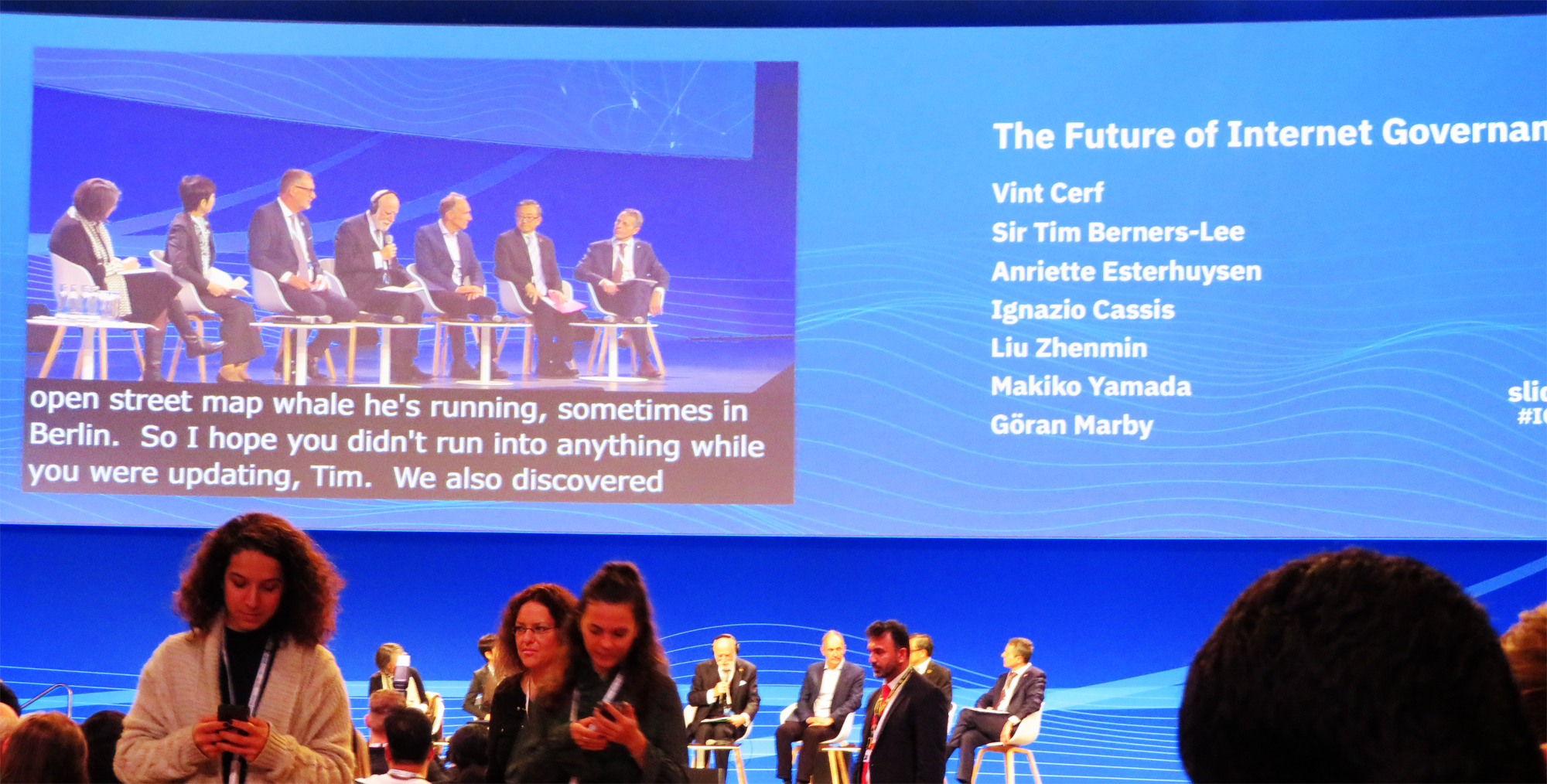
So, it was with much interest that I arrived at the IGF in Berlin on 25th November in response to three invitations: to participate in a session on ICTs for people with disabilities, to support colleagues involved in the EQUALS initiative intended to increase gender digital equality, and also to participate in a side event on Many Worlds.  Many Nets.  Many Visions, for which I had contributed a short piece on our TEQtogether initiative designed to change men’s attitudes and behaviours towards women and technology.  To this end, it is salient to note the largely elderly white male dominance on the key opening plenary panel on the future of Internet governance shown in the picture above – more on that later!  I had many interesting discussions during the week, but want here to share five main reflections and challenges in the hope that they will provoke dialogue and discussion.

IGF (plus?)…

Water stationms

Water Station at IGF 2019

It was rumoured that the German government had put aside some €10 million to cover the costs of this year’s IGF.  Whilst that may well be an exaggeration we were certainly hosted in great luxury, and it would be churlish not to thank the German government for their generous hospitality.  In compliance with increasing concerns over plastic and climate change, there was even a very impressive water station in the exhibition area!  They had also done much to encourage the participation of many quite young people, and to get the gender balance better than at some similar digital technology events in the past.  The IGF 2019 outputs are already available and make interesting reading.

UN SG speaking in IGF 2019 Opening Ceremony

UN SG speaking in IGF 2019 Opening Ceremony

However, I was struck by the relative absence of people from China, India and Russia, as well as from many of the poorer countries of the world who were unable to afford the travel costs or who had difficulties in obtaining visas.  This absence set me thinking of the wider global geopolitical interests involved in the IGF process.  At a time when the ITU is unfortunately being increasingly criticised by North American and European countries for being too heavily in the pocket of Chinese organisations and companies (recent criticism of China’s efforts to influence global standards on facial recognition is but one small example), free-market capitalist governments have turned ever more to the IGF as the main forum for their engagement on Internet issues.

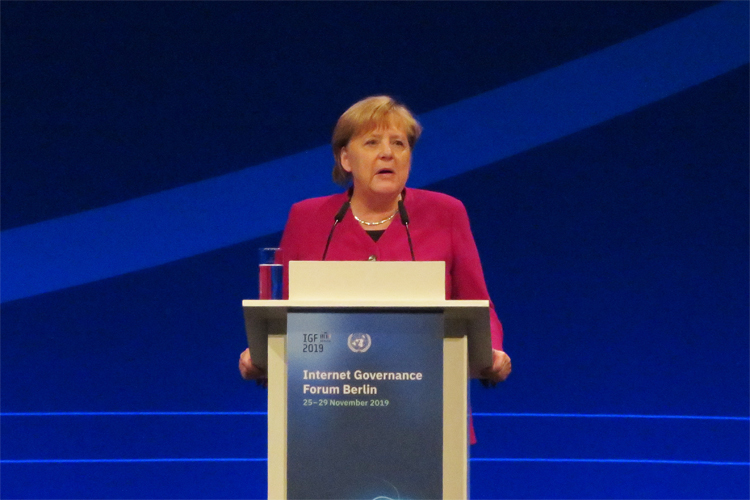
Angela Merkel in IGF 2019 Opening Ceremony

Angela Merkel in IGF 2019 Opening Ceremony

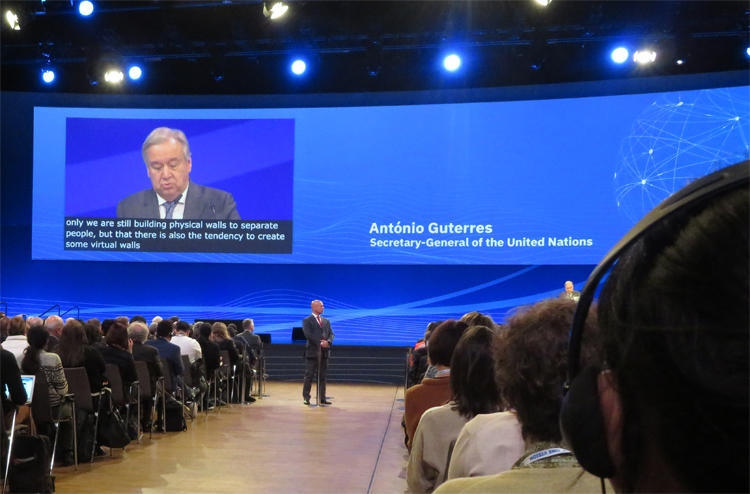
The theme of this year’s IGF One World.  One Net.  One Vision. says it all (and hence why I was so eager to be involved in the innovative and creative Many Worlds. Many Nets.  Many Visions initiative).  The IGF is about maintaining a unitary free open Internet in the face of perceived attempts by countries such as China and Russia to fragment the Internet.  It is no coincidence that next year’s IGF is in another European country, Poland, and that the last two IGFs have been in France and Switzerland.  The messages of the UN Secretary General and the German Chancellor (shown in the images above) were equally forceful about the kind of Internet that they want to see.

Moreover, this hidden war over the future of the Internet is also being played out through the HLPDC process which has suggested that there are three possible architectures for digital cooperation.  The presence of such high-level participants at this year’s IGF very much conveyed the impression that the IGF Plus option is the one that they prefer as the main forum for policy making over the Internet in the future.  This is scarcely surprising: all but two (one Chinese and one Russian) of the 20 members of the HLPDC Panel and Co-chairs are from free-market capitalist-inclined countries; 8 of the 20 are from the USA and Europe.

The sale of .org by ISOC to Ethos Capital

Another major issue that raised its head during this year’s IGF was the very controversial sale by the Internet Society (ISOC) of its non-profit Public Internet Registry (PIR) which had previously managed the top-level domain .org to a for-profit company, Ethos Capital, for the sum of $1.135 bn.

Key elements of the controversy that were widely mentioned during the IGF, and are well summarised by The Registry, include:

  • ISOC’s decision under a new CEO to shift its financial structure from benefitting from the variable profits derived from .org to creating a foundation from which it would then use the interest to fund the activities of its various chapters (the new Internet Society Foundation was created in February 2019);
  • The lifting of the cap announced in May 2019 by ICANN on prices of .org domain names, which would enable the owner of the .org registry to impose unlimited price rises for the 10 million .org domain name owners; and
  • The observation that the former CEO of ICANN had personally registered the domain name used by Ethos Capital only the day after the cap had been lifted (it appears that he and a small number of his close affililates linked to ICANN are the only people involved in Ethos Capital) .

The lack of transparency over this entire process, and the potential for significant profits to be gained by certain individuals from these changes have given rise to huge concerns, especially among civil society organisations that use .org domain names.  As a recent article in The Register concludes, “The deal developed by former ICANN CEO Chehade is worth billions of dollars. With that much money at stake, and with a longstanding non-profit registry turned into a for-profit with unlimited ability to raise prices, the internet community has started demanding answers to who knew what and when”.

Inclusion, accessibility and people with disabilities…

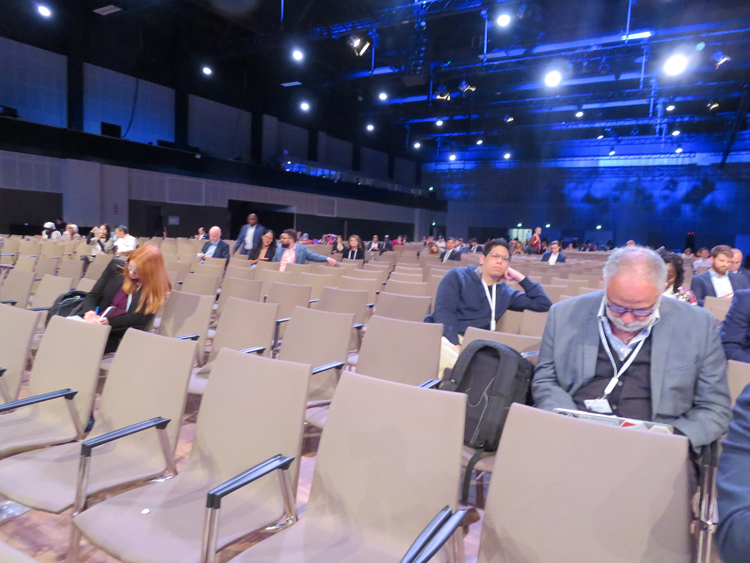
Absence of people in IGF 2019 Main Hall for High Level Session on Inclusion

Absence of people in IGF 2019 Main Hall for High Level Session on Inclusion

It was good to see a considerable number of sessions devoted to inclusion, accessibility and people with disabilities at this year’s IGF.  However, it was sad to see how relatively poorly attended so many of these sessions were.  The exodus from the Main Hall between the High Level Session on the Future of Internet Governance and the High Level Session on Inclusion, for example, was very noticeable.  The content of most of these sessions on disabilities and inclusion was generally interesting, and it is just such a shame that the wider digital community still fails to grasp that digital technologies will increase the marginalisation of those with disabilities unless all such technologies are designed as far as is reasonably possible to be inclusive in the first place.  Assistive technologies can indeed make a very significant difference to the lives of people with disabilities, but such persons should not have to pay more for them to counter the increased marginalisation that they face when many non-inclusive new technologies are introduced.

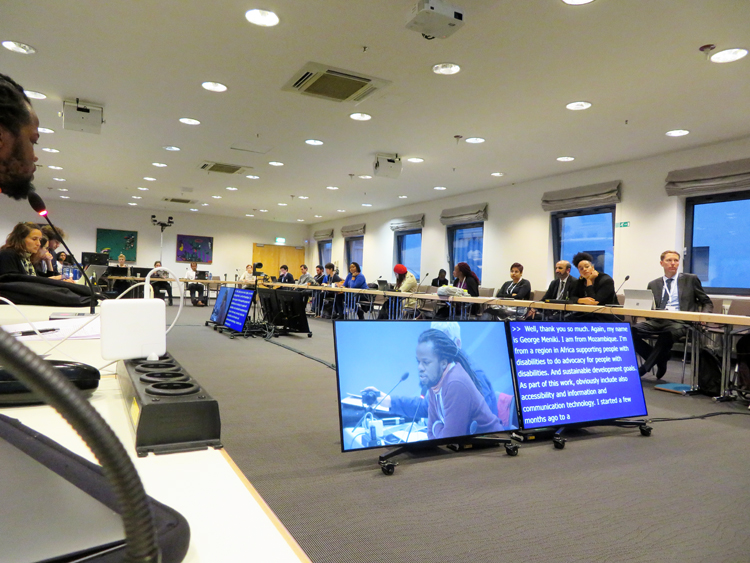
IGF 2019 Session WS#64 on empowering persons with disabilities

IGF 2019 Session WS#64 on empowering persons with disabilities

I was, though, hugely challenged by my own participation in one of these sessions.  Having been invited by Brian Scarpelli to be the penultimate speaker in a session that he had convened on Internet Accessibility Empowering Persons with Disabilities (WS #64), I just felt that it needed a little livening up by the time it was my turn to speak.  I therefore decided to take a roving microphone, and did my presentation walking around inside the cage of desks around which everyone was seated.  I wanted to engage with the “audience” several of whom did indeed have disabilities, and I tried hard to involve them by, for example, describing myself and the venue for those who were blind.  The audience seemed to welcome this, and I had felt that I had got my messages across reasonably well.  Afterwards, though, someone who is autistic came up to me and in the nicest way berated me for having walked around.  She said that the movement had distressed her, and made it difficult for her to follow what I was saying.  She suggested that in the future I should stay still when doing presentations.

This presented me with a real challenge, since I have been encouraged all my life to deliver presentations as a performance – using my whole body to engage with the audience to try to convince them of my ideas.  So, what should we do when making presentations to an audience of such varied abilities?  Can we cater for them all? Clearly, I don’t want to upset those with one disability.  Should I ask if anyone in an audience minds if I walk around?  But then, someone with autism might well not want to speak out and say that they did actually mind?  Should the preference of one person with a disability over-ride the preferences of the remaining 49 people in a room?  There is no easy answer to these questions, but I would greatly value advice from those more familiar with such challenges than I am.

Exclusion in the midst of diversity: being an elderly, white, grey-haired, European man…

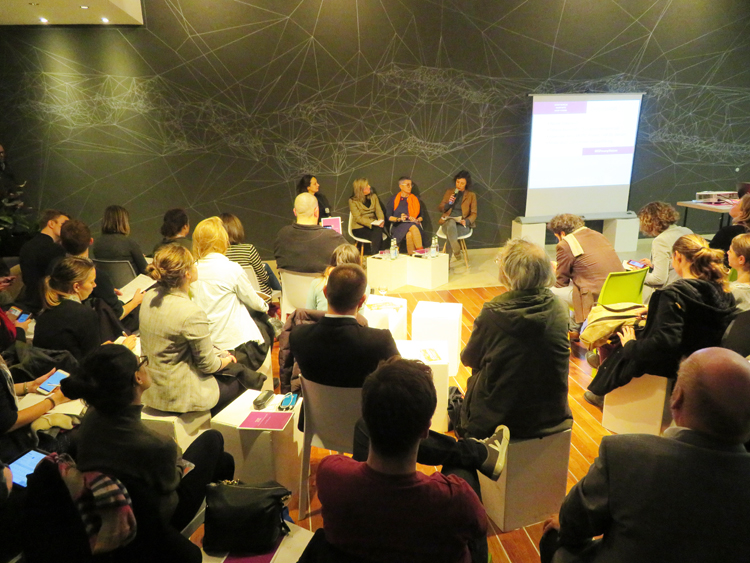
"Many Worlds. Many Nets. Many Visions" gathering held during IGF 2019 at HIIG

“Many Worlds. Many Nets. Many Visions” gathering held during IGF 2019 at HIIG

Far too many international events associated with digital technologies continue to be excessively male dominated, and it was refreshing to see the considerable gender diversity evident at IGF 2019.  Despite this, as noted above, several panels did remain very “male”!  It was therefore very refreshing to participate in the Many Worlds.  Many Nets.  Many Visions side event held at the Alexander von Humboldt Institute for Internet and Society (HIIG), and congratulations should once again be given to Matthias Kettemann and Katharina Mosene for putting this exciting and challenging initiative together.

Reflecting on the various gender-related events held during and around IGF 2019, though, has made me very uneasy.  I was particularly struck by the frequency with which presenters advocating plurality and diversity of ideas, behaviours, and self-identification, nevertheless also seemed to castigate, and even demonise one particular group of people as being, in effect, the “enemy”.  That group is the group that others see me as belonging to: elderly/middle-aged, white, grey-haired, European (and let’s add north American and Oceanian as well), men!  Perhaps it was just in the sessions that I attended, but over and over again this group was seen as being oppressive, the main cause of gender digital inequality, and those who are to be fought against.  The language reminded me very much of some of the feminist meetings that I attended back in the 1970s.

I was surprised, though, how sad this made me feel.  Some elderly, white, grey-haired, European (etc.) men have indeed worked over many decades to help change social attitudes and behaviours at the interface between women and technology.  This group is not uniform!  Some have written at length about these issues; some have helped implement programmes to try to make a real difference on the ground.  To be sure, we need to continue to do much more to change men’s attitudes and behaviours;  TEQtogether has been set up to do just this.  What upset me most, though, is that these efforts were rarely recognised by those who were so critical of  this particular “uniform” group.  Too often, all elderly, white, grey-haired, European (etc.) men seemed to be lumped together in a single group by those very people who were calling for recognition of the importance of diversity and multiple identities. There is a sad irony here.  Perhaps it is time for me just to grow old gracefully…

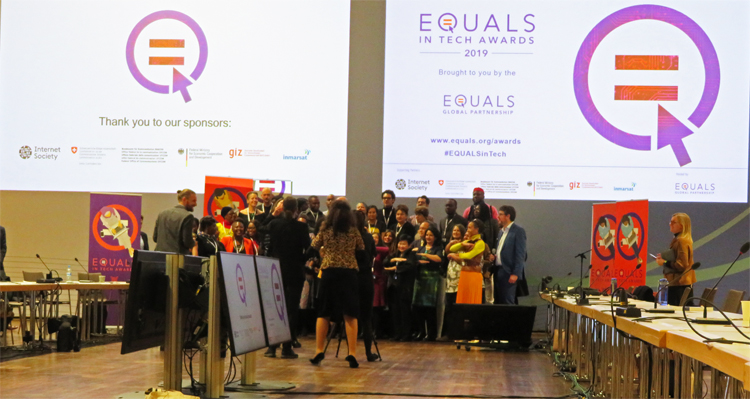
EQUALSIt was therefore amazingly humbling that, almost at the end of the EQUALS in Tech awards, a young woman who I had never met before, came up to me and simply said thank you.  Someone had told her what one elderly, white, grey-haired, European (etc.) man had tried to do over the last 40 years or so…  I wonder if she has any idea of just how much those few words meant to me.

Novelty and learning from the past

Poster about sexual exploitation of children, Ethiopia, 2002

Poster about sexual exploitation of children, Ethiopia, 2002

Finally, the 2019 IGF re-emphasised my concerns over the claims of novelty by people discovering the complexity of the inter-relationships between technology and society.  All too often speakers were claiming things that had actually been said and done twenty or more years ago as being new  ideas of their own.  This was typified by a fascinating session on Sex Work, Drug Use, Harm Reduction, and the Internet (WS 389).  Whilst this is indeed a very important topic, and one that should be addressed in considerably more detail, few of the presenters made any reference to past work on the subject, or appeared to have made much attempt to learn from previous research and practice in the field.  Back in the early 2000s, for example, the Imfundo initiative had spent time identifying how “bar girls” in Ethiopia might have been able to use digital technologies that were novel then to help transform their lives and gain new and better jobs.  I wonder how many people attending Session WS 389 were at all aware of the complex ethical questions and difficulties surrounding the conduct of research and practice on this topic that the Imfundo team had explored all those years ago.  There were important lessons to be learnt, and yet instead the wheel seems to be being reinvented over and over again.

This example was not isolated, and a recurrent feature of the field of ICT for Development is that people so rarely seem to learn from mistakes of the past, and everyone wants to claim novelty for ideas that have already been thoroughly explored elsewhere.  I  must write at length some time about the reasons why this seems to happen so often…


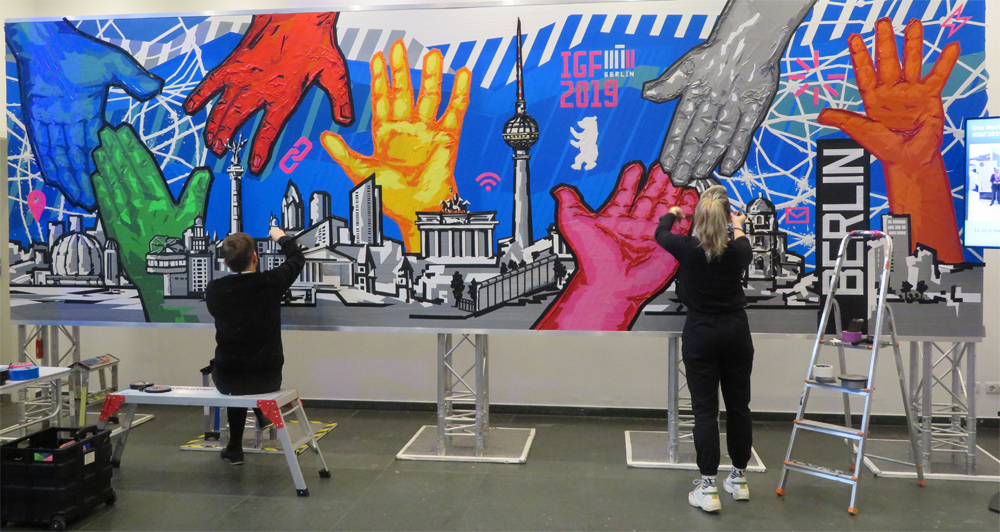
Finally, the artists who created this image of Berlin from tape during IGF 2019 deserve to be congratulated on their amazing work!

Artwork of Berlin made in tape, 25th November

Artwork of Berlin made in tape, 25th November

Artwork of Berlin made in tape, 29th November

Artwork of Berlin made in tape, 29th November

Leave a comment

Filed under Accessibility, Disability, Gender, ICT4D, ICT4D conferences, Internet