
 I am deeply humbled that the ICT4D Collective and Research Centre that we tentatively created at Royal Holloway, University of London, back in 2004 has just been recognised as the world’s 10th top Science and Technology Think Tank in the 2012 Global GoTo Think Tank Report launched at the World Bank and the United Nations in New York last week. This accolade is all the more special because the ranking is based very largely on peer review, and therefore reflects the opinions of many people in the field who I respect enormously. More than 1950 experts and peer institutions participated in the ranking process for the report which was produced by the Think Tanks and Civil Societies Program at the University of Pennsylvania.
 The Collective was established above all else to bring together colleagues who are committed to undertaking the highest possible quality of research in the interests primarily of poor people and marginalised communities. Its work is premised on the assumption that ICTs can indeed be used to support poor people, but that we need to work tirelessly to overcome the obstacles that prevent this happening.
 In 2007, we were delighted that the Collective and Centre was given the status of the UNESCO Chair in ICT4D, and although I am now only an Emeritus Professor at Royal Holloway, I am very privileged that for the time being I retain this title while also serving as Secretary General of the Commonwealth Telecommunications Organisation. It is great to be able to draw on my past research and teaching experience in this new role, to help governments across the Commonwealth use ICTs effectively and appropriately for their development agendas.
Then, in 2009 Royal Holloway, University of London, formalised the position of the ICT4D Collective by creating a new multidisciplinary research centre on ICT4D, that brought together expertise primarily from the schools and departments of Geography, Computer Science, Management and Mathematics (Information Security), with contributions also from colleagues in Earth Sciences, Politics and International Relations, and Information Services. This provides really excellent opportunities to develop new research at the exciting boundaries between disciplines.
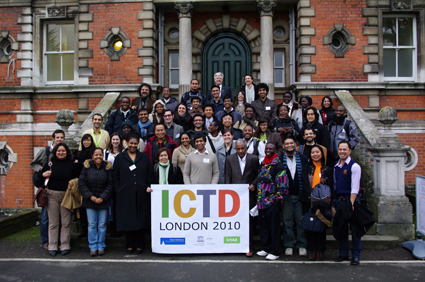 Over the eight years of the existence of the ICT4D Collective, we have focused on a wide range of activities, but have particularly sought to serve the wider interests of all researchers and practitioners working in the field of ICT4D. We were thus delighted to host the 2010 ICTD conference, which brought more than 500 colleagues to our campus, and we were immensely grateful to the generous sponsorship from global institutions that enabled us to provide scholarships for people to attend from across the world (pictured above). We have also focused much attention on supporting doctoral researchers, and it is excellent to see them now flourishing in their subsequent careers.
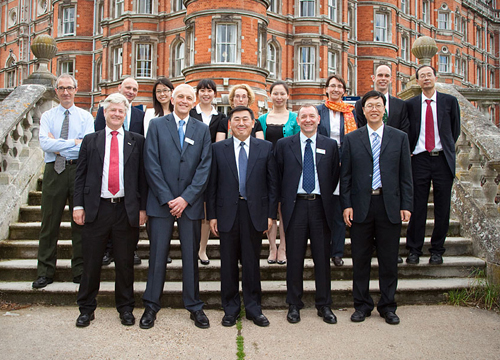 Most recently, under new leadership, the Centre is continuing to thrive, and has launched an exciting ICT4D strand within its established Master’s programme on Practising Sustainable Development. In 2012, a Branch of the UNESCO Chair in ICT4D was also established at Lanzhou University in China, reflecting the growing collaboration between our two institutions, and recognising the huge importance that China is increasingly playing not only in terms of the practical implementation of ICT initiatives, but also into research in this area.
A huge thank you to all who suggested that the ICT4D Collective and Centre should be recognised in this way. It is a massive spur to us all to keep up the work that we have been doing, and to share it more effectively with all those interested in, and committed to, using ICTs to support poor people and marginalised communities.
The top 20 ranking of Think Tanks in Science and Technology from the 2012 Global GoTo Think Tank Report is given below:
1. MIT Science, Technology, and Society Program (STS) (United States)
2. Max Planck Institute (Germany)
3. RAND Corporation (United States)
4. Center for Development Research (ZEF) (Germany )
5. Information and Technology and Innovation Foundation (ITIF) (United States)
6. Battelle Memorial Institute (United States)
7. Technology, Entertainment, Design (TED) (United States)
8. Institute for Future Technology (IFTECH) (Japan)
9. Consortium for Science, Policy, and Outcomes (CSPO) (United States)
10. Information and Communication Technologies for Development (ICT4D) (United Kingdom)
11. Science and Technology Policy Research (SPRU) (United Kingdom)
12. Institute for Basic Research (IBR) (United States)
13. Council for Scientific and Industrial Research (CSIR) (South Africa)
14. African Technology Policy Studies Network (ATPS) (Kenya)
15. Bertelsmann Foundation (Germany)
16. International Institute for Applied Systems Analysis (IIASA) (Austria)
17. Energy and Resources Institute (India)
18. The Energy and Resources Institute (TERI) (India)
19. Santa Fe Institute (SFI) (United States)
20. African Center for Technology Studies (ACTS) (Kenya)




 Tim Unwin's Blog