Category Archives: Photographs

Dilli Haat

I’m amazed that on my previous visit to Delhi no-one mentioned that I might like to explore the craft village of Dilli Haat in southern Delhi.  Perhaps I was previously simply too busy working!  However, one day last week over breakfast in the Faculty Guest House at IIT Delhi, a colleague suggested that it was not far away, and if I had time I should try to visit.  So, I made time this Saturday afternoon, with the temperature well over 95o F (35oC), to set off and explore.

The Haat (market), which opened in 1994, is run by the Delhi Tourism and Transportation Development Corporation, and includes craft stalls from many different parts of India, as well as food sellers, and a stage.  Having paid a small entrance fee (100 INR for a foreigner), one is free just to wander and explore.  In some parts of the market, brightly coloured cloth covers the alleyways, and in others the stalls are set along a sort of arcade.  There is a huge range of craft produce from many different regions of the country for sale, including clothes (mainly for women), jewellery, woodwork, pottery, spices, brass goods, leather work, musical instruments, and mother of pearl bowls.  One of the nicest things is that it was not very crowded, and few traders were overly-persistent in trying to make a sale.  Those near the back of the market clearly received less business, and so some good deals can be struck there, but other traders stated clearly that there were fixed prices.  Certainly, there is a premium to be paid over the price of goods that can be found elsewhere in the city, but the quality is good, and having so much to choose from in one place makes shopping for gifts most enjoyable!

The diversity of products, the richness of colour, as well as the taste and smells of the market all made for a wonderful couple of hours exploration, and I hope that the pictures below capture something of the essence of the place.

This slideshow requires JavaScript.

Thanks so much once again to Anushruti Vagrani for taking me there, and helping me negotiate!

Leave a comment

Filed under India, Markets, Photographs

The dogs of IIT Delhi campus

I am greatly enjoying living on the IIT Delhi campus, but have to admit that I am uneasy when walking past the many dogs that are usually roaming around in packs, seemingly on the look out for trouble!  There is always a sense of trepidation walking past them when they block the entrance to a building, or lie across the path!  Waking up in the night to hear them viciously barking, is also not exactly soothing!

Temperatures rose today, and I was surprised to see most of the dogs apparently asleep in the late afternoon sun.  This was definitely an opportunity to take my courage into my hands and photograph them!

This slideshow requires JavaScript.

Leave a comment

Filed under India, Photographs

Chandni Chowk

My beautiful pictureThe first time I visited Chandni Chowk (Moonlight Square) in Old Delhi was more than 40 years ago in 1976 (picture to the right).  I remember its vibrancy, the vivid colours, the energy, the diversity of smells, the complexity of everything that was there.  It fascinated me.  I got lost.  I wandered.  I explored back alleyways.  I emerged, having felt something of the depth of Delhi; the ever living past in its present.

I had not been back until two days ago.  Much had changed; little had changed.  I was struck anew by the splendour of some of the old buildings; the mix of religions; the melting pot of cultures that was Old Delhi; the old wooden doors; the delicious food; the wonderful colours, especially of the saris; the dogs and cat; the pale skinned mannequins.  I had to go there, just to feel, smell, hear, see and taste Old Delhi; a special treat was to eat at Parawthe Wala on Paranthe Wali Gali – it is most definitely worth searching out for every imaginable sort of paratha!

This slideshow requires JavaScript.

I was so spoilt by my friend and colleague Anushruti Vagrani from IIT Delhi, who took me back to Chandni Chowk, and had patience with me as I just absorbed anew everything about the market.

Leave a comment

Filed under India, Photographs

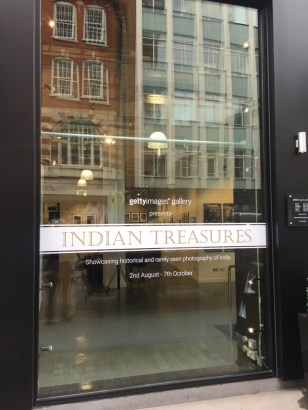
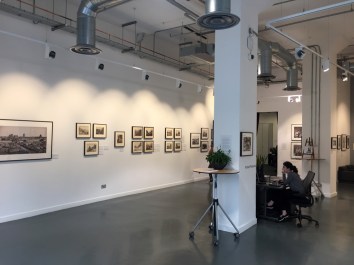
“Indian Treasures”: exhibition at gettyimages gallery in London

IT1The small Indian Treasures exhibition on until the 7th October at the gettyimages gallery on Eastcastle Street (near Oxford Circus tube station) in London, is an amazing opportunity to see photographs of “India” dating from the mid-19th century.  It has been well curated, and represents a collection of very diverse photographs, drawn mainly from a European gaze on “British India”.  However, the collection also includes photographs from Indian photographers, and illustrates seven themes: photographs by Samuel Bourne between 1863 and 1870; sun pictures from the 19tb century, illustrating both landscapes and people; methodologies, including four tinted photocrom prints; images by the photojournalist Felice Beato; studio portraiture; Princes of India; and the work of the London Stereoscope Company.

The exhibition raises so many fascinating questions, especially at a time when we “celebrate” 70 years of the independence of India and Pakistan, and remember the many atrocities that accompanied the birth of these two countries.  In particular, it highlights the way in which imagery was used to reinforce cultural stereotypes, and also the use of photography in the 19th century to capture what are seen as particular racial types.

IT2I was particularly struck by comparisons between the countries in the 19th century and how they are seen today:

  • Most photographs displayed were of India, rather than Pakistan, although mosques in Lucknow and Delhi were indeed depicted alongside temples from Tamil Nadu;
  • The pictures generally depict a very clean and tidy India, with relatively smart new buildings and largely empty streets, a far cry from the hustle and bustle of the modern sub-continent;
  • The mountain scenes from the Himalayas, which are a wonderful resource for learning more about environmental change, and especially glacial retreat;
  • Jantar Mantar (described as the Old Observatory) near Delhi is shown apparently in an almost empty landscape, far removed from the urban  landscape that surrounds it today;
  • The shell marks on the walls of the Shahi Mosque at Qudsia Bagh serve as a reminder of the violence and atrocities of the war known by the British as the “Indian Mutiny”; and
  • It is a very male view – especially of the haunted faces of teh seemingly aloof and distant India princes; women appear mainly as nautch girls, although there is also a fascinating image of women at a bathing  ghat on the Ganges near Benares.

Above all, I was left with huge admiration of the work of photographers from a century and a half ago, who dragged their cameras and equipment across the continent to “capture” these haunting memories of India’s treasures.  This is an exhibition to be savoured and enjoyed.  Not only are the images stunningly evocative, but they also force us to rethink our understandings of the British Raj.


Leave a comment

Filed under India, Photographs

Swimming with Hector’s dolphins in Akaroa

Anyone visiting New Zealand who is interested in wildlife and conservation – as well as having amazing experiences – should most definitely make their way to the Akaroa peninsula, just 90 minutes drive from Christchurch.  Not only is the peninsula very beautiful, with stunning bays and views, but Akaroa itself is set in a magnificent natural harbour, teaming with wildlife.  It is also one of the few places where it is possible to go swimming with Hector’s dolphins.

I chose to go out with ecoseaker, the smaller of the two companies offering the opportunity to go swimming with the Hector’s dolphins – and was very pleased I did!  The firm is locally run, and uses a powerful small boat that takes between four and twelve people on the swimming trip which departs at 10.30 in the morning and lasts for about three-and-a-half hours.  Steve Hamilton, the skipper, is a 5th generation local and descendant of early French and Scottish settlers.  He grew up on a sheep farm alongside Akaroa Harbour and throughout the trip he shared his detailed knowledge of its environment and the geology of the surrounding area, as well as the importance of conserving  its wildlife.  He and his assistant, Adam, made the trip humorous and very enjoyable, as well as being educational and informative.  As well as the dolphins, we saw many New Zealand fur seals, pied cormorants and a couple of little blue penguins.  It was far from easy photographing the dolphins, especially when in the water with them, but I hope that the following sequence captures something of the excitement of the trip:

This slideshow requires JavaScript.

Leave a comment

Filed under Environment, New Zealand, Photographs

Reclaiming Information and Communication Technologies for Development

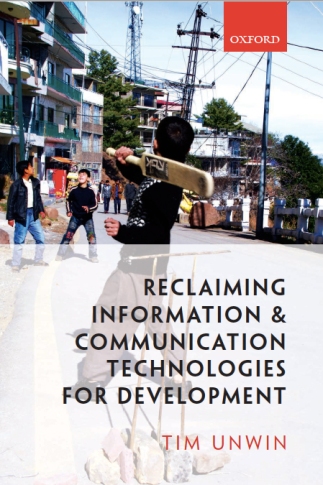
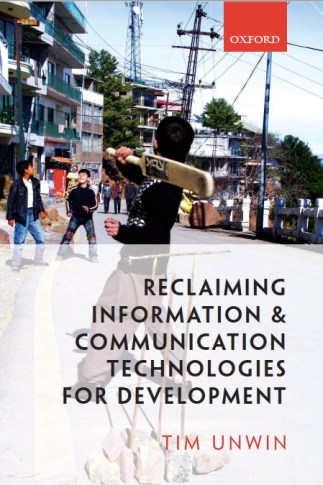
recict4dIt is always exciting to have finished the page proofs and done the index of a book, especially when this has to be completed between Christmas and the New Year as it was with Reclaiming ICT4D at the end of 2016! However, when the cover has been agreed and it appears on the publisher’s  website, then one knows that it is actually going to appear in several months time!

This is  OUP’s overview of the book:

  • Combines understanding of both theoretical and practical aspects of ICT for development (ICT4D)
  • Challenges existing orthodoxy and offers alternatives that can make a practical difference in the field
  • Addresses the interests underlying the use of technology in development
  • Wide ranging in coverage, including discussion of regulation, partnership, technological innovation, and the darker side of ICTs

I like being involved in the design of different aspects of my books, and I am so grateful to OUP for agreeing to publish Reclaiming ICT4D in two fonts, one to represent theory and the other practice.  I am also immensely happy that they were willing to use one of my pictures on the cover to represent much of what the book is about.  In case it is not immediately obvious, this picture taken a year ago in Murree (Pakistan) represents many things: a hope for the future, with the young boy vigorously hitting the ball way over his friends’ heads; cricket itself acknowledges the complex heritage of colonialism and imperialism; in the background is a telecommunications mast, providing the connectivity that has the potential to be used to reduce inequalities, but all too often increases them; the electricity so essential for powering ICTs is very visible;  and women are absent, representing another dimension of inequality that is addressed in the book.  It is also much more than this.  My father visited Murree 71 years ago, and may have walked along this street; I went there with friends, and the book is very much a personal story of how I have learnt from them and the many people who have shared their wisdom and experiences with me over the years; it is above all about how people like these boys, playing on the street, can use ICTs to transform their lives for the better, rather than becoming the cyborg cannon-fodder that global capitalism seeks to devour for the benefit of the rich and powerful.

A little more formally, this is how OUP describe the contents of the book on their website:

“The development of new Information and Communication Technologies (ICTs) has transformed the world over the last two decades. These technologies are often seen as being inherently ‘good’, with the ability to make the world better, and in particular to reduce poverty. However, their darker side is frequently ignored in such accounts.

ICTs undoubtedly have the potential to reduce poverty, for example by enhancing education, health delivery, rural development and entrepreneurship across Africa, Asia and Latin America. However, all too often, projects designed to do so fail to go to scale, and are unsustainable when donor funding ceases. Indeed, ICTs have actually dramatically increased inequality across the world. The central purpose of this book is to account for why this is so, and it does so primarily by laying bare the interests that have underlain the dramatic expansion of ICTs in recent years. Unless these are fully understood, it will not be possible to reclaim the use of these technologies to empower the world’s poorest and most marginalised.”

Its seven chapters are entitled as follows:

Preface
1: A critical reflection on ICTs and ‘Development’
2: Understanding the Technologies
3: The International Policy Arena: ICTs and Internet Governance
4: Partnerships in ICT4D: Rhetoric and Reality
5: From Regulation to Facilitation: The role of ICT and Telecommunication Regulators in a Converging World
6: Reflections on the Dark Side of ICT4D
7: …in the Interests of the Poorest and Most Marginalized.

It is also being made available as an Ebook, and publication date is estimated as 25th May 2017.

To request a review copy, do contact OUP directly using their request form.
11 Comments

Filed under Africa, Asia, Books, Development, ICT4D, Photographs, Uncategorized

Pitarra Restaurant, Barcelona

It was so good to return today to one of my favourite restaurants – Pitarra in Barcelona (on Carrer d’Avinyó) – for lunch.  It is full of atmosphere (of the theatre), the food is really excellent, it is typically Catalan, the wines are great, and the service is very friendly and helpful.  I thoroughly recommend it to anyone looking for a lovely restaurant in a quiet, rather hidden away part of Barcelona, just on the south-east edge of the Gothic Quarter.

This slideshow requires JavaScript.

1 Comment

Filed under Photographs, Spain

Dubai in 1980

Continuing the digitization of some of my early slide collections, I post below a selection of pictures from Dubai in 1980.  I remember it then undergoing a building boom, but that was of a completely different scale from what has subsequently happened over the last 30 years or so.  I wish I had been there in the 1960s, when by all reports it was a small, sleepy town built around the harbour! However, my pictures do still capture something of the old character of the city, and the busy waterfront.  I loved wandering around the Bastakiya quarter, and remember being fascinated by the wind towers and architecture. It is good to see the sympathetic restoration that has taken place in the quarter in recent years, but it does not have quite the same atmosphere that it did then!  It was good to wander in the suq and see all of the glittering gold that i could never afford! I also loved just watching the small boats and dhows plying their trade along the creek. My favourite hotel was undoubtedly the Meridien, a quiet oasis where I could escape from the business of the city, but surprisingly I never took a photograph of it!

This slideshow requires JavaScript.

2 Comments

Filed under Geography, Markets, Photographs, UAE

Abu Dhabi in 1980

I first visited Abu Dhabi in 1980; there was construction everywhere and part of me wished I had been there 20 years earlier!   The changes since then, though, have been enormous, and it is very hard to recognise any of what I experienced then in the modern city of today.  As part of my ongoing project of digitising my slides from  30-40 years ago, I hope that the selection below captures something of the city as it was at that time: the juxtaposition of small new mosques with high-rise buildings; the contrasts between the greenness of the agricultural projects at Al Ain, and the urban concrete of Abu Dhabi city itself; the differences in wealth between local citizens and immigrant labourers who were mainly from South Asia; the belief that pumping oil could create cities, whereas pumping water from the underground aquifers could turn the desert green; the rather sleepy atmosphere that pervaded the place; the beauty and colours of the dhows on the blue, blue sea; the markets on the streets where one could buy everything from animals to all sorts of imported goods from containers; the mysteries of the suq…

This slideshow requires JavaScript.

11 Comments

Filed under agriculture, Markets, Photographs, Rural, UAE, Urban

Hats (periodic markets) in South Bihar, 1976-1977

This is the last, and most important, in my series of images from 1976 and 1977 when I was in what was then South Bihar (now Jharkhand) in India.  I had the enormous privilege of assisting Sudhir Wanmali who was then undertaking research on the hats, or periodic markets in Singbhum District.  He taught me so much, not formally but just by being with him, watching and listening to how he interviewed, and above all by seeing the ways in which he interacted with people.  His wisdom, enthusiasm, generosity and passion for research were, and indeed still are, inspirational.

The hats are markets that take place regularly in different locations, and provide an opportunity not only for rural people to sell to the itinerant traders and others in the market, but also to buy things that they need and do not produce themselves.  As the following images show, it was possible to buy and sell almost anything you might need there, from the cloth, pots and brightly coloured glass bangles brought in by traders, to sweet potatoes, onions, tomatoes and many other vegetables, as well as the cattle and goats being sold by the farmers.  Some traders also collected products such as lac, collected in the forests by the people who lived there, and others would also buy up small amounts of paddy that farmers brought for sale. At the end of the day, I remember rice beer being sold in simple cups made of leaves.  The pictures below are mainly from places such as Bangaon, Hat Gamharia, Nakti, Tebo and Jagannathpur.

Sudhir’s work was published in an excellent monograph – Wanmali, S. (1981) Periodic Markets and Rural Development in India, Delhi: BR – but is also written up in other papers, including:

At the time, I was also working on medieval England and drew parallels between marketing systems that had been created there in the 14th century, and those that I had experienced in Singbhum. This was published as:

  • T. Unwin (1981) Rural marketing in medieval Nottinghamshire, Journal of Historical Geography, 7, 231–51.

I very much hope that these pictures, now some 40 years old, not only contribute to the archive of Jharkhand’s past, but also reflect the beauty of this special part of the world.  I often wonder how the lives of the many people I met there turned out…

This slideshow requires JavaScript.

Leave a comment

Filed under India, Jharkhand, Photographs, South Bihar, Uncategorized