
Category Archives: Uncategorized

The surreal world of England’s railways

It was a grey, cold, miserable afternoon today – in case anyone hadn’t noticed…

We arrived at Huntingdon station soon after 16.00, only to discover that we had just missed the 15.59 train to King’s Cross!  Buoyed by a fine lunch (at The Old Bridge) and some strong coffee we prepared to sit out the wait until the next train at 16.33. But then something must have shifted in the planetary alignments, and we entered a world that even the best imaginations could scarcely conjure up.

Over the loudspeaker an announcement came that northbound trains had been delayed at Sandy because of a trespasser on the tracks.  Oh well, the indicator board showed that the 16.33 was still scheduled, so that should be fine – or so we thought!  Unfortunately, a very helpful railway employee then told us that the train that would form the 16.33 from Peterborough was actually the train that was stuck at Sandy, still waiting to go north through Huntingdon on its way to Peterboroough.  It would be at least 40 minutes before we could catch it on its way back south, even once it had arrived at Huntingdon on its way north!

While looking if there were any alternative solutions, we heard another announcement over the speakers that the 16.33 would shortly be arriving.  So, through the ticket barriers and out onto the platform we went.  Imagine our surprise when the kindly railway employee came out and apologised that this was an automated message that bore no resemblance to the truth – or words to that effect.  He had no idea when a train might actually come.

Time for Plan B!  The thought of staying on Huntingdon station for what could be well over an hour did not fill us with excitement.  So, we decided to take a taxi south to Stevenage, where there were at least trains on different lines that could then take us on our way.  Taxi rides are always interesting – and this one was no exception with the driver waxing eloquent about the deficiencies of the potential Chancellors on the televised debate last night, Tottenham Hotspur’s current footballing success, and the UK’s social benefits system.
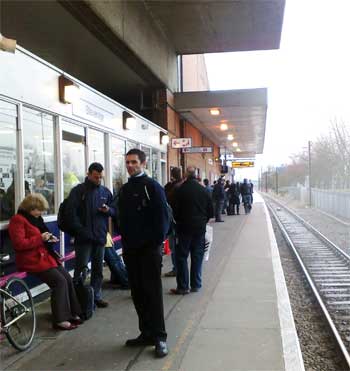
And then we arrived at Stevenage – to see a train pulling away as we rushed over the footbridge and onto the platform.  That’s where the adventure really began.  Fast – very fast – train after train rushed by on the tracks without stopping, and every time the indicator board suggested that a train might actually take us on to King’s Cross, it was either cancelled or the clock simply added minutes to its expected time of arrival as we watched.  The cold wind chilled us as we waited patiently on the platform.  Surely a train must come soon.   We put our hope in the 17.34, which somehow seemed to be likely – not least because its expected arrival time did not change.  Bang on 17.34 a train whisked past – without stopping!  Dismay!  But then, not long afterwards, a train did stop, and some of us eagerly boarded.  What could be wrong with this?  Imagine our dismay when we were told to get off the train because it was only dropping off passengers – and no one was allowed to get on!  But many of the other trains had been cancelled – and there were many of us waiting to get to King’s Cross!  Surely they would let us stay on board.  The train had after all stopped, and we had got on.  Some of us stood our ground.  The announcements over the train’s speakers got more aggressive; the train would not leave until we got off.  The anger on the faces of the other passengers was visibly rising.  Some of us stuck our ground.  But then most people left, and fearing we might be ‘shopped’ by the other, now really quite irritated,  passengers on the train we gave in and left the train.  This was not, though, to be the end.  We pleaded with the rail officials – but to no avail.  I pleaded with other travellers to take communal action and board the train – but no-one moved. They must have thought me a revolutionary firebrand! Eventually, after an unexpectedly long delay at Stevenage, that train departed.  Talking with the kind RMT official on duty at Stevenage afterwards, he told us that the conductor on the First Hull Trains train had simply refused to consider letting other delayed passengers on board, because this train was only meant to let passengers alight.

Back into the cold, damp, darkening environment of dismal Stevenage railway station. The 17.39 seemed the most promising new bet, but it was going to be at least 30 minutes delayed because of a faulty train at Royston.  The indicator’s kept us amused as trains were scheduled on time well after they should have left; others were cancelled.  One of the best messages was “Delayed due to earlier train running late”

    Eventually, a train did arrive to take us onwards – at 18.08.  Just beforehand, a kindly announcer stated that “The train may be full” and that another one was to follow on behind shortly.  Fortunately, we were all able to squeeze on board, and eventually arrived at King’s Cross by about 18.45.  To be fair, this was only an hour later than the time that the 16.33 from Huntingdon would have arrived in London, but our surreal experiences made it feel very much longer! Thanks Siobhan and Robin for the adventure!

    Leave a comment

    Filed under Restaurants, Uncategorized

    Obama wins Nobel Peace Prize

    I saw this headline and could not believe it – the Nobel Peace Prize this year has been awarded to Barack Obama “for his extraordinary efforts to strengthen international diplomacy and cooperation between peoples”!

    How could someone who kept on saying in his election speeches that he would change a particular state, he would change America and then he would change the world if elected receive such a prize? What is this brave new world going to be like? Under his ‘leadership’ so far the USA is continuing to try to impose its authority on Iraq and Afghanistan, imposing ‘democracy’ by military force? Do people in the USA not realise that most of the world does not actually want to be changed by them, but would much prefer to have greater self-determination without US interference?  If Obama’s policies led to a substantial reduction in the size of the USA’s armed forces and their rapid withdrawal from parts of the world where they are seeking to impose their military power, then perhaps he would indeed be a worthy recipient. Such awards should surely be for achievement?  What evidence is there that Obama has yet made any serious impact on peace in the world?  As the UK’s Times notes, he “has yet to deliver on any of the major foreign policy initiatives upon which he has embarked”

    Hamas, for example, according to the Xinhua News Agency has been outspoken in its criticism of this award: “Islamic Hamas movement said Friday that U.S. President Barack Obama does not deserve a Noble Peace Prize since he failed to give the Palestinian people their legitimate rights. Fawzi Barhoum, Gaza Hamas spokesman told Xinhua that “Obama does not deserve this prize,” after the Norwegian Nobel Committee announced Obama was awarded the 2009 Nobel Peace Prize.”We believe that there are lots of things needed from Obama to be presented to the Palestinian people in order to deserve this reward. Obama should change his manner and be fair,” said Barhoum”

    This decision devalues the Nobel Peace Prize.  It may well be that Obama will indeed help to shape a more humble and peaceful USA, and in time therefore be a worthy recipient of a peace prize, but until then we should not be so full of sycophantic praise.  If Obama is as great as so many claim, then he will have the humility to decline this award.

    6 Comments

    Filed under Uncategorized

    Bryan Appleyard on Steve Jobs

    I have long been a Mac user, and so read with interest Bryan Appleyard’s piece in the Sunday Times magazine yesterday about Steve Jobs.  It’s fascinating how  Jobs provokes such contradictory opinions – very evident from the many blogs and comments that have followed the article.  It is indeed an interesting question as to what will happen to Apple when he eventually ‘goes’.  I just hope that Appleyard’s suggestion that a merger with Google might be on the cards is wide of the mark!

    Leave a comment

    Filed under Uncategorized

    What happens when a bendy bus meets a traffic light?

    bendy-bus-smallI couldn’t resist posting this – seen on the way back from a meeting this afternoon: the middle of a bendy bus caught around a traffic light near Euston station!  Which ever way the driver tried to move, the traffic light remained enwrapped by the bus!  And the poor motorbike policewoman couldn’t do much to help!  I’ve no idea how the situation was resolved, but I guess that the traffic light came off worse! Have sympathy for the driver!

    Leave a comment

    Filed under Uncategorized

    UK Government announces that it has no plans to create a central database for storing communications data

    The UK’s Home Office has recently announced that it no longer has any plans to create a centralised database to store all communciations data.  In its consultation paper presented to Parliament in April 2009, and entitled “Protecting the Public in a Changing Communications Environment“, the Home Secretary Jacqui Smith commented that “this consultation explicitly rules out the option of setting up a single store of information for use in relation to communications data”.  This is excellent news for all those concerned that the government was indeed considering establishing such a centralised database of all digital communication (see my comments in February about this). The consultation paper is a very important document, and lays out clearly the various options facing a government eager to get the balance right between privacy and security.

    The consultation paper asserts that “The Government has no plans for a centralised database for storing all communications data.  An approach of this kind would require communications service providers to collect all the data required by the public authorities, and not only the data required for their business needs.  All of this communications data would then be passed to, retained in, and retrieved from, a single data store.  This could be the most effective technical solution to the challenges we face and would go furthest towards maintaining the current capability; but the Government recognises the privacy implications of a single store of communications data and does not, therefore, intend to pursue this approach”.

    With reference to third party data, two approaches are identified as possible ways forward:

    • “The responsibility for collecting and retaining this additional third party data would fall on those communications providers such as the fixed line, mobile and WiFi operators, who own the network infrastructure”
    • “A further step would be for the communications service providers to process the third party communications data and match it with their own business data where it has elements in common; this would make easier the interpretation of that data if and when it were to be accessed by the public authorities”.

    In the light of this, the government intends to legislate “to ensure that all data that public authorities might need, including third party data, is collected and retained by communication service providers; and that the retained data is further processed by communications service providers enabling specific requests by public authorities to be processed quickly and comprehensively”.

    The government is particularly eager to receive responses on four main questions:

    • Q1  On the basis of this evidence and subject to current safeguards and oversight arrangements, do you agree that communications data is vital for law enforcement, security and intelligence agencies and emergency services in tackling serious crime, preventing terrorism and protecting the public? Found on page 22
    • Q2  Is it right for Government to maintain this capability by responding to the new communications environment? Found on page 22
    • Q3  Do you support the Government’s approach to maintaining our capabilities?  Which of the solutions should it adopt? Found on page 30
    • Q4   Do you believe that the safeguards outlined are sufficient for communications data in the future? Found on page 30

    As the consultation paper concludes, “The challenge is to find a model which strikes the right balance between maximising public protection and the ability of the law enforcement and other authorities to do their jobs  to prevent and detect crime and protect the public, and minimising the intrusion into our private lives”.

    Leave a comment

    Filed under Communication, Ethics, Uncategorized

    Brussels restaurants

    Continuing my periodic restaurant commentaries, last week in Brussels provided a great opportunity to listen to advice from friends who live there, and explore hidden away restaurants.  While I am tempted to keep these to myself, I enjoyed them so much that I thought I would share them here in the hope that these excellent restaurants will benefit from additional business.  Just don’t be there when I am!

    • La Quincaillerie – Rue du Page 45, B-1050 Brussels.  As one of the first restaurants to set up in the trendy Chatelain neighbourhood, La Quincaillerie stands out among the many fashion boutiques and purveyors of upmarket knick-knacks. It has an excellent wine list, and particularly good seafood and chicken; I really enjoyed the Tartare de boeuf au parmesan et à la roquette.  To drink, I would recommend the 2005 Gewürztraminer from Louis Sipp à Ribeauvillé in Alsace
    • La Canne en Ville – Rue de la Réforme 22, B-1050 Brussels.  Exceptional!  Try the Duo de coquilles Saint Jacques rôties et filet de sole farci à la mousseline d’écrevisses, beurre fouetté au citron.  And to drink, be adventurous and taste the Bourgogne rosé Marsannay Regis Bouvier 2005.

    Leave a comment

    Filed under Restaurants, Uncategorized, Wine

    Story-telling and ICT4D

    At this year’s e-Learning Africa conference in Dakar (27th-29th May 2009) we are convening a workshop that explores the interface between story-telling and ICT4D.  One of the outputs will be a digital ‘place’ where people can contribute their stories, and thereby use ICTs to support traditional African oral and story-telling traditions.

    In this connection, it is salient to note that 20th March 2009  is World Story Telling Day – “a global celebration of the art of oral storytelling. It is celebrated every year on the spring equinox in the northern hemisphere, the first day of autumn equinox in the southern. On World Storytelling Day, as many people as possible tell and listen to stories in as many languages and at as many places as possible, during the same day and night. Participants tell each other about their events in order to share stories and inspiration, to learn from each other and create international contacts.”

    “World Storytelling Day has its roots in a national day for storytelling in Sweden, circa 1991-2. At that time, an event was organized for March 20 in Sweden called “Alla berattares dag” (All storytellers day). The Swedish national storytelling network passed out some time after, but the day stayed alive, celebrated around the country by different enthusiasts. In 1997, storytellers in Perth, Western Australia coordinated a five-week long Celebration of Story, commemorating March 20 as the International Day of Oral Narrators. At the same time, in Mexico and other South American countries, March 20 was already celebrated as the National Day of Storytellers”.

    Perhaps those who would like to tell a story related to ICT4D might like to post a comment below on March 20th!

    Leave a comment

    Filed under Uncategorized

    Kenya – political tensions rising

    The latest news from Kenya is not good.  The UK Times yesterday reported the cold blooded killings of Oscar Kamau Kingara, a human rights activit, and John Paul Oulu just outside the University of Nairobi’s halls of residence.  Apparently, they were ambushed in rush hour traffic and shot repeatedly by their killers who then sped away in two cars.

    As the report continued, ‘“The human rights community in Kenya holds the Government fully and wholly responsible for the assassinations,” said Cyprian Nyamwamu, of the Kenya Human Rights Consortium. The police deny any government responsibility for the murders. The Prime Minister, Raila Odinga, condemned the killings and warned that the country was at crisis point. “We are hurtling towards failure as a state,” he said’.

    It was the violence and bloodshed in Kenya at the end of 2007 and the beginning of 2008 that first persuaded me of the value of blogs – let us hope that the growing unrest in the country does not lead to another spate of bloodletting.

    1 Comment

    Filed under Uncategorized

    Google and privacy

    A BBC report raises concerns about privacy issues associated with Google’s new tracking service, Latitude.  This uses data from mobile phone masts, GPS, or wi-fi hardware to update a user’s location automatically.  Although it is an opt-in service, there are fears that not everyone may know that their phone is broadcasting their location.

    There is, though, huge potential for such a service – not just as a fun way for friends to ‘keep in touch’, but also possibly for people concerned about relatives with dementia, or others who might get ‘lost’.

    As ever, Google is pushing the boundaries in terms of how society uses technology, and the ways in which that technology in turn shapes society.

    1 Comment

    Filed under Ethics, ICT4D general, Uncategorized