Category Archives: United Nations

Participating in IFLA’s President’s Meeting and Ministerial Forum, Buenos Aires, 22-23 May 2019

Ministers Forum

Ministers and Secretaries of Culture Forum

It was a real privilege to have been invited to participate in the International Federation of Library Associations and Institutions (IFLA) Forum of Ministers and Secretaries of Culture of Latin America and the Caribbean on 22nd May, and to give a keynote address at its 2019 President’s meeting which was on the theme of Motors of change: libraries and sustainable development on 23rd May, both in Buenos Aires.  These meetings provided a valuable opportunity for those actively involved in the role of libraries in contributing to the development of Latin American and Caribbean countries to share ideas and experiences, and agree on ways through which their work can be further enhanced.

The Forum of Ministers and Secretaries of Culture was held in the very impressive Congress of the Argentine Nation, and provided an excellent opportunity for senior

President

IFLA President and Secretary General

government officials from across the region to share presentations and discuss the theme of Libraries, Access to Information and the Sustainable Development Goals.  Welcoming participants, IFLA President Glòria Pérez-Salmerón reminded them of the theme of her presidency – Motors of Change – and underlined the difference that libraries can make, for so many people, in so many ways.  IFLA Secretary-General Gerald Leitner stressed to the ministers of the power they had in their hands, and made the case for ensuring that they – and libraries – are included fully in national development plans.  A key outcome of the meeting was the signing of the Buenos Aires Declaration which affirmed participating governments’ commitment to the UN 2030 Agenda, and to the power of libraries and access to information to achieve it.  The meeting also saw the launch of the second edition of the Development and Access to Information Report produced by IFLA and the Technology and Social Change Group (TASCHA) at the University of Washington, focusing especially on SDG4 (education), SDG8 (decent work and economic growth), SDG10 (inequalities), SDG13 (climate chage) and SDG16 (peace, justice and strong institutions), and edited by Stephen Wyber and Maria Garrido.

In the evening, there was a Cultural Gala in the Public Hall of the Library of the National Congress, which consisted of three main elements:

  • Nacha

    Nacha Guevara

    A dance performance in two parts by the Arte Ballet Compañía: the Don Quijote suite, and Tiempos de Tango, with ideation, choreography and direction by María Fernanda Blanco.

  • Music played by the Chamber Orchestra of the Honorable Argentine Chamber of Deputies with a repertoire dedicated to the Argentine composer Astor Piazzolla, featuruing especially the saxophone soloist Jorge Retamoza.
  • A wonderful closing sequence of songs by the famous Argentine artist Nacha Guevara.

The 2019 President’s Meeting on 23rd May built on the themes of the Development and Access to Information Report, and began with a session of welcoming speeches by IFLA President Glòria Pérez-Salmerón, IFLA Secretary-General Gerald Leitner, Alejandro Lorenzo César Santa (General Coordinating Director, Library of the National Congress), and Rene Mauricio Valdes (United Nations Resident Coordinator, Argentina).  This was followed by my keynote  on Libraries and Sustainable Development: challenges of inequality in a digital world (.pdf of slide deck), which:

  • Screenshot 2019-05-25 at 21.00.54Challenged those who believe that the SDGs will deliver on their aspirations;
  • Highlighted the role of digital technologies in leading to increasing inequalities;
  • Explored issues around power, knowledge and content;
  • Advocated for the important role that libraries can serve as open places and communal resource centres; and
  • Concluded by encouraging participants to have the will to make a difference.

In the afternoon, there were three sets of discussions and presentations by the authors of the Development and Access to Information Report and others on the following themes:

  • A Library Response to Global Challenges: What Can Libraries Contribute to International Efforts to Tackle the Issues that Affect the Planet?
  • Driving Development at a Local Level: Libraries Making a Difference to People’s Lives
  • Improving Decision-Making and Accountability: Libraries as Pillars of Democracy and Good Governance
Tango 1

Our great tango teachers!

These two days of lively and interesting discussion provided a wealth of ideas for all those participating from governments and libraries to implement on return to their own countries.  It was also a very valuable opportunity to build a network of people working at the interface between libaries and international development, especially in Latin America and the Caribbean.  Very many thanks are due to the hard work and hospitality of colleagues from IFLA and our Argentian hosts.  One of my lasting memories will definitely be learning to dance the tango – for which many thanks to our brilliant teachers!


1 Comment

Filed under Conferences, Dance, ICT4D, Latin America, My Lectures, Photographs, research, SDGs, United Nations, Universities

Why the notion of a Fourth Industrial Revolution is so problematic

Watching a video last Wednesday at UNESCO’s Mobile Learning Week produced by Huawei on the Fourth Industrial Revolution reminded me of everything that is problematic and wrong with the notion: it was heroic, it was glitzy, women were almost invisible, and above all it implied that technology was, and still is, fundamentally changing the world.  It annoyed and frustrated me because it was so flawed, and it made me think back to when Klaus Schwab first gave me a copy of his book The Fourth Industrial Revolution in 2016.  I read it, appreciated its superficially beguiling style, found much of it interesting, but realised that the argument was fundamentally flawed (for an excellent review, see Steven Poole’s 2017 review in The Guardian).  Naïvely,  I thought it was just another World Economic Forum publication that would fade away into insignificance on my bookshelves.  How wrong I was!  Together with the equally problematic notion of Frontier Technologies (see my short critique), it has become a twin-edged sword held high by global corporations and the UN alike to describe and justify the contemporary world, and their attempts to change it for the better.  Whilst I have frequently challenged the notion and construction of the Fourth Industrial Revolution, I have never yet put togther my thoughts about it in a brief, easy to read format. Huawei’s video has provoked this response built around five fundamental problems.

Problem 1: a belief that technology has changed, and is changing the world

All so-called industrial revolutions are based on the fundamentally incorrect assumption that technology is changing the world.  With respect to the Fourth Industrial Revolution, Schwab thus claims that “The premise of this book is that technology and digitization will revolutionalize everything, making the overused and often ill-used adage “this time is different” apt.  Simply put, major technological innovations are on the brink of fueling momentous change throughout the world – inevitably so” (Schwab, 2016, section 1.2; see also Schwab, 2015).  The entire edifice of the Fourth Industriual Revolution is built on this myth.  However, technology itself does not change anything.  Technology is designed by people for particular purposes that serve very specific interests.  It is these that change the world, and not the technology.  The reductionist,  instrumental and deterministic views inherent within most notions of a Fourth Industrial Revolution are thus highly problematic.

In the popular mind, each so-called industrial revolution is named after a particular technology: the first associated with mechanisation, water,  steam power and railways in the late-18th and early-19th centuries; the second, mass production and assembly lines enabled by electricity in the late-19th and early-20th centuries; the third, computers and automation from the 1960s; and the fourth, often termed cyber-physical systems, based on the interconnectivity between  physical, biological and digital spheres, from the beginning of the 21st century.  However, all of these technologies were created by people to achieve certain objectives, usually to make money, become famous, or simply to overcome challenges.  It is the same today.  It is not the technologies that are changing the world, but rather the vision, ingenuity and rapaciousness of those who design, build and sell them.  Humans still have choices.  They can design technologies in the interests of the rich and powerful to make them yet richer and more powerful, or they can seek to craft technologies that empower and serve the interests of the poor and marginalised.  Those developing technologies associated with so-called “smart cities” can thus be seen as marginalising those living in rural areas and in what might disparagingly be called “stupid villages”.

Problem 2: a revolutionary view of history

Academics (especially historians and geographers) have long argued as to whether human society changes in an evolutionary or a revolutionary way.  There have thus been numerous debates as to how many agricultural revolutions there were that preceded or were associated with the so-called (first) industrial revolution (Overton, 1996). Much of this evidence suggests that whilst “revolutions” are nice, simple ideas to capture the essence of change, in reality they build on developments that have evolved over many years, and it is only when these come together and are reconfigured in new ways, to serve specific interests, that fundamental changes really occur.

For example, the Internet was initially used almost exclusively by academics, with the first e-mail systems being developed in the 1970s, and the World Wide Web in the 1980s, largely in an academic context.  It was only when the commercial potential of these technologies was fully realised in the latter half of the 1990s that use of the Web really began to expand rapidly.  In this context, most things associated with the so-called Fourth Industrial Revolution actually seem to be extensions of ideas that existed very much earlier.  The notion of integrated physical-biological systems is, for example, not something dramatically new in the 21st century, but rather has its genesis in the notion of cybernetic organisms, or cyborgs, at least as early as the 1960s.

More importantly, the main drivers of the so-called Fourth Industrial Revolution go back many centuries, and each previous “revolution” was merely an evolving process to find new ways of configuring them.  If there was any fundamental “revolutionary” change, it occurred in the rise of individualism and the Enlightenment during the 17th century in Europe.  Even this had many precursors.  Fully to understand the digital economies of the 21st century, we need to appreciate the shift in balance from communal to individual interests some four centuries previously.  Once it was appreciated that individual investment in the means of production could generate greater productivity and profit, and institutions were set in place to enable this (such as land enclosure, patent law and copyright), then the scene was set for “money bent upon accretion of money”, or capital (Marx, 1867), to become the overaching driver of an increasingly global economic system in the centuries that followed.  The interests underlying the so called Fourth Industrial Revolution are largely the same as those driving the economic, social and political systems of the previous 400 years: market expansion and a reduction of labour costs through the use of technology.  It is these interests, rather than the technologies themeselves that are of most importance.

Problem 3: an élite view of history

The notion of industrial revolutions is also largely an expression of an élite view of history. It is about, and written by, the élites who shape them and enable them.  It is about the owners of the factories rather than the labourers, it is about innovative geniuses rather than the peasants labouring to produce food for them, and it is about the wise politicians who see the potential of these technologies to transform the world in their own image.  Certainly, the Fourth Industrial Revolution is premised on an assumption that global corporations and brilliant innovative minds are driving the technological revolution that will change the world for what they see as being the better.  It is also no coincidence that the World Economic Forum’s Centre for the Fourth Industrial Revolution was established in the USA, and that most of its proponents seem to be drawn from US élites (see for example the World Economic Forum’s video What is the Fourth Industrial Revolution?).  The notion of the Fourth Industrial Revolution clearly serves the interests of USAn élite politicans, academics and business leaders far more than it does the poor and marginalised living in remote rural areas of South Asia, or the slums of Africa.

Counter to such views are those of academics and practitioners who argue that history should be as much about the poor and underprivileged as it is about their political,  military or industrial leaders.  The poor have left few historical records about their lives, and yet they vastly outnumber the few élite people who have ruled and controlled them.  Traditional history has been the history of the literate, designed to reinforce their positions of power, and this remains true of accounts of the Fourth Industrial Revolution.  In 2017, Oxfam reported that eight people thus owned the same wealth as the poorest half of humanity; five of these people made most of their wealth directly from the technology sector.  In an increasingly unequal world, the way to create greater equality cannot be through the use of the technologies that have created those inequalities in the first place.  Rather, to change the global balance of power, there needs to be a history that focuses on the lives of the poorest and most marginalised, rather than one that glorifies élites in the interests of maintaining their hold over power.

Problem 4: male heroes of the revolution

One of the most striking and shocking features of the Huawei video that prompted this critique was that almost all of the people illustrated as the heroes of the industrial revolutions were men.  Most historical accounts of industrial revolutions likewise focus on male innovators and industrialists, and yet women played a very significant part in shaping the outcomes of these technological changes, not least in their roles as workers and as mothers.  Not only are accounts of industrial revolutions élite histories, they are mainly also male histories.  It is thus scarcely surprising that men continue to dominate the rhetoric and imagery of the Fourth Industrial Revolution, despite the efforts of those who have sought to reveal the important role that women such as Ada Lovelace, Grace Hopper or Radia Perlman played in the origins of digital technologies (see techradar, 2018).

The perspective of a masculine revolutionary view of societal change presents significant challenges for those of us working to involve more women and girls in science and technology (see for example TEQtogether).  Much more needs to be done to highlight the roles of women in history, especially histories of technology, and to encourage girls to appreciate the roles that these women have played in the past and thus the potential they have to change the future themselves (see for example, the Women’s History Review and the Journal of Women’s History).  Otherwise, the masculine domination of the digital technology sector will continue to reproduce itself in ways that reproduce the gender inequalities and oppression that persist today.

Problem 5: the Fourth Industrial Revolution as a self-fulfilling prophecy

Finally, the idea of a heroic, male industrial revolution has been promoted in large part as a self fulfilling prophecy.  Schwab’s book and its offspring are not so much a historical account of the past, but rather a programme for the future, in which technology will be used to make the world a better place.  This is hugely problematic, because these technologies have actually been used to create significant inedqualiites in the world, and they are are continuing to do so at an ever faster rate.

The problem is that although the espoused aspirations to do good of those acclaiming the Fourth Industrial Revolution  may indeed be praiseworthy, they are starting at the wrong place.   The interests of those shaping these technologies are not primarily in changing the basis of our society into a fairer and more equal way of living together, but rather they are in competing to ensure their dominance and wealth as far as possible into the future.  The idea of a Fourth Industrial Revolution seeks to legitimise such behaviour at all levels from that of states such as the USA, to senior leaders and investors in  technology companies, to young entrepreneurs eager to make their first million.  Almost all are driven primarily by their interests in money bent on the accretion of money; some are beguiled by the prestige of potential status as a hero of the Fourth Industrial Revolution.  In some cultures such behaviour is indeed seen as being good, but in others there are greater goods.  The Fourth Industrial Revolution is in large part a conspiracy to shape the world ever more closely in the imagination of a small, rich, male and powerful élite.

Is it not time to reflect once more on the true meanings of a revolutionary idea, and to help empower some of the world’s poorest and most marginalised people to create a world that is better in their eyes rather than in our own?

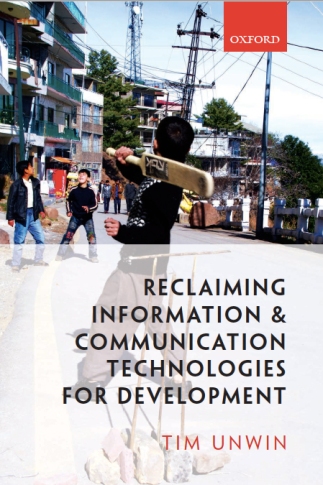
[For a wider discussion of revolution, see Unwin, Tim, A revolutionary idea, in: Unwin, Tim (ed.) A European Geography, Pearson, 1998.  As ever, please also note that a short post cannot include everything, so remember to read this in the broader context of my other writing, and especially Reclaiming ICT4D (OUP, 2017).  For my thoughts on the other edge of the two-edged sword, do read my much shorter “Why the notion of ‘frontier technologies’ is so problematic…“]


20 Comments

Filed under Africa, agriculture, capitalism, Development, Geography, Inequality, SDGs, United Nations

Interview with Teledifusão de Macau on ICT4D

It was so good to be in Macau and Shenzhen recently in my role as a member of the Advisory Board of the United Nations University Computing and Society Institute.  During my visit, colleagues at the Institute had arranged for me to participate in Teledifusão de Macau (TDM)’s prime time Talk Show with Kelsey Wilhelm.  This was a great opportunity to share some of my current thinking about the interface between digital technologies and humans, and Kelsey made sure that it was a lively and fun half hour discussion – really grateful to him for this!

The show is now available on YouTube, and begins with an overview of the current state of ICT for development, before going on to discuss

  • ways through which people with disabilities can be empowered through the use of technology,
  • the importance of new technologies being inclusive, because otherwise they lead to new inequalities,
  • working “with” the poorest and most marginalised rather than for them,
  • the role of new technologies such as AI and blockchain in serving the interests of the rich rather than the poor,
  • cyborgs and the creation of machine-humans and human-machines, and finally
  • some of the ethical issues that need to be discussed if we are to balance the benefits of new technologies whilst limiting their harm.

I very much hope that what I have to say is thought-provoking and interesting.  We need much wider public debate on these issues!

Leave a comment

Filed under ICT4D, Inequality, poverty, United Nations, Universities

Why the notion of “frontier technologies” is so problematic…

The term “frontier technologies” is increasingly being used to refer to the latest generation of technologies, especially digital technologies.  It is often also associated with the deeply flawed concept of a “fourth industrial revolution”.  The UN in particular has latched on to “frontier technologies”, mainly in the context of the impact of  Artificial Intelligence (AI) and Machine Learning, as for example in the UN Chief Executives Board for Co-ordination’s series of papers on Frontier Issues, and UN DESA’s Economic Analysis and Policy Division’s work on Frontier issues: the impact of the technological revolution on labour markets and income distributionSadly, much of this work is ill-informed, and reflects a particular set of interests.  Whilst there is indeed some interesting academic work on the potential of so-called “frontier technologies” for international development, as with Ramalingam, Hernandez, Prieto and Faith’s (2016) IDS report on Ten frontier technologies for international development, most such research fails satisfactorily to consider the deep problems with the notion and the interests that underlie it.

In undertaking some foresight work for UNICEF recently on the future relationship between digital technologies and learning, I had the chance to reflect on some of these challenges and interests, and I am sharing these reflections below, in the hope that readers will understand more about the implications of such terminology, and will cease to use the term!  These are the introductory few paragraphs to a section of my report for them on Technological changes over the next decade:

“Currently, much attention is being paid to the likely labour impacts of the latest ICTs, and the kinds of education that will be required to enable people to gain appropriate employment in the workplaces of the future.[i]  The term “frontier technologies” is now frequently used to describe the latest technologies,[ii] and their implications for education have recently received increasing attention.

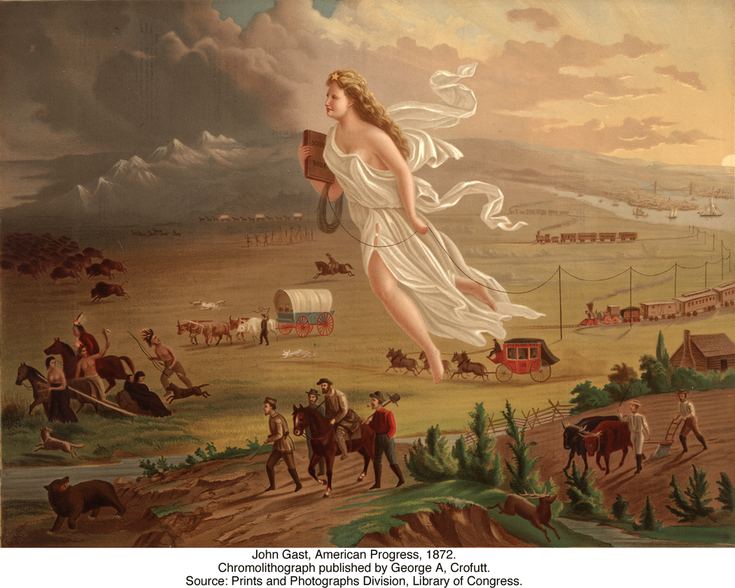
However, the concept of “frontier technologies” is deeply problematic, as is the notion of a fourth industrial revolution.[iii]  Such terms are used largely by, or about, the “heroes” of these self-conceived revolutions, in the hope of a self-fulfilling future; they beg no critique, nor any consideration of those left behind.  For example, the notion of “frontier technologies” draws heavily on the deeply embedded idea of the “American Frontier” in which US “civilization” was forged westwards, in large part through the use of new technologies.

The Frontier is thus conceived heroically, with the “savage” Native Americans, or First Peoples, being pushed westwards, to be replaced by “civilized” people mainly of European origin, as so clearly illustrated by John Gast’s famous late-19th century picture above.  Whilst the frontier was seen as being positive for the Europeans, carrying with it images of heroism and taming of the wilderness, it was anything but that for the Native Americans.  The latest “frontier technologies” of the 21st century can similarly be seen a vehicle through which USAn-led neo-imperialism is being further enforced on “peripheral” peoples and states beyond the “frontier”.  It is therefore strongly to be recommended that such terminology is rejected by those organisations and entities concerned with enhancing education in these poorer, more deprived contexts.

At a more mundane level, one person’s frontier can be someone else’s backwater; a 2G phone may indeed be novel to someone who has never had one before, whilst even a chip implant is now becoming passé for the digital human who has everything. This section therefore seeks to avoid such terminologies, and focuses instead simply on some of the most likely implications of technological change for education in the near future.”

———–

[i] See, for example, DESA (2017) Frontier Issues: the impact of technological revolution on labour markets and income distribution, https://www.un.org/development/desa/dpad/wp-content/uploads/sites/45/publication/2017_Aug_Frontier-Issues-1.pdf, accessed 30th March 2018.  There is considerable debate about the likely impact of AI on labour, and employment, with the latest OECD report arguing that the potential for AI to lead to considerable employment loss has been exaggerated in the past; see Nedelkoska, L. and Quintini, G. (2018) Automation, skills use and training, Paris: OECD, DELSA/ELSA/WD/SEM(2018)3, https://www.oecd-ilibrary.org/docserver/2e2f4eea-en.pdf?expires=1522776823&id=id&accname=guest&checksum=A498DE4EAEA4DDCC90DBE424AFB8DB0A, accessed 3rd April 2018.

[ii] See for example, Ramalingam, B., Hernandez, K., Prieto Martin, P. and Faith, B. (2016) Ten Frontier Technologies for International Development, Brighton: IDS, https://www.gla.ac.uk/media/media_524607_en.pdf, accessed 30th March 2018.

[iii] World Economic Forum (2016) The Fourth Industrial Revolution: what it means, how to respond, https://www.weforum.org/agenda/2016/01/the-fourth-industrial-revolution-what-it-means-and-how-to-respond/, accessed 30th March 2018.

7 Comments

Filed under ICT4D, United Nations

ICTs and the failure of the SDGs

Back in 2015 I wrote a short post about the role of ICTs in what I saw as being the probable failure of the SDGs.  Having attended far too many recent international meetings, all of which have focused to varying extents on how ICTs will contribute positively to the SDGs, I am now even more convinced that they have already failed, and will do very little to serve the interests of the poorest and most marginalised.

My 2015 post focused on five main issues.  In summary, these were:

  • There are far too many goals (17) and targets (169).  This has already led to diffusion of effort and lack of focus, not only within the ‘global system’, but also in individual countries.
  • Target setting is hugely problematic.  It tends to lead to resources being directed too much towards delivering measurable targets and not enough to the factors that will actually reduce inequalities and empower the poorest.
  • The SDGs remain largely concerned with absolute poverty rather than relative poverty.  The SDGs will do little fundamentally to change the structural conditions upon which the present world system is based, which remain primarily concerned with economic growth.  Although SDG 10 (on inequality) is a welcome addition, it is all too often ignored, or relegated to a minor priority.
  • These goals and targets represent the interests of those organisations driving the SDG agenda, rather than the poorest and most marginalised.  I suggested in 2015 that these were primarily the UN agencies who would use them to try to show their continued relevance in an ever-changing world, but they also included private sector corporations and civil society organisations
  • The need to monitor progress against the goals/targets will further expand the “development industry”, and consultants and organisations involved in such monitoring and evaluation will benefit hugely.

Subsequently, in 2017 I was part of the ITU’s collective book venture published as ICT-centric economic growth, innovation and job creation, in which I led on the second chapter entitled “ICTs, sustainability and development: critical elements”.  This chapter argued that serious issues need to be addressed before there can be any validity in the claim that ICTs can indeed contribute to sustainable development.  The present post seeks to clarify some of the arguments, and to summarise why the SDGs and Agenda 2030 have already failed.  There are in essence five main propositions:

  • Inherent within the SDGs is a fundamental tension between SDG 10 (to reduce inequality within and among countries) and the remaining goals which seek to enhance “development” by increasing economic growth. Most of the evidence indicates that the MDGs, which were almost exclusively focused on economic growth as the solution to poverty, substantially increased inequality, and ICTs played a very significant role in this.  The SDGs are likewise fundamentally focused on economic growth, in the belief that this will reduce absolute poverty, while quietly ignoring that such growth is actually increasing inequality, not only between countries but within them.
  • There is also a fundamental tension between the notions of “sustainability” (focusing on maintaining and sustaining certain things) and “development” (which is fundamentally about change). Although there has long been a belief that there can indeed be such a notion as “sustainable development”, this tension at its heart has been insufficiently addressed.  What is it that we want to maintain; what is it that we want to change?  ICTs are fundamentally about change (not always for the better), rather than sustaining things that are valued by many people across the world.
  • The business models upon which many ICT companies are built are fundamentally based on “unsustainability” rather than “sustainability”. Hardware is designed explicitly not to last; mobile ‘phones are expected to be replaced every 2-3 years; hardware upgrades often require software upgrades, and software upgrades likewise often need hardware enhancements, leading to a spiral of obsolescence. (For an alternative vision of the ICT sector, see the work of the Restart Project)
  • The ICT industry itself has had significant climatic and environmental impacts as well as giving rise to moral concerns: satellite debris is polluting space; electricity demand for servers, air conditioning, and battery charging is very significant; and mining for the rare minerals required in devices scars the landscape and often exploits child labour. We have not yet had a comprehensive environmental audit of the entire ICT sector; it would make much grimmer reading than most would hope for or expect!  In 2017, the World Economic Forum even posted an article that suggested that “by 2020, Bitcoin mining could be consuming the same amount of electricity every year as is currently used by the entire world”.
  • Finally, the SDGs have already failed. In their original conceptualisation, each country was meant to decide on, and set, the targets that were most relevant to their needs and priorities.  As some of us predicted at the time, the number of goals and targets was always going to be a challenge for countries, especially those with limited resources and capacities to make these decisions.  Few, if any countries have actually treated the targets seriously.  Instead, the development industry has blossomed, and various organisations have set up monitoring programmes to try to do this for them (see, for example, UN Stats, OECD,  Our World in Data).  If countries haven’t actually established targets, and do not have the baseline data to measure them, then it will be impossible to be able to say whether many targets have actually been reached.

The SDGs serve the interests of UN agencies, and those who make huge amounts of money from the “development industry” that seeks to support them.  Private sector companies and civil society see the Goals as a lucrative source of profits since governments and international organisation are prioritising spending in these areas.  This is why the original choice of goals and targets for the SDGs was so important; people and organisations can make money out of them.

There is much debate over whether target setting, as in the MDGs and SDGs, serves any value at all.  Despite many claims otherwise, the MDGs failed comprehensively to eliminate poverty.  It must therefore be asked once again why the UN system decided to create a much more complex and convoluted system of goals and targets that was even more likely to fail.  The main reason for this has to be because it served the interests of those involved in shaping them.  They do not and will not serve the interests of the poorest and most marginalised.  We are already nearly one-fifth of the way from 2015 to 2030, and the SDGs have not yet properly got started.  They have therefore already failed.  It is high time that governments of poor countries stopped even thinking about the SDGs and instead got on and simply served the interests of their poorest and most marginalised citizens.  They could begin to do so simply by spending wisely for their poorest citizens the money that they waste on attending the endless sequence of international meetings focusing on how ICTs can be used to deliver the SDGs and eliminate poverty!  ICTs can indeed help empower poor people, but to date they have failed to do so, and have instead substantially increased inequality, both between countries and within them.  We need to reclaim ICTs so that they can truly be used to empower poor people.

8 Comments

Filed under ICT4D, ICTs, SDGs, United Nations

The UNESCO Chair in ICT4D is not the same as the UNESCO Chair in ICTD

Geo.tv in Pakistan has recently run the following headline “Pakistani computer scientist Dr Umar Saif appointed UNESCO chair for ICTD”, and in the article that follows has claimed that “World-renowned Pakistani computer scientist Dr Umar Saif has been appointed as the United Nations Educational, Scientific and Cultural Organisation (UNESCO) Chair for using Information and Communication Technology for Development (ICTD). This is the first international UNESCO Chair in the field of ICTD and will help Pakistan become a centre of excellence in using Information Technology for development, especially use of technology to address the UN Sustainable Development Goals (SDGs), said a press release issued earlier.”  Other Pakistani media has run similar headlines, such as the Daily Pakistan Global’s “UNESCO appoints Pakistan’s Dr. Umar Saif as first international chair for ICTD”

Umar Saif has himself posted the following on Facebook to wide acclaim, stating that “Dear friends I have been awarded the UNESCO Chair for using ICT for development.  This is a moment of pride for Pakistan and a recognition of our work in the past 10 years”.

Following several comments and enquiries from colleagues in the field of ICT4D who have questioned the veracity of these claims, I write here just to clarify not only the nature of UNESCO Chairs, but also to make it very clear that the first UNESCO Chair in ICT4D was created at Royal Holloway, University of London, in 2007, long before the university that Umar Saif founded in Punjab in 2013 was even created; interestingly that university is named the ITU University (Information Technology University), which itself raises confusion with the International Telecommunication Union (ITU).  It is also important here to note that ICT4D and ICTD are very different!

UNESCO Chairs are created as an agreement between a university and UNESCO, and they are the term given for a community of researchers working in a particular academic field.  This can be confusing, because no individual is actually a UNESCO Chair, but rather they are appointed as a Chairholder.  While there are no restrictions on the number of Chairs in any one field, it is usual practice for chairs to be clearly differentiated, so that the majority do not have the same names.

In the light of this, when I was approached by staff at the International Technology University in Pakistan about the procedure for acquiring the status of a UNESCO Chair in 2017, I was happy to offer them some advice about how to proceed.  I had no idea that they would be applying for a Chair in exactly the same name to our own.  On discovering that such a duplicate application had been made to UNESCO, I wrote to colleagues at the Information Technology University in Pakistan suggesting that it might be useful to change the proposed name of their new Chair from ICT4D to something else, so that there would not be confusion.  They wrote back accepting a very minor change from ICT4D to ICTD.

It is up to readers of this post to judge the motives of those involved in applying for a UNESCO Chair in such a similar name to that of a long-established Chair, those on the National Committee in Pakistan who nominated such an application to UNESCO, and those who supported such an application.

To summarise and clarify for the record:

  • The first UNESCO Chair in ICT4D was established at Royal Holloway, University of London, more than a decade ago in 2007; and
  • Umar Saif has recently been appointed as the Chairholder of a UNESCO Chair at the Information Technology University in Pakistan, and is not the UNESCO Chair in ICT4D, or in ICTD.

I fear that this confusion sadly does not reflect well either on the political establishment in Pakistan who approved this nomination, nor on the professionalism of those involved in the nomination itself.  I would hope that the Pakistani press and those on social media will recognise this and respond accordingly.  I am sure they will agree that this is not a matter of pride for Pakistan, but actually sadly reflects rather badly on them.

I am somewhat saddened by this and only write to clarify the confusion that has already arisen and has been pointed out to me by colleagues.  It will not make the slightest difference to the ongoing work that my colleagues continue to do in this field.   I should also emphasise that I have many dear friends in Pakistan, and it is a wonderful and beautiful country.  I like and respect very many people in Pakistan, ranging from senior government officials to the many Commonwealth Scholarship Commission alumni who it has been my privilege to know.  The UNESCO Chair in ICT4D has worked with long established research-led universities in Pakistan, such as COMSATS IIT which has a world-renowned reputation unlike some other provincial universities in the country, and it has been an honour to undertake research with them and to promote the effective use of ICTs to support and empower the poorest and least privileged in the world.

Tim Unwin (Chairholder, UNESCO Chair in ICT4D)


15 Comments

Filed under ICT4D, United Nations

EQUALS Research Group Meeting in Macau

EQUALS 5is a global initiative committed to achieving gender equality in the digital age.  Its founding partners are the ITU, UN Women, UNU Computing and Society (UNU-CS) institute, the International Trade Centre, and the GSMA, and it has been a real privilege to work with colleagues from these organisations and other partners over the last 18 months to try to help forge this partnership to reduce the inequalities between men and women in the digital age.   There are three partner Coalitions within EQUALS: for Skills (led by GIZ and UNESCO); Access (led by the GSMA); and Leadership (led by the ITC).  These are supported by a Research Group, led by the UNU-CS. The picture above shows the first Principals meeting held in September 2017 at the edges of the UN General Assembly in New York.
Despite all of the efforts to achieve increasing female participation in STEM subjects, in employment and leadership positions in the ICT sector, and in the use of ICTs to help towards women’s empowerment, most of the indicators show that gender digital inequality is increasing.  At the broadest level, this means that most of the initiatives undertaken to date to reduce these inequalities have failed.  Business as usual is therefore not an option, and the EQUALS partnership is intended to encourage committed partners to work together in new ways, and on new initiatives, to help deliver Sustainable Development Goal 5,  to “achieve gender equality and empower all women and girls”. 

The first face-to-face physical (rather than virtual) meeting of the Research Group was convened by the UNU-CS in Macau from 5th-6th December (official press release), and it was great that both Liz Quaglia and I were able to represent the UNESCO Chair in ICT4D (at Royal Holloway, University of London) at this meeting, which was attended by researchers and policymakers from 21 universities and organizations around the world. This meeting established the group’s research agenda, drafted its work plan for 2018, and finalized the content and schedule of its inaugural report due to be published in mid-2018.  In particular, it provided a good opportunity for researchers to help shape the three Coalitions’ thinking around gender and equality in the  areas of skills, access and leadership, and also to identify ways through which they could contribute new research to enable the coalitions to be evidence-led in their activities.

This slideshow requires JavaScript.

Huge thanks are due to Araba Sey, who convened the meeting with amazing enthusiasm, insight and professionalism, and all of the other staff at UNU-CS who contributed so much to the meeting.  It was a great occasion when some of the world’s leading researchers in gender and ICTs could meet together, not only to discuss EQUALS, but also to explore other areas of related research, and to build the trust and openness necessary to increase gender equality both in the field of ICTs, and also through the ways that ICTs influence every aspect of people’s lives.  The BBQ and dancing on the last night ensured that memories of this event will last for a long time in everyone’s minds!

Leave a comment

Filed under Gender, ICT4D, ICTs, Inequality, ITU, United Nations, Universities