
The blossom has just started opening around Weiming Lake on Peking University’s campus. It’s a beautiful place simply to wander around in the early evening before the sun sets and the temperature drops to around freezing.
Category Archives: Universities
Speech at the launch of the British Academy’s Working with Africa Report
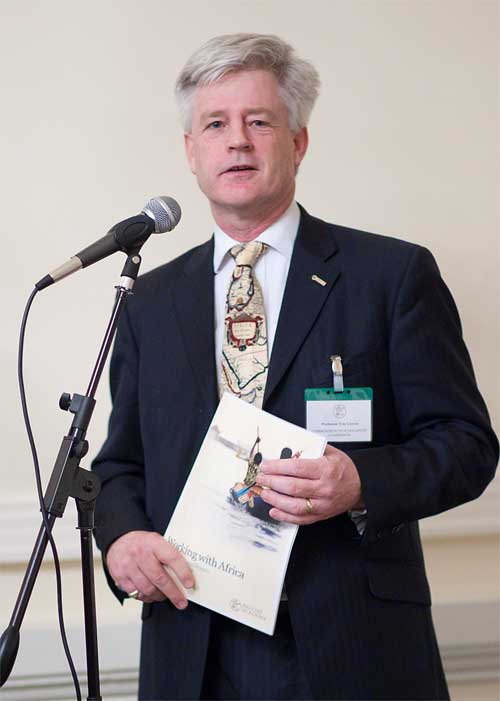 Following Professor Graham Furniss’s opening remarks, I was invited to speak in my role as Chair of the Commonwealth Scholarship Commission in the UK at the launch of the British Academy’s new report entitled “Working with Africa: Human and Social Science Research in Action” on 3rd March 2011. My short speech outlined the importance of the British Academy’s funding programmes, the difficulties facing African universities and academics, and the ways through which the Commonwealth Scholarship Commission (CSC) is seeking to support them in partnership with like-minded organisations.
I began by thanking Graham Furniss, not only for his work at the British Academy in driving forward many of their African initiatives, but also for joining the CSC as a new Commissioner. I then emphasised the quality of the research featured in Working with Africa and thoroughly recommended it to the audience as a good read. I highlighted in particular the value of the British Academy’s past small grants programme, noting that small amounts of funding can go a long way in supporting outstanding and innovative research in the humanities and social sciences. This is particularly true for UK researchers near the beginnings of their careers, but it is also very important for establishing networks and partnerships as exemplified by the Academy’s support for research in Africa.
Despite such funding, I emphasised the many challenges faced by African researchers, and the very difficult financial, infrastructural and capacity issues that African universities had to overcome. I argued that years of global emphasis on primary education in Africa had left the higher education sector in a very diminished state. I also made the point that whilst much international emphasis is placed on support for scientific research designed to reduce poverty, research in the social sciences and humanities is at least as, if not more, important. Such research helps develop understandings of critical issues concerned with governance, social equality, the law, cultural diversity and economic change.
Finally, I highlighted the critical role of the Commonwealth Scholarship Commission in supporting research and professional development in Africa. The last decade has seen a transformation in the Commission’s activities, so that far from being a traditional awarder of basic scholarships, it now provides seven different kinds of award, including distance-based studentships as well as professional and academic fellowships. Moreover, evidence from the CSC’s monitoring and evaluation programme clearly indicates the value that these have in terms of development impact. The Commission is delighted that it continues to have the strong support of the UK government, and that DFID will be providing some £20 million a year towards its programme of awards in developing countries in the 2011-15 period. To be effective, though, it is important that we work together in partnership. I concluded by reiterating my thanks to the British Academy and also emphasising the need for the Commission and the Academy to work closely together in the future to achieve our shared objectives of enhancing scholarship in African universities.
Filed under Africa, Higher Education, Universities
On publishing in ICT4D
 During the recent ICTD2010 conference, Hari kindly brought together a group of us to discuss academic publishing in the field of ICT4D. Each speaker was to talk for about ten minutes, directing our ‘advice’ primarily towards those who may be less experienced in academic publishing. Whilst I absolutely love seeing, holding and smelling the first copy of one of my new books, or reading one of my new papers in an academic journal, or seeing authors that I respect referencing one of my publications in their own work, I now recognise that a system that I once admired has become fundamentally, perhaps fatally, flawed. There is sadly much that is not really scholarly and little at all that is value free in the world of academic publishing today. It does not foster the excellence or originality that it is intended to achieve. All too often it leads instead to a morass of mediocrity and replication.
Two comments in the distant past still haunt me:
- when my first academic paper was published, a friend and colleague said “congratulations, but you don’t expect anyone will read it do you”; and
- a senior colleague in a government department once said to me: “I don’t ever read academic papers, I get consultants to provide a short synthesis of them for me”.
The reality of academic publishing is that very few papers are ever actually read, and few people are ever influenced by what is written in journals.
Some of the most challenging problems to do with academic publishing are:
- Academic journals are fundamentally a way to ensure professional exclusivity. They are a means through which one group of academics excludes others from participating in their ‘mysteries’. Thus ‘apprentices’ have to learn the rituals and obey the rules if they wish to belong to this exclusive and privileged club.
- Because of the need for authors to obey the rules, journals all too frequently fail to promote the very innovation that is meant to be their life blood. There is a real danger that referees or editors will reject papers that are too innovative or fail to abide by the logics and requirements of a particular journal’s editorial board.
- Many citation cartels exist, whereby in order to boost their rankings in citation indices, academics agree to cite each other’s papers in their own works.
- There are also real issues surrounding the dominance of the English language, and far too few journal editors or reviewers are willing to pay heed to different cultural traditions of academic writing style. We should do much more to enable people from different linguistic backgrounds to get their papers published in the ‘top’ journals.
- Peer review is by no means the innocent, quality control exercise it is meant to be. Far too often academics use it as a way of preventing ideas that are contrary to their own from being published.
- Citation indices usually only incorporate the more prestigious journals, and thus often omit the more innovative and cutting edge papers.
- The emphasis on quantity rather than quality of publication means that vast numbers of dreadful papers are submitted to journals – and it is very frustrating for editors and referees to have to sift through the dross!
The net outcome of these is that far too many papers that are published are mediocre and tend to replicate existing knowledge. Moreover, many of these problems have become exacerbated over the last 20 years as academic publication in ‘top’ journals has become such an important part of research assessment exercises.
I offered five key tips for less experienced academics who wish to succeed in this environment:
- The most important tip is that one must realise that academic publishing is a game. New academics therefore have to learn the rules and play by them – if they want to achieve success in terms that the profession’s gatekeepers have defined. Once your career is established, then you are in a position to try to change the rules!
- Write something that is reasonably good and then submit it to a journal. Referees are bound to suggest revisions, and so don’t be hurt by the comments. Use them, alongside your own developing ideas, to improve the paper and resubmit it – in most cases it will eventually be published (as long as it is reasonably good in the first place!)
- Publish less, but publish better; focus on quality rather than quantity. When I was head of department, I remember encouraging colleagues to make sure that they published just two or three papers a year in major journals, and a book every three to four years.
- Remember that few people actually read academic journals. If you want your ideas to have an impact, it is therefore essential that you make them available in different formats and contexts – as, for example, through your own blog
- Only ever agree to have your supervisor’s name as an author on the paper if she or he has actually written a substantial amount of it! Good academics don’t need to have their names on your research – although it is always nice to recognise their advice in an acknowledgement.
Two final points are worth mentioning. The first is that publishing in a multidisciplinary field such as ICT4D is fraught with a particular set of additional difficulties. Where academic success is defined in large part through publication in prestigious journals, most academics seek to publish their work in their own discipline’s top-ranked journals. It is thus more prestigious for a computer scientist working in ICT4D to publish in a top computer science journal than in a new ICT4D journal. Those who edit cross-disciplinary journals often therefore find that the papers that are submitted to them are those that have been rejected by other more mainstream journals. Consequently, papers published in multidisciplinary journals are often of less good quality than those in the major single disciplinary journals. This does, though, provide editors of multidisciplinary journals with an opportunity to be innovative and creative in what and how they publish. Moreover, it is incumbent on those working in the field to support new journals that are indeed trying to break the mould of traditional academic arrogance and exclusivity.
Finally, we need to explore alternative modalities of publishing. Those of us working in the field of ICT4D should seek to use ICTs creatively to enable multiple voices from many different backgrounds to share their research findings. However, we still need to find appropriate business models to enable more open and free publication options to be created. Traditionally, journal publishers have added considerable value to the publication process, not least through funding the editorial and publication process. Such costs remain to be covered, and few ‘free’ journals have yet actually enabled high quality original academic papers to be widely disseminated. We also need to work creatively with existing publishers, since they have much to offer the publication process.
For some of my more detailed reflections on peer review see:
[For the presentations by Geoff Walsham, Cathy Urquhart and Shirin Madon as well as the full discussion see the video “Publishing ICT4D Research“ available from ICTD2010 videos and photos]
Filed under ICT4D, Postgraduate supervision, Universities
‘Student’ protests and political process in the UK
Being at the rally in Trafalgar Square today, supposedly against the proposed cuts in higher education, made me reflect on several aspects of the contemporary political process in the UK:
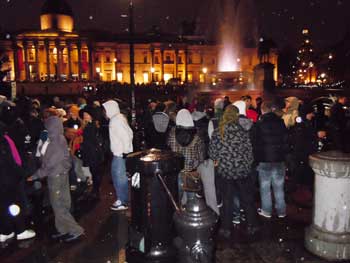 First, it is great to see so many UK students for once standing up for something that they see as being a cause worth fighting. For far too long, many students here, unlike some of their peers elsewhere, seem to have been apathetic and lazy, unwilling to engage in any form of radical political protest, with the majority preferring instead to enjoy the good life associated with undertaking a minimal amount of academic work and a maximum amount of partying. There is an irony here, though, as a young person on the train sitting next to me on the way home said “They are only looking after their own interests, in’t they. They can afford to!”
- To gain groundswell political support, it is essential to have a simple message that people can sign up to – even if their own various interpretations of that message are different. It is easy to unite people around a simple theme of complaining against ‘cuts’ that will affect them, but this hides the complexities surrounding the restructuring of UK universities and higher education.
 At the heart of today’s protests were people intent on challenging the police – seeking to provoke them into violent retaliation. At least whilst I was there, it was remarkable how calm the police remained against what many of them must have seen as being unprovoked and unfair abuse. What struck me most about this was that many of those hurling the abuse chose to hide their identities through masks and hooded clothing, whilst individual police officers were fully identifiable by their ‘numbers’. I do not want to be seen as an apologist for the police, and of course there have been cases where individual police officers have over-stepped the mark, but there is a real irony here in that protestors in the UK are indeed able to protest – peacefully – because, in general, the police have tried to be even handed in maintaining order and permitting people of all political persuasions to express an opinion.
 I was amazed at how little anyone in the crowd seemed really to care about what, to me, matters most, the destruction of university based research excellence in the UK! I have written at length elsewhere about this, but the protests convinced me even more of the importance of differentiating between ‘universities’ and higher education. We need fundamentally to restructure UK higher education, and this should involve a very dramatic reduction in the number of students going to ‘universities’. Instead, we should provide high quality and appropriate training and ‘education’, to fit all young people for the sorts of employment that they will subsequently enter. Let’s create outstanding opportunities for young people to gain the skills and education that they need – but let’s not pretend that the institutions in which this takes place are universities.
- And yes, of course, universities should be free for those able to benefit from the research-led opportunities that they provide, and for students who are committed to exploring the boundaries of knowledge diligently, rigorously and with enthusiasm!
- Finally, I find it amazing that according to the Guardian, Vince Cable, “the cabinet minister in charge of tuition fees, said today he was prepared to abstain in a key vote on the government’s policy if that was what fellow Liberal Democrat MPs decided to do as a group. The business secretary said he was prepared to take the unprecedented step of not backing his own proposals for the sake of party unity”. How can the Secretary of State responsible for the introduction of increased tuition fees not vote in favour of them? He should surely resign forthwith if that really is his view.



Filed under Higher Education, Photographs, UK, Universities
University students cheating – who is to blame?
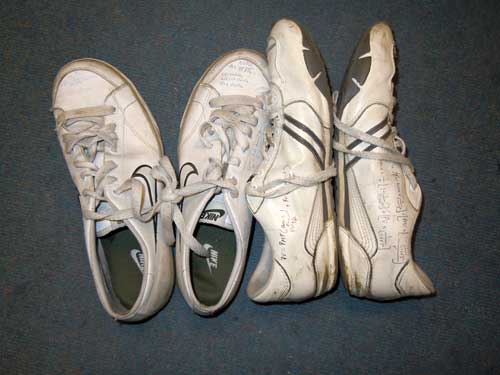 Some weeks ago, soon after exams were over, a friend brought me a couple of pairs of expensive sports shoes that she had found in a skip on campus, and asked what I thought about them. As these picture show, written all across them were formulae that had clearly been put there to ‘assist’ their owner, or to put it more simply to help them cheat.
I have seen numerous forms of cheating before, but this was a first for me – and I would have thought that it was highly risky for the perpetrator! Invigilation in exams has become ever more rigorous, and we are regularly sent lists of things to watch out for. I recall on one occasion even being told as an invigilator to be aware in case students wearing short skirts had written answers to questions on their thighs. How we were meant to investigate this, I was never told.
 Why, then, is cheating so rife? I guess, in large part it is because of the increasing credentialism and pressure that is put on students to learn and regurgitate, rather than actually thinking for themselves. If questions in exams were primarily designed to explore how students thought, rather than on what they could remember (although the two are obviously closely related), then there would be much less benefit in trying to cheat. I am also sure that cheating in part derives from the fact that many students have to spend much of their time earning an income to cover the costs of fees, accommodation and maintenance, and therefore are unable to acquire the level of knowledge that we expect from them when it comes to exams. Some might even be lazy, and simply cheat because they prefer to do that, with all the associated excitement of being caught, than actually doing the exciting intellectual work required in the first place.
In all instances, though, this is such a waste! Students should surely go to universities because they want to learn, to think for themselves, and to develop understandings that will help them influence the future for the better. No amount of cheating, regurgitating accepted truths will ever help achieve this.
The scale of cheating across universities is immense: in 2006, the Daily Mail reported that 90% of students cheat when writing essays; in 2008, the Guardian reported some 9000 cases of plagiarism across 100 universities in the UK under the heading ‘cheating rife among university students’; and the Canadian publication Macleans recently commented that ‘With more than 50 per cent of students cheating, university degrees are losing their value’.
Plagiarism software has gone some way to prevent plagiarism in the writing of course assessed essays, but this does not avoid cases where a student pays someone else to create an entirely new essay for them – which happens far more frequently than one might expect! There are also numerous websites which claim to provide a service that will not be picked up by the most sophisticated plagiarism checking software. It is ironic that one of the most important reasons why course-assessed work was introduced was that it was thought to be less stressful for students, and that they would therefore do better in it than in unseen terminal exams. Perhaps, because of so many abuses, it would be fairer to all if we just went back to such unseen tests – although I guess this would put many companies producing the plagiarism checking software out of business!
This is all just so sad, and reflects once again the commodification of knowledge that I have railed about so much in the past. Students should want to go to university to learn to think for themselves, and not just to repeat what they are expected to remember. Cheating is a sign both that we have accepted the wrong people into university, but also that we have failed to inspire them to think afresh. But then again, if universities have become just higher education institutions, teaching people to learn and regurgitate accepted facts, and if that is what society wants, then I suppose we just have to accept cheating as being central to modern life.
Just think, we could do some DNA testing on the shoes, sample all graduates, and identify who used them. I wonder what degree they actually finished up with?
Filed under Higher Education, Universities
Towards a free university
I have generally been highly critical of plans by successive UK governments to commodify higher education and create a free market in university degrees that will require students to pay fees of well over £6000 for their degrees. The review of higher education chaired by Lord Browne published on 12th October thus commented that “We do not in our proposals include a cap on what institutions can charge for the costs of learning. There is no robust way of identifying the right maximum level of investment that there should be in higher education. A cap also distorts charging by institutions” (p.37). Under these proposals, universities would be able to receive all of the money for charges of up to £6,000 and then pay a levy on the amounts that they charge above this.
So, how feasible might it be for universities in the UK not to charge students fees for the learning that they receive? The standard reaction amongst most British vice chancellors to the possibility of increasing fees has been one of relief and welcome as they see it as the only way to counter the decline in income that they have faced in recent years, and that is about to get very much more severe if reports of the impending cut of perhaps 79% in funding for undergraduate teaching in the upcoming spending review prove to be true. It would be a brave vice chancellor who used this as an opportunity to cut student fees, and provide students with a free education. However, it would be a remarkably astute piece of marketing, and might just prove to be the means to save their institutions.
This, or course, depends a little on how we choose to define a university – and I see universities as something very, very different from the low quality, mass-producing, learn and regurgitate type of higher education institutions that dominate the world today. A university should be a place of research and learning; it is where leading academics push the frontiers of knowledge forward, and in so doing enable bright students to learn something of value from them. Universities are exciting places for those who are bright enough to benefit from the opportunities that they provide; they are dreadful for students who simply want to be taught the right answers to regurgitate in exams. The tragedy in the UK is that this distinction has been blurred, and in seeking to provide a higher education system that enables half of our young people to gain degrees, we have dumbed down the quality and created a system that we can no longer afford.
So, how might a university that provides free learning work? The following are some tentative ideas:
- Such universities could focus primarily on gaining high value research funding, both from government research councils and also from external research contracts. Whilst undertaking research, academics would also be expected to do some ‘teaching’ (for free), but at a much reduced level.
- New ICTs can help dramatically to reduce the amount of time academics actually spend in classes. Filming of standard lectures, for example, which could be used for more than just one year, and the use of digital learning management systems can effectively reduce the time that academics actually need to spend teaching.
- Universities could change their employment contracts, only paying staff for nine or ten months a year (thereby leading to an immediate 16.7%-25% cut in salary bills), and expecting them to gain whatever extra income they wished to through external consultancy or contracts for the additional two or three months. This might actually turn out to be much more lucrative for academics in terms of salaries
- Once students have left halls of residence in droves (because they can no longer afford both fees and accommodation), universities could focus on using this vacated space for the conference trade and other external sources of income generation. This could then be used to subsidise free education to the students living locally
- Learning could be provided for free, but students would then be expected to pay something to take examinations if they wanted the external recognition that modern credentialism demands. Oh for the day when students could get a job without showing that they gained a 2:1 from the university of mass production, but rather by simply showing that they had learnt something from being with Dr. Wisdom!
- Might we even be able to move to a system whereby students paid academics on a voluntary basis – as with tips in a restaurant?
- Academics could write text books, make them available to students online and charge realistic prices for them, thereby gaining some of the profits traditionally made by textbook publishers.
- Traditional styles of teaching could be changed dramatically. If academics are spending most of their time doing research, perhaps students could learn by being apprentices, working together with the relevant academics and doing some of the simpler research tasks for them.
These are just a few ideas, and they are proposed here simply to show that the notion of a university where people can learn for free – something very different from free higher education for the masses – is not entirely ridiculous. All it requires is some imagination, vision and passion.
Filed under Education, Higher Education, UK, Universities
The brave new world of a free market university system in the UK
The Browne review places the final nail in the coffin for the belief that universities are about anything other than economic interest. From henceforth, university education in the UK has become a commodity to be bought and sold in a free market for individual benefit. Overthrown are beliefs that university education is about intellectual curiosity, about moral judgement, and about communal interest.
The short-sighted stupidity and naïvety of the recommendation that universities should be able to charge market prices for their offerings must, be challenged. Even for those who see the world purely through an economic lens, the arguments against Browne’s recommendations should be convincing. Imagine a world where:
- British students increasingly live at home and turn to high quality distance-based courses provided more cheaply by excellent universities, often in other countries;
- Many students go overseas to study in countries where education is free, thus making a huge cost-saving in gaining a degree and contributing to the local economies of the countries where they study (rather than the UK);
- Many UK universities shut down, because students realise that the courses they offer are a complete waste of time and do not give them any additional lifetime earning expectations; and
- Employers, realising even more than they do at present that UK universities do not provide the skills for which they are looking, increasingly employ people without degrees, and give them tailored training courses (often collaboratively with other employers) to ensure that they have the expertise required.
These are just some of the likely economic impacts of the recommendations that are now before government. The net outcome will be a dramatic reduction in the UK higher education sector, a shift overseas in the amount spent on fees and maintenance by UK born students, an increase in unemployment of former university staff who are unable to gain any other form of employment, and a decline in the wider contribution of the higher education sector to the UK economy.
Even on economic grounds, a decision to let universities charge whatever fees they think the market will stand is fundamentally flawed. So, even for those who do not care about the social divisiveness, the intellectual sterility, and the communally destructive effects of such policies, these arguments should at least carry some weight!
Filed under Higher Education, UK, Universities

 Tim Unwin's Blog