Category Archives: Wine

Majeka House – a lovely place to stay near Stellenbosch

For anyone seeking a comfortable and relaxed place to stay while exploring the wineries of Cape Province in South Africa I can thoroughly recommend the Majeka House, just outside Stellenbosch.  Hidden away in a quiet residential area, the hotel provides a wonderful oasis of luxury in which to unwind at the end of a busy day of tasting!  With a warm welcome, beautifully hand-crafted rooms, great views, a relaxing pool, and the fine Makaron Restaurant (one of the top 20 in South Africa), it is a very special place to stay.

This slideshow requires JavaScript.

Breakfasts are delicious, although I definitely preferred the anti-oxidant juice to the green revitaliser!  Also, beware the white pebbles in the birdcage at dinner – I dread to think of the teeth damage if someone bit hard on them!  As the above pictures illustrate, though, the food was innovatively presented, and of very high quality.  Make sure you book in advance, because the restaurant gets very full!

2 Comments

Filed under Africa, Restaurants, Wine

My favourite South African Wines…

ThelemaA visit to the Cape Province of South Africa last week in order to help select wines for the Athenaeum provided a great opportunity to learn something about  recent changes in the wine industry in the Cape and to taste some of the really excellent wines that are now being produced there.  It is some 40 years since I last visited Stellenbosch and Paarl, and it is great to see the quality of wines now being made in the region.

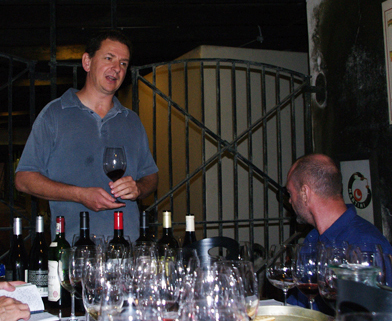
Thanks to Stuart and George who arranged the itinerary, and the hospitality of many amazing wine makers, we had the privilege of tasting nearly 200 wines from Stellenbosch, the Cape Peninsula, Franschhoek and the hinterland of Hermanus.  While this represented only a small fraction of the many wines now being made in South Africa, it did highlight three significant things for me:

  • First, the quality of the wines has improved very dramatically indeed over the last 15 or so years.  There are without doubt now some really excellent wines being made in South Africa, and they are very good value indeed, with many of the best wines being priced at under ZAR 250 (£15) a bottle.  We scarcely tasted a poor bottle, and it was difficult to choose those that I preferred best for my list of favourite wines below!
  • Second, South African wine makers have definitely learnt and understood the importance of terroir. Given my geographical wine “upbringing” in Burgundy, I have always argued that the physical environment has a very important role in determining the character of a wine, and it is good to see the increasing differentiation that now exists in the planting locations of different grape varieties in the Cape area.  Many of the wines we tasted emanated from some of the cooler vineyard locations, higher up on the mountain slopes, in windier locations, and closer to the sea.
  • Third, South Africa’s vineyards have to be amongst the most beautifully situated in the world, with many of them being in very picturesque locations, as I hope the pictures below illustrate.  Whilst leafroll virus is a serious problem for grape-growers, it does have the merit of turning vines a beautiful red colour in the autumn!

This slideshow requires JavaScript.

Despite the pleadings of my colleagues, I am still not convinced by many of the Chenin Blanc wines we tasted, perhaps with the exception of some of the sweet dessert wines.  I’m sure that some of my reticence stems from tasting too many rough Steen wines when I was younger!  While I recognise that modern good quality Chenin Blanc wines are indeed being made, I simply don’t particularly like them, finding the astringent flavours that I encountered in my youth all too often still to be present.  Likewise, I have to confess not really to liking wines made from the Pinotage grape.  All too often they too retain bitter flavours, and I found many of those we tasted to be rather unbalanced and poorly structured – with one delicious exception!

So, to conclude, my favourite wines, in alphabetical order of producers were:

  • 4Buitenverwachting (with MD Lars Maack)

    • 2009 Christine – excellent open fruity nose; 14.5% alcohol; rich, rounded, soft tannins; red fruit flavours; 45% Cabernet Franc contributes to tobacco and chocolate flavours (with 45% Cabernet Sauvignon and 10% Merlot); well balanaced and good length
  • Chamonix (with Wine-maker Gottfried Mocke)

    • 2011 Pinotage – a very unusual wine made in a similar style to Ripasso, combining fresh wine refermenting with air dried grapes; half-picked very young and undergoes carbonic maceration; other half desiccated and refermented with first picking; grown at 440 m 9on Greywacke soils; 14.5% alcohol; kept mainly in one-year-old Pinot Noir barrels; dark red with complex green and dark fruit flavours; very soft tannins.
    • 2012 Chardonnay Reserve – 13.5% alcohol; 14 months in 228 l French oak; 30 year old vines which show character and personality; 80% barrel fermented with 20% in 600 l concrete eggs, which enable wine to be oxygenated and the lees stay in suspension for longer than using other fermenters; high acidity early grapes are put into concrete, with later pickings going into barrels; always goes through malo-lactic; tries to pick fruit at lower sugar levels to make wines more in a Burgundian style; 65% new oak used for this vintage, which remains very evident; need to keep for some time.
  • 5Cape Point (with Wine-maker Duncan Savage)

    • 2011 Late Harvest Noble 8 – only made when conditions are right, with some 2000 half bottles being produced in 2011; 160 grams residual sugar; 10.5% alcohol;  Sauvignon Blanc and Semillon botrytised blend; rich balanced fruit flavours; good length; acidity balances out the rich fruit; dried apricot flavours.
  • Delheim (with Viticulturist Vic Sperling)

    • 102009 Vera Cruz Shiraz – we had the last bottle in the cellar sadly; produced from bush vines; 14.5% alcohol; rich, intense fresh red fruits on the nose; fruity flavours of plums and jam; good length and complexity; their Vera Cruz wines are only made in years when the fruit is good enough; a powerful wine to be kept for a while.
    • 2013 Edelspatz Noble Late Harvest – botrytised Riesling from Simonsberg Mountain; good acid balance; not overly rich; classic slight petrol nose, but well structured and luscious flavours of honey and apricots.
  • Glenelly (with Wine-maker Luke O’Cuinneagain)

    • 12012 Oaked Chardonnay – light golden colour; blanche toasted 500 l barrels designed to keep as much natural fruit flavour as possible; fresh with good fruit expression; distinctive pear flavour, with slight citrus touches; richer and softer than their unoaked Chardonnay; good structure and depth.
    • 2010 Syrah – designed to be like a northern Rhône wine; 100% whole bunch fermented; purple-red colour; very clean, with slight smell of bacon; white pepper and floral aromas; relatively low alcohol at 13.9%; soft tannins, but needs time to develop.
  • Klein Constantia (Wine-maker Matthew Day)

    • 22013 Sauvignon Blanc – made with free-run juice from grapes from across the property; very pale in colour; up-front nose of gooseberry and blackcurrant leaves; 4 months in steel on lees; fresh in mouth, with balanced acidity on edge of tongue; quite light and eminently drinkable
    • 2008 Vin de Constance – classic dessert wine made from Muscat de Frontignan grapes, left to dry on the vine; good rich flavours of candied orange, with other fruits including a slight pineapple taste; good depth and length; balanced acidity.
  • Meerlust (with Chris Williams, Cellar Master)

    • 62012 Pinot Noir – a serious wine; lovely rich nose; has been made since 2004 on coolest hilltops, which catch the breeze being only 3 kms from the sea; vines grown on decomposed granite; picked at 4-6 tonnes per hectare; vinified in small batches, some with natural fermentation; has an interesting liquorice nose; quite soft tannins; needs keeping for several years.
    • 2009 Rubicon – excellent Bordeaux blend style wine (69% Cabernet Sauvignon, 20% Merlot, 10% Cabernet France and 1% Petit Verdot); very rich and intense rich blackcurrant fruit flavours; complex; good length; well structured; definitely for keeping.
  • Newton Johnson (with Bevan Newton Johnson, MD)

    • 32012 Family Vineyards Pinot Noir – really good wine, clean, well structured, medium length, and rich complexity of Pinot flavours resulting from use of grapes from three adjacent vineyards (20% from Mrs. M, 30% from Block 6, and 50% from Windansea); first made in 2008/9; red fruit rather than vegetal.
    • 2012 Windansea Pinot Noir – Pinot Noir from a single vineyard which has more clay than adjacent ones, giving a deeper colour; a bit closed and more restrained than the fruitier more open Mrs. M and Block 6; well structured with good acid balance; excellent finesse; red and black berry fruits.  A really excellent wine.
  • Spier
    • 21 Gables Sauvignon Blanc – hand harvested; made from grapes grown in Durbanville near the Atlantic on red gravel and clay soils; nose of new mown hay; acidity clearly felt at edge of tongue; but well structured; rich complex flavours of gooseberry and slight asparagus; 13.5% alcohol.
  • Thelema (with Cellar Master Gyles Webb)

    • 82011 Cabernet Sauvignon “The Mint” – made from the first Cabernet Sauvignon vines they planted, with eucalyptus trees nearby, which give the wine a distinctive minty nose and flavour; mid-red colour; well-balanced and good structure; will be long-lived.
  • Vergelegen (with Wine-maker Andre van Rensburg)

    • 2011 Merlot – the first 100% Merlot wine made at Vergelegen since 1998; although Andre sees himself mainly as a Cabernet Sauvignon producer, he believes they have the environment to produce excellent Merlot; lovely soft nose and very gently tannins; still a bit young, and lacking a bit in length, but overall very pleasant.
    • 72010 DNA – Cabernet Franc does well at Vergelegen, but the yield needs to be reduced down to around 4 tonnes per hectare; aim is to pick the fruit as late as possible; mid-red, quite intense colour; 65% Cabernet Franc, Merlot 21% and Cabernet Sauvignon 13%; fantastic high notes on nose; very soft tannins; not as strong a smoky nose as I would have expected with this amount of Cabernet Franc; wine is designed to be fruity rather than green.  Wine is made in recognition of Andre’s respect to Cheval Blanc, with the DNA often being thought of as being similar to terroir.  Others might think that it is short for “Dickhead ‘n Arsehole”!  Incidentally, the label is not a fingerprint, but rather the contours of a hill!

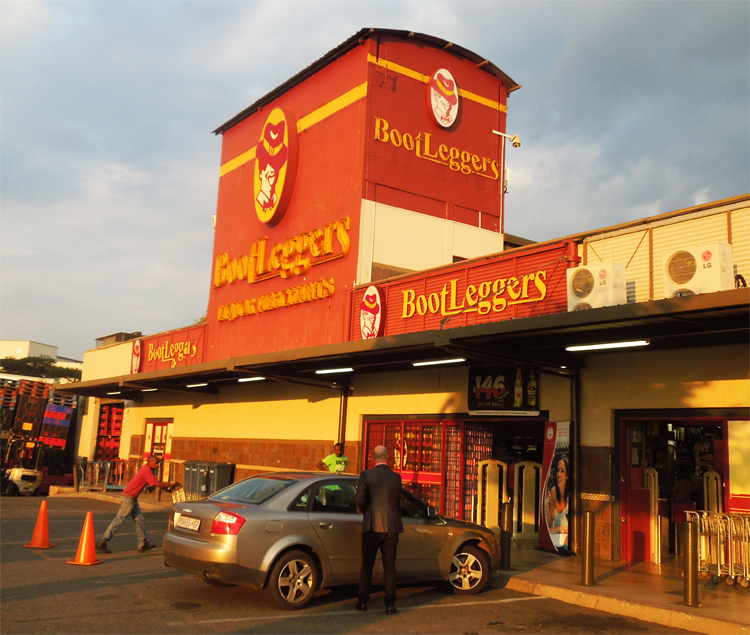
Finally, I have long appreciated the work that Charles Back has done at Fairview, and particularly his BootLeggerscommitment to social change in the region.  In 1997 he helped establish The Fairvalley Workers Association, which aims to help workers at Fairview to have their own land, and he was also the driving force behind the Fairvalley wine brand that is owned by the Workers Association, with profits from the sale of their wines (made using cellar facilities at Fairview, and FairTrade certified) being used to support community development initiatives.  Being in South Africa enabled me to access further wines that it is difficult to get in the UK, and so I particularly enjoyed the opportunity to explore the shelves of Bootleggers in Fourways Crossing and purchase additional wines, including some of Fairvalley’s remarkably good value 2009 Cabernet Sauvignon, which was delicious with boerewors, as well as  a bottle of Fairview’s 2010 Goat-Roti (Syrah/Viognier blend) that went especially well with barbecued fillet steak!

For those looking for somewhere quiet and relaxing to stay while exploring the vineyards of the Cape, I thoroughly recommend Majeka House, just outside Stellenbosch, which also houses the excellent Makaron Restaurant!


4 Comments

Filed under Africa, Photographs, Restaurants, Wine

Jordan Wine Estate, Stellenbosch

It is some 40 years since I was last in Stellenbosch – and how it has changed!  Today, I had the privilege of being introduced to the wines of Jordan Wine Estate by Gary and Kathy Jordan – in the company of some good friends.  It is great to see the impact that UC Davis has on far-flung parts of the world, and also to meet wine-makers who combine expertise in geology and economics to produce some really very good wines!  Terroir is definitely alive and well here.  Sadly, I’m not yet able to share the flavours of the wines virtually, but I hope that the images below capture something of the beauty of this part of South Africa, as well as the care and attention to detail that marks out wine-making at Jordan Wine Estate!  Have to say that I particularly enjoyed the 2011 Cobblers Hill – and the lunch!

This slideshow requires JavaScript.

Leave a comment

Filed under Africa, Photographs, Wine

Hostageria de Poblet: peaceful place to stay to the west of Barcelona

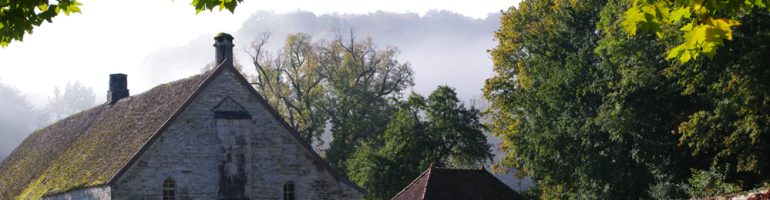
There is always a tension in writing about hidden away places where I have enjoyed staying.  Were they to become overly popular, that would destroy much of their secrecy and solitude!  However, earlier this year I discovered somewhere really lovely, and hope that by mentioning it here others will take the opportunity to enjoy what it has to offer.

The Royal Monastery of Santa Maria de Poblet in La Conca de Barberà just to the north of Reus and Tarragona, and some 130 kms west of Barcelona, is one of a group of Cistercian monasteries founded in Catalunya in the 12th century, shortly after the conquest of the province by the Catalan-Aragon monarchy.  Others  include the monasteries of Vallbona de les Monges in l’Urgell and Santes Creus in L’Alt Camp.  One day I must walk the Ruta del Coster that joins them all up!

The monastery of Santa Maria de Poblet itself had become very run down by the early 19th century.  The confiscation of church lands in 1835 and the consequent expulsion of the monks led to further decay, and it has only been in recent years that some of its character has been restored.  A community of monks returned to the monastery in 1940, and in 1991 it was declared a World Heritage Site by UNESCO.  Since then it has attracted increasing numbers of visitors, many of whom are drawn there by its magnificent setting among woods and streams sheltered by the Prades mountains.

In 2010 a new modern guesthouse, the Hostageria de Poblet, was built within the old walls of the monastery, and it provides a simple, minimalist place to stay. For those who like quiet, hidden away places, set amidst vineyards and rolling hills, the Hostageria is most definitely worth a visit.  As their brochure notes, “There are no televisions in the rooms to respect the silence and the living dynamics of the monastery”.  That having been said, the guesthouse does have Internet access for those who do not want to escape the modern technological world completely!  Currently, the Spring price for a double room varies between $49 and $59, which makes them really excellent value for money.

The Hostageria also has a restaurant that serves delicious local food – but do note that the lunch menu is much more extensive than that available in the evenings.  Alongside the restaurant is a culinary school, designed to provide both a theoretical and practical training for people living in the comarca of Conca de Barberà.  The Spring menu offers three courses for €20, with a typical choice being

  • Torradeta d’escalivada i formatge de cabra gratinat
  • Llom de bacallà a la mel a l’estil dels monjos de Poblet
  • Iogurt del monjos amb gelat de nata i xarrop de grosella

The monastery also has its own wines, developed in collaboration with the Cordoniú Group. Nine hectares within the walled enclosure were planted in 1989 with Pinot Noir grapes, chosen in memory of the Cistercian wine makers of Burgundy.  Although Pinot Noir is not widely grown in Catalunya, the wines from the monastery, include the 100% Pinot Noir Abadia de Poblet, as well as a lesser wine known as Intramurs, which is a blend of Cabernet Sauvignon, Tempranillo and Merlot, and both are definitely worth tasting while staying there.

This slideshow requires JavaScript.
Leave a comment

Filed under Photographs, Restaurants, Wine

Thanks to the Masters of Wine…

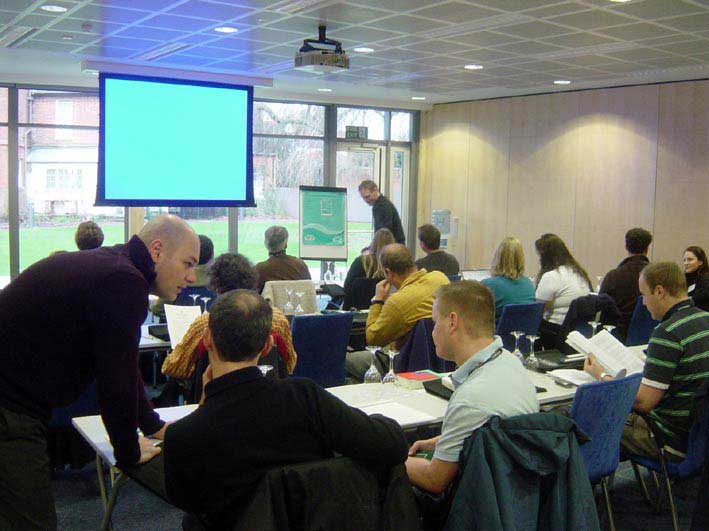
Without doubt, one of the most interesting and enjoyable aspects of my life in recent years has been serving as Academic Advisor and External Examiner for the Institute of Masters of Wine since 2004.  It has been fascinating working with some of the leading figures in the wine industry during this period, and helping them evolve their examination system to ensure that it remains at the cutting edge of good practice in professional examinations (the picture here is from one of the MW training days in Olney). One of the things I have been most impressed with is the way in which the Institute has continued to explore novel and exciting ways to assess understanding of grape growing and wine making, as well as wine tasting skills.  To be a Master of Wine, you really do need to have very considerable depth of knowledge and expertise!

This is rightly a qualification in the old medieval sense of the word ‘Master’, whereby someone only achieves the status when they have served an appropriate apprenticeship, learned the skills and knowledge requisite to become a journeyman, and then produced a master-piece that members of a guild thinks sufficiently highly of to elevate them to the status of a Master.   In this light, the dissertation can be seen as the ‘master-piece’ that all candidates have to produce before they are welcomed into the Institute!

One of the things that most impressed me was the way in which the Institute recently developed a policy of reasonable accommodation and special consideration, that specifically addresses ways through which students with a range of disabilities and other special circumstances can indeed participate in the examination process.

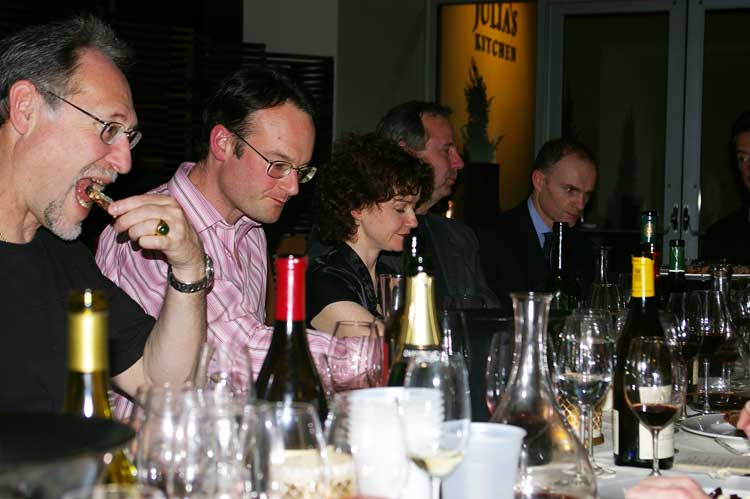
It was therefore with a real sense of sadness – at least for me – that pressures of work in my new role as CEO of the Commonwealth Telecommunications Organisation meant that in the autumn I decided that I could not continue in my role at the Institute.  I was overwhelmed by the generosity of so many members of the Institute who hosted me to a wonderful dinner at The Don in London (not the picture here, which is from a MW gathering in Napa).  Not only that, they each gave me a superb bottle of wine from their cellars, and I would just like to thank them all here for their amazing generosity.  What a wine list this makes (thanks to John for noting them down!):

The challenge will undoubtedly be to decide when to drink these very special wines – or perhaps more appropriately, with whom and alongside what food!

Thanks again so much to the Institute for all that I have learnt, and for the friendship of so many Masters of Wine.

1 Comment

Filed under Wine

Re-experiencing Bloodwood

Back in 1994, I had the real privilege to undertake a review of the extension services provided by the Australian Wine Research Institute (AWRI) – which, apart from anything else, introduced me to many people who have subsequently become great friends.  If only the UK and Australia were a little closer together! Two of these people were (and still are!) Stephen and Rhonda Doyle.  I distinctly remember being told by colleagues at the AWRI that I really should go and visit Stephen – not least because of his somewhat unorthodox approaches to the wine industry.  Mind you, I still think that many great Australian wine makers are unorthodox!

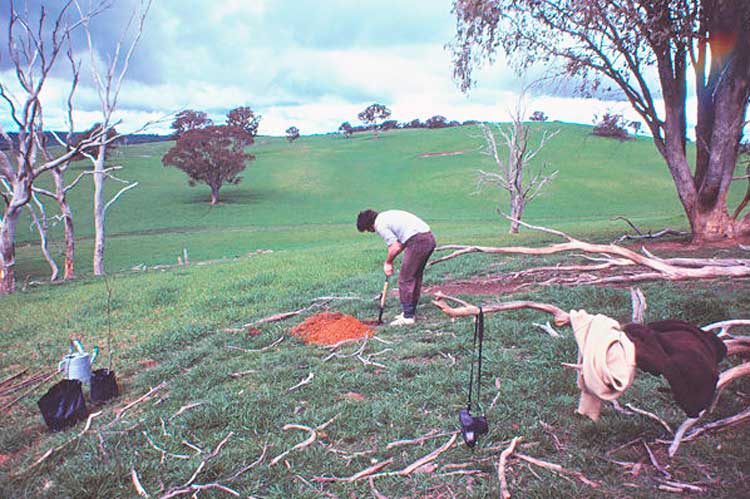
Stephen and Rhonda were the people who  identified Orange as being a great place to make wine, planting their first vineyard there back in 1983 (the adjacent picture).  They had begun making wine from grapes grown at the Glenfinlass vineyard near Wellington in New South Wales in the mid-1970s, and had subsequently spent the next decade trying to identify the best possible environment for making fine wine in Australia.  Eventually, they hit upon Orange, or more specifically as Stephen recalls “those elevated areas to the West and North West of Orange anchored by Middle Ordovician geology of the Orange Shadforth association of soils. These soils are low to moderate in vigour, warm and free draining gravel based soils which hug the northern edge of the Mount Canobolas volcanic red mountain earth plateau. They provide good air drainage for frost control and provide plenty of opportunity with their red clay base to construct hill side dams for irrigation…”  To find out more, check out Bloodwood’s history in more detail.

So, finding myself with a spare weekend in Canberra, I took the opportunity to get in touch with them, and see if they just might be around.  Wow – what hospitality!  A friend drove me the three-and-a-half hours there – thanks so much Rob! And then Stephen and Rhonda drove me back to Canberra last Sunday.  What generosity.  It was wonderful to see how they have transformed the place in the last 17 years – I took the photo alongside from almost exactly the same position that the 1983 one above was taken from!  Note the tree at the right side, and likewise the one in leaf in the middle left of both photos!

Bloodwood is not only a beautiful vineyard and winery, but it is also one where wildlife – well, most wildlife – is encouraged.  Rarely have I been to a vineyard where the annual sacrifice of grapes to the birds is treated with such equanimity – but as the photos of the landscape and Rosellas below indicate, Stephen and Rhonda have managed to achieve a wonderfully colourful balance.

This slideshow requires JavaScript.

And the wines are brilliant too!  Given my love of Burgundy, I have to confess that I like their Chardonnays and Pinot Noirs best.  As their latest online list comments:

  • 2009 Chardonnay: “Intense stone and grapefruit blossom introduce the delicate, racy palate of this fine Bloodwood Chardonnay. With flinty minerality at its core and purity of fruit across the palate, this is a crisp, refreshing wine to enjoy with pleasure in the medium term.”
  • 2009 Pinot Noir: “This perfumed, hand crafted Pinot Noir with its subdued sanguine hues and charming cherry blossom aromas entices you into a beguiling and gently delicious blood plum rich world couched in subtle barrel ferment char. Those ladies old handbags are slinking about the palate again, complementing the delicate tannins and distinguished bouquet of this fine wine”

Bloodwood can be visited by appointment – and, staying with them for a couple of days, it was fascinating to witness first hand how Stephen and Rhonda share their love and passion for wine with all their visitors – no matter how knowledgeable or inexperienced they are!

Bloodwood is a truly special place, crafted with amazing love, care and passion by very special people.  It’s scarcely surprising that they make such wonderful wines!

3 Comments

Filed under Photographs, Wine

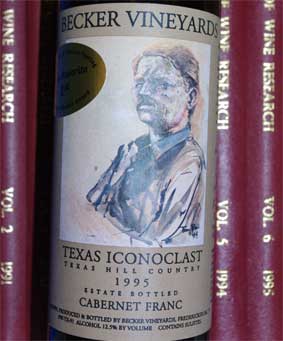
Becker Vineyards Texas Iconoclast Cabernet Franc 1995

This has to be one of the most surprising wines I have tasted in recent years.  Back in 1997 I was attending the Annual Meeting of the Association of American Geographers held in Texas, and spent some time afterwards in Austin and visiting wineries in the Texas Hill Country – among them was Becker Vineyards, established a few years previously in 1992 by Richard and Bunny Becker.  The first harvest was in 1995 and vintages are aged in either new French or American oak, and stored in the largest underground wine cellar in Texas. I remember being very surprised to find French varietals being cultivated in Texas, but also that the wines tasted surprisingly good.

The visit of two USAn friends on Friday, who had been forced to leave Egypt because of the ongoing political unrest there, and were on their way back to Houston, seemed an appropriate occasion to open this Texan Iconoclast.  I would not normally choose to drink a 15 year old Cabernet Franc – suspecting that it would be well past its best.  However, this wine was quite remarkable – and shows how ripe fruit and careful vinification can indeed produce surprising wines in very unusual circumstances.  It retained a mid-red colour, and had much less browning at the edges than I had expected.  The wine had the distinctive tobacco nose that I often associate with Cabernet Franc, but also retained a slightly woody aroma.  The flavour was delicious, with soft tannins, good depth, and a richness that I had not anticipated – very different from many of the often light, dry Cabernet Franc wines from the Loire that I am more used to. The hot Texan summers had clearly ripened the fruit fully, giving the wine a richness and depth of body that was delicious, retaining a good balance and structure, with flavours of red fruit and tobacco.

So, if you happen to be out visiting the Texan countryside, enjoy the blue bonnets, take a detour up to Stonewall, sample the Becker wines, and put a bottle in your luggage for drinking a decade later! Thanks to Bill Fleming for persuading me to explore Austin’s music scene when I was there! I also look forward to returning to Guero‘s Taco Bar on a future visit – hope it is as good now as it was then!

Leave a comment

Filed under Restaurants, Wine

Day 3 at ICTD2010

The third day – reminiscent of one of my favourite films, The Third Man. Some serious papers, excellent posters and demos. It was the conversations in the corridors that I enjoyed most…

Thanks to Paul and Michelle for the evening reception – and in case anyone is wondering about exactly which winery Michelle was referring to it was Bloodwood in Orange!

Congratulations to Georgia Tech who will be the hosts for ICTD2012!

This slideshow requires JavaScript.
Leave a comment

Filed under ICT4D, ictd2010, Photographs, Wine

First Drop – wines to look out for

Matt Gant and John Retsas have put together an exciting and eclectic range of wines under the label First Drop.  As their site says, “First Drop is about passion. for life, fun and flavour!… a lifelong commitment to making kick arse booze… wines with flavour and texture, and a splash of funk… eclectic varieties from unique vineyards in the great regions of the Barossa, Adelaide Hills, McLaren Vale… wines to drink, not just appreciate…”

Typical of the lower priced wines in the range are an Arneis from the Adelaide Hill and a Barossa Shiraz both at around £10 a bottle.    They have also particularly focused on Italian grape varieties, with a Nebbiolo Barbera and a Montepulciano from the Adelaide Hills.  At the top end, their Cream Barossa Valley Shiraz sells for around £40 a bottle, with the Fat of the Land Ebenezar Shiraz going for £30 a bottle. These wines are now available in the UK from New School Wines in Melton Mowbray.

As James Halliday’s Australian Wine Companion 2011 notes, “This is a virtual winery, with no vineyards and no winery of its own.  What it does have are two owners with immaculate credentials to produce a diverse range of wine of significantly higher quality than those of many more conventional operations …  When Matt was working at St Hallett he won the Wine Society’s Young Winemaker of the Year Award ’04, and the Young Gun of Wine Award for First Drop in ’07.  John Retsas has an equally impressive CV, working at St Hallett and Chain of Ponds and is now general manager of Schild Estate”.

In a previous life, Matt was a student at Royal Holloway, University of London, and it is great to see what he has now gone on to achieve!

Leave a comment

Filed under Wine

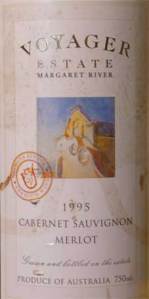
Voyager Estate, 1995 Cabernet Sauvignon and Merlot

Rarely do I use my blog to comment on a single wine, but exploring my ‘cellar’ over the Christmas period I came across a Voyager Estate Cabernet Sauvignon and Merlot (1995) that I had bought there when I visited the winery a decade ago in February 1999.  I had fully expected it to be past its best, but far from it, this was a rich, delicious wine that was well worth the wait!

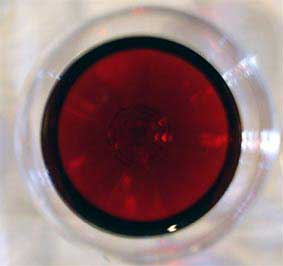
The first surprise was the colour – still a surprisingly deep red, without anything like as much browning as I would have expected from a wine of this age.  The nose was very clean, combining the typical blackcurrant aromas I had expected, but with a very distinctive scent of tobacco – a definite touch of Monte Cristo Cuban cigars!

The taste was smooth and complex, with the fine tannins having mellowed and softened – rich, soft blackcurrant fruit with a touch of cedar.  Excellent depth of flavour – and full of subtle complexity that was difficult to describe.

The label had the following account of the wine: “The 1995 season was long and dry.  The vines carried a small crop, with intensely powerful fruit flavours and fine grained tannins.  The resultant red wines represent the ultimate in Margaret River wines. Intense cassis and concentrated mulberry are beautifully integrated with the toasty characters from 24 months maturation in French oak.  Its intense amount of flavour, complexity and abundance of fine tannin augur extremely well for a long and rewarding life.  While it will be drinking well from 1999 it will be at its sublime best in 12 years time and beyond”. [13.9% alc/vol].

So, if you can find a bottle, it is definitely worth buying – and drinking – although I guess there cannot be many bottles left of this really lovely wine!

1 Comment

Filed under Wine