
Digital Inclusion in an Unequal World: An Emancipatory Overview (2026)

This book is for all those who want to ensure that the world’s poorest and most marginalised people and communities can benefit from the use of digital technologies, rather than being further marginalised and enslaved through them. It diagnoses why these technologies are increasing inequalities rather than reducing them and it concludes with a clear responsibilities-based manifesto for individuals, governments, civil society and private sector companies.


DigitaI Inequalities in an Unequal World: An Emancipatiry Manifesto has been written in an engaging style and is intended for:
- Government officials and Regulators who are committed to developing policies and practices that benefit all their citizens
- Executives in private sector companies who wish to innovate and develop new digital tech that is accessible and benefits everyone
- Those working within the UN system and other international agencies advising governments about the wise use of digital tech
- Leaders of civil society organisations seeking to support or implement sustainable and equity-focused digital interventions
- Researchers and students in the broad field of digital tech who want to learn more about the reality rather than the rhetoric of digital tech and international development
Vignettes
Thirty-one authors have contributed short vignettes to Digital Inclusion in an Unequal World to illustrate many of the book’s main themes, and these provide rich colour and insight to support its arguments. They are all available here, together with audio recordings by the authors.


What are people saying about Digital Inclusion in an Unequal World?
Read what people are saying about this important new book here.


Chapters
To read overviews of Digital Inclusion in an Unequal World‘s seven chapters click here. A draft .pdf version of the introductory chapter is also available here.


A visual interpretation of the book’s themes by the Indian cartoonist Alok Narantar

So grateful to the amazing award-winning Indian cartoonist Alok Nirantar (see @cartoonistalok) for sharing this challenging cartoon as a visual interpretation of the themes underlying Digital Inclusion in an Unequal World (Routledge 2026). This image captures many aspects of the book, raising questions about who really benefits from digital tech (represented by the mobile phone): a rich young boy surfs the Internet, as an older and poorer man tries to hold on at the back to grasp some benefits; the direction of travel from the economically poor village to the smart city (shown below the mobile phone) also hints at the wider spatial implications of the processes of digitalisation.
For a quick summary of the conclusions, watch and listen to this short video

Click on the image to watch and listen to the video
Building on…
Digital Inclusion in an Unequal World: An Emancipatory Manifesto forms the third part of an unintended trilogy, and builds on two of Tim Unwin’s earlier books on digital tech and development.

Tim Unwin (ed.) (2009) Information and Communication Technology for Development, Cambridge: Cambridge Univeristy Press.
“the book is a distinguished piece of writing and a must read for development professionals and researchers working in the field of ICTs” (D.K. Upadhyay in CEU Political Science Journal)
“ICT4D should be warmly welcomed as the first book that brings some considerable order and authority to the field. It is thorough, accessible, rich with examples, and deserves to be read by a wide swathe of the development community” (Jeffrey James in Journal of the American Society for Information Science and Technology).

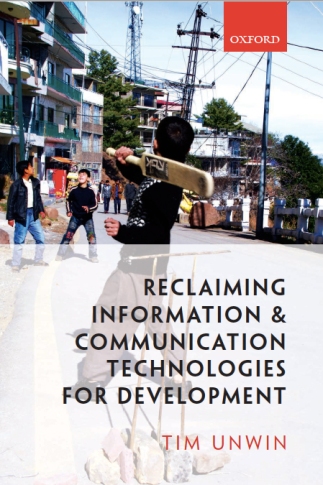
Tim Unwin (2017) Reclaiming Information and Communication Technologies for Development, Oxford: Oxford University Press
“It is a volume that should guide and inspire leadership and reorientation across many bodies” (Roy Colle, in Journal of Development Communication)
“If you’re less interested in inputs & outputs and would prefer a critical analysis of which interests are driving ICT4D then look no further than this offering from @timunwin in which he argues that development is really serving ICT interests (D4ICT)” (Tony Roberts, Institute of Development Studies).
Learn more from the flyers!
Folding A4 flyer

Alternative folding A4 flyer



 Tim Unwin's Blog