ICTs, sustainability and development

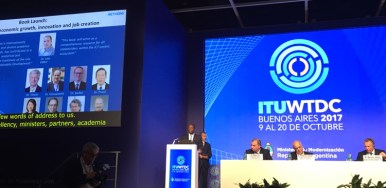
LaunchI am delighted to see my chapter on ICTs, sustainability and development just published in the ITU’s new book on ICT-Centric Economic Growth, Innovation and Job Creation launched yesterday at the World Telecommunication Development Conference (WTDC) in Buenos Aires.  This was part of a fascinating project that emerged when Dr. Ahmed Sharafat (Professor of Electrical and Computer Engineering at Tarbiat Modares University, Tehran, Iran) and Dr. Eun-Ju Kim (from the ITU) brought together a group of academics from across the world to explore issues around the ways through which ICTs can contribute to the Sustainable Development Goals (SDGs), focusing especially on economic growth and employment.  We held several meetings together over the last year, and particularly met up for a fortnight in Geneva in January 2017 to work through ideas and share drafts of manuscripts.
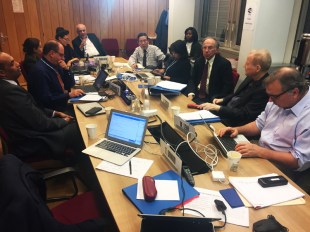
IMG_8860 smallIt is the first time I have actually worked on such a collectively authored project, and its publication says much about the willingness of all involved to collaborate supportively together under the leadership of Ahmed and Bill Lehr, who was later brought on board to co-edit the book.  Each of us took the lead on a single chapter, but everyone contributed to the ideas contained within the book.  The process of negotiation and discussion around the concepts and ideas within each chapter was fascinating, especially since it required us to hone our arguments very finely and precisely.  Most of the contributors were economists, and although at times I struggled with accepting some of their arguments, I know that their contributions very much improved the chapter on which I led.  Moreover, I am very grateful to Ahmed as editor, for letting me write what I did, since it enabled me to craft my most critical piece of work on the sustainability of the ICT sector.
ICT4SDGThe second chapter (on which I led) examines the interface between ICTs and sustainability, especially focusing on environmental issues and the conditions that need to be in place for ICT initiatives to be sustainable socially and economically. It focuses specifically on the importance of universal infrastructure, the affordability of technologies, the need for appropriate skills and awareness, and the importance of locally relevant content. For these to be delivered, the chapter emphasises that those who develop policies and implement programmes and projects to use ICTs to promote sustainable development need to address issues of empowerment, focus on the needs of the poorest, develop innovative technological solutions and new business models, legislate new kinds of regulation through which governments facilitate the ICT and telecommunication sector, and ensure that there is effective security and resilience within the systems being developed. The chapter concludes with a brief analysis of the role of multi-stakeholder partnerships in implementing such initiatives.

Where I think it makes the most significant new arguments is at the interface between ICTs and sustainability.  It does this in three main contexts:

  1. First, although this is indeed a book published by the ITU, a UN agency, and we therefore had to be very careful in our arguments, the chapter does nevertheless challenge some of the assumptions behind, and implementation of, the SDGs. In particular it draws attention to the tensions between sustainability (implying maintenance or stability) and development (implying change or growth).
  2. Second, it provides a strong critique of the environmental credentials of the ICT sector.  For example, while it acknowledges that some companies have sought to show their environmental concerns through delivering on carbon emissions,  it notes that there has been no comprehensive and rigorous environmental audit of the sector as a whole.  In particular, I recall some challenging discussions during our work on the book about the increasing amount of debris accumulating in space as a result of satellite launches, and I am pleased that colleagues eventually allowed me to include an, albeit toned down, section on this, which argues that space pollution should indeed be included as an environmental impact.
  3. Third, the chapter argues strongly that many of the main business models adopted by the private sector in rolling out ICTs are fundamentally unsustainable.  It is therefore contradictory to assert that ICTs are an important vehicle through which the Sustainable Development Goals can be implemented (even if it is accepted that these can indeed reduce poverty).  To give but one example, the mobile phone and app/content sectors function as an ever increasing spiral of unsustainability.  New devices require new apps and operating systems, which then in turn require another generation of new devices with more memory and functionality.  Hence, instead of the old landline telephones that lasted for years, most people are now encouraged to purchase new upgraded phones every couple of years.  This is unsustainability built in by the very design of the technology and business models, and it is enhanced and encouraged by the companies’ focus on marketing, modernity and fashion.

Several case studies to support these chapters are also included in the book, but sadly two of mine had to be excluded because of space, and so I will shortly be posting them separately here on my blog.

Once again, I would like to take this opportunity to thank everyone involved in this co-created book, many of whom have now become good friends.  It was a privilege to work with you all on this project, and I am so grateful to colleagues in the ITU for inviting me to participate.
 

3 Comments

Filed under ICT4D, SDGs, Uncategorized

Reflections on ICTs, the SDGs and innovation adoption

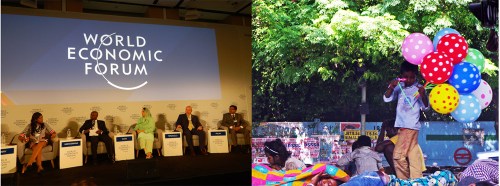
The contrast between attending a series of side events around the UN General Assembly in New York immediately following a marvellous two weeks in India has made me reflect again on the rhetoric and reality of using ICTs for development, especially in the interests of the poorest and most marginalised.

Contrast

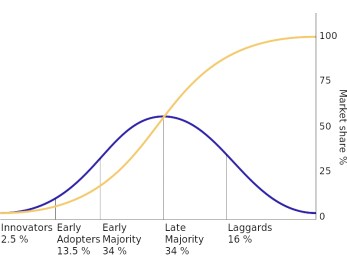
My latest book, Reclaiming Information and Communication Technologies for Development (OUP, 2017) provides an overview of the interests underlying the use of ICTs for “development”, and what needs to be done so that the poorest and most marginalised can indeed benefit from ICTs.  However, working in India, and then listening to the rhetoric of the rich and famous in New York makes me wonder whether I was sufficiently vehement in what I wrote in that book.  It also makes me return to thinking about the research I did 30 years ago on innovation adoption by farmers.  This convinced me that Rogers’ well accepted theoretical arguments around innovation adoption, the S-shaped curve (see below), and the classification of people into categories (innovators, early adopters, really majority, late majority and laggards) is fundamentally flawed.

Rogers

There was very widespread agreement amongst the world’s leaders meeting in New York last week – and most other people as well – that ICTs can contribute very significantly to delivering the Sustainable Development Goals (SDGs), and that these will eliminate poverty.  The challenge, according to them, is how to connect the “next billion” to the Internet (mobile broadband), or in Rogers’ terminology the “late majority”.  As I have argued elsewhere, this will actually further increase global inequality, and most attention should instead be paid  to connecting the “first” (because they are most important) billion, or what Rogers termed the “laggards”.

The interests underlying connecting the next billion

The global focus on rolling out broadband to deliver the SDGs (even if that was possible) is not primarily in the interest of the world’s poorest people.  Instead it is mainly driven by:

  • private sector corporations and companies, from ISPs and mobile operators to the powerful multi-service giants such as Facebook and Google, who are all primarily interested in expanding their markets and profits;
  • national governments, eager to reduce costs through the use of digital technologies (although this is often a flawed assumption), as well as to control  “their” citizens;
  • UN agencies, keen to have a role to play in delivering the SDGS; and
  • NGOs, wanting to publicise their work more widely, and continue to receive project funding for their ICT-based initiatives.

These have little to do with the real interests and needs of the poorest and most marginalised.  The language of global corporations and governments is nearly always about providing access and creating demand for digital services.  But why should poor people necessarily want to go online?

Reasons not to be online…

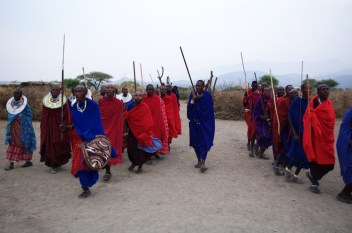
Masai welcomeI recall a wonderful conversation a couple of years ago with a Maasai chief in Tanzania. He was speaking with a group of techies about the use of mobile devices, and they were trying to persuade him of the value of mobile phones, even just to call his friends in a village the other side of the hills.  He, wisely, remained unconvinced.  For him, walking across the hills, enjoying the landscape, spending time experiencing the physicality of nature, and just thinking about life, were a crucial part of going to, and speaking with, his friend in the next village.

For the wise poor and marginalised, there are many reasons for not being connected:

  • they remain outside a world where increasingly all human actions are monetised by  profit seeking corporations who use digital technologies to track their users and generate profit from selling such information;
  • they remain free from the prying eyes of governments, whose actions may not be in their interests;
  • there is little of interest to them in solving their real needs on the Internet;
  • they do not have to spend large amounts of their very limited cash on paying for digital services that they do not really need;
  • they do not suffer from the increasing amount of online abuse and harassment from trolls and others seeking to make them suffer;
  • their small amounts of cash are not subject to online theft from hackers of mobile money systems;
  • they do not become entrapped in a social media world, where every tweet or blog can adversely influence  their thoughts and senses of well-being;
  • they do not suffer from endless messages or e-mails, the senders of which increasingly expect an immediate response; and
  • they can enjoy being truly human in the analogue physical world (of all the senses), rather than trading this for the synthetic, and much less adequate digital virtual world (of mainly the two senses of sight and sound).

To be sure, there are many advantages of being connected, but the above list (and there are numerous other reasons that could be added) emphasises that there are also many negative aspects of Internet use, especially for the poor and marginalised.

The poor are not ignorant laggards who need to be convinced to go online…

One of the fundamental flaws of the widely accepted innovation adoption model proposed by Rogers is that it classifies people into “heroic” innovators and “ignorant” laggards; it is something about the people that influences whether or not they adopt an innovation, such as mobile broadband.  Such a view is held by many of those who seek to promote the global roll-out of the Internet: those who use the latest technologies are seen as being wise, whereas those who do not are seen as being lazy, ignorant laggards.

Rogers’ formulation is fundamentally problematic because it suggests that it is something about the people themselves that determine whether or not they are leaders or laggards.  This largely ignores the structural factors that determine whether people adopt something new.  With the adoption of agricultural innovations, for example, many poor people act perfectly rationally, and choose the option that they consider suits them best.  Poor people often make very rational, wise decisions not to adopt an innovation, often because the innovation increases the risks of crop failure, and they cannot afford this risk.  Moreover, if they do not have access to innovations it is scarcely surprising that they do not adopt them; the spatial distribution of outlets for herbicides, hybrid seeds or inorganic fertilizers is the main factor influencing whether people adopt them, rather than something about their propensity to innovate.  In the ICT sector, it is hardly surprising that people living in areas without electricity, let alone connectivity, do not see the need to have the latest generation of smartphone connected to the Internet.

If progress is to be made in helping poor and marginalised people benefit from the Internet, it is essential to do away with this flawed model of innovation adoption, and understand instead the structural factors and interests underlying why wise poor people, who know the contexts of their poverty very well, do not choose to adopt such technologies.  The rich elites of the world could begin by trying to understand the real conditions of poverty, rather than simply believing that ICTs can eliminate poverty through the SDGs.

Development in the interests of the poor

children 2ICTs will never deliver on reducing inequalities in the world unless there is a fundamental sea-change in the attitudes of those leading the global private sector corporations that currently shape the world of the Internet.  It is perfectly logical for them to sign up to the SDGs formulated by the UN system, and to seek to show that expanding their digital empires will necessarily deliver the SDGs.  This is a powerful additional weapon in their armoury of market expansion and profit generation.  The problem is that these agendas will continue to increase inequality, and as yet remarkably little attention has been paid to how ICTs might actually help deliver SDG10.  Until corporations and governments really treat the link between ICTs and inequality seriously, peoples of the world will become every more divided, and if poverty is defined in a relative sense then poverty will actually increase rather than decrease as a result of roll out of the Internet.


3 Comments

Filed under Africa, agriculture, Asia, Development, Education, Entrepreneurship, ICT4D, India, Inequality, Rural, SDGs, Urban

Night life at Hauz Khas

One of the many pleasures of being at IIT Delhi over the last fortnight was its proximity to Hauz Khas “village”, with its many restaurants and sites to explore.  Originally, Hauz Khas was part of Siri, the second medieval city and fort of the Delhi Sultanate, dating mainly from the 14th century, and it was built alongside the royal water tank that gave it its name, Hauz meaning “water tank” and Khas meaning “royal”. Many buildings were constructed here by Firuz Shah, including a madrasa, a mosque, his own tomb, and domed pavilions, most of which were built soon after he became ruler in 1351.  After years of decay, the area was redeveloped in the 1980s, and efforts have been made to restore the lake and its surrounding deer park as a tourist attraction and commercial area.

Hauz Khas has developed rapidly over the last decade, and is now a popular area for eating and boutique shops. After long days of meetings and teaching at IIT Delhi, it was good to be able to relax and sample the restaurants.  One evening in the pouring monsoon rain we ate delicious south Indian food at Naivedyam (dosas, oothappam and idli), and on another it was good to catch up with Commonwealth Scholarship alumni at Rang de Basanti Urban Dhaba (for a wide range of traditional food typical of the roadside dhabas of India).  My last night in Delhi on this trip was to the very different night-club atmosphere of Hauz Khas Social, where I felt the oldest person there by far!  However, the food and drink were  good, and it was nice to relax with a view out towards the lake (although the loudness of the music did make conversation difficult!).

I hope that the pictures below capture some of the atmosphere of this colourful and vibrant part of modern Delhi.

This slideshow requires JavaScript.

Thanks so much once again to Anushruti Vagrani for taking me to places I don’t think I would have been likely to venture by myself!

Leave a comment

Filed under India, Photographs, Restaurants

Nehru Place, Delhi: a digital hive

I went seeking some new and interesting ICTs on my last full day in Delhi, and my colleague Anushruti kindly therefore took me to Nehru Place in South Delhi.   I had never been there before, and it turned out to be a fascinating exploration of Delhi’s digital world; a hive of activity, with hundreds of small tech companies each competing for business, seemingly mainly selling mobile devices or offering laptop and phone repair services.

Nehru Place was built in the early 1980s as a commercial district, focusing primarily on the financial and business sectors.  However, as new financial centres have emerged across the city, its traditional role has all but vanished, and it has now been taken over by numerous small ICT businesses; it has often been described as the IT hub of South Asia.  It has a very informal atmosphere, with people also selling software (often pirated) and other small digital goods as pavement vendors on the wide streets between the buildings.

It is a very male dominated environment, and I was also fascinated by the gendering of the ICT advertisements on display (there is definitely a research project to be done on this); the dominance of a few corporate names on the hoardings, mainly Chinese, such as Lenovo, Oppo and Vivo, was a further reminder that India does not yet have much indigenous ICT manufacturing.  The prices of many of the goods on sale were also surprisingly high (India is definitely not the place to buy Apple laptops!).

As the photographs below show, Nehru Place has a  run down feeling to it, but the informality and vibrancy are clearly indicative of a lively digital scene, and it very much reminded me of a digital beehive, with everyone labouring away in their own little cell of the honeycomb that is Nehru Place.  Sadly, I couldn’t actually find what I was seeking to purchase, despite being directed from one shop to another in the hope that I would be able to!

This slideshow requires JavaScript.

1 Comment

Filed under 'phones, ICT4D, ICTs, India, Photographs

Alawalpur: farming, mobile ‘phones and cattle

On a very hot Sunday afternoon yesterday, with temperatures reaching the high 90os F (high 30os C), colleagues (Priya Chetri, Srishti Minocha and Anushruti Vagrani) at IIT Delhi kindly took me out into the Haryana countryside where they are conducting a baseline survey on the use of mobile devices by farmers.  In the first instance, this is investigating how helpful meteorological forecasts are to the farmers, but in the longer term it is also going to explore how sensors might be able to provide more refined information that would enable farmers to increase yields and thus profitability.

This was a great opportunity to immerse myself once again in the sights, sounds, smells, tastes and touch of the Indian countryside.  We spent most of our time talking with farmers in the large village of Alawalpur, but after the interviews were over we were also shown one of  the village’s special sites, the Baniewala Mandir.  The temple itself was fascinating, but I had never expected to find the 500 cattle that are so well cared for alongside.  The freshly made chai massala made from their milk after the interviews were done was absolutely delicious!

I hope that the following pictures reveal something of the adventure.  I learnt so much, and am very grateful to Priya, Srishti and Anushruti for taking me there and to Dr. Upasna Sharma for arranging the trip.

This slideshow requires JavaScript.

Leave a comment

Filed under ICT4D, India, Photographs, Rural

Dilli Haat

I’m amazed that on my previous visit to Delhi no-one mentioned that I might like to explore the craft village of Dilli Haat in southern Delhi.  Perhaps I was previously simply too busy working!  However, one day last week over breakfast in the Faculty Guest House at IIT Delhi, a colleague suggested that it was not far away, and if I had time I should try to visit.  So, I made time this Saturday afternoon, with the temperature well over 95o F (35oC), to set off and explore.

The Haat (market), which opened in 1994, is run by the Delhi Tourism and Transportation Development Corporation, and includes craft stalls from many different parts of India, as well as food sellers, and a stage.  Having paid a small entrance fee (100 INR for a foreigner), one is free just to wander and explore.  In some parts of the market, brightly coloured cloth covers the alleyways, and in others the stalls are set along a sort of arcade.  There is a huge range of craft produce from many different regions of the country for sale, including clothes (mainly for women), jewellery, woodwork, pottery, spices, brass goods, leather work, musical instruments, and mother of pearl bowls.  One of the nicest things is that it was not very crowded, and few traders were overly-persistent in trying to make a sale.  Those near the back of the market clearly received less business, and so some good deals can be struck there, but other traders stated clearly that there were fixed prices.  Certainly, there is a premium to be paid over the price of goods that can be found elsewhere in the city, but the quality is good, and having so much to choose from in one place makes shopping for gifts most enjoyable!

The diversity of products, the richness of colour, as well as the taste and smells of the market all made for a wonderful couple of hours exploration, and I hope that the pictures below capture something of the essence of the place.

This slideshow requires JavaScript.

Thanks so much once again to Anushruti Vagrani for taking me there, and helping me negotiate!

Leave a comment

Filed under India, Markets, Photographs

The dogs of IIT Delhi campus

I am greatly enjoying living on the IIT Delhi campus, but have to admit that I am uneasy when walking past the many dogs that are usually roaming around in packs, seemingly on the look out for trouble!  There is always a sense of trepidation walking past them when they block the entrance to a building, or lie across the path!  Waking up in the night to hear them viciously barking, is also not exactly soothing!

Temperatures rose today, and I was surprised to see most of the dogs apparently asleep in the late afternoon sun.  This was definitely an opportunity to take my courage into my hands and photograph them!

This slideshow requires JavaScript.

Leave a comment

Filed under India, Photographs

Chandni Chowk

My beautiful pictureThe first time I visited Chandni Chowk (Moonlight Square) in Old Delhi was more than 40 years ago in 1976 (picture to the right).  I remember its vibrancy, the vivid colours, the energy, the diversity of smells, the complexity of everything that was there.  It fascinated me.  I got lost.  I wandered.  I explored back alleyways.  I emerged, having felt something of the depth of Delhi; the ever living past in its present.

I had not been back until two days ago.  Much had changed; little had changed.  I was struck anew by the splendour of some of the old buildings; the mix of religions; the melting pot of cultures that was Old Delhi; the old wooden doors; the delicious food; the wonderful colours, especially of the saris; the dogs and cat; the pale skinned mannequins.  I had to go there, just to feel, smell, hear, see and taste Old Delhi; a special treat was to eat at Parawthe Wala on Paranthe Wali Gali – it is most definitely worth searching out for every imaginable sort of paratha!

This slideshow requires JavaScript.

I was so spoilt by my friend and colleague Anushruti Vagrani from IIT Delhi, who took me back to Chandni Chowk, and had patience with me as I just absorbed anew everything about the market.

Leave a comment

Filed under India, Photographs

“Indian Treasures”: exhibition at gettyimages gallery in London

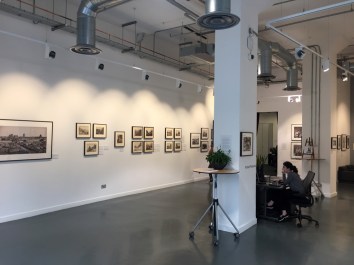
IT1The small Indian Treasures exhibition on until the 7th October at the gettyimages gallery on Eastcastle Street (near Oxford Circus tube station) in London, is an amazing opportunity to see photographs of “India” dating from the mid-19th century.  It has been well curated, and represents a collection of very diverse photographs, drawn mainly from a European gaze on “British India”.  However, the collection also includes photographs from Indian photographers, and illustrates seven themes: photographs by Samuel Bourne between 1863 and 1870; sun pictures from the 19tb century, illustrating both landscapes and people; methodologies, including four tinted photocrom prints; images by the photojournalist Felice Beato; studio portraiture; Princes of India; and the work of the London Stereoscope Company.

The exhibition raises so many fascinating questions, especially at a time when we “celebrate” 70 years of the independence of India and Pakistan, and remember the many atrocities that accompanied the birth of these two countries.  In particular, it highlights the way in which imagery was used to reinforce cultural stereotypes, and also the use of photography in the 19th century to capture what are seen as particular racial types.

IT2I was particularly struck by comparisons between the countries in the 19th century and how they are seen today:

  • Most photographs displayed were of India, rather than Pakistan, although mosques in Lucknow and Delhi were indeed depicted alongside temples from Tamil Nadu;
  • The pictures generally depict a very clean and tidy India, with relatively smart new buildings and largely empty streets, a far cry from the hustle and bustle of the modern sub-continent;
  • The mountain scenes from the Himalayas, which are a wonderful resource for learning more about environmental change, and especially glacial retreat;
  • Jantar Mantar (described as the Old Observatory) near Delhi is shown apparently in an almost empty landscape, far removed from the urban  landscape that surrounds it today;
  • The shell marks on the walls of the Shahi Mosque at Qudsia Bagh serve as a reminder of the violence and atrocities of the war known by the British as the “Indian Mutiny”; and
  • It is a very male view – especially of the haunted faces of teh seemingly aloof and distant India princes; women appear mainly as nautch girls, although there is also a fascinating image of women at a bathing  ghat on the Ganges near Benares.

Above all, I was left with huge admiration of the work of photographers from a century and a half ago, who dragged their cameras and equipment across the continent to “capture” these haunting memories of India’s treasures.  This is an exhibition to be savoured and enjoyed.  Not only are the images stunningly evocative, but they also force us to rethink our understandings of the British Raj.


Leave a comment

Filed under India, Photographs

SDG Stories: reflections on sustainability of ICT systems

E_Logo_No UN Emblem-01In the run-up to this year’s UN General Assembly, the Office of the DG of the UN Office in Geneva has launched a novel initiative on big conversations driving the big goals of the SDGs as part of their Perception Change Project.  The UNESCO Chair in ICT4D is delighted to have been invited to participate in this initiative, alongside other leading figures in the ICT4D world including Houlin Zhao (SG of the ITU, and one of our Honorary Patrons), Kathy Calvin (President and CEIO, UN Foundation), and Nicholas Negroponte (Founder MIT Media Lab).
Our stories are about the question “What are the biggest hopes and challenges we face in providing reliable ICT access to communities as we work towards improved sustainable development?

This was my response:

Seeing the eyes of a group of street children in Ethiopia light up when I let them play with my laptop in February 2002 convinced me in an instant of the potential of technology to be used effectively for learning by some of the poorest people in the world.  However, the plethora of global initiatives that have been designed to use ICTs to contribute to reducing poverty through economic growth over the last 15 years have had the consequence of dramatically increasing inequality at the same time.  The poorest and most marginalised have not benefited sufficiently from the promise of ICTs.

Few people pay appropriate attention to the dark side of technology, and yet we must understand this, and change it, if this potential is fully to be realised for all.  In the context of the SDGs, there is a fundamental challenge.  To be sure ICTs can contribute to the achievement of the SDGs, but few people sufficiently highlight their unsustainability: ICTs have seriously negative environmental impacts, and their usual business model is built on a fundamentally unsustainable logic.  In terms of environmental impact, for example, they have contributed to substantially increased electricity demand, and the amount of waste in space is now presenting very serious threats to future satellite deployment.  The business model, whereby people are encouraged to replace their mobile phones every couple of years, and new hardware often requires the next generation of software, which in turn then requires new hardware, is good for business, but not for sustainability.

If we are serious about using ICTs for sustainable development, we must do much more to address negative aspects such as these, so that the poorest individuals, communities and countries can indeed benefit.

Follow the stories at: http://www.sdgstories.com, or on Twitter using #sdgstories.E_Logo_No UN Emblem-01

Leave a comment

Filed under ICT4D, SDGs, Uncategorized