Continuing digitizing the slides from my research and travels in India in 1976 and 1977, I share here some pictures of small towns and villages in what was then South Bihar (now Jharkhand) and West Bengal. These include pictures of the towns of Chaibasa and Chakradharpur, as well as several villages in this beautiful part of India. I remember particularly the paintings on the walls of the houses in the villages, and some of the writing on them as well, not least the slogan “Fight for malaria”! The pictures here also show the sadness of smallpox, with the solitary gravestone, and also other such stones which I was told marked village boundaries. There are also images of tile and brick making, and the sequence closes with a village school, which I had forgotten about but now makes me think of all of the other schools, particularly in Africa, that I have visited in the last 15 or so years. Other rural, agricultural scenes will follow in a future post!
Small towns and villages in South Bihar and West Bengal, 1976 and 1977
Filed under India, Photographs
Jamshedpur 1976-1977
Continuing my visual reflections of India in 1976 and 1977, I spent much of my time there based at the Xavier Labour Relations Institute in Jamshedpur, in what was then South Bihar, now Jharkhand. This was an amazing oasis of peace, calm and intellectual discourse, at the edge of the “steel town” of Jamshedpur. Interestingly, my photographs do not entirely capture my memories, but they do reflect the smart houses of the rich, the dominance of the Tata Iron and Steel Company (TISCO), the Jubilee Gardens park, the street stalls where I bought a copy of the Communist Manifesto, the vibrant somewhat frightening energy of the Muharram celebrations, the hazardous scaffolding, the peace of the nearby river, and the Gurkha guards who befriended me at the XLRI. They are still vivid in my mind, and I hope that by sharing these images from 40 years ago others may glimpse into the past of this fascinating town.
Filed under India, Photographs
Scenes from Delhi in 1976
Continuing to digitize some of my old photographs, I share here pictures of Delhi in 1976. It is strange to think that it was nearer to independence in 1947 when I first visited (only 29 years), than it is now to when I first visited (40 years). So much remains the same in Delhi, but much has also changed. I note in particular the vast number of new cars – and the consequent air pollution. But it still remains an amazing city, with such fond memories. I look forward so much to my next visit.
Filed under ICT4D, India, Uncategorized
“Reclaiming ICT4D” – in the beginning
It is always exciting submitting a book manuscript to a publisher, and today is no exception! I have at last finished with my editing and revisions, and sent the manuscript of Reclaiming ICT4D off to Oxford University Press. I just hope that they like it as much as I do! It is by no means perfect, but it is what I have been wanting to write for almost a decade now.
This is how it begins – I hope you like it:
“Chapter 1
A critical reflection on ICTs and ‘Development’
This book is about the ways through which Information and Communication Technologies (ICTs) have become entwined with both the theory and the practice of ‘development’. Its central argument is that although the design and introduction of such technologies has immense potential to do good, all too often this potential has had negative outcomes for poor and marginalized people, sometime intended but more often than not unintended. Over the last twenty years, rather than reducing poverty, ICTs have actually increased inequality, and if ‘development’ is seen as being about the relative differences between people and between communities, then it has had an overwhelming negative impact on development. Despite the evidence to the contrary, I nevertheless retain a deep belief in the potential for ICTs to be used to transform the lives of the world’s poorest and most marginalized for the better. The challenge is that this requires a fundamental change in the ways that all stakeholders think about and implement ICT policies and practices. This book is intended to convince these stakeholders of the need to change their approaches.
It has its origins in the mid-1970s, when I learnt to program in Fortran, and also had the privilege of undertaking field research in rural India. The conjuncture of these two experiences laid the foundations for my later career, which over the last twenty years has become increasingly focused on the interface between Information and Communication Technologies (ICTs) on the one hand, and the idea of ‘development’ on the other. The book tells personal stories and anecdotes (shown in a separate font). It draws on large empirical data sets, but also on the personal qualitative accounts of others. It tries to make the complex theoretical arguments upon which it is based easy to understand. Above all, it has a practical intent in reversing the inequalities that the transformative impacts of ICTs have led to across the world.
I still remember the enjoyment, but also the frustrations, of using punch cards, with 80 columns, each of which had 12 punch locations, to write my simple programs in Fortran. The frustration was obvious. If you made just one tiny mistake in punching a card, the program would not run, and you would have to take your deck of cards away, make the changes, and then submit the revised deck for processing the next day. However, there was also something exciting about doing this. We were using machines to generate new knowledge. They were modern. They were the future, and we dreamt that they might be able to change the world, to make it a better place. Furthermore, there was something very pleasing in the purity and accuracy that they required. It was my fault if I made a mistake; the machine would always be precise and correct. These self-same comments also apply to the use of ICTs today. Yes, they can be frustrating, as when one’s immensely powerful laptop or mobile ‘phone crashes, or the tedium of receiving unwanted e-mails extends the working day far into time better spent doing other things, but at the same time the interface between machines and modernity conjures up a belief that we can use them to do great things – such as reducing poverty.
Figure 1.1 Modernity and the machine: Cambridge University Computer Laboratory in the early 1970s.
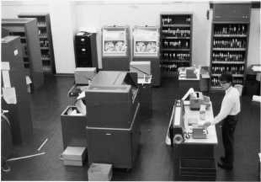
Source: University of Cambridge Computer Laboratory (1999)
In 1976 and 1977 I had the immense privilege of undertaking field research in the Singbhum District of what was then South Bihar, now Jharkhand, with an amazing Indian scholar, Sudhir Wanmali, who was undertaking his PhD about the ‘hats’, or periodic markets, where rural trade and exchange occurred in different places on each day of the week (Figure 1.2). Being ‘in the field’ with him taught me so much: the haze and smell of the woodsmoke in the evenings; the intense colours of rural India; the rice beer served in leaf cups at the edges of the markets towards the end of the day; the palpable tensions caused by the ongoing Naxalite rising (Singh, 1995); the profits made by mainly Muslim traders from the labour of Adivasi, tribal villagers, in the beautiful forests and fields of Singbhum; the creaking oxcarts; and the wonderful names of the towns and villages such as Hat Gamharia, Chakradharpur, Jagannathpur, and Sonua. Most of all, though, it taught me that ‘development’ had something powerful to do with inequality. I still vividly recall seeing rich people picnicking in the lush green gardens of the steel town of Jamshedpur nearby, coming in their smart cars from their plush houses, and then a short distance away watching and smelling blind beggars shuffling along the streets in the hope of receiving some pittance to appease their hunger. The ever so smart, neatly pressed, clothes of the urban elite at the weekends contrasted markedly with the mainly white saris, trimmed with bright colours, that scarcely covered the frail bodies of the old rural women in the villages where we worked during the week. Any development that would take place here had to be about reducing the inequalities that existed between these two different worlds within the world of South Bihar. This made me look at my own country, at the rich countries of Europe, and it made me all the more aware of two things: not only that inequality and poverty were also in the midst of our rich societies; but also that the connections between different countries in the world had something to do with the depth of poverty, however defined, in places such as the village of Sonua, or the town of Ranchi in South Bihar.
Figure 1.2: hat, or rural periodic market at Hat Gamharia, in what was then South Bihar, 1977 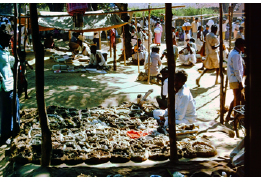 Source: Author
Between the mid-1970s and the mid-2010s my interests in ICTs, on the one hand, and ‘development’ on the other, have increasingly fascinated and preoccupied me. This book is about that fascination. It shares stories about how they are connected, how they impinge on and shape each other. I have been fortunate to have been involved in many initiatives that have sought to involve ICTs in various aspects of ‘development’. In the first instance, my love of computing and engineering, even though I am a geographer, has always led me to explore the latest technological developments, from electronic typewriters that could store a limited number of words, through the first Apple computers, to the Acorn BBC micro school and home computer launched in 1981, using its Basic BASIC programming language, and now more recently to the use of mobile ‘phones for development. I was fascinated by the potential for computers to be used in schools and universities, and I learnt much from being involved with the innovative Computers in Teaching initiative Centre for Geography in the 1990s (see Unwin and Maguire, 1990). During the 2000s, I then had the privilege of leading two challenging international initiatives that built on these experiences. First, between 2001 and 2004 I led the UK Prime Minister’s Imfundo: Partnership for IT in Education initiative, based within the Department for International Development (UK Government Web Archive 2007), which created a partnership of some 40 governments, private sector and civil society organisations committed to using ICTs to enhance the quality and quantity of education in Africa, particularly in Kenya, South Africa and Ghana. Then in the latter 2000s, I led the World Economic Forum’s Partnerships for Education initiative with UNESCO, which sought to draw out and extend the experiences gained through the Forum’s Global Education Initiative’s work on creating ICT-based educational partnerships in Jordan, Egypt, Rajasthan and Palestine (Unwin and Wong, 2012). Meanwhile, between these I created the ICT4D (ICT for Development) Collective, based primarily at Royal Holloway, University of London, which was specifically designed to encourage the highest possible quality of research in support of the poorest and most marginalized. Typical of the work we encouraged was another partnership-based initiative, this time to develop collaborative research and teaching in European and African universities both on and through the use of ICTs. More recently, between 2011 and 2015 I had the privilege of being Secretary General of the Commonwealth Telecommunications Organisation, which is the membership organisation of governments and people in the 53 countries of the Commonwealth, enhancing the use of ICTs for development.
Two things have been central to all of these initiatives: first a passionate belief in the practical role of academics and universities in the societies of which they are a part, at all scales from the local to the international; and second, recognition of the need for governments, the private sector and civil society to work collaboratively together in partnerships to help deliver effective development impacts. The first of these builds fundamentally on the notion of Critical Theory developed by the Frankfurt School (Held, 1980), and particularly the work of Jürgen Habermas (1974, 1978) concerning the notion of knowledge constitutive interests and the complex inter-relationships between theory and practice. The next section therefore explores why this book explicitly draws on Critical Theory in seeking to understand the complex role and potential of ICTs in and for development. Section 1.2 thereafter then draws on the account above about rural life in India in the 1970s to explore in further detail some of the many ways in which the term ‘development’ has been, and indeed still is, used in association with technology.”
Filed under 'phones, Accessibility, Africa, Caribbean, Commonwealth, Communication, Ethics, ICT4D, ICT4D general, India, Radio, Story-telling, Uncategorized
Fatehpur Sikri, January 1977
In January 1977 I was fortunate to be able to visit Agra, and took the opportunity to visit the amazing old city of Fatehpur Sikri, which was founded in 1569 by the Emperor Akbar, and served as the capital of the Mughal Empire from 1571 to 1585. It represents a wonderful amalgam of different architectural styles, but was abandoned shortly after its construction because the lake that supplied the city with water dried up, and increasing turmoil with the Rajputana areas made it insecure. I also particularly remember seeing a leper settlement just outside the city walls, but couldn’t bring myself to photograph the poverty and misery I saw there. Digitizing my slides from almost 40 years ago, I thought that others might like to see something of what I experienced there.
Filed under India, Photographs
Taj Mahal, January 1977
I had the enormous privilege of visiting India in 1976 and 1977, and in January 1977 went to Agra, from where I traveled the short distance to the Taj Mahal on the banks of the Yamuna River. It was a wonderful experience, and I particularly remembered the fine beauty of all the inlaid stone. Digitizing some of my slides, now almost 40 years afterwards, I just thought that it would be nice to share these here, so that others could enjoy the calmness and serenity of this beautiful mausoleum commissioned in 1632 by Shah Jahan to house the tomb of his favorite wife, Mumtaz Mahal.
Filed under India, Photographs
Reclaiming ICT4D
I am so relieved to have finished the first draft of my new book on ICT4D to be entitled “Reclaiming Information and Communication Technologies for Development” which is to be published by Oxford University Press. Now it is time to redraft and revise it in the light of all of the helpful comments that I have received from colleagues and friends – for which many thanks. Somehow, I also need to cut it in length, which is proving to be much more difficult than I had anticipated!
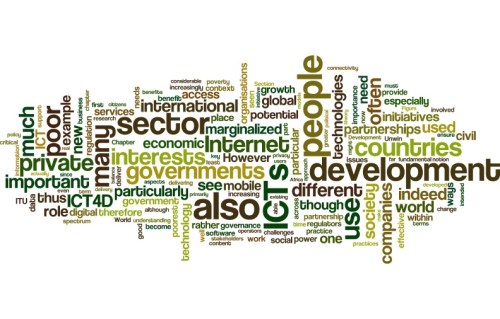
It is always fun to create wordles just to try to capture the essence of a book in an image, and so I thought I would share this to provide an overview of what I have written – and of course to whet potential readers’ appetitites. I guess that most of what I had hoped for has indeed been revealed, but of course the image does not capture the emphasis or the way in which I have referred to particular themes! It is good, though, to see the emphasis on people, development and ICTs!
 For those who would like a little more detail, this is the provisional Table of Contents – subject of course to revision:
- A critical reflection on ICTs and ‘Development’
- A ‘critical’ approach to ICTs for development
- Understanding ‘Development’
- ICT4D in theory and practice
- Reclaiming ICT for Development (ICT4D)
- Understanding the technologies
- An ever more converged and miniaturized digital world: technological and business implications
- Spectrum and their management
- From fixed line to wireless communication
- From voice to data: impacts of the digital transition
- On Openness and being Free
- Social Media and Over The Top services
- 5G and the Internet of Things
- Incubators, Digital Hubs and App Development
- The importance of a technical understanding
- The international policy arena of ICTs and Internet Governance
- Stakeholders in the international ICT arena
- The World Summit on the Information Society and the evolution of ICT4D multi-stakeholder dialogue in the context of the Sustainable Development Goals
- The differing interests of multi-stakeholderism: the ITU, ICANN and the IGF
- The future of multi-stakeholderism and interests in the Internet
- Partnerships in ICT4D: rhetoric and reality
- The idea of partnerships in development
- The emergence of Public-Private Partnerships
- ICT4D partnerships: a good case still remains
- Delivering effective multi-sector partnerships
- From regulation to facilitation: the role of ICT and Telecommunication Regulators in a converging world
- A balance of interests
- Technical aspects of ICT and telecommunication regulation
- Universal Service and Access Funds
- The challenge of revenue generation
- New models of facilitation in the interests of the poor
- Reflections on the dark side of ICT4D
- Privacy and security
- The dark side
- From ‘cybersecurity’ to resilience
- The big con: social media, Google and Big Data
- Dehumanization: cyborgs and the Internet of Things
- In the interests of the poor and marginalized
- …in the interests of the poorest and most marginalized
- ICTs and empowerment
- Technical options for empowering the poor and marginalized
- The role of governments and international organisations
- The power of multi-sector partnerships
- The Dark Side: managing security and resilience
- Enhanced learning, understanding and action
- Reclaiming ICTs for development
Filed under ICT4D, Uncategorized
Dehumanization: cyborgs and the Internet of Things
[Just written this, the beginning of Section 6.5 of my new book on ICT for Development – thought it might be of interest]
I distinctly remember once walking down Queen Victoria Street in London, and looking down through a window beneath street level to see row upon row of computers, each with their human attached, working away at delivering some unknown products. It so reminded me of my early readings of Marx’s (1976) Capital, and the dehumanization of labour through the factory system that was designed to extract yet greater surplus value for the capitalists. Although people like to think that they are in control of their ICTs, this is increasingly not the case. Office workers come into their open plan work spaces, and ‘their’ computers force them to log in so as to access the information and communication tools necessary to do their work.
All too often, people communicate together by mobile devices even when they are in the same room (Figure 6.1); the art and skill of face to face conversation is swiftly being eroded, mediated instead through technology. Internet addiction is now widely recognised as a compulsive-impulsive spectrum disorder (Block, 2008) involving excessive use, withdrawal, tolerance and negative repercussions (see also Cash et al., 2012), with rehabilitation centres being created across the world, from China to the USA, in order to try to help addicted people.
Figure 6.1: Young people communicating at the Hotel International and Terminus, Geneva, 2013
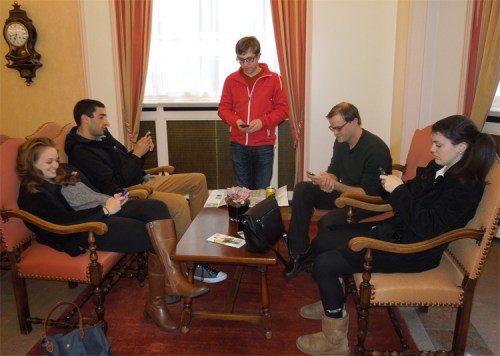
Source: Author, 19 May 2013 (taken with permission of all five people shown in the photograph).
One particularly prescient early image of the relationship between humans and technology is Villemard’s depiction in 1910 of how he thought a school might look in 2000, showing books being dropped into a machine that transforms the information, which then passes through electric cables into each pupil’s headsets. Conceptually, this is not that different from the online learning systems that now increasingly dominate classrooms on both rich and poor countries alike.
Figure 6.2: Villemard’s 1910 image À l’École, depicting how he thought a school might look in 2000.
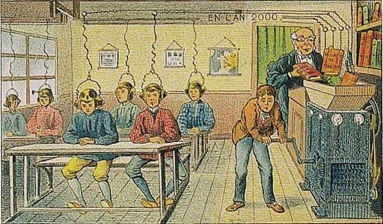
Source: http://expositions.bnf.fr/utopie/grand/3_95b1.htm, accessed 3 August 2016.
In the GSMA’s Mobile World Congress held in Barcelona in February 2014 smartwear was all the rage, and I remember thinking as I walked past Sony’s advertisement for Xperia on the metro platform wall (Figure 6.3) that there were things about my life that I would definitely not want to log, and would certainly not want others to have access to by hacking either my devices or the cloud servers where they might be stored. Yet countless people have purchased such devices, and regularly have their health data automatically uploaded so that companies can analyse it and generate profits without paying them anything in return. This is an extreme example of Big Data surplus extraction, because not only do people have to buy the devices in the first place, and sometimes the software, but they also then give the data to the companies for no recompense, and generally receive little back individually that might actually enhance their health.
Figure 6.3: Sony’s poster “Log your life with SmartWear” on the wall of a metro station in Barcelona during Mobile World Congress, 2014

Source: Author, 28 February 2014
[now time to write the actual section that explores the increasingly interwoven character of machines and humans, especially as ICTs are increasingly being advocated as a way to enhance development]
Filed under ICT4D, Photographs, Uncategorized
Response from President Juncker on UK’s EU referendum
I was, and still very much remain, deeply opposed to the referendum on whether or not the UK should remain within the EU, and on the outcome which was decided by a small minority of those who voted and which is moving towards the UK leaving the EU (see my views on why we should remain in the EU here). The referendum should never have been called, since in a representative democracy, decisions are delegated to elected representatives. The campaign itself was full of half-truths and deceit, especially promulgated by those in favour of leaving the EU. The UK government is spineless in taking the tough decision not to accept the referendum outcome in the interests of the country as a whole.
I have therefore been taking whatever action I can to promote the case for remaining, even despite the referendum outcome. As part of this process, I sent the following e-mail to the President of the European Commission on 28th June.
Dear President Juncker
You and colleagues at the European Commission must be feeling very frustrated with the people of the UK. I am so sorry for this. I believe that the majority of people in the UK do indeed value their European heritage, and indeed want to remain as the integral part of Europe that we are. I would therefore urge you to explore ways through which the very unfortunate decision by a relatively small number of people in the UK might actually be rejected, and not to press too swiftly on accepting the outcome of the referendum. As you are well aware, there are discussions in Scotland and Gibraltar, as well as a petition to the UK government with almost 4 million signatures on it, about how we might explore ways of remaining an integral part of the Union. A welcoming voice from you to those of us in the UK who value Europe would be very much appreciated.
Let me take this opportunity to remind you that only 17.4 million people voted to leave the EU, representing but 37% of the electorate (for clarity, I note that the turnout was 72.2%, so 27.8% failed to vote). However, the total population of the UK is around 65 million people, and includes the young people below the age to vote who will be most affected by this decision in the long term. Therefore, only 26.7% of the people of the UK actually voted in favour. How can we accept such a decision? Almost three-quarters of the UK population did not vote to leave Europe.
It is critically important at this juncture, when extremist people who did not tell truths to the UK population have gained the ascendency, that our friends in Europe do understand that there are very many people in Britain who value our historic and contemporary links with our European brothers and sisters, and do not want these to be yet further tarnished by the behavior of selfish and arrogant people in our country. You will have seen the behavior of Mr. Farage today in the European Parliament where he was described by MEPs as a liar who used Nazi propaganda. We cannot let people such as him come to power. Yes, in a democratic society all voices must be heard, but we must do all that we can to prevent those who can cause such damage from coming to power. Most people in Britain are not racists or fascists.
I do hope that you can have the statesmanship and leadership to be able to act wisely in this difficult situation, and recognize that it is in Europe’s interest to hold on to the UK, and not to let a relatively small group of people do irreparable damage.
With best wishes
Tim
I had not expected a reply, but thought that if enough people wrote then at least he would know that wise people in the UK were dismayed by the outcome of the referendum. I was therefore very pleasantly surprised to receive the following e-mail yesterday:
Thank you for sharing your views with me following the result of the United Kingdom’s Referendum.
I am sad about the choice of the British people. The European Commission worked hard to keep the United Kingdom in the European Union.
European leaders offered the United Kingdom a fair deal that reflected their hope that the United Kingdom remained part of the European Union.
This is an unprecedented situation but the European Union will stand strong and uphold its core values of promoting peace and the well-being of its peoples.
I truly hope that the United Kingdom will be a close partner of the European Union in the future.
I wish you well.
Jeab-Claude Juncker
European Commission
200, rue de la Loi,
1049 Bruxelles
To be sure, this is probably a standard e-mail, written by an official (which is why I feel that I can make it public), but I just wanted to share it here because it seems to strike such a generous and thoughtful chord, typical of our brothers and sisters in other European countries, who care deeply about the UK.
This can be contrasted, for example, with the response I received on 6th July from Philip Hammond to a similar letter that I sent him:
Thank you for your recent correspondence about the result of the referendum on the UK’s membership of the European Union.
The British people have voted to leave the EU and their decision will be respected. The Government will now prepare for a negotiation with the European Union, working alongside the Scottish, Welsh and Northern Ireland governments, to ensure that the interests of all parts of our UK are taken properly into account in that process.
The Prime Minister, David Cameron, has announced that he will step down in the coming months, stating that new leadership is required for this important next step in the UK’s path. The Prime Minister has also announced that he will leave it to his successor to decide when to invoke Article 50 of the Lisbon Treaty and begin the formal two-year process of exit negotiations.
Article 50 is invoked only when the Prime Minister writes to the European Council. Parliamentary approval is not required.
The Treasury, the Bank of England and the Financial Conduct Authority have spent the last few months putting in place robust contingency plans for the immediate financial aftermath in the event of this result, and the Bank has announced that it stands ready to provide £250 billion to continue to support banks and the smooth functioning of markets.
I can also reassure British nationals living in European countries and European citizens living here in the UK that there will be no immediate changes in their circumstances.
There will be no immediate change in the way Britons can travel, in the way our goods can move or the way our services can be sold. The UK will remain in the European Union with all the rights and obligations of full membership, while we negotiate our exit with our European neighbours.
Speaking personally, I am disappointed by the result because, as I said during the campaign, I believe that Britain is stronger, more influential and better off inside the European Union. By voting to leave, we have set ourselves a huge economic challenge and, in the short-term, we can expect a negative impact on living standards. The Government’s job now is to do everything in our power to negotiate the best possible deal with the European Union to minimise the negative economic effects in the medium- to long-term. In parallel, we will need to start to re-shape the UK economy for life outside the EU.
The British people have spoken and our job is to implement their decision. I will do so to the best of my ability in whatever capacity is asked of me. The challenges ahead will require steady hands, good judgement and solid pragmatism. The zealous rhetoric of the campaign needs to be put behind us. In my judgement, the person best able to deliver these qualities is the Home Secretary, Theresa May – and, for that reason, I will be backing her in the leadership contest.
On the specific concerns you raise about the validity of the referendum result, I do not believe it would be appropriate to have a second referendum on our EU Membership and the Prime Minister has been clear that this is “not remotely on the cards”. The British people voted, through a free and fair referendum on 23rd June, for the UK to leave the European Union. Whatever one’s view of this decision, it must be accepted, and the process of implementing the decision in the best possible way must now begin.
Thank you again for taking the time to contact me.
Regards,
Philip Hammond
I do not think that the referendum was necessarily fair. The British public was beguiled by lies, half-truths and deceit promulgated by deeply unpleasant, arrogant and selfish people such as Boris Johnson, Michael Gove, and Nigel Farage, who had no realistic plan for the future. It is to be regretted that Boris Johnson has been made Foreign Secretary in the new Tory government, much to the dismay and bafflement of senior officials across the world. It is, though, at least some good news that Messrs Gove and Farage are currently in the wilderness.
Filed under Politics, Uncategorized
The stained glass of Chartres Cathedral
Traveling south across France provided an opportunity to stop off overnight at the wonderful old medieval town of Chartres in the Beauce plain to the north of the river Loire in France. At the centre of the old town is the magnificent Gothic cathedral, rebuilt in the first quarter of the 13th century after the earlier Romanesque cathedral had been burnt down by fire in 1194. In the summer, it is now beautifully lit in a son et lumière display at night. The cathedral has one of the most extensive and beautiful sets of medieval stained glass windows in the world, and it was wonderful to see these with the morning sunshine flooding through them. The glass was largely donated by the rich guild members of the town between 1210 and 1240 and beautifully portray scenes from the bible alongside those from daily life in the 13th century. I particularly like those of agricultural production and wine making, captured in the selection of my photographs below. These also include a beautiful earlier blue window of the Virgin and Child that survived the fire of 1194, and was reincorporated into a 13th century window.
Filed under France, Photographs

 Tim Unwin's Blog