
One of the many challenges of attending conferences is that one usually has to spend around 12 hours a day deep underground in cavernous halls, or in dim windowless rooms watching images and words on large screens! Not only is one left bereft of natural light, but air conditioning is no replacement for the oxygen of fresh air! So after the main activities of ITU’s Telecom World were over today, I took myself back to Doha’s Souq Waqif just to immerse myself in the smells of spices, shisha and the wonderfully rich oud perfumes, to glimpse the rich colours of the textiles and jewels, to hear the laughter of small children and the squaks of parrots, and just to walk among ‘real’ people far from the robots and aggressive capitalism of many in the ICT and telecommunications sector who were expounding the virtues of the latest technologies at the conference! Although this souq is a relative modern re-interpretation of the souq that used to be here, it continues in that rich tradition of sounds, smells, tastes and textures that have always dominated markets in the region. I hope that the pictures below capture something of the reality of this world beyond the virtual!
The future of communication
In recent years, I have become increasingly interested in the interface between humans and machines, and thus the world of cyborgs. This was first formally articulated in my presentation entitled “How will the world communicate in 2113?” given at the Commonwealth Summer School held in Cumberland Lodge on 9th August 2013. However, as part of the ITU’s ongoing discussion on ICTs in the future, associated with the Leadership Summit on the Future currently being held during its Telecom World (#ituworld) event in Doha , I was asked to put together a prediction and a single slide summarising some of my thoughts on the future of communication. So, to give this a little more visibility, I thought I would also post it here:
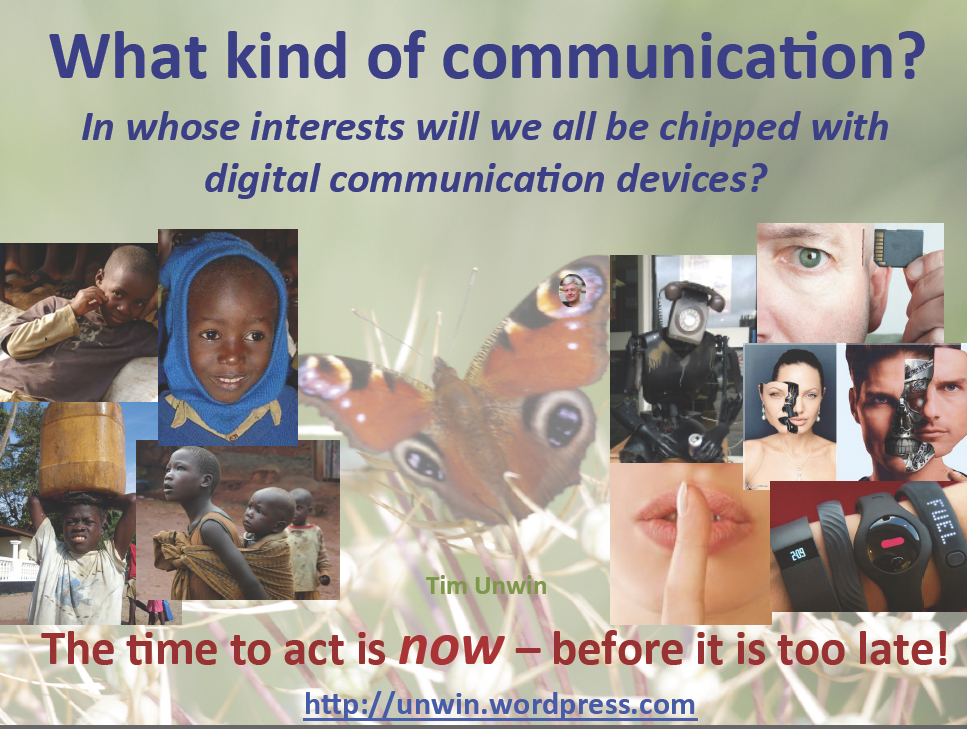
My actual short quotation was “The future is not so much about the Internet, but rather about the human-machine interface. Cyborgs are already with us. If we do not want humans to be mere appendages of machines, we must act now!””
I have to admit that I found the actual ITU session to be much less inspirational than I had expected/hoped it might be – there was very little new in what was discussed! I was therefore actually rather sad that the presentation that I sent to the ITU for possible inclusion amongst its predictions was seen as being rather too provocative for inclusion!
Filed under Commonwealth, Development, ICT4D
Wentworth Fireworks Event, 2014
This evening was the annual fireworks party celebration at the Wentworth Club in Virgina Water. It is several years since I last went, but the display this year was spectacular, and I hope that the images below capture something of the show!
Thanks to everyone who made this possible! It was a fitting evening after the magnificent rugby match at Twickenham between Australia and the Barbarians!
Filed under Photographs
In praise of the Park Hyatt, Busan
Just occasionally I discover fine wines, great restaurants and lovely places to stay that I feel I just have to write about! On my latest trip to Korea I have found just such a hotel, the Park Hyatt in Busan. On my last visit to Seoul, I remember above all else the hospitality and generosity of our hosts, but coming to Busan I have discovered a whole new side to the country and its people.
The Park Hyatt is without doubt one of the nicest hotels I have stayed in for a long time. The decor is sophisticated and functional; the rooms are beautifully appointed and decorated in pale oak colours – mine looks over the yachting harbour used in the 1988 Seoul Olympics; the staff are all amazingly helpful, friendly and oh, so courteous; there are several different lounges with varying styles and colours, but all very comfortable; the food is delicious (albeit at a price); and the swimming pool is amazing. And, having spent so much time in hotels that charge ridiculous prices for Internet access, it is so nice to stay somewhere that offers free and fast connectivity! On arrival, one is whisked up to the 30th floor where the reception is located, and the rooms are then on the floors beneath. This gives the lounges and dining rooms on floors 30-33 amazing views over the coast and harbour. I hope that the images below convey something of the lovely character of the hotel. Oh yes, and I really got a taste for Dry Finnish!
Nowhere, though, not event the Park Hyatt, Busan is perfect! So may I finish with just a few pleas:
- It would be great to have some chocolate and/or cinnamon on the capuccinos in the restaurant – especially at breakfast!
- The wine list ought to have some reasonably priced ‘house wines’ on it – fine to have the expensive classics, but a really good restaurant also has stunning reasonably priced house wines.
- The menus look delicious, but much of the food is available only for two people, which makes life rather difficult for solitary travellers 😉 !
- Finally, I could not decide whether or not to post a picture, but for those of us from northern Europe who are unused to multi-functional loos, and were brought up having to urinate on the ice in the pan of the outside netty on a frozen winter morning, these devices are really threatening, and it would be great to have some instructions! How is one meant to know which button to push: rear cleansing; soft rear cleansing; front cleansing; dryer; oscillating; pulsating; rhythm; stop? I was too scared even to experiment!
Filed under Photographs, Restaurants
Korean hospitality and vitality at opening evening of ITU Plenipotentiary 2014
When I was last in Korea in 2013, I had the opportunity to watch some amazing drumming, martial arts and dancing in Seoul. I was therefore greatly looking forward to the celebration of Korean culture that was to accompany the welcome dinner for the ITU 2014 Plenipotentiary conference held in Busan this evening. As I hope the images below indicate, this was a vibrant and energetic performance that showed much about Korean culture, both old and new. Thanks to the people of Korea, and of Busan in particular, for sharing with us just a little bit of their beauty, culture and hospitality this evening.
Filed under Dance, ICT4D, Music, Photographs
Opening ceremony of ITU Plenipotentiary 2014 in Busan
Just thought I would share some images from the recently completed opening ceremony of the ITU’s 2014 Plenipotentiary meeting in Busan. This featured very sophisticated presentations of the Republic of Korea’s achievements in the field of ICTs, as well as the beauty of its traditional culture and dance. South Korea is certainly an absolutely fascinating place, in which we have been made to feel most welcome. It was good to see the emphasis placed on the use of ICTs by people with disabilities, and also Hamadoun Touré’s commitment to finding ways through which ICTs can be used to help resolve the current Ebola crisis in western Africa (see my regularly updated blog post on ways through which ICTs can indeed contribute).
Sorry I could not post these live during the event, but the WiFi system was down while President Park Geun-hye was in the room. Let’s hope we all have a fruitful and productive Plenipot meeting.
Filed under ICT4D, Photographs
On the contribution of ICTs to overcoming the impact of Ebola
I am regularly updating and revising this post (current update 21st December 2014; originally posted 12th October 2014), so that it brings together some of the most important work being done on ICTs and Ebola. In recent weeks there have been a plethora of new initiatives, but there is now a very real danger of affected regions and people becoming swamped with far too much digital information, and over-eager digital enthusiasts actually impeding the delivery of effective interventions.
I remember a conversation with a dear friend from Sierra Leone back in May about the growing impact of Ebola in his country. I remember him saying that it was already far more widespread than was being reported. I remember sharing this information with many people that I met at that time. I regret that I only started Tweeting about the seriousness of what was happening in West Africa on June 27th. However, I have been Tweeting ever since, and have become increasingly appalled about the tardiness of the international response. If appropriate action had been taken in May and June, if appropriate support had been given to the affected countries at that time, and if appropriate care had been given to communities and individuals affected, then I have absolutely no doubt that thousands of lives could have been saved across the world.
It is simply not good enough to say that we should be concentrating on practical action now rather than laying blame and being critical of the response to date – although there are some really very bizarre things currently being said in the mainstream and social media. The most important outcome of the current crisis has to be an investigation of why so many organisations and individuals failed to take notice of all of the early signs, and failed to act to prevent the spread of the virus. I also feel very angry that attention is only really being directed to dealing with the disease now that people are dying of it in Europe and North America. Undoubtedly, in the longer term, it is also essential that we all help build capacity in the health systems of poor countries so as to enable them to respond more effectively and swiftly to the outbreak of such diseases in the future.
In an effort to bring together some of the disparate information about ways through which ICTs can be used effectively to counter the spread of Ebola, I raised this issue among members of the ICT4D group on Facebook in early October 2014. Surprisingly, there was not an overwhelmoing response. Hence, I have tried to pull together some of the most interesting ongoing work, in the hope that it can be used as swiftly as possible to make a difference to the lives of people who are already affected and those who will become affected in the weeks and months ahead. It is great to see that some other organisations such as Telecentre.org and TechChange have also started to do this. Many, many poor people will die of Ebola before we get it under control collectively. We must never make the same mistakes again.
Communicating accurate and relevant materials to affected individuals and communities
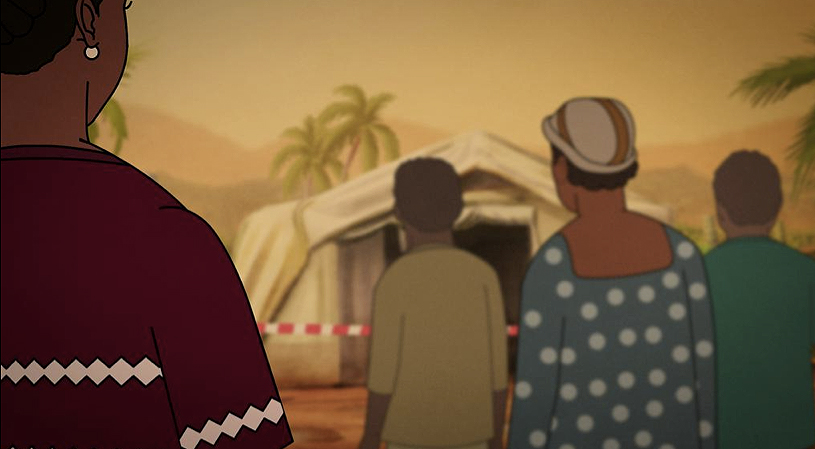
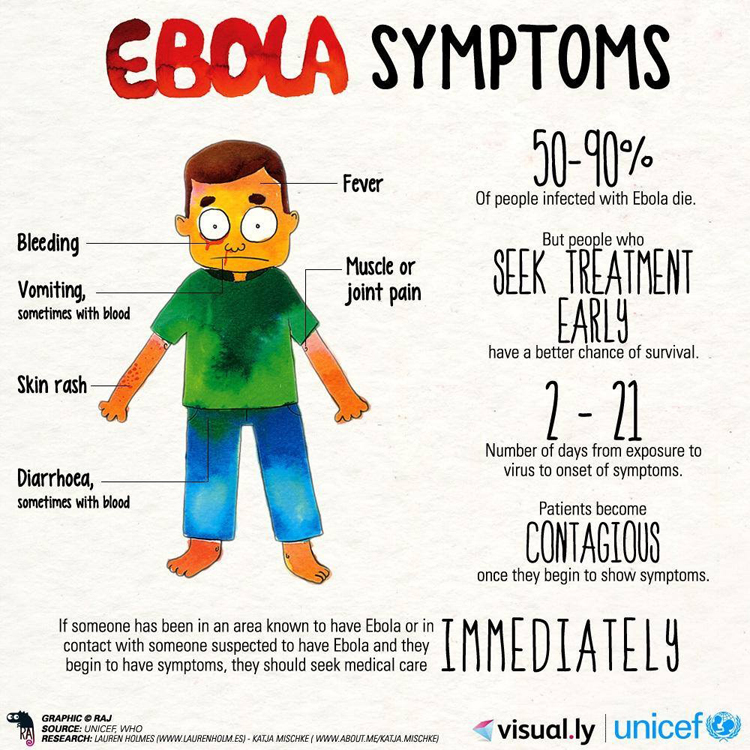
It is critically important that people know how to respond swiftly and appropriately when a case of Ebola is identified in their communities. In the absence of an appropriate vaccine or cure, it is absolutely essential that early diagnosis and quarantine takes place. Changing cultural behaviours, especially surrounding the emotionally very distressing experience of death from Ebola, is extremely difficult, but if the rapid increase in cases is to be reduced, then this is absolutely essential. The use of ICTs, in the form of radio broadcasts, television messages, videos and text information in local languages through the Internet and on mobile ‘phones can therefore play a very helpful role. People can also use mobile devices to report where and when outbreaks occur, so that medical staff can respond more quickly. An interesting recent development has been the way through which the Sierra Leone government has been providing a hotline through which worried people can contact officials for advice, but as ever there are many challenges with such a service, not least prank calls and the quality of advice given. At last, though, some useful resources are being developed, and the following is a list of the ones that I have found to be of particular interest, value and importance:
 Great animated video on Ebola prevention (by Firdaus Kharas #Culture_Shift) (Link to small sized file)
- BBC News How not to catch Ebola
- Ebola Alert on Twitter
- Giving hope to people – stories of survival, such as this case from Sierra Leone
 Cosmos News: What is Ebola and how it works video
- About Ebola page on Facebook
- Washington Post informatic about spread of Ebola by Bonnie Berkowitz and Lazaro Gamio
- BBC Public Information Service on Ebola for West Africa using WhatsApp
- Graphics and posters about Ebola from UNICEF
- Commonwealth Broadcasting Association Ebola briefing 8 August 2014
- Guardian report on use of hotlines in Sierra Leone
- Awareness campaign through use of SMS in Mali – free service through which people can SMS the word EBOLA to short code 36011 and will then receive several text messages on Ebola over a 2 day period
- Use of music in reaching people with relevant information about Ebola – a collective of African musicians have come together to record a song to help raise awareness about Ebola in Africa. The song, entitled “Africa Stop Ebola”, features the singers Tiken Jah Fakoly, Amadou & Mariam, Salif Keita, Oumou Sangare, Kandia Kora, Mory Kante, Sia Tolno, Barbara Kanam and rappers Didier Awadi, Marcus (from the band Banlieuz’Arts) and Mokobe, and also includes the musicians Sékou Kouyaté (electric guitar, bass, electric kora) et Ludovic N’Holle (drums).
- Good report by Al Jazeera on Living with Ebola in Liberia
A real challenge now, though, is that so many initiatives are trying to develop digital resources to support the response to Ebola that there is a danger of massive duplication of effort, overlap, and simply overload on the already stretched infrastructure, and indeed people, in the affected countries. As Wayan Vota has noted in a useful overview at the end of October 2014, there are now more than 200 initiatives that are seeking to provide information relating to Ebola to communities. Many of these are being developed with little if any real understanding of the practical realities on the ground in west Africa! What, to me, is even worse, is the way in which many organisations and companies are now using this opportunity to generate income so that they can provide yet further Ebola resources. The following examples are typical of this:
- Afrelib’s Ebola Education Campaign – seeking $100,000 to fund Medikidz to develop a digital comic on Ebola for “kids”
- Ebola Grand Challenge – USAID partnering with the White House Office of Science and Technology Policy, the Centers for Disease Control and Prevention and the United States Department of Defense to launch open innovation platform, challenge competition and partnerships
These may indeed be ‘worthy’ initiatives, but my fundamental point is that too many people are now using Ebola as an excuse to get funding for their own initiatives and ideas, and this is leading to massive duplication, replication and overlap. Moreover, by the time most of these initiatives might come on stream, the Ebola outbreak will either have been contained or will have become so out of control that none of these little projects will actually be able to make any difference at all! We know how to deal with Ebola. Countries such as the Democratic Republic of Congo have learnt how to manage and control Ebola. If the world had acted back in May and June, using some of the lessons already learnt, we would not be in the situation we now are.
Communicating with sick relatives without touching them
Mobile ‘phones are excellent devices for communicating at a distance. Whilst being very afraid of Ebola, family members want to communicate with their sick relatives – at a distance, without touching them. Hence, the use of mobile devices can provide a really valuable and reassuring mechanism through which family members can communicate, when one or more of them are in isolation wards or quarantine locations. Very simply, if sick people could be given mobile devices to communicate with their loved ones, then some of the pain and anguish could be alleviated.
Mapping the spread of the disease
ICTs can be used very effectively to map the spread of Ebola, so that medical administrators can respond more quickly. As noted above, mobile devices can also be used to inform medical staff when a new case is identified. Crowd-sourcing (such as Ushahidi) could be used effectively to develop such response maps, although we must recognise that many people are very afraid of reporting that a friend or relative may have Ebola. There has also been some reporting on the potential use of call data records – although I retain concerns here about the ethics of such usage.
- Humanitarian Open Street Map Team’s mapping of Ebola
- BBC reporting on mapping the outbreak
- Economist report on potential use of Call Data Records
- Standby Task Force mapping and sharing geographical data
Information networks for professionals and others dealing with Ebola
A growing amount of information is now available for professionals and those dealing with Ebola and so only a limited amount is noted below:
- The ITU’s Ebola-Info-Sharing Mobile App
- Consortium of Universities for Global Health Ebola Crisis Information Center
- Humanitarian Data Exchange‘s platform for sharing information about Ebola
- @StopEbola on Twitter
- @EbolaVirusNews on Twitter
- WHO Ebola Virus News
- Training health care workers – webinar series by TechChange starting on 21st October 2014
- Outcomes from the Technology Salon discussion on 30th October 2014 on how ICTs can improve our Ebola response – a good list of resources.
Funding and crowd-sourcing for resourcing support for Ebola victims and research on the disease
There is an enormous need for funding to support health workers in affected countries, not least by providing enough protective clothing. Much work could be done on this, but there are few examples available.
Overall, this page is just a starting point. PLEASE respond and add information to it so that we can all use ICTs more effectively for tackling this outbreak of Ebola which could easily have been curtailed if only we had acted together sooner.
Ebola and Security: on entering the USA
I had a weird experience on arriving at Los Angeles Airport yesterday. For the first time ever, there was almost no queue as I approached the border guards for passport checking. However, I did notice that they were wearing bright blue gloves. My mind then starting putting two and two together, and I realised that the US was beginning to put into practice border checks for people with possible Ebola entering the country. As I read the press this morning, I note increasing anxiety across the more developed countries of the world, especially here in the USA as it is reported that “A Texan health worker who treated Ebola victim Thomas Eric Duncan before he died is also infected with the virus, according to a preliminary test”.
However, as I leant forward to put my fingers on the fingerprint reader I realised just how ridiculous this is. If someone with Ebola had a cut finger, or was sweating profusely in the queue before me, and I put my fingers where his or hers had been, what was the chance that I too could catch Ebola? It was probably quite high. So, by forcing me to have my finger prints checked, the US government could have forced me to catch Ebola, all in the name of border security. I shared my reflections with the unusually pleasant official checking my passport, and he expressed real shock and worry, pointing out that no-one had raised this previously!
This seems to raise really interesting questions about the use of digital technologies for border security! An answer, of course, is for any health checks to be done before people pass through passport security checks, but is this actually going to happen, and what delays could it generate at international airports?
Jenny and Al’s wedding, 20th September 2014
Yesterday was a very special day – Jenny and Al were married at Emmanuel College, Cambridge. All of the hard work and attention to detail that they and so many others put into the preparation paid off enormously. It was truly a fantastic day, from the practice session and dinner the night before, through the early morning hair, make-up and dressing, to the service itself, the reception, wonderful meal and evening party! Thanks so much to everyone there who made it a really special day. Jeremy, Arnold and Kathleen made the service itself very memorable and joyous. The staff at Emma did a brilliant job with the food. Ettie made an incredible cake – well, actually three cakes in one! The musicians and band (The Zoots) were great – and it was so rewarding seeing everyone dancing and enjoying themselves so much! I hope that the informal pictures below capture something of a truly memorable day. Thanks to everyone for making it such a very happy celebration. Congratulations Mr. and Mrs. Bowe!
Filed under Photographs
Education Fast Forward’s Eleventh Debate: Mobile Learning for the Masses
 Education Fast Forward (EFF) was co-founded by Jim Wynn, formerly at Promethean and now EFF’s Chief Executive Officer, to bring together some of the world’s leading figures in the word of education to debate key issues facing governments, educators and employers. Its aim is not only just to debate these issues, but more importantly to come up with practical solutions that people can adopt, particularly in ensuring that technology is used appropriately to deliver effective solutions that will make a step change in learning experiences. EFF also ensures that it puts its body where its mouth is, so participants can engage in the debates through a variety of different modalities, including the use of Cisco’s Telepresence and WebEx environments, and also through live webstreaming, Twitter and other social media.
The Eleventh debate on 17th September, chaired by the irrepressible Gavin Dykes, was on the theme of Mobile Learning for the Masses? Realistic Expectations and Success Criteria. It began with two tone-setting presentations by Professor Miguel Nussbaum (Professor at the Computer Science Department of the School of Engineering of Pontificia Universidad Católica de Chile) and David Atchoarena (Director of the Division for Policies and Lifelong Learning Systems at UNESCO).
 Miguel Nussbaum began with a summary of his long career in using technology for learning, ranging from his early experience of using netbooks and tablets in Chile, to more recent work with multiple mice and mobile devices. His main presentation focused on how technology is used in the classroom, addressing three main issues: the way we teach; how we use technology, and how we can integrate technology in the classroom so that teachers make good use of it, and that students can really learn. At the heart of his presentation were the arguments that it is not the technology that matters, but rather we should focus on how technology can be used to deliver on curriculum needs.
 David Atchoarena then followed, emphasising once again that technology must be a means rather than an end. It has to be used to solve specific challenges and needs. Recognising that in 2014 we are nearly at the end of the period set for achieving the Education for All Goals and the Dakar Framework, he noted that whilst progress has been achieved, very real challenges still remain in three areas: literacy, gender equality and teacher shortages. In all of these areas, he argued that mobile technologies can indeed make a significant difference.
The subsequent conversation, bringing together people from across the world explored a wide range of issues related to the implications of these arguments in the context of mobile learning. For me, six main themes emerged:
- Relevance for the poorest people in the poorest countries. Without electricity and connectivity, the most marginalised people and communities are not going to benefit from the potential of ICTs, be they mobile or otherwise! While many argued that it is merely a matter of time before everyone everywhere is connected, Adrian Godfrey from the GSMA noted that, although there are more SIM card registrations than there are people in the world, only just under half of the world’s population have their own access to mobile devices. Against this background, David Coltart, the former Minister of Education in Zimbabwe, emphasised the critical financial and infrastructure constraints facing educationalists in many of the world’s poorest countries, especially in Africa.
- The need to work closely with teachers. Teachers are central to the learning process and the general consensus was that they have to be involved at the heart of initiatives designed to introduce technology into education. Whilst it was recognised that people can indeed learn using the Internet on their mobile devices without any teacher involvement, it was also argued most strongly that we have to focus on pedagogy and the role of teachers in using technology in the classroom. This is not just to do with the way we teach, but also with what we teach. As Miguel Nussbaum commented, we have to ensure that teachers are trained to be collaborative, interdependent and seeking common goals. The pedagogy has to come before the technology!
- The power of assessment and the curriculum. Closely linked to the discussion of the role of teachers and pedagogy were comments about the power of assessment. For some, we need to change the ways in which learning is assessed if we are truly to benefit from the opportunities offered by mobile technologies; as long as we ‘test’ in traditional ways, pupils will not be able to take advantage of all the opportunities for collaboration and interaction offered by mobiles. For others, it was the curriculum that matters most, on the grounds that assessment usually follows the requirements of the curriculum.
- The interests underlying the introduction of mobile technologies in the classroom. My main contribution fell largely on deaf ears, but I do believe that in understanding these processes we have to understand the interests underlying the introduction of such technologies into the classroom. This is primarily driven by the interests of capital, and the need for companies to generate the maximum profits from their investments in digital technologies. Operators need to draw traffic through their networks, and if people can be encouraged to use these to gain useful learning resources, and network better with their peers, then this has to be a good thing. For content providers, mobiles offer a huge opportunity for generating additional revenue. Until we understand these interests, and realise that they are not driven primarily by pedagogy and the learning needs of pupils, then we will continue to be bemused by the failure of ICTs to transform the learning outcomes of formal educational systems
- Mobile devices can transform the learning experiences of some of the world’s most marginalised people and communities. Despite all of the challenges, it was great to see a small group of participants arguing that mobile devices can have a huge impact on the learning experiences of those living in refugee camps (Eliane Metni from Lebanon) and people with disabilities. We need to do much more to ensure that this work is supported, because otherwise these communities and individuals will become even further distanced from the rich who have access to the latest digital technologies.
- A call for action. There is far too much talking, and not enough action! Michelle Selinger, in particular, argued that you will only get effective action through dialogue between teachers policy makers, industry and academics. She also emphasised that, while content is important, it is crucial to remember the potential of mobile devices for crafting new types of collaboration through voice, video and text.
Education Fast Forward does not just finish with the live debate itself, and the EFF website, as well as their Twitter account (see #EFF11) provide ready means through which to continue the discussion. Thanks Jim, Gavin and all of the contributors for a thought-provoking discussion.
Postscript:
There is a huge amount of ongoing work on the use of mobiles for learning, and the International Telecommunication Union’s m-Powering Development initiative has recently produced a useful report on m-learning that is highly pertinent to this debate. This highlights the following eight main conclusions about things that are essential for the success of any m-learning initiative:
- It is essential to focus on learning outcomes not just the technology;
- Teachers and users should be involved at all stages in the development and implementation of m-learning initiatives;
- Sustainability, maintenance and financing should be considered right at the beginning of any initiative;
- It is important to think holistically and systemically;
- All relevant government departments must be involved in any m-learning initiative;
- Equality of access to all learners must be ensured, otherwise m-learning initiatives will lead t greater inequality;
- Appropriate and rigorous monitoring and evaluation must be in place; and
- Participatory approaches must be utilised in design.
Some, but not all of these issues were captured in the debate!
Filed under 'phones, Development, Education, ICT4D

 Tim Unwin's Blog