Google and privacy

I am often criticised for my concerns over Google’s ethical claims. Most people seem to like the apparently ‘free’ services that the company offers, and are not greatly concerned about the implications of sharing private information with a corporate giant that claims to do no evil.  I was therefore very pleased to see a report yesterday on the the BBC’s news site that Google is to be audited over privacy concerns relating to its social network Buzz.  Highlights of the article noted that:

  • “Google will be subjected to independent privacy audits for the next 20 years over charges that it “violated its own privacy promises”.  The US Federal Trade Commission (FTC) said that the search giant wrongly used information from Google Mail users last year to create its social network Buzz”
  • “When companies make privacy pledges, they need to honour them,” said Jon Leibowitz, chairman of the FTC. “This is a tough settlement that ensures that Google will honour its commitments to consumers and build strong privacy protections into all of its operations.”
  • “Buzz’s launch in February 2010 came under heavy criticism from users. According to Google, the system was designed to bring together members’ personal and private lives. One widespread complaint was over a feature that allowed it to publicly list other Gmail contacts a user was most frequently in touch with. While this feature could be turned off, the default setting was to leave it on – potentially revealing a user’s contact with an ex-spouse, employer or similar.”
  • “The FTC said “deceptive tactics” were used to populate the network with personal data gained from use of Gmail, and that when users were given the change to opt-out of Buzz, they were still enrolled in some of its features”
  • “The FTC said Google violated its privacy policy which stated: “When you sign up for a particular service that requires registration, we ask you to provide personal information.”
  • “Reflecting on the latest settlement, Alma Whitten, Google’s director of privacy, product and engineering, said: “We’d like to apologize again for the mistakes we made with Buzz. “While today’s announcement thankfully put this incident behind us, we are 100 percent focused on ensuring that our new privacy procedures effectively protect the interests of all our users going forward.”

In another recent report from the BBC, it is also interesting to note that the US Department of Justice has approved a New York court ruling that blocked an agreement between Google and publishers over the publication of books online.  As the report noted, “An agreement between Google and publishers over the web firm’s publication of books online has been blocked by a US court. The web giant has scanned millions of books and made them available online via its eBooks platform. Google had negotiated the deal to settle a six-year-old class action suit claiming infringement of copyright. But the New York court said the deal would “simply go too far”, giving Google an unfair competitive advantage”.
Leave a comment

Filed under Ethics, ICT4D

北京大學 – Life on Peking University Campus

I have been here for 10 days – amazing how quickly the time has flown by.  Given how tired I am, though, I guess it has been time very well spent!  Life – both intellectual and quotidian – is intense.  The campus itself is a great place to work, and the buildings and lake on the northern part of the campus are lovely places to walk in the early evenings to relax. It is fascinating being on campus, and very much living surrounded by the students.  Reflecting on my time here so far, the following spring to mind:

  • spring is advancing – blossom buds were just opening on a tree as I walked to work this morning
  • good to see somewhere else that matches my own usual ‘office’ day from 8 in the morning until six in the evening (although they do have a two hour lunch break)!
  • walking across campus to work in the morning, students and bicycles are enthusiastically everywhere- long before their peers would even be awake on the Holloway campus back home!
  • the first thing to be done on getting into the office is to fill one’s hot water carrier (thermos equivalent) from the tank and then make a cup of green tea – which is subsequently refreshed throughout the day
  • the intellectual vitality and curiosity – amongst students and staff – is so refreshing! UK students – at least many with whom I come into contact – have much to learn from the commitment and dedication of their peers here.
  • yesterday’s session with ‘my’ group of Master’s students was on research design – and it was great to explore aspects of Habermas’s work with them, and briefly summarise my critique of grounded theory.  They are so knowledgeable about much existing European social and educational theory!  It’s a real pleasure to work with them – and my concerns that my participatory ‘teaching’ style might not be acceptable were certainly ill-founded.
  • much exciting research is being done at the Graduate School of Education – and I am having really useful (if a bit exhausting) discussions with colleagues about everything from designing online surveys, to the use of mobiles for schools and parents to communicate, to the government’s plans to have interactive whiteboards in every classroom!
  • the IT services are great – thanks to the IT Service@Peking University.  It is brilliant to have wireless access in my office and ethernet in our hotel room.  Mind you, I do wish that I did not have so many e-mails from my other lives that need to be answered!
  • The diversity of places to buy food is overwhelming – there are just so many, and such a diversity of different tastes and textures
  • I even bought a very palatable bottle of Great Wall Cabernet Sauvignon on campus last night for RMB 34 (about £3.50) – the first wine to have passed my lips since arriving!

The photos below give just a flavour of the diversity and intensity of life here.  Thanks to all those who have made Pam and me feel so welcome here at Beida!

This slideshow requires JavaScript.

Leave a comment

Filed under China, Higher Education, Photographs

八達嶺 – The Great Wall at Badaling

An early rise, and then a couple of bus journeys north took us to the Great Wall at Badaling.  Without Chen Fei to guide us, we would never have found our way there and back by local transport!  However, this definitely added to the adventure.  On arrival, we chose to head south-westwards up the Wall, rather than north-east where most of the other visitors seemed to be heading.  Even in March, though, the Wall was crowded, as the pictures below illustrate.  It is an amazing construction, and it is hard to imagine the scale of the effort that went into its creation! Building the Wall across such inhospitable environments was an extraordinary feat!

This slideshow requires JavaScript.

Leave a comment

Filed under China, Photographs

故宫 – The Forbidden City

When I first visited Beijing in January 2004, I remember being amazed by the grandeur and beauty of the Forbidden City, experiencing it on a very cold day with almost no-one there.  Returning today, in late March, the queues to enter were long, but the Palace somehow swallowed them all up.  It had lost nothing of its impressive beauty and splendour.  As well as the sheer scale of the buildings and courtyards, much of its beauty lies in the detail of the paintings and carvings.  It is the small hidden courtyards of the north-eastern corner where much of its special enchantment can be found. The Forbidden City is by far and away the most impressive building complex I have ever visited.

This slideshow requires JavaScript.

1 Comment

Filed under China, Photographs

First signs of Spring at Peking University

The blossom has just started opening around Weiming Lake on Peking University’s campus.  It’s a beautiful place simply to wander around in the early evening before the sun sets and the temperature drops to around freezing.

This slideshow requires JavaScript.

Leave a comment

Filed under China, Photographs, Universities

Policy Brief on the Development Impact of ICT4D Partnerships

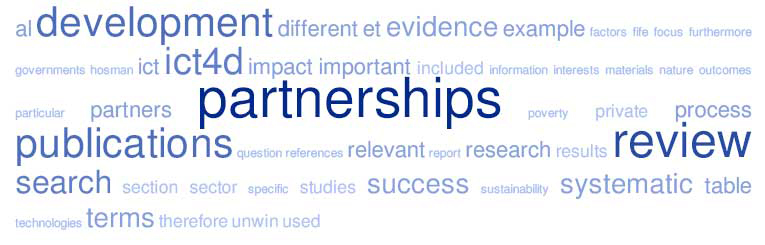
The Policy Brief resulting from the systematic review report by Marije Geldof, David Grimshaw, Dorothea Kleine and Tim Unwin on the development impact of ICT4D partnerships is now avalable from the R4D website (Policy Brief) and the ICT4D Collective website (Policy Brief).

This emphasises five key findings:

  1. Success is increased when detailed attention is paid to the local context and the involvement of the local community in partnership implementation.
  2. It is important for such partnerships to have clear and agreed intended development out-comes, even where constituent partners may themselves have different reasons for being involved in the partnership.
  3. Sustainability and scalability of the intended development intervention need to be built into partnership design at the very beginning.
  4. Successful partnerships are built on trust, honesty, openness, mutual understanding and respect.
  5. A supportive wider ICT environment needs to be in place, both in terms of policy and infrastructure, if such partnerships are to flourish and deliver effective development outcomes

Link to Full Systematic Review Report on ICT4D Partnerships (.pdf)

Leave a comment

Filed under Development, ICT4D

First impressions of Peking University campus

My first 48 hours at the Graduate School of Education (GSE) in Peking University (PKU) has provided a wealth of contrasting impressions.  Above all, though, I am incredibly grateful to the hospitality and friendliness of the staff and students.  Without them I would feel incredibly lost!  My language skills are improving, but need to do so very much more rapidly!

My main impressions so far:

  • The colours are every shade of grey and brown – it is early Spring.  The blossom is only just beginning to come into flower, and the deciduous trees have yet to burst into leaf
  • The campus itself is like a quiet oasis, amidst the noise and traffic of Beijing – with its West, South and East Gates, it is like a calm village within the city
  • Many of the buildings are striking and new – I am delighted to have an office in the splendid new Graduate School of Education; but there are also interesting old buildings, particularly around Courtyards Nos.1-6
  • Shops of all kinds, and seven different main restaurants are scattered throughout the southern part of the campus – and one can eat so many different styles of food (there’s even a restaurant serving pizza, although I have not sampled Chinese-Italian food yet)
  • Delighted to find a cashpoint machine that takes my bank card – on arrival had been told that it probably would not work!
  • Pedestrians and bicycles jostle for space, and silent electric scooters weave their way swiftly between them
  • Had real difficulties with my e-mails on arrival, but it turned out to be a problem back at Royal Holloway! No-one told me that work was being done on the servers, and I had to change my settings!  Mind you, Twitter and Facebook are blocked…

Tomorrow, I have my first two-hour lecture – am not sure whether the students or I am more nervous – guess I probably am!  If only humans  (and I in particular) could adapt more swiftly to crossing time zones – I so dislike being 8 hours adrift!

This slideshow requires JavaScript.

Leave a comment

Filed under China, Photographs

ICTD2012 Call for Papers

The call for papers for the ICTD2012 conference has just been released – full details given below:

CALL FOR PAPERS
Fifth IEEE/ACM International Conference on Information and Communication Technologies and Development, Georgia Institute of Technology, Atlanta GA USA

Conference dates: March 12-16, 2012
Paper submission deadline: July 22, 2011 (11:59pm UTC)
Conference website: http://www.ictd2012.org
Contact us at: program@ictd2012.org
Twitter: @ICTD2012   Facebook: ICTD 2012 Atlanta

ICTD provides an international forum for scholarly researchers exploring the
role of information and communication technologies (ICTs) in social,
political, and economic development. The conference program and accepted
papers will reflect and deepen the multidisciplinary nature of ICTD
research, with anticipated representation from anthropology, computer
science, communication, design, economics, electrical engineering,
geography, information science, political science, public health, sociology,
and so on.

Submitted papers are subject to a rigorous and selective double-blind peer
review; accepted papers will appear in electronic conference proceedings and
will be archived in the ACM and/or IEEE systems. A subset of the papers will
also appear in a special issue of Information Technologies & International
Development.

ICTD2012 is the fifth of an ongoing series of conferences occurring every
one-and-a-half years; previous conferences have taken place in: Berkeley, CA
(USA) ICTD 2006; Bangalore (India) ICTD 2007; Doha (Qatar) ICTD 2009; and London (United Kingdom) 2010.

For the purposes of this conference the term “ICT” comprises electronic
technologies for information processing and communication, as well as
platforms that are built on such technologies. “Development” means
international development, including, but not restricted to, poverty
alleviation, education, agriculture, healthcare, general communication,
gender equality, governance, infrastructure, environment and sustainable
livelihoods. Papers considering novel designs, new technologies, project
assessments, policy analyses, impact studies, theoretical contributions,
social issues around ICT and development, and so forth will be considered.
Well-analyzed negative results from which generalizable conclusions can be
drawn are also sought.

Relevant papers reporting high-quality original research are solicited. Full
papers will be reviewed by a multidisciplinary panel, and evaluated
according to their novel research contribution, methodological soundness,
theoretical framing and reference to related work, quality of analysis, and
quality of writing and presentation. Authors are encouraged (but not
required) to address the diversity of approaches in ICTD research by
providing context, implications, and actionable guidance to researchers and
practitioners beyond the authors’ primary domains.

Only original, unpublished, full research papers in English will be
considered. Submissions not meeting a minimum bar of academic research
writing will be rejected without full review. Papers should contain a
maximum of 8000 words. Reviews are double blind, so papers should not
include author names or other information that would identify the authors
(references to previous work by the authors should be in the third person).
Authors should follow IEEE formats and styles
http://www.ieee.org/documents/stylemanual.pdf. Samples of this are also
available in PDF at http://www.ictd2012.org/ICTD2012_sample.pdf and MS Word
http://www.ictd2012.org/ICTD2012_sample.doc formats. Authors will be
required to sign a copyright release for publication in the conference
proceedings.  Additional submission details will be posted on the conference
website at http://www.ictd2012.org, as the information becomes available.

As a new opportunity for 2012, we are offering a peer mentorship program for paper submissions. Submit your paper early (by May 1st, 2011) to this
program and get feedback from peer mentors ahead of the normal submission process and June deadline. See http://www.ictd2012.org/mentorship for details.

Atlanta is a world-class city with a rich and passionate history. Spring
comes early to Atlanta; March is likely to be sunny, crisp, and pleasant.
The conference venue is the Georgia Tech Hotel and Conference Center
(http://www.gatechhotel.com/). Georgia Tech is one of the top research
universities in the United States, distinguished by its commitment to
improving the human condition through advanced science and technology.

The conference website is http://www.ictd2012.org. Follow us on Twitter
@ICTD2012, or visit our Facebook page at “ICTD 2012 Atlanta”.

Contact us at program@ictd2012.org

Important dates:
Peer review mentor program submission deadline: May 1, 2011
Paper submission deadline: July 22, 2011
Acceptance notifications: September 16, 2011
Camera-ready papers due: January 16, 2012
Conference dates: March 12-16, 2012

Program Committee Chairs
Jonathan Donner, Microsoft Research India
Beki Grinter, Georgia Institute of Technology
Gary Marsden, University of Cape Town

General Conference Chairs
Michael Best, Georgia Institute of Technology
Ellen Zegura, Georgia Institute of Technology

2 Comments

Filed under Development, ICT4D, ICT4D conferences, ictd2010

Balancing democracies…

An invitation to give the opening keynote address (video) at the “Commonwealth, Human Rights and Development” conference held at Cumberland Lodge from 11th-13th March 2011, gave me the opportunity to pull together some of my thoughts over the last couple of years concerning democracy and human rights.  In particular, I sought to address:

  • the diversity of meanings attributed to democracy;
  • the coalescence of interest between the rhetorics of democracy and the free market following the collapse of the Soviet Union;
  • the importance of the notion of democracy in the Commonwealth
  • the character of democratic institutions; and
  • the need to challenge widely taken for granted assumptions about the benefits of democracy and human rights.

In so doing, I drew six main conclusions:

  • Notions of democracy and universal human rights should be contested and not accepted automatically as something ‘good’.
  • We need to contest many of the claims to legitimacy of democratic states and rulers. In particular, attempts by powerful states to impose democracy on other states, seem to me to be highly hypocritical.
  • Instead of seeking to impose democracy on others, those who believe in democratic values would be better advised to help support the development of democratic institutions, especially elected parliaments, the judiciary and political parties
  • Discourses on rights should be balanced by ones on responsibilities;  a shift of attention to responsibility might well be able to deliver more for the poor and the marginalised
  • The communal traditions of Africa may offer interesting insights to counter the negative aspects of the individualism associated with human rights, democracy and capitalism.
  • Finally, it seems to me that a practical focus on how we treat others, especially the poor and the marginalised, is of much more importance than claiming that they have universal human rights.

I remain to be convinced that humans do indeed have universal rights.

1 Comment

Filed under Commonwealth, Politics

Expanding range of countries now offering Commonwealth Scholarships

Thanks to the Commonwealth Scholarship and Fellowship Plan (CSFP) Endowment Fund, Commonwealth scholarships and fellowships are now available in more countries than ever.  New awards are available in Kenya, Mauritius, Tanzania, the South Pacific, Nigeria and South Africa.

A CSFP Press Release notes that: “Postgraduate students in Commonwealth countries can apply to study in a range of new destinations from 2011, thanks to a range of international scholarships launched this week. The first set of scholarships, set to start between September 2011 and February 2012, are for Master’s degree study in Kenya, Mauritius, Tanzania, and the South Pacific. A three-month Commonwealth Fellowship for an established academic at the University of Ibadan in Nigeria is also available. In addition, two Commonwealth Scholarships for PhD and postdoctoral study are also currently available at the University of Pretoria, in South Africa. These scholarships have been made available by the Commonwealth Scholarship and Fellowship Plan endowment fund. The fund, established to mark the 50th anniversary of Commonwealth Scholarships in 2009, has now raised over £2 million, through contributions from alumni and Commonwealth governments. According to Fund Secretary Dr John Kirkland, the stated aim of the fund is to broaden the range of destinations in which Commonwealth Scholarships can be held: ‘In the 1960s, there was a sizeable number of international students undertaking postgraduate research at universities in developing countries – particularly in Africa. Now, after a period of decline in the 1980s and 1990s, many of these universities are actively looking to recruit international students again’.”

Leave a comment

Filed under Commonwealth