Becker Vineyards Texas Iconoclast Cabernet Franc 1995

This has to be one of the most surprising wines I have tasted in recent years.  Back in 1997 I was attending the Annual Meeting of the Association of American Geographers held in Texas, and spent some time afterwards in Austin and visiting wineries in the Texas Hill Country – among them was Becker Vineyards, established a few years previously in 1992 by Richard and Bunny Becker.  The first harvest was in 1995 and vintages are aged in either new French or American oak, and stored in the largest underground wine cellar in Texas. I remember being very surprised to find French varietals being cultivated in Texas, but also that the wines tasted surprisingly good.

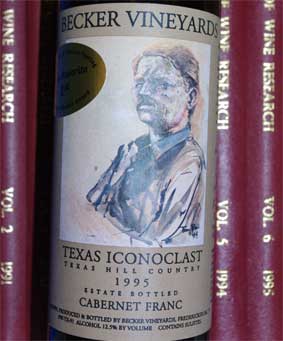
The visit of two USAn friends on Friday, who had been forced to leave Egypt because of the ongoing political unrest there, and were on their way back to Houston, seemed an appropriate occasion to open this Texan Iconoclast.  I would not normally choose to drink a 15 year old Cabernet Franc – suspecting that it would be well past its best.  However, this wine was quite remarkable – and shows how ripe fruit and careful vinification can indeed produce surprising wines in very unusual circumstances.  It retained a mid-red colour, and had much less browning at the edges than I had expected.  The wine had the distinctive tobacco nose that I often associate with Cabernet Franc, but also retained a slightly woody aroma.  The flavour was delicious, with soft tannins, good depth, and a richness that I had not anticipated – very different from many of the often light, dry Cabernet Franc wines from the Loire that I am more used to. The hot Texan summers had clearly ripened the fruit fully, giving the wine a richness and depth of body that was delicious, retaining a good balance and structure, with flavours of red fruit and tobacco.

So, if you happen to be out visiting the Texan countryside, enjoy the blue bonnets, take a detour up to Stonewall, sample the Becker wines, and put a bottle in your luggage for drinking a decade later! Thanks to Bill Fleming for persuading me to explore Austin’s music scene when I was there! I also look forward to returning to Guero‘s Taco Bar on a future visit – hope it is as good now as it was then!

Leave a comment

Filed under Restaurants, Wine

Ofsted report on declining Geography in England’s schools

In a press release, Ofsted comment on their report on school geography in the UK published today that ‘A polarised picture of school geography teaching has emerged … While geography was flourishing in a minority of the schools visited by inspectors, it was found to be under pressure in the rest.’   As the press release continues ‘The primary schools visited presented a sharp contrast between inadequate and outstanding practice. Half were characterised by a lack of expertise and awareness of what constituted good geography. In approximately one in 10 of the primary schools visited, geography was more or less disappearing. Just over half the primary and secondary schools visited did not use fieldwork adequately. In some of the secondary schools visited, there was a drop in the numbers studying geography GCSE. Uninspiring teaching and the lack of challenge discouraged many students from choosing geography at GCSE. The quality of provision was declining and the time allocated to the subject in the first critical years of secondary schools was being reduced’.

The study is based on observations of geography classes in 91 primary schools and 90 secondary schools between 2007 and 2010, and represents a depressing picture of the present state of teaching in the discipline.  Official figures show that the number of people taking GCSE in geography fell from 173,800 in 2008-9 to 169,800 in 2009-10, with the number of state schools not entering pupils for the subject increasing from 97 (out of more than 3000) in 2007 to 137 in 2009.

As a BBC report on the findings commented, ‘”Core knowledge for the majority of the students surveyed, but especially for those in the weaker schools, was poor,” it said. It found all but the best students were “spatially naive” and that they were unable to locate countries, key mountain ranges or other features with any degree of confidence.”For example, they understood about development issues in Kenya but had little or no idea of where Kenya was in Africa.”Many of them had studied Amazonia and could talk with some conviction about the exploitation of resources and environmental degradation but they knew nothing about the rest of South America.”‘

This is hugely damning, not only for those who care about geography as a discipline, but also for the futures of our young people. Geography is one of the most important and exciting subjects of all:

  • it explores the place of people in the world – in both a conceptual and a physical sense;
  • it is explicitly concerned with the interactions between people and the physical environment – which lie at the heart of so many contemporary global issues such as climate change, the impact of migration, resource allocation and distribution, and international development;
  • it provides young people with an understanding of the importance of diversity and tolerance based on a detailed understanding of other cultures and people; and
  • it is one of the most enjoyable and exciting subjects to study at school and university – reflected in the importance of field work and a practical understanding of places.

In a response to the Oftsed report, the Geographical Association (GA) notes, amongst other things, that:

  • ‘This Report therefore sends a strong message to senior leaders in primary and secondary
    schools: it is unacceptable to tolerate geography that is weak, because this impoverishes the
    curriculum. If geography is weak it “is a key issue to be addressed by the leadership teams in
    these schools” (p5)’;
  • ‘The Report shows many examples of schools in which geography has been encouraged and is
    flourishing. These are schools where the geography is driven by challenging questions about the
    contemporary world, where pupils’ knowledge of people, places and environments is extensive
    and where the teaching is lively, topical and well informed. One reason for good geography was
    found to be where “subject specific professional support had been sought out and utilized” (p6)’; and that
  • ‘A strong theme is the polarized pattern of provision in terms of the quality of teaching and
    learning and the curriculum between schools. This is linked to the lack of subject specialist
    teachers and/or lack of subject specialist training. It is therefore a worry that training numbers
    are being cut in geography.’

As David Lambert, the GA’s Chief Executive notes, ‘It is a pity that Ofsted’s own press release designed to draw attention to this report is headlined ‘geography declining in schools’. Why? Because the report makes clear that the story is much more complicated than that. In some schools, if you suggested that geography were declining you’d be faced with puzzlement, for the subject is thriving. And yet, the national picture which has been taking shape for many years now, is unsatisfactory. The GA takes this very seriously. The decline in school geography means that there is less geography being taught in school and more children leaving school with an inadequate knowledge and understanding of their existence on planet earth’.

The report nevertheless represents systematic failings across the discipline, and far too much complacency amongst professional academic geographers. Whilst the GA has been valiantly trying to support secondary and primary geography over many years, the number of university academics involved in and willing to give their time to school geography (other than as part of their own selfish recruitment drives) has dwindled dramatically.  We need to provide a vision of the excitement of the discipline that inspires young people to engage in the discipline.  We also need to act much more strategically at a political level with Ministers, senior Civil Servants and leaders of the private sector to advocate for the value of geography.  If we do not, we will not only have failed a generation of school pupils, but will ultimately have helped to create a society with little understanding of the complex relationships that shape interactions between people and the physical environment.

Leave a comment

Filed under Education, Geography

Social networks, digital technologies and political change in North Africa

Much has been written about the potential of new ICTs, and particularly mobile technologies and social networking software, to transform political and social systems.  A fundamental question that underlies all work in ICT4D is whether new ICTs can indeed be used by the poor to overthrow oppressive regimes, or whether, like other technologies before them, ICTs are used primarily by the rich and powerful to maintain their positions of power.  Until very recently, it seemed that despite the potential of ICTs to undermine dominant political structures, most attempts to do so have been ruthlessly crushed.  The ruling regime in Iran was thus able to suppress the ‘Twitter Revolution’ of 2009-10, and the Burmese government likewise maintained its grip on power despite extensive use of mobile ‘phones and the Internet during protests in 2007.

Recent events in North Africa, with the overthrow of President Ben Ali in Tunisia and the continuing protests against President Mubarak in Egypt, have widely been attributed in considerable part to the agency of mobile ‘phones and the use of social networking environments over the Internet.  Whilst it is too early fully to judge their importance in fueling such political protests, the following reports provide evidence in support of such claims:

Tunisia

Egypt

Wider ramifications

Much research needs to be undertaken on the real role of ICTs in these ongoing political processes.  What seems apparent, though, is that many participants do indeed believe that these technologies are helping them achieve their objectives.

5 Comments

Filed under 'phones, Accessibility, Africa, Development, Ethics, Social Networking

Corruption in the Global Fund – implications for ICT4D

I have long been critical of many aspects of the work of the Global Fund to Fight Aids, Tuberculosis and Malaria, and it therefore comes as no surprise to learn that the Fund’s newly reinforced Inspector General’s office has encountered corruption.  What is surprising, though, is its scale.  As an Associated Press report on 24th January  comments, “A full 67 percent of money spent on an anti-AIDS program in Mauritania was misspent, the investigators told the fund’s board of directors. So did 36 percent of the money spent on a program in Mali to fight tuberculosis and malaria, and 30 percent of grants to Djibouti.In Zambia, where $3.5 million in spending was undocumented and one accountant pilfered $104,130, the fund decided the nation’s health ministry simply couldn’t manage the grants and put the United Nations in charge of them. The fund is trying to recover $7 million in “unsupported and ineligible costs” from the ministry.”

In response, the Global Fund has issues a Press Release, including the following assertions: “The Global Fund has zero tolerance for corruption and actively seeks to uncover any evidence of misuse of its funds. It deploys some of the most rigorous procedures to detect fraud and fight corruption of any organization financing development. The vast majority of funds disbursed by the Global Fund is untainted by corruption and is delivering dramatic results in the fight against the three diseases.“Transparency is a guiding principle behind the work of the Global Fund and we expect to be held to the highest standards of accountability,” said Prof. Michel Kazatchkine, Executive Director of the Global Fund. The news report that has caused concerns refers to well-known incidents that have been reported by the Global Fund and acted on last year. There are no new revelations in yesterday’s media reports. In its report last year, the Global Fund’s Inspector General listed grave misuse of funds in four of the 145 countries which receive grants from the Global Fund. As a result immediate steps were taken in Djibouti, Mali, Mauritania and Zambia, to recover misappropriated funds and to prevent future misuse of grant money”.

At the time of the World Summit for the Information Society in 2003 and 2005, many private sector and civil society organisations were clamouring for a similar fund to support the implementation of ICT4D initiatives, and I distinctly remember discussions among donor government officials who strongly opposed such ideas.  In part, their arguments were based on the need to focus on using general budgetary support mechanisms to foster economic growth through Poverty Reduction Strategy Paper processes, but they also reflected concerns about the difficulty of ensuring that money from funds such as the Global Fund could be appropriately accounted for.  Whilst there are problems in accounting for all so-called Official Development Assistance, the Global Fund’s experiences suggest that bilateral donors were right in their scepticism. It is to be hoped that all those involved in the substantial disbursal of ‘development assistance’, and especially some of the large private foundations that have been established in recent years, will look closely at these findings, and act upon them to ensure that well-intentioned assistance does indeed go to the people who have most need of it.

Leave a comment

Filed under Development, ICT4D

Last day in Nerja – riding above Frigiliana

The second day of independent student projects once again saw staff serving as taxi drivers.  However, it did also provide a brief moment for a participatory experience of  local tourist provision as two of us explored Frigiliana on horseback.  Much, much later the partying began.

Thanks to Don Thompson for organising another inspiring field course – and to all the students who made it so worth while.

This slideshow requires JavaScript.

Leave a comment

Filed under Geography, Higher Education, Photographs

Day 5 – taxi service and the Río de la Miel rally

On the last two days of the field course, students work in groups on their own research projects exploring aspects of the geography of the Nerja region – ranging from studies of Quaternary deposits to the architectural identity of villages transformed by tourism.  So, for much of the day I became a taxi driver, dropping off students measuring river morphology in the Chillar valley and others interviewing tourists and farmers in the picturesque village of Frigiliana.  The day ended, though, with experiencing the unique rally environment of the upper Río de la Miel valley (see video),  and then clambering up into the clouds to see the remains of the old fortress of Los Castillejos.  That was before the night began!

This slideshow requires JavaScript.

Leave a comment

Filed under Geography, Higher Education, Photographs

Andalucia Day 4 – tourism and argiculture in Frigiliana and Maro

The fourth day of our undergraduate field course based around Nerja saw us exploring the tensions between agriculture and tourist expansion in the villages of Maro and Frigiliana.  It was interesting to see how much change has taken place over the last few years, with considerable expansion in the amount of holiday accommodation, accompanied by some evidence of agricultural decline.  Yet, in part, the success of tourism is based very much on the landscapes created by a vibrant agricultural sector.

This slideshow requires JavaScript.

Leave a comment

Filed under Higher Education, Photographs

Andalucia Field Course Day 3 – Valle Tropical

The third day of our undergraduate field course in Andalucia took us to the villages of Otivar and Jete in the Valle Tropical to the north of Almunécar.  It provided a vivid reminder that geography is about all of the senses:

  • sights: the mountains, valleys, diversity of crops (from chirimoyas and bananas to vines and beans), tourist apartments, hang gliders…
  • sounds: birds, goats, dogs, children at school, cars driving along the motorway cutting across the valley…
  • tastes: the local wine, solomillo de cerdo (in the great Buena Vista restaurant in Otivar), asparagus in vegetable broth with bits of ham
  • smells: wild lavender and fennel; burning rubbish…
  • touch: steering wheels, the roughness of the schist and avocado skins

Thanks Mike and Alex

This slideshow requires JavaScript.

Leave a comment

Filed under Higher Education, Photographs, Restaurants

Day 2 Nerja

The second day of our urban exploration of Nerja led by Alasdair Pinkerton and Sara Fregonese – traditional architectures, urban origins, and cultural understandings of place…

This slideshow requires JavaScript.

Leave a comment

Filed under Higher Education, Photographs

Experiencing Nerja – Day 1

The Geography Department at Royal Holloway, University of London, has been taking first year students to the Andalucian town of Nerja and its surroundings since the late 1990s.  Below are just a few photos from the first day exemplifying

  • that geography is about understanding the human interactions with the physical environment that shape places, and
  • field trips should be about working hard and playing hard!

Video of panorama from Balcon de Europa

This slideshow requires JavaScript.

2 Comments

Filed under Higher Education, Photographs