Wow – what a great set of sessions on the first afternoon of ICTD2010 – everything from IPID’s award for the best postgraduate paper, through practical training in participatory video, to media literacy, SPIDER’s session on decision making and accountability, and a mirror of what’s been happening online! Thanks so much to Dorothea Kleine for putting such a great programme together, and for all the team who registered delegates so swiftly – there’s even a picture below of me thanking Matthew Woodham from Facilities Management at Royal Holloway, University of London, who has been fantastic in ensuring that everything has run so smoothly.
The first morning at ICTD2010
Thanks to everyone for getting ICTD2010 off to such a great start. I just want to thank the whole team of postgraduates, undergraduates and visitors acting as staff for everything that they have done, as well as the registration team who have processed everyone so efficiently! Brilliant effort and team work!
Below are some shots from the morning’s sessions
Filed under ICT4D, ictd2010, Photographs
On-site arrival now open for ICTD2010
The bag-packing is over, the rooms are prepared, and delegates have started to arrive at ICTD2010! Thanks to all of the helpers who have put everything together, and especially to Sandie and Annieka for managing the registration process. Come and get your badges, registration packs and meal tickets!
Filed under ICT4D, ictd2010, Photographs
Packing Bags for ICTD2010
Very many thanks to Caitlin, Ati, Ben and Ettie for all of their help in packing the delegate bags for ICTD2010 this morning! Given the larger than expected numbers attending, not all delegates will be able to have the full suite of sponsor materials in their bags, but the first 550 delegates to collect bags will indeed have a bag, hard copy programme and digital card with the papers, programme and session materials on it!
Filed under ICT4D
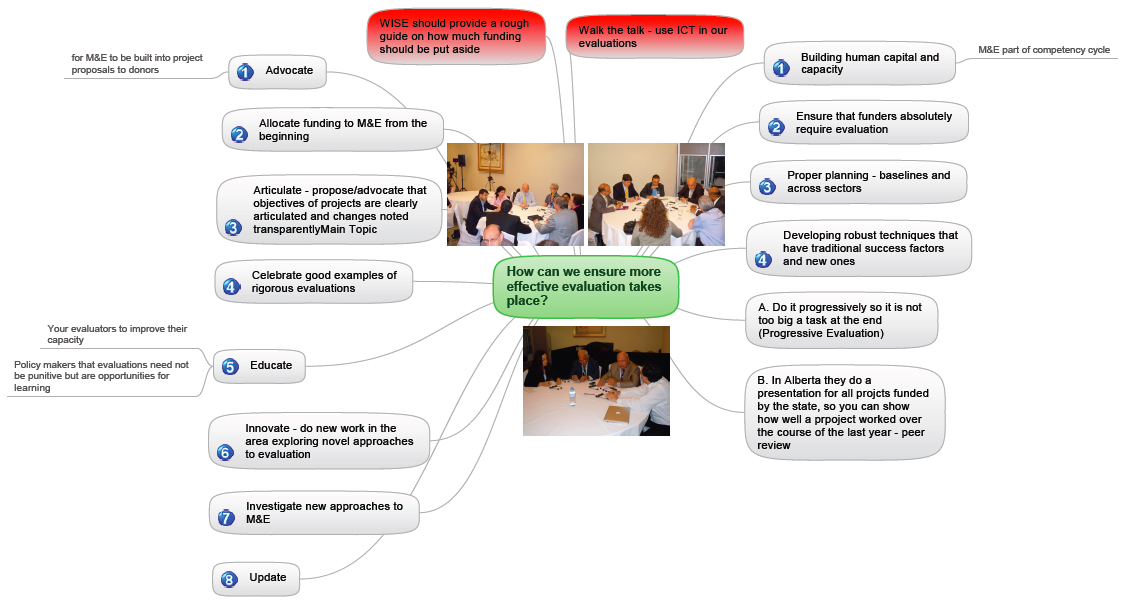
Monitoring and Evaluation of ICT in Education initiatives: reflections from WISE
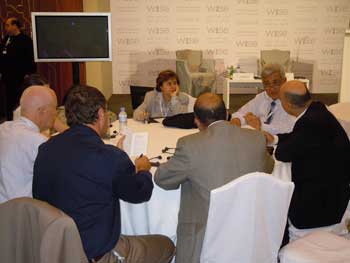 The second WISE (World Innovation Summit for Education) summit provided an opportunity for colleagues from Education Impact to host a lively and highly participatory workshop designed to contribute to more effective monitoring and evaluation of ICT in education activities, focusing particularly on developing countries.
It was premised on two assumptions:
- that there is too little monitoring and evaluation of ICT for education initiatives, and much of what is undertaken is of poor quality; and
- that it is important to differentiate between monitoring (the process of continuing self-reflection within organisations and individuals aimed at improving their performance) and evaluation (the review of outcomes against targets, often undertaken by external agencies)
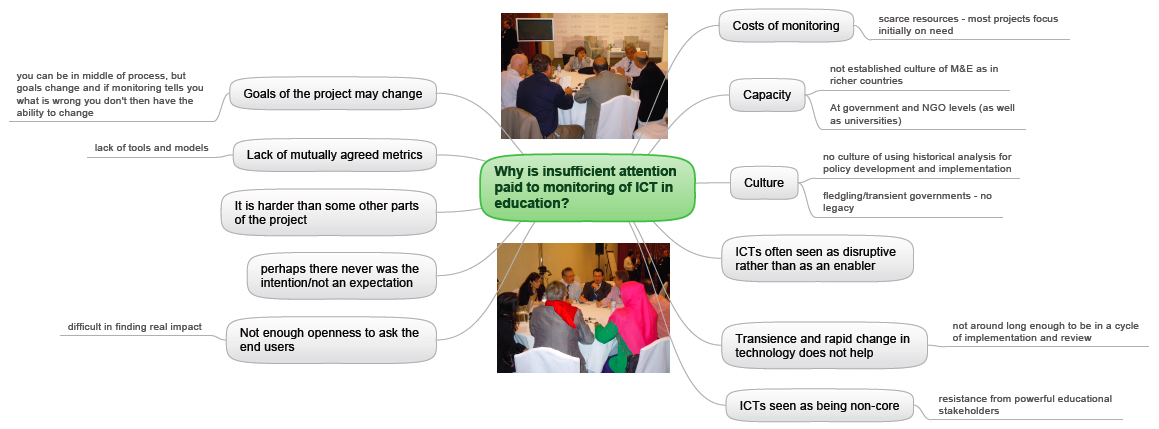
The workshop began by identifying the reasons why there is so little effective monitoring
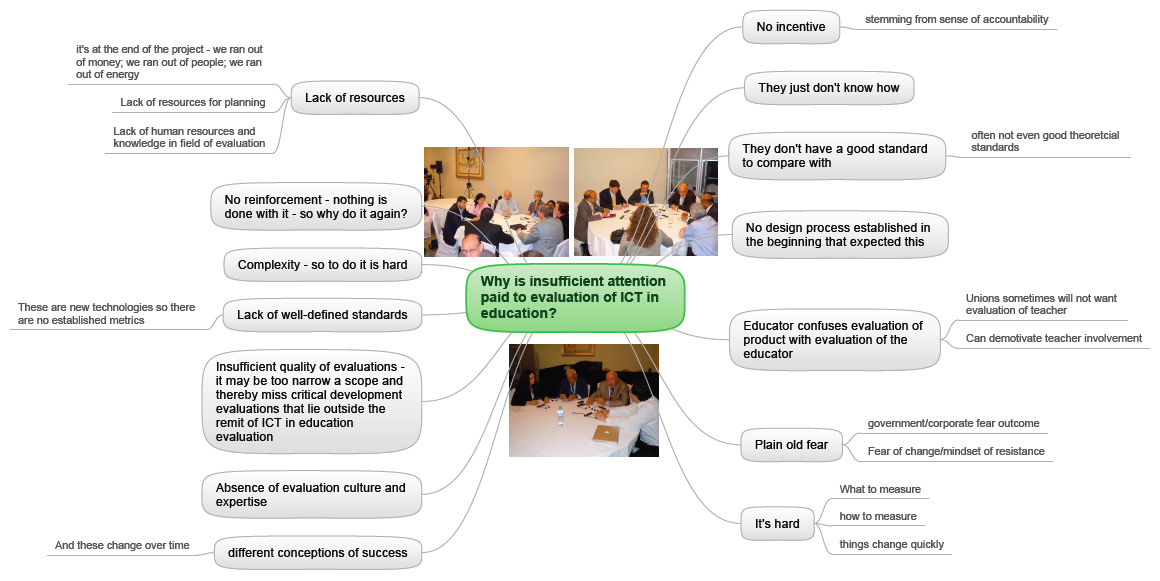
and then why there is so little good and effective evaluation
This was then followed by a discussion of how we can ensure better monitoring

and the things that need to be put in place to ensure better evaluation.
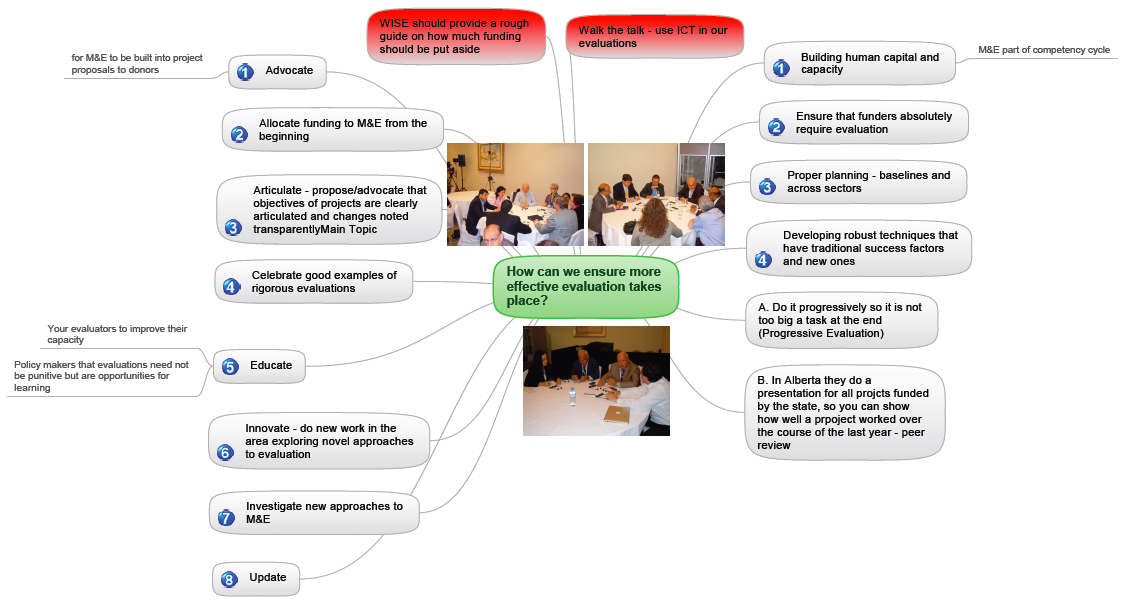
Clicking on the above mind-maps enables them to be viewed at full size!
ICTs, citizens and the state: moral philosophy and development practices
Great to see my latest paper just published in The Electronic Journal on Information Systems in Developing Countries – thanks to Mark Levy and Vignesh Ilvarasan for all their editorial work on this.
The paper examines the moral implications of the use of ICTs in e-government initiatives, focusing especially on national databases, identity cards, and surveillance technologies. It suggests that in resolving debates over these, we need to reach ethical resolutions concerning notions of trust, privacy, and the law. It also draws attention to the ethical problems that emerge in linking the notion of of Universal Human Rights with the introduction of ICTs in developing countries.
As I argue in the paper, “The really difficult ethical questions that arise from this are about how we judge whether it is better for poor and marginalised communities for such egovernment initiatives to have been introduced, or whether they might actually be more advantaged if their governments did not spend vast sums of money on their implementation. Just because it is possible to implement national citizen databases, to use biodata for ID cards, and to introduce sophisticated digital surveillance mechanisms does not mean that it is right to do so”.
Filed under Development, Ethics, ICT4D
‘Student’ protests and political process in the UK
Being at the rally in Trafalgar Square today, supposedly against the proposed cuts in higher education, made me reflect on several aspects of the contemporary political process in the UK:
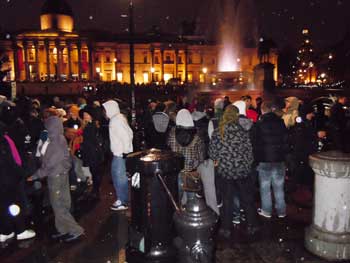 First, it is great to see so many UK students for once standing up for something that they see as being a cause worth fighting. For far too long, many students here, unlike some of their peers elsewhere, seem to have been apathetic and lazy, unwilling to engage in any form of radical political protest, with the majority preferring instead to enjoy the good life associated with undertaking a minimal amount of academic work and a maximum amount of partying. There is an irony here, though, as a young person on the train sitting next to me on the way home said “They are only looking after their own interests, in’t they. They can afford to!”
- To gain groundswell political support, it is essential to have a simple message that people can sign up to – even if their own various interpretations of that message are different. It is easy to unite people around a simple theme of complaining against ‘cuts’ that will affect them, but this hides the complexities surrounding the restructuring of UK universities and higher education.
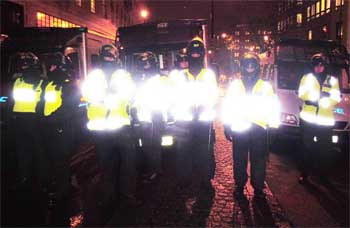
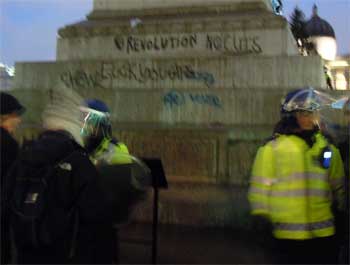
 At the heart of today’s protests were people intent on challenging the police – seeking to provoke them into violent retaliation. At least whilst I was there, it was remarkable how calm the police remained against what many of them must have seen as being unprovoked and unfair abuse. What struck me most about this was that many of those hurling the abuse chose to hide their identities through masks and hooded clothing, whilst individual police officers were fully identifiable by their ‘numbers’. I do not want to be seen as an apologist for the police, and of course there have been cases where individual police officers have over-stepped the mark, but there is a real irony here in that protestors in the UK are indeed able to protest – peacefully – because, in general, the police have tried to be even handed in maintaining order and permitting people of all political persuasions to express an opinion.
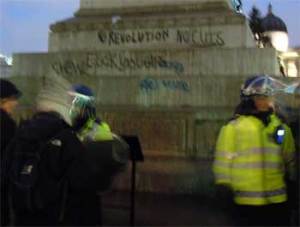 I was amazed at how little anyone in the crowd seemed really to care about what, to me, matters most, the destruction of university based research excellence in the UK! I have written at length elsewhere about this, but the protests convinced me even more of the importance of differentiating between ‘universities’ and higher education. We need fundamentally to restructure UK higher education, and this should involve a very dramatic reduction in the number of students going to ‘universities’. Instead, we should provide high quality and appropriate training and ‘education’, to fit all young people for the sorts of employment that they will subsequently enter. Let’s create outstanding opportunities for young people to gain the skills and education that they need – but let’s not pretend that the institutions in which this takes place are universities.
- And yes, of course, universities should be free for those able to benefit from the research-led opportunities that they provide, and for students who are committed to exploring the boundaries of knowledge diligently, rigorously and with enthusiasm!
- Finally, I find it amazing that according to the Guardian, Vince Cable, “the cabinet minister in charge of tuition fees, said today he was prepared to abstain in a key vote on the government’s policy if that was what fellow Liberal Democrat MPs decided to do as a group. The business secretary said he was prepared to take the unprecedented step of not backing his own proposals for the sake of party unity”. How can the Secretary of State responsible for the introduction of increased tuition fees not vote in favour of them? He should surely resign forthwith if that really is his view.

Filed under Higher Education, Photographs, UK, Universities
Feeding in the scrum
Am I the only one who is utterly fed up with the way in which blatant feeding in the scrum is not penalised by referees? Being in Edinburgh yesterday, I couldn’t resist watching part of the match between Scotland and New Zealand (more entertaining than wading through draft PhD theses!), and time and again Cowan was putting the ball in almost behind his hooker’s feet!
Law 20.6 (d) states that “The scrum half must throw in the ball straight along the middle line, so that it first touches the ground immediately beyond the width of the nearer prop’s shoulders”.
In effect, feeding the ball to your own hooker – or indeed second row – means that there is little skill left in hooking, and very little real competition in the scrum. I remember years ago as a scrum half, trying my best to keep the ball straight – and being penalised by referees whenever it went slightly astray. If referees are no longer going to penalise feeding, then there seems little real point in having scrums at all, and one might as well just give the ball to the scrum half of the side to which the scrum is awarded!
Filed under Rugby
UNESCO publishes report on ICTS for people with disabilities
UNESCO has recently published a short report by a group of experts on “ICT for persons with disabilities“.
This presented the following recommendations to UNESCO for consideration:
“Making UNESCO ICT-accessible
The group of experts recommended that UNESCO should ensure overall accessibility of persons with disabilities. To achieve this goal the Organization should improve its online presence and the accessibility of its website. It should also create accessible physical environment, develop appropriate procurement and recruitment policies, and ensure training and retaining of the employees.
Mainstreaming ICT in inclusive education
UNESCO is encouraged to foster effective use of ICT that are accessible, adaptive and affordable for person with disabilities. Specific guidelines and tools are needed to teach persons with disabilities and to ensure that corresponding ICT competencies are embedded in initial teacher training.
Mobilizing resources and international cooperation
The experts stressed the importance of identifying arguments for shifts in policy practices and determining funding opportunities where UNESCO could get involved. It is important to cooperate with organizations of persons with disabilities in order to get the best possible input and to have credible action lines and projects for funding.
Creating an information and knowledge access ecosystem
This recommendation focuses on “touch points”, such as WorldWide Web, broadcasting, publishing, languages, etc., in the system in which people and humans interact with information and services. It also includes e-governance, which could be used to promote e-voting and e-democracy initiatives for citizen participation in an accessible way, as well increase participation in cultural activities.”
Filed under Accessibility, ICT4D
Reflections on Open Educational Quality Initiative discussions
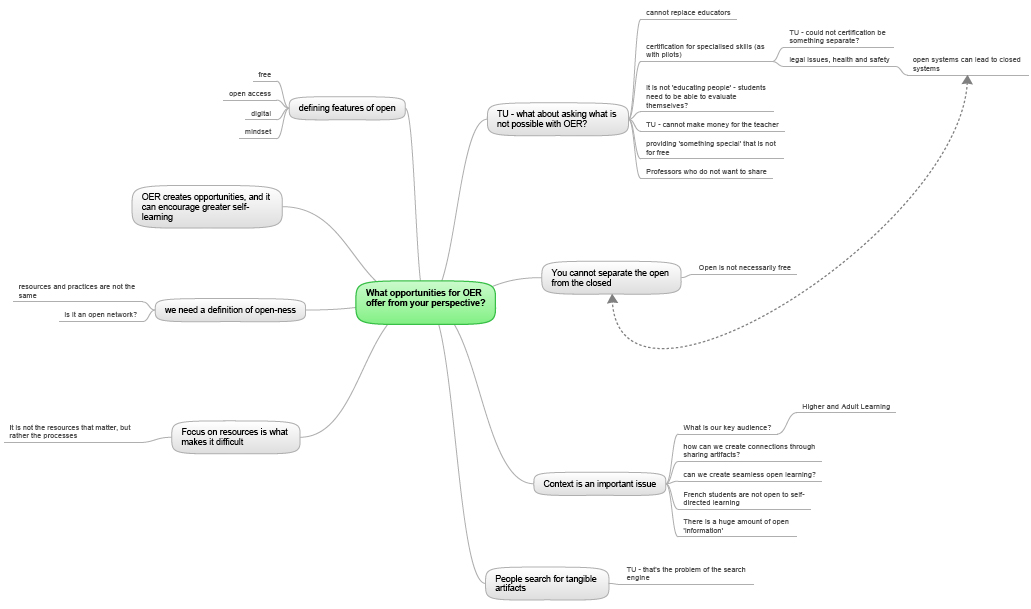
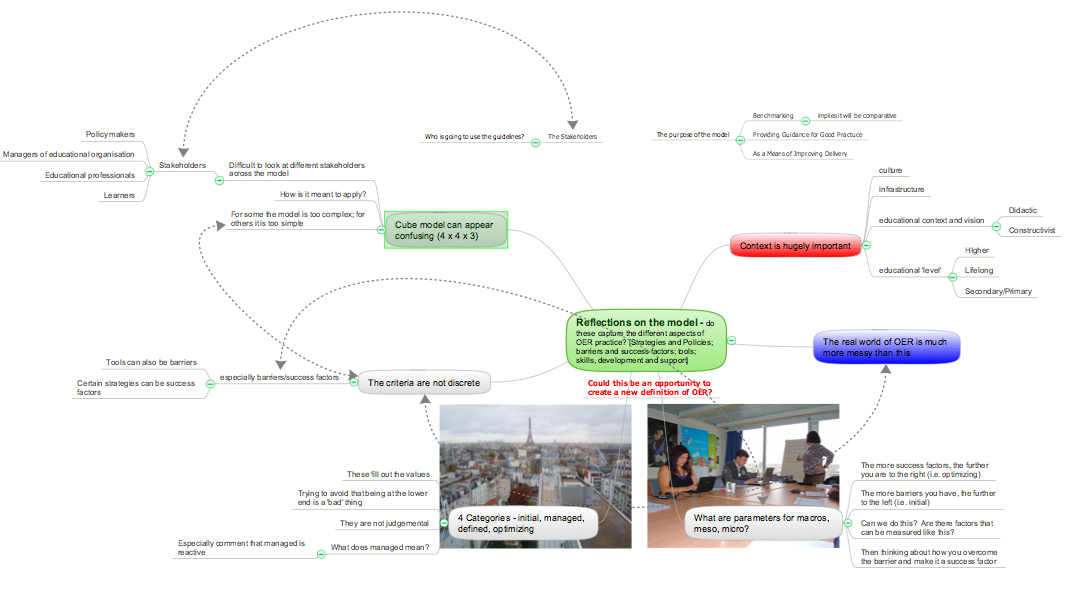
The Open Educational Quality Initiative’s (OPAL) workshop at UNESCO in Paris on 8th and 9th November offered a valuable opportunity to explore a range of issues relating to how we can build on Open Educational Resources to encourage Open Educational Practices.
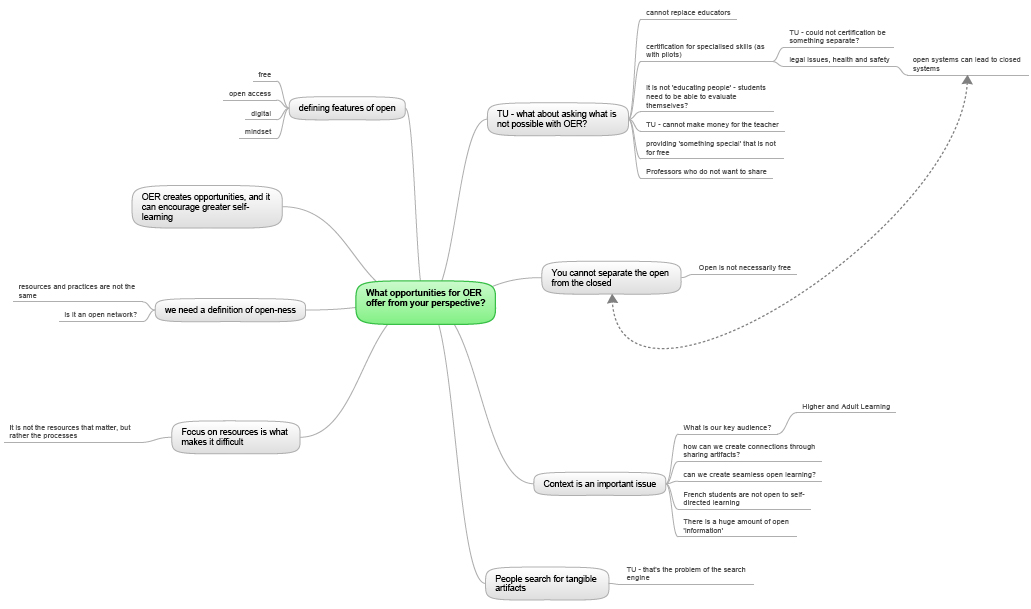
Below are the mind maps I constructed from our discussions on the following themes (click on the image to get higher resolution and larger versions!). Thanks to everyone who contributed to shaping my thoughts in these ways.
What are the main opportunities offered by Open Educational Resources?
What are the key challenges for preventing the implementation of the OPAL vision?
Reflections on the OPAL model – does it capture the different aspects of OER practices?
How can we best contribute?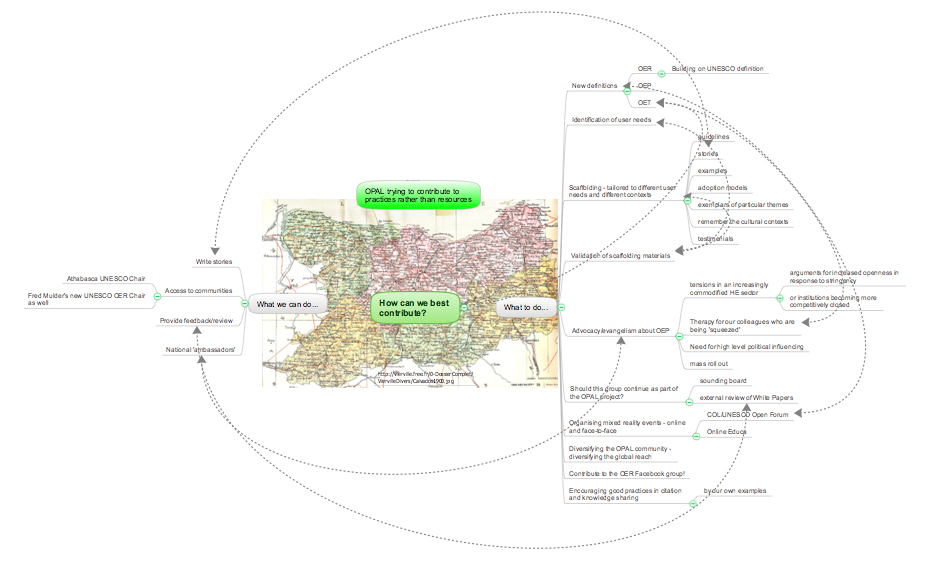
Thanks to everyone who put this interesting gathering together – especially Ulf and Gráinne. Everything can be followed up on the OPAL site and its Cloudworks environment.
Filed under Higher Education, ICT4D

 Tim Unwin's Blog