ICTs, citizens and the state: moral philosophy and development practices

Great to see my latest paper just published in The Electronic Journal on Information Systems in Developing Countries – thanks to Mark Levy and Vignesh Ilvarasan for all their editorial work on this.

The paper examines the moral implications of the use of ICTs in e-government initiatives, focusing especially on national databases, identity cards, and surveillance technologies. It suggests that in resolving debates over these, we need to reach ethical resolutions concerning notions of trust, privacy, and the law. It also draws attention to the ethical problems that emerge in linking the notion of of Universal Human Rights with the introduction of ICTs in developing countries.

As I argue in the paper, “The really difficult ethical questions that arise from this are about how we judge whether it is better for poor and marginalised communities for such egovernment initiatives to have been introduced, or whether they might actually be more advantaged if their governments did not spend vast sums of money on their implementation. Just because it is possible to implement national citizen databases, to use biodata for ID cards, and to introduce sophisticated digital surveillance mechanisms does not mean that it is right to do so”.

Leave a comment

Filed under Development, Ethics, ICT4D

‘Student’ protests and political process in the UK

Being at the rally in Trafalgar Square today, supposedly against the proposed cuts in higher education, made me reflect on several aspects of the contemporary political process in the UK:

  • First, it is great to see so many UK students for once standing up for something that they see as being a cause worth fighting.  For far too long, many students here, unlike some of their peers elsewhere, seem to have been apathetic and lazy, unwilling to engage in any form of radical political protest, with the majority preferring instead to enjoy the good life associated with undertaking a minimal amount of academic work and a maximum amount of partying.  There is an irony here, though, as a young person on the train sitting next to me on the way home said “They are only looking after their own interests, in’t they. They can afford to!”
  • To gain groundswell political support, it is essential to have a simple message that people can sign up to – even if their own various interpretations of that message are different.  It is easy to unite people around a simple theme of complaining against ‘cuts’ that will affect them, but this hides the complexities surrounding the restructuring of UK universities and higher education.
  • At the heart of today’s protests were people intent on challenging the police – seeking to provoke them into violent retaliation.  At least whilst I was there, it was remarkable how calm the police remained against what many of them must have seen as being unprovoked and unfair abuse.  What struck me most about this was that many of those hurling the abuse chose to hide their identities through masks and hooded clothing, whilst individual police officers were fully identifiable by their ‘numbers’.  I do not want to be seen as an apologist for the police, and of course there have been cases where individual police officers have over-stepped the mark, but there is a real irony here in that protestors in the UK are indeed able to protest – peacefully – because, in general, the police have tried to be even handed in maintaining order and permitting people of all political persuasions to express an opinion.
  • I was amazed at how little anyone in the crowd seemed really to care about what, to me, matters most, the destruction of university based research excellence in the UK!  I have written at length elsewhere about this, but the protests convinced me even more of the importance of differentiating between ‘universities’ and higher education.  We need fundamentally to restructure UK higher education, and this should involve a very dramatic reduction in the number of students going to ‘universities’.  Instead, we should provide high quality and appropriate training and ‘education’, to fit all young people for the sorts of employment that they will subsequently enter.  Let’s create outstanding opportunities for young people to gain the skills and education that they need – but let’s not pretend that the institutions in which this takes place are universities.
  • And yes, of course, universities should be free for those able to benefit from the research-led opportunities that they provide, and for students who are committed to exploring the boundaries of knowledge diligently, rigorously and with enthusiasm!
  • Finally, I find it amazing that according to the Guardian, Vince Cable, “the cabinet minister in charge of tuition fees, said today he was prepared to abstain in a key vote on the government’s policy if that was what fellow Liberal Democrat MPs decided to do as a group. The business secretary said he was prepared to take the unprecedented step of not backing his own proposals for the sake of party unity”. How can the Secretary of State responsible for the introduction of increased tuition fees not vote in favour of them?  He should surely resign forthwith if that really is his view.

Leave a comment

Filed under Higher Education, Photographs, UK, Universities

Feeding in the scrum

Am I the only one who is utterly fed up with the way in which blatant feeding in the scrum is not penalised by referees?  Being in Edinburgh yesterday, I couldn’t resist watching part of the match between Scotland and New Zealand (more entertaining than wading through draft PhD theses!), and time and again Cowan was putting the ball in almost behind his hooker’s feet!

Law 20.6 (d) states that “The scrum half must throw in the ball straight along the middle line, so that it first touches the ground immediately beyond the width of the nearer prop’s shoulders”.

In effect, feeding the ball to your own hooker – or indeed second row – means that there is little skill left in hooking, and very little real competition in the scrum.  I remember years ago as a scrum half, trying my best to keep the ball straight – and being penalised by referees whenever it went slightly astray. If referees are no longer going to penalise feeding, then there seems little real point in having scrums at all, and one might as well just give the ball to the scrum half of the side to which the scrum is awarded!

Leave a comment

Filed under Rugby

UNESCO publishes report on ICTS for people with disabilities

UNESCO has recently published a short report by a group of experts on “ICT for persons with disabilities“.

This presented the following recommendations to UNESCO for consideration:

“Making UNESCO ICT-accessible
The group of experts recommended that UNESCO should ensure overall accessibility of persons with disabilities. To achieve this goal the Organization should improve its online presence and the accessibility of its website. It should also create accessible physical environment, develop appropriate procurement and recruitment policies, and ensure training and retaining of the employees.

Mainstreaming ICT in inclusive education
UNESCO is encouraged to foster effective use of ICT that are accessible, adaptive and affordable for person with disabilities. Specific guidelines and tools are needed to teach persons with disabilities and to ensure that corresponding ICT competencies are embedded in initial teacher training.

Mobilizing resources and international cooperation
The experts stressed the importance of identifying arguments for shifts in policy practices and determining funding opportunities where UNESCO could get involved. It is important to cooperate with organizations of persons with disabilities in order to get the best possible input and to have credible action lines and projects for funding.

Creating an information and knowledge access ecosystem
This recommendation focuses on “touch points”, such as WorldWide Web, broadcasting, publishing, languages, etc., in the system in which people and humans interact with information and services. It also includes e-governance, which could be used to promote e-voting and e-democracy initiatives for citizen participation in an accessible way, as well increase participation in cultural activities.”

Leave a comment

Filed under Accessibility, ICT4D

Reflections on Open Educational Quality Initiative discussions

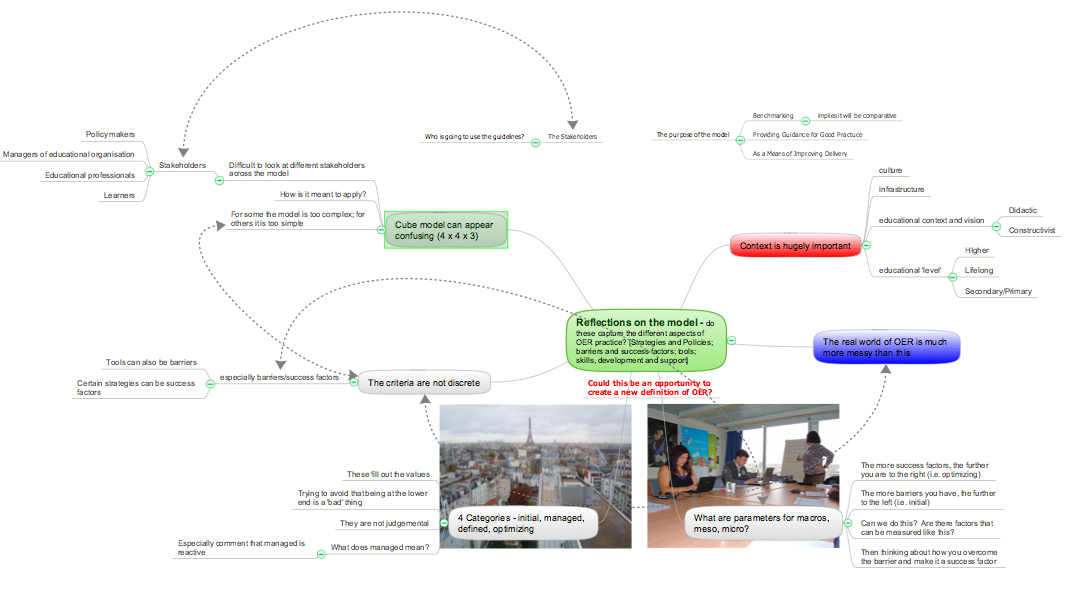
The Open Educational Quality Initiative’s (OPAL) workshop at UNESCO in Paris on 8th and 9th November offered a valuable opportunity to explore a range of issues relating to how we can build on Open Educational Resources to encourage Open Educational Practices.

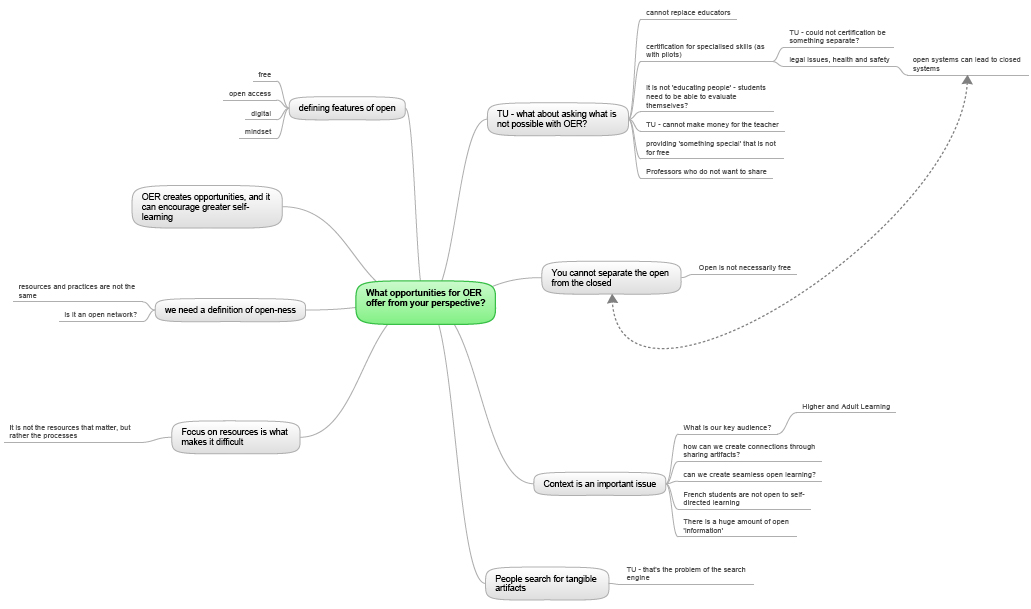
Below are the mind maps I constructed from our discussions on the following themes (click on the image to get higher resolution and larger versions!). Thanks to everyone who contributed to shaping my thoughts in these ways.

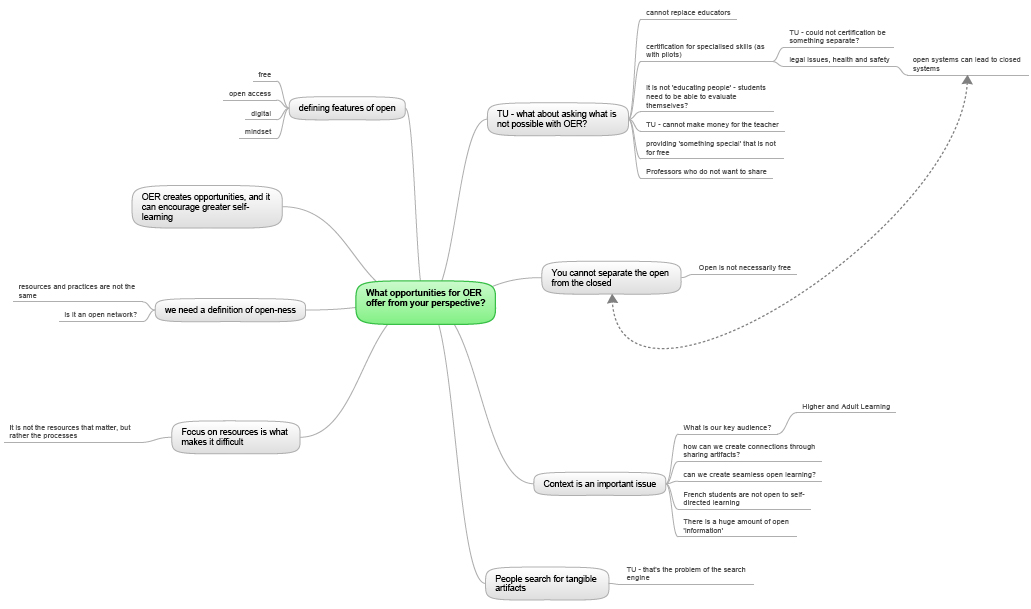
What are the main opportunities offered by Open Educational Resources?


What are the key challenges for preventing the implementation of the OPAL vision?


Reflections on the OPAL model – does it capture the different aspects of OER practices?


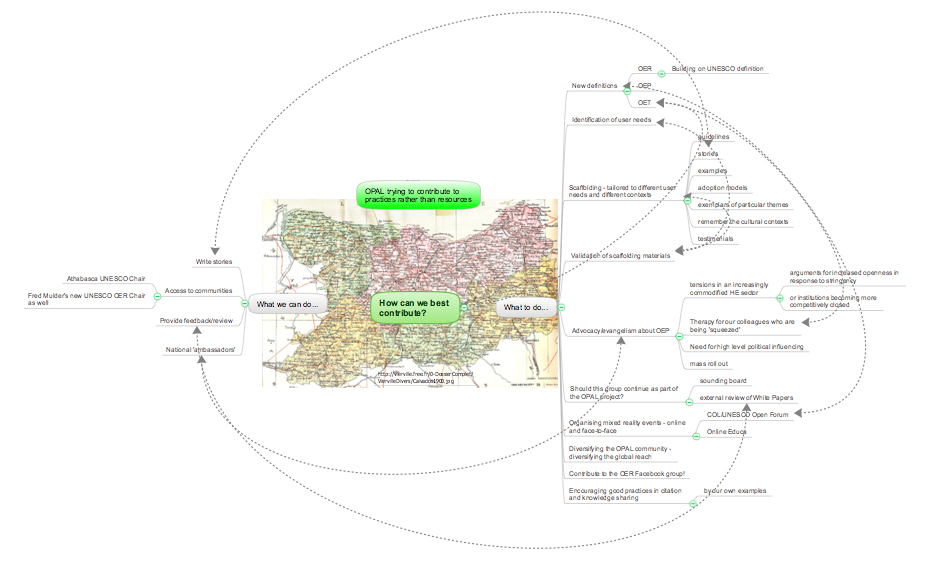
How can we best contribute?

Thanks to everyone who put this interesting gathering together – especially Ulf and Gráinne. Everything can be followed up on the OPAL site and its Cloudworks environment.

1 Comment

Filed under Higher Education, ICT4D

Development as ‘economic growth’ or ‘poverty reduction’

Will economic growth lead to poverty reduction?  I believe passionately that the market will never serve the interests of the poorest and most marginalised.  This seems to me to be so clear and obvious that it scarcely needs defending!  However, I am becoming increasingly worried that such opinions are very much in the minority. The dominant, hegemonic view amongst most of those working in the field of development really does seem to be that economic growth will indeed eliminate poverty.

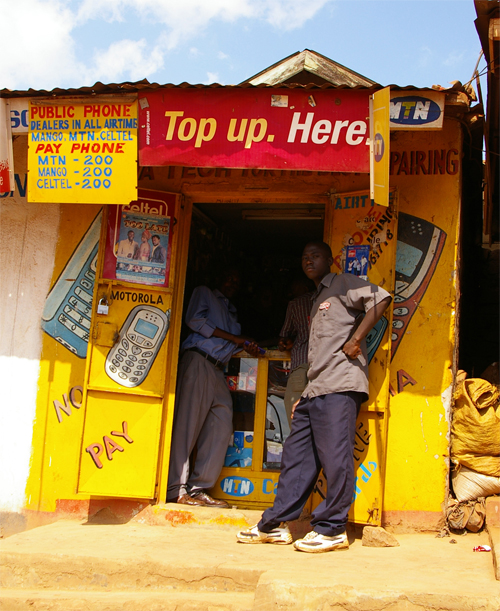
Following my recent keynote at m4Life on 28th October, at which I argued that we need to develop ways in which mobiles can be used to support marginalised groups, such as people with disabilities, I was very strongly challenged by an African colleague, whose views I respect.  In essence, she accused me of being a typical western academic who does not really understand Africa, and that if I did I would know that most Africans wanted economic growth. By focusing on the poorest, she suggested that my views were tantamount to arguing that Africans should remain poor. I felt deeply hurt by these accusations, and am still smarting from their vehemence some two weeks later! I actually don’t know why, they hurt so much, but perhaps it is because I have elsewhere argued strongly that Africa is indeed rich, and that we need to help build on its richness rather than always describing it as being poor!  The irony is that the paper I have written on this has continually been rejected by academic journals – quite possibly because it too does not conform to accepted dogma!

I clearly need to learn to express my arguments more convincingly.  This is a brief attempt to do so in the form of some basic principles:

  • The potential for inequality to increase is inherent within all economic growth.
  • Economic growth, defined in absolute terms, cannot therefore eliminate poverty (see my critique of Jeffrey Sachs, for example, in ‘No end to poverty’)
  • If economic growth proceeds unchecked, it will inevitably lead to increased inequality that will ultimately fuel social and political unrest at a range of scale
  • A fundamental role of states is thus to intervene in the market to ensure that the poorest and most marginalised are not excessively disadvantaged.
  • Given that the market serves the interests of the majority of people, it is incumbent on those who care about reducing inequalities specifically also to address the needs and interests of the poor.
  • Such an argument can be justified both on moral grounds (that it is just), and also on socio-political grounds (to reduce potential violence)
  • With reference to mobile technologies, therefore, all I was doing in my keynote was to argue that companies, entrepreneurs, app developers, and all those claiming to use ‘mobiles for development’ should seek to address the needs of the poor and marginalised, alongside those of global corporations and their shareholders.
  • This is premised upon a belief that ‘development’ is about rather more than just economic growth, and includes notions of equality of opportunity and social justice.

These arguments are developed more fully in:

15 Comments

Filed under Africa, Development, Ethics, ICT4D, Photographs

Watching the watchers watching…

In recent months I seem to have posted several photos of ongoing surveillance, generally by people acting on behalf of the state.  Perhaps I should start a collection of these!  So, here is another one (Camden CCTV again) patrolling the streets near Euston.  I wonder how much footage they take and what they do with the images.

This is what Camden Council’s website has to say on this under the heading of “enforcement”: “We have responsibility for the enforcement of the borough’s parking and moving traffic regulations and this is carried out by Civil Enforcement Officers (CEOs) (formerly known as Parking Attendants) and through the use of CCTV. The scheme is part of the Association of London Government’s (ALG), the Mayor of London and London Borough of Camden’s commitment to the travelling public to keep London moving and ease congestion.”

What an amazing upgrade, Parking Attendants can now be confused with Chief Executive Officers!

Camden’s more detailed account goes on to say that this is done:
  • “to stop traffic congestion
  • alienate inconsiderate motorists
  • free up the bus lane to combat delays for commuters
  • to allow the free flow of traffic
  • improve journey times for bus users”

Am I the only one who finds words such as “enforcement”, “alienate” and “combat” just  a tiny bit worrying?  So, let’s keep watching the watchers…

Leave a comment

Filed under Ethics, Photographs, UK

UK government set to re-examine Google’s infringements of privacy

Great to see the announcement reported by the BBC that Britain’s privacy watchdog is to re-examine the personal information that Google has gathered from private wi-fi networks.

As the BBC article commented, “The Information Commissioner’s Office had investigated a sample earlier this year after it was revealed that Google had collected personal data during its Street View project. At the time, it said no “significant” personal details were collected. But Google has since admitted that e-mails and passwords were copied. … Google’s admission of more detailed data has prompted further action by the ICO. “We will be making enquires to see whether this information relates to the data inadvertently captured in the UK, before deciding on the necessary course of action, including a consideration of the need to use our enforcement powers,” a spokesman said.‬ Google’s director of privacy Alma Whitten said the company would work with the ICO to answer its “further questions and concerns”.”

Leave a comment

Filed under Ethics, UK

University students cheating – who is to blame?

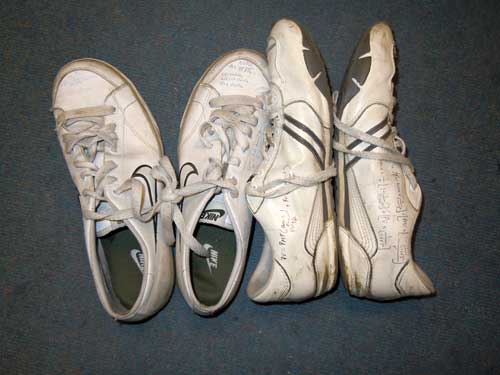
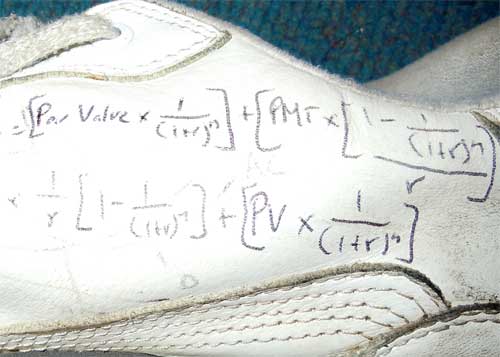
Some weeks ago, soon after exams were over, a friend brought me a couple of pairs of expensive sports shoes that she had found in a skip on campus, and asked what I thought about them.  As these picture show, written all across them were formulae that had clearly been put there to ‘assist’ their owner, or to put it more simply to help them cheat.

I have seen numerous forms of cheating before, but this was a first for me – and I would have thought that it was highly risky for the perpetrator!  Invigilation in exams has become ever more rigorous, and we are regularly sent lists of things to watch out for.  I recall on one occasion even being told  as an invigilator to be aware in case students wearing short skirts had written answers to questions on their thighs.  How we were meant to investigate this, I was never told.

Why, then, is cheating so rife?  I guess, in large part it is because of the increasing credentialism and pressure that is put on students to learn and regurgitate, rather than actually thinking for themselves.  If questions in exams were primarily designed to explore how students thought, rather than on what they could remember (although the two are obviously closely related), then there would be much less benefit in trying to cheat.  I am also sure that cheating in part derives from the fact that many students have to spend much of their time earning an income to cover the costs of fees, accommodation and maintenance, and therefore are unable to acquire the level of knowledge that we expect from them when it comes to exams.  Some might even be lazy, and simply cheat because they prefer to do that, with all the associated excitement of being caught, than actually doing the exciting intellectual work required in the first place.

In all instances, though, this is such a waste!  Students should surely go to universities because they want to learn, to think for themselves, and to develop understandings that will help them influence the future for the better.  No amount of cheating, regurgitating accepted truths will ever help achieve this.

The scale of cheating across universities is immense: in 2006, the Daily Mail reported that 90% of students cheat when writing essays; in 2008, the Guardian reported some 9000 cases of plagiarism across 100 universities in the UK under the heading ‘cheating rife among university students’; and the Canadian publication Macleans recently commented that ‘With more than 50 per cent of students cheating, university degrees are losing their value’.

Plagiarism software has gone some way to prevent plagiarism in the writing of course assessed essays, but this does not avoid cases where a student pays someone else to create an entirely new essay for them – which happens far more frequently than one might expect! There are also numerous websites which claim to provide a service that will not be picked up by the most sophisticated plagiarism checking software.  It is ironic that one of the most important reasons why course-assessed work was introduced was that it was thought to be less stressful for students, and that they would therefore do better in it than in unseen terminal exams.  Perhaps, because of so many abuses, it would be fairer to all if we just went back to such unseen tests – although I guess this would put many companies producing the plagiarism checking software out of business!

This is all just so sad, and reflects once again the commodification of knowledge that I have railed about so much in the past.  Students should want to go to university to learn to think for themselves, and not just to repeat what they are expected to remember.  Cheating is a sign both that we have accepted the wrong people into university, but also that we have failed to inspire them to think afresh.  But then again, if universities have become just higher education institutions, teaching people to learn and regurgitate accepted facts, and if that is what society wants, then I suppose we just have to accept cheating as being central to modern life.

Just think, we could do some DNA testing on the shoes, sample all graduates, and identify who used them.  I wonder what degree they actually finished up with?

1 Comment

Filed under Higher Education, Universities

First Drop – wines to look out for

Matt Gant and John Retsas have put together an exciting and eclectic range of wines under the label First Drop.  As their site says, “First Drop is about passion. for life, fun and flavour!… a lifelong commitment to making kick arse booze… wines with flavour and texture, and a splash of funk… eclectic varieties from unique vineyards in the great regions of the Barossa, Adelaide Hills, McLaren Vale… wines to drink, not just appreciate…”

Typical of the lower priced wines in the range are an Arneis from the Adelaide Hill and a Barossa Shiraz both at around £10 a bottle.    They have also particularly focused on Italian grape varieties, with a Nebbiolo Barbera and a Montepulciano from the Adelaide Hills.  At the top end, their Cream Barossa Valley Shiraz sells for around £40 a bottle, with the Fat of the Land Ebenezar Shiraz going for £30 a bottle. These wines are now available in the UK from New School Wines in Melton Mowbray.

As James Halliday’s Australian Wine Companion 2011 notes, “This is a virtual winery, with no vineyards and no winery of its own.  What it does have are two owners with immaculate credentials to produce a diverse range of wine of significantly higher quality than those of many more conventional operations …  When Matt was working at St Hallett he won the Wine Society’s Young Winemaker of the Year Award ’04, and the Young Gun of Wine Award for First Drop in ’07.  John Retsas has an equally impressive CV, working at St Hallett and Chain of Ponds and is now general manager of Schild Estate”.

In a previous life, Matt was a student at Royal Holloway, University of London, and it is great to see what he has now gone on to achieve!

Leave a comment

Filed under Wine