
Development as ‘economic growth’ or ‘poverty reduction’

Will economic growth lead to poverty reduction?  I believe passionately that the market will never serve the interests of the poorest and most marginalised.  This seems to me to be so clear and obvious that it scarcely needs defending!  However, I am becoming increasingly worried that such opinions are very much in the minority. The dominant, hegemonic view amongst most of those working in the field of development really does seem to be that economic growth will indeed eliminate poverty.

Following my recent keynote at m4Life on 28th October, at which I argued that we need to develop ways in which mobiles can be used to support marginalised groups, such as people with disabilities, I was very strongly challenged by an African colleague, whose views I respect.  In essence, she accused me of being a typical western academic who does not really understand Africa, and that if I did I would know that most Africans wanted economic growth. By focusing on the poorest, she suggested that my views were tantamount to arguing that Africans should remain poor. I felt deeply hurt by these accusations, and am still smarting from their vehemence some two weeks later! I actually don’t know why, they hurt so much, but perhaps it is because I have elsewhere argued strongly that Africa is indeed rich, and that we need to help build on its richness rather than always describing it as being poor!  The irony is that the paper I have written on this has continually been rejected by academic journals – quite possibly because it too does not conform to accepted dogma!

I clearly need to learn to express my arguments more convincingly.  This is a brief attempt to do so in the form of some basic principles:

  • The potential for inequality to increase is inherent within all economic growth.
  • Economic growth, defined in absolute terms, cannot therefore eliminate poverty (see my critique of Jeffrey Sachs, for example, in ‘No end to poverty’)
  • If economic growth proceeds unchecked, it will inevitably lead to increased inequality that will ultimately fuel social and political unrest at a range of scale
  • A fundamental role of states is thus to intervene in the market to ensure that the poorest and most marginalised are not excessively disadvantaged.
  • Given that the market serves the interests of the majority of people, it is incumbent on those who care about reducing inequalities specifically also to address the needs and interests of the poor.
  • Such an argument can be justified both on moral grounds (that it is just), and also on socio-political grounds (to reduce potential violence)
  • With reference to mobile technologies, therefore, all I was doing in my keynote was to argue that companies, entrepreneurs, app developers, and all those claiming to use ‘mobiles for development’ should seek to address the needs of the poor and marginalised, alongside those of global corporations and their shareholders.
  • This is premised upon a belief that ‘development’ is about rather more than just economic growth, and includes notions of equality of opportunity and social justice.

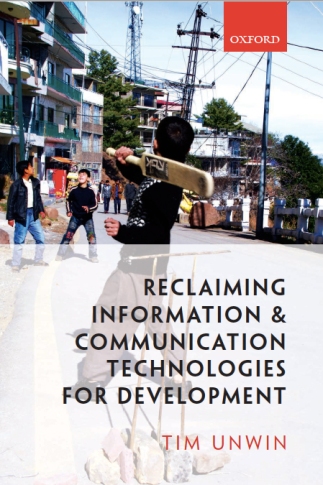
These arguments are developed more fully in:

15 Comments

Filed under Africa, Development, Ethics, ICT4D, Photographs

Watching the watchers watching…

In recent months I seem to have posted several photos of ongoing surveillance, generally by people acting on behalf of the state.  Perhaps I should start a collection of these!  So, here is another one (Camden CCTV again) patrolling the streets near Euston.  I wonder how much footage they take and what they do with the images.

This is what Camden Council’s website has to say on this under the heading of “enforcement”: “We have responsibility for the enforcement of the borough’s parking and moving traffic regulations and this is carried out by Civil Enforcement Officers (CEOs) (formerly known as Parking Attendants) and through the use of CCTV. The scheme is part of the Association of London Government’s (ALG), the Mayor of London and London Borough of Camden’s commitment to the travelling public to keep London moving and ease congestion.”

What an amazing upgrade, Parking Attendants can now be confused with Chief Executive Officers!

Camden’s more detailed account goes on to say that this is done:
  • “to stop traffic congestion
  • alienate inconsiderate motorists
  • free up the bus lane to combat delays for commuters
  • to allow the free flow of traffic
  • improve journey times for bus users”

Am I the only one who finds words such as “enforcement”, “alienate” and “combat” just  a tiny bit worrying?  So, let’s keep watching the watchers…

Leave a comment

Filed under Ethics, Photographs, UK

UK government set to re-examine Google’s infringements of privacy

Great to see the announcement reported by the BBC that Britain’s privacy watchdog is to re-examine the personal information that Google has gathered from private wi-fi networks.

As the BBC article commented, “The Information Commissioner’s Office had investigated a sample earlier this year after it was revealed that Google had collected personal data during its Street View project. At the time, it said no “significant” personal details were collected. But Google has since admitted that e-mails and passwords were copied. … Google’s admission of more detailed data has prompted further action by the ICO. “We will be making enquires to see whether this information relates to the data inadvertently captured in the UK, before deciding on the necessary course of action, including a consideration of the need to use our enforcement powers,” a spokesman said.‬ Google’s director of privacy Alma Whitten said the company would work with the ICO to answer its “further questions and concerns”.”

Leave a comment

Filed under Ethics, UK

University students cheating – who is to blame?

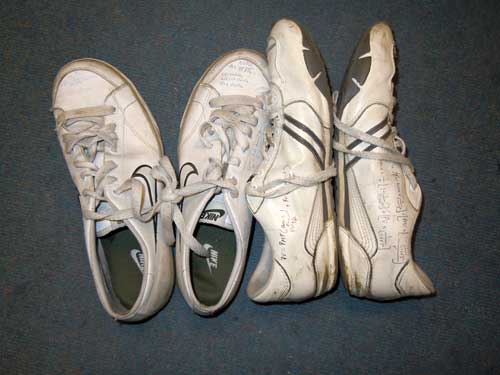
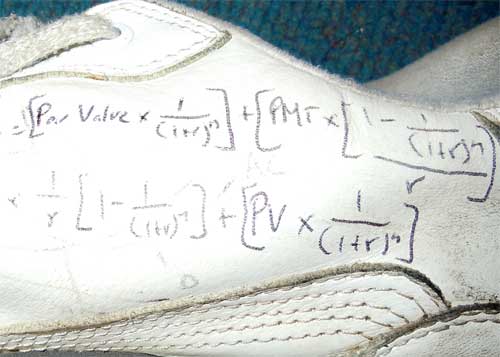
Some weeks ago, soon after exams were over, a friend brought me a couple of pairs of expensive sports shoes that she had found in a skip on campus, and asked what I thought about them.  As these picture show, written all across them were formulae that had clearly been put there to ‘assist’ their owner, or to put it more simply to help them cheat.

I have seen numerous forms of cheating before, but this was a first for me – and I would have thought that it was highly risky for the perpetrator!  Invigilation in exams has become ever more rigorous, and we are regularly sent lists of things to watch out for.  I recall on one occasion even being told  as an invigilator to be aware in case students wearing short skirts had written answers to questions on their thighs.  How we were meant to investigate this, I was never told.

Why, then, is cheating so rife?  I guess, in large part it is because of the increasing credentialism and pressure that is put on students to learn and regurgitate, rather than actually thinking for themselves.  If questions in exams were primarily designed to explore how students thought, rather than on what they could remember (although the two are obviously closely related), then there would be much less benefit in trying to cheat.  I am also sure that cheating in part derives from the fact that many students have to spend much of their time earning an income to cover the costs of fees, accommodation and maintenance, and therefore are unable to acquire the level of knowledge that we expect from them when it comes to exams.  Some might even be lazy, and simply cheat because they prefer to do that, with all the associated excitement of being caught, than actually doing the exciting intellectual work required in the first place.

In all instances, though, this is such a waste!  Students should surely go to universities because they want to learn, to think for themselves, and to develop understandings that will help them influence the future for the better.  No amount of cheating, regurgitating accepted truths will ever help achieve this.

The scale of cheating across universities is immense: in 2006, the Daily Mail reported that 90% of students cheat when writing essays; in 2008, the Guardian reported some 9000 cases of plagiarism across 100 universities in the UK under the heading ‘cheating rife among university students’; and the Canadian publication Macleans recently commented that ‘With more than 50 per cent of students cheating, university degrees are losing their value’.

Plagiarism software has gone some way to prevent plagiarism in the writing of course assessed essays, but this does not avoid cases where a student pays someone else to create an entirely new essay for them – which happens far more frequently than one might expect! There are also numerous websites which claim to provide a service that will not be picked up by the most sophisticated plagiarism checking software.  It is ironic that one of the most important reasons why course-assessed work was introduced was that it was thought to be less stressful for students, and that they would therefore do better in it than in unseen terminal exams.  Perhaps, because of so many abuses, it would be fairer to all if we just went back to such unseen tests – although I guess this would put many companies producing the plagiarism checking software out of business!

This is all just so sad, and reflects once again the commodification of knowledge that I have railed about so much in the past.  Students should want to go to university to learn to think for themselves, and not just to repeat what they are expected to remember.  Cheating is a sign both that we have accepted the wrong people into university, but also that we have failed to inspire them to think afresh.  But then again, if universities have become just higher education institutions, teaching people to learn and regurgitate accepted facts, and if that is what society wants, then I suppose we just have to accept cheating as being central to modern life.

Just think, we could do some DNA testing on the shoes, sample all graduates, and identify who used them.  I wonder what degree they actually finished up with?

1 Comment

Filed under Higher Education, Universities

First Drop – wines to look out for

Matt Gant and John Retsas have put together an exciting and eclectic range of wines under the label First Drop.  As their site says, “First Drop is about passion. for life, fun and flavour!… a lifelong commitment to making kick arse booze… wines with flavour and texture, and a splash of funk… eclectic varieties from unique vineyards in the great regions of the Barossa, Adelaide Hills, McLaren Vale… wines to drink, not just appreciate…”

Typical of the lower priced wines in the range are an Arneis from the Adelaide Hill and a Barossa Shiraz both at around £10 a bottle.    They have also particularly focused on Italian grape varieties, with a Nebbiolo Barbera and a Montepulciano from the Adelaide Hills.  At the top end, their Cream Barossa Valley Shiraz sells for around £40 a bottle, with the Fat of the Land Ebenezar Shiraz going for £30 a bottle. These wines are now available in the UK from New School Wines in Melton Mowbray.

As James Halliday’s Australian Wine Companion 2011 notes, “This is a virtual winery, with no vineyards and no winery of its own.  What it does have are two owners with immaculate credentials to produce a diverse range of wine of significantly higher quality than those of many more conventional operations …  When Matt was working at St Hallett he won the Wine Society’s Young Winemaker of the Year Award ’04, and the Young Gun of Wine Award for First Drop in ’07.  John Retsas has an equally impressive CV, working at St Hallett and Chain of Ponds and is now general manager of Schild Estate”.

In a previous life, Matt was a student at Royal Holloway, University of London, and it is great to see what he has now gone on to achieve!

Leave a comment

Filed under Wine

Towards a free university

I have generally been highly critical of plans by successive UK governments to commodify higher education and create a free market in university degrees that will require students to pay fees of well over £6000 for their degrees.  The review of higher education chaired by Lord Browne published on 12th October thus commented that “We do not in our proposals include a cap on what institutions can charge for the costs of learning. There is no robust way of identifying the right maximum level of investment that there should be in higher education. A cap also distorts charging by institutions” (p.37).  Under these proposals, universities would be able to receive all of the money for charges of up to £6,000 and then pay a levy on the amounts that they charge above this.

So, how feasible might it be for universities in the UK not to charge students fees for the learning that they receive?  The standard reaction amongst most British vice chancellors to the possibility of increasing fees has been one of relief and welcome as they see it as the only way to counter the decline in income that they have faced in recent years, and that is about to get very much more severe if reports of the impending cut of perhaps 79% in funding for undergraduate teaching in the upcoming spending review prove to be true.  It would be a brave vice chancellor who used this as an opportunity to cut student fees, and provide students with a free education.  However, it would be a remarkably astute piece of marketing, and might just prove to be the means to save their institutions.

This, or course, depends a little on how we choose to define a university – and I see universities as something very, very different from the low quality, mass-producing, learn and regurgitate type of higher education institutions that dominate the world today.  A university should be a place of research and learning; it is where leading academics push the frontiers of knowledge forward, and in so doing enable bright students to learn something of value from them.  Universities are exciting places for those who are bright enough to benefit from the opportunities that they provide; they are dreadful for students who simply want to be taught the right answers to regurgitate in exams. The tragedy in the UK is that this distinction has been blurred, and in seeking to provide a higher education system that enables half of our young people to gain degrees, we have dumbed down the quality and created a system that we can no longer afford.

So, how might a university that provides free learning work?  The following are some tentative ideas:

  1. Such universities could focus primarily on gaining high value research funding, both from government research councils and also from external research contracts.  Whilst undertaking research, academics would also be expected to do some ‘teaching’ (for free), but at a much reduced level.
  2. New ICTs can help dramatically to reduce the amount of time academics actually spend in classes.  Filming of standard lectures, for example, which could be used for more than just one year, and the use of digital learning management systems can effectively reduce the time that academics actually need to spend teaching.
  3. Universities could change their employment contracts, only paying staff for nine or ten months a year (thereby leading to an immediate 16.7%-25% cut in salary bills), and expecting them to gain whatever extra income they wished to through external consultancy or contracts for the additional two or three months. This might actually turn out to be much more lucrative for academics in terms of salaries
  4. Once students have left halls of residence in droves (because they can no longer afford both fees and accommodation),  universities could focus on using this vacated space for the conference trade and other external sources of income generation.  This could then be used to subsidise free education to the students living locally
  5. Learning could be provided for free, but students would then be expected to pay something to take examinations if they wanted the external recognition that modern credentialism demands. Oh for the day when students could get a job without showing that they gained a 2:1 from the university of mass production, but rather by simply showing that they had learnt something from being with Dr. Wisdom!
  6. Might we even be able to move to a system whereby students paid academics on a voluntary basis – as with tips in a restaurant?
  7. Academics could write text books, make them available to students online and charge realistic prices for them, thereby gaining some of the profits traditionally made by textbook  publishers.
  8. Traditional styles of teaching could be changed dramatically.  If academics are spending most of their time doing research, perhaps students could learn by being apprentices, working together with the relevant academics and doing some of the simpler research tasks for them.

These are just a few ideas, and they are proposed here simply to show that the notion of a university where people can learn for free – something very different from free higher education for the masses – is not entirely ridiculous.  All it requires is some imagination, vision and passion.

Leave a comment

Filed under Education, Higher Education, UK, Universities

ICT4D Partnerships

I cannot resist the fun of trying to express ICT4D ideas in different ways, and  always enjoy playing with tag clouds when I am writing.  An excuse to revisit the chapter on partnerships in my recent edited book on Information and Communication Technologies for Development, led me to generate this cloud.  I just thought I would share it as a summary statement of my thoughts on the subject of ICT4D policy and partnership!  Thanks to TagCrowd for the crunching!

Leave a comment

Filed under ICT4D

The brave new world of a free market university system in the UK

The Browne review places the final nail in the coffin for the belief that universities are about anything other than economic interest.  From henceforth, university education in the UK has become a commodity to be bought and sold in a free market for individual benefit. Overthrown are beliefs that university education is about intellectual curiosity, about moral judgement, and about communal interest.

The short-sighted stupidity and naïvety of the recommendation that universities should be able to charge market prices for their offerings must, be challenged.  Even for those who see the world purely through an economic lens, the arguments against Browne’s recommendations should be convincing. Imagine a world where:

  • British students increasingly live at home and turn to high quality distance-based courses provided more cheaply by excellent universities, often in other countries;
  • Many students go overseas to study in countries where education is free, thus making a huge cost-saving in gaining a degree and contributing to the local economies of the countries where they study (rather than the UK);
  • Many UK universities shut down, because students realise that the courses they offer are a complete waste of time and do not give them any additional lifetime earning expectations; and
  • Employers, realising even more than they do at present that UK universities do not provide the skills for which they are looking, increasingly employ people without degrees, and give them tailored training courses (often collaboratively with other employers) to ensure that they have the expertise required.

These are just some of the likely economic impacts of the recommendations that are now before government.  The net outcome will be a dramatic reduction in the UK higher education sector, a shift overseas in the amount spent on fees and maintenance by UK born students, an increase in unemployment of former university staff who are unable to gain any other form of employment, and a decline in the wider contribution of the higher education sector to the UK economy.

Even on economic grounds, a decision to let universities charge whatever fees they think the market will stand is fundamentally flawed.  So, even for those who do not care about the social divisiveness, the intellectual sterility, and the communally destructive effects of such policies, these arguments should at least carry some weight!

1 Comment

Filed under Higher Education, UK, Universities

The Browne Review of Higher Education

Can anyone tell me why Lord Mandelson (the former Business Secretary) chose John Browne (Baron Browne of Madingley) to chair the review of higher education in the UK that is due to report on 12th October?  Given his background, and the wider political agenda of which the review is a part, the report’s conclusions can never really have been in question:

  • Browne spent almost his entire career at BP, beginning as an apprentice in 1966 and rising to Group Chief Executive of the combined BP Amoco group in 2007
  • He was one of the most highly paid executives in the UK, with a reported £5.7 million salary in 2004
  • According to some, he was the person most responsible for cost cutting at BP that many attribute to having led to the Texas City refinery explosion in 2005 and most recently the Deepwater Horizon Explosion in 2010.

In short, he is a businessman, who was paid a salary that most people can only dream of, and built his ‘success’ on cuts.  Although he is a Fellow of the Royal Society, a Fellow of the Royal Academy of Engineering, and a Fellow of the Institute of Physics (amongst others), he has shown that he has little real understanding of the purpose of universities, the issues and challenges facing academic and students, and the crucial role that high quality research and teaching must play in Britain’s future.

Surely even he is intelligent enough to understand that increasing fees twofold or threefold will mean that many students will no longer be able to afford to go to university, or will choose instead to go to universities elsewhere in countries  that still believe in the provision of free, high quality university education. A free market in higher education cannot serve the interests of students, of the country, or of university excellence.

Just because Browne was able to earn such a large salary having gained a Physics degree from Cambridge and a Business Master’s degree from Stanford, does not mean that every graduate will be able to do likewise.  Only a few are able to earn the grossly inflated salaries that now seem to be so prevalent amongst senior executives in major corporations and the bankers who brought our financial systems to the point of crisis that has been so damaging to our economy.

A more intelligent and sympathetic Chair might just have led to a more creative and viable future for our once great universities.

Links to my reflections on:

Together, we might just be able to salvage a small number of high quality universities from the impending bonfire of the vanities.

2 Comments

Filed under Higher Education, UK

Religious faith in the UK

A recent report in The Times highlights that almost 80% of people in Britain describe themselves as having a religious faith:

“More than seven out of ten people in Britain describe themselves as Christian, according to government research. Nearly eight in ten have a religious faith. The number of trainee clergy in the Roman Catholic and Church of England is also approaching record levels, according to figures released yesterday. The first Office for National Statistics household survey recorded Christianity at 71.4 per cent, Judaism at 0.6 per cent, Islam at 4.2 per cent and Hinduism at 1.5 per cent. Sikhism was 0.7 per cent and Buddhism 0.4 per cent. Slough is the most religious town in England, where 93 per cent profess a religious belief, while Brighton is the least, with 58 per cent”.

2 Comments

Filed under UK