Changes to A-levels: improving the quality of learning?

A report in today’s Sunday Times, highlights concerns expressed by the Education Secretary Michael Gove, about the structure of assessment in British secondary education.  As the paper reported, “Michael Gove wants to see A-levels become more academically rigorous and to scrap AS-levels, which are in the first year of the sixth form … He is responding to complaints by universities that the current A-level system, introduced in 2000, fails to prepare pupils for in-depth study”.

As the Sunday Times goes on to observe, Gove “will invite universities to design new A-levels, modelled on the new Cambridge Pre-U qualification, taken by a number of leading state and independent schools in preference to A-levels. Gove said: ‘We will see fewer modules and more exams at the end of two years of sixth form and, as a result, a revival of the art of deep thought'”.

There is absolutely no doubt that in terms of academic rigour most students who are educated in the British education system today lack many of the skills required to undertake a traditional university education successfully.  This is one of the factors underlying the dumbing down of standards in British universities that has occurred over the last decade.  The reform of A-levels may therefore be able to contribute to the training of young people’s minds so that they can better cope with the intellectual rigours required of a high quality university education.

However, this is only part of the story.  Many young people work incredibly hard for their A-levels, and perform outstandingly well at good universities – even under the present system.  Our secondary schools also provides them with a diversity of skills and other experiences that were simply not available a decade ago.  Such skills are important – but do not necessarily fit them for intellectually rigorous university degrees. Let us not decry the huge achievements of our young people who have gained excellent A-level grades over the last decade, and their teachers who have struggled to help them learn whilst also navigating the ever increasing amount of regulation imposed on them.

Yes, universities are indeed about training people’s minds, encouraging them to think beyond the confines of existing knowledges, and developing the incredibly important skill of critical analysis.  But we should not expect 50% of our young people to be interested in doing this, or indeed to be able to do it successfully!  We do need rigorous ways of accessing people’s aptitude to enter a high quality university system, and the present AS and A2 system has undoubtedly failed to do this.  However, so-called university courses that cater for the apparent demand for dumbed down mass higher education system do not need rigorous A-levels as a mechanism for judging the quality of applicants. If you can get into a university today with C, D and E grades under the present A-level system, it seems to be to be very clear that these universities are not actually interested in the skills that new, more rigorous and intellectually challenging A-levels might provide.

We must have an intellectually vibrant and challenging university system in this country.  But until it is accepted that this means we need fewer universities, and that other forms of further education are more appropriate for perhaps a quarter of our young people, tinkering with the examinations that young people  undertake at the end of secondary education will make little difference.

Leave a comment

Filed under Higher Education

Entourage glitches

I don’t seem to have much luck using Entourage (version 12.2.5) (yes, of course I am a Mac user) with OS 10.6.4 – and connecting to the university’s Exchange server !  So, as I manage to resolve issues I thought it might be helpful to others to post some useful tips.

Problems receiving e-mails:

  • If you can send e-mails OK, and all of your account settings are fine, this is most probably a cache issue
  • Go to the Inbox on Entourage, control click and access Folder Properties
  • Then simply click on Empty Cache [OK – any items that are not synchronised with the Exchange server will be lost, but it’s about your only way to resolve this]
  • But this solution has worked a couple of times recently [thanks to Matthew Convery for discovering it for me!]

When things go really wrong:

  • remember that Time Machine does not really back up your Entourage database effectively
  • about the only solution is to try to rebuild your database
  • In the past, I have been unlucky with this, but recently leaving the rebuild to sort itself out overnight did the trick, and the rebuilt database works
  • Mind you, the best solution is periodically to back up your Entourage database.  This is located in Documents – Microsoft User Data – Office 2008 Identities – Main Identity – Database [Entourage really does not like it when this file gets to around 10 GB!]

Leave a comment

Filed under ICT4D

New guide to good practices in UK-Africa Higher Education partnerships

The Association of Commonwealth Universities’ Africa Unit has just published an excellent short guide on good practices in developing educational partnerships between higher education institutions in Africa and the UK.

As the Africa Unit comments, “The main reason behind the preparation of this Guide … is the lack of knowledge about the scope, nature and depth of partnerships in this area. The Guide does not set out to present a set of universal, objective rules to be followed and which will guarantee success. Instead, it identifies 10 valuable ‘principles of management and good governance’ which have been the driver behind a number of successful and sustainable UK-Africa partnerships, which can inform future partnerships”.

This is a really useful document, full of helpful tips and advice, and anyone considering developing such partnerships should get hold of a copy and read it diligently. The ten key principles that it advocates are:

  1. Shared Ownership
  2. Trust and Transparency
  3. Mutual Understanding of different Cultural and Working Environments
  4. Clear Division of Roles and Responsibilities
  5. Effective and Regular Communication
  6. Joint Strategic Planning and Implementation
  7. Strong Commitment across the board from Staff and Management
  8. Supportive Institutional Infrastructure
  9. Monitoring and Evaluation
  10. Sustainability

As someone who has been actively involved in such partnerships over the last decade, these principles resonate very strongly with my own experiences.  Many thanks to the Africa Unit for expressing them so clearly and succinctly.

1 Comment

Filed under Africa, Higher Education

Who’s watching who at LHR?

The extent of state surveillance in the UK increases apace. Imagine my surprise when I saw this police car with a surveillance camera on the roof when I was recently passing through London Heathrow!

Perhaps we should all start taking photographs of those who are taking photographs of us while we are going about our day-to-day business!

What happens to all the photographs that the police take of us?  Imagine what would happen if we all asked for copies of such photographs under Freedom of Information legislation! Just because it is possible for the state to photograph its citizens and store this information does not mean that it is right for the state to do so.

Leave a comment

Filed under Ethics, Photographs

Love Arlanda, 6th-19th June 2010

I have long enjoyed landing at Arlanda airport to the north of Stockholm.  Somehow, the pace of life changes as soon as the plane’s wheels touch the ground.  The clean air, the clean lines of the airport, and the pace at which the Swedes manage to live their lives to the full, are just inspirational.

Imagine my surprise earlier this year when the Swedes declared Arlanda as the Official Love Airport to celebrate the wedding on June 19th between HRH Crown Princess Victoria and Mr. Daniel Westling.  Mind you, it seems a bit weird to lay claim to such a title!

Leave a comment

Filed under Photographs

In defence of Godstone

Today’s announcement that “Lawyers representing 28 victims of last year’s E. coli outbreak at Godstone farm in Surrey are preparing to demand “substantial” damages in a group legal action” raises complex and interesting issues. Of course it is extremely sad that so many people suffered, and are still suffering, from the outbreak of E. coli traced to the farm in September 2009.  However, Godstone farm has provided an important source of education and enjoyment for thousands of people over many years.  It does not make huge profits, and it is difficult to imagine how the owners could afford to pay substantial damages.

I have extremely fond memories of taking my children to Godstone farm on many occasions more than a decade ago.  What struck me particularly was just how much the owners advertised the importance of people washing their hands.  Indeed, I find it difficult to believe that anyone could have visited the farm then without being aware of the risks that were involved.  Godstone provided many more notices and offered more taps for people to use than did most other farms that we visited.

There is always a risk that people can pick up infections and illnesses from animals.  Parents of young children have responsibilities for their care in all sorts of situations – including the need to wash their hands carefully when they have been in contact with animals.  Likewise, farms have a duty to inform the public as soon as they are aware that their animals definitely carry disease.

I guess that the only real winners in this case will be the lawyers!

———————————————————————————————————————————

The subsequent independent report published on 15th June  was widely reported as being critical of both the Health Protection Agency and the farm:

  • “A “substantial” number of E.coli cases could have been prevented if health chiefs had responded quickly to an outbreak at a petting farm, a damning report said today. The Health Protection Agency (HPA) missed a key opportunity to take action which would have restricted the size of the outbreak at Godstone Farm, near Redhill, Surrey, last year” (The Independent)
  • St George’s University of London press release about the findings of Professor George Griffin who led the investigation

Leave a comment

Filed under UK

IPID annual conference: 9th-10th September in Barcelona

The IPID annual conferences have become one of the major global events for young researchers in the field of ICT4D to share their experiences.  This year’s conference is being hosted by the Open University of Catalonia and the Polytechnic University of Catalonia on 9th and 10th September 201o and will be held at the Universitat Politècnica de Catalunya in Barcelona, Spain:

1 Comment

Filed under ICT4D, ICT4D conferences

WISE Awards 2010 – closing date 15th July

The Qatar Foundation has recently announced the WISE (World Innovation Summit for Education) Awards application process for 2010 – with a closing date of 15th July 2010.

Recipients of the 2009 WISE Awards were:

  • Sheetal Mehta for Project Nanhi Kali (India)
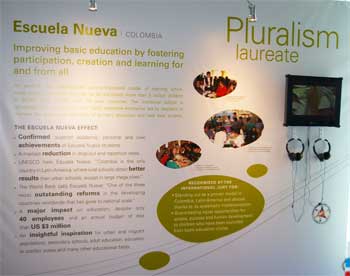
  • Vicky Colbert for Escuela Nueva (Colombia)
  • Delio Morais for Distance Learning in the Amazon Forest (Brazil)
  • Peter Levy for Curriki (USA)
  • Martin Burt for The Self-Sufficient School (Paraguay)
  • Joyce Dongotey-Padi for the Widows Alliance Network for Sustainable Economic Development in Ghana

The 2010 WISE Awards are designed to recognise and support outstanding practice and achievement within the theme of Transforming Education: Investment, Innovation and Inclusion. Applicants must show how they deliver on the following ten criteria:

  1. Educational Transformation: the overall extent to which the educational activity has transformed an aspect of education that has also had societal impact;
  2. Sustainable investment: the extent to which the educational activity is funded in a sustainable way to ensure its continuing viability;
  3. Innovation: the extent to which the educational activity is innovative in design and/or practice, thereby transforming traditional means of educational delivery;
  4. Inclusion and Diversity: the extent to which the activity includes a diversity of beneficiaries and has enhanced equality of access to education;
  5. Quality of Learning: the extent to which the transformation has improved the quality of learning;
  6. Scalability: the extent to which there is evidence that the educational activity has the potential to be scaled up effectively, or has already been replicated at a larger scale than originally piloted;
  7. Partnership and Participation: the extent to which the educational activity has established effective partnerships and includes participation from beneficiaries and stakeholders;
  8. Monitoring and Evaluation: the extent to which there is evidence of effective ongoing enhancement of the programme through regular monitoring and also evidence of formal internal or external evaluation procedures;
  9. Dissemination: the extent to which the organisations involved are already effectively disseminating and sharing their educational practices with other practitioners;
  10. Clarity of proposal: the extent to which the proposal is clearly intelligible and conforms to the requirements of the application process.
The  application process is designed to generate six Awards. Each of the six recipients will receive a WISE Prize Award of $20,000 at the Gala Dinner on 8 December 2010. Recipients will also be given the opportunity to showcase their projects during the WISE Summit to be held in Doha from 7 to 9 December 2010.
The WISE Awards application process is open to individuals or teams of individuals from across the world and across all education sectors (apart from previous WISE Award winners). Thirty finalists will be announced by mid August 2010, and they will be invited to submit more detailed applications. The six prize winners will be selected from these finalists.

Leave a comment

Filed under Education, Higher Education

Heading to e-Learning Africa, 26th-28th May 2010

This year’s eLearning Africa takes place in Lusaka, Zambia, later this week, and promises to be a great chance to catch up with colleagues working on ICT4D!  I have been lucky enough to participate in all of the four previous eLearning Africa conferences in Ethiopia, Kenya, Ghana and Senegal, and they have always provided a useful opportunity to learn about some of the latest developments in the field.  It is particularly good to meet African academics and activists committed to using ICTs to support the aspirations of poor and marginalised people across the continent.

Thanks to all those at ICWE who have been working so hard in recent months to put on the conference – I hope it’s a great success.

Leave a comment

Filed under Africa, Higher Education, ICT4D conferences

Google admits that its Street View cars collected WiFi information

The Guardian newspaper reported yesterday that “Google has been accidentally gathering extracts of personal web activity from domestic wifi networks through the Street View cars it has used since 2007”.

Can anyone really believe that Google did this by accident? The ‘discovery’ was made because Germany’s data protection authority demanded an audit of Google’s data. As the Guardian report continued “As well as systematically photographing streets and gathering 3D images of cities and towns around the world, Google’s Street View cars are fitted with antennas that scan local wifi networks and use the data for its location services”.

This is a clear invasion of privacy, and is absolutely typical of Google’s cavalier attitude towards the ways in which ICTs have transformed our approaches to what can be deemed ‘public’ and ‘private’ information.

Google’s blog on the 14th May, included a statement by Alan Eustace, Senior VP, Engineering & Research who commented that “Nine days ago the data protection authority (DPA) in Hamburg, Germany asked to audit the WiFi data that our Street View cars collect for use in location-based products like Google Maps for mobile, which enables people to find local restaurants or get directions. His request prompted us to re-examine everything we have been collecting, and during our review we discovered that a statement made in a blog post on April 27 was incorrect. In that blog post, and in a technical note sent to data protection authorities the same day, we said that while Google did collect publicly broadcast SSID information (the WiFi network name) and MAC addresses (the unique number given to a device like a WiFi router) using Street View cars, we did not collect payload data (information sent over the network). But it’s now clear that we have been mistakenly collecting samples of payload data from open (i.e. non-password-protected) WiFi networks, even though we never used that data in any Google products”.

Google went on to say that this was quite simply a mistake: “So how did this happen? Quite simply, it was a mistake. In 2006 an engineer working on an experimental WiFi project wrote a piece of code that sampled all categories of publicly broadcast WiFi data. A year later, when our mobile team started a project to collect basic WiFi network data like SSID information and MAC addresses using Google’s Street View cars, they included that code in their software—although the project leaders did not want, and had no intention of using, payload data”.

The point is that mistakes do happen; no digital system is entirely secure.  This is one of the reasons why they should not be collecting such data in the first place!  If they make mistakes such as this, how can anyone believe them when they say that they are not using the data?  They use all other data that they collect, such as information from searches on Google, and the e-mails people send using Google mail!

Eustace concluded by saying what Google would do about this incident: “Maintaining people’s trust is crucial to everything we do, and in this case we fell short. So we will be:

  • Asking a third party to review the software at issue, how it worked and what data it gathered, as well as to confirm that we deleted the data appropriately; and
  • Internally reviewing our procedures to ensure that our controls are sufficiently robust to address these kinds of problems in the future…

The engineering team at Google works hard to earn your trust—and we are acutely aware that we failed badly here. We are profoundly sorry for this error and are determined to learn all the lessons we can from our mistake”.

Google have not had my trust for a very long time.  Yes, they have a great search engine – but they should stick to that, and stop “ogling” at us in other ways!

It is also a timely reminder for those who do not protect their WiFi networks, that they should indeed do so with robust passwords!

Other reports on this announcement include:

Leave a comment

Filed under Ethics, ICT4D general