Male Attitudes and Behaviours Towards Women and Digital Technologies in Pakistan

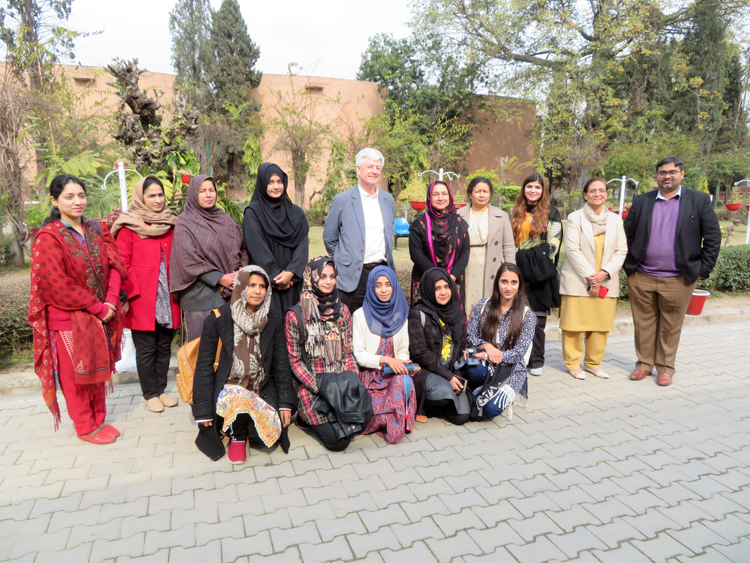
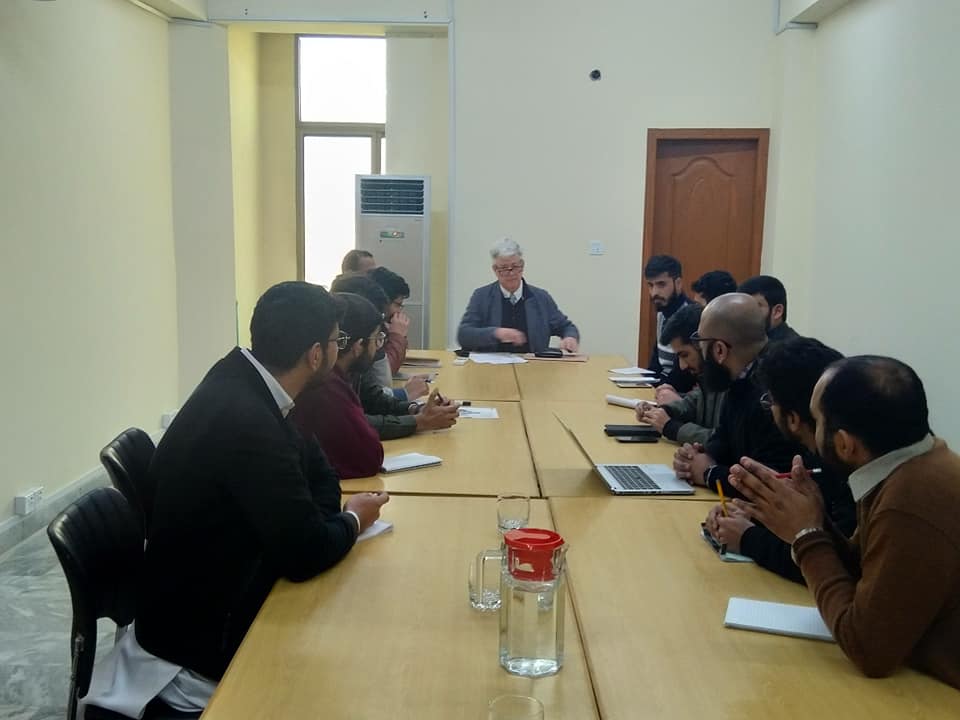
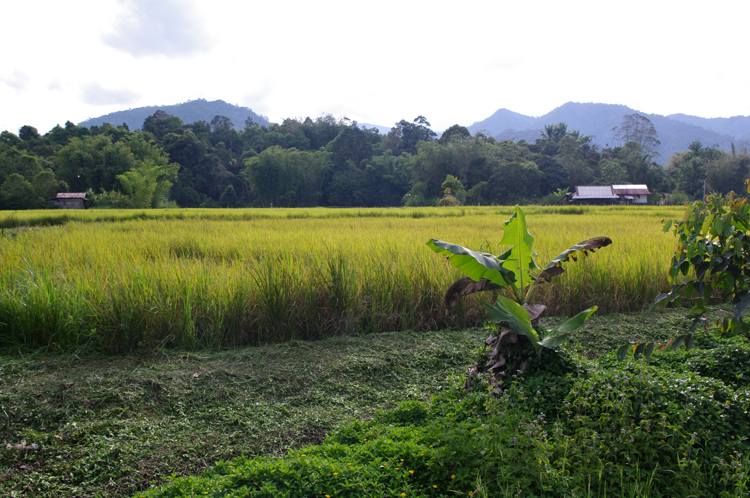
I am delighted to see the research practice paper that I worked on and wrote with my dear friend and colleague Dr. Akber Gardezi has now been made available within the UNESCO Chair in ICT4D working paper series. It is one of the most important pieces of research that I have ever done, but academic journals did not see fit to publish it. Perhaps this is because it is indeed worthless, and we have done a disservice to all those who contributed to our research, but perhaps it may also be because it challenges too many of the taken for granted assumptions about style and content of publishing in ICT4D academic journals in the 2020s. Both Akber and I are immensely grateful to the many people in Pakistan with whom we spoke for this reseach, typified by the group of amazing women illustrated in the photo above from 2020.

I wanted the paper to be published in a good academic journal to help Akber’s career, but in the end after journal rejections we decided that the messages were too important simply to be binned in the rejection folder. I will let readers judge whether it is indeed worthless – but for those of you who think it is, please at least take away some of the important messages contained within it.

Abstract

The full paper is available here, but the abstract reads as follows:

This paper reports on qualitative research undertaken to explore men’s attitudes and behaviours towards women and technology in Pakistan (in Azad Kashmir, Islamabad, Punjab and Sindh) in January-February 2020.  It is premised on a concern that much research and practice on gender digital equality is based on ideas emanating mainly from North America and Europe, and may not be nuanced enough and sufficiently culturally appropriate to be relevant in different contexts, such as an Islamic state in South Asia.  It builds on our previous research on mobile ‘phones and identity, as well as the use of mobiles for sexual harassment in Pakistan.  Four main conclusions are drawn: first, wider aspects of Pakistan’s society and culture would need to be changed before substantial gender digital equality (as conceived in most “Western” literature) is achieved; second, there was considerable diversity in the views expressed by our participants about gender digital equality, and whilst we do draw some general conclusions these should not mask the importance of such diversity; third, despite the challenges, the last decade has seen substantial changes in the use of digital technologies by women, especially in urban areas and among the higher classes, with many more girls now studying STEM subjects and a small but growing number of women taking jobs in the tech sector; and finally, it highlights complex and difficult questions about universal and relativist approaches to gender digital equality.

Acknowledgements

Very many people contributed to this research, and it is their voices that we wanted to reproduce in the paper. Many of them asked to be named in anything we wrote, and so I reproduce the paper acknowledgements here in full:

We are extremely grateful to colleagues in COMSATS University Islamabad (especially Dr. Tahir Naeem), the University of Sindh (especially Dr. Mukesh K. Khatwani) and the International Islamic University Islamabad (Dr. Bushra Hassan) for facilitating and supporting this research.  We are also grateful to those in Riphah International University (especially Dr. Ayesha Butt) and Rawalpindi Women University (especially Prof Ghazala Tabassum), as well as senior management of those companies (Alfoze and Cavalier) who helped with arrangements for convening the focus groups.

This paper is above all, though, an expression of our efforts to share the views of the many people who contributed so passionately and openly to our questions.  These people (listed in alphabetical order of first names) are therefore, in practice, the originators of the views that we have sought to combine and share more widely: Aakash Kumar, Abdul Bari, Abdul Maalik, Abdul Manan, Abdul Rehman, Abdul Saud, Afsheen Altaf, Ahmed Bilal, Ali, Ali Shah, Dr. Alina Zeeshan, Amir Gohar, Amna Anwar, Anam, Andleeb Ismail, Anmol, Anzalna, Arslan Ahmad, Asad Malik, Atia-Tul-Karim, Awais Ahmed, Awais Rahat, Ayesha Kayani, Dr. Azhar Mahmood, Babar Ali, Balaj Chaudary, Bilawal Ali, Bushra Kanwal, Ch. Hussain, Ch. Murtaza, Danish Shoukat, Danyal Malik, Darima Habib, Darshana, Fahad Saleem, Fahim, Faiza Kanwal, Faiza Shah, Faizan Abrar, Fatima Seerat, Ghazala Tabbassum, Heba Mariyam, Habibullah, Hafeez ur Rehman, Hafsa, Hamid Nawaz, Hamza, Hassan, Hina Akram, Humna Ikhlaq, Ihtisham Ijaz, Kainat Aslam, Kainat Malik, Khuda Bux, M. Hamza Tahir, M. Hassan, M. Riaz, M. Wajahat, M. Hassan Zehri, Maira, Manzoor Ali, Maryam Rehmat, Mehmoona Akram, Memoona, Mishkat, Mohsin Tumio, Muhammad Ali, Muhammad Sarwar, Muhammad Zeeshan, Munawar Gul, Muqadas Saleem, Muqaddas Abid, Noman Javed, Noor Nabi, Noor ul Ain Maroof, Osama Osmani,Paras, Qayoum, Rajesh, Ramsha, Rashid Ali, Rashid Shah, Raza Asif Ali, Rehan Arshad, Renuka, Rohit Kumar, Rumaisa Feroz, Saeed Ahmed, Saima Mehar, Dr. Sajjad Manzoor, Saleha Kamal, Sameen Rashid, Saqib Hussain, Sara Shahzad, Sarfraz, Sarmed Javed, Sarwan Nizamani, Shahid Sohail, Dr. Shahwawa, Sharjeel, Shehrol Asmat , Sonia Khan, Sumaira Tariq, Syed Ahmed, Talha, Tasneem, Tehmina Yousaf, Tehreem, Usama Basharat, Usama Nasir Khan, Usama Thakur, Usman Farooq, Waleed Khan, Waqas Masood, Yasir Iqbal, Yousif Khan, and Zahra Ali.  We hope that we have done them justice.  All of them ticked the box indicating that they wished for their names to be recorded in material that we wrote; those few who chose to tick the box saying that they did not want their names recorded are not mentioned here, but we are very grateful to them nonetheless.

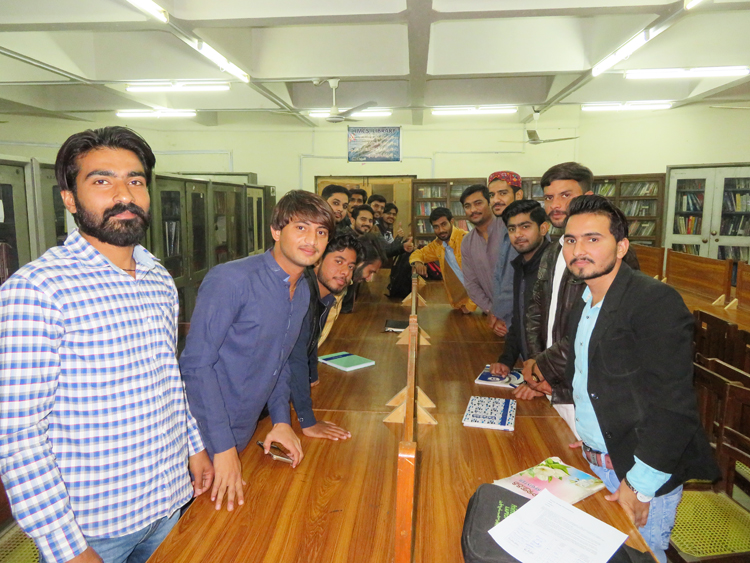
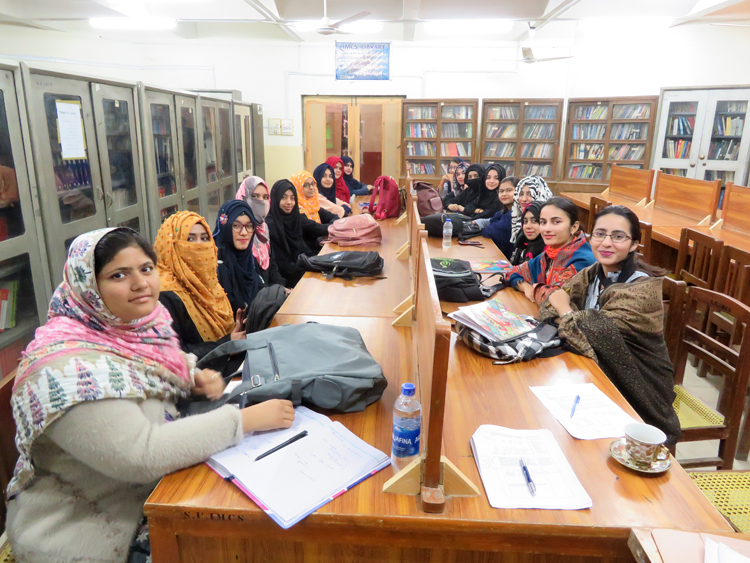
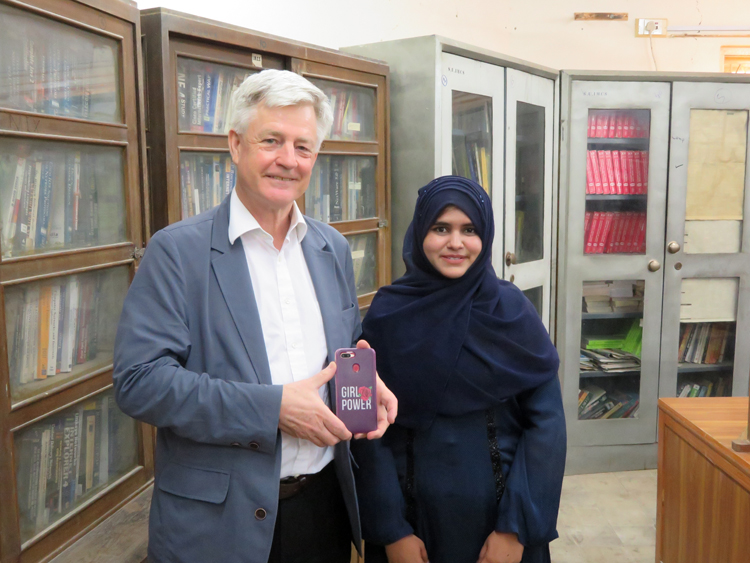
Some of the brilliant people with whom we spoke are illustrated in the images below, and I hope that what Akber and I have written does indeed do justice to the time you spent sharing your thoughts with us, and that together we can indeed begin to change attitudes towards the interactions between women and digital tech.
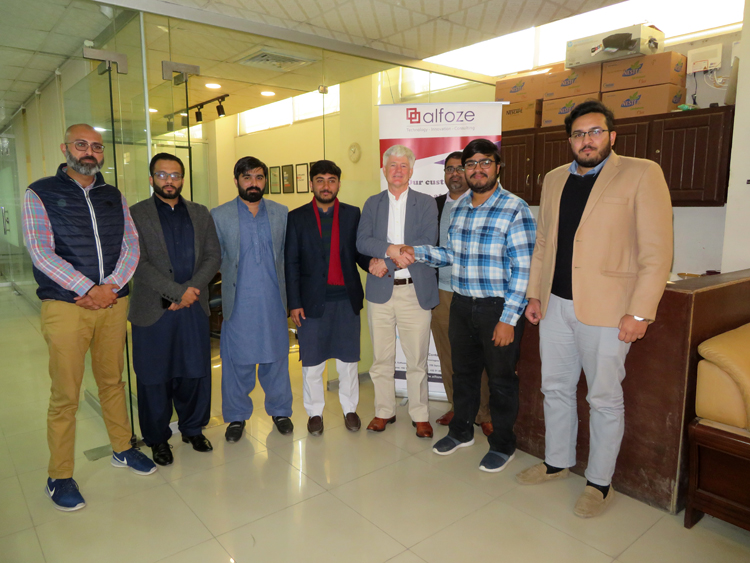
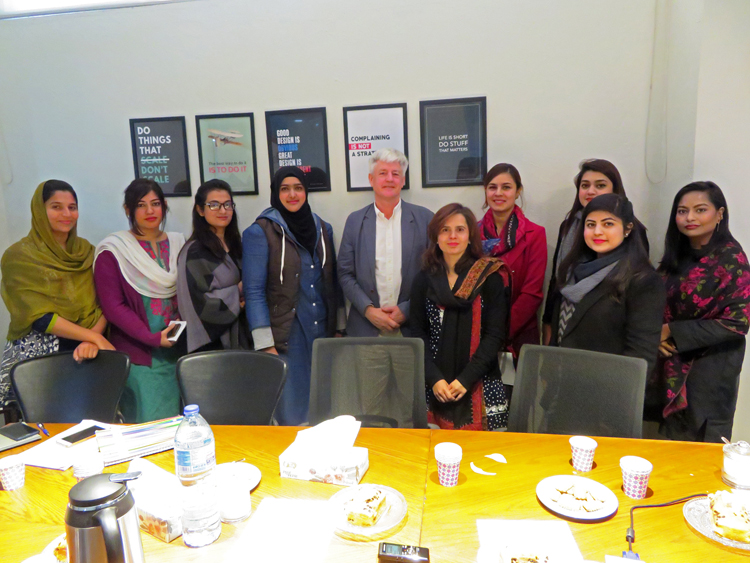
All of the material resulting from our research is available on the TEQtogether site in the section on our research in Pakistan, including the guidance notes that have subsequently been produced in Urdu and English based on the research.
Leave a comment

Filed under digital technologies, Gender, ICT4D, Inequality, Pakistan

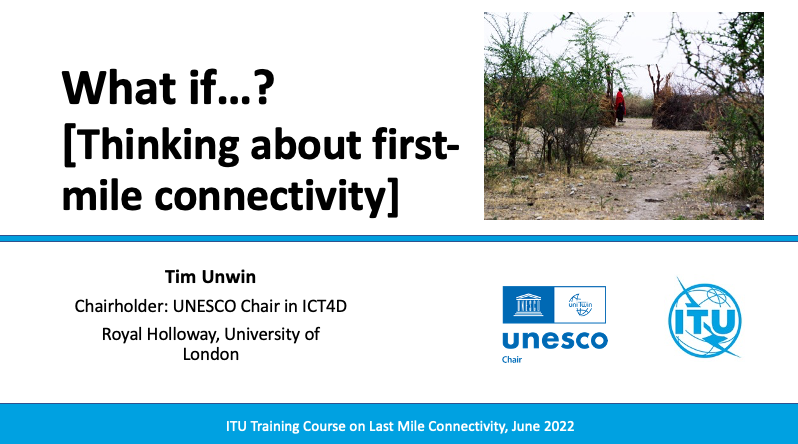
What if…?  [Thinking about first-mile connectivity]

It was great to have been invited by Aminata Amadou Garba to give the final talk in the ITU Academy’s training session on Last Mile Connectivity on 30th June. She was happy for me to be a little bit provocative, and so I returned to one of my long-standing arguments – that by using terms such as “the last mile” or the “last billion” we often denigrate the poorest and the most marginalised. If we really want to ensure that they benefit from the use of digital technologies, we should instead start thinking about them as “the first mile” because they are most important!

The session addressed seven main themes:

  1. The “last” mile in whose eyes?
  2. Parallels with the “next billion”
    • and the “Digital Divide”
  3. Whose perspectives matter most?
  4. The political economy of connectivity
  5. The fundamental role of regulation
  6. Global connectivity initiatives
  7. Environmental implications

I’m so glad that we were able to have quite a lively discussion both during and after the presentation – a copy of which is available here for those who might be interested.

1 Comment

Filed under digital technologies, Education, Environment, ICT4D, inclusion, Inequality, ITU, My Lectures, technology

Goodwood Festival of Speed

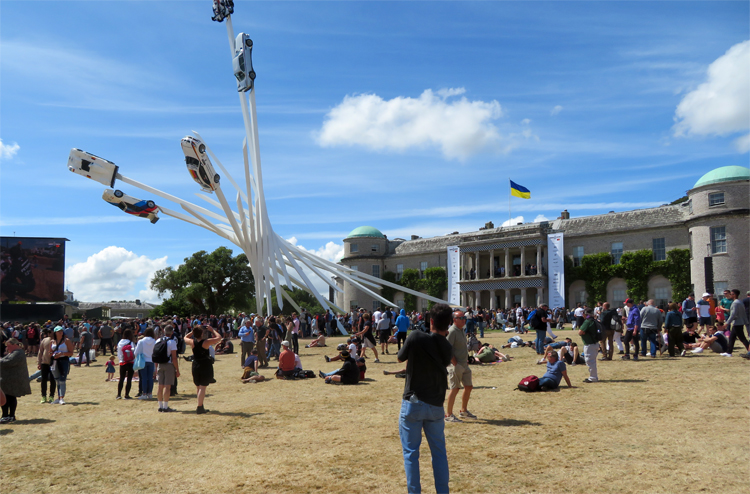
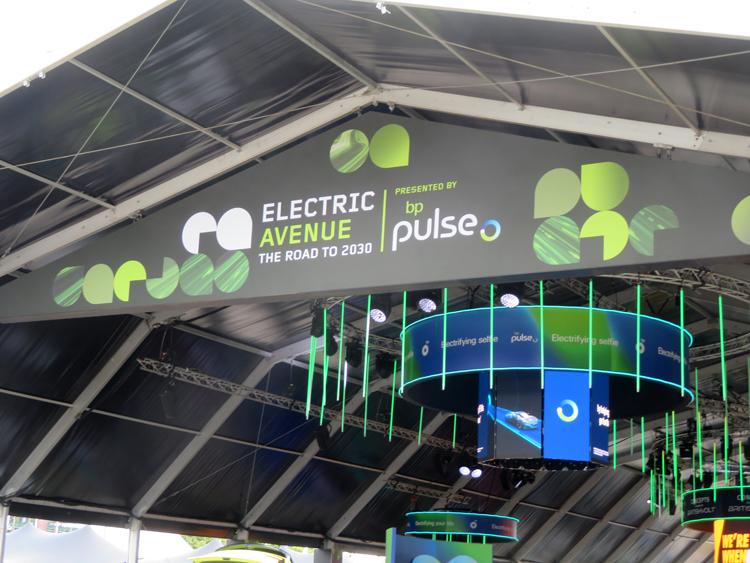
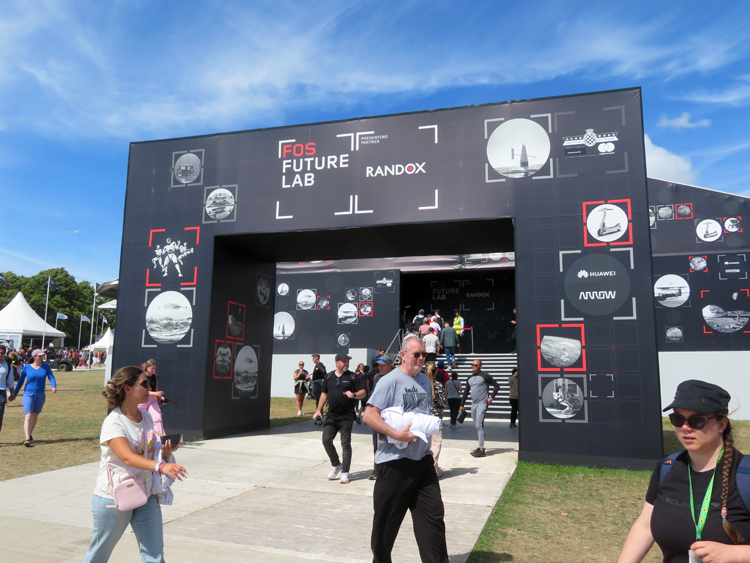
I greatly enjoyed my first adventure to the Goodwood Festival of Speed yesterday, courtesy of a good friend on the Board of Lotus Cars. What an amazing day out! It was vastly more extensive than I had ever imagined, and apart from a rather circuitous (not well sign-posted) route to the parking, everything seemed to be highly efficiently organised. There was generally plenty of space, despite the many thousands of people there, and almost magically one didn’t even really have to queue to cross the bridges! There was so much to see, from the current F1 teams to classic cars, from the wide range of contemporary electric cars to the future of robotics (and even a glimpse of Nigel Mansell reunited with his F1 Title Williams FW14B). I hope that the pictures below capture something of what an enjoyable and fascinating day it was – culminating in an impressive display by the Red Arrows!

Thanks so much again for the Lotus hospitality (including a delicious lunch in good company). It brought back fond memories of regularly having to fix the starter motor in cold and wet weather on my original Ford Escort, and always wanting a Lotus Europa! It was a reminder too of how driving has changed over the last 50 years, with a large slice of sadness that much of the fun has now gone out of driving – at least in the UK. It’s rather good to think that I have been able really to enjoy driving in a world before a future when all cars are made to drive us around. Am I one of the last to believe that autonomous humans are preferable to autonomous cars?

1 Comment

Filed under AI, digital technologies, Energy, Malaysia, Photographs, Transhumanism

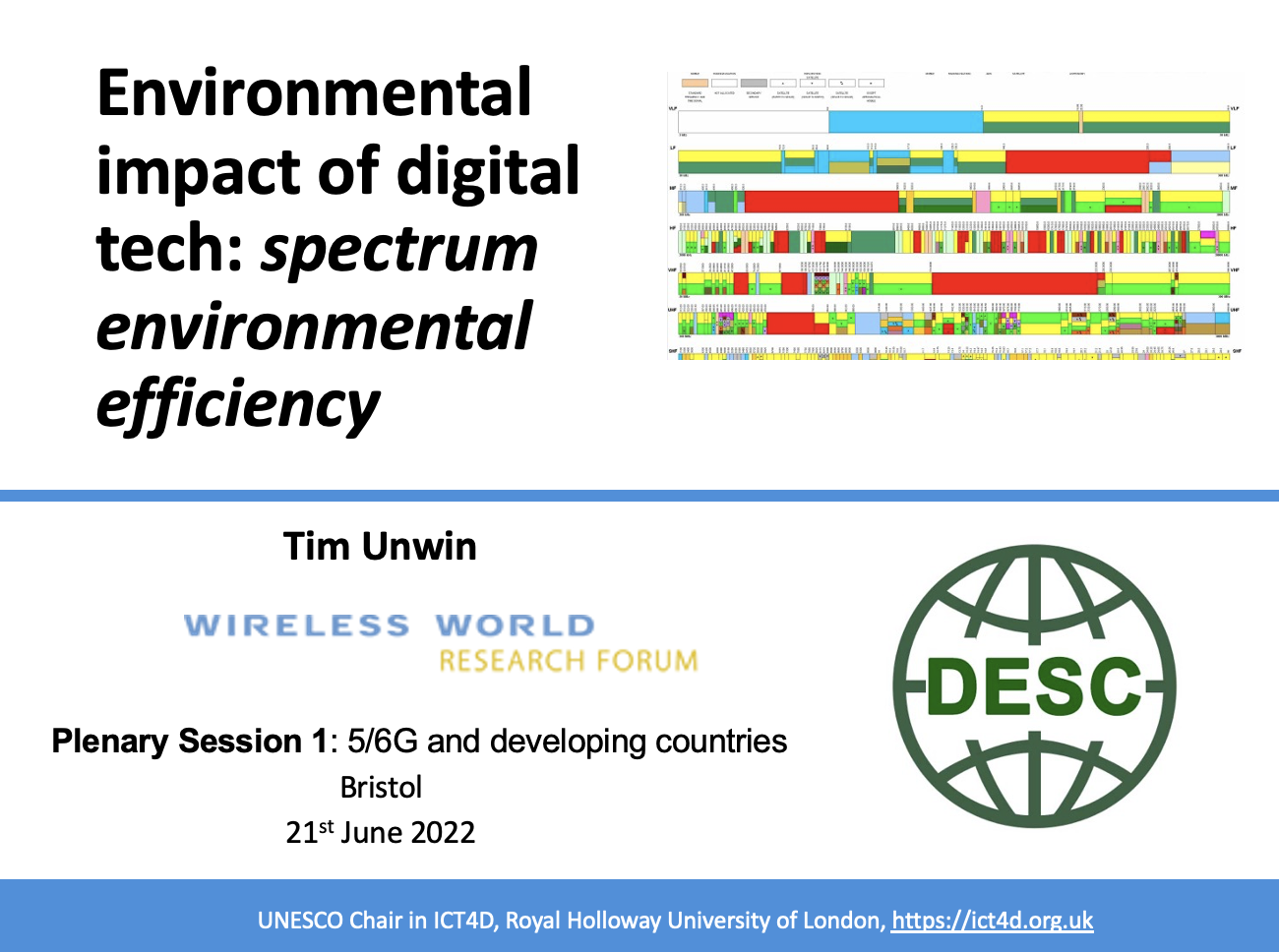
Environmental impact of digital tech: spectrum environmental efficiency

It was a real pleasure to join the Wireless World Research Forum’s (WWRF) 47th meeting held at the University of Bristol today, where at the invitation of Knud Erik Souby I presented a short paper entitled “Environmental impact of digital tech: spectrum environmental efficiency“. This provided a broad introduction to the reseach agenda of the Digital Environment System Coalition (DESC) Working Group on spectrum environmental efficiency.

In essence, the paper

  • emphasised the substantial amount of existing research on spectrum efficiency and energy efficiency;
  • highlighted the lack of existing research on “spectrum environmental efficiency” (rather than just on energy);
  • reflected on the observation that, although 5G is widely seen as being more energy efficient, the total increase in traffic (and sensors) means that 5G systems as a whole require more energy than was the case with previous wireless generations;
  • emphasised the importance of future wireless generations being designed to reduce environmental harms;
  • outlined aspects of the future research agenda of the working group, including:
    • always taking environmental considerations (not just climate and energy) into our research practice;
    • what are environmental implications of using different parts of the spectrum?
    • how do different masts/antennae impact the environment?
    • new ways of assessing landscape impact
    • environmental implications of sensor network
    • recommendations for good practices by telecom/wireless companies – and regulators
    • helping develop a toolkit for the UN Partner2Connect digital coalition
    • how can future wireless generations minimise environmental harms?
    • links with DESC working group on satellites and outer space (with UNOOSA involvement);
  • recognised the importance of listening to and understanding alternative/indigenous knowledges about the environment (and digital tech);
  • noted that the WWRF is a formal partner of DESC; and
  • invited members of the WWRF, and especially those from the private sector, to join DESC and contribute to our future work.

3 Comments

Filed under Climate change, DESC, Development, digital technologies, ICT4D, ICT4D conferences, ICTs, research

Academic perspectives on WSIS and the SDGs, WSIS 2022

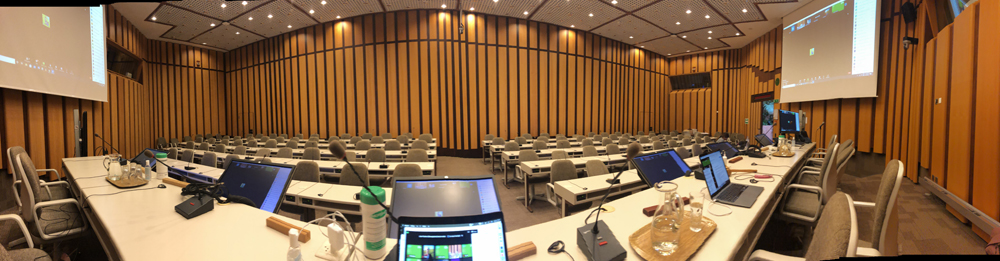
It was a great pleasure to have been invited to contribute as a panellist to Session 406 of the WSIS Annual Forum on 2nd June 2022 on the theme of “Academic perspectives on WSIS and the SDGs”. This was a hybrid event, and as the picture below shows it was sadly not attended by very many people actually in Geneva! (Follow this link for my short, full presentation.)

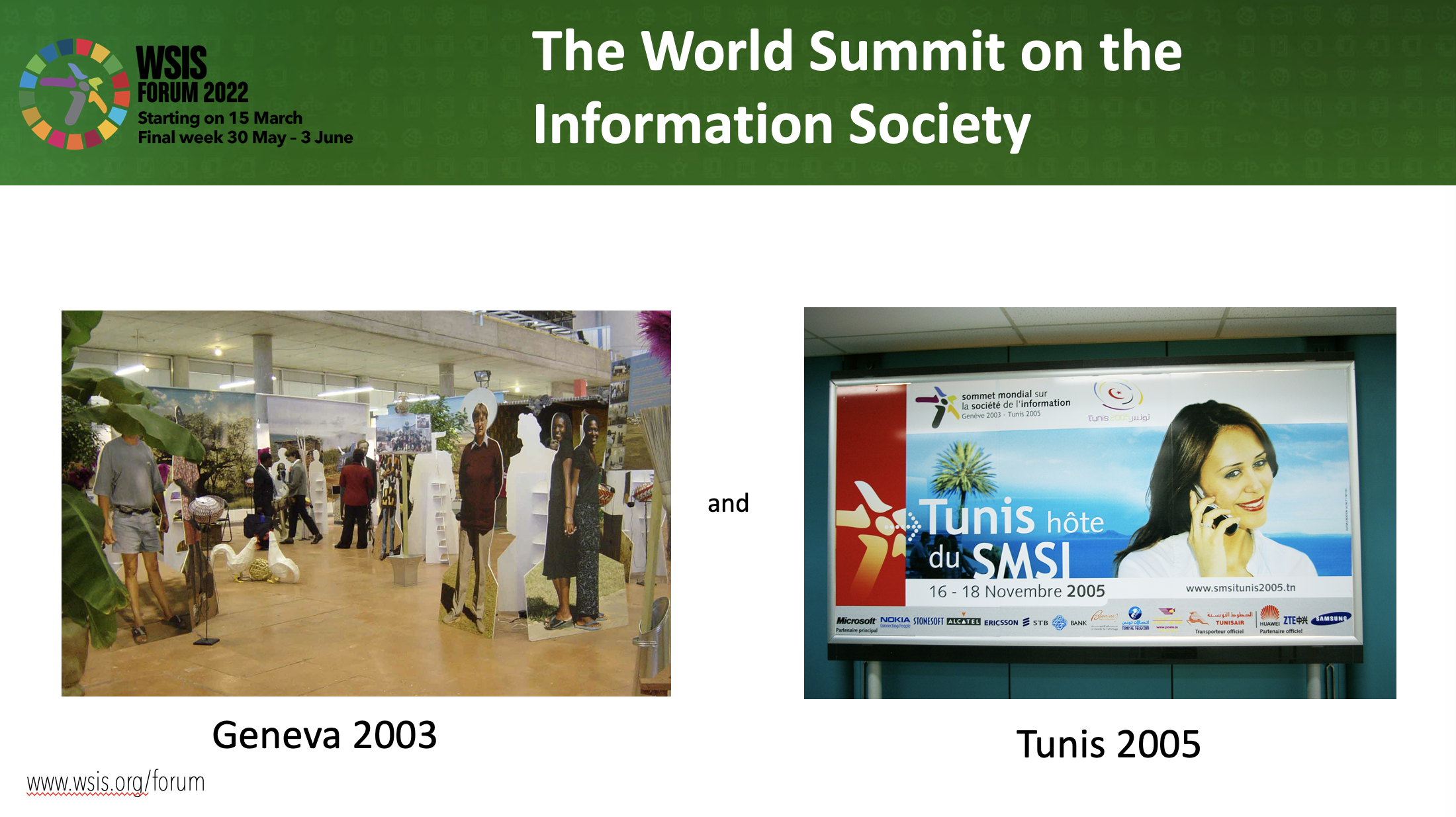
However there was active participation online, and it was good to share some reflections on the theme. As ever, I tried to be diplomatically provocative, reflecting on my participation in the original World Summit on the Information Society in Geneva (2003) and Tunisia (2005)…

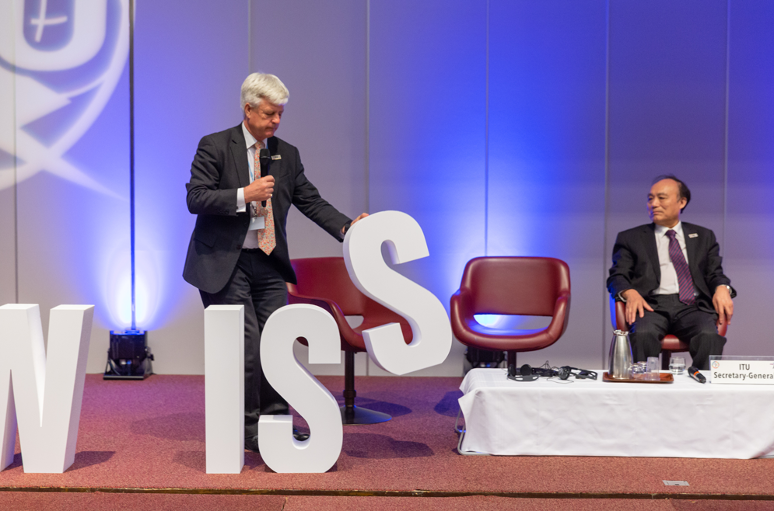
… as well as on many occasions since at the WSIS annual forums, especially when in 2019 I changed WSIS to MISS in front of my good friend Houlin Zhao the Secretary General of the ITU:

My presentation in particular emphasised the important need for the UN system to stop replicating and duplicating its efforts to use ICTs for “development” (or should this read “to serve the interests of the rich and powerful” especially the “digital barons“?); it is striking and sad, for example, that the UN Secretary General’s Roadmap for digital cooperation and Our Common Agenda make no mentions at all of the WSIS process.

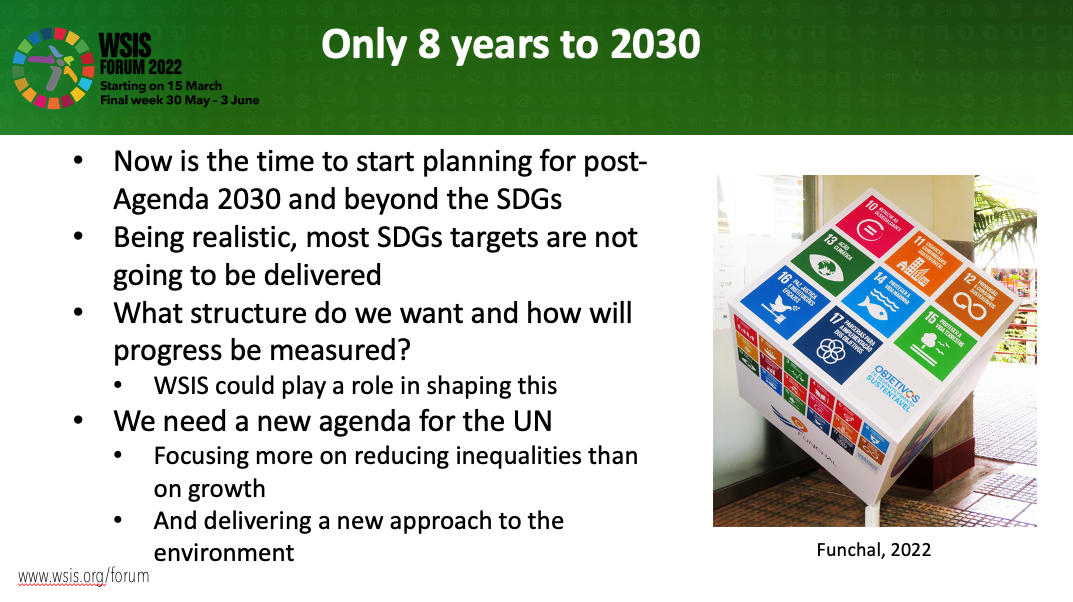
My main argument was that with only eight years to go, it is essential that we start planning now for what will replace the SDGs, especially with respect to the uses of digital tech.

I did, though, also address to other themes: how academics can indeed benefit from the WSIS process (see below) as well as a short introduction to the work that we are now doing as part of the Digital-Environment System Coalition (DESC).

Follow this link for my short, full presentation.

1 Comment

Filed under Conferences, Development, ICT4D, ICT4D conferences, United Nations

Freedom, enslavement and the digital barons: a thought experiment

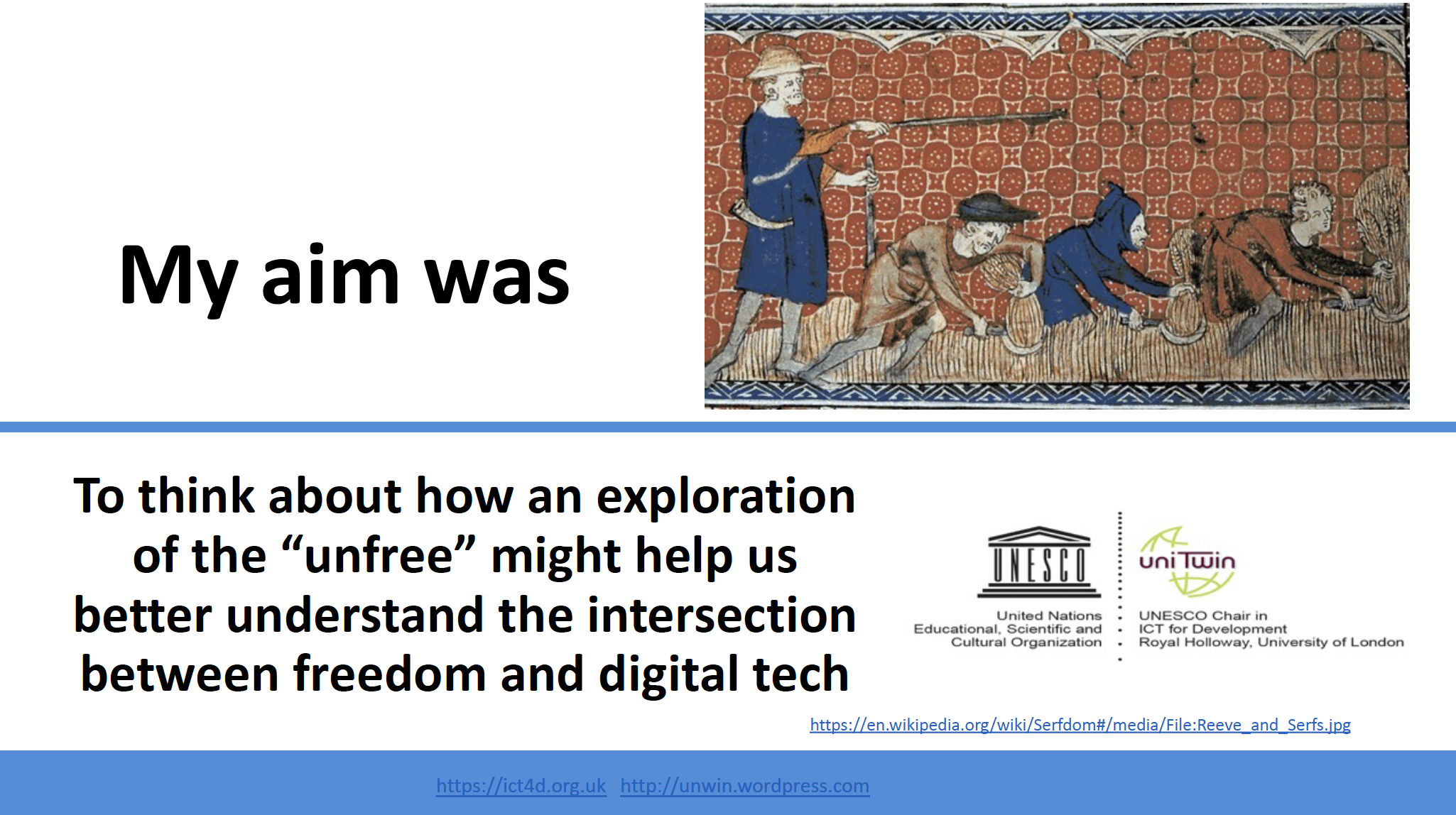
It was a delight and a challenge to have the opportunity earlier today to present a keynote for this year’s IFIP 9.4 conference on Freedom and Social Inclusion in a Connected World in the form of a thought experiment on the topic of “Freedom, enslavement and the digital barons“.

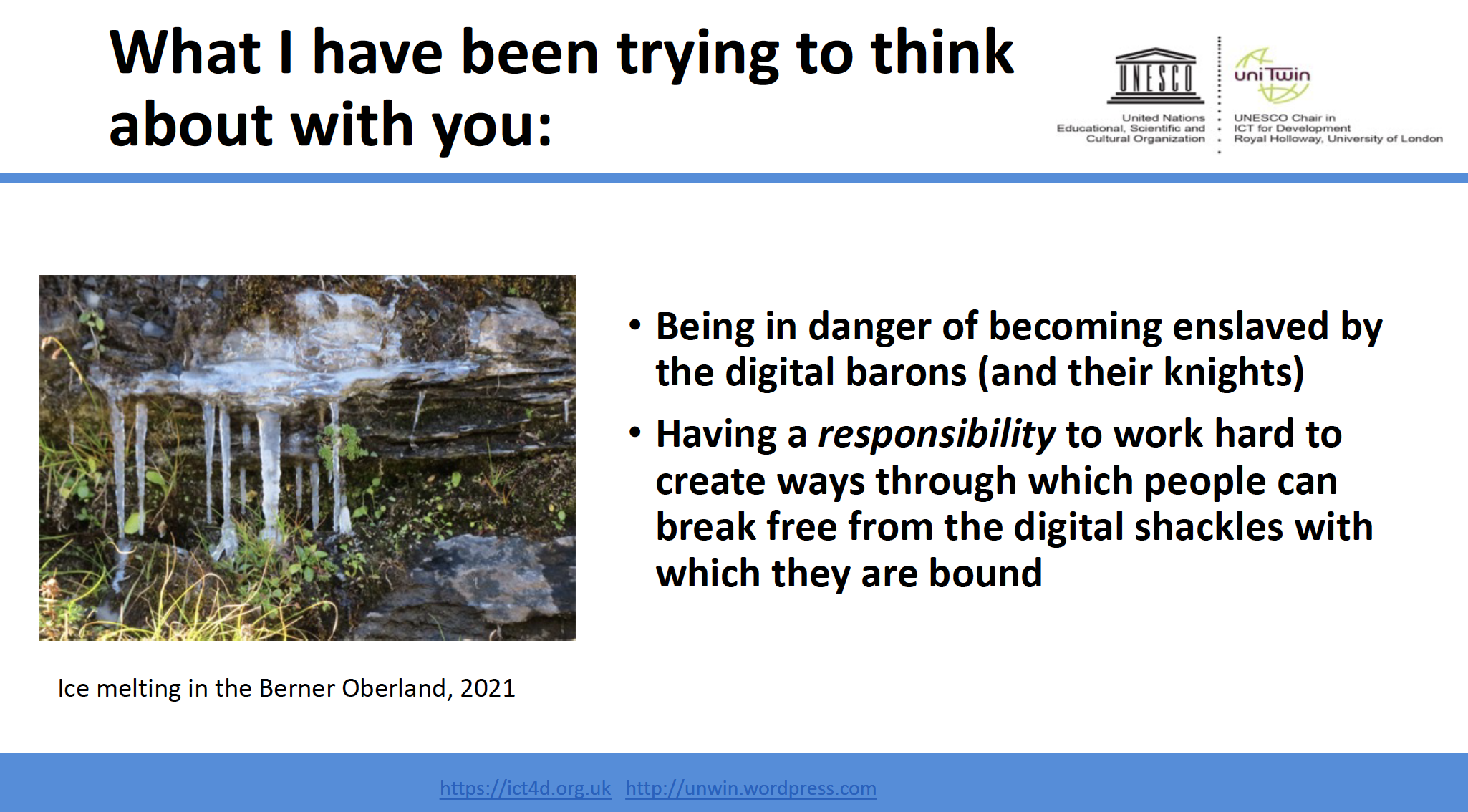
My main aim was to explore how thinking about the “unfree” can help us better understand the intersection between freedom and digital tech. In particular I focused on five main themes: some of the ways in which academics have previously considered the concept of freedom within the field of Information and Communication Technologies for Development (ICT4D); ways of understanding “unfreedom”; six examples of digital enslavement; the relationships between freedom, rights and responsibilities; and the ways in which people in general and academics in particular can resist enslavement by the digital barons.

The examples of digital enslavement that I briefly explored were:

  • Digital addiction
  • We are the data
  • Governments enforcing use of digital systems for government services
  • Labour exploitation (through extending the working week)
  • Digital poverty and education
  • Digital tech contributing to modern slavery

Time precluded the inclusion of several other forms of enslavement that I might have considered. Drawing on my medievalist backgroung, I was especially interested in the role and interests of the Digital Barons.

In part, this keynote drew on arguments that I have previously addressed in more detail in

I also made it clear that appropriately designed digital tech can be used to great advantage by poor and marginalised communities, although given the theme of the confernce I concentrated exclusively on “digital enslavement” and the role of the “digital barons”.

The full slide deck (in .pdf format) is available here without the transitions and animations. It also omits the subtitles in Spanish that were included for our colleagues in Peru who had originally been planning to host us in person.

7 Comments

Filed under Conferences, ICT4D, ICT4D conferences, Inequality

On language, gender and digital technologies

I wrote a short post back in 2018 on the gendered languages of ICTs and ICT4D, and partly in the light of this I was very kindly invited to contribute to the fascinating collection of essays edited by Domenico Fiormonte, Sukanta Chaudhuri and Paola Ricaurte on Global Debates in the Digital Humanities, recently published by the University of Minnesota Press.

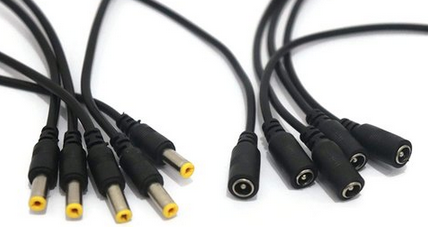
The short chapter is divided into two parts. The first on language, gender and digital tech is based on the premise that in the broad field of digital technologies, most practitioners have been blind to the gendering of language and thus perpetuate a male-dominated conceptualization of ICT4D. It addresses: the gendering of electronic parts, the use of language in ICT4D, digital technologies represented by male nouns, and computer code: bits and qubits. The second part explores some of my thoughts on the use of the term “frontier technologies”, building on another 2018 blog post.

Male & Female Connectors

I’m delighted that the publishers have now shared a copy of this with me, and have also given me permission to share it here. The chapter is only seven pages long, but I hope that readers may find that it challenges some of their existing thoughts about aspects of gender and digital tech. I would be delighted to carry on the conversation with anyone who mght be interested…

Leave a comment

Filed under digital technologies, Gender, ICT4D, language

“Open Science” Keynote for WACREN

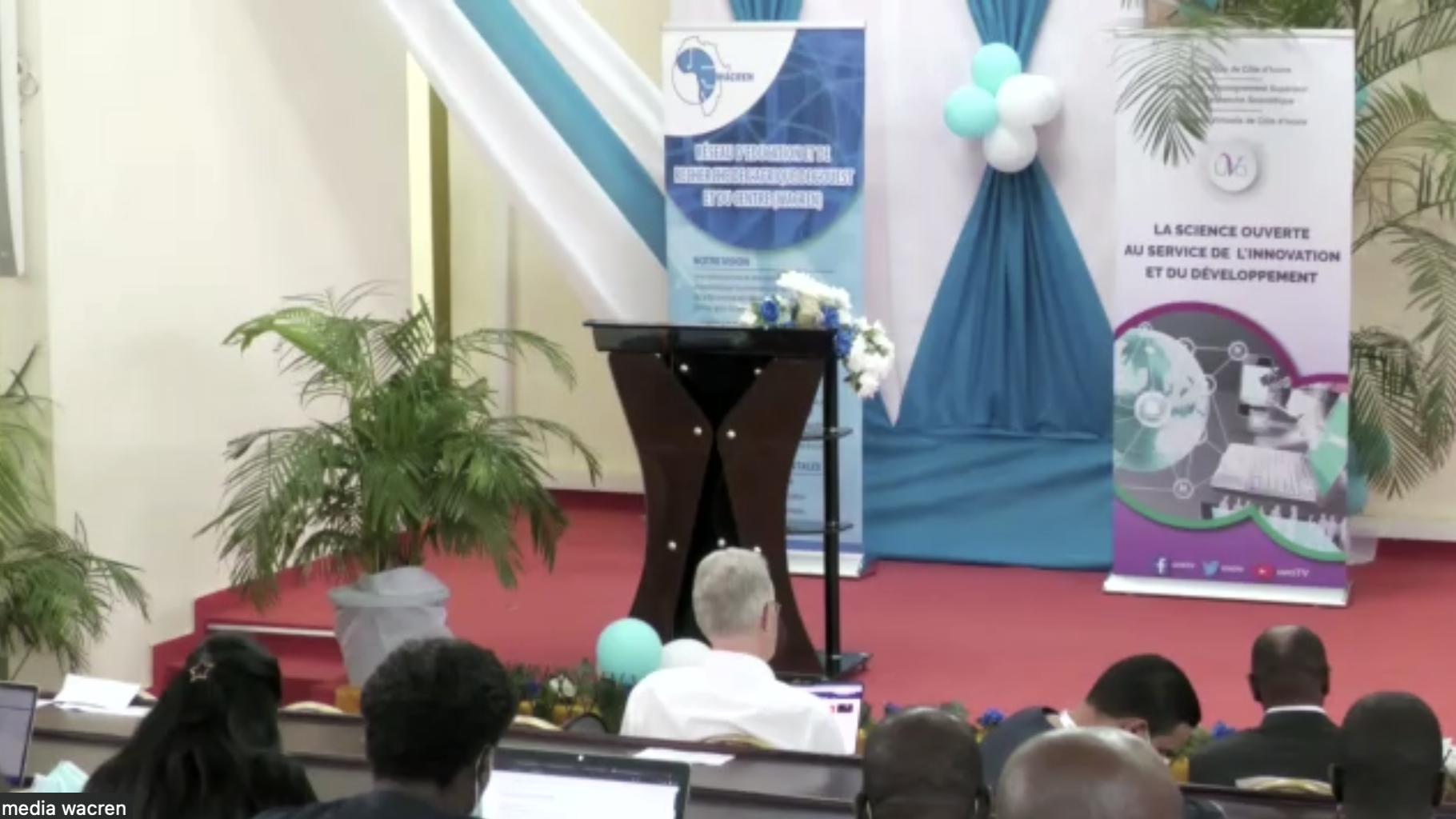
It was a real privilege to have been invited to give a keynote on “Open Science in Africa and for Africans: addressing the challenges” this morning at the West and Central African Research and Education Network (WACREN) 2022 conference held in Abidjan. The role of a keynote is to provoke and challenge, and so I took the opportunity to share some of the reflections and challenges that I have been struggling with over many years, and especially since I first met the inspirational CEO of WACREN, Boubakar Barry, some 18 years ago in Dakar, Sénégal at an event we participated in on Free/Libre and Open Source Software convened by Imfundo.

Participating online in the hybrid WACREN 2022 conference

The six challenges on which I focused in the Keynote were:

  • Whose interests does Open Science really serve?
  • The rise of individualism: is it too late for communal science?
  • Which models of publication best serve Africa?
  • How valuable are Open Data, and for whom?
  • The dangers of Scientism?
  • Who pays?

Underlying my thoughts are two fundamental concerns:

  • If you don’t have access to, or cannot use “Open Science”, can you really benefit from it? Does “Open Science” really empower the poor and marginalised?
  • Is Open Science mainly a means through which the rich and powerful continue to maintain their positions of privilege? This is typified by the ways through which global corporations and companies persuade governments to make their data about citizens available as Open Data, so that these companies can then extract considerable profit from them.

The full slide deck in .pdf format is available here, and the slide below summarises my final thoughts about the ways forward.

Leave a comment

Filed under Africa, Conferences, ICT4D, ICTs, research

London International Model UN 2022: A new UN for a New World Order

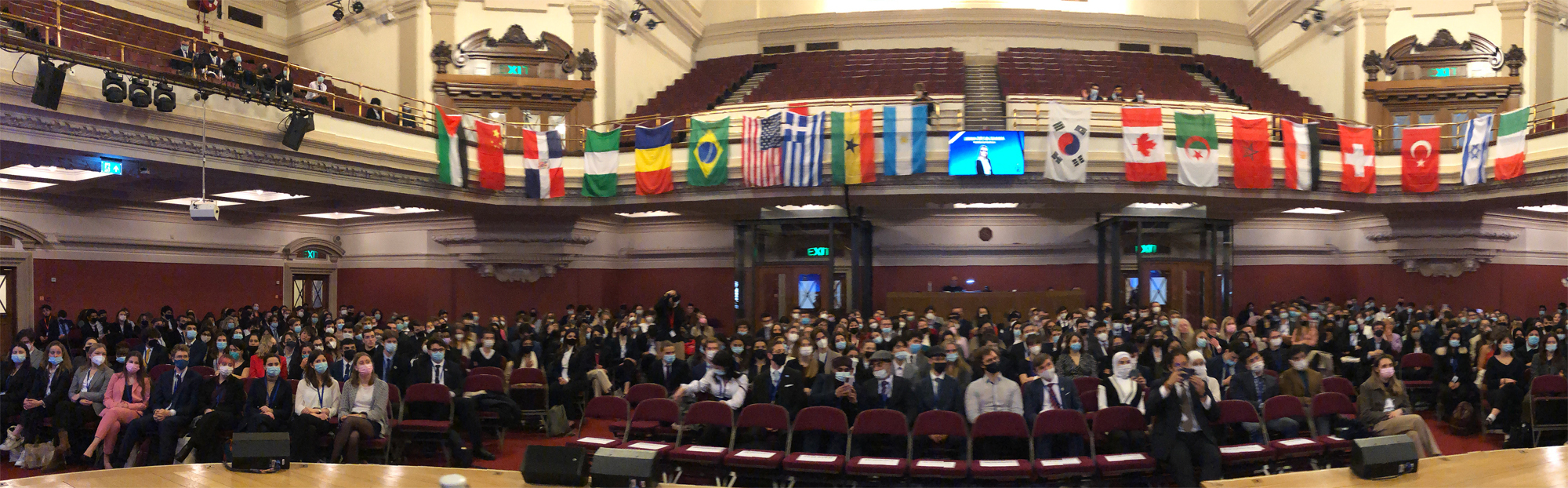
Delegates at the London International Model UN conference, 25 February 2022

It was a real privilege to have been invited to give the keynote address at the 2022 London International Model UN conference held at Central Hall, Westminster on 25th February. After much discussion with the organisers we agreed that I would use the occasion to challenge the delegates with some of the problems I see facing the UN as an organisation, and offer some recommendations as to how these can be addressed. With the invasion of Ukraine by Russia the day before, I considered fundamentally revising what I had intended to say, until I realised that much of what I had prepared was even more relevant following the events of the previous 24 hours.

The event was recorded by the organisers, but for those wishing to have an outline of what I said it is available in .pdf format here (with low resolution images). I was delighted to receive so many questions, and I very much hope that my answers were able to provide further insights into my thinking on these matters.

It was a wonderful opportunity to engage in intergenerational dialogue, and I am most grateful to Luna, Savvas and Siddarth, as well as other members of the Secretariat, for all of their organisation and bringing together so many inspirational young people in London to discuss the important issues facing the world today.

The choice of blue and yellow flowers for my “thank you bouquet” was brilliantly appropriate!

Leave a comment

Filed under Conferences, SDGs, United Nations

To app or not to app? How migrants can best benefit from the use of digital tech

This post was first published on the OECD’s Development Matters site on 7th February 2022, and is reproduced here with permission and under a slightly different title

Introductory

UN agencies, donors, and civil society organisations have invested considerable time, money and effort in finding novel ways through which migrants, and especially refugees, can benefit from the use of digital technologies. Frequently this has been through the development of apps specifically designed to provide them with information, advice and support, both during the migration journey and in their destination countries. All too often, though, these initiatives have been short-lived or have failed to gain much traction. The InfoAid app, for example, launched by Migration Aid in Hungary amid considerable publicity in 2015 to make life easier for migrants travelling to Europe, posted a poignant last entry on its Facebook page in 2017: “InfoAid app for refugees is being rehauled, so no posting at the moment. Hopefully we will be back soon in a new and improved form! Thank you all for your support!”

However, new apps continue to be developed, drawing on some lessons from past experience. Among the most interesting are MigApp (followed by 93 668 people on Facebook) developed by the International Organization for Migration (IOM) as a one-stop-shop for the most up-to-date information. Another is RedSafe developed by the International Committee of the Red Cross (ICRC), which enables those affected by conflict, migration and other humanitarian crises to access the services offered by the ICRC and its partners. Other apps seek to be more local and focused, such as Shuvayatra (followed by 114 026 on Facebook), which was developed by the Asia Foundation and its partners to provide Nepali migrant labourers with the tools they need to plan a safer period of travel and work abroad.

Our work with migrants nevertheless suggests that in practice very few migrants in the 12 countries where we are active in Africa, Asia, and Latin America and the Caribbean, ever use apps specifically designed for migrants. Moreover, most of those who claim to use such apps name them as Facebook, Imo, or WhatsApp, which were never originally intended as “migrant apps”. A fine balance therefore needs to be made when developing relevant interventions in combining the professional knowledge (often top-down) of international agencies with the more bottom-up approaches that focus on the digital tech already used by migrants.

Our wider research goes on to highlight four broad areas for action to complement the plethora of activities around app development:

1. Information sharing and collaboration

First, there needs to be much more information sharing and collaboration between international organisations working in this field. While an element of competition between agencies may be seen as positive in encouraging innovation, there remains far too much overlap, duplication and reinventing the wheel. The creation of a global knowledge-sharing platform on digital tech and migration could provide a first port of call that any organisation considering developing a new initiative could go to for ideas or potential collaborative opportunities.

2. No one-size-fits-all: diversity in the use of digital tech by migrants

Second, our research has shown very clearly that use of digital tech by migrants varies considerably in different areas of the world and between different groups of migrants. There is no one-size-fits-all, and context matters. Hence, practitioners should be careful when making generalisations about how “migrants and refugees” use, or want to use, digital tech.

3. Developing digital tech with migrants not for them

Third, it is important to remember that actions and policies are much more likely to succeed if they are developed with rather than for migrants. This fundamental principle is too frequently ignored, with well-meaning “outsiders” too often seeking to develop digital interventions for migrants without fully understanding their needs and aspirations. As our own research has shown, though, it is far from easy to appreciate and understand the underlying needs that different groups of migrants prioritise and how best they can be delivered.

4. Assisting migrants to help each other in using digital tech wisely and safely

Fourth, it sadly remains as true today as it was twenty years ago that many of the poorest and most marginalised still do not know how to use digital technologies effectively, appropriately, securely and safely. Many migrants contributing to our research own a smartphone or have access to one, but frequently they only have a rudimentary knowledge of how to use it optimally. Some aspire to use digital tech to learn and acquire skills, while others wish to enhance their business opportunities; in both cases, many do not know how best to do so. Few also sufficiently appreciate the very significant security, privacy and surveillance issues associated with using digital tech. The development of basic training courses – preferably face-to-face – may be one of the best investments that can be made in assisting migrants to help themselves when using digital tech.

Looking to the future

Looking to the future, the power relationships involved in the migration process mean it is likely that migrants will become increasingly controlled and subject to surveillance through the use of digital tech. In some circumstances, it might even be wiser for migrants to avoid using any form of digital tech at all. However, there are exciting opportunities to develop novel ways through which migrants might benefit further from digital tech. One of the challenges faced by many migrants is the sadness associated with being away from family and friends. While video calls can go some way to mitigate this, new developments in haptics may soon enable us to feel someone’s touch or hug.

Likewise, inserting microchips into our bodies is becoming increasingly widespread, and in the future this practice could offer real potential for migrants for example to have their qualifications and other documents actually within their bodies, or for their families to be able to track them on the often dangerous journey to their destination. Countering this, of course, is the likelihood that most authorities would use such technologies for surveillance purposes that would threaten migrants’ privacy.

As with all digital tech, it is important to remember that it can be used to do good or to harm. Many migrants are especially vulnerable, and it is incumbent on those seeking to support them that migrants are able to make their own informed decisions on how they choose to use digital tech. Often, the best interventions might well be built around improving existing ways through which migrants use apps and other digital technologies, rather than developing entirely new solutions that may never be widely used.


I am particularly grateful to G. Hari Harindranath and Maria Rosa Lorini, as well as the many other people and migrants with whom we are working, for their contributions to the ongoing research practice on which this post is based.

Leave a comment

Filed under Apps, digital technologies, ICT4D, ICT4D general, Migration