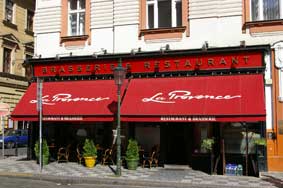
Prague – a selection of restaurants

Prague has to be one of my favourite cities in the world!  At any season, and despite the masses of tourists, it is possible to escape and find some wonderful hidden away places.  A short visit over the last couple of days provided the opportunity to explore some new restaurants that I would definitely recommend:

  • ProvenceLa Provence (Štupartská 9) – in the style of a French brasserie, serving really excellent food.  The salmon and steaks were delicious, but the desserts are indeed special: outstanding sorbet (beautifully presented) and fantastic Tarte tatin.  This restaurant is really worth searching out – and beneath the ground floor brasserie, there is a romantic cushioned dining room in the downstairs cellar.  An interesting wine list combines local Czech wines with fine French wines.
  • Mount Steak (Josefská 1) – a very different kind of restaurant from La Provence, and definitely not for vegetarians!  Mount Steak serves an enormously wide range of steaks from kangaroo to crocodile, but also has a good range of fulsome local Czech dishes with plenty of dumplings!  The pork and chicken were really good value and delicious.
  • Černý Slon (Týnská 1) – I first visited here almost a decade ago, and remember enjoying the traditional Czech food and wine.  Little has changed since then!  Hidden away near the Old Town Square, Černý Slon still serves good traditional Czech fare – the duck (with dumplings) is definitely worth trying as an example of old-style Czech cuisine.
  • Breakfast at the Hilton Old Town (V Celnici 7) also has to be one of the best international hotel starts to the day – with excellent friendly service and really fresh food.

3 Comments

Filed under Restaurants, Wine

25 years of PowerPoint

For some excellent advice on how not to use PowerPoint, see Max Atkinson’s recent article ‘celebrating’ 25 years of PowerPoint in the BBC’s online magazine.  It contains some great tips!

The BBC magazine also has a  selection of amusing PowerPoint experiences – 10 good ones, and ten bad!

Born on the 14th if August 1984, PowerPoint is still going strong – quite a testimony to the way our lives have been transformed by computer technologies.

Leave a comment

Filed under Communication, ICT4D general, Postgraduate supervision

Freedom on the Net

For those who may not have read it yet, Freedom House’s publication entitled Freedom on the Net: a Global Assessment of Internet and Digital Media and published in April 2009, provides a very valuable assessment of the balance of interests in the spread of the Internet and mobile telephony across the world.

As Freedom House’s blurb says, “As internet and mobile phone use explodes worldwide, governments are adopting new and multiple means for controlling these technologies that go far beyond technical filtering. Freedom on the Net provides a comprehensive look at these emerging tactics, raising concern over trends such as the “outsourcing of censorship” to private companies, the use of surveillance and the manipulation of online conversations by undercover agents. The study covers both repressive countries such as China and Iran and democratic ones such as India and the United Kingdom, finding some degree of internet censorship and control in all 15 nations studied.”

The overview essay by Karin Deutsch Karlekar and Sarah G. Cook argues that there is a growing diversity of threats to internet freedom and that governments have responded to the spread of new media by introducing new measures to control, regulate and censor content.  As they conclude “In a fast-changing digital world, vigilance is required if we are to ensure continued freedom on the net.”

Leave a comment

Filed under Ethics, ICT4D general

Bryan Appleyard on Steve Jobs

I have long been a Mac user, and so read with interest Bryan Appleyard’s piece in the Sunday Times magazine yesterday about Steve Jobs.  It’s fascinating how  Jobs provokes such contradictory opinions – very evident from the many blogs and comments that have followed the article.  It is indeed an interesting question as to what will happen to Apple when he eventually ‘goes’.  I just hope that Appleyard’s suggestion that a merger with Google might be on the cards is wide of the mark!

Leave a comment

Filed under Uncategorized

Croatia: seascapes, wine and food

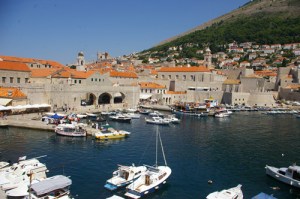
DubrovnikSo, I have been hiding away in the Dalmatian coast of Croatia for the last week – and greatly enjoying the amazing coastal scenery!

Dubrovnik – despite the thousands of tourists – has to be one of the most beautiful cities in Europe.  The opportunity to reconstruct it after the Serbian bombings of 1991-92, when an estimated 68% of the buildings in the old city were damaged, has been grasped imaginatively and effectively – the walk around the city walls is truly magnificent.

VinesI was hoping to explore some of Croatia’s vineyards and wineries during our stay – but with prices of most of the ‘quality’ wines for sale being between$30 and $50 a bottle, I swiftly changed my mind! To be sure, it is indeed possible to find some reasonable  wines at much less than this, but I cannot imagine who is willing to pay such prices – perhaps there are far too many over-rich tourists!  If Croatia wants to establish itself as a  reputable wine-making country, it needs to start making better value wines!
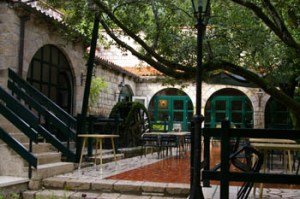
The food was also, sadly, a bit disapponting  – tasty enough, but we did not manage to find any restaurants that really impressed.Konavoski The best – and reasonably priced – was Konavoski Dvori near Gruda to the south of Dubrovnik.  The restaurant is in a restored watermill, and on a hot August day the swift-flowing river that runs past the dining tables provides a very welcome cool breeze!  Meat is cooked in an iron bell on charcoal – which keeps it succulent and moist.  Other restaurants worth visiting include:

  • Dubrovnik: Restaurant Orhan (Od Tabakarije 1) – situated at the foot of the Lovrjenac tower on the edge of a small bay some 200m away from the walls of the old city. Good seafood salads and grilled meats
  • Trogir: Alka restaurant (Obrov 10) – serving customers in the centre of the old town for 40 years, this restaurant has particularly good tradtional Dalmatian beef pašticada (marinated in vinegar, lemon and rosemary, and then cooked wth carrots, cloves, muscat nuts, red wine and prosciutto)

2 Comments

Filed under Restaurants, Wine

Lugano grottos and wines…

Smiley smallThanks to Isabella Rega, I had an opportunity  last week not only to learn much more about the exciting research ongoing at the Università degli Svizzera italiana in the field of ICT4D (NewMinE Lab and webatelier.net), but also to enjoy something of the culinary and vinous traditions of Ticino.

Hence, some additions to my periodic listing of interesting restaurants:

  • Canvetto luganese – this really good small restaurant is owned and managed by the Fundazione Diamante, which provides support and work for people with disabilities, integrating them into a diversity of different enterprises.  Since 2003 it has been recognised by the Osterie d’Italia di Slow-Food, and offers a range of delicious regional foods.  Its handmade pastas and ravioli are particularly good, as was the steak tartare!
  • Grottos – the hillsides around Lugano are replete with small restaurants, originally built around caves (hence the name ‘grottos’), but now offering some excellent freshly grilled meats and local foods in open air surroundings.  I particularly enjoyed dinner at the Grotto Circolo Sociale Montagnola, which had really excellent grilled grilled costine, as well as lunch at the Grotto Ticinese, where we shared risotto, grilled meats and salads, sitting under the trees on an otherwise very hot and humid day!
  • In Lugano itself, La Rosa dei Venti is situated on the lake shore by a small yacht club – a heavy rainstorm forced us inside, but the seafood risotto was good!

Barrell smallAs for wine, Ticino often suffers from rain and dampness in October which has a tendency to cause rot – but sadly not of the noble kind – the Botrytis cineria here in Ticino is far from benevolent! Hence, grape growers have been keen to plant early ripening varieties, most notably Merlot.  In recent years,  these red grapes have also been used to make the white wine Bianco di Merlot, which can have complexity and subtle flavours – when well-vinified they have a fresh acidity that goes really well with the local food.
  • Tenuta Bally & von Teufenstein, with vineyards and winery at Vezia, a short distance from Lugano, produces a good range of interesting wines.  As well as a rich and fruity Bianco di Merlot, their red wines (Cresperino 100% Merlot; Riserva Ernesto 75% Merlot, 25% Cabernet Sauvignon) are generally much fuller and with better tannin structure than many of the rather light Merlots that can be found in Ticino.  Their Tre Api Merlot Riserva from the excellent 2007 vintage is made from old vines, and has fine soft tannins with a real richness of flavours – combining redcurrants, blackberries and violets.  They also make a rosati wine (Sarabanda) and a sparkling Spumante di Merlot, as well as a white (La Piana) that combines Sauvignon Blanc, Chardonnay and Semillon, and an 100% Chardonnay (La Sfinge)

2 Comments

Filed under Accessibility, ICT4D, Restaurants, Wine

Conflicting views on UK ID Card announcement

Alan Johnson, the UK’s Home Secretary,  made an important announcement on 30th June about the future of UK identity cards, noting in particular that:

  • ‘I want it to be a voluntary scheme’
  • ‘It is an important tool for tackling terrorism … it is very helpful’ but is not the whole toolkit
  • it would be an ‘identity card with thumbprint and biometric features’

This was further supported by an update on identity cards posted on the Home Office’s web-site which noted that

  • ‘From 2011-12, ID cards will roll out to the wider population on an entirely voluntary basis. This accelerated roll-out will benefit those people who need the cards the most. ID cards will be particularly helpful for young people who need to prove their age, and will empower businesses to ensure that they aren’t selling items such as alcohol and cigarettes to those who are underage. The government is also exploring the option of allowing pensioners aged 75 and over to receive an ID card free of charge’.
  • ‘The Home Secretary has asked the UK Border Agency to review its successful roll-out of compulsory ID cards to foreign nationals to see how it can be sped up. The agency has already issued 50,000 ID cards to people who are legally living and working in the UK. Under current plans, within three years all non-EEA foreign nationals coming to the UK for more than six months, or extending their stay here, will have a card’.
  • ‘Home Secretary Alan Johnson, said that the cards would be the most ‘convenient, secure and affordable way of asserting identity in everyday life.’ He said, ‘The benefits are not just for individuals but also for communities where a reliable proof of age will be invaluable in the fight against underage drinking and young people trying to buy knives.’ He also pointed out the benefits to young people, who he said, ‘on average, have to prove their age more than twice as often as adults.’ ‘

One of the precipitating factors behind this announcement was rising opposition that airside workers at Manchester and London City airports were being forced to have identity cards.  The Home Office site provides the following official response: ‘Under the new proposals, ID cards will be voluntary for workers at Manchester and London City airports. Workers will continue to be encouraged to get an ID card, which they can do for free, as it makes it easier for employers to carry out background checks and issue passes.’

These announcements are generally most welcome, because they go some way to recognising that:

  • many people in the UK do not want identity cards
  • the costs of introducing ID cards are much higher than was originally anticipated
  • the claim that they will have a significant impact on terrorism is simply not  true, and therefore the government’s attempt to introduce ID cards on the back of public concern over terrorism was devious and misleading
  • ID cards are primarily a means through which the state imposes control over its citizens rather than an actual benefit to those citizens.  If we have survived without ID cards in the past, why do we need them now?

From the above announcements, it would now seem that the main case ‘for’ ID cards now rests on their ability to prevent underage drinking, smoking and knife crime.  Could someone please tell me how ID cards will actually stop young people from getting access to alcohol, tobacco and knives?

It is interesting to note how mainstream media has reported different aspects of this announcement, mostly being supportive of the changes:

  • BBC: ‘Climbdown on compulsory ID cards’
  • The Guardian: ‘ID cards policy to continue’
  • The Guardian: ‘Passport details to be kept on ID register despite card U-turn’
  • The Times: ‘ID cards ‘will never be compulsory’ for Britons’

For other views on ID cards see:

  • No2ID the UK-wide, non-partisan campaign opposing the government’s planned ID card and National Identity Register

Leave a comment

Filed under Ethics

China and Internet filtering

The BBC today reported that the Xinhua News Agency has recently announced that China is to delay a controversial plan that would require all new computers sold in the country to be equipped with internet filtering software (Green Dam Youth Escort).   According to the BBC, “Officials say it is designed to shield children from pornography and violence. However, free speech activists have criticised the software plan as an attempt to tighten the Chinese government’s already strict controls on internet usage”.

The Xinhua report is as follows: “BEIJING, June 30 (Xinhua) — China will delay the mandatory installation of the controversial “Green Dam-Youth Escort” filtering software on new computers, the Ministry of Industry and Information Technology (MIIT) said here Tuesday. The pre-installation was delayed as some computer producers said such massive installation demanded extra time, said the ministry. All computers produced or sold in China were scheduled to be installed with such software after July 1, according to MIIT’s previous announcement. The ministry would continue to provide a free download of the software and equip school and Internet bar computers with it after July 1, said a spokesman with MIIT. The ministry would also keep on soliciting opinions to perfect the pre-installation plan, he said. The software is designed to block violence and pornographic contents on the Internet to protect minors. It could also help parents control how much time their children spent online“.

This is yet another example of the intricate changes in relationships between states and individuals that have been enabled by ICTs.  Much more work needs to be done better to understand the ethical implications of such changes.

Leave a comment

Filed under ICT4D

Updates on Iran

Most technologies have traditionally be used by those in power to maintain their positions of power.  However, new ICTs, particularly those associated with the Internet, such as Blogging and Twitter, have the potential dramatically to change existing power relationships.  The current situation in Iran provides a classic example of ways in which these technologies can be used to share information and to organise political action.

For just some of the many accounts of ongoing activities in Iran, for example, see:

Other interesting material on Iran and Twitter includes the following:

2 Comments

Filed under Ethics, ICT4D, Social Networking

Digital Britain

The UK’s Department for Culture, Media and Sport (I still think this is a crazy mixture, but…)  published its final report on Digital Britain on 16th June 2009.  It claims that “The Digital Britain Report is the Government’s strategic vision for ensuring that the UK is at the leading edge of the global digital economy. It is an example of industrial activism in a crucial growth sector. The report contains actions and recommendations to ensure first rate digital and communications infrastructure to promote and protect talent and innovation in our creative industries, to modernize TV and radio frameworks, and support local news, and it introduces policies to maximize the social and economic benefits from digital technologies”.

The key measures it recommends are:

  • A three-year National Plan to improve Digital Participation
  • Universal Access to today’s broadband services by 2012
  • Next Generation fund for investment in tomorrow’s broadband services
  • Digital radio upgrade by the end of 2015
  • mobile spectrum liberalisation, enhancing 3G coverage and accelerating Next Generation mobile services
  • robust legal and regulatory framework to combat Digital Piracy
  • support for public service content partnerships
  • a revised digital remit for Channel 4
  • consultation on funding options for national, regional and local news

One of the most interesting statements in the executive summary is that “For individuals a quiet revolution has delivered seamless connectivity almost everywhere. That revolution ranges from personal pocket libraries of music, audiovisual content and increasingly electronic literature on a scale inconceivable ten years ago; inexpensive broadband which allows efficient and family-friendly working patterns in the knowledge sector of the economy – and broadband at increasing speeds – the next generation of which, already available to nearly half Britain’s homes, allows us to send or receive 200 mp3 music files in five minutes, an entire Star Wars DVD in 3 minutes and the total digitised works of Charles Dickens in less than 10 minutes. It has given us access to a wide range of social networks, allowing us to share experiences and swap and create content. The digital revolution has also led to a huge expansion in the creation and availability of professional content. Today, the typical British consumer spends nearly half of their waking hours engaged in one form or another with the products and services of the communications sector”.  The report goes on to assert that “The UK is already a digitally enabled and to a significant degree digitally dependent economy and society. The Digital Britain Report aims to be a guide-path for how Britain can sustain its position as a leading digital economy and society”.

To my mind, the report is overly up-beat.  It fails satisfactorily to address the real challenges associated with a digital Britain, and especially:

  • it focuses primarily on the technological and economic dimensions – and not enough on the social, cultural and political issues raised by these
  • there is nothing overtly on the ethical and moral issues raised by this particular vision of a ‘digital Britain’ (‘ethics’ and ‘moral’ are words that are not even mentioned in the report)
  • although trying to grapple with some of the issues surrounding unequal access, its solutions are unlikely to have a significant impact on the lives of Britain’s poorest people and communities – the concept of a ‘digital divide’ is only mentioned three times, and there is no mention of words such as ‘inequalities’ or ‘inequality’; ‘equity’ is only mentioned twice.  The market cannot provide effective solutions for the most marginalised – and it should be the role of government to intervene to ensure that as many people as possible can benefit from the potential that such technologies can offer
  • insufficient attention is paid to the negative effects of the digital economy – in terms of the ways in which it reinforces power relationships, and enables ever greater ‘control’ and manipulation of the majority by the few.  The anarchic potential of the Internet is also insufficiently explored – and is treated negatively in the only place where it is addressed (“Most consumers, except the minority of the anarchic or those who believe in ‘freedom to’ without its counterbalancing ‘freedom from’, who believe in unsupported rights without countervailing duties, would prefer to behave lawfully if they can do so practically and with a sense of equity” p.110).  “Web 2.0” is likewise only mentioned once!
  • as I have argued elsewhere, one of the implications of Britain sustaining “its position as a leading digital economy and society” is that this will necessarily mean that it will relatively disadvantage those in poorer countries of the world.  Given my own interest in trying to ensure that poor people and marginalised communities can also truly benefit from digital communities, I am concerned by the complete lack of attention that this report pays to issues of ‘development’ – Africa is not mentioned at all, and ‘developing countries’ are only mentioned once to exemplify the impact of mobile ‘phones therein!  I wonder what colleagues in the UK’s Department for International Development have to say about this – another excellent example of lack of joined up government!

The UK government needs to understand that ICTs are about much more than simply the technology and the economy – if we are truly to use them to make the world a better place, we must emphasise the social, political and cultural aspects of their use much more than does this report on Digital Britain.

For other commentary in the UK press see:

  • James Ashton in the Times: A blurred vision for Digital Britain
  • Matthew Horsman in the Daily Telegraph: Only a sketchy road map of Digital Britain
  • BBC News: Digital Britain countdown begins

Leave a comment

Filed under ICT4D