Tag Archives: Climate change

The flawed logic of the new government’s renewable energy programme: re-valuing the rural environment

“…families and businesses continue to pay the price for Britain’s energy insecurity. Bills remain hundreds of pounds higher than before the energy crisis began and are expected to rise again soon. At the same time, we are confronted by the climate crisis all around us, not a future threat but a present reality, and there is an unmet demand for good jobs and economic opportunities all across Britain
Backed by a capitalisation of £8.3 billion of new money over this Parliament, Great British Energy will work closely with industry, local authorities, communities and other public sector organisations to help accelerate Britain’s pathway to energy independence”…” Great British Energy will create thousands of good jobs, with good wages, across the country. We will seize the opportunities of the clean energy transition and ensure the British people capture those benefits”

Ed Miliband, Secretary of State for Energy Security and Net Zero, Great British Energy founding statement, 25 July 2024) https://www.gov.uk/government/publications/introducing-great-british-energy/great-british-energy-founding-statement.

The new UK government’s recent announcement about renewable energy will please many people, especially the business community who will benefit from government subsidies and easing of regulation, urban dwellers who will be able to continue their energy-extravagant lifestyles at the expense of Britain’s rural heritage, and the jingoists who believe that Britain really is “Great”.  However, it is based on a deeply flawed understanding of the causes of climate change and the need to reduce carbon emissions,[i] as well as a flawed approach to valuing the rural environment. 

In addressing these issues, I must first acknowledge my own rural “peasant” biases.  My early research in the 1970s and 1980s was about the evolution of the medieval rural landscape in England, and at the same I was also undertaking research on the contemporary lives of people living in rural areas in some of the poorest parts of Asia and Europe.  I was honoured to serve as the elected Secretary General of the Permanent European Conference for the Study of the Rural Landscape for a decade between 1990 and 2000.  These interests have never left me, and over the last 50 years I have come to have a deep love for, interest in, and understanding of the importance of rural landscapes as one of the richest parts of Britain’s heritage. I also know a world where the only heating in my house was from a back boiler, which also had to be on if I wanted any hot water.  In winter, I vividly recall the water in the glass by my bed freezing at night.  We wore layers of warm clothing in winter, and enjoyed the heat of summer, long before central heating and air conditioning[ii] became widespread.[iii]

This critique focuses primarily on three of the main issues that arise from the government’s recent announcements: lower cost electricity generation; renewable impact (both production and distribution); and the business model that serves the interests of the few rich rather than the many poor. 

Energy supply and demand: why lower cost energy will increase the environmental impact

The idea that lowering energy costs through the use of renewable energy will be good for the people and good for the environment is deeply problematic.  It appears to be grounded in the mis-placed belief that carbon emissions and their impact on climate change are perhaps the biggest challenge facing humanity, and that in our country we can address this through a heavily subsidised energy system that will enable us to be energy independent at a lower cost than we are paying at the moment.  As Ed Miliband wrote on 25 July 2024, “That is why making Britain a clean energy superpower by 2030 is one of the Prime Minister’s 5 missions with the biggest investment in home-grown clean energy in British history.”[iv]

The problem is that lowering energy costs is almost certain to increase energy consumption in the long term, and it is energy consumption that is the real problem, not the blend of energy that we choose to supply.  It is often argued that energy is an inelastic good, and that demand and supply are not responsive to price.[v]  In part, this is because there are no close substitutes for “energy” as a whole, although differential costs for alternative fuel types mean that choices of specific fuels (including renewables) will indeed change depending on price.

There are, though, at least two problems with such an argument.  First, one of the largest drivers of energy demand, and thus carbon emissions globally, is actually demographic growth (see my An environmentally harmful alliance of growth mantras).[vi]  Historically, population growth in the UK has also been one of the main factors increasing energy demand, although the restructuring of our economy since the 1970s “from energy intensive industries, such as cement and steel, to services-based industries such as finance and consulting” has actually led to a substantial decrease in overall energy consumption.[vii]  This decline in industrial consumption has masked domestic patterns of consumption.  Moreover, recent evidence suggests that the impact of increased pricing mainly as a result of the Russian invasion of Ukraine has also actually had an impact on reducing existing demand (along with warmer weather) to levels not seen since the 1950s.[viii]  This brings into question just how inelastic energy pricing really is.  It seems highly likely that reducing prices as a result of the proposed government investment in renewables will actually lead to a resurgence in domestic consumption, which is something that will have negative impacts on the environment. Second, though, demand is also heavily influenced by what societies deem to be appropriate lifestyle choices.  Being profligate with energy has been a core characteristic of British lifestyles for at least half a century when energy has been relatively cheap.  We don’t actually need to heat and cool our homes and offices as much as we do.  If price pressures encouraged us to reduce our domestic energy consumption, then this could only be a good thing nationally for the environment – although energy providing companies would undoubtedly bemoan the reduction because they flourish on increasing markets.

It would be much more sustainable to focus more on implementing effective strategies to reduce overall energy demand instead of increasing lower cost provision of renewable energy, especially when its environmental harms are fully appreciated.  To be sure, there will remain those for whom energy costs will still be too high (so-called “fuel poverty”), but it is relatively easy to resolve this through appropriate financial subsidies or tax benefits for the financially poorest in our society, rather than funding businesses to produce more cheap renewable energy.

The environmental impact of the production and distribution of renewable energy.

One core element of the new government’s plan is to change the planning procedures to make it easier for renewable energy projects, notably wind farms and solar panels to be constructed on the land of the British Isles.[ix] As Mullane (2024) has commented, “Under the old policy any local community opposition could block the development of onshore wind farms, but this is no longer the case. The revised policy places onshore wind on the same footing as other energy developments under the National Planning Policy Framework (NPPF). This means onshore wind applications will now be processed in the same way as other renewable energy projects.”[x] Moreover, if large windfarms are indeed designated as nationally significant infrastructure projects this would mean that the Secretary of State, Ed Miliband, would sign off on them, and local councils and citizens would not have a say in the decision.[xi]  For such decisions to be made, though, the Secretary of State would need to prove that the benefits of an onshore windfarm or similar energy project were greater than the costs, and among these costs has to be the environmental impact that they have.  Our present systems of judging such impact, though, are woebegone, and fail to take satisfactory recognition of the real cost of destroying the historic landscapes that lie at the heart of our culture.[xii]  The required environmental impact analyses are indeed quite detailed, but they fail sufficiently to address fundamental questions about the nature of the landscape, especially when windfarm turbines can be seen from a very long distance away.  Traditionally, many such processes have been based on some kind of “willingness to pay” approach, where costs are estimated based on how much people would be willing to pay extra not to have something, such as a windfarm, in their neighbourhood.  Unfortunately, people living in such areas are often poor, and the amounts they are willing to pay are readily overwhelmed by the financial and political alliances of companies and governments.[xiii]  The basic problem, though, is that we don’t have a robust system for judging the impact of these initiatives, and it would seem to be essential that we do put an acceptable process in place before mega-onshore-windfarms are created that will change the landscape forever.  Will, for example, detailed archaeological surveys be required before these schemes are put in place?

It is not only the environmental impact of windfarms and solar panels that requires attention but also the infrastructure necessary to transmit the electricity to where it is used.  There is a robust ongoing debate about the impact of pylons, with campaigners arguing that they should not be built, and cables instead put underground at a cost that would in most instances not make such projects feasible.[xiv]  Ultimately, the decisions that will be made will be political ones, and it seems likely at present that the new government will override such objections, claiming that they are nothing more than nimbyism.[xv]  The use of new designs of pylons in the shape of a T might go some way to reduce the eyesore of these infrastructure projects,[xvi] but other more radical solutions also need to be found.  One option, for example, would be to build entire new communities around such installations, so that there would be no need for pylons to transport electricity to current centres of high demand.  Thinking more radically, it would make sense for heavy industrial uses of electricity to be relocated to parts of the world where few people live and there are excellent sun or wind resources that could be tapped to power them.[xvii]  British companies could invest in industrial production in the Sahara for example, although this would not necessarily resolve the geo-political desire for self-sufficiency in energy.

A related challenge is that the areas of highest absolute demand for energy in the UK are often not where there is greatest potential for renewable production, especially for wind, hydro, and tidal.  Over the last 35 years, transport (c.38% in 2022) has consumed the largest share of energy, followed by domestic (c.27% in 2022), industry (c.18% in 2022) and services (c. 17% in 2022).[xviii] These activities tend to be concentrated in and around urban areas, and accessing energy from places where it tends to be produced often therefore becomes yet another example of the “urban” exploiting and extracting a surplus from the “rural”.[xix]  To be sure, wealthier people with larger houses tend to consume more energy per household, and often live in rural or suburban areas, but such impressions are misleading when interpreting total energy consumption across all sectors.  Maps of energy consumption per unit of area in different parts of the UK are difficult to find, since most data are disaggregated on a per household basis.  This in itself further disadvantages low population density, rural areas, because it gives the impression that they also have high total consumption levels, which is usually not the case.[xx]  The voices of the relative few rural people who live in areas which are likely to be dominated by renewable energy production for the urban masses and the rich, need to be heard as representatives of the heritage landscapes that cannot speak for themselves.

The business interests behind renewable energy

An important part of the government’s case for expanding renewable energy production is that it will contribute to UK economic growth, employment, and expertise that will enable British companies to have a competitive advantage abroad – so that Britain can be truly great again.  That is why Miliband makes the jingoistic claims that ““making Britain a clean energy superpower by 2030 is one of the Prime Minister’s 5 missions with the biggest investment in home-grown clean energy in British history”.[xxi]  That is why the Labour Party talks and writes about how they will “Make Britain a clean energy superpower”.[xxii]

This development will only happen if the government spends billions of pounds of taxpayer’s hard-earned money on subsidising companies to develop these technologies and build the infrastructure to provide electricity where it is wanted.  The price of renewable energy without government subsidy would be unaffordable by most people, and few companies would invest in the renewable sector without such subsidies and guarantees.  The government has announced that it will spend £8.3 billion new money over the life of this parliament in capitalising Great British Energy, a publicly owned company, to “work closely with industry, local authorities, communities and other public sector organisations to help accelerate Britain’s pathway to energy independence”.[xxiii]  Interestingly, it does not mention citizens or comrades in this list of those it will work with, let alone “for”.  Companies have sold the government a dream that renewable energy will save the world from climate change and make Britain great again. This is primarily in their interests, not ultimately in the interests of the majority of British citizens.  Moreover, the very real environmental harms caused by such massive roll-out of these technologies are either ignored or vastly under-estimated.

The growing power of the renewable energy sector is well-illustrated by their reaction to the new government’s apparently ambitious new subsidies.  As The Guardian has recently reports: “Labour’s clean energy targets may already be in jeopardy just weeks after the party came to power with the promise to quadruple Britain’s offshore wind power, according to senior industry executives…The offshore wind industry has said there will not be enough time to develop the projects needed to create a net zero electricity system by the end of the decade unless ministers increase the ambition and funding of the government’s upcoming “make or break” subsidy auctions”.[xxiv] Ironically, many environmentalists, coming from a very different position to that of most companies, have also criticised the government for not going far enough.  As the co-leader of the Green Party, Adrian Ramsey, has said “We need real change if we are to meet the demands of the climate crisis. These Labour plans do not deliver it…Compared to Labour’s original commitment to spend £28bn a year on green investment, this announcement of just £8.3bn over the course of the parliament looks tiny and is nowhere near enough to deliver Labour’s promise of ‘clean electricity’”.[xxv] 

There is much to be applauded about the government’s aspirations, but some of the propaganda such as that noted below from the Labour Party seems to be over-ambitious  – it is certainly surprising to see the claim that this will make us secure from “foreign dictators”.

Britain needs Great British Energy
A new publicly owned, clean power company for Britain.
Britain already has public ownership of energy – just by foreign governments. Taxpayers abroad profit more from our energy than we do. It is time to take back control of our energy.
A first step of a Labour government will be to set up a new publicly owned champion, Great British Energy, to give us real energy security from foreign dictators.
Great British Energy will be owned by the British people, built by the British people and benefit the British people. It will be headquartered in Scotland, invest in clean energy across our country, and make the UK a world leader in floating offshore wind, nuclear power, and hydrogen.

https://great-british-energy.org.uk/

In conclusion

The British people need to recognise that there will be a very significant impact on our precious rural landscapes from these new government policies.  The scale of this is largely unacknowledged and unappreciated.  Human impact on nature – our physical environment – has reached crisis point, and this is an issue very much bigger than merely climate change and the reduction of carbon emissions.  The new government policies, although possibly being well-intentioned, will not solve the crisis for the British people, but are in danger of making it worse.

This article has merely touched on three of the main issues surrounding the new government’s renewable energy policy, and in conclusion offers three suggestions for practical ways forward:

  • First, we should focus much more on reducing demand for energy, rather than on supply issues.  Population growth and energy-extravagant lifestyles are the real underlying reasons why we have an energy crisis.  We need to make fundamental changes to our lifestyles that respect nature rather than consume it through our selfish individualistic greed and ambition.
  • Second, we need to have a fundamental overhaul of our approaches to environmental impact assessment relating to renewable energy intiatives, that is much more holistic and places greater value on respect for nature and our cultural heritage embedded in rural landscapes.  We cannot allow a Secretary of State to over-ride citizen opinion by imposing large infrastructure projects in areas of significant environmental value.[xxvi]
  • Third, whilst energy security is an important concern of government, and it is indeed the private sector that is currently the main engine of the economy, governments need to prioritise the interests of all their citizens, and especially the poorest, helpless and most marginalised.  The proposed policies seem to serve the interests of global capital more than they do those of the majority of citizens in the UK.  It is the interests of the business sector that are now driving renewable energy development, and these insufficiently address the holistic impact of their technologies on nature.[xxvii] We therefore need to provide much more training to those in private and public sector renewable energy companies about the holistic character of environmental impact, including the importance of cultural heritage in relevant decision making processes.

This is an important moment for British society, and a change in government always provides an opportunity for the introduction of beneficial new policies and practices.  The government’s intention to address energy security and the environmental impact of energy production is to be applauded, but, and it’s a big but, these proposals seem likely to do more harm than good.  Many people might feel better off as a result in the short-term, but the long-term environmental impacts of these proposals are likely to result in irretrievable harm to the British natural and cultural environment.  It may be that people in government and large swathes of our society, many of whom live modern urban and suburban lifestyles, do not really care.  I am sure that I am in a minority, but when our children’s children grow up in a world divorced from lived reality in nature, they will not only have broken the link with their past cultural heritage, but they will have no way of reclaiming it physically.  It will become merely a virtual memory, and it will be too late to retrieve that important element of being truly human that is encapsulated in our rural landscapes.  The labour of countless rural “peasants” that is encapsulated and represented in these landscapes will be obliterated and made inaccessible for ever from our lived experience because of our modern, technology-driven ignorance and greed.


[i] See the work of the Digital-Environment System Coalition DESC at https://ict4d.org.uk/desc and Unwin, T. (2022) “Climate Change” and Digital Technologies: redressing the balance of power (Part 1), https://timunwin.blog/2022/11/10/climate-change-and-digital-technologies-redressing-the-balance-of-power-part-1/

[ii] Air conditioning in 2023 was estimated to represent about 20% of total electricity use worldwide, and 10% of use in the UK, but total usage is likely to increase in the future (Khosravi, F., Lowes, R, Ugalde-Loo, C.E. (2023) Cooling is hotting up in the UK, Energy Policy, 174, https://doi.org/10.1016/j.enpol.2023.113456.)

[iii] See also Department for Business, Energy & Industrial Strategy (2022) UK Energy in Brief, UK: National Statistics, https://assets.publishing.service.gov.uk/media/63ca75288fa8f51c836cf486/UK_Energy_in_Brief_2022.pdf; and Energy Dashboard, https://www.energydashboard.co.uk.

[iv] Miliiband, E. (2024) Great British Energy founding statement: Secretary of State forward, https://www.gov.uk/government/publications/introducing-great-british-energy/great-british-energy-founding-statement.

[v] Taylor, H. (2022) How energy prices will play out, Investors’ Chronicle, https://www.investorschronicle.co.uk/content/cae53ff0-a422-5858-b619-9ccb21a00be6.

[vi] See also my COP 27, loss and damage, and the reality of Carbon emissions, and “Climate Change” and Digital Technologies: redressing the balance of power (Part 1)

[vii] World Economic Forum (2019) UK’s energy consumption is lower than it was in 1970, https://www.weforum.org/agenda/2019/08/uk-energy-same-as-50-years-ago/.

[viii] Mavrokefalidis, D. (2024) UK energy bible shows demand plummets to 1950s levels, Energy Live News, https://www.energylivenews.com/2024/07/30/uk-energy-bible-shows-demand-plummets-to-1950s-levels/.

[ix] Gov.uk (2024) Policy statement on onshore wind, 8 July 2024, https://www.gov.uk/government/publications/policy-statement-on-onshore-wind/policy-statement-on-onshore-wind.

[x] Mullane, J. (2024) Experts react to Ed Miliband lifting ban on onshore wind farms, Homebuilding & Renovating, 11 July 2024, https://www.homebuilding.co.uk/news/experts-react-to-ed-miliband-lifting-ban-on-onshore-wind-farms

[xi] Pratley, N. (2024) Labour lifts Tories’ ‘absurd’ ban on onshore windfarms, The Guardian, 8 July 2024, https://www.theguardian.com/environment/article/2024/jul/08/labour-lifts-ban-onshore-windfarms-planning-policy.  See also, Vaughan, A. and Smyth, C. (2024) Ed Miliband scraps de facto ban on onshore wind farms, The Times, 9 July 2024, https://www.thetimes.com/uk/politics/article/ed-miliband-onshore-wind-farms-ban-gtqjvqhrm.

[xii] For a selection of relevant UK procedures, see https://www.gov.uk/guidance/environmental-impact-assessment, https://assets.publishing.service.gov.uk/media/5a7c406eed915d7d70d1d981/geho0411btrf-e-e.pdf, https://assets.publishing.service.gov.uk/media/5b4cd2c9e5274a732b817d49/SECR_and_CRC_Final_IA__1_.pdf, https://www.legislation.gov.uk/uksi/2017/572/contents, https://www.gov.uk/guidance/offshore-energy-strategic-environmental-assessment-sea-an-overview-of-the-sea-process, https://rpc.blog.gov.uk/2021/11/10/considering-environmental-issues-in-impact-assessments/,

[xiii] An interesting new approach recently adopted by the Dutch government for offshore auctions focuses instead heavily on non-price indicators, including attention to the ecosystem and possible negative effects on birds and marine habitats https://windeurope.org/newsroom/news/new-dutch-offshore-auctions-focus-heavily-on-non-price-criteria/.  My thanks to Will Cleverly for bringing this example to my attention.

[xiv] See for example, Pratley, N. (2023) The next UK net zero battleground is electricity pylons, The Guardian, 26 September 2023, https://www.theguardian.com/business/nils-pratley-on-finance/2023/sep/26/the-next-uk-net-zero-battleground-is-electricity-pylons; Davies, S. (2024) Sparking a crucial debate: the problem with pylons, NESTA, https://www.nesta.org.uk/feature/future-signals-2024/the-problem-with-pylons/; Energy Networks Association (2024) Explainer – building new pylons in the UK, ENA, 5 July 2024, https://www.energynetworks.org/newsroom/explainer-building-new-pylons-in-the-uk.

[xv] See for example, Partington, R. (2024) Labour told it will need to defeat ‘net-zero nimbys’ to decarbonise Britain, The Guardian, 22 July 2024, https://www.theguardian.com/environment/article/2024/jul/22/labour-decarbonise-britain-resolution-foundation-report-net-zero-nimbys.

[xvi] National Grid (2023) National Grid energise world’s first T-pylons, https://www.nationalgrid.com/national-grid-energise-worlds-first-t-pylons.

[xvii] See Xlinks, One world, one sun, one grid, https://xlinks.co – thanks again to Will Cleverly for this example.

[xviii] Department for Energy Security & Net Zero (2023) Energy consumption in the UK (ECUK) 1970 to 2022, https://assets.publishing.service.gov.uk/media/651422e03d371800146d0c9e/Energy_Consumption_in_the_UK_2023.pdf.

[xix] CREDS (2024) Spatial variation in household energy consumption, showing the average total energy use (per person rather than per household) for each Lower Super Output Area (LSOA) in England and Wales, CREDS, https://www.creds.ac.uk/publications/curbing-excess-high-energy-consumption-and-the-fair-energy-transition/, 30 July 2024.  See also my 2013 piece on Valuing the impact of wind turbines on rural landscapes: Conca de Barberà, as well as other writings, including Unwin, T. (2023) Experiencing digital environment interactions in the “place” of Geneva (Session 403): the DESC Walk

[xx] See for example the maps in Department for Energy Security & Net Zero (2024) Subnational electricity and gas consumption statistics, https://assets.publishing.service.gov.uk/media/65b12dfff2718c000dfb1c9b/subnational-electricity-and-gas-consumption-summary-report-2022.pdf.

[xxi] Miliiband, E. (2024) Great British Energy founding statement: Secretary of State forward, https://www.gov.uk/government/publications/introducing-great-british-energy/great-british-energy-founding-statement.

[xxii] Labour (2024) Make Britain a clean energy superpower, https://labour.org.uk/change/make-britain-a-clean-energy-superpower/.

[xxiii] Miliiband, E. (2024) Great British Energy founding statement: Secretary of State forward, https://www.gov.uk/government/publications/introducing-great-british-energy/great-british-energy-founding-statement.

[xxiv] Ambrose, J. (2024) Labour must speed up wind power expansion or miss targets, says renewables industry, The Guardian, 29 July 2024, https://www.theguardian.com/environment/article/2024/jul/29/labour-must-speed-up-wind-power-expansion-or-miss-targets-says-renewables-industry.

[xxv] Green Party (2024) Great British Energy – not the real change we need, https://greenparty.org.uk/2024/05/30/great-british-energy-not-the-real-change-we-need/

[xxvi] It can be noted that “unspoilt” rural landscape in the UK is becoming scarcer and scarcer – and thus more precious.  While this is in large part because of increasing population and affluence, it is also morally wrong that urban elites (as well as the urban and the elites generally) should impose their personal prejudices and biases that will harm rural landscapes that they do not understand or value.  Moreover, significant destruction of the physical environment is also likely negatively to impact tourism revenue as cherished landscapes are changed by the construction of windfarms and mega-solar installations.  The CLA estimates that “Rural tourism accounts for 70-80% of all domestic UK tourism and adds £14.56bn to England and Wales’ Gross Value Added” (CLA, supporting rural tourism in England, 21 March 2024, https://www.cla.org.uk/news/supporting-rural-tourism-in-england/).

[xxvii] Many people working for companies in the sector do so because of their commitment to environmental well-being, but often those trained as engineers and scientists do not have a sufficient understanding of the physical and cultural environment impacted by their technologies.
Leave a comment

Filed under Britain, culture, Energy, Environment, government, Politics, UK

COP 27, loss and damage, and the reality of Carbon emissions

The soundbites from the widely acclaimed success of COP 27, especially around the creation of a loss and damage fund (see UNCC Introduction to loss and damage), made me look once more at the realities of global CO2 emissions to see which countries are actually generating the most CO2, which are improving their performance, and which are suffering most. Sadly, this only made me appreciate yet again that the over-simplifications that occur during so many UN gatherings such as COP appear to be more about political correctness and claiming success than they do about developing real solutions to some of the most difficult challenges facing the world.

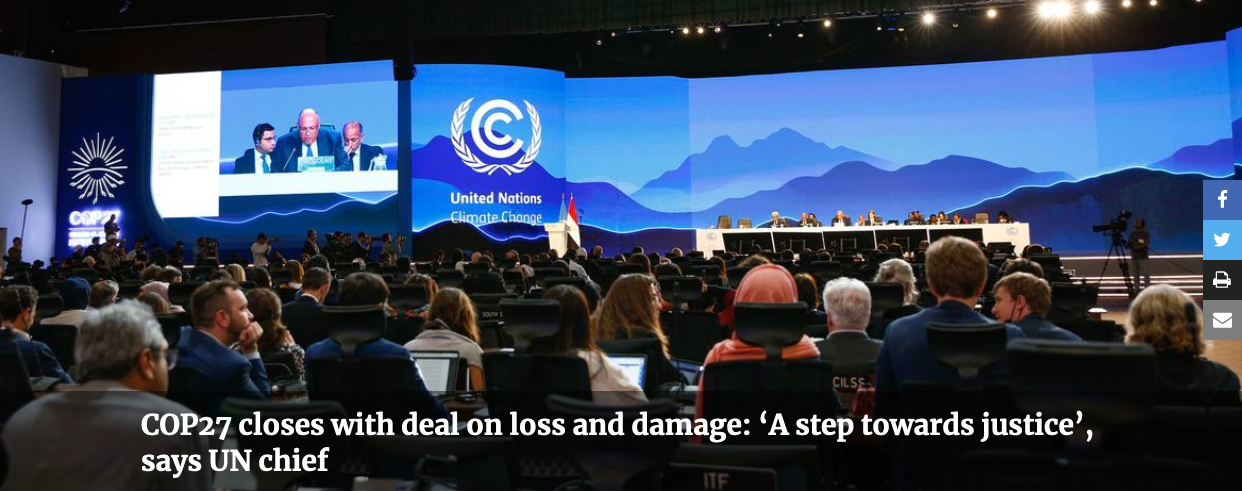
COP 27 closing ceremony https://news.un.org/en/story/2022/11/1130832

The UN Climate Press Release on 20 November summarised the outcomes relating to the fund as follows: “Governments took the ground-breaking decision to establish new funding arrangements, as well as a dedicated fund, to assist developing countries in responding to loss and damage… Parties also agreed on the institutional arrangements to operationalize the Santiago Network for Loss and Damage, to catalyze technical assistance to developing countries that are particularly vulnerable to the adverse effects of climate change”.

Unfortunately, it is not quite as easy as it might seem to validate the claim underlying this that it is the rich countries who do most of the pollution and should therefore compensate the poor countries where the most harmful damages from CO2 occur (see, for example, ThePrint, India; UN News, noting that “Developing countries made strong and repeated appeals for the establishment of a loss and damage fund, to compensate the countries that are the most vulnerable to climate disasters, yet who have contributed little to the climate crisis”; and BBC News, A historic deal has been struck at the UN’s COP27 summit that will see rich nations pay poorer countries for the damage and economic losses caused by climate change”). How should it be decided, for example, which countries should be donors to this fund, and which should be beneficiaries from it? Pakistan, which led much of the discussion around the need for richer countries to fund the poorer ones, was actually the 27th largest global emitter of CO2 in 2019; China was the largest contributor, and India the 3rd largest.

The Table below, drawing on World Bank data (2022), gives the various rankings of the top 30 countries in terms of CO2 emissions per capita in 2019, and CO2 total emissions in 1990 and 2019, as well as the change in ranking of the latter two columns.

RankCountryCO2 metric tons per capita 2019CountryCO2 total emissions kt 1990CountryCO2 total emissions kt 2019Change in rank 1990-2019
1Qatar32.474United States4844520China10707219.7+1
2Kuwait22.022China2173360United States4817720.21-1
3Bahrain20.266Russian Federation2163530India2456300.05+4
4United Arab Emirates19.330Japan1090530Russian Federation1703589.97-1
5Brunei Darussalam16.132Germany955310Japan1081569.95-1
6Canada15.431Ukraine688620Germany657400.024-1
7Luxembourg15.306India563580Iran, Islamic Rep.630010.01+12
8Saudi Arabia15.285United Kingdom561770Indonesia619840.027+16
9Oman15.282Canada538661Korea, Rep.610789.978+6
10Australia15.238Italy532860Canada580210.022-1
11United States14.673France356240Saudi Arabia523780.029+11
12Palau13.888Poland350210Mexico449269.989+2
13Trinidad and Tobago12.323Mexico269580South Africa439640.015+3
14Turkmenistan12.263Australia263630Brazil434299.988+6
15Korea, Rep.11.799Korea, Rep.247680Turkiye396839.996+11
16Russian Federation11.797South Africa247660Australia386529.999-2
17Kazakhstan11.457Kazakhstan237250United Kingdom348920.013-9
18Czechia9.820Spain214950Vietnam336489.99+59
19Japan8.541Iran, Islamic Rep.198470Italy317239.99-8
20Netherlands8.504Brazil197900France300519.989-9
21Libya8.381Romania172630Poland295130.005-9
22Singapore8.307Saudi Arabia171410Thailand267089.996+11
23Belgium8.096Czechia150200Malaysia253270.004+23
24Malaysia7.927Indonesia148530Egypt, Arab Rep.249369.995+10
25Germany7.912Netherlands148380Spain239979.996-7
26Poland7.774Turkiye139200Kazakhstan212110.001-9
27Estonia7.672Korea, DPR123330Pakistan190570.007+15
28China7.606Uzbekistan117770United Arab Emirates188860.001+16
29Iran, Islamic Rep.7.598Belgium109310Ukraine174729.996-22
30South Africa7.508Venezuela, RB101630Iraq174559.998+9

Many important observations can be made from these figures, and I highlight just a few below:

Per capita emissions

  • The highest per capita emitters are generally those in countries with recently developed hydrocarbon-based economies, such as Qatar, Kuwait, Bahrain, the UAE and Brunei Darussalam, and generally not in the old rich industrial economies of Europe.
  • Surprisingly, quite a few European countries such as the UK, Denmark and Spain (ranked 52nd-54th) actually lie well outside the top 30 highest emitters
  • The twelve lowest per capita emitters for which data are available (not shown here) are all African countries.
  • There are many fewer countries above the world average, at 4.47 metric tons per capita (which would rank 61st) and many more ranked beneath it, implying that the highest emitters are much higher than the lowest are low: Qatar at 32.47, has 28 metric tons per person more than the average; yet, 55 countries have emissions per capita of <1 metric ton.

Total emissions

  • 60% of total CO2 emission are generated by people living in five countries (China, 31.18%, the United States 14.03%, India 7.15%, the Russian Federation 7.15%, and Japan 3.15%). Eleven further countries, all producing more than 350,000 kt CO2 annually account for a further 16.68% of emissions. More than three-quarters of emissions in 2019 were therefore from people in just 16 countries.
  • Those countries with the lowest total emissions are nearly all small island states (SIDS; not shown in the Table), but note that these were not necessarily the lowest per capita emitters.
  • The changes in total emissions since 1990 are also very interesting. The highest increases within the top 30 were Indonesia (+16) and Iran (+12), although much higher risers came into the top 30 from below, including Vietnam (+59), Malaysia (+23), UAE (+16) and Pakistan (+15).

These data do not make easy reading for policy makers, campaigners and the UN system as a whole, all of whom like to have simple answers and short soundbites. The world is unfortunately too complex and messy for these. As the world’s popultion passes 8 billion (2.8 times what it was when I was born), population growth is the dominant factor in determining total country-based emissions, but economic growth (following the US-led carbon-based capitalist mode of production) has also played a significant part. The big risers in total emissions are countries with large populations and/or with high economic growth rates over the last 30 years. Neither of these should be surprising. Poor countries, with low economic growth and relatively small populations are never likely to be amongst the largest consumers of energy. Overall, the biggest factor determining total CO2 emissions over the last century, and especially in the last 50 years, has been human population growth (see my recent post on “climate change”). Moreover, there has for long been an intricate and complex relationships between humans and carbon: the carbon cycle and the production of oxygen are essential for human life, and our economic systems have also been driven by carbon as a fuelfor centuries. These complexities make it extremely difficult, if not impossible, to argue that we need to create two groups of countries: one being the recipients of funding (from a loss and damage financial facility), and the other being contributors to it. Instead, we need to work collaboratively together to transform the underying factors causing environmental change, of which CO2 emissions are actually only but a small part.

That is not, though, to say that there should not be much greater global effort to work together to resolve the environmental problems caused by our centuries old carbon-based economy (as well as those caused by so-called renewable energy). It is also completely separate from moral arguments suggesting that there should be a shift in wealth distribution from the rich to the poor. However, these should not be conflated into over-simplistic statements and assertions about responsibililty for climate change, such as those being promoted by UN agencies and mainstream media at the end of COP 27. It is also to reassert that we need to work together with renewed vigour collaboratively across sectors and disciplines to understand better the complex interactions that humans have with the environments in which we live, and then to make wise decisions how to implement them in the interests of all the world’s peoples and not just those of the rich and privileged parts of the world.

The above draft was written on 21 November 2022 (and has been revised slightly subsequently)


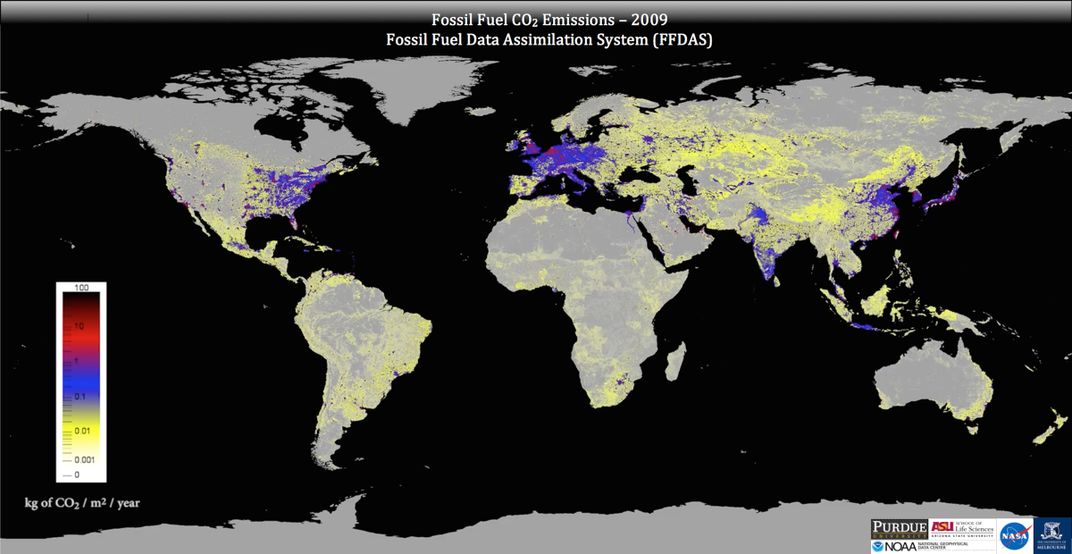
In response to the above, Olof Hesselmark kindly asked why I had not added further details also about the spatial distribution of CO2 emissions – something that as a geographer I care greatly about! I responded that I hadn’t wanted to complicate matters further, but also that I guess it was because I am aware in my own mind of these spatial distributions, and the country names (and sizes) are in-built into my consciousness! However, they do add an important additional element of complexity to the discussion, and I am delighted that he has agreed for me to add his slightly cropped map of CO2 emissions per sq km below:

I’m not entirely sure which projection this is, but my preference for such maps is Eckert IV, or other equal area projections such as Gall-Peters or Mollweide that place less visual emphasis on the apparent size of countries in high latitudes. This map nevertheless highlights the varying densities of emissions, with China, Europe and the USA being high, and Africa and Latin America being low. It should also be emphasised that there are enormous differences within countries, as well as between them, with urban-industrial environments generally being much higher in their CO2 emissions than sparsely settled rural ones.

A different perspective once again is thus from the Smithsonian Magazine‘s 2009s map below (carbon emissions from 1997-2010), which does indeed show how a very few areas contribute the largest amount of CO2 emissions.

Update 22 November 2022

5 Comments

Filed under Climate change, Environment, Geography, United Nations

“Climate Change” and Digital Technologies: redressing the balance of power (Part 1)

The Andes from the air between Santiago and Mendoza

“Climate change” causes nothing! Yes, read that again, “climate change” causes nothing. It is a result, not a cause. Yet, as delegates at COP27 continue to bemoan the impacts of climate change, promote ways of limiting carbon emissions, and redress the global balance of power and responsibility – as well as enjoying themselves, feeling important, serving their own interests, and basking in the glory of greenwashing (at last there is something on which I can agree with Greta Thunberg about!) – the adverse environmental impacts of digital technologies go almost un-noticed.

This series of three posts seeks to redress this balance, and argues for a fundamentally new approach to understanding and trying to improve the impacts of digital technologies on the environment. It situates the climate change rhetoric within the wider context of human impact on the environment (of which climate is but one element). The first of these posts provides a critique of much of the rhetoric concerning climate change, the second articulates the case for a new approach to understanding the relationships between digital tech and the environment, and the third provides positive suggestions for the next steps that need to be taken if we are indeed to use digital tech wisely to help manage our human relationships with the environment. Throughout it emphasises the need to understand the interests underlying the present rhetoric and practice around the interactions between digital tech, climate change and the environment.

The rhetoric of climate change: itself part of the problem

Changes in the earth’s climate are very real, and have existed since long before humans could appreciate them. The dramatic impact of humans on the world’s weather patterns and climate that have occurred over the last century, though, have only really been recognised and appreciated more widely in the last 40 years, in large part as a result of the dramatic increase in funding given to scientists working in this field. Climate activism and the UN’s interest in appearing to try to do something about it are relatively recent phenomena (the first COP meeting was held as late as 1995). It is fascinating to recall that ground-breaking works in the 1960s and early 1970s about human impact on the environment, such as Rachel Carson’s (1962) Silent Spring, and the Club of Rome’s (1972) Limits to Growth report, focused on a much more holistic view that paid surprisingly little explicit attention to climate. Five key inter-related concerns with the current dominant rhetoric about “climate change” can be teased out from these basic observations.

Over-simplified rhetoric of “Climate change” hides the significance of human impact

The term “climate change” has become so bowdlerized that is has lost any real value. At best, in common parlance it can be interpreted as being a shortened form of “human induced climate change”, but this shortening hides the fundamental importance of “people” as being the main cause of the changes in climate and weather patterns that are being experienced across the world. The expression “climate change” is actually just a collective observation of a series of aggregated changes in weather patterns across the world. It has no explanatory or causative power of its own. It is we humans who are causing fundamental changes to the environment, and these go far beyond just climate. We still know far too little about the complex interactions between different aspects of the world’s ecosystems to be able to predict how these will evolve with any real certainty. “Keep it Simple Stupid”(KISS) quite simply does not work when discussing human induced climate change.

Externalising “climate change”

The use of the term “climate change” also has much more subtle and malign implications, because it externalises our understanding of impacts and thus the actions that the global community (and every one of us living on this planet) need to take. Rather than human actions being seen as the fundamental cause that they are, externalising the idea of “climate change” as a cause means that the focus is subtly turned to finding ways to limit “climate change” rather than actually to change our underlying human behaviours. The classic instance of this is the focus on reducing carbon emissions by developing renewable energy sources – without actually changing our consumption patterns. The very considerable emphasis within the digital tech community on reducing its own carbon emissions and inventing ways through which digital tech can be used to contribute to “green energy” (typified by the ITU’s emphasis thereon) is but one example of this (see further in Part 2). Moreover, at a very basic level, the emphasis on carbon although important, has tended to reduce the attention paid to other contributors to global warming, such as Nitrous Oxide (N2O) which has a Global Warming Potential (GWP) 273 times that of CO2, or Methane (CH4) which has a GWP of 27-30 times, for a 100-year timescale (USA EPA, 2022).

The focus on climate means that wider environmental impacts tend to be ignored

Focusing on “climate change” in general, and rising temperatures (global warming) in particular, has had a very serious negative impact on the ways in which other environmental parameters are considered and affected. In essence, “climate impact” often trumps most other environmental considerations, even when at a local scale other environmental impacts may actually be very much more serious. In reality, climate is but a part of the wider interconnected world in which we live, and for a more sustainable future it is essential to adopt a comprehensive ecosystem approach to understanding the full environmental impacts of any intervention. But one example of this is the way that batteries are now required to store “renewable” energy from solar panels or wind turbines, and the resultant serious environmental degradation caused by mining for lithium in Chile, Australia, Argentina and China (note too that total global reserves of lithium in 2018 were only 165 times the annual production volume, and demand is increasing rapidly).

Sustainable development, climate change and economic growth.

I have long argued that the term “sustainable development” is a contradiction in terms, and that the Sustainable Development Goals (SDGs) alongside the UN’s Agenda 2030 are deeply flawed, not only in implementation but also in design (see Unwin, 2015, 2016, 2017, 2018, 2021 and 2022). In essence, while development is largely defined in terms of economic growth, it is difficult to see how it can be compatible with sustainability when defined as the maintenance of valued entities. A deep flaw in much of the global “climate change” rhetoric about the use of renewable technologies to replace energy based on hydrocarbons is that it still tends to be combined with an economic growth agenda based on technical innovation. It does little, if anything at all, about changing global consumption patterns, the “perpetual growth” model, and the underlying capitalist mode of production (see Unwin, 2019). Indeed, elsewhere, I have often reflected on what a “no-growth” model of society might look like.

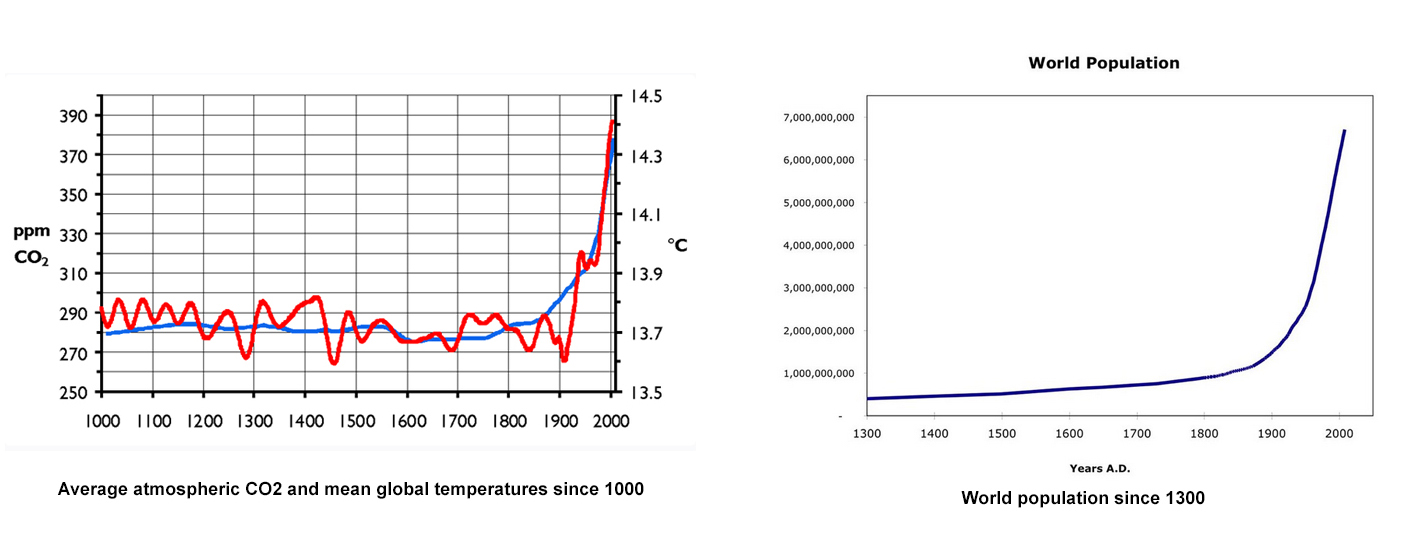
One of the core problems with the dominant global rhetoric around climate change (as expressed particularly in COP27, but also in much popular activist protest) is that it does not sufficiently tackle the fundamental challenge of population growth and increased consumption. The two simplified graphs below illustrate the scale of this basic problem.

The broad similarity in these two curves is striking. More than anything else, it has been the overall global growth in population over the last two centuries, enabled in large part by the enterprise associated with the individualistically based capitalist mode of production that has driven the environmental crisis of which “climate change” is but a part. The controversial film Planet of the Humans (Produced by Michael Moore) makes similar arguments, and it is unfortunate that its many critics have tended to focus more on some of its undoubtedly problematic points of detail rather than the crucial message of its overall argument (see Moore on Rising). The “capture”of the UN system by global corporations, exemplified by the large numbers of business leaders attending COP27, seems to confirm one of Moore’s core arguments that these companies are now driving much of the climate change agenda.

If the world’s peoples really want to “mitigate the effects of climate change”, there needs to be a dramatically more radical change to our social, cultural, political and economic systems than has heretofore been imagined, and this needs to begin with a shift to more communal rather than individualistic systems, a focus on reducing inequalities rather than maximising economic growth, and the crafting of a more holistic approach to environmental issues rather than one primarily focussing on carbon reduction to “solve” “climate change”.

Who benefits most: understanding the interests behind “climate change” rhetoric

Social movements, economic practices, cultural behaviours and political systems do not just happen, they are created by those who have interests in making them happen and the power to do so. This is as true of the “climate change” rhetoric and movement as it is of any other. Five particular groups of people have shaped and sought to take advantage of this. First, have been the scientists who have believed in the importance of this issue and have sought to build their careers around it. Academic careers are not neutral, and the story of how they built coalitions and peer networks, influenced research councils and political groups, and helped to forge a global “climate change” agenda that served their own interests is a fascinating one that remains to be told. Second, have been private sector businesses and corporations big and small who have sought to influence global policy and profit from a shift from hydrocarbons to renewable energy. This has been fuelled by the fetish for innovation, and the idea that technological change can inject a new impetus to economic growth. Their lobbying of governments to subsidise many of the start-up costs of renewable energy technologies, to overturn existing environmental legislation to permit the creation of new industrial landscapes in the name of solving”climate change”, and to enable consumers to afford to purchase them through further subsidising their energy costs, has been hugely successful. The global capitalist system, utterly dependent on economic growth, is ultimately leading ever more rapidly to its own environmental catastrophe. Third have been those who enjoy the thrill and camaraderie of political activism who have found in the simple “climate change” mantra something that will unite many of their common interests. Fourth, has been the UN system with all of its distinct agencies, each of which has found a cause around which to promote its identity as contributing in a worthwhile way for the benefit of humanity. Finally, have been the politicians, eaager to be seen to be doing “good”, and to contribute to a worthy international cause, in the interests of enhancing their own political careers.

The trouble is that it is not “climate change” itself that is the problem. Instead it is these interests, shaping the rhetoric of climate change, that have helped to exacerbate the very real environmental damage that is being caused to this planet. Self-interestedly promoting the rhetoric of “climate change” is of course much easier than it is to tackle the real roots of the problem, which lie in the economic, political, social and cultural processes that they too have crafted over the last half-century.


Part 2 of this trilogy of posts examines how these arguments apply in the context of the digital tech sector, and Part 3 calls for a dramatic new approach to balancing the environmental harms and benefits of the creation and use of such technologies,

3 Comments

Filed under Climate change, digital technologies, ICT4D

Inter Islamic Network on IT and COMSATS University workshop on ICT for Development: Mainstreaming the Marginalised

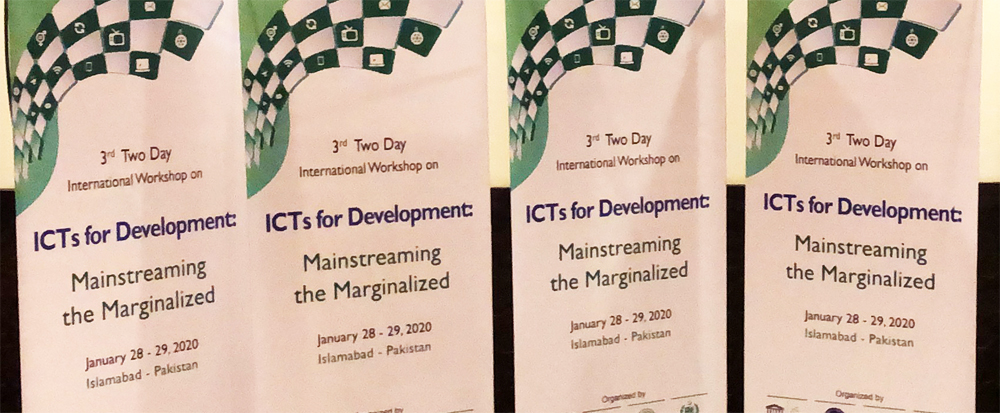
PostersThe 3rd ICT4D workshop convened by the Inter Islamic Network on IT (INIT) and COMSATS University in Islamabad, and supported by the UNESCO Chair in ICT4D (Royal Holloway, University of London) and the Ministry of IT and Telecom in Pakistan on the theme of Mainstreaming the Marginalised was held at the Ramada Hotel in Islamabad on 28th and 29th January 2020.  This was a very valuable opportunity for academics, government officials, companies, civil society organisations and donors in Pakistan to come together to discuss practical ways through which digital technologies can be used to support  economic, social and political changes that will benefit the poorest and most marginalised.  The event was remarkable for its diveristy of participants, not only across sectors but also in terms of the diversity of abilities, age, and gender represented.  It was a very real pleasure to participate in and support this workshop, which built on the previous ones we held in Islamabd in 2016 and 2017.

The inaugural session included addresses by Prof Dr Raheel Qamar (President INIT and Rector COMSATS University, Islamabad), Mr. Shoaib Ahmed Siddiqui (Federal Secretary Ministry of IT & Telecom) and Dr. Tahir Naeem (Executive Director, INIT), as well as my short keynote on Digital Technologies, Climate Change and Sustainability.  This was followed by six technical sessions spread over two days:

  • Future of learning and technology
  • Policy to practice: barriers and challenges
  • Awareness and inclusion: strategizing through technology
  • Accessibility and Technology: overcoming barriers
  • Reskilling the marginalised: understandng role reversals
  • Technical provisio: indigenisation for local needs.

These sessions included a wide diversity of activities, ranging from panel sessions, practical demonstrations, and mind-mapping exercises, and there were plenty of opportunities for detailed discussions and networking.

Highlights for me amongst the many excellent presentations included:

  • Recollections by Prof Abdful Mannan and Prof Ilyas Ahmed of the struggles faced by people with disabilities in getting their issues acknowledged by others in society, and of the work that they and many others have been doing to support those with a wide range of disabilities here in Pakistan
  • The inspirational presentations by Julius Sweetland of his freely available Open Source Optikey software enabling those with multiple disbilities to use only their eyes to write and control a keyboard
  • Meeting the young people with Shastia Kazmi (Vision 21 and Founder of Little Hands), who have gained confidence and expertise through her work and are such an inspiration to us all in continuing our work to help some of the pooorest and most marginalised to be empowered through digital technologies.
  • The very dynamic discussions around practical actions that we can all take to enable more inclusive use of  digital technologies (mindmaps of these available below)

Enormous thanks must go to Dr. Tahir Naeem (COMSATS University and Executive Director of INIT) and his team, especially Dr. Akber Gardezi and Atiq-ur-Rehman, for all that they did to make this event such a success.

A shortened version of this workshop was also subsequently held on Monday 3rd February at the University of Sindh in Jamshoro, thanks to the support and facilitation of Dr. Mukesh Khatwani (Director of the Area Study Centre for Far East and Southeast Asia) and his colleagues.  This also focused on the practical ways through which some of the most marginalised can benefit from the appropriate use of digital technologies, and it was once again good to have the strong involvement of persons with disabilities.

Quick links to workshop materials and outputs:


Leave a comment

Filed under Climate change, Conferences, Environment, Gender, ICT4D, ICT4D conferences, Pakistan, Uncategorized

Digital technologies and climate change, Part III: Policy implications towards a holistic appraisal of digital technology sector

This is the third of a trilogy of posts on the interface between digital technologies and “Climate Change”.  Building on the previous discussion of challenges with the notion of “climate change” and the anti-sustainability practices of the digital technology sector, this last piece in the trilogy suggests policy principles that need to be put in place, as well as some of the complex challenges that need to be addressed by those who do really want to address the negative impact of digital technologies on the environment.

Telecentre small

To be sure, various global initiatives have been put in place to try to address some of the challenges noted above, and the impact of digital technologies on “Climate Change” is being increasingly recognised, although much less attention is paid to its impact on wider aspects of the environment.  One challenge with many such global initiatives is that they have tended to suffer from an approach that fragments the fundamental problems associated with the environmental impact of digital technologies into specific issues that can indeed be addressed one at a time.  This is problematic, as noted in the previous two parts of this commentary, because addressing one issue often causes much more damage to other aspects of the environment.

As I have noted elsewhere,[i] the Global e-Sustainability Initiative (GeSI) is one of the most significant such initiatives, having produced numerous reports, as well as a Sustainability Assessment Framework (SASF) that companies and organisations can use to evaluate their overall sustainability.  This has three main objectives:

  • “Strengthen ICT sector as significant player for achieving sustainable development goals
  • Enable companies to evaluate and improve their product portfolios with a robust and comprehensive instrument
  • Address sustainability issues of products and services in a coherent manner providing the basis for benchmarking and voluntary agreements”.[ii]

However, GeSI is made up almost exclusively of private sector members, and is primarily designed to serve corporate interests as the wording of the above objectives suggests.  Typically, for example, it has shown clearly how companies can reduce their carbon imprint,[iii] and many are now beginning to do so quite effectively, but the unacknowledged impact of their behaviour on other aspects of the environment is often down-played.  Little of their work has, for example, yet included the impact of satellites on the environment.  Likewise, it has failed to address the fundamentally anti-sustainable business model on which much of the sector is based.

Similarly, civil society organisations have also tended to fragment the digital-environment into a small number of parts for which it is relatively easy to gather quantifiable data. Thus, Greenpeace’s greener electronics initiative focuses exclusively on energy use, resource consumption and chemical elimination.[iv] These are important, though, showing that most digital companies that they analysed have a very long way to go before they could be considered in any way “green”; in 2017 only Fairphone (B) and Apple (B-) came anywhere near showing a shade of green in their ranking.  Recent work by other organisations such as the carbon transition think tank The Shift Project has also begun to suggest ways through which ICTs can become a more effective part of the solution to the environmental impact of ICTs rather than being part of the problem as it is at present, although usually primarily from a carbon-centric perspective focusing on climate change.[v]

These observations, alongside those in Parts I and II, give rise to at least seven main policy implications:

Above all, it is essential that a much more holistic approach is adopted to policies and practices concerning the environmental impact of digital technologies.

These must go far beyond the current carbon fetish and include issues as far reaching as landscape change, the use of satellites and the negative environmental impacts of renewable energy provision.  There is a long tradition of research and practice on Environmental Impact Analysis that could usefully be drawn upon more comprehensively in combination with the ever-expanding, but more specific, attention being paid purely to “Climate Change”.

Such assessments need to weigh up both the positive and the negative environmental impacts of digital technologies.

This issue is discussed further below, but there needs to be much more responsible thinking about how we evaluate the wider potential impact of one kind of technology, which might do harm directly, although offering some beneficial solutions more broadly.

The fundamental anti-sustainability business models and practices of many companies in the digital technology sector must be challenged and changed.

The time has come for companies that claim to be doing good with respect to carbon emissions, but yet remain bound by a business approach that requires ever more frequent new purchases, need to be called to task.  Companies that maintain restrictive policies towards repairing devices must be challenged.  Mindsets need to change so that there is complete re-conceptualisation of how consumers and companies view technology.  Laptops, tablets and phones should, for example, be designed in ways that could allow them to be kept in use for a decade rather than a few years.  Until then, much of the rhetoric about ICTs contributing to sustainable development remains hugely hypocritical.

There needs to be fundamental innovation in the ways that researchers and practitioners theorize and think about the environmental impact of digital technologies.

It will be essential for all involved to create new approaches and methodologies in line with the emphasis on a holistic approach to understanding the environmental impact of digital technologies noted above.  Only then will it be possible to avoid the piecemeal and fragmented approach that still dominate today, and thus move towards the use of technologies that can truly be called sustainable.

In turn, it is likely that such new theorizing will have substantial implications for data.

Much work on the climate impact of digital technologies is shaped by existing data that have already been produced. New models and approaches are likely to require new data to be created.

It is important that there is open and informed public debate about the real impacts of digital technologies on the wider environment, and not just on climate.

The vested interest of companies, still driven by their unsustainable practices, against such debate are huge.  However, if consumers could better understand the environmental damage caused by the digital technology system, they would be able to make improved choices about the sorts of technology they use, and how long they keep it for before replacing it.  This is why the work or organisations such as the Restart Project is so important.[vi]

Government action and international agreements are essential.

There is insufficient good evidence that the private sector will regulate itself sufficiently to make the fundamental changes necessary. Government action and international agreement are therefore essential elements of an integrated approach to the wiser use of digital technologies.  The European Union’s recent steps in 2019 concerning the right to repair are a beginning to move in this direction,[vii] but much more comprehensive action is necessary.  International organisations such as the International Telecommunication Union have a key role to play here, but their increasing alliance with private sector companies to fund their activities and their determination to show that the sector is indeed delivering on the Sustainable Development Goals make it difficult for them to respond to the extent required.  Leaders and Ministers in small island states, who are likely to be impacted most imminently by sea level change, might well be able to play an important role in sensitising the wider global community to the importance of these agendas.

The creation of a multi-sector commission

We can no longer rely on private sector funded and led entities to shape the global dialogue on the environmental impact of digital technology.[viii] If there is sufficient will in the international community, a strong case can be made for the creation of a new multi-sector global commission or similar such body to address these issues.  Amongst other things, this could shape the necessary holistic approach, disseminate reliable and trustworthy knowledge, commission new research, present unbiased conclusions, and advise governments on the actions they need to take to ensure that digital technology is developed wisely and environmentally responsibly.


This trilogy has been written to raise awareness of some of the challenges and issues relating to the impact of digital technology on the environment. It is by no means comprehensive, and many important issues have not been addressed.  Amongst the most significant of these are questions around the balance between serving broader good while doing localised harm.  For example, is it acceptable to use digital technologies that do indeed cause environmental harm, if such use actually reduces significant environmental harm caused by other economic or cultural activities?  Such questions are of profound importance, and can only be resolved effectively through ethical considerations and people’s moral agendas. There needs to be widespread public debate as to the kind of future we wish to create.  I have addressed some of these in my previous work, but they remain worthy of a much more comprehensive analysis.[ix]


It is time to unmask the hypocrisy of those shaping a future of anti-sustainable digital technologies whilst claiming that they contribute to sustainable development.  It is not yet too late to reject the false promises of the digital barons, and reclaim our full sentient experience of the physical environment. It is not yet too late to reject the digital slavery that they seeking to impose on us.  It is not yet too late for us to reclaim our role as guardians of our planet’s future.


[i] Unwin, T. (2017) ICTs, sustainability and development: critical elements, in: Sharafat, A. and Lehr, W. (eds) ICT-Centric Economic Growth, Innovation and Job Creation, Geneva: ITU, 37-71

[ii] https://gesi.org/platforms/sustainability-assessment-framework-sasf-1

[iii] Much of GeSI’s work has been driven by the need for companies to respond to the Carbon fetish, with its latest statements on ways through which the sector can deliver the 2030 sustainability agenda being replete with mentions of CO2 https://smarter2030.gesi.org/the-opportunity/.

[iv] See https://www.greenpeace.org/archive-international/en/campaigns/detox/electronics/Guide-to-Greener-Electronics/. See also Greenpeace’s (2017) Guide to Greener Electronics, https://www.greenpeace.org/usa/wp-content/uploads/2017/10/Guide-to-Greener-Electronics-2017.pdf.

[v] The Shift Project (2019) Lean ICT – Towards Digital Sobriety, https://theshiftproject.org/wp-content/uploads/2019/03/Lean-ICT-Report_The-Shift-Project_2019.pdf.

[vi] https://therestartproject.org/

[vii] https://ec.europa.eu/commission/presscorner/detail/en/IP_19_5895

[viii] Although GeSI has produced much interesting work, its private sector focus means that it is by no means impartial.  Eight of its Board members, for example, are drawn from the private sector, with the ninth being a representative of the ITU; most of its staff have an industry background; and almost all of its members and partners are private sector companies or entities.

[ix] Unwin, T. (2017) Reclaiming ICT4D, Oxford: Oxford University Press.

4 Comments

Filed under Climate change, digital technologies, ICT4D, Sustainability, Uncategorized

Digital technologies and climate change, Part I: Climate change is not the problem; we are

This is the first part of a trilogy of posts about the interface between digital technologies and climate change, and suggests that “Climate change” is a deeply problematic concept. Its widespread use, and the popular rhetoric surrounding it, may well be doing more harm than good as far as the environment is concerned.  At least six key issues need to be addressed with respect to the “climate change” mantra in the context of its linkages with digital technologies.

Panorama Jolly Harbour Bay

“Climate Change” is a result of many variables and is not per se a cause of anything.

Language matters. Saying, for example, that “Climate Change is causing drought and famine” is meaningless.  The term “Climate Change” is just a description of what is happening; it has no actual causal power.  It is thus changes in rainfall patterns, the uses made of water, changes in population distribution and many other factors that actually cause drought.  Although it is a surrogate collective term for many such underlying factors that are causing changes in the relationships between people and the physical environment, “Climate Change” has itself been given enormous “power” of its own in the popular imagination.  In part, this is because the term serves the interests of all those promoting its use,[i] and detracts from the fundamental changes that need to be made.  Focusing on “Climate Change” actually hinders people from considering the real underlying factors that are causing such changes, which are most notably aspects of human behaviour such as the pursuit of individual greed rather than communal well-being.  Not least, these include the rapid spread in the use and spread of digital technologies.

It is essential to differentiate between (a) the impacts of humans on climate change and (b) the natural changes that influence the world’s climate.

Climate has always changed.  There is nothing new in this.[ii]  As long as humans have lived on planet Earth they have had an influence on its climate.  What has changed is that there are now many more people alive, and they are having a much greater impact on the climate, over and above the “natural” changes taking place.  The pace of change has undoubtedly increased rapidly.  The popular, but erroneous, belief that it is actually possible to combine “development” with environmental sustainability[iii] considerably exacerbates matters and has meant that more and more people aspire to greater material benefits at lower financial cost than ever before.  Population pressure, foreseen long ago in the late 18th century work of Thomas Malthus, and highlighted in the more recent work of the Club of Rome[iv] in the 1970s with its publication of The Limits to Growth,[v] is one of the root cause of human induced climate change.  Yet far too little emphasis is being placed on this.  Somehow, it seems “right” that we can continue to prolong life, often through enhanced interfaces with digital technologies,[vi] and thereby place even more pressure on the world’s limited environmental “resources”.  Whilst there have been many valid criticisms of such arguments, and economic developments in the 20th century did indeed suggest that such limits could continuously be overcome, Malthus’s positive checks of hunger, disease and war remain all too relevant in the 21st  While many people fear the prospects of a new plague, horrendous famines or devastating global wars, these may well actually remain the ultimate safety valves through which the human species may survive and rebuild a better balance with the environment (of which climate is an integral part; see below).

Humans want to be in control.

Part of the problem with the notion of “Climate Change” as applied primarily to human-induced climate change is that it implies that humans have caused climate change and so can therefore reverse it, if only they had the will and knowhow to do so. Such a notion of “Climate Change” is thus part of the underlying belief system that humans control the “natural environment”, rather than being part of it.  This is related to the much wider debate over the dichotomy between the “mental” and the “physical”, the “spiritual” and the “material”, that has lain at the heart of geography since long before its foundation as an academic discipline.[vii]  Humans today are thus always shocked by so-called ”natural disasters”, such as volcanoes, earthquakes and tsunamis, when their control is shown to be powerless in the face of the forces of the physical world.  Ultimately, humans are not actually more powerful than, or separate from, the forces of nature.  Yet, advocates of the use of digital technologies to control nature perpetuate the myth that “we” can indeed increasingly be in control.

It is very dangerous to separate “climate” as being somehow distinct from other aspects of the environment in which we live.

The increased rhetoric and activism over “Climate Change” is overshadowing the important wider environmental issues of which it is but a part.  This is highlighted for example, in contexts as diverse as Extinction Rebellion’s dominant slogan “We are facing an unprecedented global climate emergency”,[viii] and the UN Secretary General’s continued emphasis that we must all “confront the world’s climate emergency”.[ix] It is fascinating to see how entities as diverse as these persist in using the word “climate”, rather than “environmental”.  Yet climate change is but a part of the wider changes that are taking place as a result of human exploitation of the limited physical environment in which we live.  Climate must therefore be understood within the holistic context of that wider environment rather than as a separate entity; climate is no more important than the destruction of vegetation, or despoliation of soils, or plastic pollution of the oceans, or even the use of outer space as a satellite graveyard.  If there is one lesson we are beginning to learn it is that all of these are integrally connected within a global ecosystem that must be understood holistically.  “Climate’s” domination of both activism and policy-making suggests that this agenda is being driven by a particular set of interests that are able to benefit from such a focus on climate alone.

The carbon fetish.

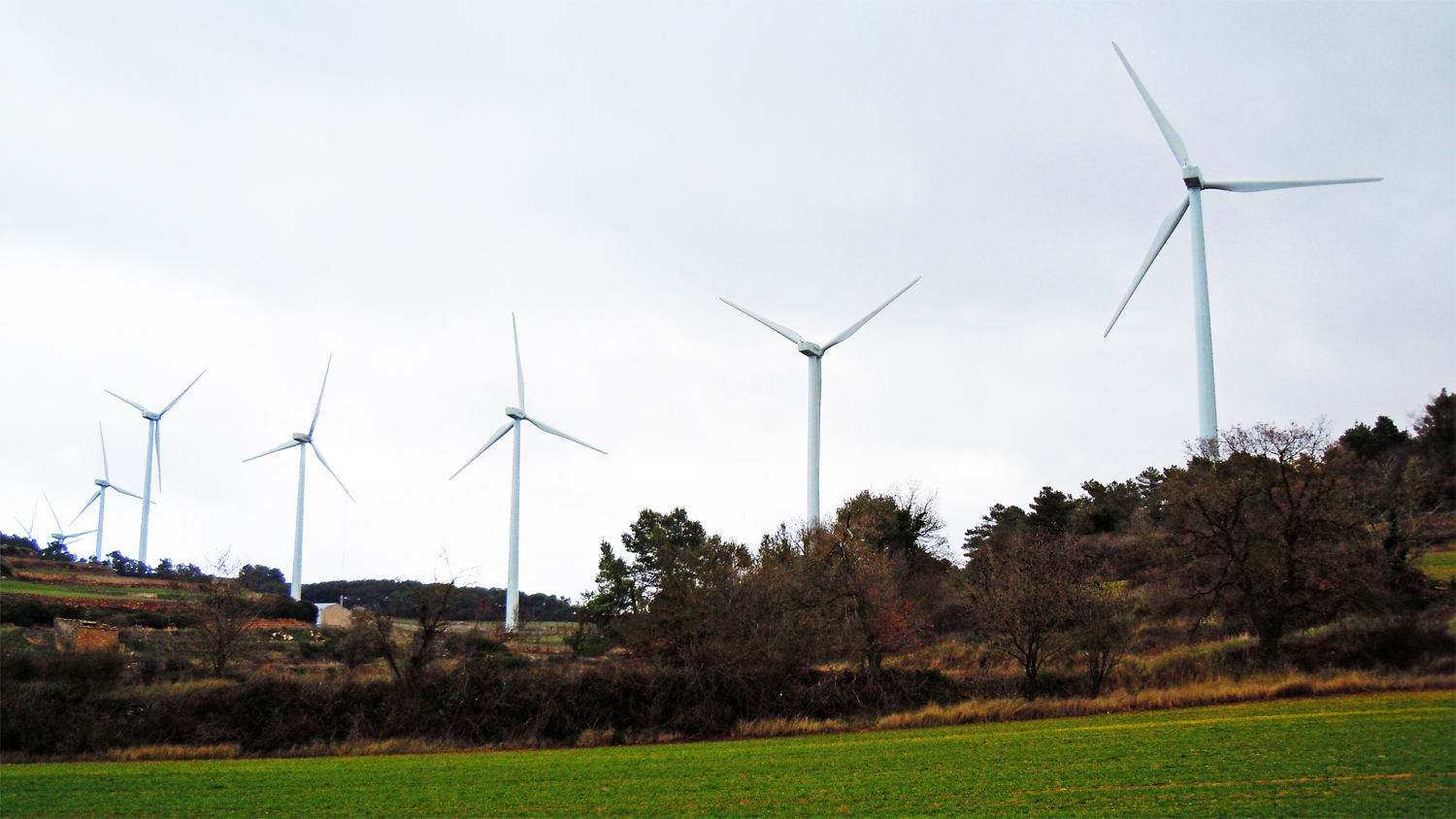
One of these interest groups is those involved in carbon trading, who have been able to generate significant profits from so doing.[x]  As the European Environment Agency notes, “Despite fewer EU emission allowances (EUAs) being auctioned in 2018 than in 2017, revenue from auctions increased from EUR 5.5 billion to EUR 14.1 billion”.[xi]  Carbon emissions in the form of CO2 have undoubtedly had a significant impact on global temperatures, and yet the overwhelming focus explicitly on carbon has meant that other damaging environmental changes have been relatively ignored.  A classic example of this was the promotion of diesel cars following the 1997 Kyoto Protocol because they produced lower CO2 emissions than did petrol cars.  Only later was it realised that the NOx and particulate matter emissions from diesel vehicles, caused other damage to the environment and human health.[xii] Likewise, the shift to so-called “renewable” sources of energy, such as wind turbines, in order to reduce carbon emissions, has also led to an increase in the use of Sulphur Hexofluoride (SF6), which is used across the electricity sector to prevent short circuits and fires, but has the highest global warming potential of any known substance.[xiii] Demonising carbon has thus often led to the introduction of different, and sometimes even more damaging, alternatives.  The carbon fetish has also meant that the digital technology sector has focused very substantially on showing how it can reduce its carbon imprint, and thus be seen as being “green” or environmentally friendly,[xiv] whilst actually continuing to have very significant negative environmental impacts in other ways.  The dramatically increased emphasis on non-carbon sources of electricity has likewise caused very significant landscape change across the world through the introduction of solar farms, wind turbines and huge dams for hydroelectric plants.  These landscape changes are difficult to quantify in monetary terms, but need to be taken into consideration in any rigorous evaluation of the environmental impact of digital technologies.  Moreover, much of this technology is itself not particularly renewable.  Wind turbine blades, for example, have to be disposed of in landfill sites once they reach the end of their usable lives.  Likewise, despite solar panels being largey recylable, they too give rise to potentially high levels of waste.  It has been estimated that unless effective recycling processes are put in place there could be 60 million tons of PV panels waste in landfill sites by the 2050Moreover, a recent report by UK FIRES notes that it is important to respond urgently to change using today’s technologies, because so-called breakthrough technologies cannot be relied on to meet the 2050 zero-carbon targets.Turbines in Catalunya

The positive aspects of climate change.

Humans have always responded to changes in long term weather patterns and thus climate change in the past.  Substantial migrations, changes in trade routes, and the settlement of previously uninhabited areas were all commonplace occurrences in antiquity and prehistoric times.[xv]  Yet, the construction of powerful nation states and increasingly fixed national borders have tended to limit the ease with which migration, or forced settlement, can happen.  Indeed, it has often been said that the free movement of people across the earth is the one human right for which we are not ready.[xvi]  The impact of processes associated with climate change, such as sea-level rise and changing weather patterns, is in part fundamentally tied up with this notion of movement.  Theoretically, if people were able (and willing) to move freely from increasingly hazardous environments to ones that were more amenable, they could travel across the world seeking (or competing for) access to the most propitious places in which to live.  Farmers in low-lying countries flooded out by sea-level change could, for example, move to areas suitable for grain production and pasture that were once on the margins of frozen tundra.[xvii]  Clearly, there are huge political, social and cultural issues to be addressed with such suggestions, but the key point in raising them is to emphasise that there can be positive as well as negative impacts of so-called “Climate Change”.  Indeed, these are readily apparent at a more mundane level.  Already, Champagne producers are investing in vineyards in England, as they seek to mitigate the impact of changes in weather patterns in northern France.[xviii]  Likewise, the amount of energy used to heat buildings in areas of the world that were previously colder in winter has now declined.  This is not in any way to deny the scale, rapidity and significance of the changes the combine to influence “Climate Change”, but it is to argue that they need again to be seen in a holistic way, and not purely as being negative.


In summary, this section has suggested that we need to focus on the root causes of the phenomena contributing to changes in weather patterns and to treat these holistically as part of the wider impact that increasing numbers of humans are having on the physical environment.  Human behaviours are creating these environmental changes rather than an exogenous force called “Climate Change”.  Only when we address these human behaviours will we begin to start creating a more sustainable and vibrant ecosystem in which our children and grandchildren can thrive.  This will require fundamentally different ways of living that most people currently seem unwilling to accept.[xix]  Not least, there needs to be a qualitative shift away from more individualistic, greed-led selfish agendas, to more communal and collaborative ones.  Whilst it is very frequently claimed that digital technologies can indeed help to deliver the so-called Sustainable Development Goals and mitigate the climate crisis, the next section argues that the design and use of these very technologies lie at the heart of the environmental challenges caused by the social and economic systems created by a few rich and powerful humans.


For the second part of this triology, see Digital technologies and climate change, Part II: “Unsustainable” digital technologies cannot deliver the Sustainable Development Goals


[i] For a brief discussion of these interests (including those of scientists working in the field, who have actually been one of the biggest beneficiaries of the climate change mantra in terms of research grants and prestige) see https://unwin.wordpress.com/2010/01/27/problems-with-the-climate-change-mantra/

[ii] Much could be written about this, not least concerning the increasing resolution and accuracy with which we measure contemporary changes in climatic variables, in contrast to the necessity to rely on surrogate measures in the past.

[iii] Unwin, T. (2018) ICTs and the failure of the SDGs, https://unwin.wordpress.com/2018/04/23/icts-and-the-failure-of-the-sdgs/

[iv] History of the Club of Rome, https://www.clubofrome.org/about-us/history/

[v] Meadows et al. (1972)The Limits to Growth, Universe Books,  https://www.clubofrome.org/report/the-limits-to-growth/

[vi] See, for example, the research and development being undertaken by Calico https://www.calicolabs.com/, and Elon Musk’s launching of Neuralink https://www.neuralink.com/

[vii] See Unwin, T, (1992) The Place of Geography, Harlow: Longman.  The belief systems of many indigenous peoples across the world are very different from those derived from European cultures.  Australian aborigines, for example, see themselves very much as being part of nature; the “country” includes them, rather than humans owning the land.

[viii] See for example https://www.xrebellion.nyc/events/heading-for-extinction-and-what-to-do-about-it-8619-darwz-wm6aw-kjakr-e9k6j-7k2pz-4y8gz-py5cy, https://www.brightest.io/cause/extinction-rebellion/, or https://politicalemails.org/organizations/648

[ix] As for example in November 2019 at the ASEAN-UN Summit https://news.un.org/en/story/2019/11/1050501

[x] David Sheppard in The Financial Times thus commented in 2018 that “A select group of specialist traders at hedge funds and investment banks, including Morgan Stanley and Goldman Sachs, are churning bumper profits from a once niche commodity that has risen phoenix-like from a decade-long slump. Carbon credits, introduced by the EU to curb pollution by companies in the trading bloc, have soared almost fourfold in the past year to above €20 per tonne of CO2, following legislative changes designed to get the scheme working…”

[xi] European Environment Agency (2019) The EU Emissions Trading System in 2019: trends and projections, https://www.eea.europa.eu/publications/the-eu-emissions-trading-system/at_download/file

[xii] https://www.theengineer.co.uk/fact-check-are-diesel-cars-really-more-polluting-than-petrol-cars/

[xiii] McGrath, M. (2019) Climate change: Electrical industry’s ‘dirty secret’ boosts warming, BBC News 13 Sept 2019, and for a defence from the wind sector see https://windeurope.org/newsroom/news/wind-energy-and-sf6-in-perspective/

[xiv] Typified by the work of GeSI in developing a methodology to assess carbon reducing impacts of ICTs http://www.gesi.org/research/evaluating-the-carbon-reducing-impacts-of-ict-an-assessment-methodology.

[xv] See, for example, Yang, L.E., Bork, H-R, Fang, X. and Mischke, E. (eds) (2018) Socio-Environmental Dynamics along the Historical Silk Road, Cham: Springer Nature; Pappas, S. (2012) Wet climate may have fuelled Mongol invasion, LiveScience, July 2012; Fleming, S. (2019) Climate change helped destroy these four ancient civilisations, World Economic Forum, March 2019; What drove ancient human migration? Climate Change via NPR, Re-imagining migration.

[xvi] Nett, R. (1971) The civil right we are not ready for: the right of free movement of people on the face of the earth, Ethics, 81(3), 212-27.

[xvii] Nobel, J. (2013) Farming in the Arctic: it can be done, Modern Farmer, October 2013.

[xviii] Smithers, R. (2017) French champagne house Taittinger plants first vines in English soil, The Guardian, May 2017.

[xix] One such radical example would be the eradication of pets.  The impact of meat consumption on “Climate Change” has recently been widely publicised following the IPCC special report on climate change and land in 2019.  Its emphasis on the need for a substantial reduction in meat consumption was interpreted by many as being a call for people across the world to eat less meat.  This, in turn, has supported the Vegan food industry, and those advocating Veganuary as a New Year’s Resolution that can help save the planet.  A radical alternative, though, would be to prevent people from keeping pets such as cats and dogs, or at least to regulate the pet-food industry so that it only supplied vegetarian food.  Pets are estimated to eat 20% of the world’s meat and fish, and are thus responsible for a fifth of the environmental impact that this causes; likewise, it has been reported that a quarter of the environmental impact of meat production apparently comes from the pet-food industry.[xix]  Although these estimates seem to be largely based on data from the richer countries of the world, eliminating all pets would be an easy way of dramatically cutting the impact of humans on climate change.  Yet this is not something that most people are willing to consider.  The 874 page IPCC report does not mention pets or the pet-food industry once.

2 Comments

Filed under Climate change, digital technologies, Environment, ICT4D, Uncategorized

Digital technologies and climate change

The claim that the use of digital technologies is a solution for the problems of “climate change” and environmental sustainability is fundamentally flawed.[i] The creation of such technologies, and the interests that underlie their design and sale, are part of the problem rather than the solution.  An independent, comprehensive and holistic review of the environmental impact of such technologies therefore urgently needs to be undertaken.

A farm near Tartu in Estonia in the mid-1990s

This reflection brings together some of my previous comments on digital technologies and environmental change that have been scattered across different publications.[ii] It focuses on three main arguments, each addressed in a separate post:

  • Part I suggests that “Climate change” is a deeply problematic concept. Its widespread use, and the popular rhetoric surrounding it, may well be doing more harm than good as far as the environment is concerned
  • Part II argues that the current design and use of digital technologies are largely based on principles of un-sustainability, and are therefore having a seriously damaging impact on the environment.
  • Part III proposes that there is consequently an urgent need for a comprehensive and holistic audit of the impact of digital technologies on the environment.

Lest I be misunderstood in the arguments that follow, I believe passionately in the need for wise human guardianship of the environment in which we live.  Some of my previous research as a geographer[iii] has explicitly addressed issues commonly associated with “climate change”, and I have no doubt that humans are indeed influencing weather patterns across the globe.  However, “climate change” per se is not the problem.  Instead the problem is the behaviour of humans, and especially those in the richer countries of the world who wish to maintain their opulent lifestyles, not least through using the latest digital technologies.  “Climate change” is but a subset of wider and more fundamental issues concerned with the interactions between people and the environment.[iv]  Focusing simply on “climate change” takes our eyes off the most important problems.


[i] Typical of such claims is Ekholm, B. and Rockström, J. (2019) Digital technology can cut global emissions by 15%.  Here’s how, World Economic Forum.

[ii] See Unwin, T. (1992) The Place of Geography, Harlow: Longman; Owen, L. and Unwin, T. (eds) (1997) Environmental Management: Readings and Case Studies, Oxford: Blackwell; Unwin, T. (ed.) (2009) ICT4D: Information and Communication Technologies for Development, Cambridge: CUP; Unwin, T. (2010) Problems with the climate change mantra, 27 Jan 2010; Unwin, T. (2017) ICTs, sustainability and development: critical elements, in: Sharafat, A. and Lehr, W. (eds) ICT-Centric Economic Growth, Innovation and Job Creation, Geneva: ITU, 37-71; Unwin, T. (2017) Reclaiming information and communication technologies for Development, Oxford: OUP.

[iii] See references above in footnote 2.

[iv] The interactions between people and the environment have long been part of the domain of Geography, and this reflection is thus largely constructed through a geographer’s lens (see footnote 2: Unwin, 1992)

5 Comments

Filed under Climate change, digital technologies, Environment, ICT4D