Tag Archives: development

ICTs and the failure of the Sustainable Development Goals

The euphoria associated with the consensus reached by UN member states on 2nd August on the Sustainable Development Agenda to be signed by World Leaders in New York on 25-27 September is fundamentally misplaced, although not unexpected (for process see UN Post-2015 Development Agenda).  The Sustainable Development Goals (SDGs) will do little to reduce poverty, will continue to propagate a world system based on inequality, and will continue primarily to serve the interests of those in the UN system and practitioners in the “development industry”.

I find it difficult to believe how Ban Ki-moon could really believe the words he said when welcoming the agreement, saying it “encompasses a universal, transformative and integrated agenda that heralds an historic turning point for our world … This is the People’s Agenda, a plan of action for ending poverty in all its dimensions, irreversibly, everywhere, and leaving no one behind. It seeks to ensure peace and prosperity, and forge partnerships with people and planet at the core. The integrated, interlinked and indivisible 17 Sustainable Development Goals are the people’s goals and demonstrate the scale, universality and ambition of this new Agenda”.

Here, I wish to focus attention particularly on the almost complete omission of ICTs from the final agreed SDGs, and why this is a very serious failing.  Back in June 2013, I wrote stridently about the paucity of mentions of ICT in the report of the High-Level Panel of Eminent Persons on the Post-2015 Development Agenda, which provided the initial basis for the agreement reached last Sunday.  Little has changed since then. Although my focus is on ICTs, it is important, though, to begin by noting some of the fundamental structural issues that mean the SDG process has been so flawed, and will fail to address the interests of the world’s poorest people:

  • There are far too many goals (17) and targets (169) – this will lead to diffusion of effort and lack of focus, not only within the ‘global system’, but also in individual countries.  It is much better to do a few things well, rather than try to do too many things, and fail to do any of them well.  The reality is that this list is a compromise of everything that those involved in the formal deliberations could think of that might reduce poverty (and serve their own interests)
  • Target setting is hugely problematic in that it can lead to resources being directed too much towards delivering the targets and not enough to other factors that might actually have greater impact.  This would not be so worrying if goals and targets were treated as flexible aspirations, but the reasons for the failure to deliver on many of the original Millennium Development Goals (MDGs) should have sent a much more powerful message to those planning the SDGs.  The UN’s own 2014 report on the MDGs, for example, stated that “Substantial progress has been made in most areas, but much more effort is needed to reach the set targets”.  If the world could not deliver on 8 Goals in 15 years, how is it going to deliver on 17 goals and 169 targets in the next 15 years?
  • The process remains largely concerned with absolute poverty rather than relative poverty.  Claiming that the SDG agenda will end poverty in all of its dimensions is, I’m afraid, crass (see my now very old paper No end to poverty that explores this further).  The SDGs will do little fundamentally to change the structural conditions upon which the present world system is based, which remain primarily concernd with economic growth rather than reducing social and economic inequality (despite claims that the agenda does indeed address inequality, as in Goal 10).
  • These goals and targets represent the interests of those organisations (UN, civil society, private sector) driving the SDG agenda, rather than the poorest and most marginalised; it is these organisations that are actually likely to benefit most from the SDG agenda.  Perhaps more than anything else, the SDGs have become a vehicle through which the UN and its many agencies can try to show their continued relevance in an ever-changing world.
  • The need to monitor progress against the goals/targets will further expand the “development industry”, and consultants and organisations involved in such monitoring and evaluation will undoubtedly benefit hugely.  Small, poor countries simply do not have the capacity to implement, let alone develop the complex monitoring systems required by, the new SDGs and targets.
  • The SDGs reflect a relatively small set of interests (economic growth, agriculture, health, education, gender, environment and climate, justice and security, urban/industrial development), and focus insufficiently on some of the key issues that require attention if we are to create a fairer and more equal world, notably the role of ICTs, and the relative lack of attention paid to people with disabilities.

Each of the above claims (and indeed the many other reasons why the SDGs will fail) needs justifying at much greater length, but the last point brings me directly to the abject failure of the SDG agenda to pay sufficient attention to the critical role of ICTs in shaping contemporary development.  ICTs are not mentioned directly in any of the SDGs, and are only to be found in but four of the 169 targets:

  • 4b) By 2020, substantially expand globally the number of scholarships available to developing countries, in particular least developed countries, small island developing States and African countries, for enrolment in higher education, including vocational training and information and communications technology, technical, engineering and scientific programmes, in developed countries and other developing countries
  • 5b) Enhance the use of enabling technology, in particular information and communications technology, to promote the empowerment of women
  • 9c) Significantly increase access to information and communications technology and strive to provide universal and affordable access to the Internet in least developed countries by 2020
  • 17.8) Fully operationalize the technology bank and science, technology and innovation capacity-building mechanism for least developed countries by 2017 and enhance the use of enabling technology, in particular information and communications technology

Only one of these (9c) has a focus on ICTs as a direct aim.  All of the others merely mention ICTs in an enabling role: for higher education scholarships (4b); to promote the empowerment of women (5b); and for the development of a technology bank and science, technology and innovation capacity-building mechanism (17.8).  In this context, it is quite scandalous that the SDGs, while mentioning the empowerment of women, fail to mention the much more significant use that ICTs can make to the lives of the 10% of the world’s population with disabilities.

There is widespread agreement that ICTs have been one of the major factors that have transformed the world over the 15 years of the MDGs.  They have driven extraordinary economic growth, have opened up entirely news ways of delivering education, health and rural development, have transformed the relationships between governments and citizens, and have created an interconnected world of communication and knowledge sharing.  It is not an exaggeration to say that they have been one of the most significant changes to humanity over the last 20 years.  Yet, those determining the SDG agenda for the next 15 years barely give them any recognition at all.  This would not be so worrying if ICTs had not also created some of the greatest inequalities that the world has ever seen; the differences in life experience between someone connected through mobile broadband to a 4G network, and someone with only 2G connectivity, let alone without a smartphone or equivalent digital device, is extraordinary (for a wider discussion see some of my recent papers).  ICTs have the capacity to be used for great good, and to transform the lives of poor people; but they also have the capacity to be used to create vast inequality, and to do much that is negative.

Hence, those involved in crafting the SDGs should have paid very much greater attention to the transformative role of ICTs.  The single target (9c) “Significantly increase access to information and communications technology and strive to provide universal and affordable access to the Internet in least developed countries by 2020” is indeed to be welcomed, but as one of only 169 targets there is a real danger that it will be lost in the plethora of other competing aspirational targets for governments across the world.  As it is, there is little indication of what “significantly increase” actually means, or indeed of how best this target can be achieved.  The dominant rhetoric in the “global community” is still of how to reach the “next billion”, rather than how to serve the needs of the poorest and most marginalised, what most people call the “bottom billion” but which should better be termed the “first billion” to focus our attention on it being the most important!

The failure of ICTs to be mentioned more substantially within the SDGs provides a salutary example of how such goals are formulated, and the politics of the UN and international development system.  Looking back, it is remarkable that ICTs were mentioned explicitly within the sixth target of Goal 8 of the original MDGs in 2000: “In cooperation with the private sector, make available benefits of new technologies, especially information and communications”.  Yet, from this highpoint the role of ICTs within the SDG agenda of 2015 can be seen to have diminished almost to insignificance.  In large part this reflects the failure of international organisations with interests in ICTs to realise the significance of the SDG agenda early enough, and then to engage sufficiently actively in the discussions surrounding their formulation.  In this context, I was delighted that under my leadership the Commonwealth Telecommunications Organisation (CTO) did indeed reach agreement in 2014 on a statement about the role of ICTs in the SDGs, but sadly this fell on rather deaf ears in the wider international community. Interestingly, during informal discussions with several multilateral and bilateral donors in recent years, during which I have personally sought to promote the crucial role of ICTs in development, I have regularly been told that the relevant UN organisations (such as the ITU) and other donors have insufficiently promoted the need for a goal on ICTs.  This, I am sure, is correct, but it is also important to understand why this might be the case.  At least four reasons seem relevant:

  • First, the UN system is one of strict hierarchy, with some agencies being seen as much more powerful and dominant than others.  Despite dramatic enhancements in the efficacy and role of the ITU in recent years under the leadership of Hamadoun Touré and now Houlin Zhao, it still seems to lack the clout at the wider international table of some of the other more powerful UN organisations and lobbies, for example, in the fields of health, gender and climate change.
  • Second, despite their being some young brilliant Ministers for ICTs/Telecommunciations across the world, more often that not these ministers are relatively low down the national hierarchy of ministerial responsibility, and were therefore unable effectively to influence national delegations who contributed to the crafting of the SDGs about the importance of ICTs.
  • Third, many bilateral and multilateral donors remain unconvinced of the power of ICTs to transform development in the interests of the poor and marginalised. This reflects badly both on the ICT for Development (ICT4D) community who have failed to provide enough evidence of the real development benefits of ICTs, but also on the ignorance, self-interest and bigotry of many of those working for donor agencies.
  • Fourth, when push comes to shove, individuals and institutions will usually focus on their own core areas, rather than on cross-cutting or collaborative initiatives.  Hence, the WHO and the powerful international health lobbies focus primarily on delivering health, UNESCO and the educational industry will focus on education, and the FAO and rural development lobby will focus on agriculture and rural development.  The ICT for Development field is relatively new, and remains insufficiently robust to compete against these powerful existing entities.

Building on this last point, it is highly salient that at the May 2015 WSIS Forum held in Geneva, the UN agencies involved explicitly recognised that the battle had been lost to have one of the SDGs with an explicit focus on ICTs, and instead developed a matrix to show how ICTs as represented in the WSIS Action Lines could contribute to each of the emerging SDGs.  While this goes some way to indicate how different UN agencies can indeed use ICTs to deliver their wider SDG commitments,  it fails comprehensively to tackle the deep structural issues that mean that ICTs are continuing to contribute to greater global inequality.

Without much greater focus on ensuring that the poorest and most marginalised, including people with disabilities, can use ICTs effectively to lead enhanced lives, the SDGs will inevitably lead to a more fractured and unequal world.

21 Comments

Filed under Development, ICT4D

Thoughts on mobile learning for the EFA GMR 2015

GMRI was delighted to have been asked by UNESCO to write an overview of the evolution of mobile devices and their uses in learning (m-learning), focusing especially on the fifteen-year period of the first Millennium Development Goals, as a background paper for the 2015 Education for All Global Monitoring Report, and it is great that this has now been published.

I thought it might be useful to summarise some of the key points here. The paper highlights eight emerging good practices, and six significant policy implications. The emerging good practices are:

  • Focusing on learning outcomes not technology
  • Involving teachers and users at all stages from design to implementation and review
  • Involve participatory approaches in design so as to ensure that adoption of technology is user-centric
  • Consider sustainability, maintenance and financing right at the beginning
  • Think holistically and systemically
  • Ensure that all relevant government departments are involved
  • Ensure equality of access to all learners, especially those who are marginalised
  • Appropriate and rigorous monitoring and evaluation must be in place

The policy implications identified are closely linked to these and can be summarised as:

  • Joined up approaches across Governments
  • Sharing of effective and rigorous monitoring and evaluation findings
  • Ensuring affordability
  • Providing connectivity
  • Effective multi-stakeholder partnerships
  • Development of relevant content

Four case studies drawn from different parts of the world and at different scales were used to illustrate the considerable success that can be achieved through m-learning. These were:

  • BBC Janala in Bangladesh;
  • Red UnX: a mobile learning community for entrepreneurship in Latin America;
  • Learning on the Move in Singapore; and
  • Worldreader: making books available to primary school children in low-income countries

However, the paper also illustrates clearly that unless very considerable efforts are made to ensure that the poorest and most marginalised people and communities have access to appropriate devices, connectivity and electricity, any increased attention on digital technologies is likely to increase inequalities rather than reduce them.

It concludes that to date, great strides have been made in using the very rapid expansion of mobile devices for the benefit of education, and for those companies involved in exploiting this. However, as a review of delivery on the past EFA goals and MDGs, it is apparent that much remains to be done in using such devices to help achieve universal primary education and gender equality in education.  Looking to the future, as more and more people gain possession of, or access to, mobile devices, they will have the opportunity to use the Internet to access an ever more innovative array of learning tools and content. The challenge, particularly for governments, is how to pay for and use this potential to enable universal access, and thus equality of opportunity within the education sector. Given the central role of teachers and administrators within education, an important concluding recommendation is that much more attention should be paid to providing training, resources and support to them in the use of mobile devices. A well-equipped, knowledgeable and inspired cadre of teachers, capable of using mobile ‘phones effectively in their classes, is a crucial first-step towards delivering m-learning for all. Sadly, all too often, even in the richest countries of the world, children are told to switch off their mobile ‘phones before entering the classroom. M-learning has much potential, but we are still a long way from using it to benefit the world’s poorest and most marginalised.

Leave a comment

Filed under 'phones, Development, Education, ICT4D

Summary of Keynote for COL’s PCF7 in Abuja

Despite limited digital connectivity, I just thought I would upload a short summary of my upcoming keynote at the Commonwealth of Learning’s Seventh Pan-Commonwealth Forum this afternoon to encourage productive debate!  Its central argument is that we are not delivering as effectively as we could in using ICTs for education at all levels, because of very explicit interests that are serving to limit this effectiveness. (Later on 17th December: the slides that accompanied the keynote have now been made available by COL)

Good practices

I begin with a short overview of ten good practices that need to be in place to ensure effective use of ICTs in education:

  1. It’s the learning that matters, not the technology
  2. Teachers must be involved from the beginning
  3. Sustainability built in from the start
  4. Supporting infrastructure must be in place
  5. Appropriate content must be developed
  6. Equality of access for all learners
  7. Continual monitoring and evaluation
  8. Appropriate maintenance contracts
  9. Using the technology 24/7
  10. Good practices, rather than best

So, why are these not done?

I focus here first on the observation that ICTs generally increase inequalities unless very specific actions are taken to ensure that the poorest and most marginalised are able to benefit.

I then explore the various interests that tend to limit delivery of the above ten practices, focusing especially on the activities of the private sector, and especially hardware and software companies, connectivity companies and content developers.

In so doing, I also draw on some of the increasing amount of empirical evidence that the use of computers in education is actually damaging learning.

Implications for innovation

In the final section, I explore some of the implications of these trends for innovation and creativity, paying specific attention to five themes:

  1. Content replication
  2. Memory
  3. Language and literacy
  4. Personalised searching
  5. Privacy and failure

In conclusion

In drawing these reflections to an end, I argue that one way forward is to work towards new and effective models of multi-stakeholder partnerships for education, that address education as something much more important, much more complex, and much more exciting than merely as a vehicle for economic transformation.

Leave a comment

Filed under Africa, Commonwealth, Development, Education, Higher Education, ICT4D

Great new book on evaluating communication for development

I have always had huge admiration for the work (research and practice) that Jo Tacchi does.  It is therefore great to see her latest book, written together with June Lennie, published at the end of last year: Evaluating Communication for Development:a Framework for Social Change (Routledge, 2012).

As the publisher’s blurb notes, “Evaluating Communication for Development presents a comprehensive framework for evaluating communication for development (C4D). This framework combines the latest thinking from a number of fields in new ways. It critiques dominant instrumental, accountability-based approaches to development and evaluation and offers an alternative holistic, participatory, mixed methods approach based on systems and complexity thinking and other key concepts. It maintains a focus on power, gender and other differences and social norms. The authors have designed the framework as a way to focus on achieving sustainable social change and to continually improve and develop C4D initiatives. The benefits and rigour of this approach are supported by examples and case studies from a number of action research and evaluation capacity development projects undertaken by the authors over the past fifteen years.

Building on current arguments within the fields of C4D and development, the authors reinforce the case for effective communication being a central and vital component of participatory forms of development, something that needs to be appreciated by decision makers. They also consider ways of increasing the effectiveness of evaluation capacity development from grassroots to management level in the development context, an issue of growing importance to improving the quality, effectiveness and utilisation of monitoring and evaluation studies in this field.

The book includes a critical review of the key approaches, methodologies and methods that are considered effective for planning evaluation, assessing the outcomes of C4D, and engaging in continuous learning. This rigorous book is of immense theoretical and practical value to students, scholars, and professionals researching or working in development, communication and media, applied anthropology, and evaluation and program planning”.

1 Comment

Filed under Communication, ICT4D

The Internet and Development: a critical perspective

9780199589074_140I am delighted to see Bill Dutton’s magisterial edited The Oxford Handbook of Internet Studies (Oxford University Press, 2013) just published.  This is a really excellent and authoritative review of current research on all aspects of the Internet, with some 26 chapters from leading figures in the field.  The 607 page book is divided into five main parts:

  1. Perspectives on the Internet and Web as objects of study
  2. Living in a network society
  3. Creating and working in a global network economy
  4. Communication, power, and influence in a converging media world
  5. Governing and regulating the Internet.

Two of the real strengths of the book as an introduction to the field of Internet studies are the very readable style of most of the chapters, and the comprehensive bibliographies that accompany them.

I was delighted to have been asked to write the chapter on the Internet and Development, which Bill suggested should be sub-titled “a critical perspective”!  As I write in the summary, “This chapter explores research on the complex inter-relationship between the Internet and ‘development’, focusing especially on the effects of the Internet on the lives of some of the poorest people and most marginalised communities.  Much of the literature on Information and Communication Technologies for Development (ICT4D) suggests that the Internet can indeed bring very significant benefits in the ‘fight against poverty’ (see, for example, Weigel and Waldburger 2004; Rao and Raman 2009; Unwin 2009), but other research is marshalled in this synthesis to challenge this assumption.  In essence, I argue that the expansion of the Internet serves very specific capitalist interests, and that unless conscious and explicit attention is paid to designing interventions that will indeed directly serve the needs of the world’s poorest people, then the Internet will only replicate and reinforce existing structures of dominance and control. This argument supports the need for more research that challenges taken-for-granted assumptions about the Internet and development”.

In essence, the Internet is not some benign force for good as is so often supposed.  Instead it is being shaped and reshaped by a relatively small group of people with very specific interests.  It is absolutely essential that those committed to trying to ensure that digital technologies are used to serve the interests of all peoples in the world, and particularly the poorest and most marginalised, do indeed continue to challenge many of the all too often taken for granted assumptions that the Internet is necessarily automatically a force for positive “development”.

1 Comment

Filed under Development, ICT4D

Accelerating development using the Web

George Sadowsky’s new edited book entitled “Accelerating development using the Web: empowering poor and marginalised populations” has just been launched at the WSIS Forum in Geneva.  This contains some really excellent material, and is an important resource for those interested in exploring ways through which the Web can be used by some of the world’s poorest and most marginalised people to enhance their lives. Generously supported by the Rockefeller Foundation, and produced in partnership with the World Wide Web Foundation and the UNDP, this book is designed as “a compendium of articles by recognized experts describing the real and potential effects of the World Wide Web in all major aspects of economic and  social development”.  Many of the authors combine academic and practical experience, and so this book is much more than just an arid digest of academic thinking on the subject.  It also challenges many of the taken for granted assumptions about the Web, and examines the structural conditions that limit its use by the poorest of the world’s people.  Chapters cover the following main themes:

  • Chapter 1 – Introduction (George Sadowsky)
  • Chapter 2 – Fundamental Access Issues (Michael Jensen)
  • Chapter 3 – Technical Access Issues (Alan Greenberg)
  • Chapter 4 – Policy Access Issues (Cynthia Waddell)
  • Chapter 5 – Governance (Raúl Zambrano)
  • Chapter 6 – Agriculture (Shalini Kala)
  • Chapter 7 – Health (Najib Al-Shorbaji)
  • Chapter 8 – Education (Tim Unwin)
  • Chapter 9 – Commerce and Trade (Torbjörn Fredriksson)
  • Chapter 10 – Finance (Richard Duncombe)
  • Chapter 11 – Gender (Nancy Hafkin)
  • Chapter 12 – Language and Content (Daniel Pimienta)
  • Chapter 13 – Culture (Nnenna Nwakanma)
  • Chapter 14 – Conclusion

It was great fun working with George and the team on this project, and I do hope that those who read it will find a sense of our commitment, enthusiasm and, at times, outrage.  The Web is in danger of becoming a vehicle through which greater divides are created in our societies.  We have to take specific actions if the enormous benefits that it can provide are to be made available to all of the world’s people.  This is most definitely not the same as saying that access to the Web should be a human right – something that I  most profoundly disagree with.  However, it is most certainly to suggest that we cannot simply take it for granted that providing Internet access will without question benefit the poor. If the poor and the marginalised are indeed to benefit from the Web, there have to be clear mechanisms that enable them to use it to deliver on their needs and aspirations.

1 Comment

Filed under Development, ICT4D

Advice for students on ICT4D programmes…

I’ve just had a great question posed to me by Brooke Kania: “I was just wondering, what are you looking for in students who are coming out of IDEV or ICT4D programs – what do you think the field needs from academic training? What advice would you give to aspiring ICT4D professionals?”.  The question is easy; the answer is not!  Fueled by a couple of very good glasses of Chianti, let me have a go at responding.  Here then are the ten things I would look for, and also some reflections as to why:

  • A willingness to cross boundaries.  The great thing about ICT4D is that it is not (yet) a specific discipline, but brings together people from many different backgrounds.  Exciting things happen at the edges!  Get a computer scientist and a philosopher talking together, and great things can happen.  The only trouble is that most academic ‘life’ is now about becoming the global expert in a tiny field of academic enquiry, and despite the rhetoric of interdisciplinarity, old disciplinary boundaries remain strong!
  • Understanding the real needs of users.  Far too many ICT4D projects are invented by academics who have little clue about what the real needs of users actually are, and they are then surprised that the projects fail!  In part, this reflects the tyranny of the one year Master’s programme or three-year PhD, that limits the potential for a researcher to go into the field, really discover what would then make a difference to the lives of poor people, and then work with them to develop technologies that can really serve their interests.
  • Humility.  The Academy is all too often about ‘experts’ and people who claim to ‘have all the answers’.  In my experience, that is the death of enquiry and exploration.  There is much truth in the statement that “the more I know, the more I realise how little I know”.  Interestingly, I think I have met more ‘bright’ people outside universities than I have within them!  Far too often, academics create a language of obfuscation, to prevent others from understanding how ignorant they really are!
  • Being technically sound. ICT4D is fundamentally about technology – not necessarily in an instrumentalist way, but it is definitely concerned with technology, both how it is shaped by society, and also how it shapes society.  It is therefore essential that everyone working in the field of ICT4D does indeed have some technical grasp of technology.  That does not mean the impossible, in other words that everyone must understand all the relevant technologies, but it does mean that we should all have some pertinent technical expertise.  Thank goodness that  I learnt to programme in Fortran as a student!
  • A focus on really understanding ‘development’.  This is difficult, very difficult.  There are many definitions of what development is about, but anyone working in the field of ICT4D must address this question in their own way.  For me, development is about addressing the appalling inequalities that exist in our societies, and this is something very, very different from the hegemonic view that development is actually mainly about economic growth.  Capitalist economic growth can never eliminate poverty, and the sooner we abandon this misguided nonsense the sooner the world’s poor and marginalised people will be able to live the lives to which they aspire.
  • Get some real ‘development’ experience!  This is tricky for a student, but it is really impossible to understand the challenges and intricacies of ‘development’, however we define it, unless we have experienced it practically on the ground.  For some 20 years I did research and taught about development, but I never worked for a development agency, the private sector, or civil society organisation in that time.  In six months working for a bilateral donor agency, I learnt more about the practice of development than I did in most of my previous research on the subject!
  • Recognition that ICT4D is a moral, rather than a technical agenda.  This is closely linked to the above point, but I think it is different.  ICT4D should be about the normative – what should be – rather than what actually is.  Academics are generally quite good about describing what exists, but far too few go beyond this to suggest what they think should happen in the light of their analyses .  This is irresponsible!  Academics are hugely privileged, and they abrogate the trust placed in them by society if they do not use their research to make the world a better place.  They can only do this by having a vision for what the world could be like, and then engaging in political action to help shape that world.
  • An ability to engage in critical analysis.  This should lie at the heart of all academic enquiry, but all too often it doesn’t!  Far too much academic research repeats the obvious, albeit dressing it up in grandiose terms.  If we want to explain or understand a phenomenon, we have to keep asking the question “why?”.  I read so many papers that fail to do this!  If the interviews, questionnaires, or experiments that are undertaken do not seek to say why something is observed, then they remain purely descriptive and fail to add to our real understanding.  If you are a social scientist, just look at the questions asked in interviews, focus groups or questionnaires.  There will usually be many “what?”, “where?”, “when” or “who?” questions, but far fewer “how?” questions, and even fewer “why?” questions!  If we do not ask “why?”, we fail really to move knowledge forward.
  • Freedom to fail!  Far too much academic work is about getting students to regurgitate accepted truths – especially the opinions of those who teach them!  What we do not seem to allow students is the opportunity to experiment and fail.  I tend to think that people generally learn more from their mistakes than they do from their successes.  So, my advice would be to try something new, and not worry about the risk of failing.  That is where true innovation comes from.  In job interviews, I often tend to ask people about one of their failures, and then get them to think about what they learnt from it.  Those who claim never to have failed, don’t come up to the mark – especially in my book!
  • Be a good team player. It was difficult to think of a tenth piece of advice – there is so much that could be said.  However, I am convinced that ICT4D is about good team work.  None of us have all the necessary skills, and so if we are going to develop appropriate solutions, we must be able to work effectively together.  Far too much academic work is now about individual success – and we have lost the collective enterprise that so inspired me as a young academic.  Wisdom, scholarship and development are above all collective enterprises, and we need to embark on them together.

So, Brooke, I hope this gives you some ideas of my thinking right now.  Don’t get me wrong, this is not a tirade against the Academy.  Far from it.  Universities are a hugely precious element in our societies, and I value them enormously.  It is just, I fear, that too many institutions and individual academics have lost their way, and have become merely another tool in the hands of those who do not want us to be free.  Ultimately, it is hugely difficult for those committed to implementing real change in our societies to be based within universities; I have tremendous respect for those who remain fighting for their integrity and sanity.  ICT4D is about engagement, not just about writing papers in academic journals that few people will ever read.  Those who determine our research agendas should be the world’s poor and marginalised.

10 Comments

Filed under Higher Education, ICT4D

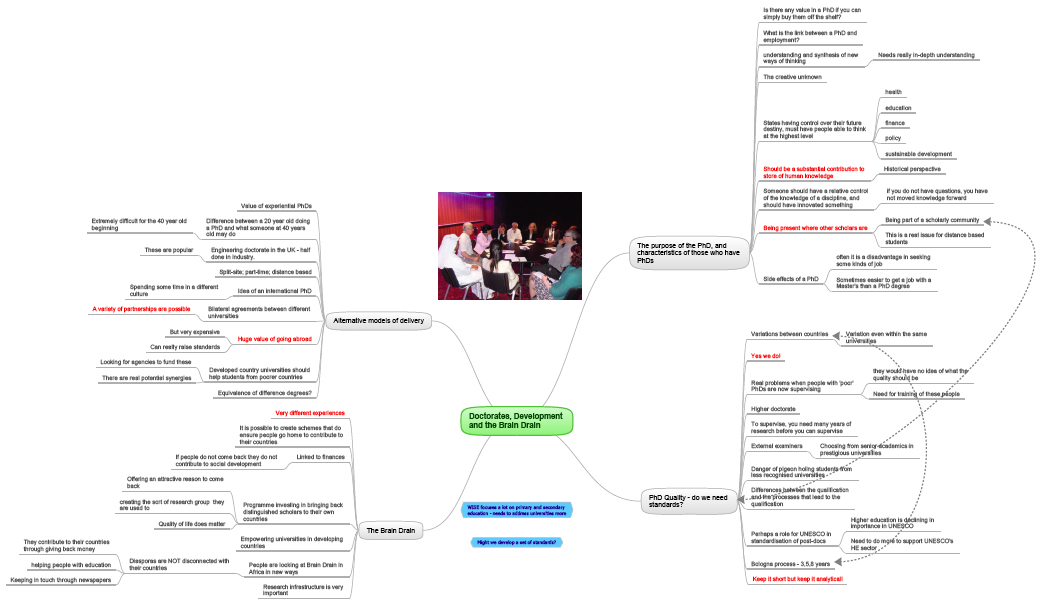
ACU Session at WISE 2011: Doctorates, development and the brain drain

I was delighted to be able to help the Association of Commonwealth Universities run a workshop on “Doctorates, development and and brain drain” at the recent World Innovation Summit for Education (WISE) held in Doha from 1st-3rd November.  This focused on four key themes:

  • the purposes of a PhD and the characteristics of those who have PhDs
  • the quality of a PhD; do we need standards?
  • alternative modes of delivery for doctorates
  • the brain drain

Although the number of participants was small, the discussion was highly interesting, and the mind map below attempts to capture what we discussed (click WISE 2011 for a .pdf version).

Leave a comment

Filed under Commonwealth, Development, Education, Higher Education, Postgraduate supervision, Universities

Resources for sharing development knowledges

Sitting in an interesting meeting of the International Advisory Group of IDS’s MK4D (Mobilising Knowledge for Development) initiative, it struck me that there are now a number of  similar initiatives, all trying to tackle the sharing of development knowledges in rather different ways, and yet no central place where these are all listed.  So, here is a list of some of the ones that I think are most interesting (sorted alphabetically!):

  • bytesforall – a citizen’s network in South Asia that identifies, discusses and builds network on emerging issues related to ICT and its impact to development
  • Comminit – The Comunication Initiative Network, where communication and media are central to social and economic development
  • Development Gateway – an international nonprofit organization with the mission to reduce poverty and enable change in developing nations through information technology (includes the Zunia programme)
  • Eldis – based at IDS and aiming  to share the best in development policy, practice and research (within the MK4D package for work at IDS)
  • Global Development Learning Network – cooordinated by the World Bank, the Global Development Learning Network (GDLN) is a partnership that collaborates in the design of customized learning solutions for individuals and organizations working in development
  • IDRC/CRDI (Canada’s International Development Research Centre) – supporting applied research to find local solutions that will have lasting impacts on communities around the world.
  • IICD – using ICTs to help people in Africa and Latin America access the information that can transform their lives
  • infoDev – supports global sharing of information on information and communication technologies for development (ICT4D), and helps to reduce duplication of efforts and investments
  • R4D (Research4Development)- the portal to DFID centrally funded research
  • Zunia Knowledge Exchange

3 Comments

Filed under ICT4D

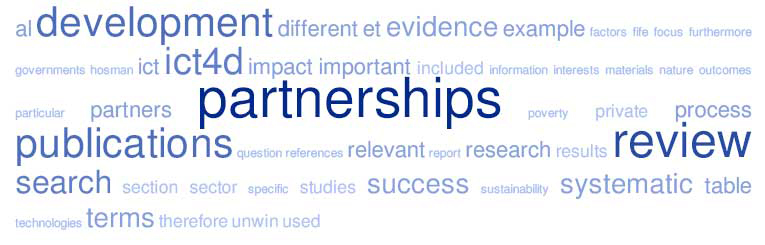
Policy Brief on the Development Impact of ICT4D Partnerships

The Policy Brief resulting from the systematic review report by Marije Geldof, David Grimshaw, Dorothea Kleine and Tim Unwin on the development impact of ICT4D partnerships is now avalable from the R4D website (Policy Brief) and the ICT4D Collective website (Policy Brief).

This emphasises five key findings:

  1. Success is increased when detailed attention is paid to the local context and the involvement of the local community in partnership implementation.
  2. It is important for such partnerships to have clear and agreed intended development out-comes, even where constituent partners may themselves have different reasons for being involved in the partnership.
  3. Sustainability and scalability of the intended development intervention need to be built into partnership design at the very beginning.
  4. Successful partnerships are built on trust, honesty, openness, mutual understanding and respect.
  5. A supportive wider ICT environment needs to be in place, both in terms of policy and infrastructure, if such partnerships are to flourish and deliver effective development outcomes

Link to Full Systematic Review Report on ICT4D Partnerships (.pdf)

Leave a comment

Filed under Development, ICT4D