
Going through my mother’s many papers recently, I discovered this document – a 1984 summary of the computer training that she had introduced to the school in the early 1980s. The remaining pages that can be seen through the thin paper continue with details of the syllabus.
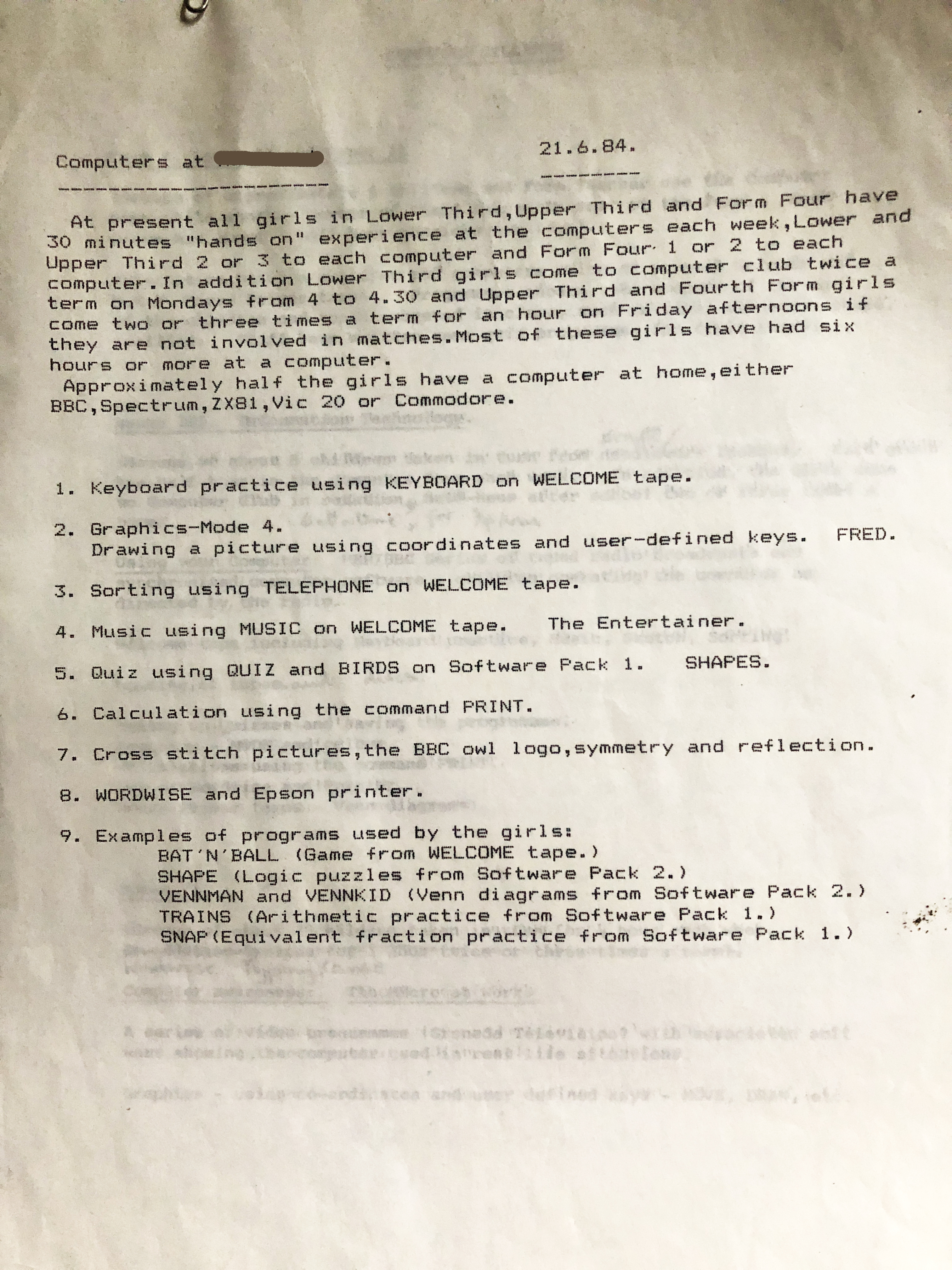
I’m sharing it here, because for me it reminds me of four very important things:
- There is actually a long history of computer learning (and the use of digital tech for other types of learning) in schools, going back at least forty years. We should surely have learnt how to do this well in that time, and yet so many initiatives do not learn from the lessons of the past, reinvent the wheel, and make the mistakes that we made beforehand!
- My mother taught at that time in a single sex primary school, and I have no doubt (from the messages I have received from those she taught at this time) that the girls she taught gained as good a digital training as any at the time, and probably very much better than most. We need to remember therefore that initiatives to teach girls to use digital tech have also been around for a long time, and yet we still don’t seem to have learnt the lessons well aboout how to do this!
- Although my mother was a maths teacher, it is great to see that she was not only teaching the girls to use computers for maths, but also for music and writing, and that she was using quizzes and games in her teaching.
- A final striking feature is that even back then she noted that about half of the girls had a computer at home (although I wish I knew whether this meant that it was their own computer or that they had access to a family computer). It remains essential for girls to have easy access to digital tech outside the school environment if they are to be able to use it effectively for their learning.
I hope others find this re-discovery as exciting as I do! The mention of BBC, Spectrum, ZXB1, Vic 20 and Commodore computers brings back so many memories of the early days of using computers in schools (and indeed in universities) at the time.
 First, the term EdTech places the emphasis on the technology rather than the educational and learning outcomes. Far too many initiatives that have sought to introduce technology systematically into education have failed because they have focused on the technology rather than on the the education. The use of the term EdTech therefore places emphasis on a failed way of thinking. Technology will only be of benefit for poor and marginalized people if it is used to deliver real learning outcomes, and this is the core intended outcome of any initiative. It is the learning that matters, rather than the technology.
 Second, it implies that there is such a thing as Educational Technology. The reality is that most technology that is used in schools or for education more widely has very little to do specifically with education or learning. Word processing and presentational software, spreadsheets, and networking software are nothing specifically to do with education, although they are usually what is taught to teachers in terms of IT skills! Such software is, after all, usually called Office software, as in Microsoft Office, or Open Office. Likewise, on the hardware side, computers, mobile phones and electronic whiteboards are not specifically educational but are rather more general pieces of technology that companies produce to generate a profit. Learning content, be it open or proprietary, is perhaps the nearest specifically educational technology that there is, but people rarely even think of this when they use the term EdTech!
 Third, it is fascinating to consider why the term EdTech has been introduced to replace others such as e-learning or ICT for education (ICT4E) which clearly place the emphasis on the learning and the education. The main reason for this is that the terminology largely reflects the interests of private sector technology companies, and especially those from the US. The interests underlying the terminology are a fundamental part of the problem. EdTech is being used and sold as a concept primarily so that companies can sell technology that has little specifically to do with education, and indeed so that researchers can be funded to study its impact!
 It is with very great sadness that I have recently learnt of Til Schönherr’s untimely and sudden death. Til was project manager for eLearning strategy, media-didactic advice and training at



 Tim Unwin's Blog