Tag Archives: Ethics

Go and ogle in Southampton and beyond…

Having just posted my last reflection on “Go, ogle”, I was in Southampton on Sunday and there it was – “Ogle Road”! This must be where the Google camera van/car/snowmobile/tricycles hang out when it’s dark and they cannot take the photos that their ‘masters’ want.

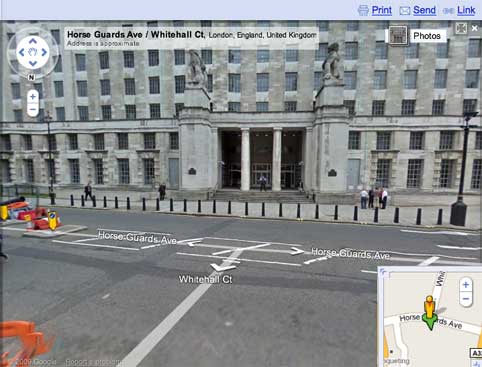
It did, though, also make me reflect further on the ethical issues surrounding Google’s Street View ‘technology’.  Much has already been written about this, but with the advent of Google’s 4th generation cameras that take near-HD quality images, and continuing debate in the EU about privacy issues associated with Street View,  for which we should all be grateful, it is worth once again highlighting some of the issues that this raises.

A recent report by Claudia Rach for Bloomberg Businessweek has some interesting comments from Michael Jones, Google’s chief technology advocate and founder of Google Earth:

  • “I think we would consider whether we want to drive through Europe again, because it would make the expense so draining”
  • “I think that privacy is more important than technology but for privacy people it is only about privacy but for us it is also about technology”

The first of these was partly in response to the suggestion that Google should only keep unblurred images for 6 months instead of a year.  Again, quoting from Rach’s report, Peter Fleischer, a Google lawyer in charge of privacy issues, said  “The need to retain the unblurred images is legitimate and justified — to ensure the quality and accuracy of our maps, to improve our ability to rectify mistakes in blurring, as well as to use the data we have collected to build better maps products for our users”.  This means that Google keep all this information unblurred on their servers – which, of course, means that Google and its relevant employees have access to it.  What happens when someone hacks into this information, or a government asks for it in connection with some important state ‘need’?

Jones’ second comment above is indeed surprising.  There is little evidence that Google has ever put privacy above technology.  Its technological prowess has been at the forefront of raising new ethical questions – one of which is indeed about privacy.

So, just to add to the debate, I thought I would come up with a list of ten interesting uses for Street View:

  • for car thieves wanting to plan where to steal particular brands of car to order – just look on people’s drives
  • for double glazing companies (or for that matter firms offering to redo your drive) to target individual houses that might be ripe for marketing – individualised targeted mailings

  • for revolutionaries (or what governments in capitalist countries call ‘terrorists’) to decide where best to plant explosive devices to cause maximum damage
  • for people wanting to reconstruct buildings on streets that have been destroyed by earthquakes (or other such disasters) – you can see how it looked a year ago
  • for burglars wanting to find the quickest getaway having robbed a property (see Phil Muncaster’s summary on v3.co.uk)
  • for recognising what your friends were doing when the Google car passed – yes, of course you can recognise people even with their faces blurred
  • for checking out those naked sunbathers

  • for finding exactly what that pub that your friends took you to last night looks like in the daylight when you can’t remember where it is
  • for checking out what the holiday villa you are thinking of booking really looks like
  • and as findaproperty says, “With the panoramic street level photographs you can get a feel for the property, its location and neighbourhood, before visiting it – which saves you a lot of time and means you don’t have to decided whether you want to view a property based solely on the description of the area as provided by the estate agents” – ah, isn’t that nice…
1 Comment

Filed under Ethics, Photographs

Google tracking

Why have I never noticed before that Google is really “Go, Ogle” – meaning “Go, stare at impertinently”?

In this context, the following report by Andrew Orlowski in yesterday’s The Register makes interesting reading:

“Google’s roving Street View spycam may blur your face, but it’s got your number. The Street View service is under fire in Germany for scanning private WLAN networks, and recording users’ unique Mac (Media Access Control) addresses, as the car trundles along. Germany’s Federal Commissioner for Data Protection Peter Schaar says he’s “horrified” by the discovery. “I am appalled… I call upon Google to delete previously unlawfully collected personal data on the wireless network immediately and stop the rides for Street View,” according to German broadcaster ARD. Spooks have long desired the ability to cross reference the Mac address of a user’s connection with their real identity and virtual identity, such as their Gmail or Facebook account. Other companies have logged broadcasting WLAN networks and published the information. By contrast Google has not published the WLAN map, or Street View in Germany; Google hopes to launch the service by the end of the year. But Google’s uniquely cavalier approach to privacy, and its potential ability to cross reference the information raises additional concerns. Google CEO Eric Schmidt recently said internet users shouldn’t worry about privacy unless they have something to hide. And when there’s nowhere left to hide…?”.

I have cautioned elsewhere about the implications of Google’s approach to digital information, and the enormous power that this gives the company.  This is yet another example of the lack of transparency, and the secrecy underlying Google’s approach to accessing information about individuals. It may well not be illegal for Google to access Mac addresses – but if the above report is true it raises fundamental questions about Google’s approach to ethics.

I have for a long time refused to have a Gmail account – and try to ensure that they have as little of my data as possible.  Perhaps the time has come for us to launch a global campaign to boycott Google?  How much ogling can we all stand? The trouble is that their search engine is really quite good!

2 Comments

Filed under Ethics

Digital databases and political campaigning

Those addicted to the potential benefits of digital databases, identity cards and biometric passports, often berate me for my concerns about  the ethical implications of the introduction of such technologies (see for example, the comments of “James Bond” in response to my blog on the Indian census).

Today’s report in the Sunday Times that the ruling Labour party in Britain has sent personalised cards to cancer sufferers, warning them of the implications of a Conservative victory in the election on May 6th should serve as a salutary reminder.  This is how it was reported:

“LABOUR has become embroiled in a row about the use of personal data after sending cancer patients alarmist mailshots saying their lives could be at risk under a Conservative government. Cards addressed to sufferers by name warn that a Labour guarantee to see a cancer specialist within two weeks would be scrapped by the Tories. Labour claims the Conservatives would also do away with the right to be treated within 18 weeks. Cancer patients who received the personalised cards, sent with a message from a breast cancer survivor praising her treatment under Labour, said they were “disgusted and shocked”, and feared that the party may have had access to confidential health data. Labour sources deny that the party has used any confidential information. However, the sources admit that, in line with other political parties, it uses socio-demographic research that is commercially and publicly available. The postal campaign started last month before the general election was called. This is the first election in which parties have been able to use internet databases and digital printing to personalise their mailshots. Labour has sent out 250,000 “cancer” postcards, each addressed to an individual, asking: “Are the Tories a change you can afford?” Many of those receiving the cards have undergone cancer scans or treatment within the past five years.”

Of course there are real benefits of digital technologies, but we do need to reflect very carefully on who has access to personalised digital records, and on how such information is used.

Leave a comment

Filed under Ethics, ICT4D, Politics

Indian biometric census – beware of the dangers!

India’s 15th census has just been launched (Times of India, newsy.com video), with the physical count of people due to take place from 9th-28th February 2011.  Over the next year, some 2.5 million census officials will be visiting households across the country, to begin the process of recording information about them.

What is unusual about this census, though, is that every person over the age of 15 will be photographed and will also have all of their fingers fingerprinted, so as to create a national biometric database, information from which will be used to issue identity cards.  The first 16-digit identity number will be issued starting in November 2010 by the Unique Identification Authority, a new state department.

The first person to be listed was President Pratibha Patil, who according to the BBC, “appealed to fellow Indians to follow her example ‘for the good of the nation’.  ‘Everyone must participate and make it successful’, she said in Delhi”.

The government expects this to bring real benefits.  As the Times commented in July 2009, “It is hoped that the ID scheme will close … bureaucratic black holes while also fighting corruption. It may also be put to more controversial ends, such as the identification of illegal immigrants and tackling terrorism. A computer chip in each card will contain personal data and proof of identity, such as fingerprint or iris scans. Criminal records and credit histories may also be included”.

This is deeply worrying, and as with other such schemes fundamentally changes the relationship between citizens and the state. Interestingly, the initiative is being headed up by Nandan Milekani, the co-founder and former CEO of Infosys, who according to the Times has said that “we have the opportunity to give every Indian citizen, for the first time, a unique identity. We can transform the country”. Does he not realise that every Indian citizen already has a unique, and very special identity – in themselves?

Just because it is possible to do this, does not mean it is right to do so.  Not only are there profound ethical concerns about states creating databases of the biometric data of citizens, but there are also real practical problems. The opportunities for identity theft on a massive scale are very real, and should not be underestimated.  More worryingly, though, is the point that this changes the balance of power between individuals and the state, very much in favour of the latter.  If governments change, and people lose trust in them – as often happens – imagine what such governments might do with biometric data on all their citizens.  Imagine if Hitler or Stalin had had access to the biometric identities of all of the people living in Germany and Russia?  Imagine if the USA gained access to biometric data of everyone in the world?

The real winners in the promulgation of such digital initiatives are the companies who promote, design and manage them!  It is no coincidence that it is the co-founder of Infosys who is now chairperson of the Unique Identification Authority of India! Mind you, another group of people who will benefit hugely from the introduction of such technology will be those who make fake fingerprints for sticking onto your fingers – or even the plastic surgeons who alter fingerprints, as in the case of the Chinese woman who entered Japan illegally after having had her fingerprints altered…

5 Comments

Filed under Ethics, ICT4D, Politics

‘Collective’ reflections on plagiarism and the production of knowledges

ICT4D BookParticipating today in a very interesting seminar organised by COPE (Committee on Publication Ethics) at Woburn House in London, made me reflect on actually why plagiarism is becoming such a ‘problem’, and on ways in which we might create alternative ideas about this.

The first question I wish to raise is whether ‘scientific ideas’ or ‘individual careers’ matter most?  As a starting point, let me suggest that actually it should be the ideas that are of most importance.  Yet, we always tend to associate ideas with people – hence, we have Nobel prizewinners who are individuals. It is authors’ names that are on articles.

But following my logic, if it is the ideas that are of most importance, then perhaps plagiarism actually becomes less of a ‘problem’.  Plagiarism is generally seen as the passing off of someone else’s ideas as being one’s own.  So, if we do not attribute ideas to people, but let the ideas in a sense speak for themselves, and make them available for public scrutiny through for example the Web, then the ideas that are deemed to be of most importance might, in a sense, float to the top by popular choice.

This is particularly important right now.  In the UK (as in many other countries) governments fund universities – both directly and through research councils.  Governments, very literally, pay academics to produce knowledge.  So, a case could be made for this knowledge to be ‘published’ under the government’s or research council’s ‘name’.  Imagine a world where there were no author(s)’s names on published articles.  Journal articles would just be known by their titles and the funding source.  Would not this be more open and honest?

What does the individual author’s name matter – other than for their own personal careers?  In a world where knowledge has increasingly become a commodity, where individual academic careers depend largely on publication records, where departmental and institutional reputations and thus funding rest on publications and grants, it is of course essential that authors are named.  That is why plagiarism is so important an issue. But if we want to fragment this system, if we believe in knowledge as something so much more valuable than a commodity, if we wish to make this freely available – if we want to be a little less selfish about our own careers – then perhaps, there is some value in my proposal.

After all, as one of my former PhD students regularly reminds me, where do our ideas actually come from?  We can never cite all of the influences on our writing.  I am quite sure that the inspirational lectures that I listened to as an undergraduate in one of the best universities in the world have influenced my subsequent writing.  The beggars I met on the street in Bihar have also influenced my ideas.  I am ashamed that I do not always cite them as influences on my writing – although I do indeed try to mention them in my acknowledgements.  In a sense, almost all of our written work is indeed plagiarised…

3 Comments

Filed under Ethics, Higher Education

Further reflections on the refereeing process

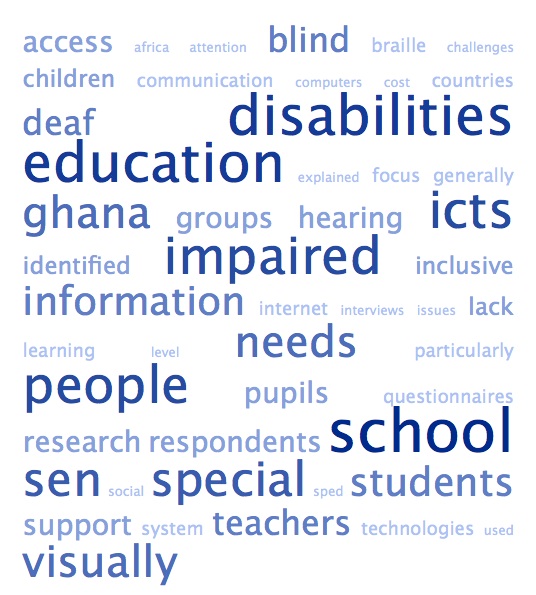
Not so long ago, I wrote about some of the issues associated with peer reviewing of research grant proposals.  This morning, I received editorial comments on one of my recently submitted papers – four sets of comments were broadly supportive, usefully recommending changes that would improve the paper.  However, a fifth referee clearly had not understood the purpose of the paper, which was a largely qualitative analysis of ICTs and disability in Ghana.  This is what the referee wrote:

“The paper lacks a profound research method & data analysis techniques.
In order to improve the paper I suggest:
-You develop taxonomy of the various possible factors (drivers, benefits, barriers, pitfalls) related to:
ICT & Special Education Needs in Developing Country Settings.
-Make a thorough field study grounded by previously derived taxonomy
-Use statistical analysis to determine the correlations between the taxonomies & derive the hypothesis for the study. Or use grounded theory analysis if you are interested more in the phenomenon rather than the correlations.
For the time being the paper findings are scattered and cannot be granted as validated or evenaccurate or complete.
Therefore the paper is not ready yet for publishing”.

OK – at one level, I accept that there are indeed different approaches to intellectual enquiry, but it seems quite clear that this referee fails to see the value of qualitative approaches, and is seeking to impose one particular view of the research process.

At least the other referees found something that they liked in the paper:

  • “This article addresses a particularly important issue very well. The authors understand the problem deeply and support their case with relevant evidence and clear writing.”
  • “This manuscript addresses an important and inadequately addressed topic. Data presented is valuable in informing programs and policy needs related to ICT for people with disabilities in educational settings in Ghana and other low-resource communities.”

I am tempted entirely to give up sending papers to academic journals – let’s face it, few people read them anyway – and instead simply put out material on the Internet and see what readers themselves make of them!

At the very least, I will try in future to submit papers to journals where I have greater faith in the quality of the refereeing process!

———————————————

Following correspondence with the journal’s Editor in Chief, I am delighted to say that my co-author and I are resubmitting our paper, and will include with this a commentary of exactly what we think of the referee’s comments above. Let’s see what happens!

7 Comments

Filed under Ethics, Higher Education

Dumbing down in UK higher education – what’s new?

Three Appeal Court judges ruled on 24th February that Paul Buckland, a professor at Bournemouth University, who resigned in 2007 in a row over the alleged dumbing down of degrees, was treated unfairly.  In essence, Professor Buckland had given fail marks to a number of students, whose papers were subsequently remarked and permitted to pass (for a detailed summary of the case, see the University and College Union News). He had complained, and subsequently resigned as a result of the university’s investigatory process.  As UCU general secretary, Sally Hunt, said: “This is an important victory for everyone who values high standards and probity in our universities. Dr Buckland’s defence of academic standards and examination procedures must be congratulated. However, we are deeply concerned about the events that led to this tribunal. Staff need the confidence to be forthright and honest in their comments and assessment of work”.

This is an important and personal case, but what surprises me most about it is that few people or reports seem to have picked up on the fundamental underlying issue, which is that universities across the country have indeed been manipulating the degrees they have been awarding in recent years to give higher marks.  According to the then Department for Children, Schools and Families, between 1994/5 and 2005/6 the percentage of first class and upper second class degrees in HE institutions in the UK increased from 47% of all first degrees awarded to 56%. The latest HESA figures show that this percentage had risen to 62% in 2008/9.

Universities, just like schools, are subject to league tables, and one of the criteria they are frequently  judged by is the percentage of students getting good honours degrees, usually defined as upper seconds and firsts.  Is it therefore surprising that universities have sought means to maximise this figure as they compete in an increasingly competitive market?  Moreover, it is perfectly possible to manipulate the percentages of good degrees gained, even without any changes in the actual rigour of the marking. Typical of such ways are the following:

  • changing the mechanisms for awarding degree grades by, for example, ignoring the worst 20% of marks given
  • discounting the first year exam marks, when students often do worst as they get used to the university system
  • reducing the amount contributed by terminal exams to the overall assessment, and increasing the amount of coursework at which most students usually do better

There is also some evidence that actual marking is becoming more lenient, as universities seek to encourage more diverse expressions and interpretations in response to assignments that are set.  This was the issue that gave rise to the original disagreement at Bournemouth. Attention paid to the quality of written expression has, in many institutions, declined, and it is therefore scarcely surprising that employers regularly complain about the quality of these skills in apparently highly qualified graduates!  The nature of assignments has also in many instances changed to make them easier.  Typical of this is the expectation of what is required for an undergraduate research dissertation.  Years ago, it was expected that students would spend most of the summer vacation between their second and third years undertaking their dissertations – and I indeed still expect a substantial amount of empirical work to be done for a dissertation to gain a good mark.  However, on more than one occasion colleagues have berated me saying that this is completely unreasonable, because students have to gain paid employment over the summer to cover their fees, and that I should therefore be willing to accept what I consider to be paltry amounts of empirical work.

The situation is at least as bad in many Master’s degrees, especially where foreign students are concerned.  Many universities rely heavily on the financial income derived from fees paid by foreign students.  Despite the requirements imposed on such students to have high language scores as tested, for example, by the International English Language Testing System (IELTS), the reality is that many such students do not have sufficient language abilities to perform at a high level in written terminal examinations.  Many Master’s degrees which in the past were assessed by terminal examinations that required a high degree of competency in academic writing in English, are now being assessed purely by course assignments, and even in some cases largely by oral presentations!  As is well know, anyone who can use a word processor with  grammar and spelling checkers can produce a half-competent piece of written work, even when their ability to do so without such support is very much less!  The assessment requirements are less challenging, and therefore the pass rates remain high.  Universities are too desperate for the fees that such students bring in that they cannot be seen to be failing large numbers of them; the assessment system therefore has to change to accommodate the financial realities.

To make matters even worse, this percentage increase in ‘good degrees’ is taking place at a time when many universities have reduced the amount of time academic staff actually spend teaching students so that they are able instead to concentrate on research.  Across the country, class sizes have gone up, there are fewer and fewer personal or group tutorials, and undergraduates have less and less contact with academics!

This is of course not to deny that many students work incredibly hard, and get the good degrees that they deserve.  However, it is to claim that university degrees taken as a whole have seen very considerable dumbing down in recent years.  There is nothing extraordinary or surprising about this.  Universities do have some clever people working for them, and in a competitive market place where they are being judged in part on the number of ‘good degrees’ that they award, some of them are bound to find ways of manipulating the system!  There is nothing new in this.

2 Comments

Filed under Education, Higher Education

ICTs, Citizens and the State – seminar at Michigan State University

Thanks to colleagues in the Telecommunication, Information Studies and Media Department at Michigan State University for their valuable critique of some of my thoughts on the ethical dimensions of e-government initiatives following my seminar there today.  My paper examined the moral implications of the use of ICTs in e-government initiatives, focusing especially on national databases, identity cards and surveillance technologies.  It suggested that in resolving debates over these, we need to reach ethical resolutions concerning notions of trust, privacy and the law.  I also drew attention to the ethical problems that emerge in linking the notion of Universal Human Rights with the introduction of ICTs in developing countries.

In terms of general conclusions, the following seem particularly pertinent:

  1. First, there are indeed many complex ethical aspects associated with e-government, and while to date the emphasis among governments of developing countries, international agencies and donors has very largely been on their positive practical benefits, I suggest that we need to pay much more thorough attention  to their ethical grounding, and especially to the balance of rights and interests between citizens and the state.
  2. Second, in so doing, I suggest that three areas warrant particular attention, namely the ethics of trust, privacy and the law.   It is here that Geuss’s (2008) emphasis on existing real political contexts, rather than the imposition of some external ideal ethical solution, needs to reiterated.  The fundamental point I wish to emphasise is that in each country where e-government initiatives are introduced, people need to ask about the rights and wrongs of such proposals in terms of existing ethical understandings of trust, privacy and the law.
  3. I also sought to raise fundamental questions concerning the continuing validity of much of the human rights based policy and legislation that has dominated global agendas during the last 50 years – particularly in the context of e-government initiatives, and their implication for the rights of individuals and the responsibilities of states.  We need to open up for sensible debate the value of the emphasis placed on human rights, criticism of which is all too often seen as being politically incorrect and a taboo subject. However, if people do not actually have ‘rights’ that they can give up to a state, then we need to reconsider the whole edifice upon which such arguments are built.  An idealistic belief that people have universal rights has not been any protection for those who have suffered at the hands of those who do not believe in such rights.  There is therefore a strong argument that we need to shift the balance away from rights, and towards the responsibilities that people and states have for each other.  For example, rather than simply claiming that knowledge is some kind of human right, it might be a much more positive step to argue that states have a responsibility to enable their citizens to gain knowledge.
  4. Capurro (2007) has argued that ‘Western’ concepts of individual privacy are very different from the ‘African’ emphasis on communal traditions.  It may well therefore be that many of the existing models of e-government developed around European and north America notions of individual privacy are inappropriate in an African or Asian context, and that instead Africans and Asians should instead be designing new such initiatives around their own traditions and cultural practices
  5. Whatever the benefits to states, individuals and communities of e-government initiatives, there is no doubt that global corporations developing the hardware and software for such systems have been very great beneficiaries.  One of the difficult ethical questions that arise from this concerns how we judge whether it is better for poor and marginalised communities for such e-government initiatives to have been introduced, or whether they might actually be more advantaged if their governments did not spend vast sums of money on their implementation.  Just because it is possible to implement national citizen databases, to use biodata for ID cards, and to introduce sophisticated digital surveillance mechanisms does not mean that it is right to do so.

2 Comments

Filed under Africa, Ethics, ICT4D, My Lectures

Peer review – implications of ‘corruption’

Two separate events that occurred at the start of this month have made me reflect once again on the many myths surrounding the ‘hallowed’ peer review process on which so much academic credibility is seen to lie.

First, I received an e-mail from a friend for whom I had written a reference in connection with a grant application that they had submitted to one of the UK’s Research Councils.  They had received the disappointing news that despite two strong references, a third referee had been highly critical of the proposal, casting aspersions on their professional expertise and on the quality of the proposed research.  I was appalled by this.  The research proposal was one of the best I have recently read, and from what the Research Council said of the comments of the ‘third’ referee, they seemed to me to be completely inappropriate.  Either the referee was ignorant of the research field, or they had vested interests in ensuring that this research was not funded.

By coincidence, at about the same time, the BBC picked up on an open letter sent by a group of scientists last July that also criticised the traditional peer review process, but this time with respect to journal articles.  As the BBC Science Correspondent Pallab Ghosh commented, “Stem cell experts say they believe a small group of scientists is effectively vetoing high quality science from publication in journals. In some cases they say it might be done to deliberately stifle research that is in competition with their own”. The 14 scientists had written that “Stem cell biology is highly topical and is attracting great interest not only within the research community but also from politicians, patient groups and the general public. However, the standard of publications in the field is very variable. Papers that are scientifically flawed or comprise only modest technical increments often attract undue profile. At the same time publication of truly original findings may be delayed or rejected”.  To try to overcome this, they proposed that “when a paper is published, the reviews, response to reviews and associated editorial correspondence could be provided as Supplementary Information, while preserving anonymity of the referees”.

Peer review is one of the fundamental principles upon which the edifice of academic reputation – and financial reward – is based.  However, the system is inherently  flawed, and I find it somewhat surprising that it still retains such power.  Six issues warrant particular consideration:

  • First, peer review is based on a belief that ‘science’ is in some way value free; that individual prejudice, political beliefs, or social agendas have no effect on academics’ judgements as to the quality of research.  Whilst many academics do indeed try to reach impartial judgements about the quality of work that they review, they undoubtedly bring biases to such judgements as a result of their own lives and research practices.  Moreover, editors of journals and Research Council panels exercise immense power through their choices of whom to ask to act as referees for papers or grant applications.  Science is not, and never has been, value free.
  • Academic status is in part based upon the number of citations a paper receives.  Academics thus seek to publish in the most prestigious journals that have high citation indexes.  For a very long time, cartels of academics have therefore operated, deliberately citing each other’s works so as mutually to raise their profiles and status. Academics are only human, and it is scarcely surprising that they operate in this way.  There is nothing exceptional about this.  Some of us may not think it right, but it happens.
  • One way that new ideas can begin to find voice is through the creation of new journals.  However, these take time to become established, and when status relies so much on having papers published in the most prestigious journals, it remains very difficult for new approaches and ideas to find widespread expression in this way; rarely do the most eminent academics deliberately choose to publish in new and ‘unimportant’ journals!
  • Those who run the major journals and sit on grant-giving Research Council Boards have immense power, and most do their very best to be fair in the judgements that they reach.  However, by definition, the peer review system is designed more to endorse existing approaches to intellectual enquiry, rather than to encourage innovative research.
  • None of this would matter particularly, and could merely be dismissed as irrelevant academic posturing, if there was not so much money involved.  Academic prestige and income depend fundamentally on success in publications and grant applications.  The UK’s Research Councils thus invest some £2.8 billion annually in support of research, and it is crucial that this is dispersed wisely.  It is therefore extremely sad – albeit typical – that in the case of my friend who had their grant application rejected, there was no right of appeal against the decision.  Panel chairs and editors must have the guts to stand up and recognise when they see flawed decisions being made by referees.  It is thus extremely encouraging to see that some Research Councils, notably EPSRC, are trying to create exciting new ways to support research that do not place excessive emphasis on traditional peer review processes.
  • Finally, there is now a good case for exploring alternative ways of judging research ‘quality’.  ‘Publishing’ papers openly on freely available websites, and then assessing their quality by the number of ‘hits’ that they get would, for example, be a rather more democratic process than that through which a small number of ’eminent’ academics judge their peers.  Of course this would be as open to abuse as existing systems, but at least it would present an alternative viewpoint.

We must debunk the myth that there is something ‘pure’ or ‘objective’ about academic peer review.  It is a social process, just like any other social process.  It has strengths and weaknesses.  For long, it has served the academic community well.  However, as the 14 stem biologists who raised the lid of Pandora’s Box implied, it is a system that fails to encourage the most original research, and instead supports the system that gave rise to it.  After all, that is not so surprising, is it?

5 Comments

Filed under Higher Education

Google Dashboard

Readers of my Blog will be well aware of my previous criticisms of the company’s ambitions to gather all of the world’s knowledge on its servers, and my concerns over its infringement of traditional ideas about privacy.

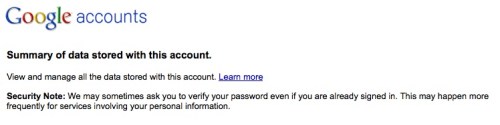
It is therefore of considerable interest that Google has just launched Dashboard.  This is intended to provide users of Google services with a summary of all the information that Google currently lets users know that it stores about them.  This is what Google Dashboard shows when you visit the site:

googleAlways having refused to have a Gmail account, and limiting my use of Google, because I do not want the company to benefit too much from the information that they have about me (yes, of course, I use Google as a search engine  – albeit as little as possible – check out Cuil), I am delighted to see this limited opening up of their secrecy.  But just imagine, they will now be checking up on those who use Dashboard, and how they use it!

Google themselves claim under a heading Transparency and Choice that “At Google, we are keenly aware of the trust you place in us and our responsibility to protect your privacy. As part of this responsibility, we let you know what information we collect when you use our products and services, why we collect it and how we use it to improve your experience. The Privacy Center was created to provide you with easy-to-understand information about our products and policies to help you make more informed choices about which products you use, how to use them, and what information you provide to us”.

Brian Heater on PCMag comments as follows: “That whole ‘don’t be evil’ thing is all well and good, but when a company’s whole goal is cataloging the world’s information, it would–at the very least–be nice to know what Google knows about you. The company has just launched Dashboard, which aggregates the different information its gathered from 20 different Google products, including Gmail, Calendar, Docs, Web History, Orkut, YouTube, Picasa, Talk, Reader, Alerts, and Latitude. You’ll need to sign in to view your own personal information. Users can also edit account information from the page, such as privacy settings. Of course transparency doesn’t mean that you can’t still pat yourself on the back. The scale and level of detail of the Dashboard is unprecedented, and we’re delighted to be the first Internet company to offer this–and we hope it will become the standard,” Google said in a statement”.

So, will this actually make users realise exactly how much information and power they are giving Google, or will they consider that the benefits that they get from using Google’s services are worth it?  Google’s financial success has been based on persuading people to give them information for free from which they can then generate huge revenue. This has undoubtedly been one of the biggest business success stories – or cons, depending on how one looks at it – in recent years.  I watch with interest to see whether Google Dashboard will indeed persuade users that the company is as ‘innocent’ as it would like to appear to be.

1 Comment

Filed under Ethics, ICT4D