

Tag Archives: Google

Google tracking

Why have I never noticed before that Google is really “Go, Ogle” – meaning “Go, stare at impertinently”?

In this context, the following report by Andrew Orlowski in yesterday’s The Register makes interesting reading:

“Google’s roving Street View spycam may blur your face, but it’s got your number. The Street View service is under fire in Germany for scanning private WLAN networks, and recording users’ unique Mac (Media Access Control) addresses, as the car trundles along. Germany’s Federal Commissioner for Data Protection Peter Schaar says he’s “horrified” by the discovery. “I am appalled… I call upon Google to delete previously unlawfully collected personal data on the wireless network immediately and stop the rides for Street View,” according to German broadcaster ARD. Spooks have long desired the ability to cross reference the Mac address of a user’s connection with their real identity and virtual identity, such as their Gmail or Facebook account. Other companies have logged broadcasting WLAN networks and published the information. By contrast Google has not published the WLAN map, or Street View in Germany; Google hopes to launch the service by the end of the year. But Google’s uniquely cavalier approach to privacy, and its potential ability to cross reference the information raises additional concerns. Google CEO Eric Schmidt recently said internet users shouldn’t worry about privacy unless they have something to hide. And when there’s nowhere left to hide…?”.

I have cautioned elsewhere about the implications of Google’s approach to digital information, and the enormous power that this gives the company.  This is yet another example of the lack of transparency, and the secrecy underlying Google’s approach to accessing information about individuals. It may well not be illegal for Google to access Mac addresses – but if the above report is true it raises fundamental questions about Google’s approach to ethics.

I have for a long time refused to have a Gmail account – and try to ensure that they have as little of my data as possible.  Perhaps the time has come for us to launch a global campaign to boycott Google?  How much ogling can we all stand? The trouble is that their search engine is really quite good!
2 Comments

Filed under Ethics

Google publishes details of requests from governments

Google has just published some fascinating data, and a map, showing the numbers of requests from government agencies around the world to remove content from its services, or to provide information about users of its services and products.

According to this, the highest numbers of requests for removals of data between July and December 2009 were from:

  • Brazil 291
  • Germany 188
  • India 142
  • USA 123

Similarly, the highest numbers of data requests were from:

  • Brazil 3663
  • United States 3580
  • United Kingdom 1166
  • India 1061

I was surprised by the high figures for Brazil, but as Google note “For Brazil and India, government requests for content removal are high relative to other countries in part because of the popularity of our social networking website, orkut. The majority of the Brazilian and Indian requests for removal of content from orkut relate to alleged impersonation or defamation”.  Likewise, in commenting on the high figures for Germany, Google comment that “A substantial number of the German removals resulted from court orders that relate to defamation in search results”.

Interesting observations indeed!  It is good to see Google becoming more transparent in such matters.

1 Comment

Filed under Ethics

Google Dashboard

Readers of my Blog will be well aware of my previous criticisms of the company’s ambitions to gather all of the world’s knowledge on its servers, and my concerns over its infringement of traditional ideas about privacy.

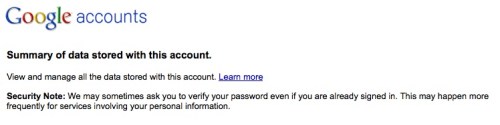
It is therefore of considerable interest that Google has just launched Dashboard.  This is intended to provide users of Google services with a summary of all the information that Google currently lets users know that it stores about them.  This is what Google Dashboard shows when you visit the site:

googleAlways having refused to have a Gmail account, and limiting my use of Google, because I do not want the company to benefit too much from the information that they have about me (yes, of course, I use Google as a search engine  – albeit as little as possible – check out Cuil), I am delighted to see this limited opening up of their secrecy.  But just imagine, they will now be checking up on those who use Dashboard, and how they use it!

Google themselves claim under a heading Transparency and Choice that “At Google, we are keenly aware of the trust you place in us and our responsibility to protect your privacy. As part of this responsibility, we let you know what information we collect when you use our products and services, why we collect it and how we use it to improve your experience. The Privacy Center was created to provide you with easy-to-understand information about our products and policies to help you make more informed choices about which products you use, how to use them, and what information you provide to us”.

Brian Heater on PCMag comments as follows: “That whole ‘don’t be evil’ thing is all well and good, but when a company’s whole goal is cataloging the world’s information, it would–at the very least–be nice to know what Google knows about you. The company has just launched Dashboard, which aggregates the different information its gathered from 20 different Google products, including Gmail, Calendar, Docs, Web History, Orkut, YouTube, Picasa, Talk, Reader, Alerts, and Latitude. You’ll need to sign in to view your own personal information. Users can also edit account information from the page, such as privacy settings. Of course transparency doesn’t mean that you can’t still pat yourself on the back. The scale and level of detail of the Dashboard is unprecedented, and we’re delighted to be the first Internet company to offer this–and we hope it will become the standard,” Google said in a statement”.

So, will this actually make users realise exactly how much information and power they are giving Google, or will they consider that the benefits that they get from using Google’s services are worth it?  Google’s financial success has been based on persuading people to give them information for free from which they can then generate huge revenue. This has undoubtedly been one of the biggest business success stories – or cons, depending on how one looks at it – in recent years.  I watch with interest to see whether Google Dashboard will indeed persuade users that the company is as ‘innocent’ as it would like to appear to be.

1 Comment

Filed under Ethics, ICT4D

Google books – philanthropy or piracy?

In the Observer on 30th Augsut, William Skidelsky has added a contribution to the debate about Google’s plans to create the world’s biggest online library.  As he comments “Google has already scanned 10 million books in its bid to digitise the contents of the world’s major libraries, but a copyright battle now threatens the project, with Amazon and Microsoft joining authors and publishers opposed to the scheme”.

As he points out, Google claims that they are doing this for the good of society.  However, he notes that opponents have been critical on the grounds that:

  • “First, they have questioned whether the primary responsibility for digitally archiving the world’s books should be allowed to fall to a commercial company”, and
  • “The second, related criticism is that Google’s scanning of books is actually illegal”

As he concludes, “No one knows the precise use Google will make of the intellectual property it has gained by scanning the world’s library books, and the truth, as Gleick points out, is that the company probably doesn’t even know itself. But what is certain is that, in some way or another, Google’s entrance into digital bookselling will have a significant impact on the book world in years to come”.

See also

Leave a comment

Filed under Ethics, Higher Education, ICT4D

Google and privacy

A BBC report raises concerns about privacy issues associated with Google’s new tracking service, Latitude.  This uses data from mobile phone masts, GPS, or wi-fi hardware to update a user’s location automatically.  Although it is an opt-in service, there are fears that not everyone may know that their phone is broadcasting their location.

There is, though, huge potential for such a service – not just as a fun way for friends to ‘keep in touch’, but also possibly for people concerned about relatives with dementia, or others who might get ‘lost’.

As ever, Google is pushing the boundaries in terms of how society uses technology, and the ways in which that technology in turn shapes society.

1 Comment

Filed under Ethics, ICT4D general, Uncategorized