Tag Archives: ICT4D

Policy Brief on the Development Impact of ICT4D Partnerships

The Policy Brief resulting from the systematic review report by Marije Geldof, David Grimshaw, Dorothea Kleine and Tim Unwin on the development impact of ICT4D partnerships is now avalable from the R4D website (Policy Brief) and the ICT4D Collective website (Policy Brief).

This emphasises five key findings:

  1. Success is increased when detailed attention is paid to the local context and the involvement of the local community in partnership implementation.
  2. It is important for such partnerships to have clear and agreed intended development out-comes, even where constituent partners may themselves have different reasons for being involved in the partnership.
  3. Sustainability and scalability of the intended development intervention need to be built into partnership design at the very beginning.
  4. Successful partnerships are built on trust, honesty, openness, mutual understanding and respect.
  5. A supportive wider ICT environment needs to be in place, both in terms of policy and infrastructure, if such partnerships are to flourish and deliver effective development outcomes

Link to Full Systematic Review Report on ICT4D Partnerships (.pdf)

Leave a comment

Filed under Development, ICT4D

Important new report on the impact of ICT4D partnerships on development

Together with Marije Geldof, David Grimshaw and Dorothea Kleine from the ICT4D Collective, I have just completed a DFID funded systematic review on the development impact of ICT4D partnerships. This is part of the extensive programme of systematic reviews initiated recently by DFID, that draws very largely on the model of such reviews used in the medical sciences.  DFID thus emphasises that ‘Systematic reviews have been used in health, education and social policy to meet this need. Systematic reviews are a well-established and rigorous method to map the evidence base in an unbiased way as possible, assess the quality of the evidence and synthesize it. Systematic reviews can then be mediated in specific ways to make it easier for policy makers and practitioners to rapidly understand the body of evidence and use this as a strong foundation on which to base policy and practice decisions’.  Undertaking the review was both challenging and interesting, and we not only reached substantive conclusions about the role of ICT4D partnerships, but we also made considerable comments about the difficulties in undertaking rigorously defined systematic reviews on topics such as this.

Based on our review of 53 key publications in the field, we had five main substantive conclusions:

  • Success of ICT4D partnerships is increased when detailed attention is paid to the local context and the involvement of the local community in partnership implementation
  • It is important for such partnerships to have clear and agreed intended development outcomes, even where constituent partners may themselves have different reasons for being involved in the partnership
  • Sustainability and scalability of the intended development intervention need to be built into partnership design at the very beginning
  • Successful partnerships are built on trust, honesty, openness, mutual understanding and respect
  • A supportive wider ICT environment needs to be in place, both in terms of policy and infrastructure, if such partnerships are to flourish and deliver effective development outcomes

In terms of our recommendations relating to the actual systematic review methodology, we suggest that

  • When dealing with multidisciplinary issues such as this, it is crucial to retain some flexibility in search strategies, and procedures such as those often adopted in reviews of health interventions may sacrifice real understanding in the name of overly zealous adherence to claimed rigour
  • External reviewers play a crucial role in guaranteeing the quality of such reviews, and they need to be rewarded for their contributions
  • Many of the publications that we reviewed lacked a rigorous account of their research methodology, and we recommend that all funders of development related research should insist that researchers carefully document their methods in all of their publications, so that readers can judge the reliability of the findings
  • Many publications on ICT4D partnerships do not specify either what they mean by partnerships or the real development outcomes that they were pursuing.  It is therefore very difficult to identify the precise impact of partnerships on development.  It may well be that interventions that claim to have benefited from partnerships could have been delivered more effectively through other contractual arrangements

Copy of report (.pdf)

Policy brief (.pdf)

Leave a comment

Filed under Development, ICT4D

On publishing in ICT4D

During the recent ICTD2010 conference, Hari kindly brought together a group of us to discuss academic publishing in the field of ICT4D.  Each speaker was to talk for about ten minutes, directing our ‘advice’ primarily towards those who may be less experienced in academic publishing.  Whilst I absolutely love seeing, holding and smelling the first copy of one of my new books, or reading one of my new papers in an academic journal, or seeing authors that I respect referencing one of my publications in their own work, I now recognise that a system that I once admired has become fundamentally, perhaps fatally, flawed.  There is sadly much that is not really scholarly and little at all that is value free in the world of academic publishing today.  It does not foster the excellence or originality that it is  intended to achieve.  All too often it leads instead to a morass of mediocrity and replication.

Two comments in the distant past still haunt me:

  • when my first academic paper was published, a friend and colleague said “congratulations, but you don’t expect anyone will read it do you”; and
  • a senior colleague in a government department once said to me: “I don’t ever read academic papers, I get consultants to provide a short synthesis of them for me”.

The reality of academic publishing is that very few papers are ever actually read, and few people are ever influenced by what is written in journals.

Some of the most challenging problems to do with academic publishing are:

  • Academic journals are fundamentally a way to ensure professional exclusivity.  They are a means through which one group of academics excludes others from participating in their ‘mysteries’.  Thus ‘apprentices’ have to learn the rituals and obey the rules if they wish to belong to this exclusive and privileged club.
  • Because of the need for authors to obey the rules, journals all too frequently fail to promote the very innovation that is meant to be their life blood.  There is a real danger that referees or editors will reject papers that are too innovative or fail to abide by the logics and requirements of a particular journal’s editorial board.
  • Many citation cartels exist, whereby in order to boost their rankings in citation indices, academics agree to cite each other’s papers in their own works.
  • There are also real issues surrounding the dominance of the English language, and far too few journal editors or reviewers are willing to pay heed to different cultural traditions of academic writing style.  We should do much more to enable people from different linguistic backgrounds to get their papers published in the ‘top’ journals.
  • Peer review is by no means the innocent, quality control exercise it is meant to be.  Far too often academics use it as a way of preventing ideas that are contrary to their own from being published.
  • Citation indices usually only incorporate the more prestigious journals, and thus often omit the more innovative and cutting edge papers.
  • The emphasis on quantity rather than quality of publication means that vast numbers of dreadful papers are submitted to journals – and it is very frustrating for editors and referees to have to sift through the dross!

The net outcome of these is that far too many papers that are published are mediocre and tend to replicate existing knowledge.  Moreover, many of these problems have become exacerbated over the last 20 years as academic publication in ‘top’ journals has become such an important part of research assessment exercises.

I offered five key tips for less experienced academics who wish to succeed in this environment:

  • The most important tip is that one must realise that academic publishing is a game.  New academics therefore have to learn the rules and play by them – if they want to achieve success in terms that the profession’s gatekeepers have defined.  Once your career is established, then you are in a position to try to change the rules!
  • Write something that is reasonably good and then submit it to a journal.  Referees are bound to suggest revisions, and so don’t be hurt by the comments.  Use them, alongside your own developing ideas, to improve the paper and resubmit it – in most cases it will eventually be published (as long as it is reasonably good in the first place!)
  • Publish less, but publish better; focus on quality rather than quantity.  When I was head of department, I remember encouraging colleagues to make sure that they published just two or three papers a year in major journals, and a book every three to four years.
  • Remember that few people actually read academic journals. If you want your ideas to have an impact, it is therefore essential that you make them available in different formats and contexts – as, for example, through your own blog
  • Only ever agree to have your supervisor’s name as an author on the paper if she or he has actually written a substantial amount of it!  Good academics don’t need to have their names on your research – although it is always nice to recognise their advice in an acknowledgement.

Two final points are worth mentioning.  The first is that publishing in a multidisciplinary field such as ICT4D is fraught with a particular set of additional difficulties.  Where academic success is defined in large part through publication in prestigious journals, most academics seek to publish their work in their own discipline’s top-ranked  journals.  It is thus more prestigious for a computer scientist working in ICT4D to publish in a top computer science journal than in a new ICT4D journal. Those who edit cross-disciplinary journals often therefore find that the papers that are submitted to them are those that have been rejected by other more mainstream journals.  Consequently, papers published in multidisciplinary journals are often of less good quality than those in the major single disciplinary journals.  This does, though, provide editors of multidisciplinary journals with an opportunity to be innovative and creative in what and how they publish. Moreover, it is incumbent on those working in the field to support new journals that are indeed trying to break the mould of traditional academic arrogance and exclusivity.

Finally, we need to explore alternative modalities of publishing.  Those of us working in the field of ICT4D should seek to use ICTs creatively to enable multiple voices from many different backgrounds to share their research findings.  However, we still need to find appropriate business models to enable more open and free publication options to be created.  Traditionally, journal publishers have added considerable value to the publication process, not least through funding the editorial and publication process.  Such costs remain to be covered, and few ‘free’ journals have yet actually enabled high quality original academic papers to be widely disseminated. We also need to work creatively with existing publishers, since they have much to offer the publication process.

For some of my more detailed reflections on peer review see:

[For the presentations by Geoff Walsham, Cathy Urquhart and Shirin Madon as well as the full discussion see the video “Publishing ICT4D Research available from ICTD2010 videos and photos]

2 Comments

Filed under ICT4D, Postgraduate supervision, Universities

Geoff Walsham’s Keynote Address at ICTD2010

Great Keynote Address by Geoff Walsham at ICTD2010 – reminding us not only of the importance of the FOR DEVELOPMENT in ICT4D, but also that one can combine high quality scholarship with a touch of levity!  His jokes were a definite antidote to any excesses of the night before, and inspired us for the third day of ICTD2010.

This slideshow requires JavaScript.

Leave a comment

Filed under ICT4D, ictd2010, Photographs

Sir Tim Berners-Lee at ICTD2010

It was great to hear Sir Tim Berners-Lee give a Keynote Address at ICTD2010 on 14th December.  Some photographs are given below:

This slideshow requires JavaScript.

2 Comments

Filed under ICT4D, ictd2010, Photographs

The first afternoon at ICTD2010

Wow – what a great set of sessions on the first afternoon of ICTD2010 – everything from IPID’s award for the best postgraduate paper, through practical training in participatory video, to media literacy, SPIDER’s session on decision making and accountability, and a mirror of what’s been happening online!  Thanks so much to Dorothea Kleine for putting such a great programme together, and for all the team who registered delegates so swiftly – there’s even a picture below of me thanking Matthew Woodham from Facilities Management at Royal Holloway, University of London, who has been fantastic in ensuring that everything has run so smoothly.

This slideshow requires JavaScript.

Leave a comment

Filed under ICT4D, ictd2010, Photographs

On-site arrival now open for ICTD2010

The bag-packing is over, the rooms are prepared, and delegates have started to arrive at ICTD2010!  Thanks to all of the helpers who have put everything together, and especially to Sandie and Annieka for managing the registration process.  Come and get your badges, registration packs and meal tickets!

This slideshow requires JavaScript.

Leave a comment

Filed under ICT4D, ictd2010, Photographs

ICT4D Partnerships

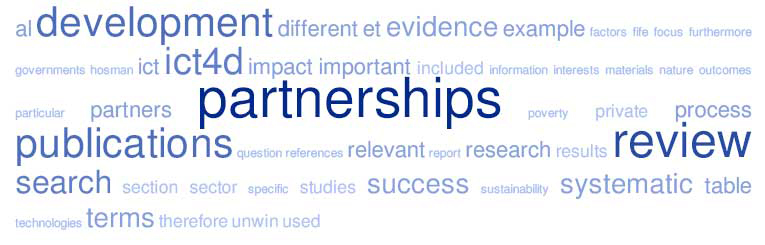
I cannot resist the fun of trying to express ICT4D ideas in different ways, and  always enjoy playing with tag clouds when I am writing.  An excuse to revisit the chapter on partnerships in my recent edited book on Information and Communication Technologies for Development, led me to generate this cloud.  I just thought I would share it as a summary statement of my thoughts on the subject of ICT4D policy and partnership!  Thanks to TagCrowd for the crunching!

Leave a comment

Filed under ICT4D

IPID Annual Conference at UPC Barcelona

The International Network for Postgraduate Students working in ICT4D (IPID) is currently (9th-10th September 2010) holding its 5th annual conference at the Universitat Politècnica de Catalunya in Barcelona. A wealth of current postgraduate research in ICT4D is being presented around the following themes:

  • gender
  • e-agriculture
  • rural communities
  • online communities
  • e-government
  • technology
  • ICT in education
  • e-health
  • entrepreneurship
  • networks

The conference is being broadcast live at http://www.canalupc.tv/media/simposium-upc-uoc .

Ismael Peña Lopez’s comprehensive blog on the conference.

Leave a comment

Filed under ICT4D, ICT4D conferences

Reflections on the Internet and Development

Just finished writing a chapter about the Internet and Development, and am surprised at the vehemence of my own conclusions:

In conclusion…

Three important and inter-related conclusions can be drawn from this short overview of research on the Internet and development.  First, it must be remembered that the Internet is but one of a number of new digital ICTs.  Whilst many have given it predominance, “Internet use has spread much less rapidly in low-income countries than other ICTs – notably broadcast radio … and television and, more recently, mobile telephony” (Souter 2007: 33).  As Souter (2007: 33) goes on to emphasise, ultimately “the potential of the Internet can only be achieved if effective access is available”, and this requires the availability of the ICT infrastructure and reliable electricity at an affordable price for the poor, and that it provides relevant information that is not available more cheaply through other means.  If the world’s poor are truly to benefit from the Internet, then far more attention needs to be paid explicitly to ways in which they can indeed use it to their real advantage, thereby enabling them to benefit at the expense of the world’s rich. Only then will relative poverty be reduced.

Second, the success of the Internet in delivering development objectives depends very much on how such objectives are defined.  Much research and practice has focused on the hegemonic notion that development is about economic growth, and there are convincing arguments that the Internet can indeed contribute to such an objective.  However, even here, it is evident that the presence of the Internet alone will not in most instances contribute to the economic well-being of the poorest and most marginalised. From a relativist perspective, focusing particularly on social equality, the evidence is far more uncertain.  Numerous studies (Huyer and Hafkin 2007), for example, show how women in patriarchal societies are increasingly marginalised by their exclusion from access to the Internet.  Likewise, if development is seen as being concerned with freedoms, then the ambivalent character of the technology of the Internet is once more revealed.

A final important characteristic of the Internet in the context of development has been its dehumanising and alienating effects.  Just as factory production in the 19th century made humans appendages of machines (Lukács 1923), so too in the 21st century has the Internet made people ever more the appendages of computers.  In so doing, users are becoming further alienated from the physical world of nature and creativity, and ever more constrained by those who design the virtual realities of which we are now part.  What is remarkable about this is that in the name of progress, such virtual worlds are accepted and applauded as being ‘good’ and where the future lies (Carr 2008). Such arguments need to be strongly countered if we are to retain the very essence of what makes us human.  By enabling people to work away from their offices, by dramatically reducing the constraints of time and space on production, consumption and exchange, the Internet has enabled owners of capital to exploit their workforces far more efficiently and effectively than ever before, whilst at the same time making them think that they are enjoying it.  Imagine a world where one was not expected to answer the hundred or so e-mails that arrive every day, and where one actually had time to think, be creative and enjoy the physical experience of being human!  Paradoxically, the poor and marginalised, those without access to the Internet, may ultimately actually be very much richer than the bankers, traders and business executives who have become the new proletariat of the digital age, quite simply because the poor without access to the Internet are not bound by its dehumanising, unspoken and constraining rules.”

I guess it is now time for me to take a digital break!

1 Comment

Filed under ICT4D