Tag Archives: ICT4D

ICTs and Urban Micro-enterprises in Mumbai

P.Vigneswara Ilvarasan and Mark Levy have just made available the final report from their exciting and innovative IDRC funded research on the use of ICTs by urban micro-enterprises in Mumbai, employing fewer than 20 hired workers.  This is one of the most important analyses of ICTs and entrepreneurs that I have recently read.  The methodology is much more rigorous than that of most research in the field of ICT4D, which means that considerable credence can be placed on the reliability of the results. Some 329 male owners or managers of micro-enterprises, and 231 female owners were interviewed between April and June 2009, and a further 102 men and women were surveyed in September and November 2009.

Whilst I might have some quibbles over definitions – surely in general usage, the term micro-enterprise is used to refer to much smaller units than those employing 20 people – this is a really excellent piece of research that deserves widespread citation.  Its key findings are:

  • “Nearly everyone who owned or managed a microenterprise—regardless of sex—had a mobile phone.
  • Many female and male microentrepreneurs who owned or managed microenterprises and who used a mobile for business communication reported that the year-over-year income of their business had risen.
  • Urban microentrepreneurs experience different levels of economic growth depending on how they use their mobiles for business communication.
  • The positive impact of mobile phones on microenterprises might emerge only after two years of use. Microentrepreneurs who owned a mobile for two years or less saw some growth in business income; those who had begun to use their mobile more than two years earlier experienced even greater income growth.
  • Levels of PC ownership and usage at home and work were low.
  • Few microentrepreneurs frequented Internet cafés for business purposes.
  • Only small numbers used their mobiles for the full range of business-enhancing activities.
  • Consideration of a microentrepreneur’s full repertoire of ICT use showed a positive relationship with microenterprise growth, especially when other factors such as gender and motivation were also taken into account.
  • Compared to women-owned microenterprises, microenterprises owned or managed by men had much greater increases in business income, although female owned microenterprises also experience some growth
  • The more positive a female microentrepreneur felt about her status and power because of her business, the more she was motivated to use ICTs in support of her business.
  • The more that a woman entrepreneur used mobile phones, workplace computers, etc., the more her microenterprise grew, especially businesses in the trade sector of the informal economy.”

Thanks Vignesh and Mark for enriching us with this important study.

2 Comments

Filed under Entrepreneurship, ICT4D

IPID annual conference: 9th-10th September in Barcelona

The IPID annual conferences have become one of the major global events for young researchers in the field of ICT4D to share their experiences.  This year’s conference is being hosted by the Open University of Catalonia and the Polytechnic University of Catalonia on 9th and 10th September 201o and will be held at the Universitat Politècnica de Catalunya in Barcelona, Spain:

1 Comment

Filed under ICT4D, ICT4D conferences

Heading to e-Learning Africa, 26th-28th May 2010

This year’s eLearning Africa takes place in Lusaka, Zambia, later this week, and promises to be a great chance to catch up with colleagues working on ICT4D!  I have been lucky enough to participate in all of the four previous eLearning Africa conferences in Ethiopia, Kenya, Ghana and Senegal, and they have always provided a useful opportunity to learn about some of the latest developments in the field.  It is particularly good to meet African academics and activists committed to using ICTs to support the aspirations of poor and marginalised people across the continent.

Thanks to all those at ICWE who have been working so hard in recent months to put on the conference – I hope it’s a great success.

Leave a comment

Filed under Africa, Higher Education, ICT4D conferences

OLPC and the East African Community

A report today by the BBC highlights that a new partnership has been established between One Laptop per Child (OLPC) and the East African Community (EAC) to deliver 30 million laptops in the region by 2015.  As the report goes on to say, the EAC first needs to raise cash for the laptops!  It also comments that “OLPC has had difficulty selling its computers and its alternative vision of education around the world”.

I find such announcements hugely worrying. There have been sufficient critiques published on the OLPC model for governments, donors, and all those involved in education to be aware of the fundamental difficulties associated with its roll out (see for example Bob Kozma‘s comments in 2007, David Hollow‘s 2009 account of their introduction in Ethiopia, Scott Kipp‘s comments in 2009, and Ivan Krstic’s devastating critique of the concept and its implementation at the UOC UNESCO Chair in e-Learning Fifth International Seminar in 2008).

Let me here highlight what I see as being some of the most important issues:

  1. Cost – 30 million laptops at $200 each amounts to $6,000 million.  Might this money not be more effectively spent in other ways, such as providing teachers in East Africa with better training, or even simply remunerating them better so that they do not have to do several jobs at once in order to support their families?
  2. Pedagogic model – is there one? OLPC has claimed to be an educational initiative, but a fundamental problem with most OLPC roll outs has been that they have not been integrated into the existing educational structures.  In the worst instances, the laptops have been given to children but not to their teachers.  The tensions that this causes are immense.
  3. Lack of Content – the OLPC vision is  “To create educational opportunities for the world’s poorest children by providing each child with a rugged, low-cost, low-power, connected laptop with content and software designed for collaborative, joyful, self-empowered learning”. The problem is that there is very little available learning content suitably designed and integrated with the curricula in the countries where the laptops are being introduced.  Simply expecting young people to be able to learn by connecting to the internet is like throwing someone into the sea and expecting them to swim.
  4. Monitoring and Evaluation – there have been too few rigorous monitoring and evaluation studies to be able to say with any certainty what the impact of these computers might be in Africa.  Surely, we should undertake high quality studies of the educational impact before spending such huge amounts of money on rolling them out?
  5. Who gets them? This is a real issue.  In many instances, the choice about where the computers are given reflects social, economic and political interests.  The sampling strategy for the roll outs needs to be thought through extremely carefully, and not just left to some enthusiastic youth volunteers (as in the OLPCorps programme – the selection of participants for which is itself highly problematic and controversial). If XO computers do have a beneficial effect, then why should only some young people (in most cases those who are already privileged in some way) benefit from them?  Will they go to the poorest and most marginalised, those who most need help in isolated rural areas?  Ethiopia alone has an estimated 9 million children out of school.  Will they receive laptops?
  6. External technology-led initiatives – most of the evidence suggests that top-down, externally-driven and technology-led initiatives are much less successful than initiatives that are explicitly designed and tailored to the needs and aspirations of the people for whom they are intended.  It is crucial that we begin with the educational needs of people in East Africa, and then identify the most cost-effective way of delivering on them. As Bob Kozma says, “Is this an education project or merely a laptop project?”.
  7. Sustainability – what happens when the first batch of computers breaks down, or becomes outdated?  Let’s be generous, and estimate that each might last five years.  Can East Africa afford another $6,000 million in five years time?  What will happen to the debris of the old computers?  How will their materials be recycled, or will they just be dumped?
  8. The technology?  There are some great things about the technical achievements in creating the OLPC XO laptops – but anecdotal evidence suggests that actually it is not quite as good and effective as is often claimed.  In particular, there have been numerous issues with the mesh networking and connectivity when actually rolled out into the rural village conditions of Africa.

So, I ask again, why does there remain such euphoria about the OLPC initiative?  Surely, the East African Community has better things to spend its money on?  If only it could find the funds to support good education effectively, that would be a start! Nicholas Negroponte is a charismatic and enthusiastic champion of OLPC, but is it not time that he recognises that his vision is fundamentally flawed? African governments have better things to do than to be beguiled into spending their limited resources on such a delusional concept.

12 Comments

Filed under Africa, Entrepreneurship, ICT4D general

Go and ogle in Southampton and beyond…

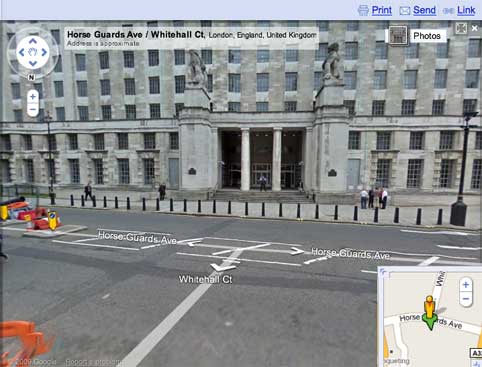
Having just posted my last reflection on “Go, ogle”, I was in Southampton on Sunday and there it was – “Ogle Road”! This must be where the Google camera van/car/snowmobile/tricycles hang out when it’s dark and they cannot take the photos that their ‘masters’ want.

It did, though, also make me reflect further on the ethical issues surrounding Google’s Street View ‘technology’.  Much has already been written about this, but with the advent of Google’s 4th generation cameras that take near-HD quality images, and continuing debate in the EU about privacy issues associated with Street View,  for which we should all be grateful, it is worth once again highlighting some of the issues that this raises.

A recent report by Claudia Rach for Bloomberg Businessweek has some interesting comments from Michael Jones, Google’s chief technology advocate and founder of Google Earth:

  • “I think we would consider whether we want to drive through Europe again, because it would make the expense so draining”
  • “I think that privacy is more important than technology but for privacy people it is only about privacy but for us it is also about technology”

The first of these was partly in response to the suggestion that Google should only keep unblurred images for 6 months instead of a year.  Again, quoting from Rach’s report, Peter Fleischer, a Google lawyer in charge of privacy issues, said  “The need to retain the unblurred images is legitimate and justified — to ensure the quality and accuracy of our maps, to improve our ability to rectify mistakes in blurring, as well as to use the data we have collected to build better maps products for our users”.  This means that Google keep all this information unblurred on their servers – which, of course, means that Google and its relevant employees have access to it.  What happens when someone hacks into this information, or a government asks for it in connection with some important state ‘need’?

Jones’ second comment above is indeed surprising.  There is little evidence that Google has ever put privacy above technology.  Its technological prowess has been at the forefront of raising new ethical questions – one of which is indeed about privacy.

So, just to add to the debate, I thought I would come up with a list of ten interesting uses for Street View:

  • for car thieves wanting to plan where to steal particular brands of car to order – just look on people’s drives
  • for double glazing companies (or for that matter firms offering to redo your drive) to target individual houses that might be ripe for marketing – individualised targeted mailings
  • for revolutionaries (or what governments in capitalist countries call ‘terrorists’) to decide where best to plant explosive devices to cause maximum damage
  • for people wanting to reconstruct buildings on streets that have been destroyed by earthquakes (or other such disasters) – you can see how it looked a year ago
  • for burglars wanting to find the quickest getaway having robbed a property (see Phil Muncaster’s summary on v3.co.uk)
  • for recognising what your friends were doing when the Google car passed – yes, of course you can recognise people even with their faces blurred
  • for checking out those naked sunbathers
  • for finding exactly what that pub that your friends took you to last night looks like in the daylight when you can’t remember where it is
  • for checking out what the holiday villa you are thinking of booking really looks like
  • and as findaproperty says, “With the panoramic street level photographs you can get a feel for the property, its location and neighbourhood, before visiting it – which saves you a lot of time and means you don’t have to decided whether you want to view a property based solely on the description of the area as provided by the estate agents” – ah, isn’t that nice…

1 Comment

Filed under Ethics, Photographs

Reflections on the effects of the Eyjafjallajökull volcanic eruption

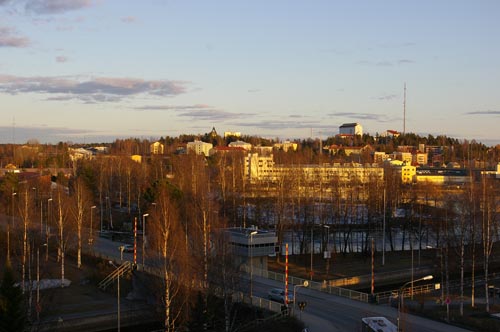
The transport disruption caused by ash from the erupting Eyjafjallajökull volcano has had enormous impact across the world, not only for economic activity but also for individual human lives.  Having been ‘stuck’ in the North Karelian town of Joensuu in eastern Finland for the last week, I have been interested and surprised by the emotional impact that this has had on me:

  • I discovered that eastern Finland is really a long way from anywhere!  Joensuu is four-and-a-half hours by train north-east from Helsinki, and almost at the same latitude as the Eyjafjallajökull volcano in Iceland!
  • Finland itself is amazingly isolated, and very much like an island.  Almost everyone who wanted to leave during the cessation of flights had to get ferries – from Turku or Helsinki to Stockholm, or from Helsinki to Tallinn.  According to travel agents, many of these were fully booked, and so it was difficult to ‘escape’.  The prospects of the Finnair offer of a 34 hour bus journey to Berlin, with two nights and a day on board, were not particularly appealing – especially when other parts of Europe seemed to be opening up their air-space. Most people who left, and took onward trains through Sweden and Denmark, or across Europe from Berlin took three or four days to get back to England!  Being in ‘mainland Europe’ would have been so much easier – a train from Prague to Madrid would, for example, have been simplicity itself compared with leaving Finland!
  • The most disturbing feature of the disruption for me was the uncertainty!  I was surprised how much not knowing when it might be possible to leave affected me – and particularly my ability to concentrate on work.  Might it be worth taking the bus to Berlin – and then the subsequent problems associated with getting a train back to the UK?  Should I go to Turku and hope for the best? When might flights start again?  Should I try to get a train to Helsinki in case the flights from there are going to be a better bet than risking a flight from Joensuu to Helsinki first?
  • It can be really lonely…  Thanks to all those friends who kept in touch on Skype, Facebook and by e-mail!
  • But I also discovered the real value of open-handed friendship.  After I had stayed a couple of extra nights in a hotel, Erkki and Päivi welcomed me into their home, and this transformed things.  Their hospitality enabled me to get on with some work (despite my difficulties in concentrating on it), and provided an enormous warmth of personal support.  They have been absolutely amazing, and I hope one day to be able to return the favour.
  • A real lesson to be learnt from this is therefore that we should all be generously open and welcoming to ‘refugees’ – from wherever they come.  Whilst it is completely inappropriate for those of us caught up in the dislocation caused by the closure of air space to draw comparisons with the experiences of political refugees, I do think I have gained a whole lot more insight into some of the anguish that they must face.
  • One can spend an age trying to rearrange flights!  Many, many calls to Finnair were ‘answered’ with a message saying that their system was overloaded – even at 05.00 in the morning!  Eventually, it took almost an hour of waiting earlier in the week to reschedule my flights for tomorrow  – but who knows now even if that will be leaving!
  • It’s therefore crucially important to take advantage of every opportunity that such chaos can afford!  It was great to visit Koli, and also to spend time participating in academic discussions and teaching at the Computer Science Department at the University of Eastern Finland – thanks for the opportunity.
  • This disruption also, though, shows the huge value of modern ICTs – the ability to hold conference calls with people in many different parts of the world, to receive e-mails (although not necessarily my ability to answer them all), to speak with loved ones ‘dislocated’ elsewhere (providing their ‘phones are charged), to find out information about the latest delays, to give a conference presentation at a distance (not easy – but see #beyond2010) and to find communal means of resolving travel problems (such as stuckineurope.com)! When the fuel runs out for ‘traditional’ air transport, life might become very much more human!

Apologies to everyone whose e-mails I have not responded to, and for the meetings I have missed!  I should have been back in the UK on the 18th – and it is now the 23rd.  Finavia this morning at last announced that “Based on the current forecasts all airports in Finland have been opened for air traffic and operate normally”, although lots of flights in Finland today have still been cancelled!  Hopefully tomorrow will improve, and I will indeed return home.  I intend to take a few days off – just to smell the late spring flowers, to taste some fine wine and to relax!

3 Comments

Filed under Ethics, Higher Education, Photographs

Unleashing the Potential: ICTs for Development

I had the privilege of being a keynote speaker at the SciFest symposium on ICT for development and learning held in association with a meeting of the Computer Science Days of the Finnish Computer Society held at the University of Joensuu on 15th April. Here is a summary of the key issues that I raised:

  • The main question I sought to address was “How can Computer Science contribute to the lives of some of  the poorest and most marginalised people in the world?”
  • Much computer science seems to be very theoretical, and practised by people who prefer to remain in their familiar institutional surroundings
  • However, for those who wish to gain new experiences, insights and intellectual challenges, working in some of the poorest countries of the world offers great opportunities
  • Unfortunately, much so-called ICT4D research and practice tends to be top-down and led by people from Europe and north America
  • All too rarely does such research really address development needs
  • As privileged academics, we ought to listen much more to the stated needs of the poorest and most marginalised in crafting our research agendas
  • The private sector is likely to enable many relatively poor people to benefit from ICTs, but the very poorest – those with disabilities and street children – need interventions by governments and civil society organisations to help them use ICTs to achieve their aspirations
  • For those computer scientists not lured by the interests of capital, there remains the wonderful challenge of working for social agendas that can make a difference – both to their own intellectual benefit, and to the benefit of the world’s poorest people

Leave a comment

Filed under Africa, ICT4D, My Lectures

ICT4D Students at World Economic Forum

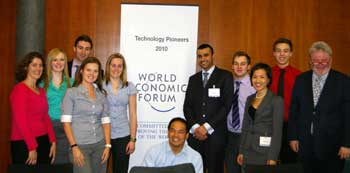
The final year undergraduate students studying ICT4D at Royal Holloway, University of London, have to do a formal presentation on some aspect of the course as part of their assessment (along with annotated bibliographies and a website – this year on Healthy Homes).

For 2010, we had the privilege of being able to convene these presentations at the World Economic Forum‘s offices in Cologny, Geneva on Thursday 8th April, on the themes of:

  • Why have mobile phones become so popular in Africa? (Alex Hamilton)
  • Education in Post-Conflict Zones: Pathways to Peace? (Helen Blamey)
  • Internet Access and Usage in Africa (Michael Hart)
  • What is really innovative about ICT4D? (James Huntley)
  • ICTs, Climate Change and Sustainable Development (Elizabeth Coulter)
  • Freeplay Energy: education and health solutions (Rickesh Patel)

Alex Wong (Senior Director, World Economic Forum), Joanna Gordon (Associate Director responsible for the ICT sector at the World Economic Forum) and Daniel Stauffacher (Chairman ICT4Peace Foundation) also gave short presentations on their work, as well as providing feedback on the student presentations.

Being in Geneva provided an opportunity to see various UN buildings in the City, and some of the group also went on a six hour walk in the vicinity of Mont Salève (down from the Télépherique du Salève, through the villages of Mounetier and Mornex, and back to Veyrier) – a great opportunity to discuss ICT4D in the French countryside!

This slideshow requires JavaScript.

Leave a comment

Filed under Higher Education, ICT4D, Photographs

ICTs and Development: workshop at IIT Delhi (Day 2)

Welcome back to the second day of the ICTs and development workshop at IIT Delhi.

We got underway with Jonathan Donner’s (Microsoft Research India) invited lead talk on The changing roles of mobile phones in development: some examples from Africa

  • Emphasised amazing growth of mobile ‘phones – but rightly noted that this is neither universal not homogenous
  • We need to focus on the people rather than the technology – M4D is the tip of an iceberg of uses that people make of mobile ‘phones
  • Uses of mobiles for agriculture: use of mobiles for ‘traditional’ extension; creating platform mobile services including new market systems such as Manobi, or lean market places such as Google Trader
  • Homegrown services: M-PESA and MXIT – low barriers to adoption, affordable and compelling relative to existing alternatives, woven into everyday life, network effects.  They do well because they are so simple.
  • Both of these offer real possibilities for scale – albeit not yet for the poorest of the poor – and do things that traditional voice cannot do
  • Importance of unintended consequences
  • We need more evidence; we need to distinguish between mobility and connectivity; and we need to take the long view
  • We should also resist the use of “M4D” as a research term so as to de-fetishise it – moving the emphasis to the people not the technology; if we keep the term, we need to focus on the “4”

MOBILES AND MICRO-ENTREPRENEURS

Parveen Pannu (University of Delhi, India) Mobiles and socio-economic life of press workers in Delhi

  • Focus on urban growth in India and the rapid adoption of mobiles, especially among informal sector workers
  • Having clothes ironed is a central part of urban middle class India – the ironing business depends a lot on personal contact and good will (but there is also a press workers union)
  • Survey of households who did ironing work: c.65% had a family mobile ‘phone; cost of ‘phones was major factor influencing price (some received them from their customers); users of mobile ‘phones earned more than non-users, but cause/effect not known; usage – 38% social, 29% work related; most calls were received from the lady of the house who arranged collection/delivery of clothes and finding new companies; 50% were not into texting SMS messages (not comfortable because of English language texting)

Ishita Shruti (IIT Delhi) Remittance behaviour and doing business among Indian rural salesmen in Cambodia

  • New ICTs have played an important role in remittances (both economic and social) – focus of this ethnographic research is on rural salesmen mostly from UP
  • Internet based ‘phone calls are the cheapest means of communicating – so people use internet cafés/’booths’
  • ‘Agents’ are used to deliver remittances – informal network enabled through ‘phone calls (social capital plays an important role in delivering remittances)
  • Mobile ‘phones have also facilitated business, enabling salesmen to interact with family but also to make decisions about their businesses

ICTs, CIVIL SOCIETY AND THE STATE

Jean-Yves Hamel (UNDP) Public interests, private costs: civil society and the use of ICTs in Timor Leste

  • Placed emphasis on the notion of freedoms and the capability approach
  • Highlighted role of FDI from Telstra – supported by UN – and subsequent problems associated with its monopoly position. Monopolies are associated with high costs of ICT provision; regulators are unable to challenge these.
  • Noted the early use of ICTs from 1994 to enable communication of civil society ‘opposition’ with the rest of world
  • Key role of deep women’s networks – links to health organisations, scholarships, women’s rights groups
  • ICTs provide an important window on the world

ICTs AND ECONOMY

Nimmi Rangaswamy (Microsoft Research India) The PC aided enterprise and recycling ICT

  • Role of ICTs in expanding small and micro-enterprises in Mumbai slums
  • ICTs can help promote skill building; business are organic and self-sustaining
  • Nice business ecology coming into play – capital, space, skills, hardware
  • Not simply assimilating technology for business, but also creating new systems and processes
  • “There is no ‘for D’ in it, because they are doing it themselves” – not sure I agree with this, surely this is itself a form of development

Jack Linchuan Qiu (Chinese University, Hong Kong) Working-class information society? Open questions about China and ICTs

  • Focused on the “information have-less”
  • Some statistics from China: internet users 2 m in 1998, but 298 m in 2008; 49% of internet users are now not college-educated – so Internet is being used much more widely across different sectors of the population
  • Private sector now accounts for more than half of urban population employment – so people have to find jobs, and this has been associated with a rapid increase in ICTs: does macro-empowermnet lead to (seemingly) micro-empowerment
  • Measuring information needs is complex; fundamental differences between information needs and wants.
  • Bottom of pyramid innovations are firstly social and only secondarily technological
  • Developing a new class analysis based on horizontal networking among workers
  • Chindia as a new path to development – a re-evaluation of labour-centred production

INTERNET AND SOCIAL CHANGE

Otgonjargal Okhidoi (Educational Channel Television, Mongolia) Can technology level the inequality in education delivery? Blended technology based education program in Mongolia

  • Mongolian democritisation and economic liberalisation created freedom for flourishing media companies, mostly for profit commercial broadcasting – mostly focus on imported programmes (soaps, sumo…)
  • Educational Channel TV began only three years ago for public sector broadcasting (4-6 hours airtime a day on academic subjects; not for profit and one of only 2 nationwide broadcasters).  Then Internet service and cellphone messaging added on to make it more interactive and provide feedback (focus of project on English language and IT)
  • 93% of total population of Mongolia names TV as the key source of information
  • Inequality of access to education and quality of content – 66% of children live outside Ulaanbatar, and are poorly served by education
  • Almost all schools have computer labs set up by donor funding, and all are connected to the Internet – but there is not much good content available.  So, they used 20 minute TV programmes and followed up with work in class on Internet. Reported that impact on knowledge acquisition was positive, and it enhanced self-learning

S. Subash (National Academy of Agricultural Research Management) Knowledge empowerment of farmers through interactive web-module on dairy innovations

  • Use of ICTs for technology transfer agricultural extension in the field of dairying focusing particularly on web-module (Haryana and Tamil Nadu case study)
  • Training in ICT centres given to farmers; needs of farmers identified and web-based learning module given to them
  • Reported that farmers in Haryana has a 16% knowledge gain as a result of the intervention, and 28% gain in Tamil Nadu – although some concerns were expressed in questions about the impact of experimental design
  • Benefits also gained by extension workers
  • Users requested more interactivity and provision of real-time information; it is important to ensure that content is regularly updated; mobile alerts for farmers should also be introduced

Murali Shanmugavelan (Panos, London) Telecentres and public spaces

  • Substantial amount of recent support for telecentres in India – but “what information is reaching what communities?”
  • How do telecentres interact with village communities – are they reinforcing or changing social structures? Study of 12 telecentres of different kind.
  • ICTs can constrain or expand public spaces (four layers of public: physical, management, human as public, and services) – communication practices can create a chaos in traditional systems
  • Key factors: location influences accessibility; telecentres specifically designed for particular underprivileged groups such as dalits are exclusionary rather than ‘public’; management layer is very influential (recruiting women increases inclusivity); type of service delivery influences usage (and real needs of excluded users are not necessarily delivered); social and cultural factors constrain usage (discrimination against women and dalits; low participation of elderly and disabled communities)
  • There is a real need to map non-users and understand more about why they do not use ICTs – traditional hierarchies

Leave a comment

Filed under ICT4D, ICT4D conferences

ICTs and Development: workshop at IIT Delhi (Day 1)

It is good to be back in Delhi – and to have an opportunity to reflect on the use of ICTs in development practice with colleagues from across the world.  Thanks to Vigneswara Ilavarasan and Mark Levy for bringing us all together at IIT Delhi.

Following introductions from Prof Amrit Srinivasan (Head of the Department of Humanities and Social Sciences, IIT Delhi), Prof. Balakrishnan (Deputy Director, IIT Delhi) and Phet Sayo (Senior Program Officer, IIT Delhi), we got underway with the real business.  Below are some of my reflections on some of the presentations:

Rohan Samarajiva (Chair and CEI Lirneasia, Sri Lanka) Invited Lead Talk 1

  • Highlighted the key importance of bringing mobile prices down which led to expanded usage
  • Competition played an important part in this – he argues that this will actually lead to greater use by the poor
  • Implications for broadband and internet connectivity – will this follow the same path as with mobiles?
  • Policy implications: role of regulation (must deregulate); need to bring prices down; need for ‘fat pipes’ (international broadband connectivity); problems associated with rent seeking; need to go gentle on quality of service regulation (he commented that “I am a lapdog of the capitalists, but I prefer to work for the bottom of the pyramid”); in the end, customers pay taxes that governments impose on companies, so we need to phase out universal-service levies (companies show they do not need to be persuaded to work in rural areas).
  • Competition will find its level – he is a strong believer that the market will provide the right solutions.  My experience does not confirm this – I do not accept that the market will indeed serve the interests of the poorest and most marginalised.
ICTs AND SMEs
Vigneswara Ilavarasan (IIT Delhi) and Mark Levy (Michigan State University) ICTs and micro-enterprises
  • Used a probability sampling strategy of small/micro enterprises in Mumbai
  • Fundamental conclusion was that there is a mis-match between the rhetoric and reality of ICT-use for business purposes
  • Mobile phones are used for contacting employees and some business contacts, but they are used much more for social purposes with family and friends
  • Fewer enterprises have computers than mobile ‘phones, but those who have computers do use them more extensively for business purposes (using them for stock inventories, employee records, and tracking business processes)
Khalid Rabayah (Arab American University, Palestine) ICT use among Palestinian enterprises
  • Survey of just under 3000 Palestinian enterprises
  • Most business owners do not see much use for computers or Internet for their enterprises
  • Those who do use the Internet primarily use it for e-mail and searching for information; main reason for using Internet is to save time
  • They primarily use the communicating aspect of ICTs, and therefore especially use mobile telephony
  • Internet is not used much for business – mainly for cultural reasons; 50% prefer doing business face-to-face
Godfred Kwasi Frempong (Science and Technology Policy Research institute, Ghana) Mobile ‘phones and micro/small enterprises in Ghana

  • Reported the high usage of mobile ‘phones by businesses in Ghana.  Most used voice and only 21% used SMS as a business tool. Key issue why SMS is not used more is because people have to be literate to read a SMS message
  • Missed calls (flashing) are very important – some 65% of enterprises use them as an important business tool
  • Only 1% of the sample  used mobile ‘phone banking (although 13% knew about this)

ICTs AND WOMEN
Shikoh Gitau (University of Cape Town) Job-seekers in Khayelitsha

  • Highlighted the growing importance of mobile Internet
  • Reported on training scheme for a small group of young women in Khayelitsha – main use was to explore ways of accessing the Internet for gaining jobs
  • Other reasons why people were using mobile Internet included gospel music, news and information, Facebook and MXit
  • Knowledge among other people that they knew how to use the Internet raised their social capital

S. Nandini (Working Women’s Forum, India) ICT and women in the informal sector

  • Survey of usage by group of women in the Working Women’s Forum
  • Emphasised that women had an unfilled real need for communication, and mobile ‘phones can indeed now provide this.  Women in the informal sector has facilitated them in juggling multiple roles (social, business, etc.)

ICTs AND AGRICULTURE
Mokbul Morshed Ahmad (Asian Institute of Technology) Mobiles in Kampong Thom, Cambodia

  • Mobile ‘phones are mainly used for social purposes, but farmers can save some costs in terms of time spent travelling; that having been said, they need to find the means to pay for them
  • Traders generally use ‘phones more than the farmers

Surabhi Mittal (Indian Council for Research on International Economic Relations) Mobile ‘phones as a catalyst for agricultural growth in India

  • Mobile ‘phones can help linkage between agricultural extension services and farmers, and this can improve farm profitability
  • Farmers subscribe to customised services – mainly seeking information on weather, market prices, inputs, government services…
  • Knowledge of better input prices and information do indeed enable higher productivity and thus enhanced farm profitability going up between 5 and 25%

3 Comments

Filed under ICT4D