Tag Archives: ICT4D

Against “EdTech”…

Sitting in on a recent donor-stakeholder discussion about the use of ICTs to support education for poor people in developing countries, inspired me to formalize my critical thoughts on the increasingly common usage of the term “EdTech”.   There are three main reasons why this terminology is so problematic:

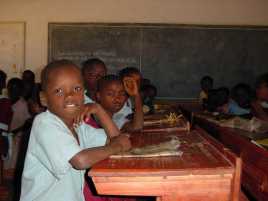
  • children-in-malawi-schoolFirst, the term EdTech places the emphasis on the technology rather than the educational and learning outcomes. Far too many initiatives that have sought to introduce technology systematically into education have failed because they have focused on the technology rather than on the the education.  The use of the term EdTech therefore places emphasis on a failed way of thinking.  Technology will only be of benefit for poor and marginalized people if it is used to deliver real learning outcomes, and this is the core intended outcome of any initiative. It is the learning that matters, rather than the technology.
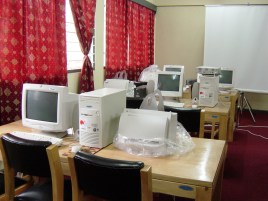
  • jica-stm-ptc-computersSecond, it implies that there is such a thing as Educational Technology. The reality is that most technology that is used in schools or for education more widely has very little to do specifically with education or learning.  Word processing and presentational software, spreadsheets, and networking software are nothing specifically to do with education, although they are usually what is taught to teachers in terms of IT skills! Such software is, after all, usually called Office software, as in Microsoft Office, or Open Office. Likewise, on the hardware side, computers, mobile phones and electronic whiteboards are not specifically educational but are rather more general pieces of technology that companies produce to generate a profit.  Learning content, be it open or proprietary, is perhaps the nearest specifically educational technology that there is, but people rarely even think of this when they use the term EdTech!
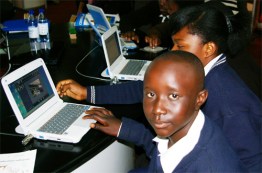
  • intel-classmate-zambia-2010Third, it is fascinating to consider why the term EdTech has been introduced to replace others such as e-learning or ICT for education (ICT4E) which clearly place the emphasis on the learning and the education.  The main reason for this is that the terminology largely reflects the interests of private sector technology companies, and especially those from the US. The interests underlying the terminology are a fundamental part of the problem.  EdTech is being used and sold as a concept primarily so that companies can sell technology that has little specifically to do with education, and indeed so that researchers can be funded to study its impact!

1

Those who use the term EdTech are all conspiring to place the emphasis on the technology rather than on the education.  This is often deliberate, but always misguided!  Many of those who use the term are also concerned primarily in generating profits from education rather than delivering effective, life-changing opportunities for people to learn.  If you ever use the word again, please think twice about it, and preferably use something more appropriate!

4 Comments

Filed under Development, Education, ICT4D

“Reclaiming ICT4D” – in the beginning

It is always exciting submitting a book manuscript to a publisher, and today is no exception!  I have at last finished with my editing and revisions, and sent the manuscript of Reclaiming ICT4D off to Oxford University Press.  I just hope that they like it as much as I do!  It is by no means perfect, but it is what I have been wanting to write for almost a decade now.

This is how it begins – I hope you like it:

“Chapter 1

A critical reflection on ICTs and ‘Development’

This book is about the ways through which Information and Communication Technologies (ICTs) have become entwined with both the theory and the practice of ‘development’.  Its central argument is that although the design and introduction of such technologies has immense potential to do good, all too often this potential has had negative outcomes for poor and marginalized people, sometime intended but more often than not unintended.  Over the last twenty years, rather than reducing poverty, ICTs have actually increased inequality, and if ‘development’ is seen as being about the relative differences between people and between communities, then it has had an overwhelming negative impact on development.  Despite the evidence to the contrary, I nevertheless retain a deep belief in the potential for ICTs to be used to transform the lives of the world’s poorest and most marginalized for the better.  The challenge is that this requires a fundamental change in the ways that all stakeholders think about and implement ICT policies and practices.  This book is intended to convince these stakeholders of the need to change their approaches.

It has its origins in the mid-1970s, when I learnt to program in Fortran, and also had the privilege of undertaking field research in rural India.  The conjuncture of these two experiences laid the foundations for my later career, which over the last twenty years has become increasingly focused on the interface between Information and Communication Technologies (ICTs) on the one hand, and the idea of ‘development’ on the other.  The book tells personal stories and anecdotes (shown in a separate font).  It draws on large empirical data sets, but also on the personal qualitative accounts of others.  It tries to make the complex theoretical arguments upon which it is based easy to understand.  Above all, it has a practical intent in reversing the inequalities that the transformative impacts of ICTs have led to across the world.

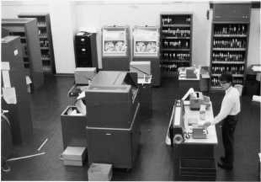
I still remember the enjoyment, but also the frustrations, of using punch cards, with 80 columns, each of which had 12 punch locations, to write my simple programs in Fortran.  The frustration was obvious.  If you made just one tiny mistake in punching a card, the program would not run, and you would have to take your deck of cards away, make the changes, and then submit the revised deck for processing the next day.  However, there was also something exciting about doing this.  We were using machines to generate new knowledge.  They were modern.  They were the future, and we dreamt that they might be able to change the world, to make it a better place.  Furthermore, there was something very pleasing in the purity and accuracy that they required.  It was my fault if I made a mistake; the machine would always be precise and correct.  These self-same comments also apply to the use of ICTs today.  Yes, they can be frustrating, as when one’s immensely powerful laptop or mobile ‘phone crashes, or the tedium of receiving unwanted e-mails extends the working day far into time better spent doing other things, but at the same time the interface between machines and modernity conjures up a belief that we can use them to do great things – such as reducing poverty.

Figure 1.1 Modernity and the machine: Cambridge University Computer Laboratory in the early 1970s.
1.1

Source: University of Cambridge Computer Laboratory (1999)

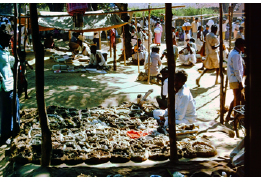
In 1976 and 1977 I had the immense privilege of undertaking field research in the Singbhum District of what was then South Bihar, now Jharkhand, with an amazing Indian scholar, Sudhir Wanmali, who was undertaking his PhD about the ‘hats’, or periodic markets, where rural trade and exchange occurred in different places on each day of the week (Figure 1.2).  Being ‘in the field’ with him taught me so much: the haze and smell of the woodsmoke in the evenings; the intense colours of rural India; the rice beer served in leaf cups at the edges of the markets towards the end of the day; the palpable tensions caused by the ongoing Naxalite rising (Singh, 1995); the profits made by mainly Muslim traders from the labour of Adivasi, tribal villagers, in the beautiful forests and fields of Singbhum; the creaking oxcarts; and the wonderful names of the towns and villages such as Hat Gamharia, Chakradharpur, Jagannathpur, and Sonua.  Most of all, though, it taught me that ‘development’ had something powerful to do with inequality.  I still vividly recall seeing rich people picnicking in the lush green gardens of the steel town of Jamshedpur nearby, coming in their smart cars from their plush houses, and then a short distance away watching and smelling blind beggars shuffling along the streets in the hope of receiving some pittance to appease their hunger.  The ever so smart, neatly pressed, clothes of the urban elite at the weekends contrasted markedly with the mainly white saris, trimmed with bright colours, that scarcely covered the frail bodies of the old rural women in the villages where we worked during the week.  Any development that would take place here had to be about reducing the inequalities that existed between these two different worlds within the world of South Bihar.  This made me look at my own country, at the rich countries of Europe, and it made me all the more aware of two things: not only that inequality and poverty were also in the midst of our rich societies; but also that the connections between different countries in the world had something to do with the depth of poverty, however defined, in places such as the village of Sonua, or the town of Ranchi in South Bihar.

Figure 1.2: hat, or rural periodic market at Hat Gamharia, in what was then South Bihar, 1977 1.2 Source: Author
            Between the mid-1970s and the mid-2010s my interests in ICTs, on the one hand, and ‘development’ on the other, have increasingly fascinated and preoccupied me.  This book is about that fascination.  It shares stories about how they are connected, how they impinge on and shape each other.  I have been fortunate to have been involved in many initiatives that have sought to involve ICTs in various aspects of ‘development’.  In the first instance, my love of computing and engineering, even though I am a geographer, has always led me to explore the latest technological developments, from electronic typewriters that could store a limited number of words, through the first Apple computers, to the Acorn BBC micro school and home computer launched in 1981, using its Basic BASIC programming language, and now more recently to the use of mobile ‘phones for development.  I was fascinated by the potential for computers to be used in schools and universities, and I learnt much from being involved with the innovative Computers in Teaching initiative Centre for Geography in the 1990s (see Unwin and Maguire, 1990).  During the 2000s, I then had the privilege of leading two challenging international initiatives that built on these experiences.  First, between 2001 and 2004 I led the UK Prime Minister’s Imfundo: Partnership for IT in Education initiative, based within the Department for International Development (UK Government Web Archive 2007), which created a partnership of some 40 governments, private sector and civil society organisations committed to using ICTs to enhance the quality and quantity of education in Africa, particularly in Kenya, South Africa and Ghana.  Then in the latter 2000s, I led the World Economic Forum’s Partnerships for Education initiative with UNESCO, which sought to draw out and extend the experiences gained through the Forum’s Global Education Initiative’s work on creating ICT-based educational partnerships in Jordan, Egypt, Rajasthan and Palestine (Unwin and Wong, 2012).  Meanwhile, between these I created the ICT4D (ICT for Development) Collective, based primarily at Royal Holloway, University of London, which was specifically designed to encourage the highest possible quality of research in support of the poorest and most marginalized.  Typical of the work we encouraged was another partnership-based initiative, this time to develop collaborative research and teaching in European and African universities both on and through the use of ICTs.  More recently, between 2011 and 2015 I had the privilege of being Secretary General of the Commonwealth Telecommunications Organisation, which is the membership organisation of governments and people in the 53 countries of the Commonwealth, enhancing the use of ICTs for development.

Two things have been central to all of these initiatives: first a passionate belief in the practical role of academics and universities in the societies of which they are a part, at all scales from the local to the international; and second, recognition of the need for governments, the private sector and civil society to work collaboratively together in partnerships to help deliver effective development impacts.  The first of these builds fundamentally on the notion of Critical Theory developed by the Frankfurt School (Held, 1980), and particularly the work of Jürgen Habermas (1974, 1978) concerning the notion of knowledge constitutive interests and the complex inter-relationships between theory and practice.  The next section therefore explores why this book explicitly draws on Critical Theory in seeking to understand the complex role and potential of ICTs in and for development.  Section 1.2 thereafter then draws on the account above about rural life in India in the 1970s to explore in further detail some of the many ways in which the term ‘development’ has been, and indeed still is, used in association with technology.”

4 Comments

Filed under 'phones, Accessibility, Africa, Caribbean, Commonwealth, Communication, Ethics, ICT4D, ICT4D general, India, Radio, Story-telling, Uncategorized

Reclaiming ICT4D

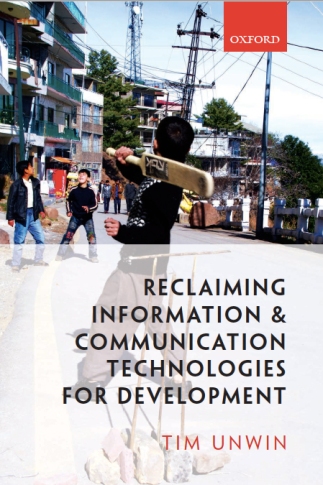
I am so relieved to have finished the first draft of my new book on ICT4D to be entitled “Reclaiming Information and Communication Technologies for Development” which is to be published by Oxford University Press.  Now it is time to redraft and revise it in the light of all of the helpful comments that I have received from colleagues and friends – for which many thanks.  Somehow, I also need to cut it in length, which is proving to be much more difficult than I had anticipated!

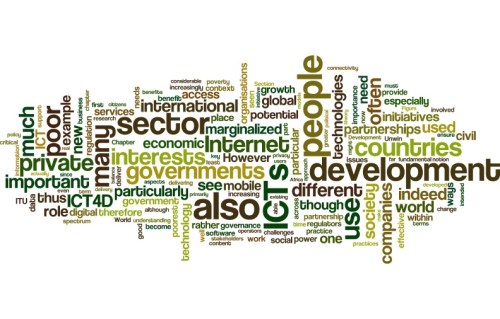
It is always fun to create wordles just to try to capture the essence of a book in an image, and so I thought I would share this to provide an overview of what I have written – and of course to whet potential readers’ appetitites.  I guess that most of what I had hoped for has indeed been revealed, but of course the image does not capture the emphasis or the way in which I have referred to particular themes!  It is good, though, to see the emphasis on people, development and ICTs!

ICT4DwordleFor those who would like a little more detail, this is the provisional Table of Contents – subject of course to revision:

  1. A critical reflection on ICTs and ‘Development’
    • A ‘critical’ approach to ICTs for development
    • Understanding ‘Development’
    • ICT4D in theory and practice
    • Reclaiming ICT for Development (ICT4D)
  1. Understanding the technologies
    • An ever more converged and miniaturized digital world: technological and business implications
    • Spectrum and their management
    • From fixed line to wireless communication
    • From voice to data: impacts of the digital transition
    • On Openness and being Free
    • Social Media and Over The Top services
    • 5G and the Internet of Things
    • Incubators, Digital Hubs and App Development
    • The importance of a technical understanding
  1. The international policy arena of ICTs and Internet Governance
    • Stakeholders in the international ICT arena
    • The World Summit on the Information Society and the evolution of ICT4D multi-stakeholder dialogue in the context of the Sustainable Development Goals
    • The differing interests of multi-stakeholderism: the ITU, ICANN and the IGF
    • The future of multi-stakeholderism and interests in the Internet
  1. Partnerships in ICT4D: rhetoric and reality
    • The idea of partnerships in development
    • The emergence of Public-Private Partnerships
    • ICT4D partnerships: a good case still remains
    • Delivering effective multi-sector partnerships
  1. From regulation to facilitation: the role of ICT and Telecommunication Regulators in a converging world
    • A balance of interests
    • Technical aspects of ICT and telecommunication regulation
    • Universal Service and Access Funds
    • The challenge of revenue generation
    • New models of facilitation in the interests of the poor
  1. Reflections on the dark side of ICT4D
    • Privacy and security
    • The dark side
    • From ‘cybersecurity’ to resilience
    • The big con: social media, Google and Big Data
    • Dehumanization: cyborgs and the Internet of Things
    • In the interests of the poor and marginalized
  1. …in the interests of the poorest and most marginalized
    • ICTs and empowerment
    • Technical options for empowering the poor and marginalized
    • The role of governments and international organisations
    • The power of multi-sector partnerships
    • The Dark Side: managing security and resilience
    • Enhanced learning, understanding and action
    • Reclaiming ICTs for development

7 Comments

Filed under ICT4D, Uncategorized

Dehumanization: cyborgs and the Internet of Things

[Just written this,  the beginning of Section 6.5 of my new book on ICT for Development – thought it might be of interest]

I distinctly remember once walking down Queen Victoria Street in London, and looking down through a window beneath street level to see row upon row of computers, each with their human attached, working away at delivering some unknown products.  It so reminded me of my early readings of Marx’s (1976) Capital, and the dehumanization of labour through the factory system that was designed to extract yet greater surplus value for the capitalists.  Although people like to think that they are in control of their ICTs, this is increasingly not the case.  Office workers come into their open plan work spaces, and ‘their’ computers force them to log in so as to access the information and communication tools necessary to do their work.

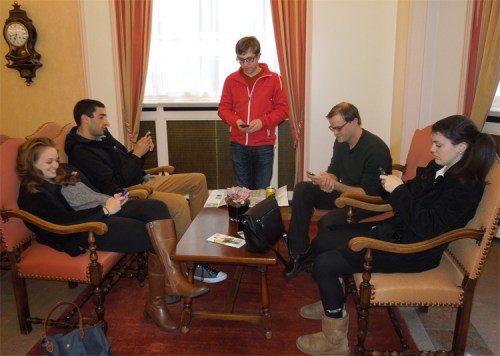
All too often, people communicate together by mobile devices even when they are in the same room (Figure 6.1); the art and skill of face to face conversation is swiftly being eroded, mediated instead through technology.  Internet addiction is now widely recognised as a compulsive-impulsive spectrum disorder (Block, 2008) involving excessive use, withdrawal, tolerance and negative repercussions (see also Cash et al., 2012), with rehabilitation centres being created across the world, from China to the USA, in order to try to help addicted people.

Figure 6.1: Young people communicating at the Hotel International and Terminus, Geneva, 2013

Dehumanisation

Source: Author, 19 May 2013 (taken with permission of all five people shown in the photograph).

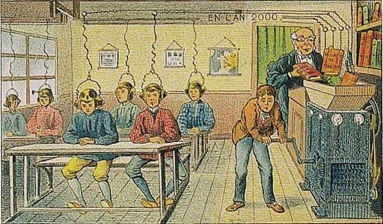
One particularly prescient early image of the relationship between humans and technology is Villemard’s depiction in 1910 of how he thought a school might look in 2000, showing books being dropped into a machine that transforms the information, which then passes through electric cables into each pupil’s headsets.  Conceptually, this is not that different from the online learning systems that now increasingly dominate classrooms on both rich and poor countries alike.

Figure 6.2: Villemard’s 1910 image À l’École, depicting how he thought a school might look in 2000.

Villemard

Source: http://expositions.bnf.fr/utopie/grand/3_95b1.htm, accessed 3 August 2016.

In the GSMA’s Mobile World Congress held in Barcelona in February 2014 smartwear was all the rage, and I remember thinking as I walked past Sony’s advertisement for Xperia on the metro platform wall (Figure 6.3) that there were things about my life that I would definitely not want to log, and would certainly not want others to have access to by hacking either my devices or the cloud servers where they might be stored.  Yet countless people have purchased such devices, and regularly have their health data automatically uploaded so that companies can analyse it and generate profits without paying them anything in return.  This is an extreme example of Big Data surplus extraction, because not only do people have to buy the devices in the first place, and sometimes the software, but they also then give the data to the companies for no recompense, and generally receive little back individually that might actually enhance their health.

Figure 6.3: Sony’s poster “Log your life with SmartWear” on the wall of a metro station in Barcelona during Mobile World Congress, 2014

Sony

Source: Author, 28 February 2014

[now time to write the actual section that explores the increasingly interwoven character of machines and humans, especially as ICTs are increasingly being advocated as a way to enhance development]

2 Comments

Filed under ICT4D, Photographs, Uncategorized

Sexual harassment at international ICT events: a call for action

I have become increasingly saddened and dismayed in recent years at the level of sexual harassment, and what I see as inappropriate and unacceptable behaviour by a surprising number of men at the ICT conferences and exhibitions convened by some international organisations.  This ranges from generally loutish actions by some groups of young men, to what can only be called predatory behaviour by some older and more senior figures in the sector.  Until the last couple of years, I had thought that such behaviour had largely disappeared, but from what I have witnessed myself, from what I have heard from women in the sector, and from what I have read, it is clear that action needs to be taken urgently by all those in the sector, and particularly those who are organising conferences and events.

ITU maleThe ICT industry has for far too long been dominated by men, much to its disadvantage, and it is good that an increasing amount of publicity is being shed on the sexism that has come to dominate the sector more widely.  In 2014, the Guardian newspaper ran an interesting series of reports on the subject, one of which was entitled “Women ‘belittled, underappreciated and underpaid’ in tech industry“, and in 2015, the BBC also featured a report on “Sexism in Silicon Valley and beyond: tech wake-up call” following the case brought by Reddit boss Ellen Pao against her former employer, venture capitalist Kleiner Perkins.  However, this is the tip of the iceberg.

UN Women Watch has defined sexual harassment as “Unwelcome sexual advances, requests for sexual favors, and other verbal or physical conduct of a sexual nature”, and has provided an excellent detailed document describing this in more detail and giving example of verbal, non-verbal and physical sexual harassment.  Such behaviour can certainly be by both men and women, but the vast majority of perpetrators are men, and it is high time that concerted action is taken to stop it.

ZTE.jpgAs a first step, I am issuing this call for all international organisations in the field of ICTs to issues guidelines on expected behaviour at their events.  I prefer guidelines to codes, because codes generally require policing, and the imposition of penalties or sanctions should anyone be found guilty.  In practice, this is extremely difficult to implement and enforce.  Guidelines, instead, reflect expected norms, and should be acted upon by everyone participating in an event.  If someone witnesses inappropriate behaviour, it should be their responsibility to take action to ensure that the perpetrator stops.  In far too many cases, though, people at present do not take enough action, especially when the harassment is by someone senior in the sector.  This has to change.  We must all take collective responsibility for bringing an end to such behaviour, so that everyone can participate equally at international ICT events without fear of being harassed because of their gender or sexuality.
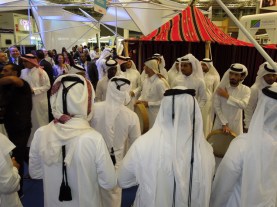
DohaTo be sure, there are very complex cultural issues to be considered in any such discussion, but the fundamental aspect of harassment is that it is any behaviour that someone else considers to be unacceptable.  Hence, we must all consider the other person’s cultural context in our actions and behaviours, rather than our own cultural norms.  Just because something might be acceptable in our own culture, does not mean that it is acceptable in another person’s culture.  Despite such complexities, some international organisations have indeed produced documents that can provide the basis for good practices in this area.  Some of the most useful are:

  • The UN’s Standards of Conduct for the International Civil Service, which has a useful paragraph (21) on harassment: “Harassment in any shape or form is an affront to human dignity and international civil servants must not engage in any form of harassment. International civil servants have the right to a workplace environment free of harassment or abuse. All organizations must prohibit any kind of harassment. Organizations have a duty to establish rules and provide guidance on what constitutes harassment and abuse of authority and how unacceptable behaviour will be addressed”
  • The Internet Governance Forum, has a short and straightforward code of conduct, which begins by stating that participants must “Treat all members of the IGF community equally, irrespective of nationality, gender, racial or ethnic origin, religion or beliefs, disability, age, or sexual orientation; all stakeholders of the IGF community should treat each other with civility, both face to face and online”.  This could be more explicit with respect to harassment, but it is at least a start.
  • One of the clearest and most detailed documents is the conference anti-harassment policy template, developed by the Geek Feminism Wiki.  This has useful suggested texts of different lengths, with the  shortest being “$CONFERENCE is dedicated to a harassment-free conference experience for everyone. Our anti-harassment policy can be found at: [URL for full anti-harassment policy]”.  It goes on to give medium and full length policy templates, as well as suggestions for actions that participants and staff should take.

I look forward to the day when all international ICT conferences do indeed have such guidelines on sexual harassment, and hope that this will begin to create a better, safer and happier environment where we can all work together more effectively to reach appropriate decisions about these important technologies and their use.

8 Comments

Filed under Conferences, ICT4D

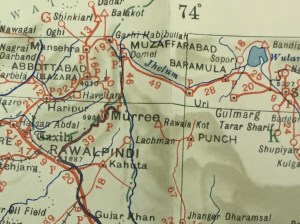
Murree, Pakistan, 1946-2016

My father spent time in Pakistan in 1946, and it is some 70 years since then that I now have the privilege of  visiting the country for the first time.  During the 1939-45 war, he had served in the Signals with the 8th Indian Division, and had been in North Africa, and then fought with them up the eastern coast of Italy.  At the end of the war he had returned with them to India, and particularly to the north-west, in the towns of what became Pakistan after partition in 1947.  The time he spent here was one of the happiest  of his life, and I particularly remember stories he told about the times he spent in Murree and Tret to the north east of Rawalpindi.  Islamabad had not even been thought of by then.

The opportunity to run a workshop for the Ministry of IT and another under the auspices of the Inter-Islamic Network for IT over the last fortnight provided me with a chance to visit some of the places he had known and told me about many years ago, and it was wonderful to experience the magic of the landscape and generosity of the people in this particular part of Pakistan.

IMG_5679Just before I left, my mother showed me an old map, dating from 1945, on which he had depicted the route he had followed across India, highlighted with a black pen.  The map as a whole provides fascinating insights into what the sub-continent looked like before the traumatic events of partition in 1947.  Murree is clearly shown, as befits its role as the summer capital of the Punjab Province until 1864, and its beautiful position as well as its relatively cooler climate makes it clear why it was such a popular location, particular for the British living in India.  Indeed, it had recently snowed when I visited, even though the weather was much warmer only a relatively short distance away in Islamabad.

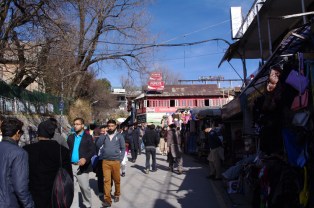
My father had taken some pictures of his time at Murree, and in the village of Tret approximately mid-way between Murree and Islamabad in April 1946, and these provided me with an amazing opportunity to compare how things had changed.  First, was the view of the mountains of Kashmir from Kashmir Point in Murree

Kashmir Point 1946 Kashmir Point 3

It was extraordinary to have been able to find almost exactly where he must have stood to take his photograph, and almost equally interesting to note how rather little must have changed since he had been there.  He would certainly have recognised my photographs!

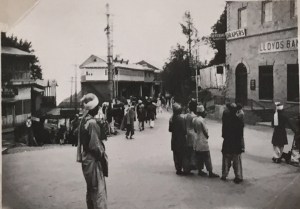
He had also taken a photograph of a street scene in Murree, which included a Lloyds Bank building.  Unfortunately I was not able to find it any more, but the accompanying photograph shows how very much more crowded the streets are today than they were 70 years ago!

Lloyds MurreeStreet scene

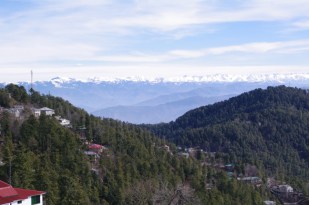
My father clearly loved the mountains and landscapes, and took several photographs of these.  Again, I attach one below (labelled “Hills from Murree Road – 5000 feet”), together with one of the hills between Tret and Murree today, albeit from a different viewpoint.  Both pictures  illustrate a typical settlement on the top of the hills in the mid-distance, but a contrast between them is the difference in forest cover.

Hills from Murree roadHills

I was not able to find exactly where he was based while in Tret, but the photo on the left below shows a 1946 view of the military encampment there with the village in the background on the hill top, and to the right my 2016 photo which might just be of the same buildings.  The photo on the right is also particularly interesting because it shows many black flags flying on the buildings, indicating that these houses belong to some of the Shia minority.

Tret 2016Tret 1946

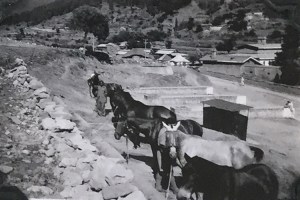
Sadly I was not able to locate the old regimental animal lines shown in the picture on the left below, but have matched it with a view of Tret today on the right.  My father had been a keen polo player, and had become very fond of one of his horses (Bellezza) in particular, and I recall him being very sad that he had to leave the horse behind on his next assignment. Remarkably, on returning to Islamabad, a friend told me that the old polo ground is still there, and had managed to survive encroachment from the bus station.  Next time I visit Pakistan I will have to return and try to find it.

Daddy's horses Tret 3

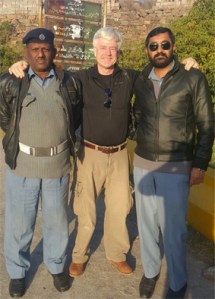
I’m so grateful to everyone who made this visit possible and particularly colleagues in the Ministry of IT, my security team (below), and Asim Malik who accompanied me.

Tret security copy

15 Comments

Filed under ICT4D, Photographs

Reflections on government-led infrastucture development in the ICT sector in the Caribbean

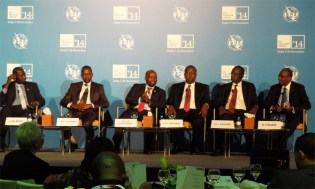
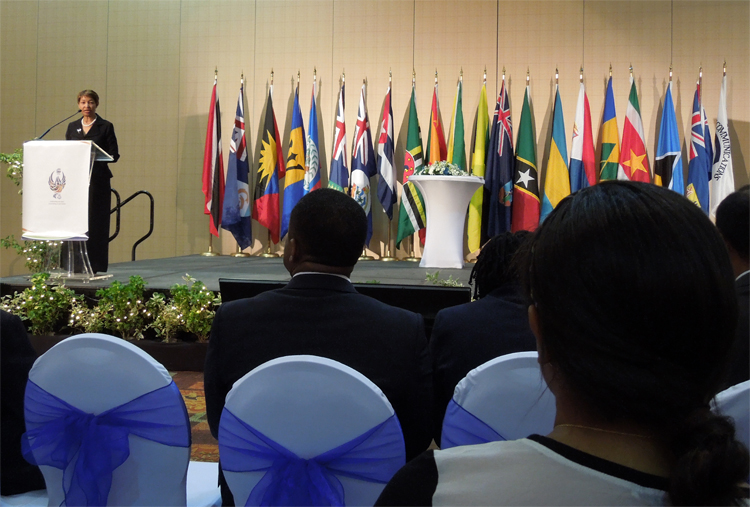
CTUI had the privilege of being invited to moderate the session on government-led infrastucture development at the Caribbean Telecommunications Union‘s 25th anniversary event held in Port of Spain, Trinidad, this week.  It provided an excellent opportunity to discuss in quite some detail the balance between private sector and state investment in the ICT sector, and ways through which infrastructure could be made available to some of the poorest and most marginal communities.  As a moderator, I always see my role primarily as being to facilitate some lively, and hopefully provocative, discussion, and so I tried to say very little myself during the session. Reflecting afterwards, though, particularly in the wider context of the Commonwealth as a whole, the following broad observations seem appropriate:

  1. There is very great diversity within the Caribbean, but nevertheless I did sense that there was much greater appetite here for the state to play a significant role in infrastructure development than is encountered in many other parts of the world.  It was very refreshing, for example, to hear the term “public utilities” spoken about almost with reverence.  The all-too-often accepted “development mantra” that privatisation of public utilities will ensure that they are much more efficient and thus deliver on the needs of poor people and communities, was not one that seemed to be widely accepted.  The belief that states have a clear duty to serve the interests of all of their people, and that this cannot be achieved through privatisation, was healthy and very different from the views that I all too often encounter.
  2. It was, though, clear that old business models are already failing to deliver sufficient profits for many of those involved in the sector, and that new models are required.  I find this particularly exciting, because I firmly believe that there are many exciting ways through which both public services and private benefit can be achieved, through a closer working relationship between companies and governments.
  3. The role of regulators is particularly important at this interface.  In particular, and recalling a session at the ITU’s Telecom World in Doha that I chaired last December, there is a need for regulators to think of themselves much more as “facilitators” than as “controllers”.  This applies not only in terms of providing the context through which the private sector can generate profits across all sectors of the economy, and thus enable governments to generate greater taxation revenues, but also through facilitating public awareness and understanding.  I was thus impressed by the way in which TATT (the Telecommunications Authority of Trinidad and Tobago) provides a considerable amount of information directly to consumers on such matters as “Cyberspace Dangers”, level of services expectations, and complaints procedures.
  4. Nevertheless, throughout the conference, I gained the impression that all too often conversations across the Caribbean have tended to happen in silos, and this was certainly the case  in the session on government-led infrastructure!  I was impressed that most panel sessions had speakers drawn from government, the private sector and civil society, but I got the feeling that the positions of each “sector” were often rather far apart.  There needs to be much more effective dialogue between the different sectors across the region (and indeed elsewhere in the world as well) if innovative solutions are to be developed to enable everyone to benefit from Internet connectivity.  To do this, there needs to be a cadre of well qualified and effective brokers who can facilitate such discussions.  This is one of the key roles that I believe the Commonwealth Telecommunications Organisation can play.
  5. Small Island Developing States (SIDS) face very problematic challenges, not least because of their small market size.  This reinforces the impression that I have previously gained from discussions at the UN’s SIDS conference in Samoa last year as well as work that I have done in the Pacific islands and elsewhere in the Caribbean.  In particular, I am convinced that traditional arguments about competition bringing the price of delivery down for consumers simply don’t apply in many such circumstances.   It really does not make sense to expect two or three operators to compete to deliver services in tiny islands.  Again, the precise business models need to be thought through very carefully, but where there is a social and political appetite for public utilities still to be delivered by governments, I see no logical reason why state-owned entities cannot provide value for money efficient ICT services in small island states.
  6. One of the most interesting discussions during the session was the ways through which existing government infrastructure can be used to reduce costs of rolling out ICT infrastructure, notably fibre.  In particular, the Puerta Rican El Zum initiative sounds especially interesting, in that it intends to deliver fibre connectivity through the sewers that link to most houses in the country.  Whilst this is not a solution that would suit every country, the idea of using the vast network of existing public infrastructure as a means through which to bring connectivity to the home is indeed appealing.  Likewise, I am more than ever convinced about the value of shared infrastructure solutions, and I see this as being one of the most significant things that governments can insist on in trying to reduce costs, especially in rural low-density contexts.
  7. This still, though, leaves the challenge of reaching the most remote, sparsely settled areas of any country, and few clear solutions or recommendations were received on how this could best be done. The debate over whether or not Universal Service/Access funds are effective continues apace, and I think that this increasingly reflects political dogma rather than actual practical reality! The reality is indeed often that money in such funds is either not used effectively, or sometimes not used at all, but the notion that taxation of some kind should be used to benefit the poor and marginalised is still a powerful one (the GSMA reports on such funds provide much helpful evidence).  The size of many Caribbean, and indeed Pacific, islands is nevertheless also one advantage for them, in that being small means that the distances required for roll out of fibre, or in provision of mobile broadband services, are not particularly large, and are thus relatively cheaper than those of large land-locked states.
  8. Finally, we had an interesting debate on the potential of mobile app development in the Caribbean and small island states more generally.  On balance, there seemed to be some agreement that the potential for app development to bring large numbers of people into the productive economy is very much less than some might advocate; thus 1.6% of app developers make more money than the remaining 98.4% combined (Financial Times).  (Incidentally, Mobile Vision has some useful statistics and data on the app sector).  There were, though, suggestions that there could be some potential in the Caribbean for local app developers to work on locally relevant e-government applications.

Overall, it was a fascinating discussion that raised many interesting ideas.

1 Comment

Filed under Caribbean, Commonwealth, ICT4D

On deciding to leave after one term of office as Secretary General of the Commonwealth Telecommunications Organisation

The advertisement for my replacement as Secretary General of the Commonwealth Telecommunications Organisation (CTO) has precipitated numerous questions as to why I am leaving.  So, I thought it might be helpful – not least to applicants – if I briefly tried to explain my decision here.  In so doing, I should stress right at the beginning that many members of the CTO’s Council and our Executive Committee were rather surprised by my decision, and did their best to try to persuade me to stay on.  I am immensely grateful to them for their support.  It is a huge privilege to be Secretary General of the CTO, and I have learnt a phenomenal amount doing the job.  I have also met some absolutely outstanding people – and to be sure, some less outstanding ones! The chance to lead an international organisation, committed to using ICTs to support people across the 53 countries of the Commonwealth is absolutely amazing, and I have thoroughly enjoyed the challenges that this has involved. However, there are two fundamental reasons why I have decided  to serve only one four-year term. These are what I have shared with members of our Council:

  • First, it is very important for there to be clarity and certainty over any transition in leadership of an organisation.  Changes of Chief Executives – or Secretary Generals – must be handled with very great care so that there is a smooth hand-over, and that confidence and trust in the organisation remains high.  I am going to be 60 this year (the truth is now out!), and I would like to have the opportunity to be considered for other jobs before I retire!  Sadly, some international organisations still have relatively low upper-age limits, with the UN, for example, having a mandatory age limit of 62!  Hence, I took the view that I should not stand for a second term as Secretary General of the CTO.  I simply felt that it would have been destabilising and damaging to the CTO if I had indeed been appointed for a second term, and then people had heard that I might be applying for various other jobs a year later, whether or not I actually got them.
  • Second, I think that eight years is too long for a single person to head an international organisation such as the CTO.  With such a long term of office, there becomes a real danger that the incumbent can begin to treat the organisation as his or her personal fiefdom, and I do not think that this is a particularly healthy situation.  Having just completed a three-year plus three-year stint as Chair of the Commonwealth Scholarship Commission, I am all the more convinced that six years (in a three plus three format) should be the maximum term of office for heads of organisations.  Fresh ideas, and new ways of doing things are definitely needed after this length of time!  I also think that any organisation should be bigger than its leader.  After a long period at the helm, there is a very real tendency for a leader and ‘their’ organisation to be seen as being very closely associated if not one-and-the-same, and I simply do not think that this is particularly healthy for the organisation.

I know that not everyone agrees with these views, but two of the things that I have sought to bring to the CTO have been trust and transparency, and it seems to me that both of these are absolutely central to the decision I have made. Of course there are other reasons as well.  The strategic plan that we created back in 2012 had at its heart an expansion in membership.  The aim was to bring back countries and organisations that had previously left the CTO, such as India, Australia, Canada and New Zealand.  Without them, the CTO is but a fraction of what it could be!  Not least, the additional membership fees would enable the CTO to expand its staffing and thereby deliver more and better services to all of its members.  Furthermore, since people can only be employed at the CTO if they are nationals of Full Member Countries, the absence of these countries means that the organisation is more restricted in its employment potential than need be the case – and membership is only £20,000 a year! Despite encouraging words, and indeed promises from some countries to rejoin, these have not yet materialised. Having banged my head against a brick wall on this, and one or two other matters, for nearly four years, I think it is time that I moved on and let someone else build on the foundations we have laid. As I began, let me conclude by stressing once again that the post is an amazing one.  It provides an opportunity to work with some fantastic people, to deliver real on-the-ground solutions that can help poor and marginalised communities use ICTs effectively for their development aspirations.  When eventually I leave in September this year, I know that I will have many regrets.  I have done my best to lead the CTO forward, so that it will be in a better position than when I started.  It is now time for someone else to take the CTO forward so that it can indeed achieve its full potential. Oh yes, and the deadline for applications is 26th January!

Leave a comment

Filed under Africa, Caribbean, Commonwealth, Development, ICT4D

The future of communication

In recent years, I have become increasingly interested in the interface between humans and machines, and thus the world of cyborgs.  This was first formally articulated in my presentation entitled “How will the world communicate in 2113?” given at the Commonwealth Summer School held in Cumberland Lodge on 9th August 2013.  However, as part of the ITU’s ongoing discussion on ICTs in the future, associated with  the Leadership Summit on the Future currently being held during its Telecom World (#ituworld) event in Doha , I was asked to put together a prediction and a single slide summarising some of my thoughts on the future of communication.  So, to give this a little more visibility, I thought I would also post it here:

ITU futures

My actual short quotation was “The future is not so much about the Internet, but rather about the human-machine interface.  Cyborgs are already with us.  If we do not want humans to be mere appendages of machines, we must act now!””

I have to admit that I found the actual ITU session to be much less inspirational than I had expected/hoped it might be – there was very little new in what was discussed!  I was therefore actually rather sad that the presentation that I sent to the ITU for possible inclusion amongst its predictions was seen as being rather too provocative for inclusion!

1 Comment

Filed under Commonwealth, Development, ICT4D

Opening ceremony of ITU Plenipotentiary 2014 in Busan

Just thought I would share some images from the recently completed opening ceremony of the ITU’s 2014 Plenipotentiary meeting in Busan.  This featured very sophisticated presentations of the Republic of Korea’s achievements in the field of ICTs, as well as the beauty of its traditional culture and dance.  South Korea is certainly an absolutely fascinating place, in which we have been made to feel most welcome.  It was good to see the emphasis placed on the use of ICTs by people with disabilities, and also Hamadoun Touré’s commitment to finding ways through which ICTs can be used to help resolve the current Ebola crisis in western Africa (see my regularly updated blog post on ways through which ICTs can indeed contribute).

This slideshow requires JavaScript.

Sorry I could not post these live during the event, but the WiFi system was down while President Park Geun-hye was in the room.  Let’s hope we all have a fruitful and productive Plenipot meeting.

Leave a comment

Filed under ICT4D, Photographs