Tag Archives: ICT4D

The Internet and Development: a critical perspective

9780199589074_140I am delighted to see Bill Dutton’s magisterial edited The Oxford Handbook of Internet Studies (Oxford University Press, 2013) just published.  This is a really excellent and authoritative review of current research on all aspects of the Internet, with some 26 chapters from leading figures in the field.  The 607 page book is divided into five main parts:

  1. Perspectives on the Internet and Web as objects of study
  2. Living in a network society
  3. Creating and working in a global network economy
  4. Communication, power, and influence in a converging media world
  5. Governing and regulating the Internet.

Two of the real strengths of the book as an introduction to the field of Internet studies are the very readable style of most of the chapters, and the comprehensive bibliographies that accompany them.

I was delighted to have been asked to write the chapter on the Internet and Development, which Bill suggested should be sub-titled “a critical perspective”!  As I write in the summary, “This chapter explores research on the complex inter-relationship between the Internet and ‘development’, focusing especially on the effects of the Internet on the lives of some of the poorest people and most marginalised communities.  Much of the literature on Information and Communication Technologies for Development (ICT4D) suggests that the Internet can indeed bring very significant benefits in the ‘fight against poverty’ (see, for example, Weigel and Waldburger 2004; Rao and Raman 2009; Unwin 2009), but other research is marshalled in this synthesis to challenge this assumption.  In essence, I argue that the expansion of the Internet serves very specific capitalist interests, and that unless conscious and explicit attention is paid to designing interventions that will indeed directly serve the needs of the world’s poorest people, then the Internet will only replicate and reinforce existing structures of dominance and control. This argument supports the need for more research that challenges taken-for-granted assumptions about the Internet and development”.

In essence, the Internet is not some benign force for good as is so often supposed.  Instead it is being shaped and reshaped by a relatively small group of people with very specific interests.  It is absolutely essential that those committed to trying to ensure that digital technologies are used to serve the interests of all peoples in the world, and particularly the poorest and most marginalised, do indeed continue to challenge many of the all too often taken for granted assumptions that the Internet is necessarily automatically a force for positive “development”.

1 Comment

Filed under Development, ICT4D

World Bank report on maximising mobiles

The World Bank has just published a useful new report entitled Maximizing Mobile (full report .pdf).  This “report analyzes the growth and evolution of applications for mobile phones, focusing on their use in agriculture, health and financial services, as well as their impact on employment and government. It also explores the consequences for development of the emerging ‘app economy’, summarizing current thinking and seeking to inform the debate on the use of mobile phones for development. It’s no longer about the phone itself, but about how it is used, and the content and applications that mobile phones open”.

Individuals chapters address the use of mobile devices in agriculture, health, finance, entrepreneurship, and government.  A final chapter provides insights on financing mobile broadband.

Leave a comment

Filed under ICT4D

Advice for students on ICT4D programmes…

I’ve just had a great question posed to me by Brooke Kania: “I was just wondering, what are you looking for in students who are coming out of IDEV or ICT4D programs – what do you think the field needs from academic training? What advice would you give to aspiring ICT4D professionals?”.  The question is easy; the answer is not!  Fueled by a couple of very good glasses of Chianti, let me have a go at responding.  Here then are the ten things I would look for, and also some reflections as to why:

  • A willingness to cross boundaries.  The great thing about ICT4D is that it is not (yet) a specific discipline, but brings together people from many different backgrounds.  Exciting things happen at the edges!  Get a computer scientist and a philosopher talking together, and great things can happen.  The only trouble is that most academic ‘life’ is now about becoming the global expert in a tiny field of academic enquiry, and despite the rhetoric of interdisciplinarity, old disciplinary boundaries remain strong!
  • Understanding the real needs of users.  Far too many ICT4D projects are invented by academics who have little clue about what the real needs of users actually are, and they are then surprised that the projects fail!  In part, this reflects the tyranny of the one year Master’s programme or three-year PhD, that limits the potential for a researcher to go into the field, really discover what would then make a difference to the lives of poor people, and then work with them to develop technologies that can really serve their interests.
  • Humility.  The Academy is all too often about ‘experts’ and people who claim to ‘have all the answers’.  In my experience, that is the death of enquiry and exploration.  There is much truth in the statement that “the more I know, the more I realise how little I know”.  Interestingly, I think I have met more ‘bright’ people outside universities than I have within them!  Far too often, academics create a language of obfuscation, to prevent others from understanding how ignorant they really are!
  • Being technically sound. ICT4D is fundamentally about technology – not necessarily in an instrumentalist way, but it is definitely concerned with technology, both how it is shaped by society, and also how it shapes society.  It is therefore essential that everyone working in the field of ICT4D does indeed have some technical grasp of technology.  That does not mean the impossible, in other words that everyone must understand all the relevant technologies, but it does mean that we should all have some pertinent technical expertise.  Thank goodness that  I learnt to programme in Fortran as a student!
  • A focus on really understanding ‘development’.  This is difficult, very difficult.  There are many definitions of what development is about, but anyone working in the field of ICT4D must address this question in their own way.  For me, development is about addressing the appalling inequalities that exist in our societies, and this is something very, very different from the hegemonic view that development is actually mainly about economic growth.  Capitalist economic growth can never eliminate poverty, and the sooner we abandon this misguided nonsense the sooner the world’s poor and marginalised people will be able to live the lives to which they aspire.
  • Get some real ‘development’ experience!  This is tricky for a student, but it is really impossible to understand the challenges and intricacies of ‘development’, however we define it, unless we have experienced it practically on the ground.  For some 20 years I did research and taught about development, but I never worked for a development agency, the private sector, or civil society organisation in that time.  In six months working for a bilateral donor agency, I learnt more about the practice of development than I did in most of my previous research on the subject!
  • Recognition that ICT4D is a moral, rather than a technical agenda.  This is closely linked to the above point, but I think it is different.  ICT4D should be about the normative – what should be – rather than what actually is.  Academics are generally quite good about describing what exists, but far too few go beyond this to suggest what they think should happen in the light of their analyses .  This is irresponsible!  Academics are hugely privileged, and they abrogate the trust placed in them by society if they do not use their research to make the world a better place.  They can only do this by having a vision for what the world could be like, and then engaging in political action to help shape that world.
  • An ability to engage in critical analysis.  This should lie at the heart of all academic enquiry, but all too often it doesn’t!  Far too much academic research repeats the obvious, albeit dressing it up in grandiose terms.  If we want to explain or understand a phenomenon, we have to keep asking the question “why?”.  I read so many papers that fail to do this!  If the interviews, questionnaires, or experiments that are undertaken do not seek to say why something is observed, then they remain purely descriptive and fail to add to our real understanding.  If you are a social scientist, just look at the questions asked in interviews, focus groups or questionnaires.  There will usually be many “what?”, “where?”, “when” or “who?” questions, but far fewer “how?” questions, and even fewer “why?” questions!  If we do not ask “why?”, we fail really to move knowledge forward.
  • Freedom to fail!  Far too much academic work is about getting students to regurgitate accepted truths – especially the opinions of those who teach them!  What we do not seem to allow students is the opportunity to experiment and fail.  I tend to think that people generally learn more from their mistakes than they do from their successes.  So, my advice would be to try something new, and not worry about the risk of failing.  That is where true innovation comes from.  In job interviews, I often tend to ask people about one of their failures, and then get them to think about what they learnt from it.  Those who claim never to have failed, don’t come up to the mark – especially in my book!
  • Be a good team player. It was difficult to think of a tenth piece of advice – there is so much that could be said.  However, I am convinced that ICT4D is about good team work.  None of us have all the necessary skills, and so if we are going to develop appropriate solutions, we must be able to work effectively together.  Far too much academic work is now about individual success – and we have lost the collective enterprise that so inspired me as a young academic.  Wisdom, scholarship and development are above all collective enterprises, and we need to embark on them together.

So, Brooke, I hope this gives you some ideas of my thinking right now.  Don’t get me wrong, this is not a tirade against the Academy.  Far from it.  Universities are a hugely precious element in our societies, and I value them enormously.  It is just, I fear, that too many institutions and individual academics have lost their way, and have become merely another tool in the hands of those who do not want us to be free.  Ultimately, it is hugely difficult for those committed to implementing real change in our societies to be based within universities; I have tremendous respect for those who remain fighting for their integrity and sanity.  ICT4D is about engagement, not just about writing papers in academic journals that few people will ever read.  Those who determine our research agendas should be the world’s poor and marginalised.

10 Comments

Filed under Higher Education, ICT4D

Donating Computers to Schools

A young acquaintance from Europe visiting a country many miles away sent me an e-mail saying that she was about to set out on a programme to donate computers to schools, and asking my advice. Such enquiries are hard to answer.  On the one hand I want to support such commitment and enthusiasm, but on the other I know just how problematic so many such initiatives have been.

This is how I responded:

There are many initiatives that have been set up to ‘deliver’ computers into schools (and other places), many of which have been unsuccessful. Some of these have used refurbished computers (such as Computer Aid); others have been donated new by NGOs. Invariably, they are ‘given’ by people who know what computers can do – often based on their own experiences – and think that it would be great if less advantaged people could benefit likewise. However, invariably this is not a good use of money and resources. As you can imagine, there is a huge literature on this – but I guess your connectivity may not be that good in terms of wanting to download information!

So, a few key tips are:

  • begin with the teachers and ensure that everything is led by them, and integrated into what and how they teach.
  • much better to contribute to expanding an existing successful initiative, rather than starting up something from scratch
  • don’t try and reinvent the wheel – build on existing experience and good practices
  • ensure that there is effective electricity and connectivity – as well as the money to pay for it
  • ensure that any content is in local languages and integrated with the curriculum
  • ensure that the use of the computers is also about communication and not just content
  • use of computers in schools is far more than just teaching people to learn how to use office skills – so make sure they are really used for education
  • try to ensure that the computers are used 24/7 – by for example running adult training courses in the schools out of hours
  • try to identify how the computers can be used to generate an income, so that the school can then have enough money to buy more and replace the ones that break
  • ensure that there is technical back up and support, so that if minor things go wrong (like a plug being accidentally pulled out), then people can simply fix it
  • do not have a printer (it gets very expensive on paper and ink and usually breaks swiftly)
  • think of using COWS (Computers on Wheels) that can be rolled around from classroom to classroom, rather than having a computer lab
  • if there are only one or two computers, make sure that they do not finish up (unused) in the head teacher’s office
  • build usage of the computers around community needs – involving parents, siblings and the wider community – so that everyone can see their worth
  • if teachers and children have mobile ‘phones, think of building the learning solutions around them, rather than around computers

I wonder how others would have advised my young acquaintance…

7 Comments

Filed under Education, ICT4D

Data on Internet and social media usage

One of the interesting things about the Internet is actually how difficult it is to find out detailed and accurate information about its usage, especially with respect to social media. The International Telecommunications Union does, though, provide some useful high level data.  Given all of the emphasis on the apparent ‘ubiquity’ of Internet use, these provide some very salient reminders that in 2011

  • some 35% of the world’s population use the Internet – which means that 65% still do not!
  • although 45% of Internet users are under 25, 75% of the world’s under-25s still do not use the Internet.
  • there are twice as many mobile-broadband as there are fixed-broadband subscribers across the world

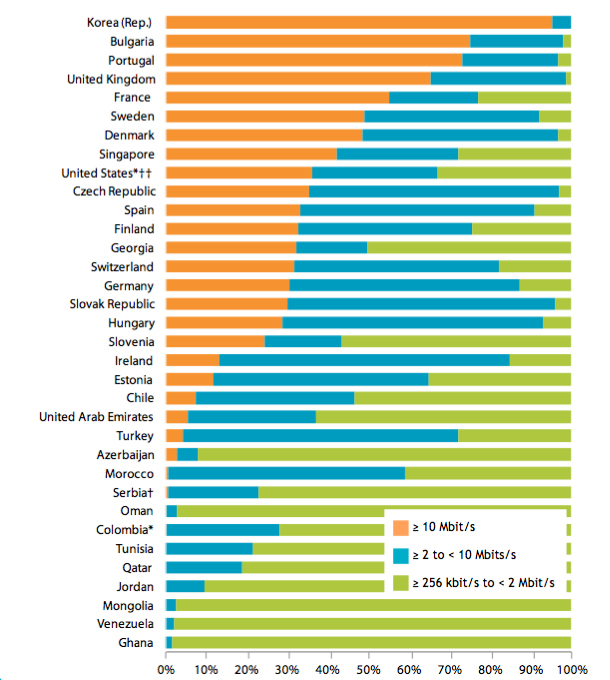
It is not just connectivity, though, that matters.  The available bandwidth and speed of connectivity are also crucial.  The following ITU graph (click on image for larger version) thus illustrates the enormous contrasts that still exist in this respect:
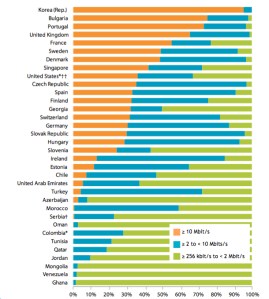
Whereas more than 95% of fixed broadband connections in South Korea have advertised speeds of ≥ 10 Mbit/s, some 98% of connections in Ghana, Venezuela and Mongolia have speeds of ≤ 2 Mbit/s.

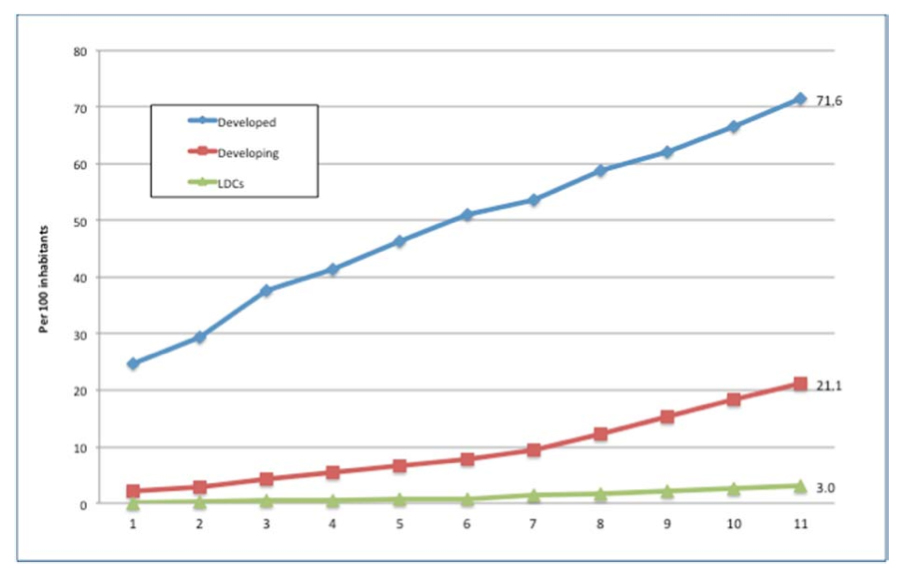
Of equal concern is the observation that the least developed countries are being left further and further behind in the race for digital connectivity.  In a striking report on the role of ICTs in the “least developed countries”, the ITU  shows this particularly graphically in the chart below (click on image for larger version), which illustrates the percentages of people who are Internet users:

This shows, for example, that the difference between the percentage of Internet users in the “developed” and the “least developed” countries in 2000 was only about 25 people per 100, whereas by 2010 it had leaped to more than 68 people per 100.  Despite growth in the number of Internet users in the developing countries, they were likewise still 50 people per 100 behind the “developed” countries in 2010.  The differences between rich and poor are thus getting dramatically bigger rather than lessening.

As 2012 gets underway, let us all commit ourselves more strongly than ever before to ensuring that these trends are reversed, and that the world’s poorest and most marginalised are indeed able to benefit from the ICTs that so many people living in the richest countries of the world now take for granted.

One aspect of data on Internet usage that I find particularly frustrating is the difficulty of finding accurate information on social media usage.  This is especially important when there is so much rhetoric about the ways in which such media are transforming social, economic, political and cultural life.  It seems to me that, once again, this may well be true of the world’s richest 10% or so of people, but is scarcely true of the majority!

Facebook, for example, is renowned for how little information it shares, with its statistics page only giving very sparse information about five categories of data, including the ‘fact’ that there are 800 million active users.  But what does “Active Users” mean?  According to Facebook it is people who have returned to the site in the last 30 days, although we are told that half of these (c.400 million) use Facebook every day.  If the world’s population is taken as being ‘approximately’ 6.984 billion, that means that about 1 in 17.46 people are using Facebook every day.  Before we get too carried away with the enormity of this figure, we should recognise that this is only 5.7% of the world’s population, which means that a huge 94.3% of the world’s people do not use Facebook daily!

It is likewise not that easy to find out detailed data from Twitter, although officially some 177 million Tweets were sent on 11 March 2011.  In the above vein, though, it should be noted that this is equivalent to only 1 per every 2.5% of the world’s population (some useful sites providing more comprehensive visual summaries of data on Twitter include MarketingGum and digitalbuzz, although these are becoming rather dated; see also report on CMSWire). In September 2011, Twitter announced that it had 100 million active global users logging in once a month – but again this only represents 1.4% of the world’s population!

When we read about how Facebook and Twitter are going to change the world, we therefore need to think very carefully about whose world, and the kind of world they might create.  To be sure, digital technologies have enormous potential to serve the interests of the poorest and most marginalised, and the numbers of users of services such as Twitter and Facebook are indeed increasing impressively, but with such low levels of global reach they are not yet the dominant force that many would claim them to be – or indeed some users might like to think they are!  So, how many people have more than 1000 followers on Twitter?!

1 Comment

Filed under ICT4D

How to make ICT4D partnerships better deliver real development impacts

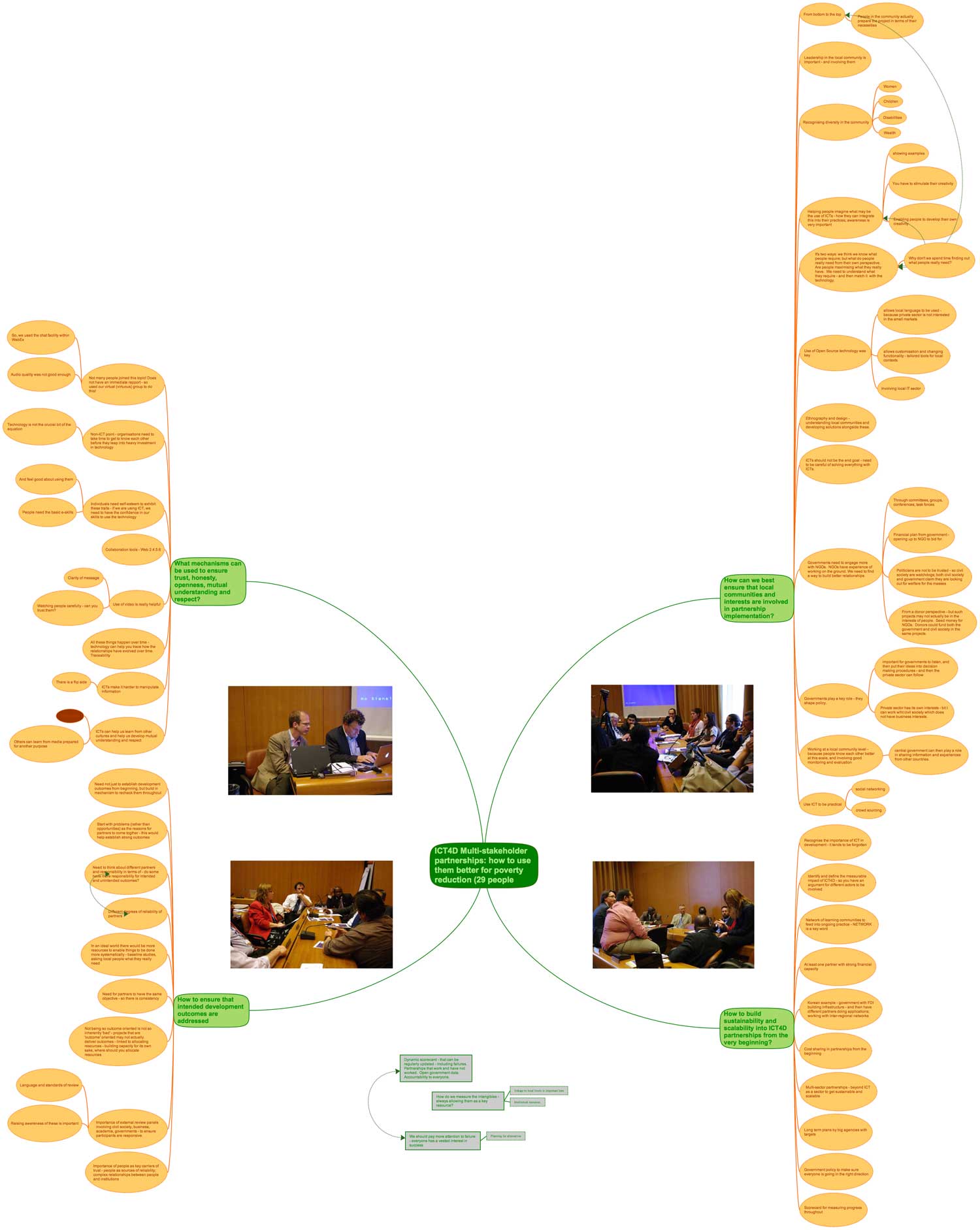
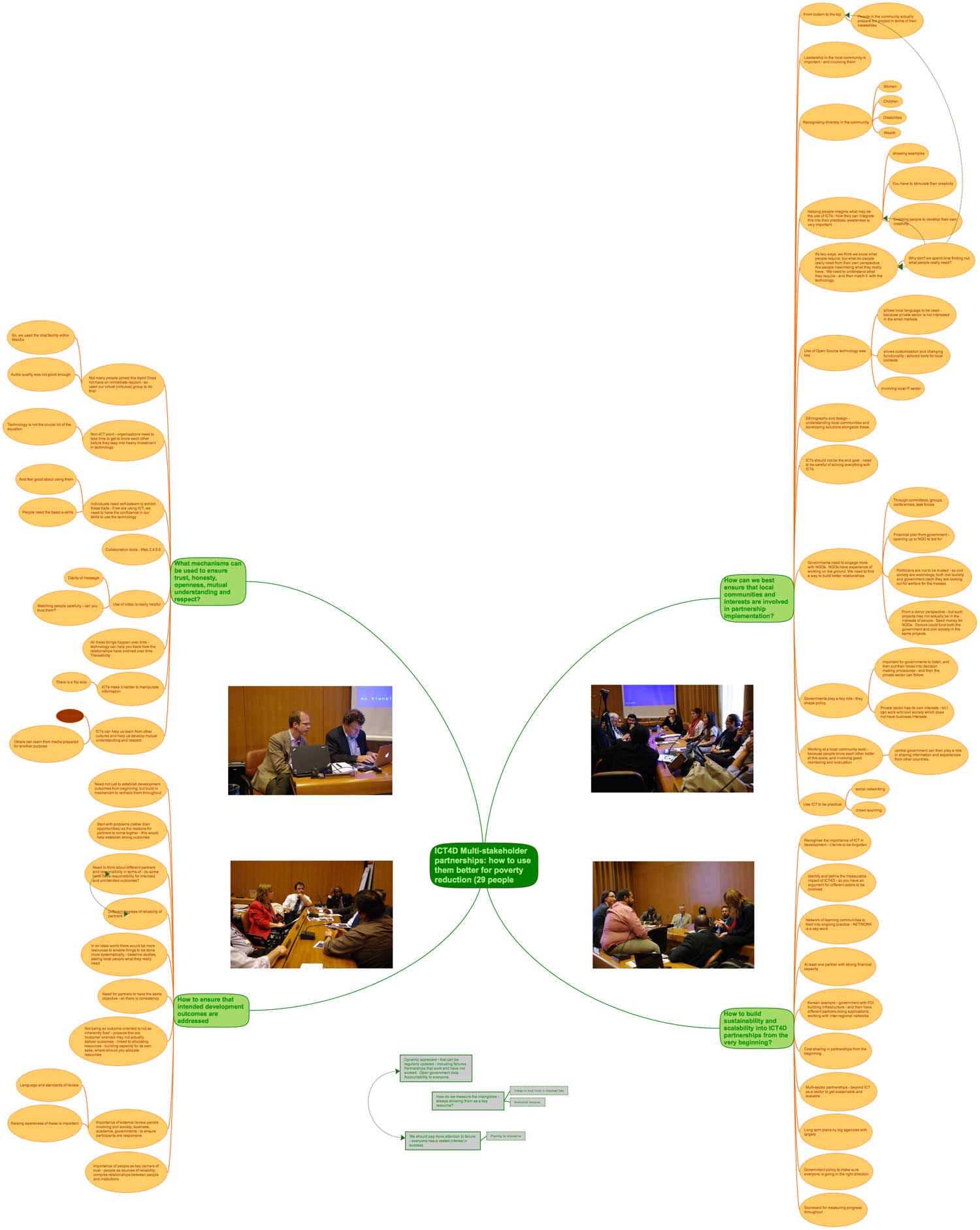
The ICT4D Collective hosted a workshop at the WSIS Forum in Geneva today on the key factors colleagues considered to be necessary to overcome four of the most important problems in delivering effective ICT4D partnerships.  The idea for the workshop stemmed from the systematic review of the impact of ICT4D partnerships completed by Marije Geldof, David Grimshaw, Dorothea Kleine and myself for DFID earlier this year.  This highlighted four main areas where further thought was required:

  • How can we best ensure that local communities and interests are involved in partnership implementation?
  • How to ensure that intended development outcomes are really addressed?
  • How to build sustainability and scalability into ICT4D partnerships from the very beginning?
  • What mechanisms can be used to ensure trust, honesty, openness, mutual understanding and respect?

Following an opening presentation by David Grimshaw (Practical Action, and Royal Holloway, University of London), we divided up into four groups (chaired by Paola Uimonen from SPIDER, Peter Drury from Cisco, and Dorothea Kleine and myself from Royal Holloway, University of London), each discussing one of these themes, and the outcome was the following mind map (click on image for larger version) that reflected the collected views of the 30 or so people present, as well as those who joined by WebEx video conferencing services kindly provided by Cisco.


A more detailed .pdf file of the mind-map is available here: WSIS Forum 2011

Thanks to everyone who participated, and helped to make the discussions so interesting.

Leave a comment

Filed under ICT4D

World Telecommunication and Information Society Day

Today, May 17th, is World Telecommunication and  Information Society Day.  The theme is Better Life in Rural Communities with ICTs – which seems highly appropriate!  Let’s hope we can all do something to make this aspiration a reality!

Leave a comment

Filed under ICT4D

Remote participation at the 2011 WSIS Forum in Geneva

This week’s WSIS Forum is just about to get underway in Geneva.  The organisers have been very eager to ensure that people can participate remotely.  Full details of how to watch and engage in the discussions ‘at a distance’ are copied below:

“The WSIS Forum has a multi-stakeholder character. The WSIS Stakeholders include governments, civil society, private sector and international organizations from all parts of the world. Today, information and communication technologies (ICTs) provide the opportunity for representation and inclusion of all stakeholders in the WSIS Forum by way of remote participation. In order to ensure participation and inclusion of all WSIS Stakeholders, remote participation has been designed as an integral feature of the WSIS Forum 2011.

Building on the success of remote participation facilities initiated at WSIS Forum 2010, the organizers are working towards integrating the most user friendly and widely used tools for encouraging remote participation at WSIS Forum 2011. These easy to participate tools will enable two way communication, allowing the WSIS Stakeholders to participate in the WSIS Forum at their own convenience at the same time, disemminate information about the different sessions and happenings at the Forum.

Components of Remote Participation at WSIS Forum 2011

Webcast
Remote Participation will be a key feature of the WSIS Forum 2011 and you can follow all sessions via the video webcast (registration not required).
Webcast page: http://www.itu.int/ibs/WSIS/201105forum/index.html.

iWrite4WSIS
All Forum sessions will feature live reporting via twitter, as part of the iWrite4WSIS campaign.

Adobe Connect Conference Rooms
If you would like to participate actively in this conference as a remote delegate, you can do so by registering to participate via the Adobe Connect (virtual) conference rooms.   This will allow you to follow the video feed of the conference room, hear what is being discussed (English channel), see presentations and documents, and put questions to panelists via chat.   Each session will have 10-15 minutes for questions from remote delegates.  Participation, as a remote delegate, requires registration. (See registration page)

Short Video: Inside an Adobe Connect Meeting Room

The Adobe Connect Conference Rooms are provided below:

You can login to any of these rooms to have a look around, however they will only be active from Monday, 16 May at 08h45(Geneva time)

See also Frequently Asked Questions for Remote Participants

Leave a comment

Filed under ICT4D

New ITU report on the role of ICTs in advancing growth in the least developed countries

The ITU has just published a very important report on the role of ICTs in enhancing development in the least developed countries.  I was privileged to have been asked to write the foreword, in which I made the following comments:

  • “This important ITU report focuses explicitly on the experiences of people living in the world’s ‘Least Developed Countries’ (LDCs). It addresses not only how and why ‘outsiders’ have been eager to offer new ICTs as a means to encourage their ‘development’, but also how technical innovation can occur in some of the poorest countries of the world. Above all, it suggests that there is nothing automatic about the potential contribution of ICTs to ‘development’ processes, however these are defined. If marginalised people and poor countries are to take advantage of ICTs in transforming their fortunes, then specific efforts need to be made to address their needs and aspirations. The market by itself will not deliver on the information and communication requirements of the poorest and most marginalised people and communities”, and
  • “This exciting report points in many directions. It highlights both the successes and the failures of ICT initiatives and developments over the last decade, particularly with respect to LDCs. It emphasises the many challenges that still need to be overcome before we can claim that these technologies really have had the equalising benefits that many attendees at WSIS had hoped for. However, above all, it provides suggestions for innovative ways forward through which some of the poorest countries in the world can grasp the potential of ICTs to enhance the lives of their peoples”.

The charts and graphs contained within the volume provide very important evidence that many of the poorest countries and people in the world have not yet benefited from the potential of ICTs, and that very substantial effort is needed to ensure that ICTs do not actually lead to further increases in the differences in access between the world’s richer and poorer people.  This is essential reading for all involved in ICT4D.

2 Comments

Filed under Africa, Development, ICT4D

The development impact of ICT4D partnerships: join our discussion online at the WSIS Forum

Cisco is generously sponsoring the opportunity for anyone to participate in the session on the Development Impact of Multi-stakeholder Partnerships in ICT4D ( http://groups.itu.int/wsis-forum2011/Agenda.aspx?event=event_60) that the ICT4D Collective is convening from 16.30-18.00 Geneva time (15.30-17.00 UK time) on Tuesday 17th May at the WSIS Forum ( http://groups.itu.int/default.aspx?tabid=856).  Please share this information as widely as possible, so that colleagues across the world can join in our discussions and deliberations.

To join the online discussion, please use the following information (best to try to log-on about ten minutes in advance to download the applet and check the systems are working) :

Meeting Number: 608 639 429
Meeting Password: 123

——————————————————-
To join this meeting (Now from mobile devices!)
——————————————————-
1. Go to https://ciscosales.webex.com/ciscosales/j.php?J=608639429&PW=NYzY4NDE5MjI3
2. Enter the meeting password: 123
3. Click “Join Now”.
4. Follow the instructions that appear on your screen.

—————————————————————-
ALERT:Toll-Free Dial Restrictions for (408) and (919) Area Codes
—————————————————————-

The affected toll free numbers are: (866) 432-9903 for the San Jose/Milpitas area and (866) 349-3520 for the RTP area.

Please dial the local access number for your area from the list below:
–  San Jose/Milpitas (408) area:  525-6800
–  RTP (919) area:  392-3330

——————————————————-
To join the teleconference only
——————————————————-
1. Dial into Cisco WebEx (view all Global Access Numbers at
http://cisco.com/en/US/about/doing_business/conferencing/index.html
2. Follow the prompts to enter the Meeting Number (listed above) or Access Code followed by the # sign.

San Jose, CA: +1.408.525.6800  RTP: +1.919.392.3330

US/Canada: +1.866.432.9903  United Kingdom: +44.20.8824.0117

India: +91.80.4350.1111  Germany: +49.619.6773.9002

Japan: +81.3.5763.9394  China: +86.10.8515.5666

Leave a comment

Filed under ICT4D, ICT4D conferences