Tag Archives: ICTs

Transform Africa 2013 and a celebration of Rwanda

I had the great privilege – especially as a white Yorkshireman – to be invited to chair the session on Smart Education at Transform Africa 2013 held in Kigali, Rwanda – a conference led by Africans, for Africans.  It is some five year since I was last in Rwanda, and the changes that have been made in the country over this time, especially in the field of ICTs, are palpable.

It was really excellent to hear seven Presidents of east African countries champion the potential of ICTs to transform Africa, whilst also being realistic about the challenges that still remain in using them effectively to contribute to the social, political and economic development of their countries.

It was also good to experience some of the musical heritage of Rwanda – and even to have the chance of learning yet another different style of African dance!  This was especially so at the launch of Rwandapedia this evening – an excellent resource for those wishing to learn more about Rwanda’s turbulent history over the last 20 years or so.  Congratulations, too, to the Panorama Restaurant at the Des Mille Collines for what has to be one of the best dinners I have recently had in Africa!

The photos below catch but a glimpse of some of my experiences here over the last few days.
This slideshow requires JavaScript.

1 Comment

Filed under Africa, Commonwealth, Development, Education, ICT4D

ICTs for Education Initiatives

I spent last week in Abuja for the Commonwealth Telecommunications Organisation‘s Annual Forum and Council meeting, during which there was also a meeting of ICT Ministers, at which many of them highlighted the importance of ICT initiatives for education in their countries.  One thing that particularly struck me about some of the discussions I had was, that despite such interest, there remains a surprising lack of knowledge about many of the challenges that exist in delivering such initiatives.  All too often it is simply taken for granted that such programmes must be successful, and that they will unquestionably lead to an improvement in education.  I find this deeply worrying, because one of the few things that we really know is that the majority of ICT for education initiatives in developing countries have actually been disappointing failures – at least as far as delivering effective educational change is concerned.  I have therefore spent some of today writing a page on the CTO’s site about this, trying to summarise some of the findings of work in which I have been engaged over the last decade.

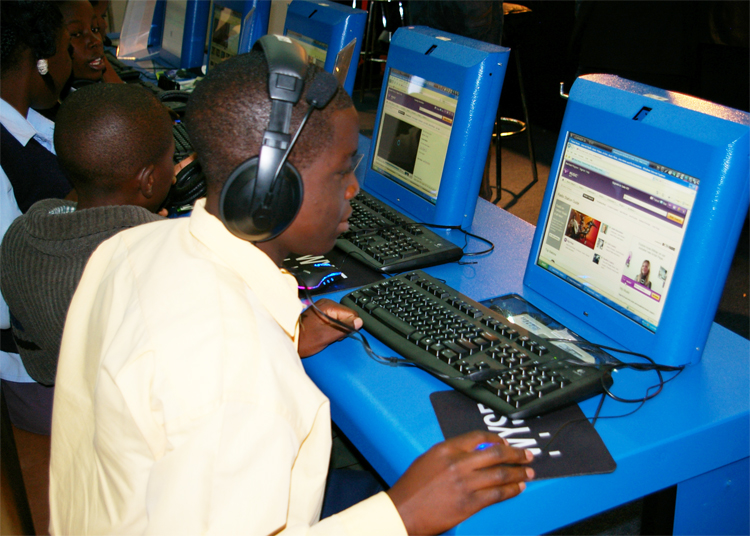
boy with computer smallI am also making these ideas available on my personal blog to try to encourage debate around this important subject.  There is far too much duplication of effort, and reinventing the wheel in terms of how to deliver effective ICT for education initiatives.  This can be incredibly wasteful of valuable resources, and I hope that by providing links to some of the more important available resources people will at least have a starting point from which to work.  It would be good also if colleagues could add to the list of the most important references and websites/portals by leaving comments, thereby using this as a vehicle for sharing more information on the subject.

Based on my work over the last decade or so, I have come to the conclusion that ten key issues need to be considered if effective ICT in education initiatives are to be delivered:

  1. It is the learning that matters and not the technology. Many e-learning and m-learning initiatives place the emphasis on the technology – be it laptops or mobile ‘phones.  Effective initiatives begin with identifying the learning objectives, and then identify the technologies that are best suited to delivering them.
  2. Teachers must be closely involved in the implementation of ICT for education initiatives, and they need to be given effective training in advance of the roll-out of computers in schools.
  3. Sustainability issues must be considered at the very beginning.   Computers, laptops and mobile ‘phones are expensive.  Whilst it can be affordable to purchase these as a one-off investment, careful thought must be given to the budget costs of maintaining this equipment, and of how to provide it for the next generation of school-children.  Computers do not last forever, and a substantial budget stream must constantly be made available.
  4. The supporting infrastructure must be in place.  All too often insufficient attention is paid to ensuring that there is sufficient reliable electricity and Internet connectivity to enable the equipment to be used, and for teachers and students to gain access to the Internet.
  5. Appropriate content must be available to help deliver the curriculum and learning needs.  All too often ICT initiatives merely provide access to internationally available content delivered in foreign languages.  It is important that local content developers are involved in shaping learning content, and that as much attention is focused on using ICTs to provide new ways of communicating, and not just delivering information.
  6. Ensure equality of access to all learners.  ICTs enhance inequality between those who have access to them and those who do not.  It is essential therefore that attention is paid to ensuring that all learners are indeed able to access the benefits.  Usually, ICT for education initiatives start with those who are already privileged, through their wealth or by living in urban environments with the necessary infrastructures.  Enlightened initiatives actually begin with delivering learning solutions to the most marginalised people and those living in rural areas.  Remember that people with greater disabilities have more to gain from learning ICT skills than do those with fewer disabilities.
  7. Appropriate monitoring and evaluation must be undertaken from the very beginning to ensure that learning objectives are indeed being delivered, and that the initiative can be tweaked accordingly.
  8. Appropriate maintenance contracts for equipment and networks need to be established.  Training local people in the maintenance of learning technologies is essential so as to ensure that the equipment is used effectively. This can also provide a real boost to local economies.
  9. Use equipment and networks in schools for as long as possible each day.  ICT equipment and networks in schools should be used by local communities in out-of-school hours.  This maximises the use of expensive equipment, and can provide a source of income generation that can help defray the costs of its usage.
  10. Think creatively in your own context.  There are no best practices, only a range of good practices from which to choose.  Develop solutions that best fit your learning needs, and then get on with implementing them!

I  very much look forward to developing these ideas in more detail in my keynote address on technology in education at the Commonwealth of Learning’s seventh Pan-Commonwealth Forum to be held in Abuja this December.

It is hugely difficult to summarise the vast wealth of existing literature on ICTs and education in a development context, but I suggest that the following ten publications are essential reading for anyone engaged in delivering effective ICT for education initiatives, particularly through multi-stakeholder partnerships (listed alphabetically):

I have always found that the following websites on ICTs and education in a development context (listed alphabetically) contain a wealth of useful information:

4 Comments

Filed under Commonwealth, Development, Education, ICT4D

How will we communicate in 2113?

ScholarsAn invitation to speak on the theme of “How will we communicate in 2113?” at the third annual Commonwealth Residential School meeting at Cumberland Lodge provided an interesting opportunity (at least for me!) to explore some fascinating interests “at the edges” of communication and technology.

The outline of what I intended to say focused around the following themes:

  • Grounding prediction
  • Are there any certainties?
  • How do we communicate today, and why?
    • In whose interests?
  • Trends in communication and technology
  • Extending into the foreseeable future

In particular, I explored the implications of seven trends:

  • The observation that technology can be used for “good” or for “evil” – challenging the many instrumental views of technology in development that so often dominate thinking today
  • Making the case that technology is increasing inequality rather than reducing it – too few people really understand this, but to me it is critically important, and has very significant implications for the future
  • Those in power use technology to remain in power: both states and global corporations.  This is one of the key drivers for how ICTs will be designed and used in the future
  • The ways in which our understandings of privacy have been changed as a result of recent developments in ICTs, and the implications for the relationships between citizens, states, and global corporations
  • Cambridge telephone statueThe ICT sustainability crisis – not only in terms of the energy demands of ICTs, but much more importantly the ways through which corporations generate much of their profit through  making users buy new hardware and software on a regular basis
  • The implications for learning and literacy of next generation ICTs – we will no longer need to learn to read and write, we will be able to understand people speaking any language, and the changes to the brain caused by no longer needing to remember things.
  • The blurring of the human and the machine – and whether or not we want to become cyborgs (encouraging participants to see one of my favourite films – Blade Runner – and also to see the recently released Cloud Atlas!).

One of the fun things about the session was that for the first time I used Promethean’s ActivInspire to gauge participants’ thoughts on a range of issues around their current usage of ICTs.  This did not throw up any particularly novel views from the participants – although 25% felt that Edward Snowden was wrong in exposing the NSA’s mass surveillance programme, with 56%  agreeing that he was right to do so.

Ultimately, I found myself arguing that we have some very important ethical decisions that need to be made here and now with respect to our relationships with ICTs, because there are many forces at play that are seeking to make us increasingly intertwined, and unless we act very soon we may already be far too far down the path to turn back.

Leave a comment

Filed under Development, Ethics, ICT4D

Ensuring disability agendas are embedded effectively in national ICT strategies

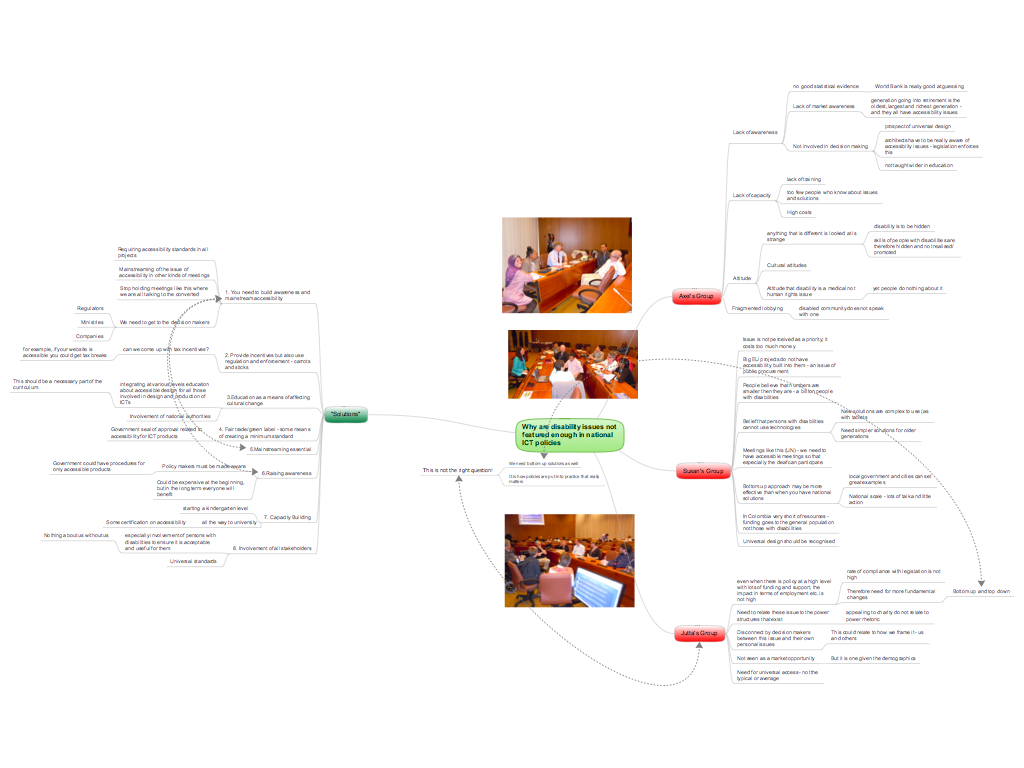
At today’s WSIS Forum session on ICTs and disability (#ICT4DD) led by the Commonwealth Telecommunications Organsation and the UNESCO Chair in ICTD at Royal Holloway, University of London, more than 35 people in Geneva and some 15 people participating externally came together to explore ways through which accessibility/disability issues can be included more effectively in national ICT strategies.  Three breakout groups came up with some 17 main reasons why disability issues are not more included within such policies and strategies, and then identified 7 practical ways through which these challenges can be overcome.  Details of the outcomes are summarised in the mind map below (click on the image itself for a larger version, or the link below for a full sized version).

WSIS Disability session

Solutions recommended included:

  1. The need to build awareness
  2. Mainstreaming accessibility
  3. Providing incentives, whilst also using regulation and enforcement
  4. Education as a means for affecting cultural change
  5. Using a quality label as a means for creating a minimum standard
  6. Capacity development
  7. The involvement of all stakeholders (Nothing about us without us)

Thanks to everyone who participated, and to all of the session partners including the ITU, G3ICT, the University of Michigan, OCAD University, the Daisy Consortium, and the Global Public Inclusive Infrastructure initiative.

2 Comments

Filed under Accessibility, ICT4D

New ITU report on the role of ICTs in advancing growth in the least developed countries

The ITU has just published a very important report on the role of ICTs in enhancing development in the least developed countries.  I was privileged to have been asked to write the foreword, in which I made the following comments:

  • “This important ITU report focuses explicitly on the experiences of people living in the world’s ‘Least Developed Countries’ (LDCs). It addresses not only how and why ‘outsiders’ have been eager to offer new ICTs as a means to encourage their ‘development’, but also how technical innovation can occur in some of the poorest countries of the world. Above all, it suggests that there is nothing automatic about the potential contribution of ICTs to ‘development’ processes, however these are defined. If marginalised people and poor countries are to take advantage of ICTs in transforming their fortunes, then specific efforts need to be made to address their needs and aspirations. The market by itself will not deliver on the information and communication requirements of the poorest and most marginalised people and communities”, and
  • “This exciting report points in many directions. It highlights both the successes and the failures of ICT initiatives and developments over the last decade, particularly with respect to LDCs. It emphasises the many challenges that still need to be overcome before we can claim that these technologies really have had the equalising benefits that many attendees at WSIS had hoped for. However, above all, it provides suggestions for innovative ways forward through which some of the poorest countries in the world can grasp the potential of ICTs to enhance the lives of their peoples”.

The charts and graphs contained within the volume provide very important evidence that many of the poorest countries and people in the world have not yet benefited from the potential of ICTs, and that very substantial effort is needed to ensure that ICTs do not actually lead to further increases in the differences in access between the world’s richer and poorer people.  This is essential reading for all involved in ICT4D.

2 Comments

Filed under Africa, Development, ICT4D

First impressions of Shenzhen

I flew down from Beijing to Shenzhen today for a 48 hour visit to meet with colleagues at the University.  This evening my good friend Man Xu kindly took me for an exploration of this extraordinary city.  Until 1979 when it became China’s first Special Economic Zone, it was little more than a fishing village just to the north of Hong Kong.  Over the last 30 years, it has come to symbolise China’s energy and dynamism, becoming one of the fastest growing cities of the world.

Thanks to Jack’s suggestion, I took the opportunity to visit the digital rabbit warren that is Huaqiangbei, where you can buy everything, and copies of everything, electronic that you could ever want – apparently except any accessibility related hardware!  Given my interest in disability, we explicitly asked repeatedly whether there were, for example, any Braille keyboards or other assistive technologies, but no-one seemed aware that such things could exist.

And then we visited one of the smart new malls (MIXC), replete with numerous luxury stores rather putting London’s Bond Street to shame! The wealth that has accumulated here in such a short time, fueled by the city’s high-tech industries and banking sector is quite extraordinary.

Oh yes, and why is it that so many models on the advertising hoardings across China are ‘Western’ and blonde?

This slideshow requires JavaScript.

2 Comments

Filed under China, ICT4D

Glitch with using Google Mail View – be warned!

Wow – managed to track down an elusive error!  Has anyone else come across this glitch? Guess they must have….

A colleague was transferring data from a large number of .doc forms completed in Microsoft Word into an Excel spreadsheet, and instead of downloading the .doc files, simply opened them in Google Mail’s View function.  However, the data ‘appeared’ different to what was shown when the files were downloaded and opened in Word – so, most of the figures incorporated into the spreadsheet were actually wrong.  Basically, Google View represented the figures  incorrectly.

The problem seems to have been because the forms on the original .doc documents had been completed using drop-down menus, and therefore that the View function did not pick these up correctly.  There was no way of knowing that the figures were wrong, unless the original files were actually opened and checked.  I wonder how many other people have therefore incorporated incorrect data into their work as a result of this glitch?

So, don’t rely on Google Mail’s View function if your document includes such things as drop-down menus!  Just wondering, is this actually a subtle way of Google trying to undermine Microsoft?

1 Comment

Filed under ICT4D

Digital databases and political campaigning

Those addicted to the potential benefits of digital databases, identity cards and biometric passports, often berate me for my concerns about  the ethical implications of the introduction of such technologies (see for example, the comments of “James Bond” in response to my blog on the Indian census).

Today’s report in the Sunday Times that the ruling Labour party in Britain has sent personalised cards to cancer sufferers, warning them of the implications of a Conservative victory in the election on May 6th should serve as a salutary reminder.  This is how it was reported:

“LABOUR has become embroiled in a row about the use of personal data after sending cancer patients alarmist mailshots saying their lives could be at risk under a Conservative government. Cards addressed to sufferers by name warn that a Labour guarantee to see a cancer specialist within two weeks would be scrapped by the Tories. Labour claims the Conservatives would also do away with the right to be treated within 18 weeks. Cancer patients who received the personalised cards, sent with a message from a breast cancer survivor praising her treatment under Labour, said they were “disgusted and shocked”, and feared that the party may have had access to confidential health data. Labour sources deny that the party has used any confidential information. However, the sources admit that, in line with other political parties, it uses socio-demographic research that is commercially and publicly available. The postal campaign started last month before the general election was called. This is the first election in which parties have been able to use internet databases and digital printing to personalise their mailshots. Labour has sent out 250,000 “cancer” postcards, each addressed to an individual, asking: “Are the Tories a change you can afford?” Many of those receiving the cards have undergone cancer scans or treatment within the past five years.”

Of course there are real benefits of digital technologies, but we do need to reflect very carefully on who has access to personalised digital records, and on how such information is used.

Leave a comment

Filed under Ethics, ICT4D, Politics

ICTs and educational reconstruction in post-earthquake Chile

How can ICTs best be used to support educational reconstruction in Chile following the devastating earthquake there on 27th February?

The Chilean Ministry of Education has established a task force to design a strategy for using ICTs to help alleviate the educational challenge of having some 500,000 children out of school for weeks, or even months, until new schools are constructed. They  need solutions that are practical, affordable and can be deployed rapidly.

A good friend of mine, Pedro Hepp from TIDE S.A, has been appointed to this task force and is eager to draw down on as much global experience as possible.  Much work has been done on ways in which ICTs can be used in the immediate aftermath of earthquake disasters, such as

However, many of these initiatives focus on the immediate aftermath of earthquake disasters.  Important as these are, the ’emergency’ aspects of Chile’s earthquake are now over, and the government is still facing the long haul of providing basic services to those who have lost so much. Now the spotlight of the international media has turned away from Chile, it is still important for people across the world to offer support and help to the victims of this devastating earthquake.

Please contact Pedro with advice and examples of good practices that have used ICTs in educational reconstruction following earthquakes elsewhere in the world.

[Photo from the BBC‘s site]

Leave a comment

Filed under ICT4D